service FORD CONTOUR 2000 2.G User Guide
[x] Cancel search | Manufacturer: FORD, Model Year: 2000, Model line: CONTOUR, Model: FORD CONTOUR 2000 2.GPages: 248, PDF Size: 2.23 MB
Page 91 of 248
Seating and safety restraints
91 Determining if the system is
operational
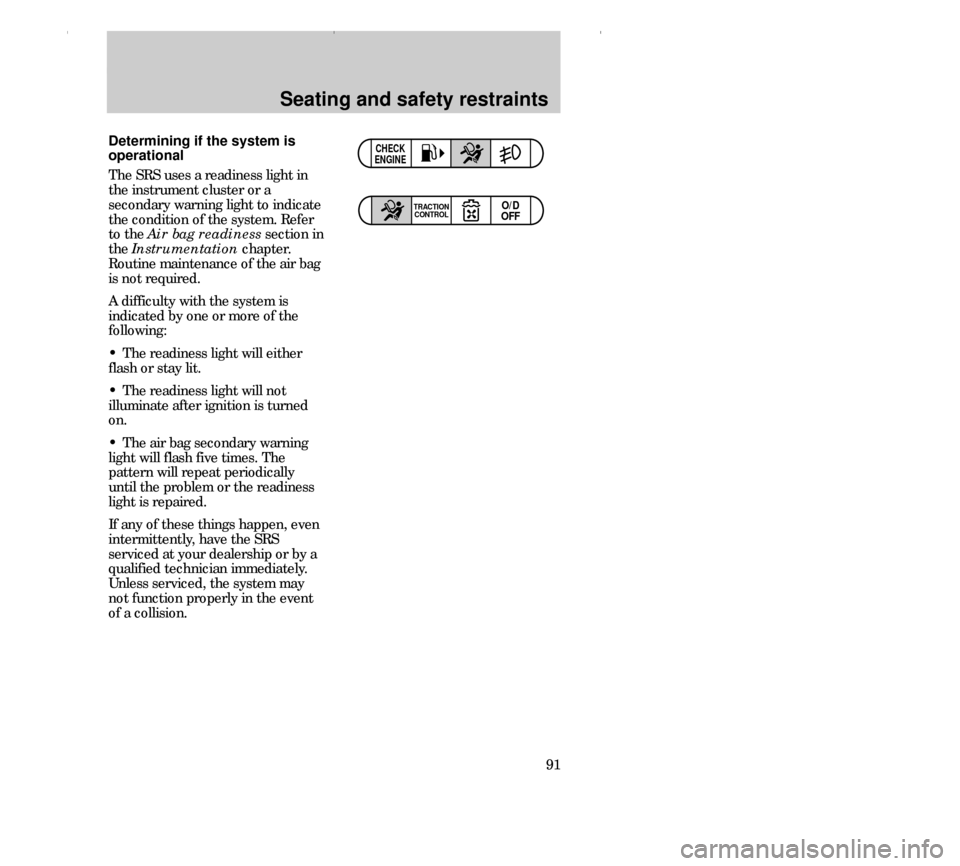
The SRS uses a readiness light in
the instrument cluster or a
secondary warning light to indicate
the condition of the system. Refer
to the Air bag readinesssection in
the Instrumentationchapter.
Routine maintenance of the air bag
is not required.
A difficulty with the system is
indicated by one or more of the
following:
• The readiness light will either
flash or stay lit.
• The readiness light will not
illuminate after ignition is turned
on.
• The air bag secondary warning
light will flash five times. The
pattern will repeat periodically
until the problem or the readiness
light is repaired.
If any of these things happen, even
intermittently, have the SRS
serviced at your dealership or by a
qualified technician immediately.
Unless serviced, the system may
not function properly in the event
of a collision.
CHECK
ENGINE
O/D
OFFTRACTION
CONTROL
14CSSen 17.6.99 11:00 Uhr Seite 91
Page 108 of 248

Starting
108
Extended idling at high
engine speeds can produce
very high temperatures in the
engine and exhaust system,
creating the risk of fire or other
damage.
IMPORTANT SAFETY
PRECAUTIONS
A computer system controls the
engine’s idle revolutions per minute
(rpm). When the engine starts, the
idle rpm runs faster to warm the
engine. If the engine idle speed
does not slow down automatically,
have the vehicle checked by your
dealer or a qualified service
technician. Do not allow the vehicle
to idle for more than ten minutes.
Do not park, idle, or drive
your vehicle in dry grass or
other dry ground cover. The
emission system heats up the
engine compartment and exhaust
system, which can start a fire.
21CSten 17.6.99 11:06 Uhr Seite 108
Page 110 of 248
Starting
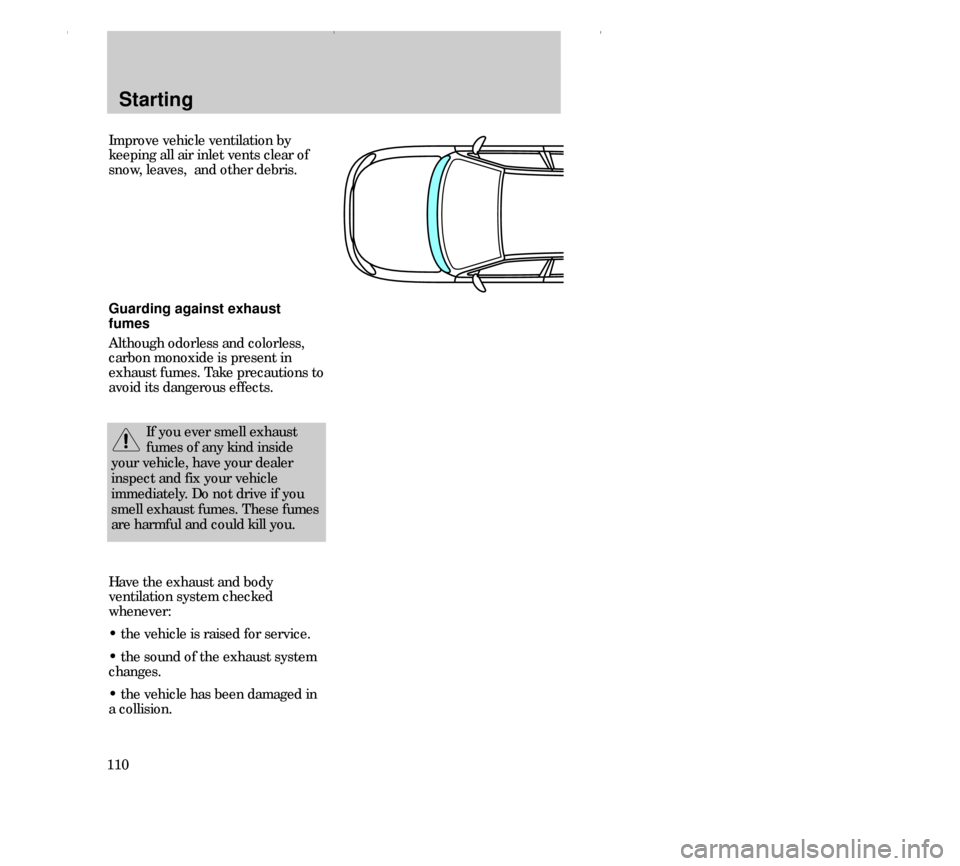
110Improve vehicle ventilation by
keeping all air inlet vents clear of
snow, leaves, and other debris.
Guarding against exhaust
fumes
Although odorless and colorless,
carbon monoxide is present in
exhaust fumes. Take precautions to
avoid its dangerous effects.
Have the exhaust and body
ventilation system checked
whenever:
• the vehicle is raised for service.
• the sound of the exhaust system
changes.
• the vehicle has been damaged in
a collision.
If you ever smell exhaust
fumes of any kind inside
your vehicle, have your dealer
inspect and fix your vehicle
immediately. Do not drive if you
smell exhaust fumes. These fumes
are harmful and could kill you.
21CSten 17.6.99 11:06 Uhr Seite 110
Page 113 of 248
Starting
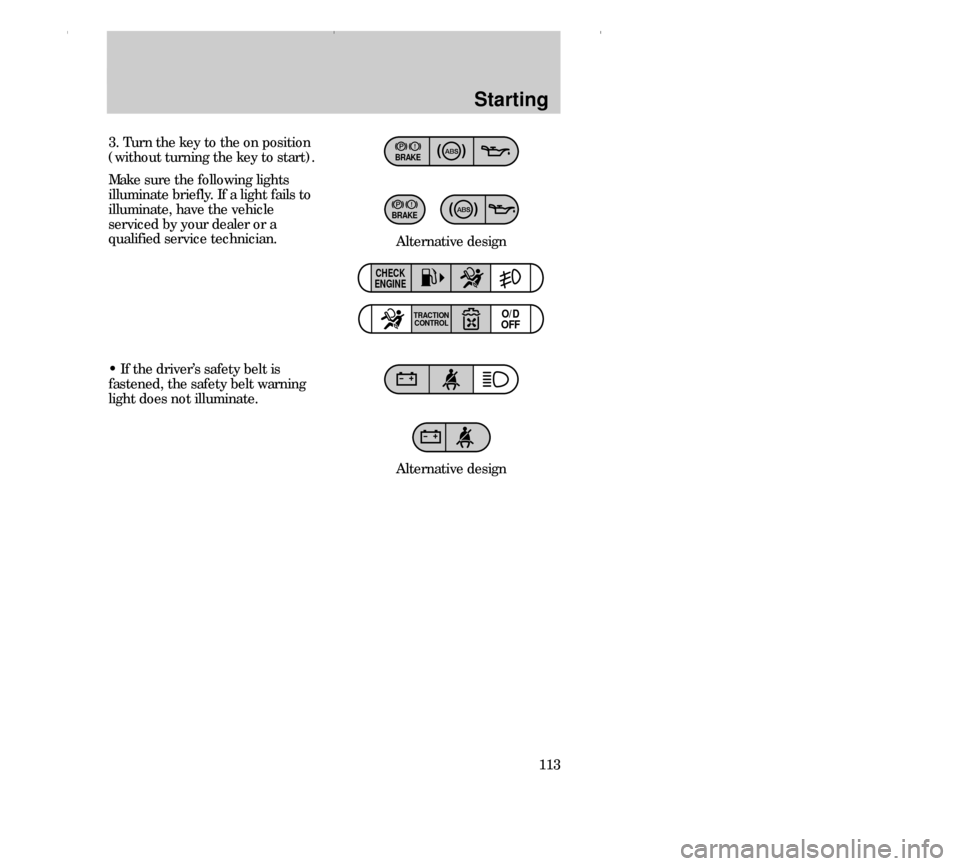
113 3. Turn the key to the on position
(without turning the key to start).
Make sure the following lights
illuminate briefly. If a light fails to
illuminate, have the vehicle
serviced by your dealer or a
qualified service technician.
BRAKE
BRAKE
CHECK
ENGINE
• If the driver’s safety belt is
fastened, the safety belt warning
light does not illuminate.Alternative design
Alternative design
O/D
OFFTRACTION
CONTROL
21CSten 17.6.99 11:06 Uhr Seite 113
Page 119 of 248
Driving
119 TRACTION CONTROL
(if equipped)
This system prevents wheel spin at
all speeds. The control will toggle
this function on and off, but the
feature defaults to on after each
cycle of the ignition key.
The traction control system
controls excessive wheel spin by
automatically applying and
releasing the brakes in conjunction
with engine torque reductions.
This can occur when accelerating
on a slippery road, a loose surface
or when pulling away on a hill. The
traction control lamp flashes on the
instrument panel when the system
is functioning to regulate tire
traction.
When the ignition is turned to the
on position, the traction control
system light comes on for
approximately three (3) seconds. If
the light does not come on when
the ignition is turned to the on
position or if it remains on
continuously when the traction
control system is turned on, have
the system serviced by your dealer
or a qualified service technician.
You can continue to drive and do
not need to have the vehicle towed
in.
You should not take unnecessary
driving risks because of the
system’s safety potential.
22CDren 17.6.99 11:08 Uhr Seite 119
Page 135 of 248
Driving
135 Follow these guidelines to ensure
safe towing procedure:
• Stay within your vehicle’s load
limits.
• Thoroughly prepare your vehicle
for towing. Refer to Preparing to
towin this chapter.
• Use extra caution when driving
while trailer towing. Refer to
Driving while towing a trailerin
this chapter.
• Service your vehicle more
frequently if you tow a trailer.
Refer to the severe duty schedule
in the “Scheduled Maintenance
Guide”.
• Do not tow a trailer until your
vehicle has been driven at least
800 km (500 miles).
• Refer to the instructions
included with towing accessories
for the proper installation and
adjustment specifications.
22CDren 17.6.99 11:09 Uhr Seite 135
Page 142 of 248
142
Roadside emergencies
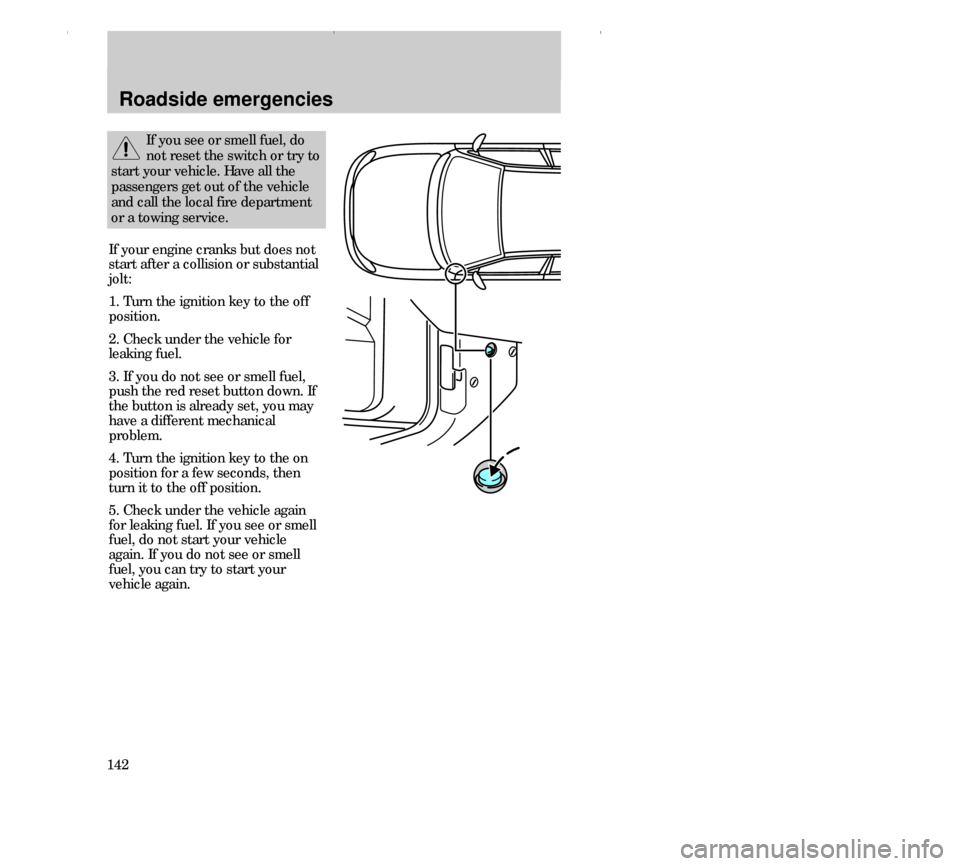
If your engine cranks but does not
start after a collision or substantial
jolt:
1. Turn the ignition key to the off
position.
2. Check under the vehicle for
leaking fuel.
3. If you do not see or smell fuel,
push the red reset button down. If
the button is already set, you may
have a different mechanical
problem.
4. Turn the ignition key to the on
position for a few seconds, then
turn it to the off position.
5. Check under the vehicle again
for leaking fuel. If you see or smell
fuel, do not start your vehicle
again. If you do not see or smell
fuel, you can try to start your
vehicle again.
If you see or smell fuel, do
not reset the switch or try to
start your vehicle. Have all the
passengers get out of the vehicle
and call the local fire department
or a towing service.
23CREen 17.6.99 11:11 Uhr Seite 142
Page 143 of 248
Roadside emergencies
143 Even after a fuse is replaced, it will
continue to blow if the cause of the
overload is not identified and
corrected. If the fuse continues to
blow, have the vehicle’s electrical
system checked by your dealer or a
qualified service technician.
To reset a circuit breaker, press the
reset button.
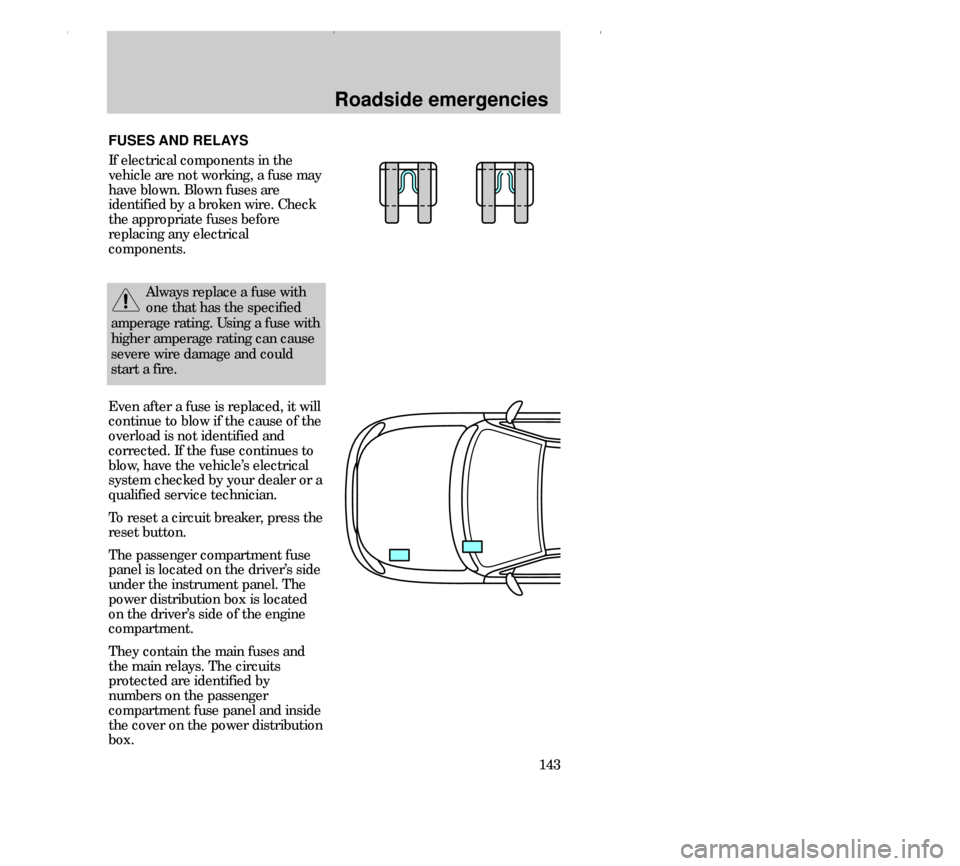
The passenger compartment fuse
panel is located on the driver’s side
under the instrument panel. The
power distribution box is located
on the driver’s side of the engine
compartment.
They contain the main fuses and
the main relays. The circuits
protected are identified by
numbers on the passenger
compartment fuse panel and inside
the cover on the power distribution
box.
FUSES AND RELAYS
If electrical components in the
vehicle are not working, a fuse may
have blown. Blown fuses are
identified by a broken wire. Check
the appropriate fuses before
replacing any electrical
components.
Always replace a fuse with
one that has the specified
amperage rating. Using a fuse with
higher amperage rating can cause
severe wire damage and could
start a fire.
23CREen 17.6.99 11:11 Uhr Seite 143
Page 162 of 248
Maintenance and care
162SERVICE RECOMMENDATIONS
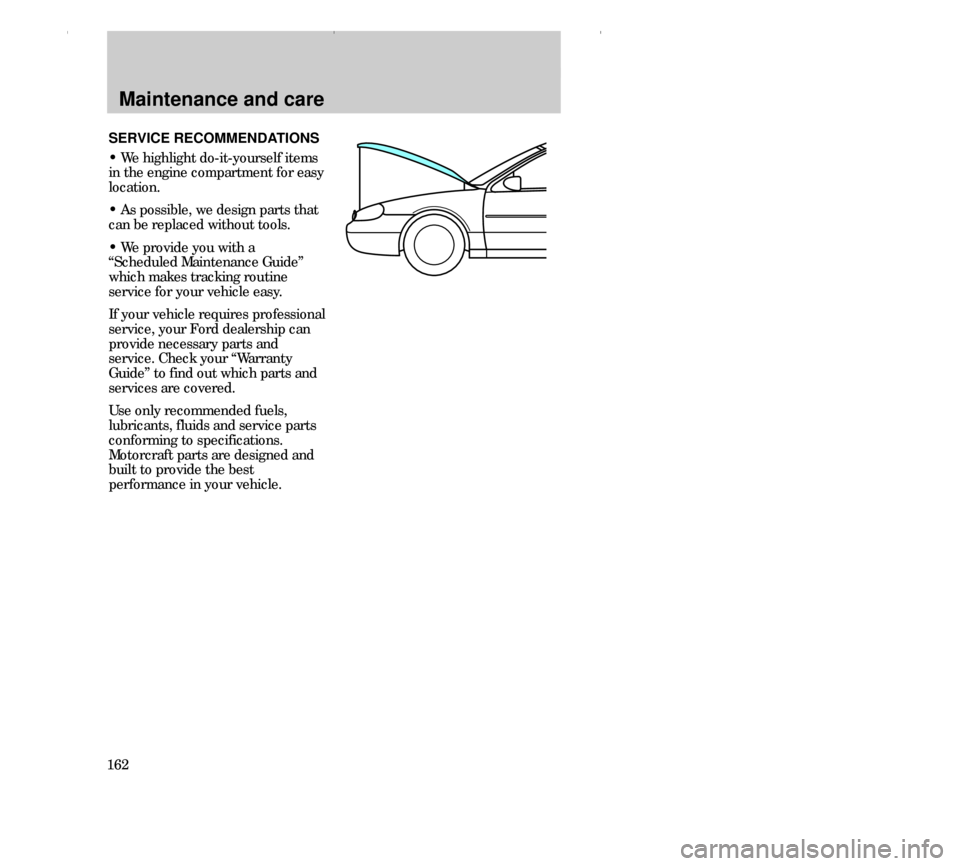
• We highlight do-it-yourself items
in the engine compartment for easy
location.
• As possible, we design parts that
can be replaced without tools.
• We provide you with a
“Scheduled Maintenance Guide”
which makes tracking routine
service for your vehicle easy.
If your vehicle requires professional
service, your Ford dealership can
provide necessary parts and
service. Check your “Warranty
Guide” to find out which parts and
services are covered.
Use only recommended fuels,
lubricants, fluids and service parts
conforming to specifications.
Motorcraft parts are designed and
built to provide the best
performance in your vehicle.
31CMCen 17.6.99 11:15 Uhr Seite 162
Page 170 of 248
Maintenance and care
1706. If the oil level is below the
minimum line, add engine oil as
necessary. If the oil level is beyond
the maximum line, engine damage
or high oil consumption may occur
and some oil must be removed
from the engine by a service
technician.
7. Put the dipstick back in and
ensure it is fully seated.
Continuous contact with
used motor oil has caused
cancer in laboratory mice.
Adding engine oil
1. Check the engine oil. For
instructions, refer to Checking the
engine oilin this chapter.
2. If the fluid level is not within the
normal range, add only certified
engine oil of the preferred
viscosity. Add engine oil through
the oil filler cap. Remove the filler
cap and use a funnel to pour oil in
the opening.
3. Recheck the oil level.
Make
sure the oil level is not above
the MAX mark on the dipstick.
Change your engine oil and oil filter
according to the scheduled mileage
and time requirements, whichever
occurs first.
31CMCen 17.6.99 11:15 Uhr Seite 170