maintenance FORD CONTOUR 2000 2.G Repair Manual
[x] Cancel search | Manufacturer: FORD, Model Year: 2000, Model line: CONTOUR, Model: FORD CONTOUR 2000 2.GPages: 248, PDF Size: 2.23 MB
Page 213 of 248

Maintenance and care
213 Aiming the headlamps
Your vehicle is equipped with a
Vehicle Headlamp Aim Device
(VHAD) on each headlamp body.
Each headlamp may be properly
aimed in the horizontal direction
(left/right) and the vertical
direction (up/down).
A non-zero bubble reading (vertical
indicator) does not necessarily
indicate out-of-aim headlamps. If
your vehicle is not positioned on a
level surface, the slope will be
included in the vertical indication.
Therefore, vertical and horizontal
headlamp adjustment should be
performed only when beam
direction appears to be incorrect. AIMING THE HEADLAMPS
The alignment of your headlamps
should be checked if:
• Oncoming motorists frequently
signal you to deactivate your high
beams, and your high beams are
not activated.
• The headlamps do not seem to
provide enough light for clear night
vision.
• The headlamp beams are pointed
substantially away from a slightly
down and to the right position.
31CMCen 17.6.99 11:16 Uhr Seite 213
Page 214 of 248
Maintenance and care
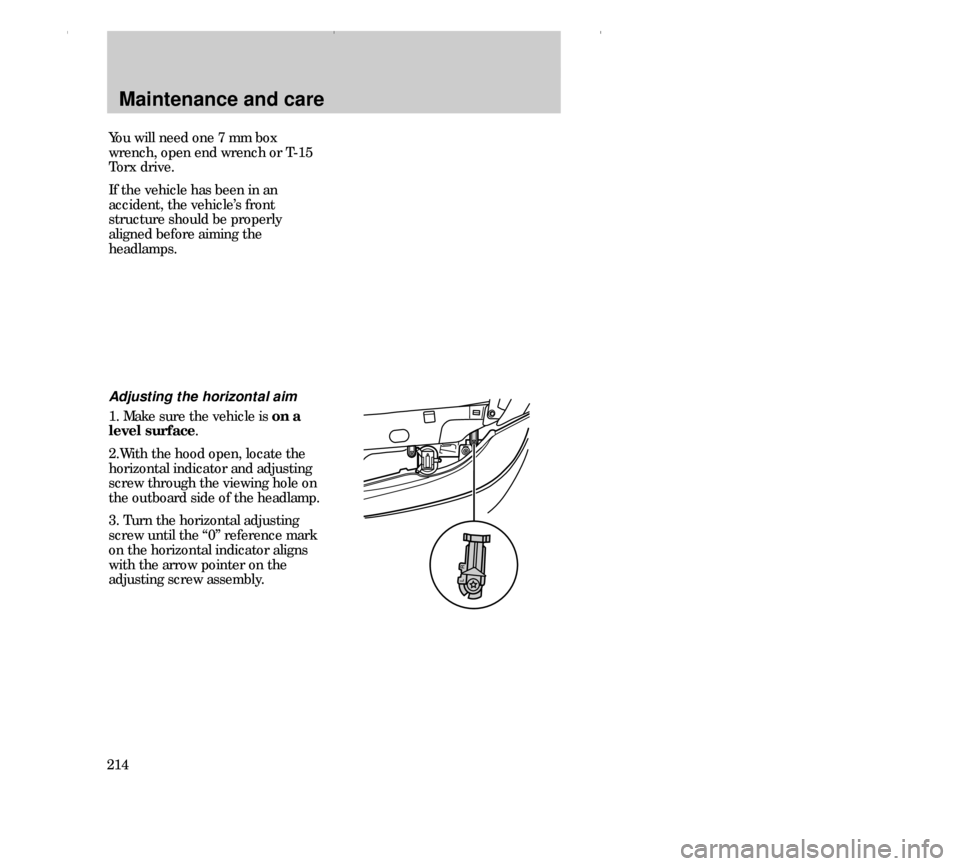
214Adjusting the horizontal aim
1. Make sure the vehicle is on a
level surface.
2.With the hood open, locate the
horizontal indicator and adjusting
screw through the viewing hole on
the outboard side of the headlamp.
3. Turn the horizontal adjusting
screw until the “0” reference mark
on the horizontal indicator aligns
with the arrow pointer on the
adjusting screw assembly. You will need one 7 mm box
wrench, open end wrench or T-15
Torx drive.
If the vehicle has been in an
accident, the vehicle’s front
structure should be properly
aligned before aiming the
headlamps.
31CMCen 17.6.99 11:16 Uhr Seite 214
Page 215 of 248
Maintenance and care
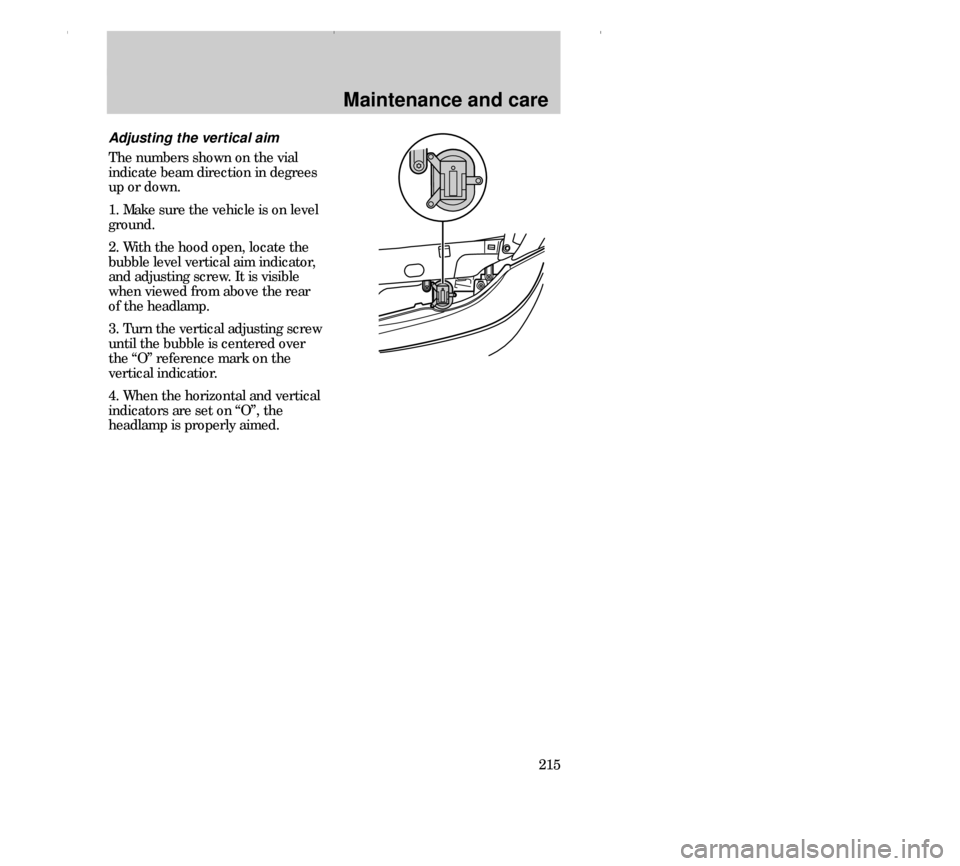
215 Adjusting the vertical aim
The numbers shown on the vial
indicate beam direction in degrees
up or down.
1. Make sure the vehicle is on level
ground.
2. With the hood open, locate the
bubble level vertical aim indicator,
and adjusting screw. It is visible
when viewed from above the rear
of the headlamp.
3. Turn the vertical adjusting screw
until the bubble is centered over
the “O” reference mark on the
vertical indicatior.
4. When the horizontal and vertical
indicators are set on “O”, the
headlamp is properly aimed.
31CMCen 17.6.99 11:16 Uhr Seite 215
Page 216 of 248
Maintenance and care
216
Washing your vehicle
Only use car washing areas
that have environmentally
friendly drainage systems.
VEHICLE CARE
Wash your vehicle regularly with
cold or lukewarm water. Never use
strong detergents or soap. If your
vehicle is particularly dirty, use a
quality car wash detergent. Always
use a clean sponge, washing glove
or similar device and plenty of
water for best results. To avoid
spots, avoid washing when the
hood is still warm, immediately
after or during exposure to strong
sunlight.
31CMCen 17.6.99 11:16 Uhr Seite 216
Page 217 of 248
Maintenance and care
217 Waxing your vehicle
The best way to determine when
the paintwork needs waxing is by
noting when water stops beading
on the surface. This could be every
three or four months depending on
operating conditions.
Use only carnauba or synthetic-
based waxes. Remove any bugs and
tar before waxing the vehicle. Use
cleaning fluid or alcohol with a
clean cloth to remove bugs. Use tar
remover to remove any tar spots.
During winter months, it is
especially important to wash the
vehicle on a regular basis. Large
quantities of dirt and road salt are
difficult to remove, and they also
cause damage to the vehicle.
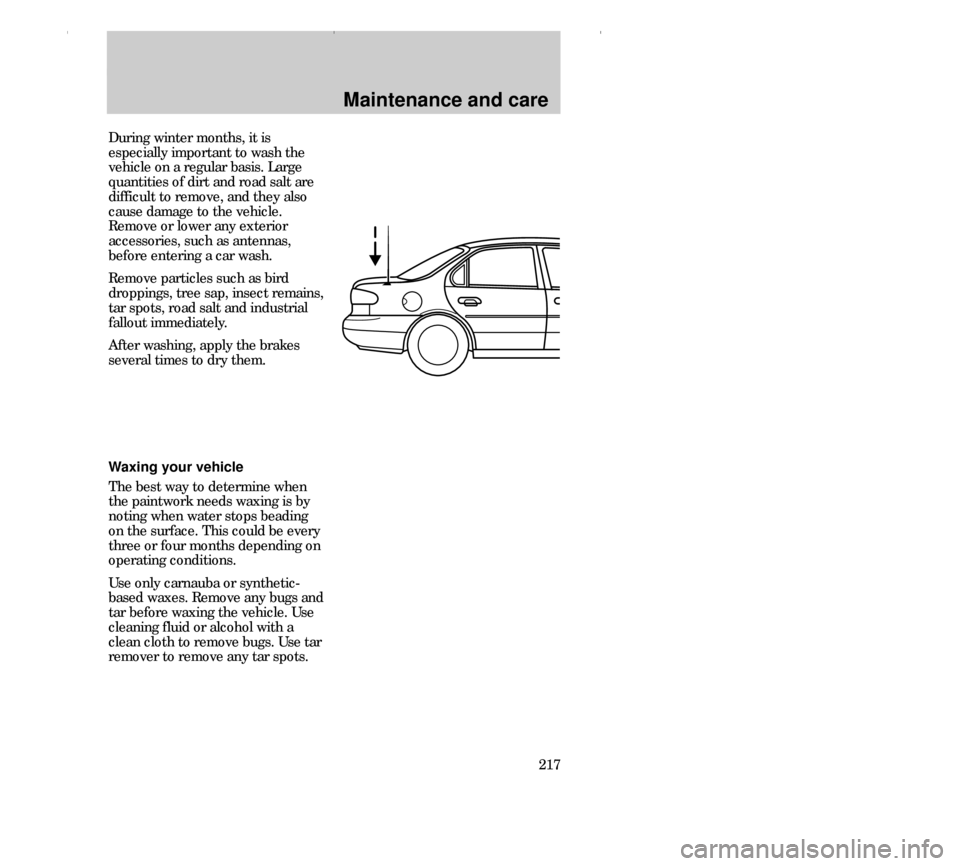
Remove or lower any exterior
accessories, such as antennas,
before entering a car wash.
Remove particles such as bird
droppings, tree sap, insect remains,
tar spots, road salt and industrial
fallout immediately.
After washing, apply the brakes
several times to dry them.
31CMCen 17.6.99 11:16 Uhr Seite 217
Page 218 of 248
Maintenance and care
218Repairing paint chips
Minor scratches or paint damage
from road debris may be repaired
with the Ultra Touch Prep and
Finishing Kit (# F7AZ-19K507-BA).
Lacquer Touch-up Paint (# ALBZ-
19500-XXXXA) or Exterior Acrylic
Spray Lacquer (# ALAZ-19500-
XXXXA) from the Ford Car Care
Chemicals line. Please not that the
part numbers (shown as XXXX
above) will vary with your vehicle’s
specific coloring. Observe the
application instructions on the
products.
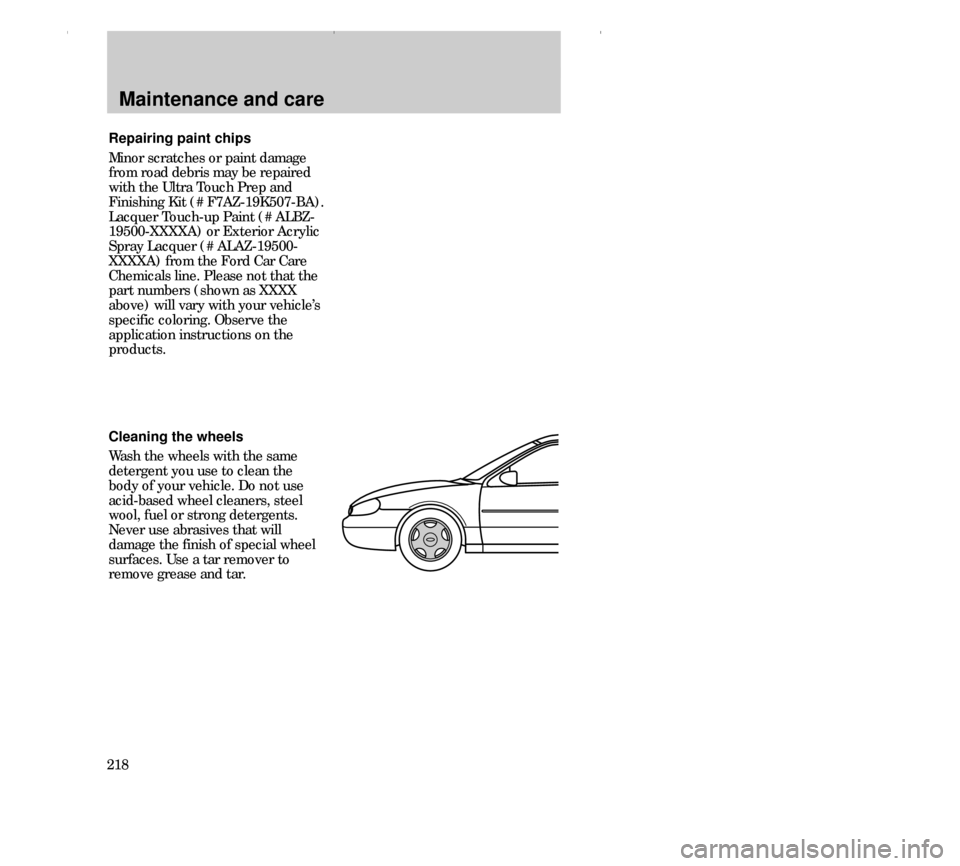
Cleaning the wheels
Wash the wheels with the same
detergent you use to clean the
body of your vehicle. Do not use
acid-based wheel cleaners, steel
wool, fuel or strong detergents.
Never use abrasives that will
damage the finish of special wheel
surfaces. Use a tar remover to
remove grease and tar.
31CMCen 17.6.99 11:16 Uhr Seite 218
Page 219 of 248

Maintenance and care
219 Cleaning the engine
Engines are more efficient when
they are clean because grease and
dirt buildup act as insulators and
keep the engine warmer than
normal. Follow these guidelines to
clean your engine:
• Take care when using a power
washer to clean the engine. The
high pressure fluid could penetrate
the sealed parts and cause damage.
• Do not spray with cold water, to
avoid cracking the engine block.
• Cover the alternator to prevent
water damage when cleaning the
engine.
• Never wash or rinse the engine
while it is running; water in the
running engine may cause internal
damage.
31CMCen 17.6.99 11:16 Uhr Seite 219
Page 220 of 248

Maintenance and care
220Cleaning plastic exterior parts
Use a vinyl cleaner for routine
cleaning of plastic. Clean with a tar
remover if necessary. Do not clean
plastic parts with thinners, solvents
or petroleum-based cleaners.
Cleaning the exterior lamps
Wash the exterior lamps with the
same detergent you use to wash
the exterior of your vehicle. Use
glass cleaner or tar remover if
necessary.
To avoid scratching the lamps, do
not use a dry paper towel, chemical
solvents or abrasive cleaners to
clean the lamps.
Cleaning the wiper blades
If the wiper blades do not wipe
properly, clean both the windshield
and wiper blades using undiluted
windshield wiper solution or a mild
detergent. Rinse thoroughly with
clean water. To avoid damaging the
blades, do not use fuel, kerosene,
paint thinner or other solvents.
31CMCen 17.6.99 11:16 Uhr Seite 220
Page 221 of 248
Maintenance and care
221 Cleaning the interior fabric
Remove dust and loose dirt with a
whisk broom or a vacuum cleaner.
Remove fresh spots immediately.
Follow the directions that come
with the cleaner.
Cleaning leather seats
(if equipped)
For routine cleaning, wipe the
surface with a soft, damp cloth. For
more thorough cleaning, wipe the
surface with a leather and vinyl
cleaner or a mild soap.
Ford recommends using the
Deluxe Leather Care Kit
F8AZ-196253-AA, which is
available from your Ford dealer.
This mild cleaner and special pad
cleans the leather and maintains its
natural beauty. Follow the
instructions on the cleaner label.
Regular cleaning of your leather
upholstery helps maintain its
resiliency and color.
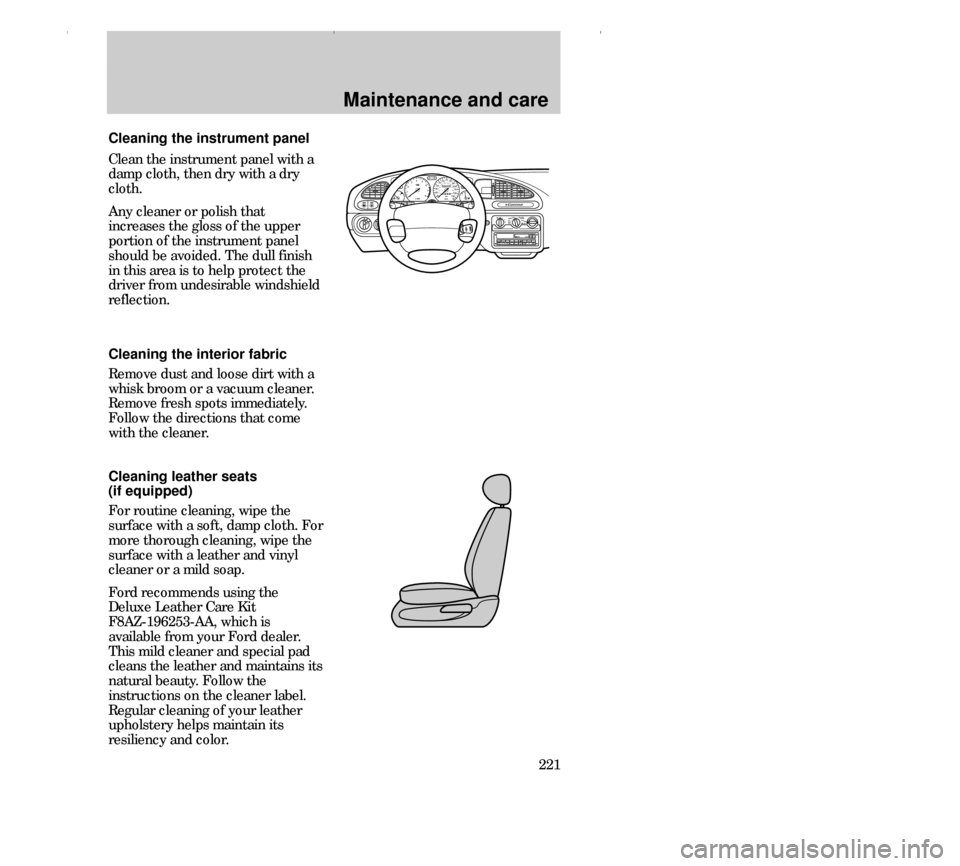
Cleaning the instrument panel
OFF LO PNL/FLR
PANEL
A/CFLOOR
DEF FLR
DEF
MAX
A/C HI/
POWER AUDIO AM/FM
SCAN
SEEK 31245ANSSIDE 1-2EJECTVOLUME
000123000010 20 3040506070
80
90
10 0
110
120
13 0MPH20 406055
80120 10 0
14 0
160
18 0
200EF12
03x 1000
4
5
6
7
8
CHECK
ENGINE TRACTION
CONTROLO/D
OFF
MIRRORS
CLOCK
H C
Clean the instrument panel with a
damp cloth, then dry with a dry
cloth.
Any cleaner or polish that
increases the gloss of the upper
portion of the instrument panel
should be avoided. The dull finish
in this area is to help protect the
driver from undesirable windshield
reflection.
31CMCen 17.6.99 11:16 Uhr Seite 221
Page 222 of 248
Maintenance and care
222Cleaning and maintaining the
safety belts
Clean the safety belts with a mild
soap solution recommended for
cleaning upholstery or carpets and
warm water. Do not bleach or dye
the belts, because these actions
may weaken the belt webbing.
Check the safety belt system
periodically to make sure there are
no nicks, wear or cuts.
Cleaning and caring for your
vehicle
Refer to the Customer assistance
chapter for a list of Ford-approved
cleaners, polishes and waxes.
Ford recommends that all
safety belt assemblies and
attaching hardware should be
inspected by a qualified technician
after any collision. Safety belt
assemblies not in use during a
collision should also be inspected
and replaced if either damage or
improper operation is noted.
32CCSen 17.6.99 11:31 Uhr Seite 222