ABS FORD CROWN VICTORIA 1998 2.G Owners Manual
[x] Cancel search | Manufacturer: FORD, Model Year: 1998, Model line: CROWN VICTORIA, Model: FORD CROWN VICTORIA 1998 2.GPages: 160, PDF Size: 1.24 MB
Page 9 of 160

Anti-lock brake system (ABS) (If equipped)
Momentarily illuminates when the
ignition is turned on and the engine
is off. If the light does not illuminate
momentarily at start up, remains on
or continues to flash, the ABS needs
to be serviced. With the ABS light on, the anti-lock brake system is
disabled and normal braking is still effective unless the brake warning
light also remains illuminated with parking brake released.
Turn signal
Illuminates when the left or right
turn signal or the hazard lights are
turned on. If one or both of the
indicators stay on continuously or
flash faster, check for a burned-out
turn signal bulb. Refer toExterior bulbsin theMaintenance and care
chapter.
High beams
Illuminates when the high beam
headlamps are turned on.
Charging system
Illuminates when the ignition is
turned to the ON position and the
engine is off. The light also
illuminates when the battery is not
charging properly, requiring
electrical system service.
ABS
Instrumentation
9
Page 22 of 160
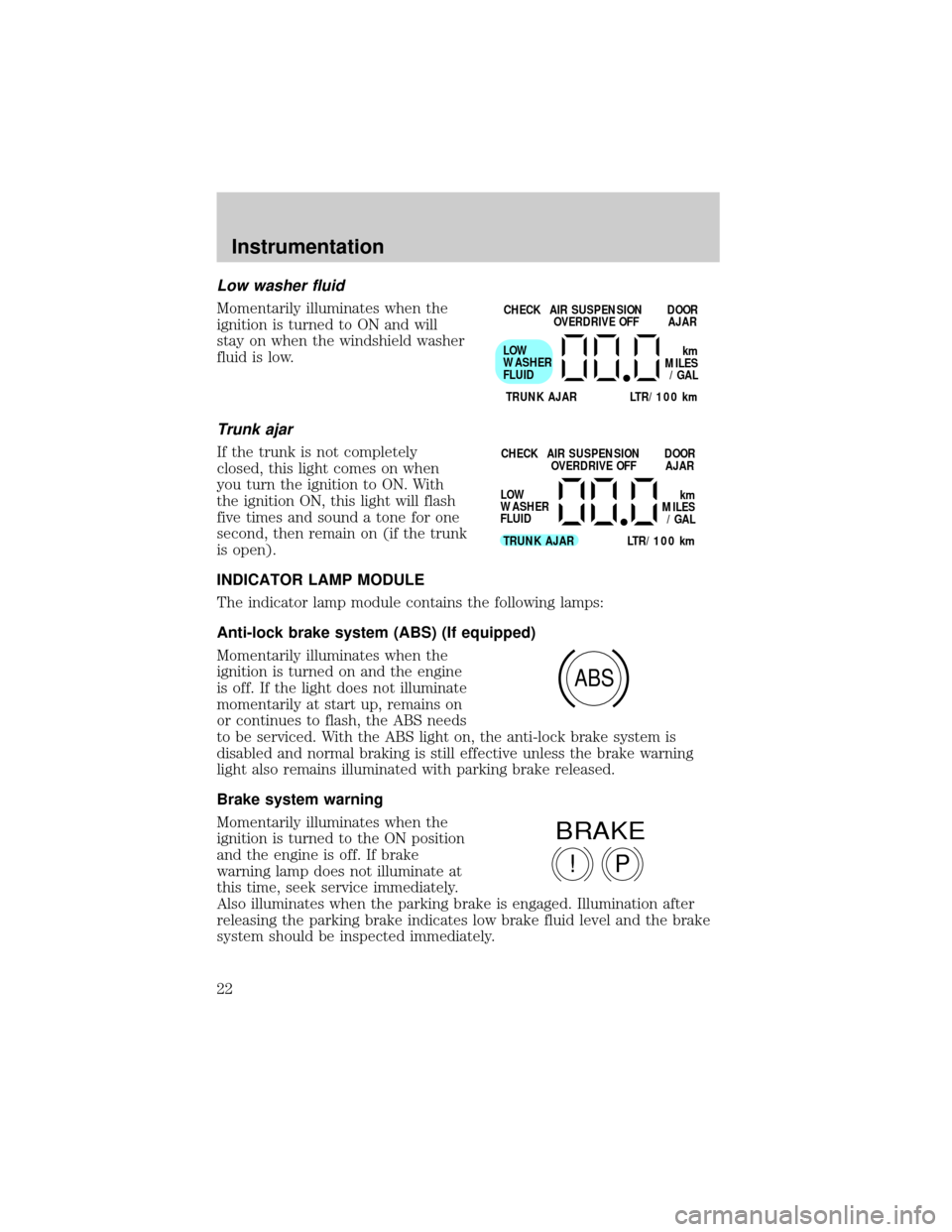
Low washer fluid
Momentarily illuminates when the
ignition is turned to ON and will
stay on when the windshield washer
fluid is low.
Trunk ajar
If the trunk is not completely
closed, this light comes on when
you turn the ignition to ON. With
the ignition ON, this light will flash
five times and sound a tone for one
second, then remain on (if the trunk
is open).
INDICATOR LAMP MODULE
The indicator lamp module contains the following lamps:
Anti-lock brake system (ABS) (If equipped)
Momentarily illuminates when the
ignition is turned on and the engine
is off. If the light does not illuminate
momentarily at start up, remains on
or continues to flash, the ABS needs
to be serviced. With the ABS light on, the anti-lock brake system is
disabled and normal braking is still effective unless the brake warning
light also remains illuminated with parking brake released.
Brake system warning
Momentarily illuminates when the
ignition is turned to the ON position
and the engine is off. If brake
warning lamp does not illuminate at
this time, seek service immediately.
Also illuminates when the parking brake is engaged. Illumination after
releasing the parking brake indicates low brake fluid level and the brake
system should be inspected immediately.
CHECK
TRUNK AJAR LTR/100 kmAIR SUSPENSION
OVERDRIVE OFFDOOR
AJAR
LOW
WASHER
FLUID
km
MILES
/GAL
CHECK
TRUNK AJAR LTR/100 kmAIR SUSPENSION
OVERDRIVE OFFDOOR
AJAR
LOW
WASHER
FLUID
km
MILES
/GAL
ABS
P!
BRAKE
Instrumentation
22
Page 83 of 160
BRAKES
Your brakes are self-adjusting. Refer to the ªService Guideº for scheduled
maintenance.
Occasional brake noise is normal and often does not indicate a
performance concern with the vehicle's brake system. In normal
operation, automotive brake systems may emit occasional or intermittent
squeal or groan noises when the brakes are applied. Such noises are
usually heard during the first few brake applications in the morning;
however, they may be heard at any time while braking and can be
aggravated by environmental conditions such as cold, heat, moisture,
road dust, salt or mud. If a ªmetal-to-metal,º ªcontinuous grindingº or
ªcontinuous squealº sound is present while braking, the brake linings
may be worn-out and should be inspected by a qualified service
technician.
Anti-lock brake system (ABS) (if equipped)
On vehicles equipped with an anti-lock braking system (ABS), a noise
from the hydraulic pump motor and pulsation in the pedal may be
observed during ABS braking events. Pedal pulsation coupled with noise
while braking under panic conditions or on loose gravel, bumps, wet or
snowy roads is normal and indicates proper functioning of the vehicle's
anti-lock brake system. If the vehicle has continuous vibration or shudder
in the steering wheel while braking, the vehicle should be inspected by a
qualified service technician.
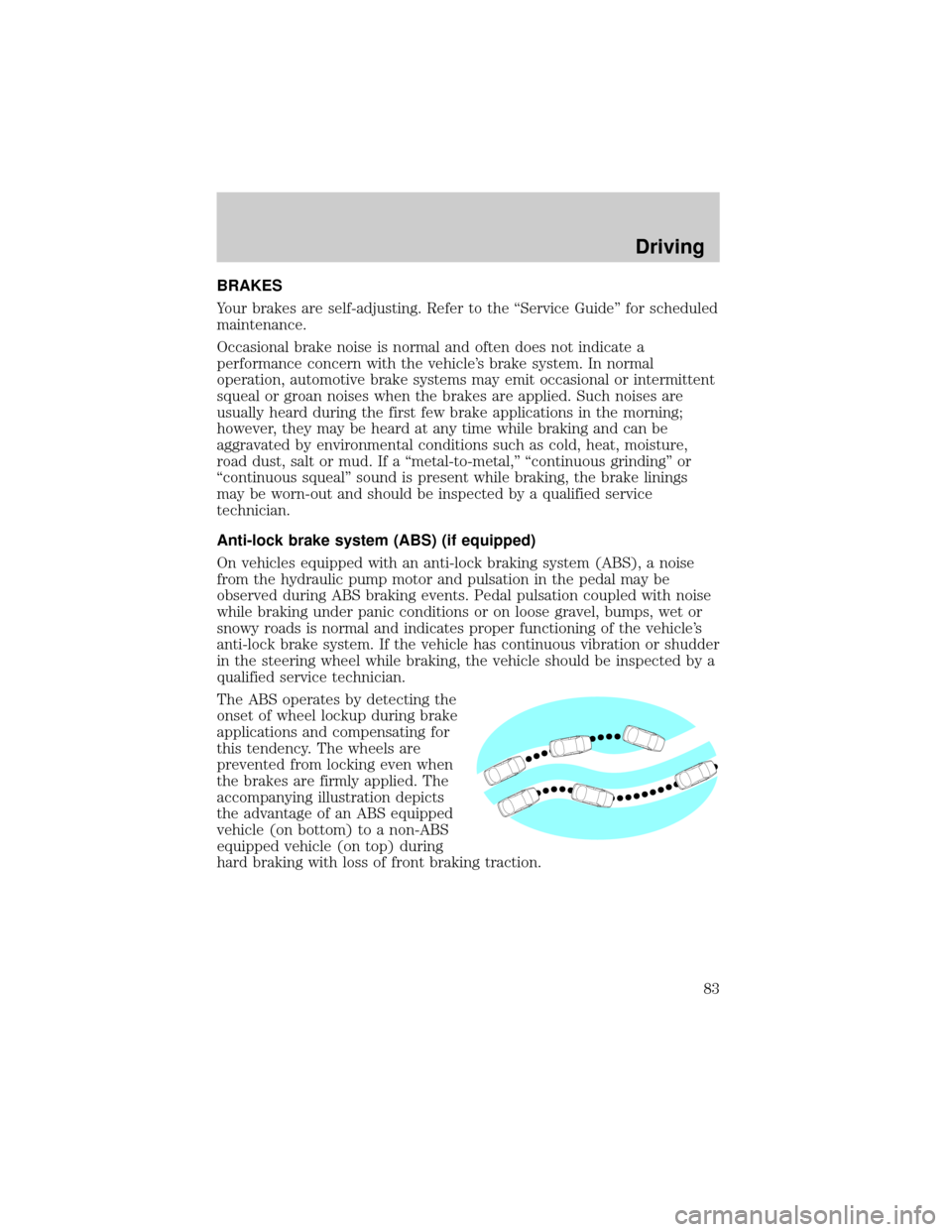
The ABS operates by detecting the
onset of wheel lockup during brake
applications and compensating for
this tendency. The wheels are
prevented from locking even when
the brakes are firmly applied. The
accompanying illustration depicts
the advantage of an ABS equipped
vehicle (on bottom) to a non-ABS
equipped vehicle (on top) during
hard braking with loss of front braking traction.
Driving
83
Page 84 of 160
ABS warning lamp
The
ABSwarning lamp in the instrument cluster illuminates for about
five seconds when starting the vehicle. If an ABS fault is detected, the
light will remain on, the ABS system is disabled with normal braking still
effective, and your vehicle should be serviced as soon as possible.
Normal braking is still effective
unless the BRAKE warning lamp is
also illuminated.
Using ABS
²In an emergency or when maximum efficiency from the ABS is
required, apply continuous full force on the brake. The ABS will be
activated immediately, thus allowing you to retain full steering control
of your vehicle and, providing there is sufficient space, will enable you
to avoid obstacles and bring the vehicle to a controlled stop.
²The Anti-Lock system does not decrease the time necessary to apply
the brakes or always reduce stopping distance. Always leave enough
room between your vehicle and the vehicle in front of you to stop.
²We recommend that you familiarize yourself with this braking
technique. However, avoid taking any unnecessary risks.
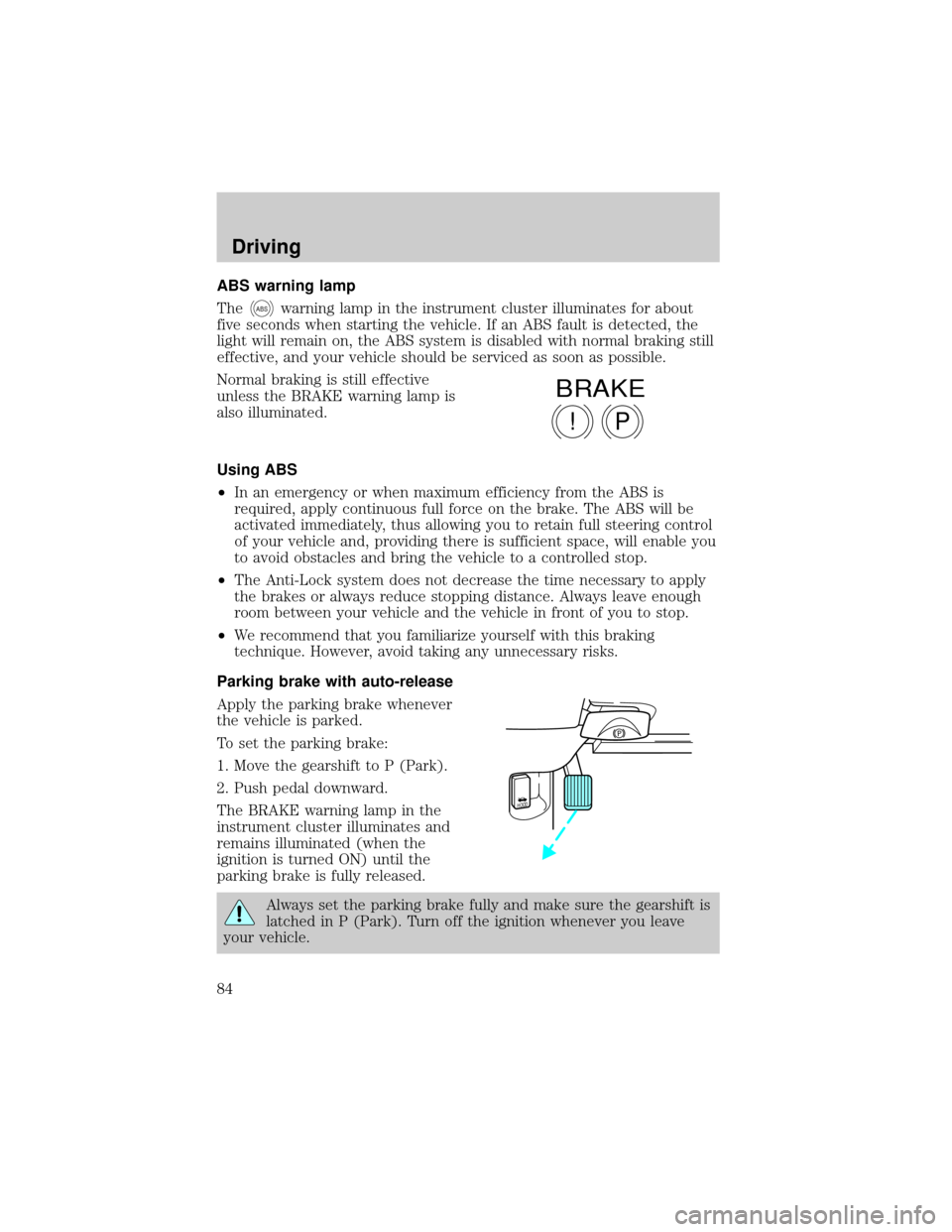
Parking brake with auto-release
Apply the parking brake whenever
the vehicle is parked.
To set the parking brake:
1. Move the gearshift to P (Park).
2. Push pedal downward.
The BRAKE warning lamp in the
instrument cluster illuminates and
remains illuminated (when the
ignition is turned ON) until the
parking brake is fully released.
Always set the parking brake fully and make sure the gearshift is
latched in P (Park). Turn off the ignition whenever you leave
your vehicle.
P!
BRAKE
HOOD
Driving
84
Page 85 of 160
The parking brake is not designed to stop a moving vehicle. However, if
the normal brakes fail, the parking brake can be used to stop your
vehicle in an emergency. Since the parking brake applies only the rear
brakes, the vehicle's stopping distance will increase greatly and the
handling of your vehicle will be adversely affected.
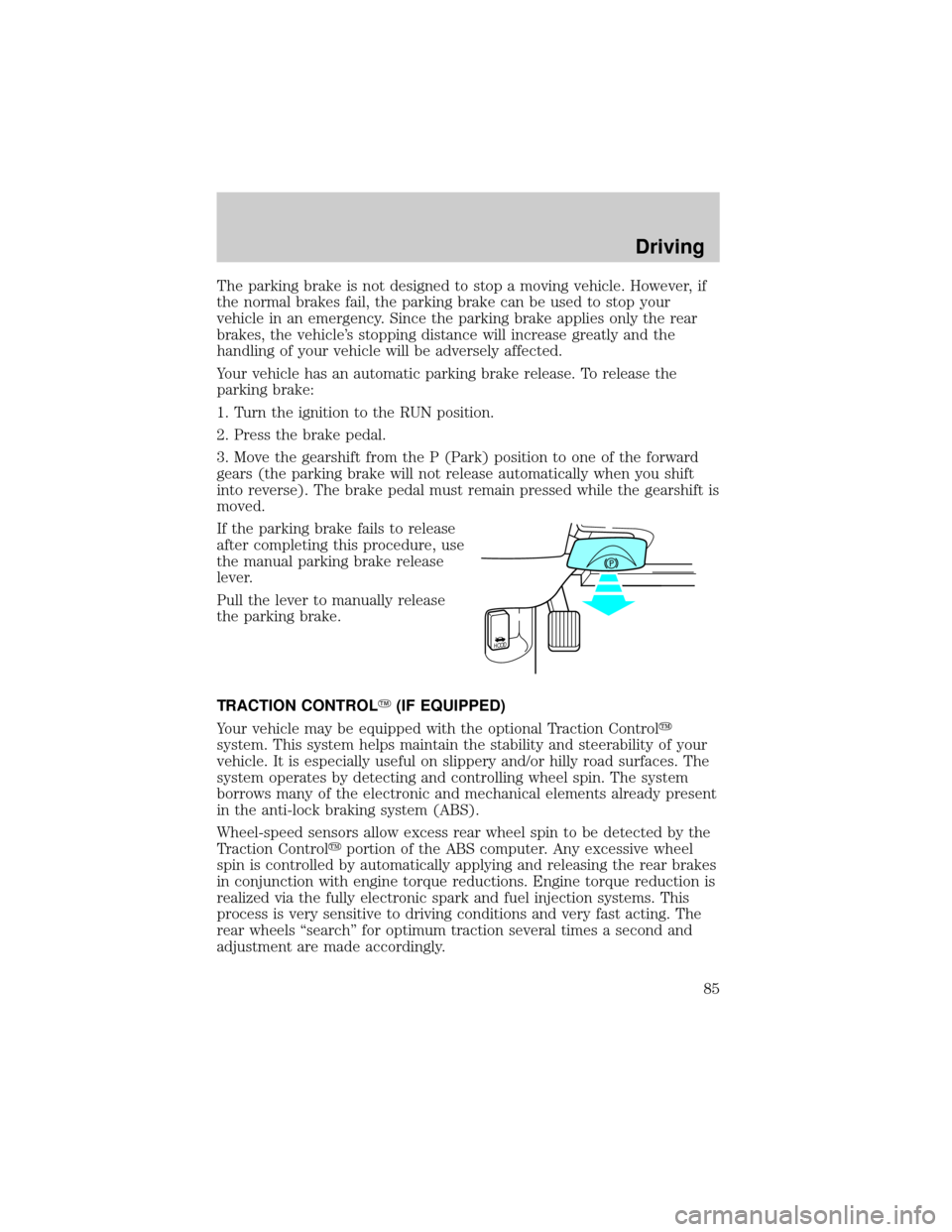
Your vehicle has an automatic parking brake release. To release the
parking brake:
1. Turn the ignition to the RUN position.
2. Press the brake pedal.
3. Move the gearshift from the P (Park) position to one of the forward
gears (the parking brake will not release automatically when you shift
into reverse). The brake pedal must remain pressed while the gearshift is
moved.
If the parking brake fails to release
after completing this procedure, use
the manual parking brake release
lever.
Pull the lever to manually release
the parking brake.
TRACTION CONTROLY(IF EQUIPPED)
Your vehicle may be equipped with the optional Traction Controly
system. This system helps maintain the stability and steerability of your
vehicle. It is especially useful on slippery and/or hilly road surfaces. The
system operates by detecting and controlling wheel spin. The system
borrows many of the electronic and mechanical elements already present
in the anti-lock braking system (ABS).
Wheel-speed sensors allow excess rear wheel spin to be detected by the
Traction Controlyportion of the ABS computer. Any excessive wheel
spin is controlled by automatically applying and releasing the rear brakes
in conjunction with engine torque reductions. Engine torque reduction is
realized via the fully electronic spark and fuel injection systems. This
process is very sensitive to driving conditions and very fast acting. The
rear wheels ªsearchº for optimum traction several times a second and
adjustment are made accordingly.
HOOD
Driving
85
Page 132 of 160

²Avoid inhaling fuel vapors. Inhaling too much fuel vapor of any kind
can lead to eye and respiratory tract irritation. In severe cases,
excessive or prolonged breathing of fuel vapor can cause serious
illness and permanent injury.
²Avoid getting fuel liquid in your eyes. If fuel is splashed in the eyes,
remove contact lenses (if worn), flush with water for 15 minutes and
seek medical attention. Failure to seek proper medical attention could
lead to permanent injury.
²Fuels can also be harmful if absorbed through the skin. If fuel is
splashed on the skin and/or clothing, promptly remove contaminated
clothing and wash skin thoroughly with soap and water. Repeated or
prolonged skin contact with fuel liquid or vapor causes skin irritation.
²Be particularly careful if you are taking ªAntabuseº or other forms of
disulfiram for the treatment of alcoholism. Breathing gasoline vapors,
or skin contact could cause an adverse reaction. In sensitive
individuals, serious personal injury or sickness may result. If fuel is
splashed on the skin, promptly wash skin thoroughly with soap and
water. Consult a physician immediately if you experience an adverse
reaction.
Choosing the right fuel
Use only UNLEADED FUEL. The use of leaded fuel is prohibited by law
and could damage your vehicle.
Your vehicle was not designed to use fuel or fuel additives with metallic
compounds, including manganese-based compounds containing (MMT).
Vehicles certified to meet California emission standards (indicated on the
underhood Vehicle Emissions Control Information label) are designed to
operate on California reformulated gasolines. If California reformulated
gasoline is not available when you refuel, your vehicle can be operated
on non-California fuels. However, even though your engine will perform
adequately on other gasolines, the performance of the emission control
devices and systems may be adversely affected.
Repair of damage caused by using a fuel for which your vehicle was not
designed may not be covered by your warranty.
Maintenance and care
132
Page 137 of 160
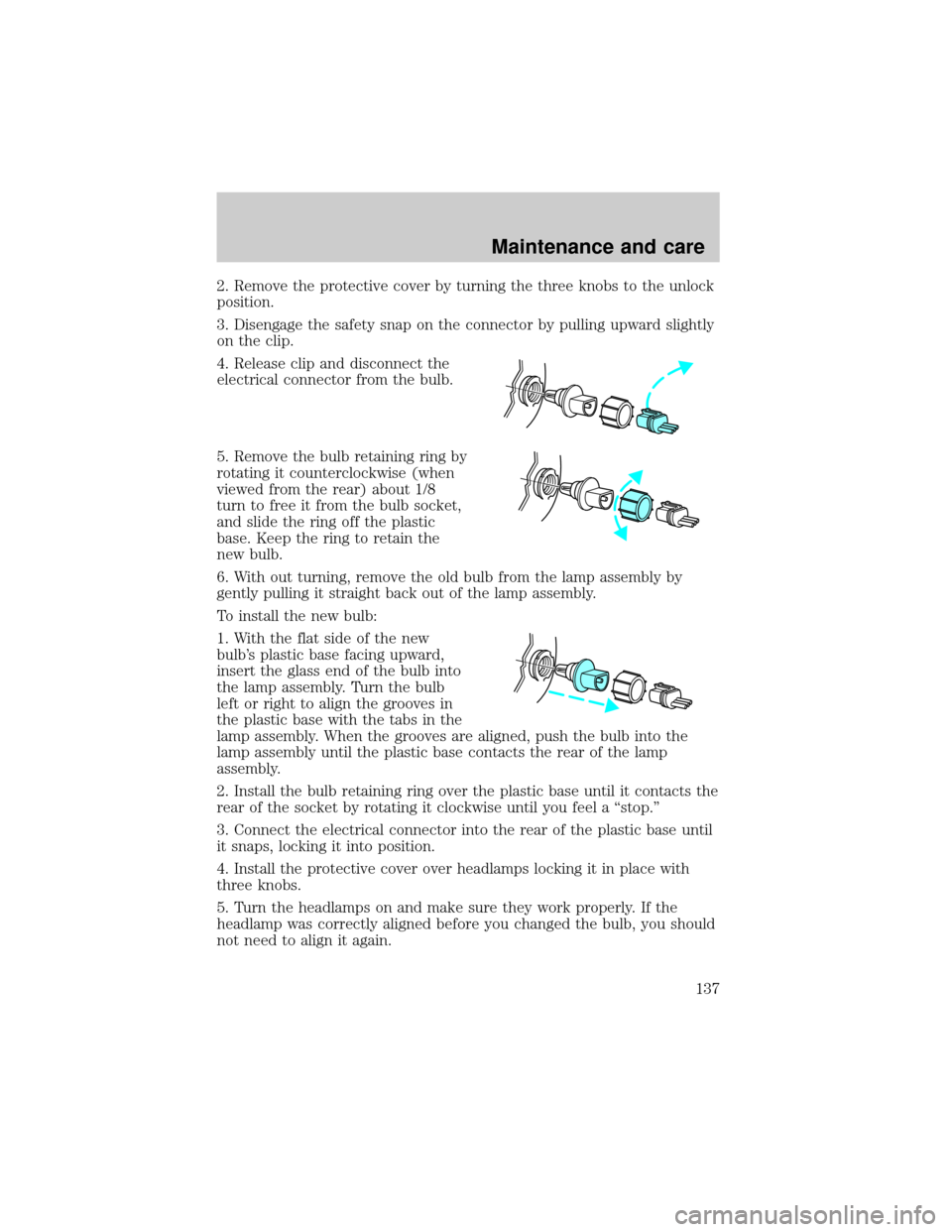
2. Remove the protective cover by turning the three knobs to the unlock
position.
3. Disengage the safety snap on the connector by pulling upward slightly
on the clip.
4. Release clip and disconnect the
electrical connector from the bulb.
5. Remove the bulb retaining ring by
rotating it counterclockwise (when
viewed from the rear) about 1/8
turn to free it from the bulb socket,
and slide the ring off the plastic
base. Keep the ring to retain the
new bulb.
6. With out turning, remove the old bulb from the lamp assembly by
gently pulling it straight back out of the lamp assembly.
To install the new bulb:
1. With the flat side of the new
bulb's plastic base facing upward,
insert the glass end of the bulb into
the lamp assembly. Turn the bulb
left or right to align the grooves in
the plastic base with the tabs in the
lamp assembly. When the grooves are aligned, push the bulb into the
lamp assembly until the plastic base contacts the rear of the lamp
assembly.
2. Install the bulb retaining ring over the plastic base until it contacts the
rear of the socket by rotating it clockwise until you feel a ªstop.º
3. Connect the electrical connector into the rear of the plastic base until
it snaps, locking it into position.
4. Install the protective cover over headlamps locking it in place with
three knobs.
5. Turn the headlamps on and make sure they work properly. If the
headlamp was correctly aligned before you changed the bulb, you should
not need to align it again.
Maintenance and care
137
Page 152 of 160

Aiming headlamps ....................138
Air bag supplemental restraint
system ..........................................68
and child safety seats ..............69
description ................................68
disposal ......................................72
indicator light ...........................71
passenger air bag .....................70
Air conditioning
manual heating and air
conditioning system ............25,26
Air suspension
description ................................87
Anti-lock brake system
(ABS)description
Battery .......................................124
voltage gauge ............................16
Brake fluid
checking and adding ..............114
Brakes ..........................................83
anti-lock .....................................83
anti-lock brake system (ABS)
warning light .............................84
fluid, checking and adding ....114
traction control .........................85
Brake-shift interlock ...................88
Break-in period .............................2
Bulbs, replacing ........................136
headlamps ...............................136
specifications ..........................139
Changing a tire .........................101
Child safety seats ........................73
Childproof locks ..........................48
Chime
headlamps on ............................12
Cleaning your vehicle ...............140
engine compartment .......141,142
exterior ....................................143
headlamps ...............................142
plastic parts ............................142
washing ....................................140
waxing .....................................140wheels ......................................141
windows ..................................144
wiper blades ............................142
Climate control system
automatic temperature
control ...................27,28,29,30,32
Clock ............................................33
Compass, electronic ....................43
calibration .................................45
set zone adjustment .................44
Coolant (see Engine coolant)
temperature gauge ...................15
Defrost
rear window ..............................24
Emission control system ..........134
Engine
service points ..........................111
Engine block heater ...................81
Engine coolant
checking and adding ..............116
disposal ....................................117
refill capacities ........................118
Engine oil ...........................112,113
changing oil and oil filter .......114
checking and adding .......112,113
Exhaust fumes ............................82
Floor mats ...................................48
Fuel
calculating fuel economy .......134
improving fuel economy ..........94
octane rating ...........................133
quality ......................................133
running out of fuel .................134
safety information relating to
automotive fuels .....................131
Fuel pump shut-off switch .........95
Fuse panels
instrument panel ......................97
power distribution box .............99
Fuses .......................................96,97
Gauges, Mechanical ....................12
fuel gauge ..................................12
Index
152
Page 153 of 160

Hazard flashers ...........................95
Headlamps ...................................23
autolamp system .......................24
daytime running lights .............24
flashing ......................................23
high beam .................................23
Heating ........................................25
High beams
indicator light .............................9
Hood
release lever ............................110
Ignition
positions of the ignition ...........35
Instrument panel
cleaning ...................................143
lighting up panel and interior .23
Keyless entry system
autolock .....................................50
keypad .......................................55
programming entry code ....56,57
Keys
key in ignition chime ...............11
Lamps
headlamps ...............................136
high-mount brakelamp ...........138
interior lamps .........................139
parking lamps .........................138
tail lamps .................................138
License plate lamps ..................138
Lights, warning and indicator
air bag ..........................................8
air suspension ...........................10
anti-lock brakes (ABS) .........9,22
brake .......................................8,22
charging system ..........................9
check engine ...............................7
fuel reset .....................................6
low coolant ................................10
oil pressure ...............................10
overdrive off ..............................11
safety belt ...................................8
turn signal indicator ...................9Lubricant specifications ...........147
Message center ...........................17
reset button .........................17,18
select button .............................18
Mirrors
automatic dimming rearview
mirror ........................................42
side view mirrors (power) .......47
Motorcraft parts ........................145
Odometer .....................................14
Panic alarm feature, remote
entry system ................................51
Parking brake ..............................84
Power door locks ........................47
Power steering
fluid, checking and adding ....121
Radio ............................................33
Refill capacities for fluids ........146
Relays ...................................96,101
Remote entry system .................48
illuminated entry ......................51
locking/unlocking doors ...........49
replacement/additional
transmitters ...............................53
replacing the batteries .............52
Reporting safety defects ..........151
Safety restraints
center front lap belt .................65
cleaning the safety belts ........143
extension assembly ..................66
for children ...............................72
warning light and
chime ...............................11,66,67
Safety seats for children
attaching with tether straps ....77
in rear seat ................................77
tether anchorage hardware .....77
Seat belts (see Safety
restraints) ....................................61
Seats ............................................58
adjusting the seat, manual ..58,59
adjusting the seat, power ...59,61
Index
153