oil temperature FORD CROWN VICTORIA 1998 2.G Owners Manual
[x] Cancel search | Manufacturer: FORD, Model Year: 1998, Model line: CROWN VICTORIA, Model: FORD CROWN VICTORIA 1998 2.GPages: 160, PDF Size: 1.24 MB
Page 10 of 160

Engine oil pressure (if equipped)
Illuminates when the oil pressure
falls below the normal range. Stop
the vehicle as soon as safely
possible and switch off the engine
immediately. Check the oil level and
add oil if needed. Refer toEngine oilin theMaintenance and Care
chapter.
This lamp also illuminates when the ignition is turned to ON and the
engine is off.
Engine coolant temperature
Illuminates when the engine coolant
temperature is high. Stop the
vehicle as soon as safely possible,
switch off the engine and let it cool.
Never remove the coolant
recovery cap while the
engine is running or hot.
Refer toEngine coolantin theMaintenance and carechapter. If light
stays on or continues to turn on after the vehicle warms up, have your
vehicle serviced.
This light also illuminates briefly when the ignition key is turned to ON.
Air suspension (if equipped)
This light tells you if the air
suspension needs repair or if the air
suspension switch is OFF. For
information on the air suspension
system, refer to theDriving
chapter.
AIR
SUSP
Instrumentation
10
Page 16 of 160
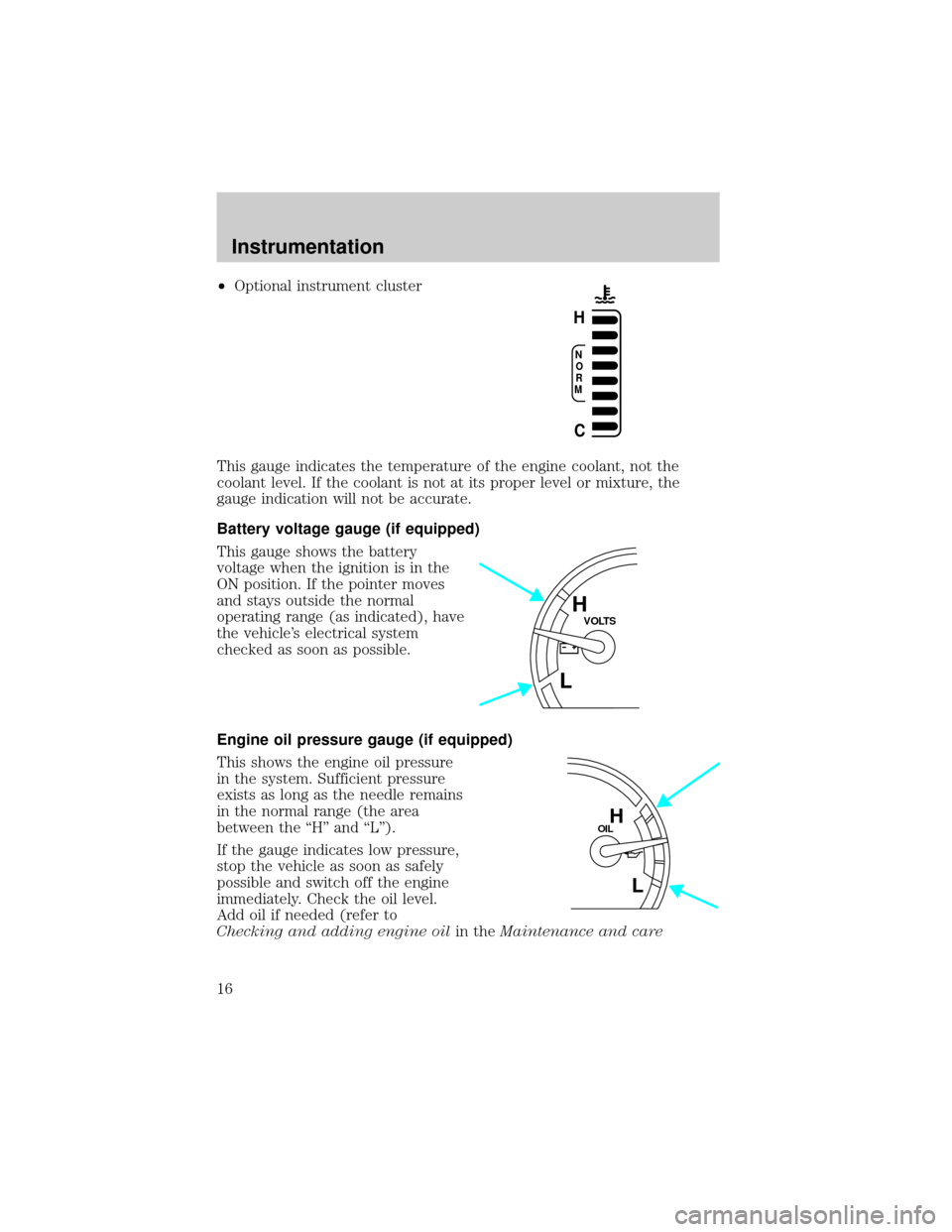
²Optional instrument cluster
This gauge indicates the temperature of the engine coolant, not the
coolant level. If the coolant is not at its proper level or mixture, the
gauge indication will not be accurate.
Battery voltage gauge (if equipped)
This gauge shows the battery
voltage when the ignition is in the
ON position. If the pointer moves
and stays outside the normal
operating range (as indicated), have
the vehicle's electrical system
checked as soon as possible.
Engine oil pressure gauge (if equipped)
This shows the engine oil pressure
in the system. Sufficient pressure
exists as long as the needle remains
in the normal range (the area
between the ªHº and ªLº).
If the gauge indicates low pressure,
stop the vehicle as soon as safely
possible and switch off the engine
immediately. Check the oil level.
Add oil if needed (refer to
Checking and adding engine oilin theMaintenance and care
N
O
R
M
H
C
VOLTSH
L
OILH
L
Instrumentation
16
Page 135 of 160

The scheduled maintenance items listed in the ªService Guideº are
essential to the life and performance of your vehicle and to its emissions
system.
If other than Ford, Motorcraft or Ford-authorized parts are used for
maintenance replacements or for service of components affecting
emission control, such non-Ford parts should be equivalent to genuine
Ford Motor Company parts in performance and durability.
Do not park, idle, or drive your vehicle in dry grass or other dry
ground cover. The emission system heats up the engine
compartment and exhaust system, which can start a fire.
Lumination of the charging system warning light, ªCheck Engineº light or
the temperature warning light, fluid leaks, strange odors, smoke or loss
of oil pressure, could indicate that the emission control system is not
working properly.
If you smell exhaust fumes of any kind inside your vehicle, have
the dealer inspect and fix your vehicle immediately. Do not drive
if you smell exhaust fumes. These fumes are harmful and could kill
you.
Do not make any unauthorized changes to your vehicle or engine. By
law, vehicle owners and anyone who manufactures, repairs, items, sells,
leases, trades vehicles, or supervises a fleet of vehicles are not permitted
to intentionally remove an emission control device or prevent it from
working. Information about your vehicle's emission system is on the
Vehicle Emission Control Information Decal located on or near the
engine. This decal identifies engine displacement and gives some tune up
specifications.
Please consult your ªWarranty Guideº for complete emission warranty
information.
Readiness for inspection/maintenance (I/M) testing
In some localities, it may be a legal requirement to pass an I/M test of
the on-board diagnostic (OBD-II) system. If your ªCheck Engine/Service
Engine Soonº light is on, refer to the description in theWarning Lights
and Chimessection of theInstrumentationchapter. Your vehicle may
not pass the I/M test with the ªCheck Engine/Service Engine Soonº light
on.
Maintenance and care
135
Page 136 of 160

If the vehicle's powertrain system or its battery has just been serviced,
the OBD-II system is reset to a ªnot ready for I/M testº condition. To
ready the OBD-II system for I/M testing, a minimum of 30 minutes of city
and highway driving is necessary as described below:
²First, at least 10 minutes of driving on an expressway or highway.
²Next, at least 20 minutes driving in stop-and-go, city-type traffic with
at least four idle periods.
Allow the vehicle to sit for at least eight hours without starting the
engine. Then, start the engine and complete the above driving cycle. The
engine must warm up to its normal operating temperature. Once started,
do not turn off the engine until the above driving cycle is complete.
EXTERIOR BULBS
Replacing exterior bulbs
Check the operation of the following lamps frequently:
²Headlamps
²Tail lamps
²Brakelamps
²High-mount brakelamp
²Turn signals
²Backup lamps
²License plate lamp
Do not remove lamp bulbs unless they will be replaced immediately. If a
bulb is removed for an extended period of time, contaminants may enter
the lamp housings and affect performance.
Replacing headlamp bulbs
Handle a halogen headlamp bulb carefully and keep out of
children's reach. Grasp the bulb only by its plastic base and do
not touch the glass. The oil from your hand could cause the bulb to
break the next time the headlamps are operated.
To remove the headlamp bulb:
1. Make sure headlamp switch is in OFF position, then open the hood.
Maintenance and care
136
Page 152 of 160
Aiming headlamps ....................138
Air bag supplemental restraint
system ..........................................68
and child safety seats ..............69
description ................................68
disposal ......................................72
indicator light ...........................71
passenger air bag .....................70
Air conditioning
manual heating and air
conditioning system ............25,26
Air suspension
description ................................87
Anti-lock brake system
(ABS)description
Battery .......................................124
voltage gauge ............................16
Brake fluid
checking and adding ..............114
Brakes ..........................................83
anti-lock .....................................83
anti-lock brake system (ABS)
warning light .............................84
fluid, checking and adding ....114
traction control .........................85
Brake-shift interlock ...................88
Break-in period .............................2
Bulbs, replacing ........................136
headlamps ...............................136
specifications ..........................139
Changing a tire .........................101
Child safety seats ........................73
Childproof locks ..........................48
Chime
headlamps on ............................12
Cleaning your vehicle ...............140
engine compartment .......141,142
exterior ....................................143
headlamps ...............................142
plastic parts ............................142
washing ....................................140
waxing .....................................140wheels ......................................141
windows ..................................144
wiper blades ............................142
Climate control system
automatic temperature
control ...................27,28,29,30,32
Clock ............................................33
Compass, electronic ....................43
calibration .................................45
set zone adjustment .................44
Coolant (see Engine coolant)
temperature gauge ...................15
Defrost
rear window ..............................24
Emission control system ..........134
Engine
service points ..........................111
Engine block heater ...................81
Engine coolant
checking and adding ..............116
disposal ....................................117
refill capacities ........................118
Engine oil ...........................112,113
changing oil and oil filter .......114
checking and adding .......112,113
Exhaust fumes ............................82
Floor mats ...................................48
Fuel
calculating fuel economy .......134
improving fuel economy ..........94
octane rating ...........................133
quality ......................................133
running out of fuel .................134
safety information relating to
automotive fuels .....................131
Fuel pump shut-off switch .........95
Fuse panels
instrument panel ......................97
power distribution box .............99
Fuses .......................................96,97
Gauges, Mechanical ....................12
fuel gauge ..................................12
Index
152