brake light FORD E-150 2001 User Guide
[x] Cancel search | Manufacturer: FORD, Model Year: 2001, Model line: E-150, Model: FORD E-150 2001Pages: 224, PDF Size: 1.99 MB
Page 130 of 224
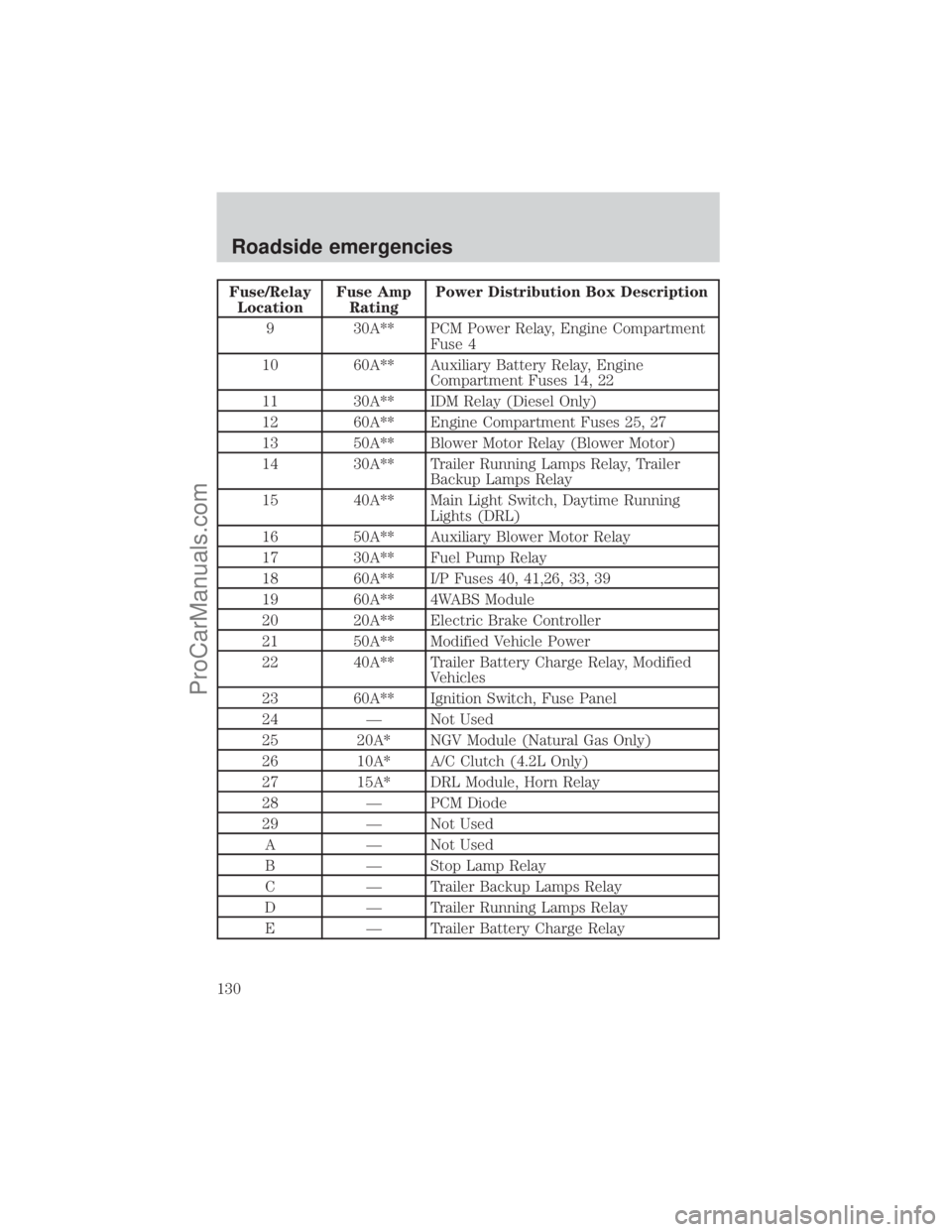
Fuse/Relay
LocationFuse Amp
RatingPower Distribution Box Description
9 30A** PCM Power Relay, Engine Compartment
Fuse 4
10 60A** Auxiliary Battery Relay, Engine
Compartment Fuses 14, 22
11 30A** IDM Relay (Diesel Only)
12 60A** Engine Compartment Fuses 25, 27
13 50A** Blower Motor Relay (Blower Motor)
14 30A** Trailer Running Lamps Relay, Trailer
Backup Lamps Relay
15 40A** Main Light Switch, Daytime Running
Lights (DRL)
16 50A** Auxiliary Blower Motor Relay
17 30A** Fuel Pump Relay
18 60A** I/P Fuses 40, 41,26, 33, 39
19 60A** 4WABS Module
20 20A** Electric Brake Controller
21 50A** Modified Vehicle Power
22 40A** Trailer Battery Charge Relay, Modified
Vehicles
23 60A** Ignition Switch, Fuse Panel
24 Ð Not Used
25 20A* NGV Module (Natural Gas Only)
26 10A* A/C Clutch (4.2L Only)
27 15A* DRL Module, Horn Relay
28 Ð PCM Diode
29 Ð Not Used
A Ð Not Used
B Ð Stop Lamp Relay
C Ð Trailer Backup Lamps Relay
D Ð Trailer Running Lamps Relay
E Ð Trailer Battery Charge Relay
Roadside emergencies
130
ProCarManuals.com
Page 144 of 224
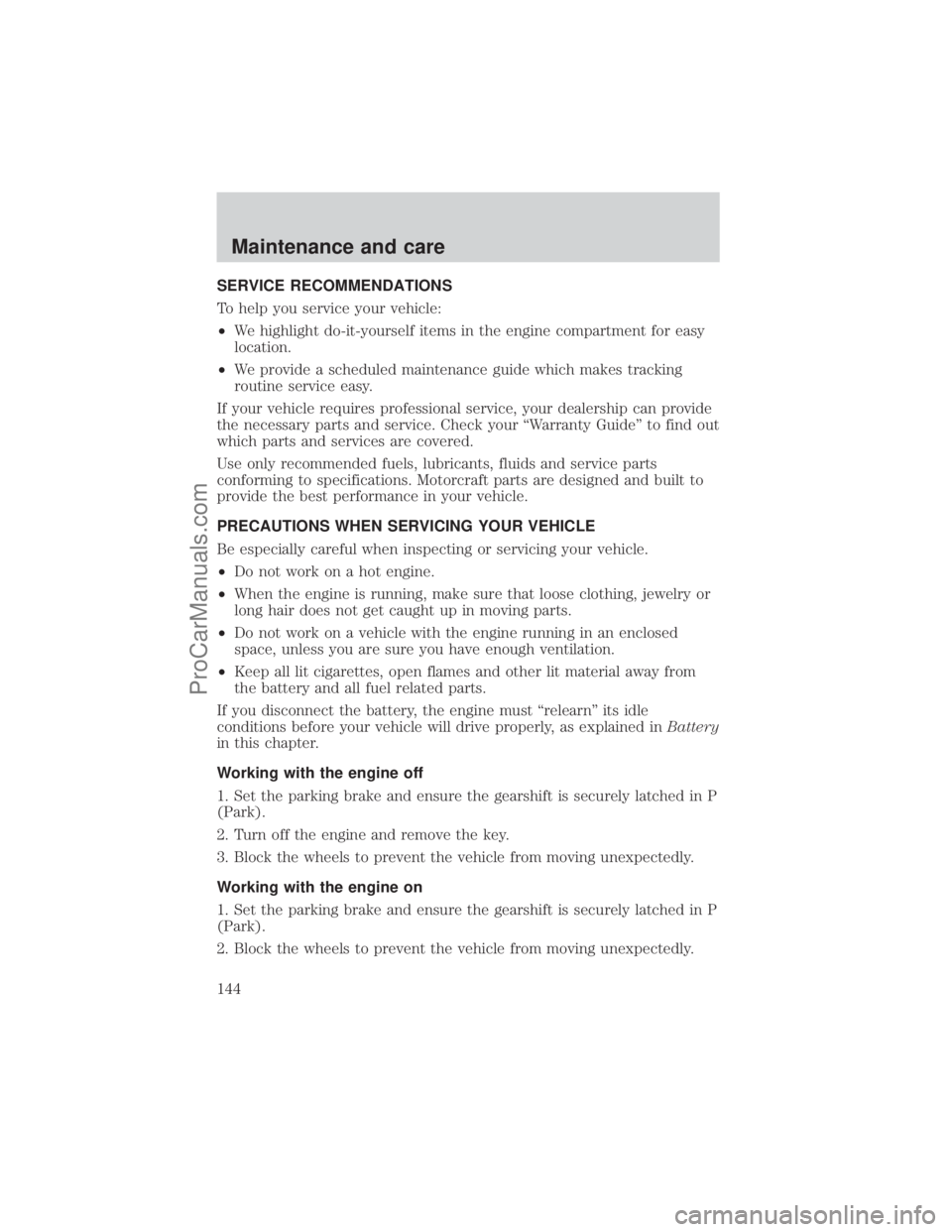
SERVICE RECOMMENDATIONS
To help you service your vehicle:
²We highlight do-it-yourself items in the engine compartment for easy
location.
²We provide a scheduled maintenance guide which makes tracking
routine service easy.
If your vehicle requires professional service, your dealership can provide
the necessary parts and service. Check your ªWarranty Guideº to find out
which parts and services are covered.
Use only recommended fuels, lubricants, fluids and service parts
conforming to specifications. Motorcraft parts are designed and built to
provide the best performance in your vehicle.
PRECAUTIONS WHEN SERVICING YOUR VEHICLE
Be especially careful when inspecting or servicing your vehicle.
²Do not work on a hot engine.
²When the engine is running, make sure that loose clothing, jewelry or
long hair does not get caught up in moving parts.
²Do not work on a vehicle with the engine running in an enclosed
space, unless you are sure you have enough ventilation.
²Keep all lit cigarettes, open flames and other lit material away from
the battery and all fuel related parts.
If you disconnect the battery, the engine must ªrelearnº its idle
conditions before your vehicle will drive properly, as explained inBattery
in this chapter.
Working with the engine off
1. Set the parking brake and ensure the gearshift is securely latched in P
(Park).
2. Turn off the engine and remove the key.
3. Block the wheels to prevent the vehicle from moving unexpectedly.
Working with the engine on
1. Set the parking brake and ensure the gearshift is securely latched in P
(Park).
2. Block the wheels to prevent the vehicle from moving unexpectedly.
Maintenance and care
144
ProCarManuals.com
Page 151 of 224
Do not let the reservoir for the master cylinder run dry. This
may cause the brakes to fail.
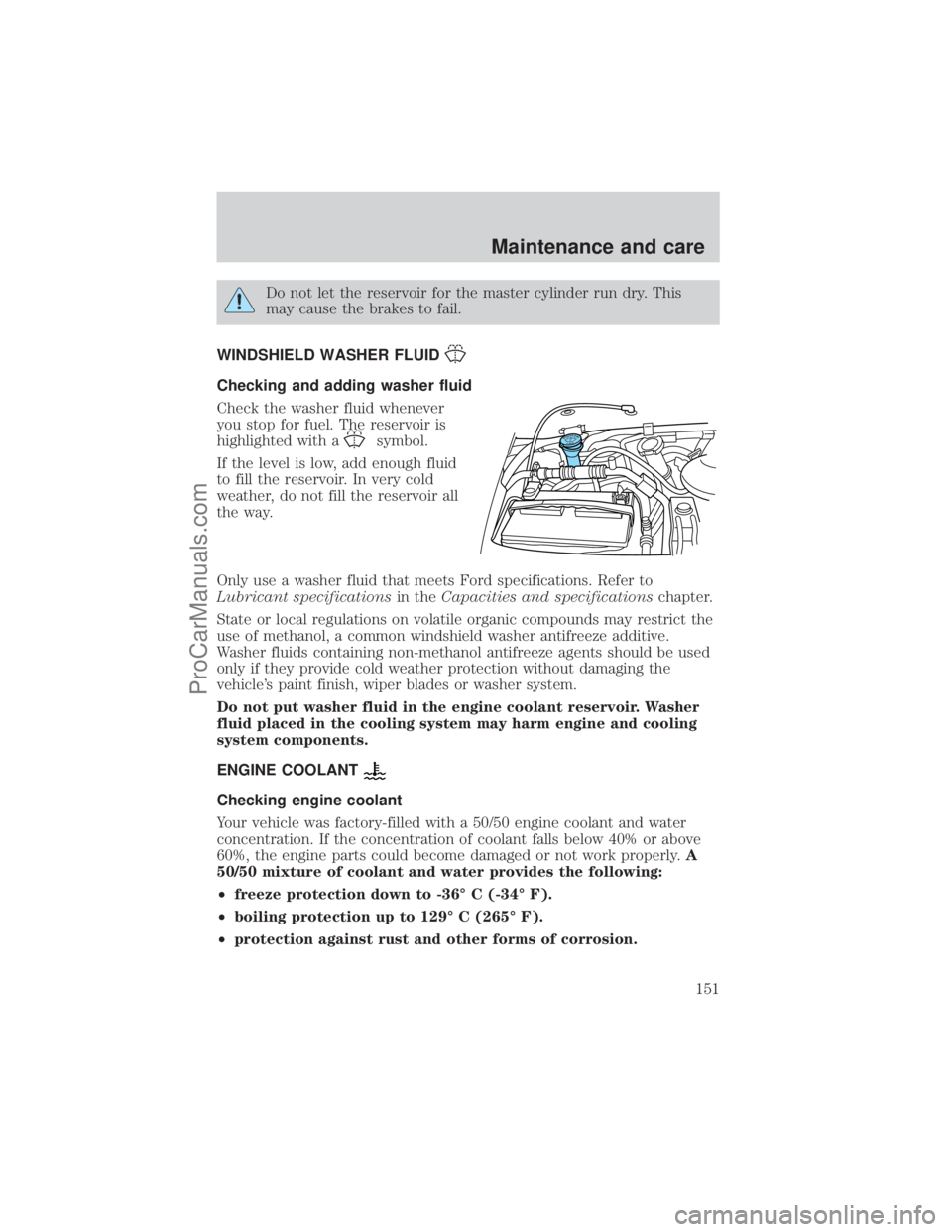
WINDSHIELD WASHER FLUID
Checking and adding washer fluid
Check the washer fluid whenever
you stop for fuel. The reservoir is
highlighted with a
symbol.
If the level is low, add enough fluid
to fill the reservoir. In very cold
weather, do not fill the reservoir all
the way.
Only use a washer fluid that meets Ford specifications. Refer to
Lubricant specificationsin theCapacities and specificationschapter.
State or local regulations on volatile organic compounds may restrict the
use of methanol, a common windshield washer antifreeze additive.
Washer fluids containing non-methanol antifreeze agents should be used
only if they provide cold weather protection without damaging the
vehicle's paint finish, wiper blades or washer system.
Do not put washer fluid in the engine coolant reservoir. Washer
fluid placed in the cooling system may harm engine and cooling
system components.
ENGINE COOLANT
Checking engine coolant
Your vehicle was factory-filled with a 50/50 engine coolant and water
concentration. If the concentration of coolant falls below 40% or above
60%, the engine parts could become damaged or not work properly.A
50/50 mixture of coolant and water provides the following:
²freeze protection down to -36É C (-34É F).
²boiling protection up to 129É C (265É F).
²protection against rust and other forms of corrosion.
Maintenance and care
151
ProCarManuals.com
Page 162 of 224
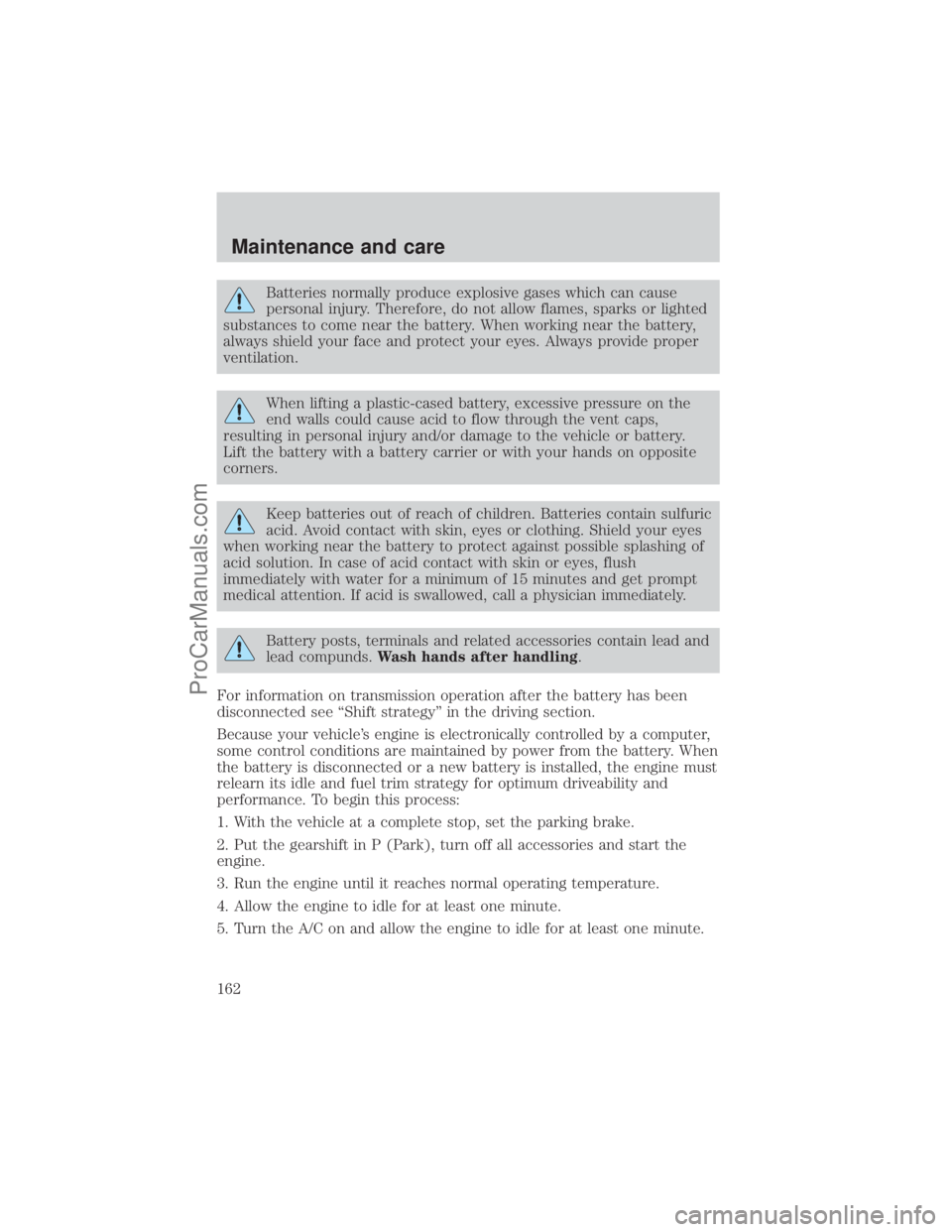
Batteries normally produce explosive gases which can cause
personal injury. Therefore, do not allow flames, sparks or lighted
substances to come near the battery. When working near the battery,
always shield your face and protect your eyes. Always provide proper
ventilation.
When lifting a plastic-cased battery, excessive pressure on the
end walls could cause acid to flow through the vent caps,
resulting in personal injury and/or damage to the vehicle or battery.
Lift the battery with a battery carrier or with your hands on opposite
corners.
Keep batteries out of reach of children. Batteries contain sulfuric
acid. Avoid contact with skin, eyes or clothing. Shield your eyes
when working near the battery to protect against possible splashing of
acid solution. In case of acid contact with skin or eyes, flush
immediately with water for a minimum of 15 minutes and get prompt
medical attention. If acid is swallowed, call a physician immediately.
Battery posts, terminals and related accessories contain lead and
lead compunds.Wash hands after handling.
For information on transmission operation after the battery has been
disconnected see ªShift strategyº in the driving section.
Because your vehicle's engine is electronically controlled by a computer,
some control conditions are maintained by power from the battery. When
the battery is disconnected or a new battery is installed, the engine must
relearn its idle and fuel trim strategy for optimum driveability and
performance. To begin this process:
1. With the vehicle at a complete stop, set the parking brake.
2. Put the gearshift in P (Park), turn off all accessories and start the
engine.
3. Run the engine until it reaches normal operating temperature.
4. Allow the engine to idle for at least one minute.
5. Turn the A/C on and allow the engine to idle for at least one minute.
Maintenance and care
162
ProCarManuals.com
Page 179 of 224
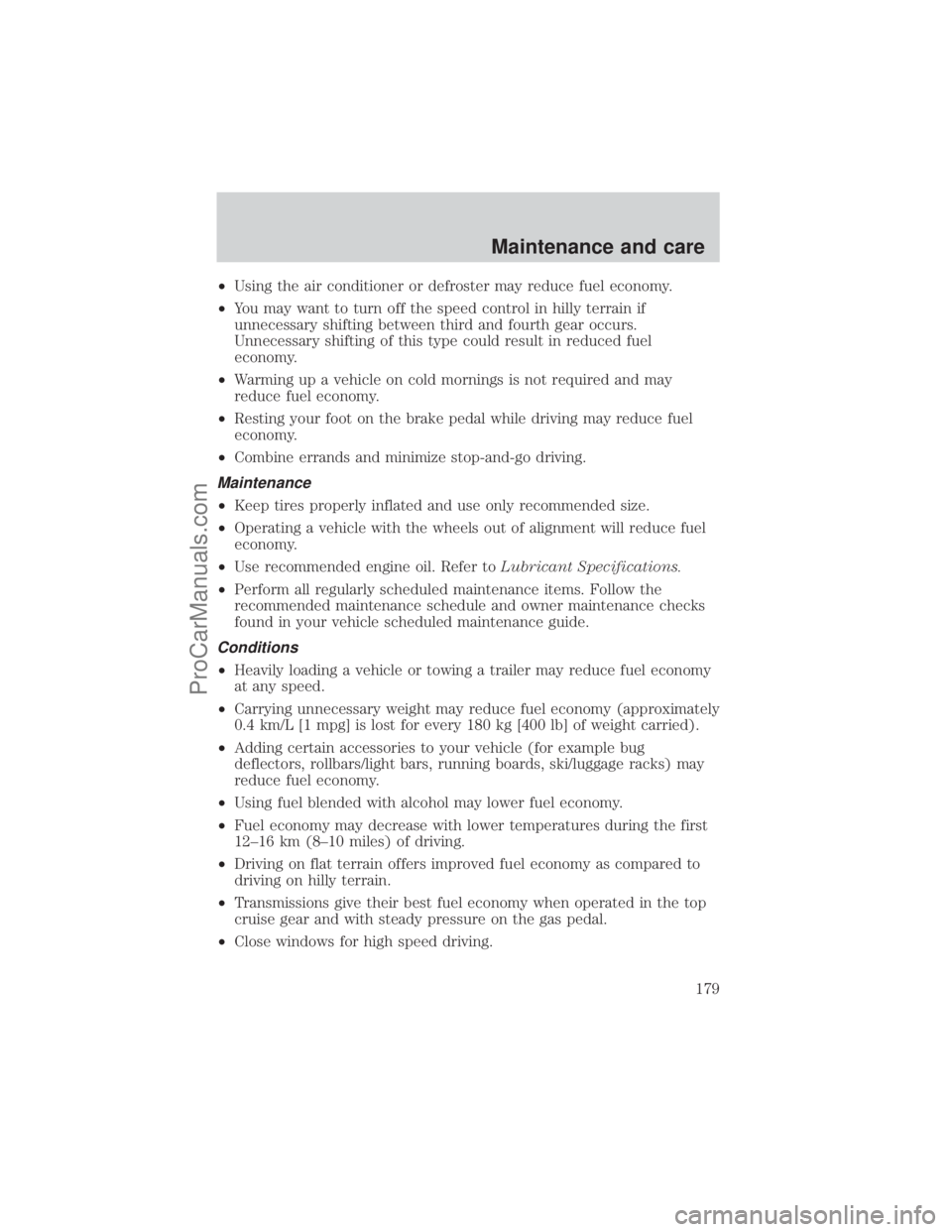
²Using the air conditioner or defroster may reduce fuel economy.
²You may want to turn off the speed control in hilly terrain if
unnecessary shifting between third and fourth gear occurs.
Unnecessary shifting of this type could result in reduced fuel
economy.
²Warming up a vehicle on cold mornings is not required and may
reduce fuel economy.
²Resting your foot on the brake pedal while driving may reduce fuel
economy.
²Combine errands and minimize stop-and-go driving.
Maintenance
²Keep tires properly inflated and use only recommended size.
²Operating a vehicle with the wheels out of alignment will reduce fuel
economy.
²Use recommended engine oil. Refer toLubricant Specifications.
²Perform all regularly scheduled maintenance items. Follow the
recommended maintenance schedule and owner maintenance checks
found in your vehicle scheduled maintenance guide.
Conditions
²Heavily loading a vehicle or towing a trailer may reduce fuel economy
at any speed.
²Carrying unnecessary weight may reduce fuel economy (approximately
0.4 km/L [1 mpg] is lost for every 180 kg [400 lb] of weight carried).
²Adding certain accessories to your vehicle (for example bug
deflectors, rollbars/light bars, running boards, ski/luggage racks) may
reduce fuel economy.
²Using fuel blended with alcohol may lower fuel economy.
²Fuel economy may decrease with lower temperatures during the first
12±16 km (8±10 miles) of driving.
²Driving on flat terrain offers improved fuel economy as compared to
driving on hilly terrain.
²Transmissions give their best fuel economy when operated in the top
cruise gear and with steady pressure on the gas pedal.
²Close windows for high speed driving.
Maintenance and care
179
ProCarManuals.com
Page 187 of 224
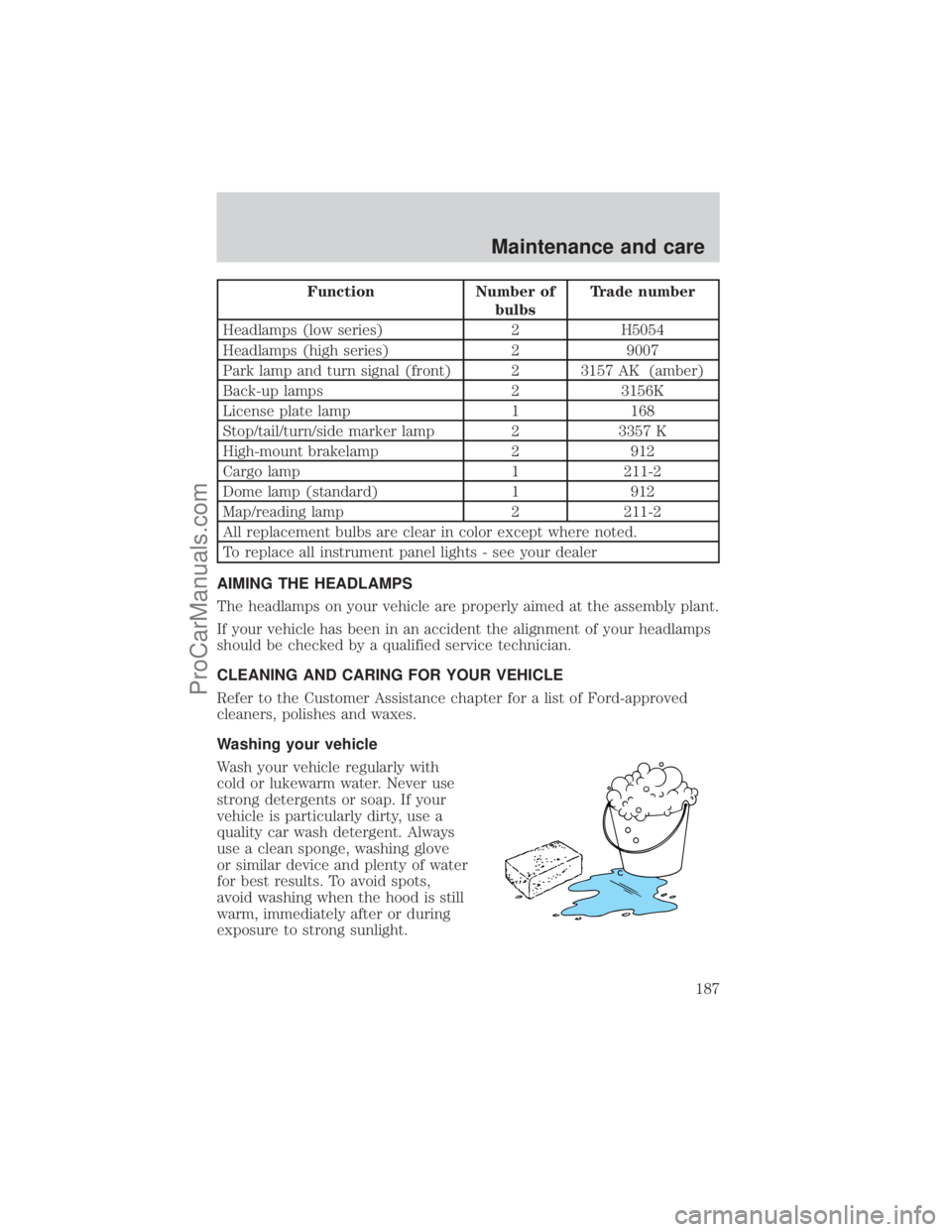
Function Number of
bulbsTrade number
Headlamps (low series) 2 H5054
Headlamps (high series) 2 9007
Park lamp and turn signal (front) 2 3157 AK (amber)
Back-up lamps 2 3156K
License plate lamp 1 168
Stop/tail/turn/side marker lamp 2 3357 K
High-mount brakelamp 2 912
Cargo lamp 1 211-2
Dome lamp (standard) 1 912
Map/reading lamp 2 211-2
All replacement bulbs are clear in color except where noted.
To replace all instrument panel lights - see your dealer
AIMING THE HEADLAMPS
The headlamps on your vehicle are properly aimed at the assembly plant.
If your vehicle has been in an accident the alignment of your headlamps
should be checked by a qualified service technician.
CLEANING AND CARING FOR YOUR VEHICLE
Refer to the Customer Assistance chapter for a list of Ford-approved
cleaners, polishes and waxes.
Washing your vehicle
Wash your vehicle regularly with
cold or lukewarm water. Never use
strong detergents or soap. If your
vehicle is particularly dirty, use a
quality car wash detergent. Always
use a clean sponge, washing glove
or similar device and plenty of water
for best results. To avoid spots,
avoid washing when the hood is still
warm, immediately after or during
exposure to strong sunlight.
Maintenance and care
187
ProCarManuals.com
Page 216 of 224
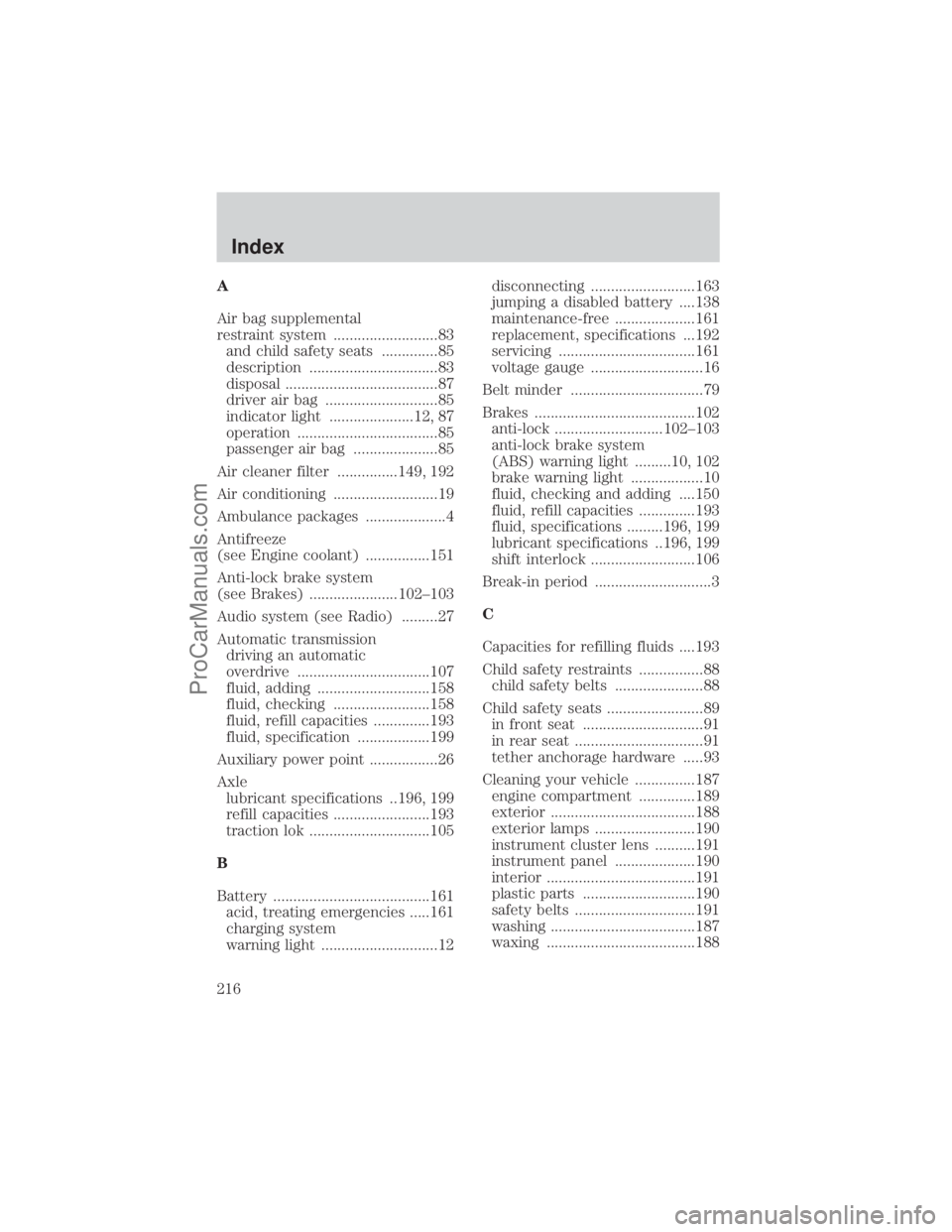
A
Air bag supplemental
restraint system ..........................83
and child safety seats ..............85
description ................................83
disposal ......................................87
driver air bag ............................85
indicator light .....................12, 87
operation ...................................85
passenger air bag .....................85
Air cleaner filter ...............149, 192
Air conditioning ..........................19
Ambulance packages ....................4
Antifreeze
(see Engine coolant) ................151
Anti-lock brake system
(see Brakes) ......................102±103
Audio system (see Radio) .........27
Automatic transmission
driving an automatic
overdrive .................................107
fluid, adding ............................158
fluid, checking ........................158
fluid, refill capacities ..............193
fluid, specification ..................199
Auxiliary power point .................26
Axle
lubricant specifications ..196, 199
refill capacities ........................193
traction lok ..............................105
B
Battery .......................................161
acid, treating emergencies .....161
charging system
warning light .............................12disconnecting ..........................163
jumping a disabled battery ....138
maintenance-free ....................161
replacement, specifications ...192
servicing ..................................161
voltage gauge ............................16
Belt minder .................................79
Brakes ........................................102
anti-lock ...........................102±103
anti-lock brake system
(ABS) warning light .........10, 102
brake warning light ..................10
fluid, checking and adding ....150
fluid, refill capacities ..............193
fluid, specifications .........196, 199
lubricant specifications ..196, 199
shift interlock ..........................106
Break-in period .............................3
C
Capacities for refilling fluids ....193
Child safety restraints ................88
child safety belts ......................88
Child safety seats ........................89
in front seat ..............................91
in rear seat ................................91
tether anchorage hardware .....93
Cleaning your vehicle ...............187
engine compartment ..............189
exterior ....................................188
exterior lamps .........................190
instrument cluster lens ..........191
instrument panel ....................190
interior .....................................191
plastic parts ............................190
safety belts ..............................191
washing ....................................187
waxing .....................................188
Index
216
ProCarManuals.com
Page 219 of 224
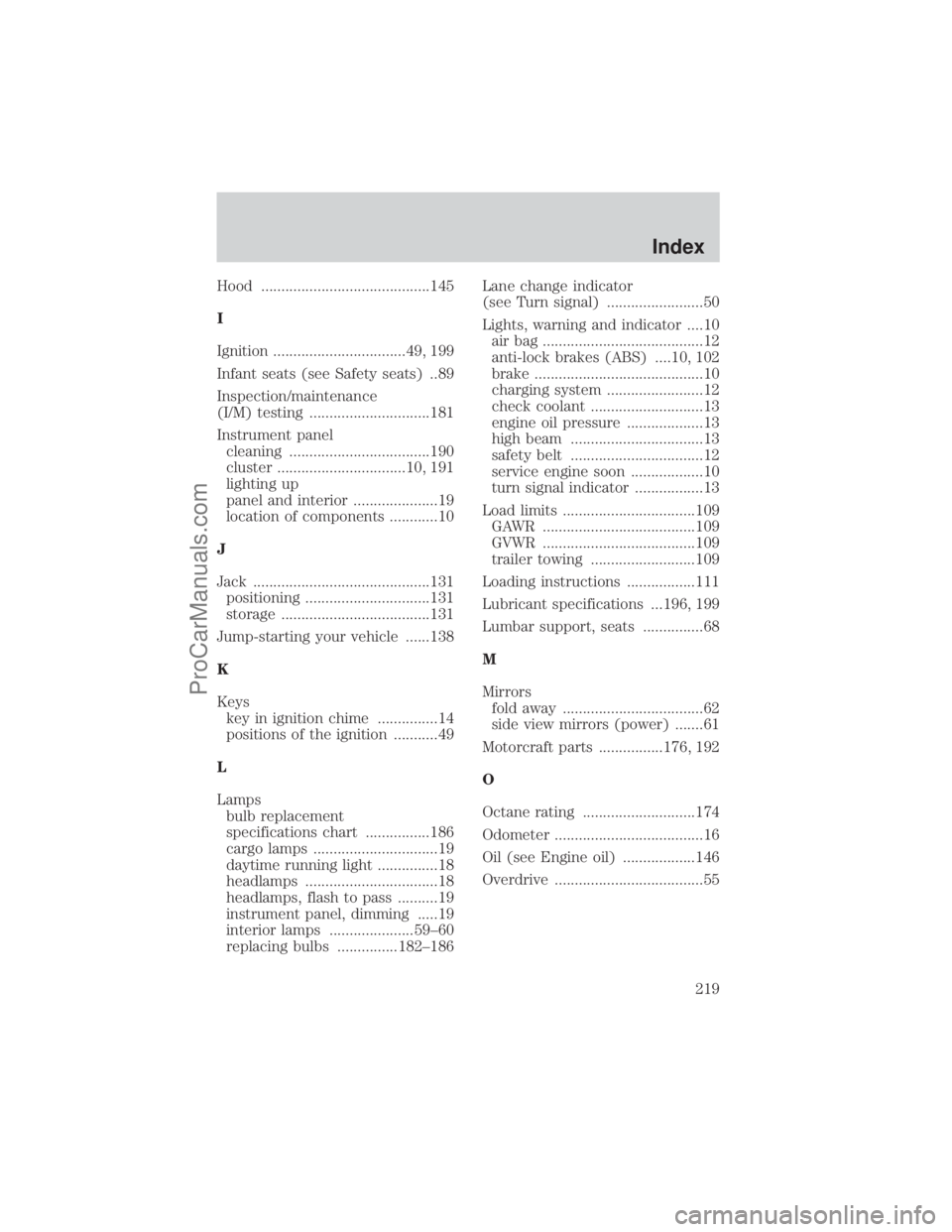
Hood ..........................................145
I
Ignition .................................49, 199
Infant seats (see Safety seats) ..89
Inspection/maintenance
(I/M) testing ..............................181
Instrument panel
cleaning ...................................190
cluster ................................10, 191
lighting up
panel and interior .....................19
location of components ............10
J
Jack ............................................131
positioning ...............................131
storage .....................................131
Jump-starting your vehicle ......138
K
Keys
key in ignition chime ...............14
positions of the ignition ...........49
L
Lamps
bulb replacement
specifications chart ................186
cargo lamps ...............................19
daytime running light ...............18
headlamps .................................18
headlamps, flash to pass ..........19
instrument panel, dimming .....19
interior lamps .....................59±60
replacing bulbs ...............182±186Lane change indicator
(see Turn signal) ........................50
Lights, warning and indicator ....10
air bag ........................................12
anti-lock brakes (ABS) ....10, 102
brake ..........................................10
charging system ........................12
check coolant ............................13
engine oil pressure ...................13
high beam .................................13
safety belt .................................12
service engine soon ..................10
turn signal indicator .................13
Load limits .................................109
GAWR ......................................109
GVWR ......................................109
trailer towing ..........................109
Loading instructions .................111
Lubricant specifications ...196, 199
Lumbar support, seats ...............68
M
Mirrors
fold away ...................................62
side view mirrors (power) .......61
Motorcraft parts ................176, 192
O
Octane rating ............................174
Odometer .....................................16
Oil (see Engine oil) ..................146
Overdrive .....................................55
Index
219
ProCarManuals.com
Page 220 of 224
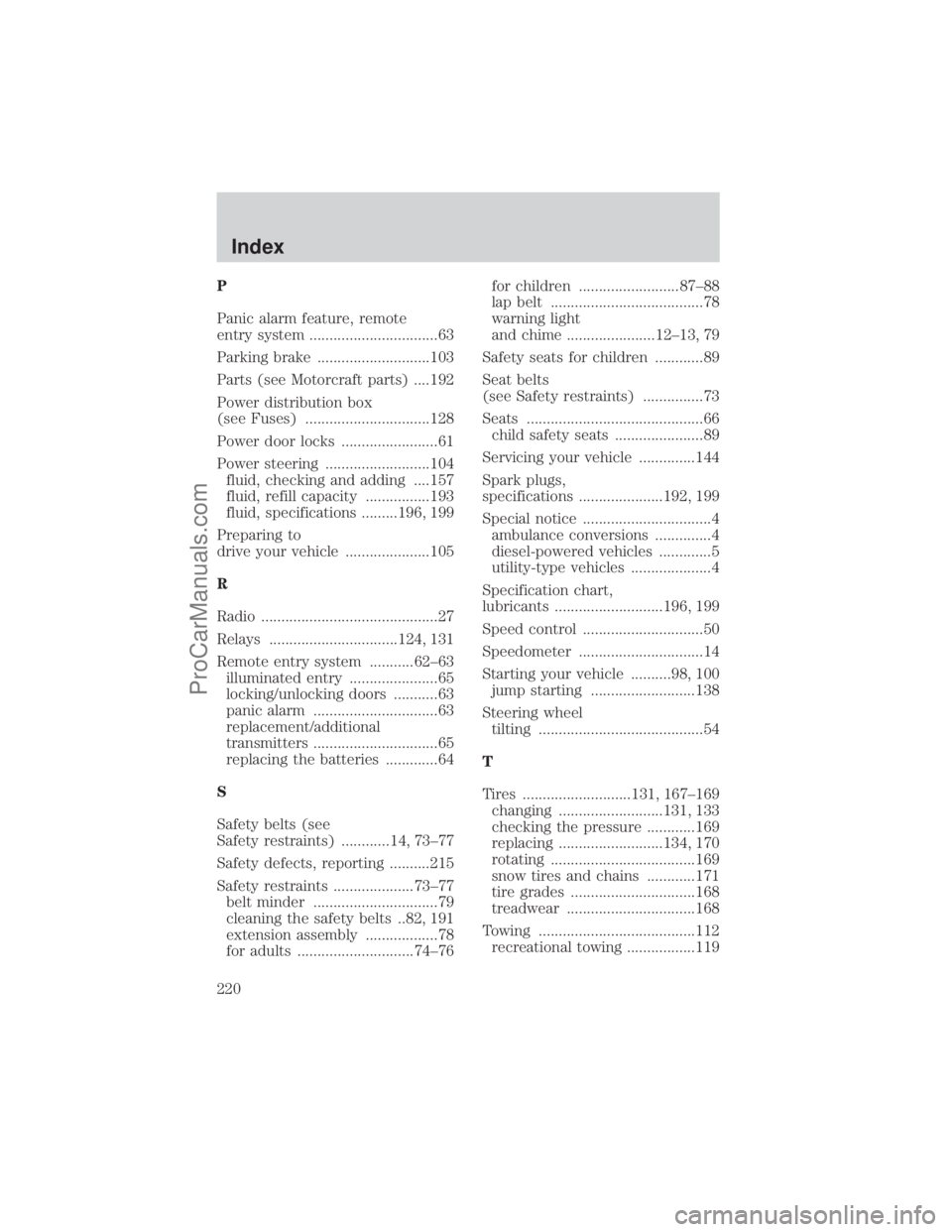
P
Panic alarm feature, remote
entry system ................................63
Parking brake ............................103
Parts (see Motorcraft parts) ....192
Power distribution box
(see Fuses) ...............................128
Power door locks ........................61
Power steering ..........................104
fluid, checking and adding ....157
fluid, refill capacity ................193
fluid, specifications .........196, 199
Preparing to
drive your vehicle .....................105
R
Radio ............................................27
Relays ................................124, 131
Remote entry system ...........62±63
illuminated entry ......................65
locking/unlocking doors ...........63
panic alarm ...............................63
replacement/additional
transmitters ...............................65
replacing the batteries .............64
S
Safety belts (see
Safety restraints) ............14, 73±77
Safety defects, reporting ..........215
Safety restraints ....................73±77
belt minder ...............................79
cleaning the safety belts ..82, 191
extension assembly ..................78
for adults .............................74±76for children .........................87±88
lap belt ......................................78
warning light
and chime ......................12±13, 79
Safety seats for children ............89
Seat belts
(see Safety restraints) ...............73
Seats ............................................66
child safety seats ......................89
Servicing your vehicle ..............144
Spark plugs,
specifications .....................192, 199
Special notice ................................4
ambulance conversions ..............4
diesel-powered vehicles .............5
utility-type vehicles ....................4
Specification chart,
lubricants ...........................196, 199
Speed control ..............................50
Speedometer ...............................14
Starting your vehicle ..........98, 100
jump starting ..........................138
Steering wheel
tilting .........................................54
T
Tires ...........................131, 167±169
changing ..........................131, 133
checking the pressure ............169
replacing ..........................134, 170
rotating ....................................169
snow tires and chains ............171
tire grades ...............................168
treadwear ................................168
Towing .......................................112
recreational towing .................119
Index
220
ProCarManuals.com