brakes FORD E-150 2001 User Guide
[x] Cancel search | Manufacturer: FORD, Model Year: 2001, Model line: E-150, Model: FORD E-150 2001Pages: 224, PDF Size: 1.99 MB
Page 150 of 224
5. Install a new air filter element. Be careful not to crimp the filter
element edges between the air filter housing. This could cause filter
damage and allow unfiltered air to enter the engine if not properly
seated.
6. Replace the two halves of the air filter housing and secure the clamp.
7. Connect the fresh air inlet tube to the radiator support.
BRAKE FLUID
Checking and adding brake fluid
Brake fluid should be checked and
refilled as needed. Refer to the
scheduled maintenance guide for
the service interval schedules.
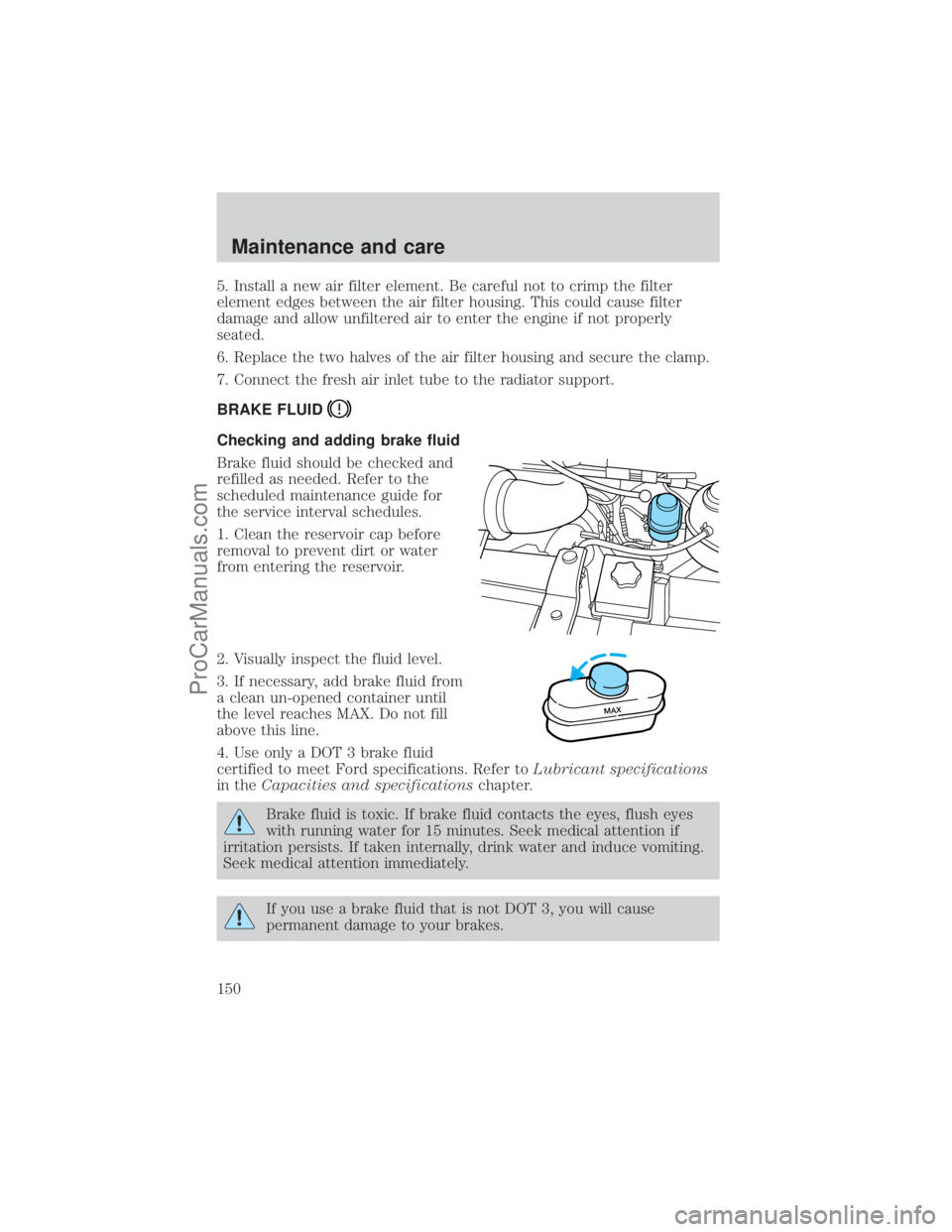
1. Clean the reservoir cap before
removal to prevent dirt or water
from entering the reservoir.
2. Visually inspect the fluid level.
3. If necessary, add brake fluid from
a clean un-opened container until
the level reaches MAX. Do not fill
above this line.
4. Use only a DOT 3 brake fluid
certified to meet Ford specifications. Refer toLubricant specifications
in theCapacities and specificationschapter.
Brake fluid is toxic. If brake fluid contacts the eyes, flush eyes
with running water for 15 minutes. Seek medical attention if
irritation persists. If taken internally, drink water and induce vomiting.
Seek medical attention immediately.
If you use a brake fluid that is not DOT 3, you will cause
permanent damage to your brakes.
MAX
Maintenance and care
150
ProCarManuals.com
Page 151 of 224
Do not let the reservoir for the master cylinder run dry. This
may cause the brakes to fail.
WINDSHIELD WASHER FLUID
Checking and adding washer fluid
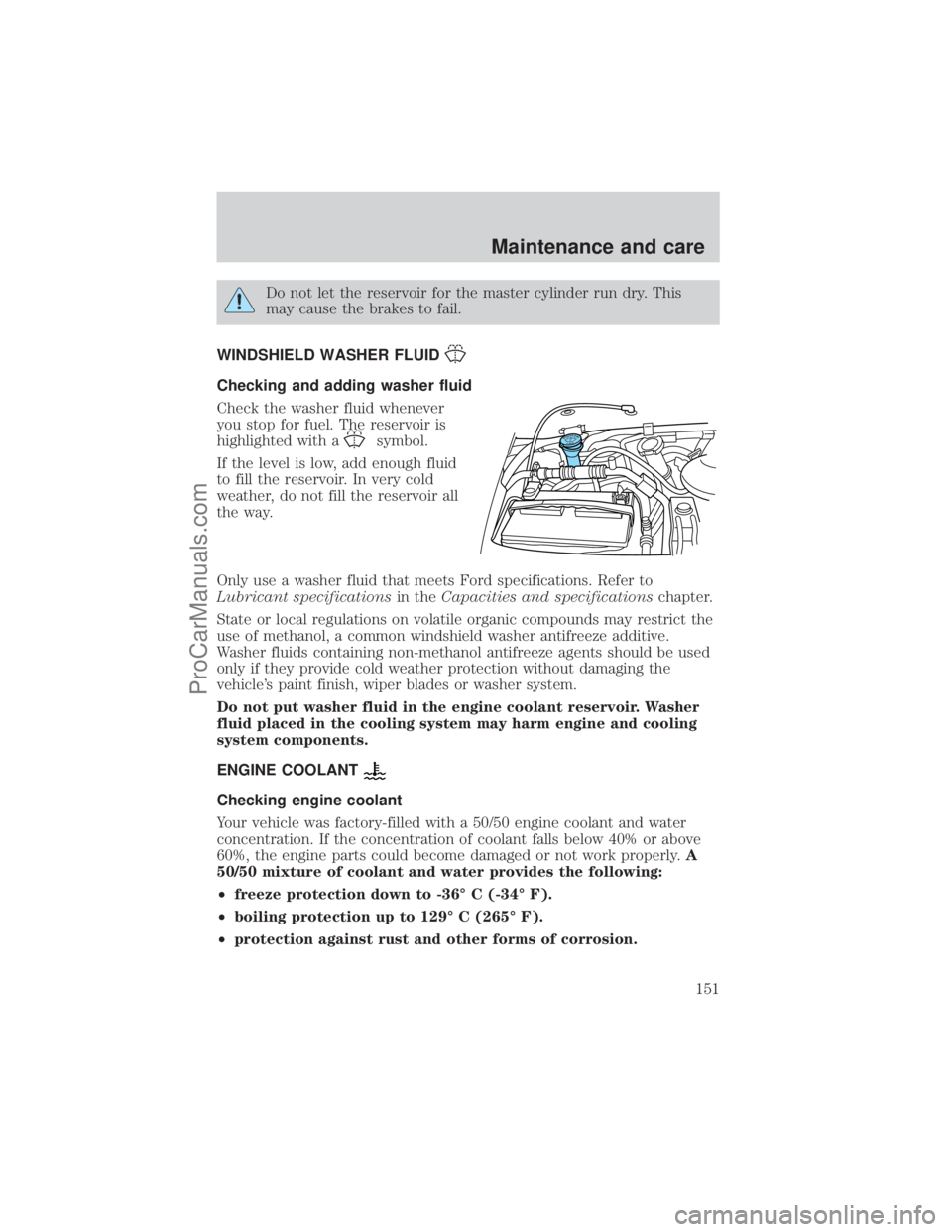
Check the washer fluid whenever
you stop for fuel. The reservoir is
highlighted with a
symbol.
If the level is low, add enough fluid
to fill the reservoir. In very cold
weather, do not fill the reservoir all
the way.
Only use a washer fluid that meets Ford specifications. Refer to
Lubricant specificationsin theCapacities and specificationschapter.
State or local regulations on volatile organic compounds may restrict the
use of methanol, a common windshield washer antifreeze additive.
Washer fluids containing non-methanol antifreeze agents should be used
only if they provide cold weather protection without damaging the
vehicle's paint finish, wiper blades or washer system.
Do not put washer fluid in the engine coolant reservoir. Washer
fluid placed in the cooling system may harm engine and cooling
system components.
ENGINE COOLANT
Checking engine coolant
Your vehicle was factory-filled with a 50/50 engine coolant and water
concentration. If the concentration of coolant falls below 40% or above
60%, the engine parts could become damaged or not work properly.A
50/50 mixture of coolant and water provides the following:
²freeze protection down to -36É C (-34É F).
²boiling protection up to 129É C (265É F).
²protection against rust and other forms of corrosion.
Maintenance and care
151
ProCarManuals.com
Page 188 of 224
During winter months, it is especially important to wash the vehicle on a
regular basis. Large quantities of dirt and road salt are difficult to
remove and also cause damage to the vehicle.
Any gasoline spilled on the vehicle or deposits such as bird droppings
should be washed and sponged off as soon as possible. Deposits not
removed promptly can cause damage to the vehicle's paintwork.
Remove any exterior accessories, such as antennas, before entering a car
wash. If you have wax applied to the vehicle at a commercial car wash, it
is recommended that you clean the wiper blades and windshield as
described inCleaning the wiper blades and windshield.
After washing, apply the brakes several times to dry them.
Underbody
Flush the complete underside of vehicle frequently. Keep body drain
holes unplugged. Inspect for road damage.
Waxing your vehicle
Waxing your vehicle on a regular basis will reduce minor scratches and
paint damage.
Wax when water stops beading on the surface. This could be every three
or four months, depending on operating conditions.
Use only carnauba or synthetic-based waxes. Use a cleaning fluid with a
clean cloth to remove any bugs before waxing your vehicle. Use tar
remover to remove any tar spots.
Avoid getting wax on the windshield, or on any surfaces which appear
coarse or bumpy. If you have wax applied at a commercial car wash, it is
recommended that you clean the wiper blades and windshield as
described inCleaning the wiper blades and windshield.
Repairing paint chips
Minor scratches or paint damage from road debris may be repaired with
the Ultra Touch Prep and Finishing Kit (#F7AZ-19K507±BA), Lacquer
Touch-up Paint (#ALBZ-19500±XXXXA), or Exterior Acrylic Spray
Lacquer (#ALAZ-19500±XXXXA) from the Ford Car Care Chemicals line.
Please note that the part numbers (shown as XXXX above) will vary with
your vehicle's specific coloring. Observe the application instructions on
the products.
Maintenance and care
188
ProCarManuals.com
Page 216 of 224
A
Air bag supplemental
restraint system ..........................83
and child safety seats ..............85
description ................................83
disposal ......................................87
driver air bag ............................85
indicator light .....................12, 87
operation ...................................85
passenger air bag .....................85
Air cleaner filter ...............149, 192
Air conditioning ..........................19
Ambulance packages ....................4
Antifreeze
(see Engine coolant) ................151
Anti-lock brake system
(see Brakes) ......................102±103
Audio system (see Radio) .........27
Automatic transmission
driving an automatic
overdrive .................................107
fluid, adding ............................158
fluid, checking ........................158
fluid, refill capacities ..............193
fluid, specification ..................199
Auxiliary power point .................26
Axle
lubricant specifications ..196, 199
refill capacities ........................193
traction lok ..............................105
B
Battery .......................................161
acid, treating emergencies .....161
charging system
warning light .............................12disconnecting ..........................163
jumping a disabled battery ....138
maintenance-free ....................161
replacement, specifications ...192
servicing ..................................161
voltage gauge ............................16
Belt minder .................................79
Brakes ........................................102
anti-lock ...........................102±103
anti-lock brake system
(ABS) warning light .........10, 102
brake warning light ..................10
fluid, checking and adding ....150
fluid, refill capacities ..............193
fluid, specifications .........196, 199
lubricant specifications ..196, 199
shift interlock ..........................106
Break-in period .............................3
C
Capacities for refilling fluids ....193
Child safety restraints ................88
child safety belts ......................88
Child safety seats ........................89
in front seat ..............................91
in rear seat ................................91
tether anchorage hardware .....93
Cleaning your vehicle ...............187
engine compartment ..............189
exterior ....................................188
exterior lamps .........................190
instrument cluster lens ..........191
instrument panel ....................190
interior .....................................191
plastic parts ............................190
safety belts ..............................191
washing ....................................187
waxing .....................................188
Index
216
ProCarManuals.com
Page 219 of 224
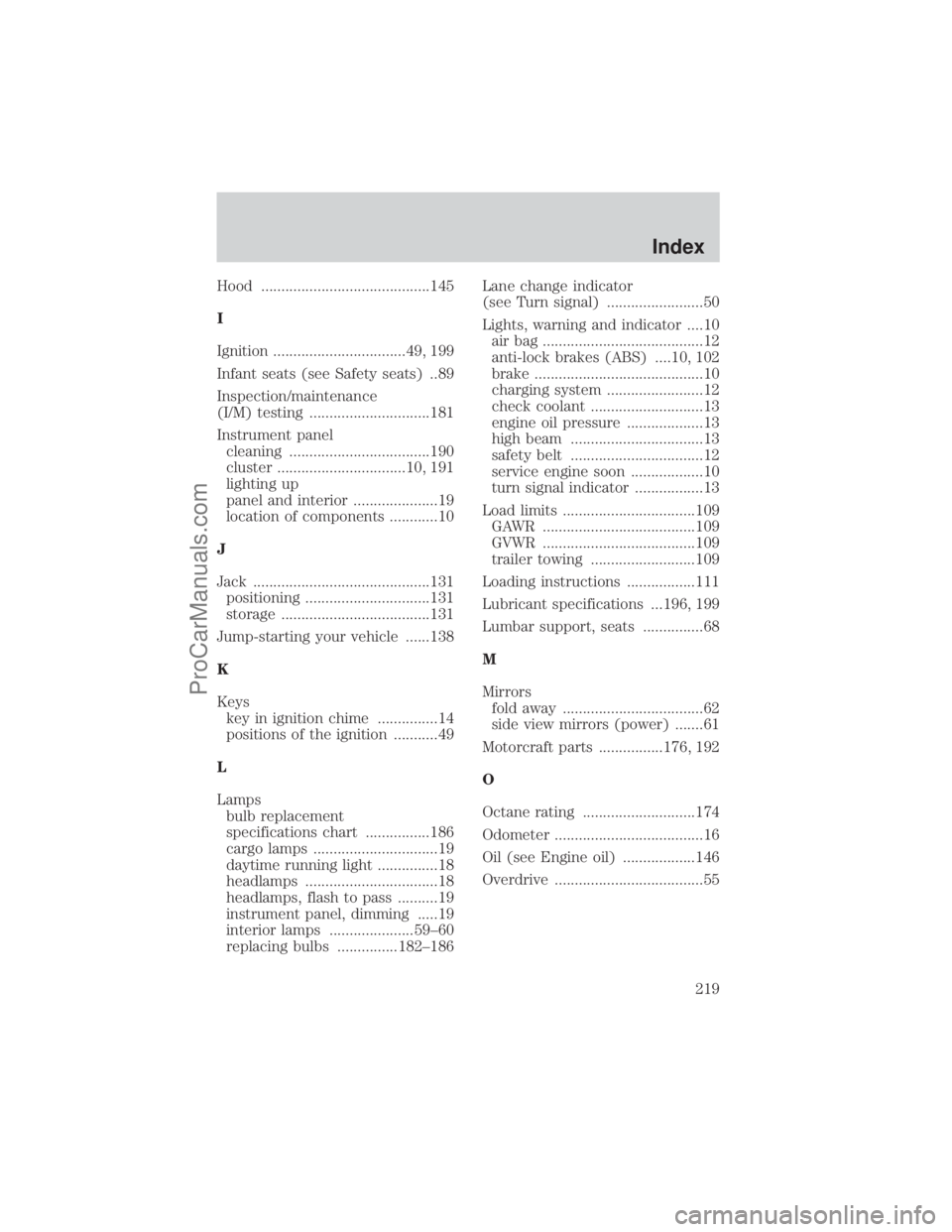
Hood ..........................................145
I
Ignition .................................49, 199
Infant seats (see Safety seats) ..89
Inspection/maintenance
(I/M) testing ..............................181
Instrument panel
cleaning ...................................190
cluster ................................10, 191
lighting up
panel and interior .....................19
location of components ............10
J
Jack ............................................131
positioning ...............................131
storage .....................................131
Jump-starting your vehicle ......138
K
Keys
key in ignition chime ...............14
positions of the ignition ...........49
L
Lamps
bulb replacement
specifications chart ................186
cargo lamps ...............................19
daytime running light ...............18
headlamps .................................18
headlamps, flash to pass ..........19
instrument panel, dimming .....19
interior lamps .....................59±60
replacing bulbs ...............182±186Lane change indicator
(see Turn signal) ........................50
Lights, warning and indicator ....10
air bag ........................................12
anti-lock brakes (ABS) ....10, 102
brake ..........................................10
charging system ........................12
check coolant ............................13
engine oil pressure ...................13
high beam .................................13
safety belt .................................12
service engine soon ..................10
turn signal indicator .................13
Load limits .................................109
GAWR ......................................109
GVWR ......................................109
trailer towing ..........................109
Loading instructions .................111
Lubricant specifications ...196, 199
Lumbar support, seats ...............68
M
Mirrors
fold away ...................................62
side view mirrors (power) .......61
Motorcraft parts ................176, 192
O
Octane rating ............................174
Odometer .....................................16
Oil (see Engine oil) ..................146
Overdrive .....................................55
Index
219
ProCarManuals.com