brake light FORD E-150 2002 User Guide
[x] Cancel search | Manufacturer: FORD, Model Year: 2002, Model line: E-150, Model: FORD E-150 2002Pages: 256, PDF Size: 3.52 MB
Page 148 of 256
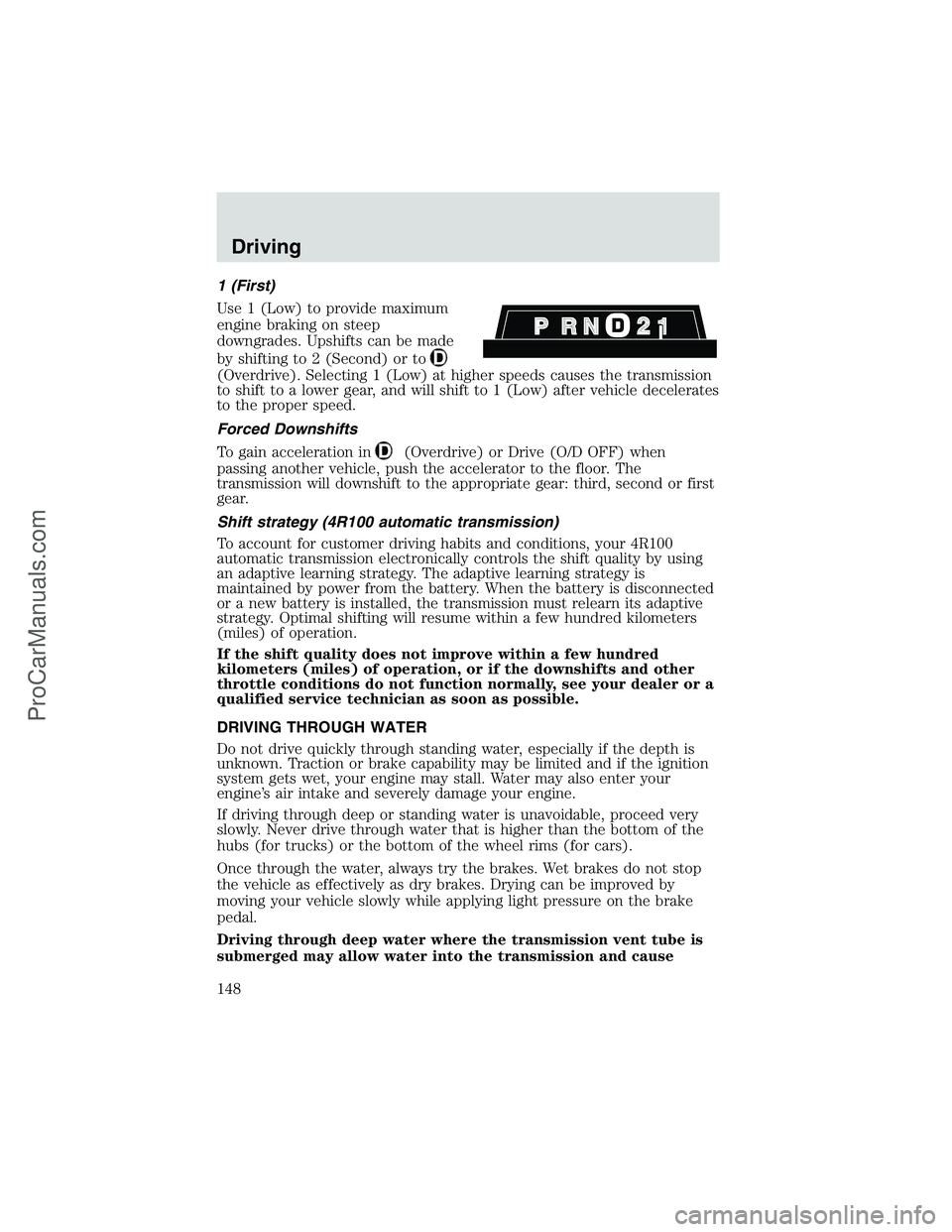
1 (First)
Use 1 (Low) to provide maximum
engine braking on steep
downgrades. Upshifts can be made
by shifting to 2 (Second) or to
(Overdrive). Selecting 1 (Low) at higher speeds causes the transmission
to shift to a lower gear, and will shift to 1 (Low) after vehicle decelerates
to the proper speed.
Forced Downshifts
To gain acceleration in
(Overdrive) or Drive (O/D OFF) when
passing another vehicle, push the accelerator to the floor. The
transmission will downshift to the appropriate gear: third, second or first
gear.
Shift strategy (4R100 automatic transmission)
To account for customer driving habits and conditions, your 4R100
automatic transmission electronically controls the shift quality by using
an adaptive learning strategy. The adaptive learning strategy is
maintained by power from the battery. When the battery is disconnected
or a new battery is installed, the transmission must relearn its adaptive
strategy. Optimal shifting will resume within a few hundred kilometers
(miles) of operation.
If the shift quality does not improve within a few hundred
kilometers (miles) of operation, or if the downshifts and other
throttle conditions do not function normally, see your dealer or a
qualified service technician as soon as possible.
DRIVING THROUGH WATER
Do not drive quickly through standing water, especially if the depth is
unknown. Traction or brake capability may be limited and if the ignition
system gets wet, your engine may stall. Water may also enter your
engine’s air intake and severely damage your engine.
If driving through deep or standing water is unavoidable, proceed very
slowly. Never drive through water that is higher than the bottom of the
hubs (for trucks) or the bottom of the wheel rims (for cars).
Once through the water, always try the brakes. Wet brakes do not stop
the vehicle as effectively as dry brakes. Drying can be improved by
moving your vehicle slowly while applying light pressure on the brake
pedal.
Driving through deep water where the transmission vent tube is
submerged may allow water into the transmission and cause
Driving
148
ProCarManuals.com
Page 163 of 256
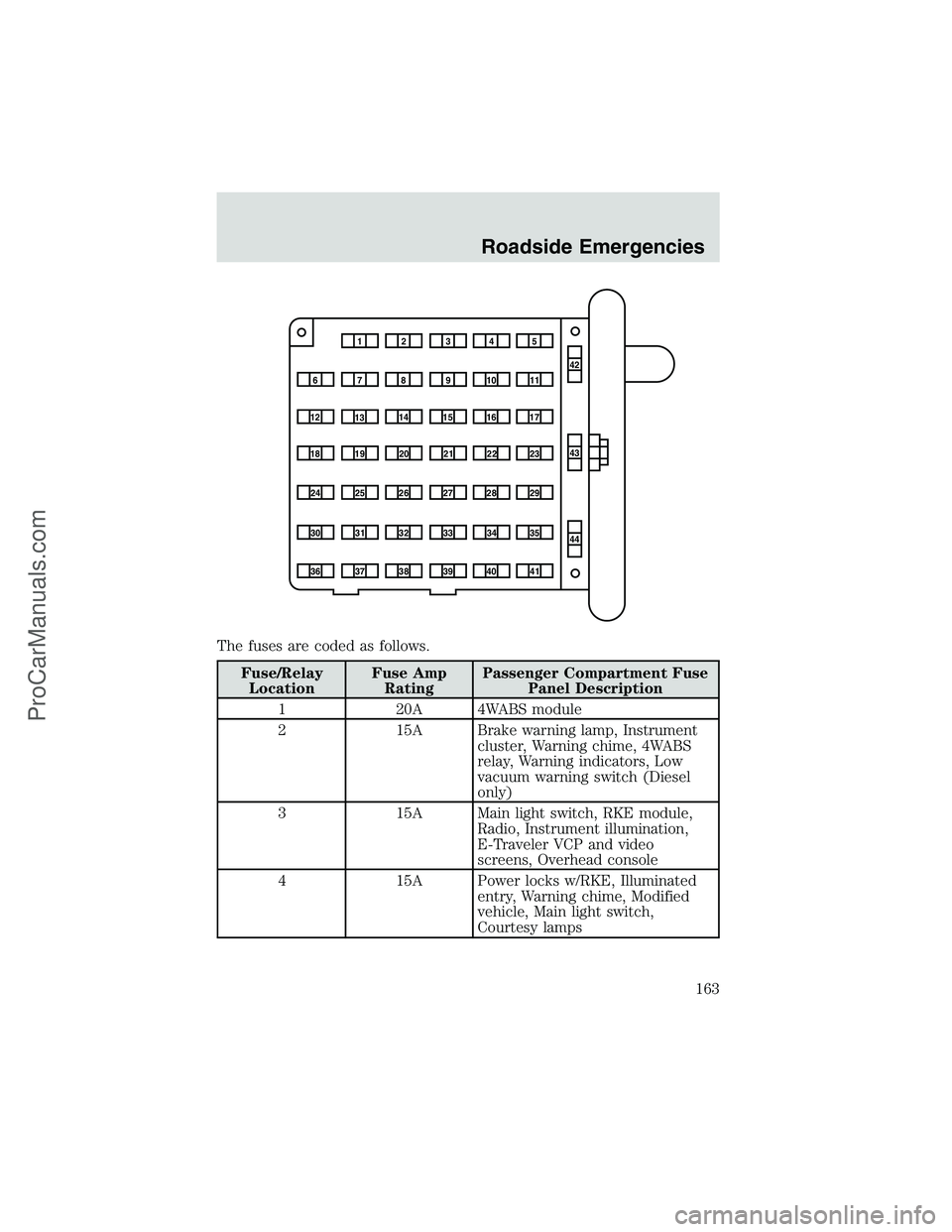
The fuses are coded as follows.
Fuse/Relay
LocationFuse Amp
RatingPassenger Compartment Fuse
Panel Description
1 20A 4WABS module
2 15A Brake warning lamp, Instrument
cluster, Warning chime, 4WABS
relay, Warning indicators, Low
vacuum warning switch (Diesel
only)
3 15A Main light switch, RKE module,
Radio, Instrument illumination,
E-Traveler VCP and video
screens, Overhead console
4 15A Power locks w/RKE, Illuminated
entry, Warning chime, Modified
vehicle, Main light switch,
Courtesy lamps
1234
5
7
689101142
43
44 13 12 14
15 16 17
19 18
2021 22 23
25 24
26 27 28 29
31 30 32 33 3435
37
3638 3940
41
Roadside Emergencies
163
ProCarManuals.com
Page 164 of 256
Fuse/Relay
LocationFuse Amp
RatingPassenger Compartment Fuse
Panel Description
5 20A RKE module, Power lock
switches, Memory lock, Power
locks with RKE
6 10A Brake shift interlock, Speed
control, DRL module
7 10A Multi-function switch, Turn signals
8 30A Radio capacitor(s), Ignition coil,
PCM diode, PCM power relay,
Fuel heater (Diesel only), Glow
plug relay (Diesel only)
9 30A Wiper control module, Windshield
wiper motor
10 20A Main light switch, Park lamps,
License lamp (external lamps),
Multi-function switch
(flash-to-pass)
11 15A Brake pressure switch,
Multi-function switch (hazards),
Brake lamp switch, Brake lamps
12 15A Transmission Range (TR) sensor,
Backup lamps, Auxiliary battery
relay
13 15A Blend door actuator, A/C heater,
Function selector switch
14 5A Instrument cluster (air bag and
charge indicator)
15 5A Trailer battery charge relay
16 30A Power seats
17—Not used
18—Not used
19 10A Air bag diagnostic monitor
20 5A Overdrive cancel switch
21 30A Power windows*
22 15A Memory power radio, E-Traveler
radio, E-Traveler console
Roadside Emergencies
164
ProCarManuals.com
Page 167 of 256
Fuse/Relay
LocationFuse Amp
RatingPower Distribution Box
Description
8 60A** I/P fuses 4, 5, 10, 11, 16, 22, 23,
28, 32, 38
9 30A** PCM power relay, Engine
compartment fuse 4
10 60A** Auxiliary battery relay, Engine
compartment fuses 14, 22
11 30A** IDM relay (Diesel only)
12 60A** Engine compartment fuses 25, 27
13 50A** Blower motor relay (blower
motor)
14 30A** Trailer running lamps relay,
Trailer backup lamps relay
15 40A** Main light switch, Daytime
Running Lights (DRL)
16 50A** Auxiliary blower motor relay
17 30A** Fuel pump relay
18 60A** I/P fuses 33, 37, 39, 40, 41
19 60A** 4WABS module
20 20A** Electric brake controller
21 50A** Modified vehicle power
22 40A** Trailer battery charge relay,
Modified vehicles
23 60A** Ignition switch, Fuse panel
24 30A* Natural gas tank valves (NGV
only)
25 20A* NGV module (NGV only)
26 10A* A/C clutch (4.2L only)
27 15A* DRL module, Horn relay
28—PCM diode
29—Not used
A—Marker lamps relay
B—Stop lamp relay
Roadside Emergencies
167
ProCarManuals.com
Page 176 of 256
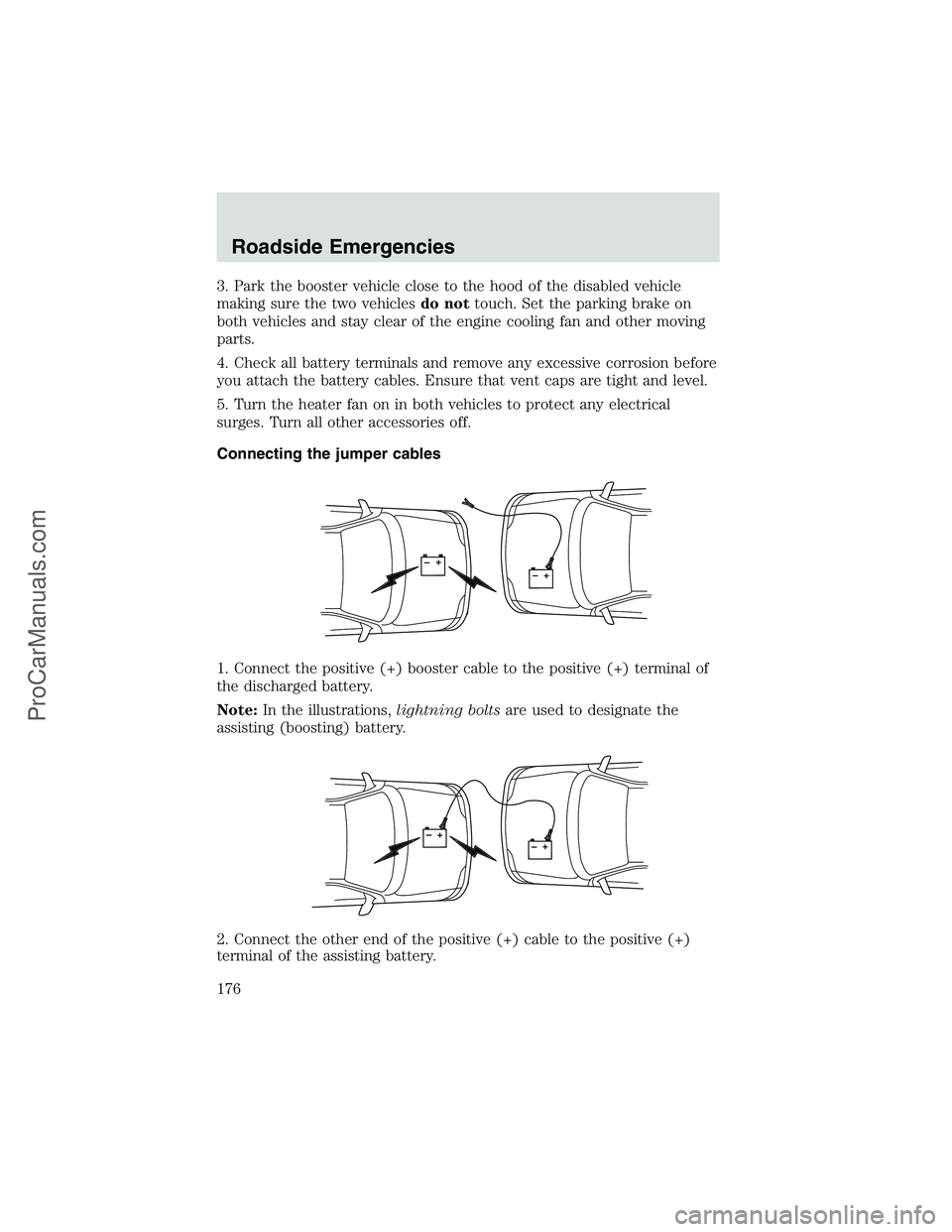
3. Park the booster vehicle close to the hood of the disabled vehicle
making sure the two vehiclesdo nottouch. Set the parking brake on
both vehicles and stay clear of the engine cooling fan and other moving
parts.
4. Check all battery terminals and remove any excessive corrosion before
you attach the battery cables. Ensure that vent caps are tight and level.
5. Turn the heater fan on in both vehicles to protect any electrical
surges. Turn all other accessories off.
Connecting the jumper cables
1. Connect the positive (+) booster cable to the positive (+) terminal of
the discharged battery.
Note:In the illustrations,lightning boltsare used to designate the
assisting (boosting) battery.
2. Connect the other end of the positive (+) cable to the positive (+)
terminal of the assisting battery.
+–+–
+–+–
Roadside Emergencies
176
ProCarManuals.com
Page 198 of 256
SERVICE RECOMMENDATIONS
To help you service your vehicle:
•We highlight do-it-yourself items in the engine compartment for easy
location.
•We provide a scheduled maintenance guide which makes tracking
routine service easy.
If your vehicle requires professional service, your dealership can provide
the necessary parts and service. Check yourWarranty Guide/Owner
Information Guideto find out which parts and services are covered.
Use only recommended fuels, lubricants, fluids and service parts
conforming to specifications. Motorcraft parts are designed and built to
provide the best performance in your vehicle.
PRECAUTIONS WHEN SERVICING YOUR VEHICLE
Be especially careful when inspecting or servicing your vehicle.
•Do not work on a hot engine.
•When the engine is running, make sure that loose clothing, jewelry or
long hair does not get caught up in moving parts.
•Do not work on a vehicle with the engine running in an enclosed
space, unless you are sure you have enough ventilation.
•Keep all lit cigarettes, open flames and other lit material away from
the battery and all fuel related parts.
If you disconnect the battery, the engine must“relearn”its idle
conditions before your vehicle will drive properly, as explained in the
Batterysection of this chapter.
Working with the engine off
1. Set the parking brake and ensure the gearshift is securely latched in P
(Park).
2. Turn off the engine and remove the key.
3. Block the wheels to prevent the vehicle from moving unexpectedly.
Working with the engine on
1. Set the parking brake and ensure the gearshift is securely latched in P
(Park).
2. Block the wheels to prevent the vehicle from moving unexpectedly.
Note:Do not start your engine with the air cleaner removed and do not
remove it while the engine is running.
Maintenance and Specifications
198
ProCarManuals.com
Page 200 of 256
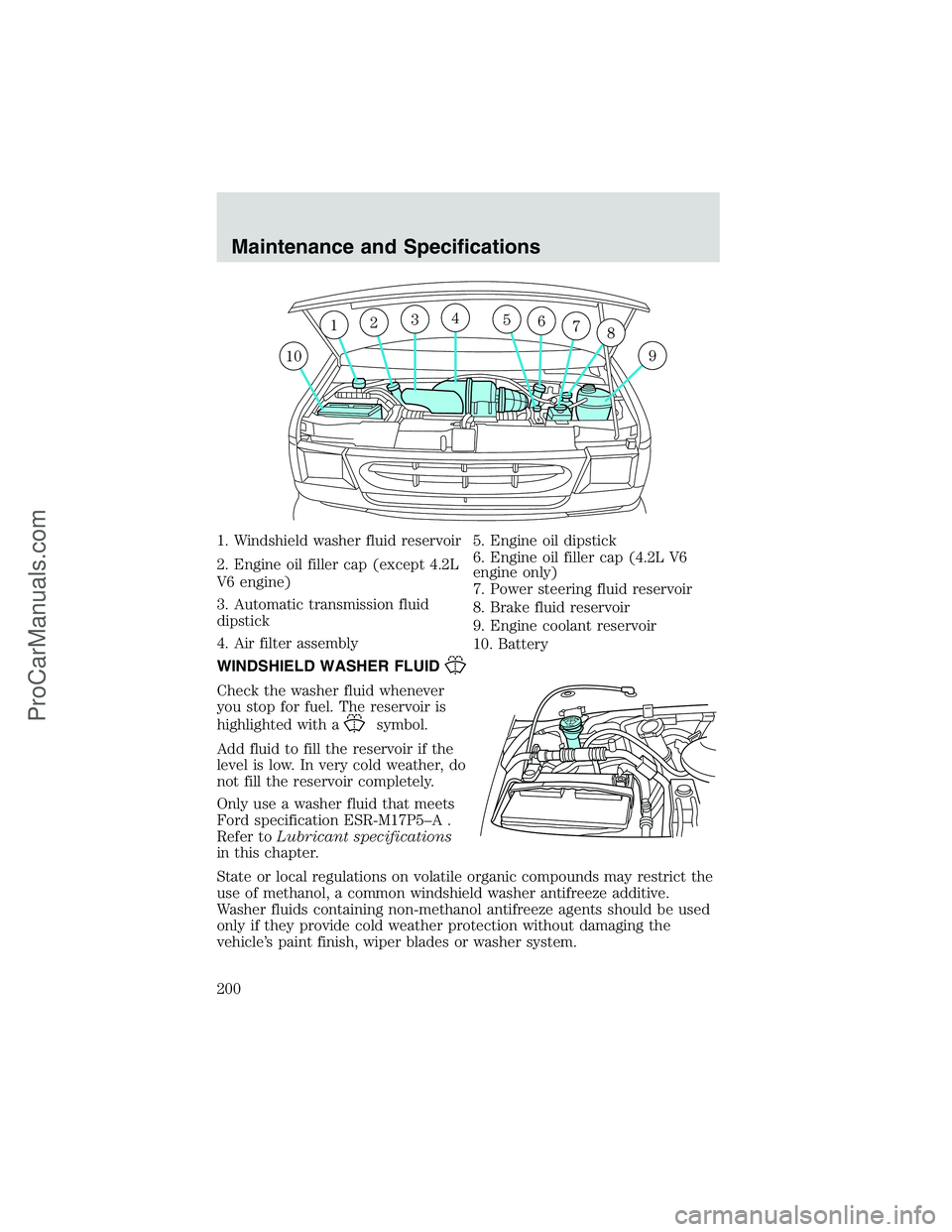
1. Windshield washer fluid reservoir
2. Engine oil filler cap (except 4.2L
V6 engine)
3. Automatic transmission fluid
dipstick
4. Air filter assembly5. Engine oil dipstick
6. Engine oil filler cap (4.2L V6
engine only)
7. Power steering fluid reservoir
8. Brake fluid reservoir
9. Engine coolant reservoir
10. Battery
WINDSHIELD WASHER FLUID
Check the washer fluid whenever
you stop for fuel. The reservoir is
highlighted with a
symbol.
Add fluid to fill the reservoir if the
level is low. In very cold weather, do
not fill the reservoir completely.
Only use a washer fluid that meets
Ford specification ESR-M17P5–A.
Refer toLubricant specifications
in this chapter.
State or local regulations on volatile organic compounds may restrict the
use of methanol, a common windshield washer antifreeze additive.
Washer fluids containing non-methanol antifreeze agents should be used
only if they provide cold weather protection without damaging the
vehicle’s paint finish, wiper blades or washer system.
12345678
910
Maintenance and Specifications
200
ProCarManuals.com
Page 251 of 256
A
ABS (see Brakes) .....................141
Air bag supplemental restraint
system ................................119–120
and child safety seats ............121
description ..............................120
disposal ....................................124
driver air bag ..........................122
indicator light ...................12, 123
operation .................................122
passenger air bag ...................122
Air cleaner filter ...............229, 235
Air conditioning
manual heating and air
conditioning system .................71
Ambulance packages ....................6
Antifreeze (see Engine
coolant) .....................................209
Anti-lock brake system
(see Brakes) ..............................141
Audio system
(see Radio) ................17, 22, 28, 36
Automatic transmission
driving an automatic
overdrive .................................146
fluid, adding ............................227
fluid, checking ........................227
fluid, refill capacities ..............236
fluid, specification ..................243
Auxiliary power point .................86
Axle
lubricant specifications ..240, 243
refill capacities ........................236
traction lok ..............................143
B
Battery .......................................204acid, treating emergencies .....204
charging system warning
light ............................................12
disconnecting ..........................206
jumping a disabled battery ....175
maintenance-free ....................204
replacement, specifications ...235
servicing ..................................204
voltage gauge ............................15
BeltMinder .................................115
Brakes ........................................140
anti-lock ...................................141
anti-lock brake system (ABS)
warning light .....................12, 142
brake warning light ..................11
fluid, checking and adding ....226
fluid, refill capacities ..............236
fluid, specifications .........240, 243
lubricant specifications ..240, 243
shift interlock ..........................145
Break-in period .............................5
Bulbs ............................................79
C
Capacities for refilling fluids ....236
CD-6 disc .....................................36
CD-single premium .....................28
Changing a tire .........................168
Child safety restraints ..............125
child safety belts ....................125
Child safety seats ......................127
in front seat ............................129
in rear seat ..............................129
tether anchorage hardware ...131
Cleaning your vehicle
engine compartment ..............192
exterior ....................................195
instrument panel ....................194
Index
251
ProCarManuals.com
Page 254 of 256
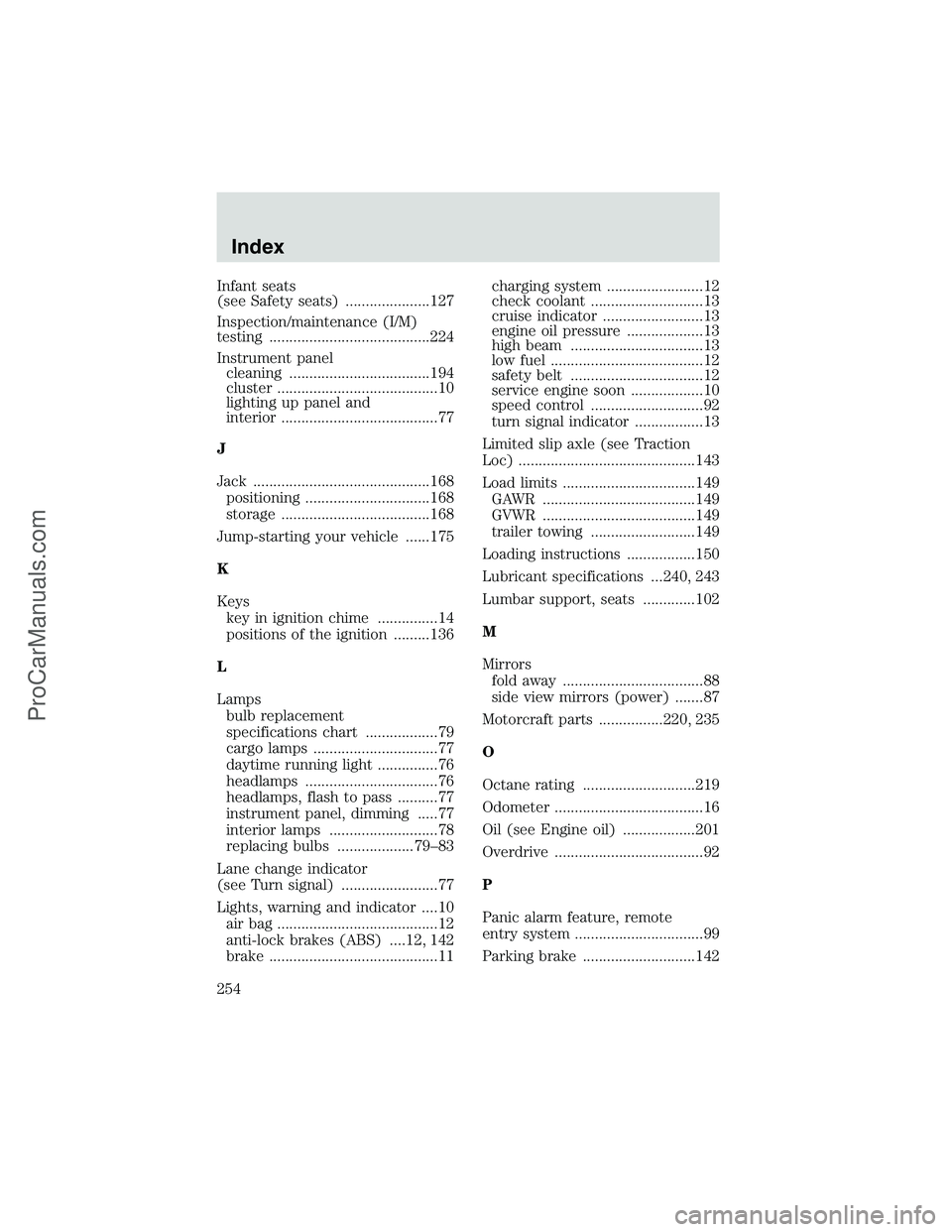
Infant seats
(see Safety seats) .....................127
Inspection/maintenance (I/M)
testing ........................................224
Instrument panel
cleaning ...................................194
cluster ........................................10
lighting up panel and
interior .......................................77
J
Jack ............................................168
positioning ...............................168
storage .....................................168
Jump-starting your vehicle ......175
K
Keys
key in ignition chime ...............14
positions of the ignition .........136
L
Lamps
bulb replacement
specifications chart ..................79
cargo lamps ...............................77
daytime running light ...............76
headlamps .................................76
headlamps, flash to pass ..........77
instrument panel, dimming .....77
interior lamps ...........................78
replacing bulbs ...................79–83
Lane change indicator
(see Turn signal) ........................77
Lights, warning and indicator ....10
air bag ........................................12
anti-lock brakes (ABS) ....12, 142
brake ..........................................11charging system ........................12
check coolant ............................13
cruise indicator .........................13
engine oil pressure ...................13
high beam .................................13
low fuel ......................................12
safety belt .................................12
service engine soon ..................10
speed control ............................92
turn signal indicator .................13
Limited slip axle (see Traction
Loc) ............................................143
Load limits .................................149
GAWR ......................................149
GVWR ......................................149
trailer towing ..........................149
Loading instructions .................150
Lubricant specifications ...240, 243
Lumbar support, seats .............102
M
Mirrors
fold away ...................................88
side view mirrors (power) .......87
Motorcraft parts ................220, 235
O
Octane rating ............................219
Odometer .....................................16
Oil (see Engine oil) ..................201
Overdrive .....................................92
P
Panic alarm feature, remote
entry system ................................99
Parking brake ............................142
Index
254
ProCarManuals.com