tire pressure FORD E-150 2004 User Guide
[x] Cancel search | Manufacturer: FORD, Model Year: 2004, Model line: E-150, Model: FORD E-150 2004Pages: 256, PDF Size: 2.42 MB
Page 226 of 256
5. Repeat this procedure for each tire, including the spare.
Note:Some spare tires require higher inflation pressure than the other
tires. Check the tire label on the B pillar or the edge of the driver’s door
for the recommended spare tire pressure.
6. Visually inspect the tires to make sure there are no nails or other
objects embedded that could poke a hole in the tire and cause an air
leak.
7. Check the sidewalls to make sure there are no gouges, cuts or bulges.
Tire inflation information
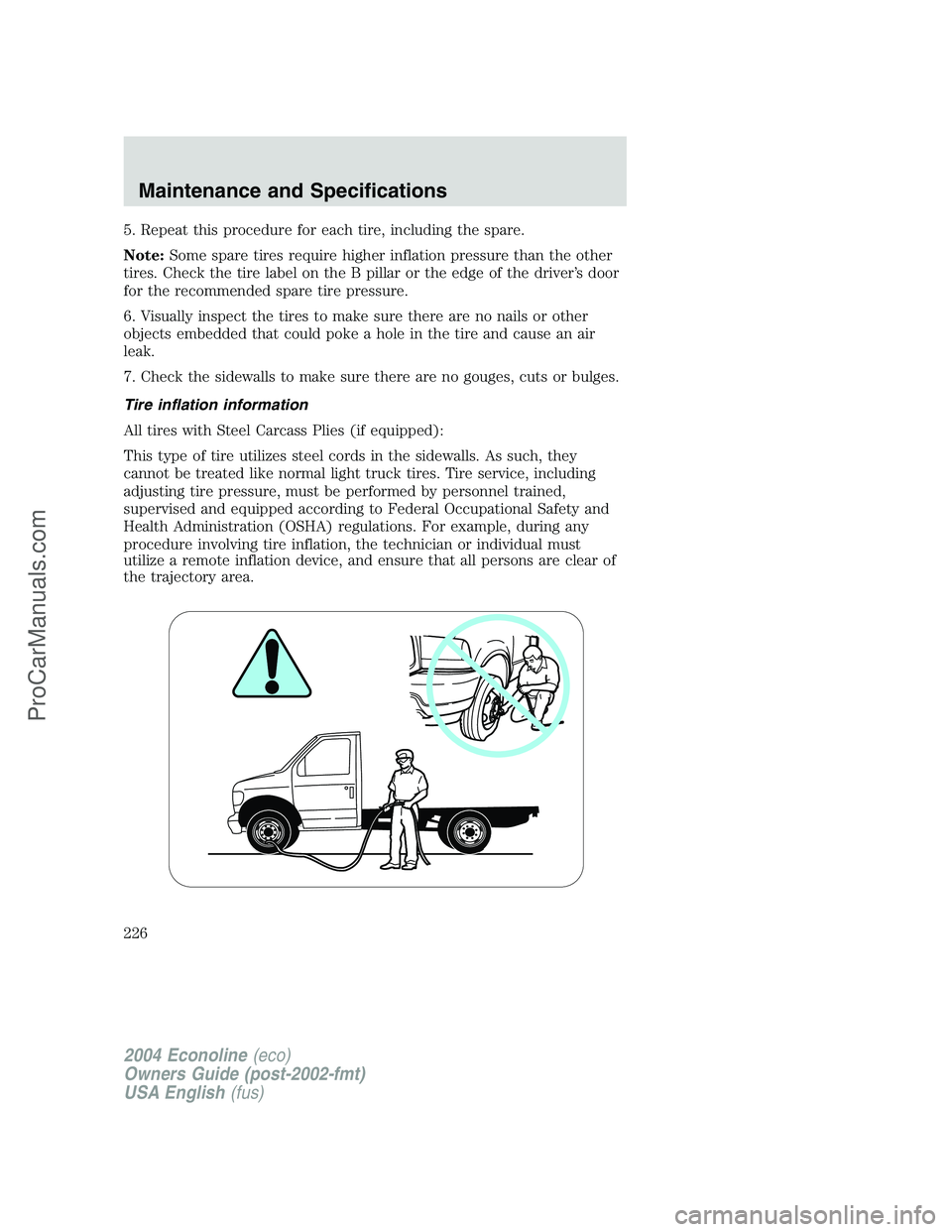
All tires with Steel Carcass Plies (if equipped):
This type of tire utilizes steel cords in the sidewalls. As such, they
cannot be treated like normal light truck tires. Tire service, including
adjusting tire pressure, must be performed by personnel trained,
supervised and equipped according to Federal Occupational Safety and
Health Administration (OSHA) regulations. For example, during any
procedure involving tire inflation, the technician or individual must
utilize a remote inflation device, and ensure that all persons are clear of
the trajectory area.
2004 Econoline(eco)
Owners Guide (post-2002-fmt)
USA English(fus)
Maintenance and Specifications
226
ProCarManuals.com
Page 229 of 256
Note:If your tires show uneven wear ask a qualified technician at a
Ford or Lincoln/Mercury dealership to check for and correct any wheel
misalignment, tire imbalance or mechanical problem involved before tire
rotation.
Note:Your vehicle may be equipped with a dissimilar spare tire/wheel. A
dissimilar spare tire/wheel is defined as a spare tire and/or wheel that is
different in brand, size or appearance from the road tires and wheels. If
you have a dissimilar spare tire/wheel it is intended for temporary use
only and should not be used in a tire rotation.
Note:After having your tires rotated, inflation pressure must be checked
and adjusted to the vehicle requirements.
Tire wear
Measure and inspect the tire tread on all your tires periodically.
Advanced and unusual tire wear can reduce the ability of tread to grip
the road in adverse (wet, snowy, etc.) conditions. Visually check your
tires for uneven wear, looking for high and low areas or unusually
smooth areas. Also check for signs of tire damage.
When the tread is worn down to
1/16th of an inch (2 mm), tires must
be replaced to prevent your vehicle
from skidding and hydroplaning.
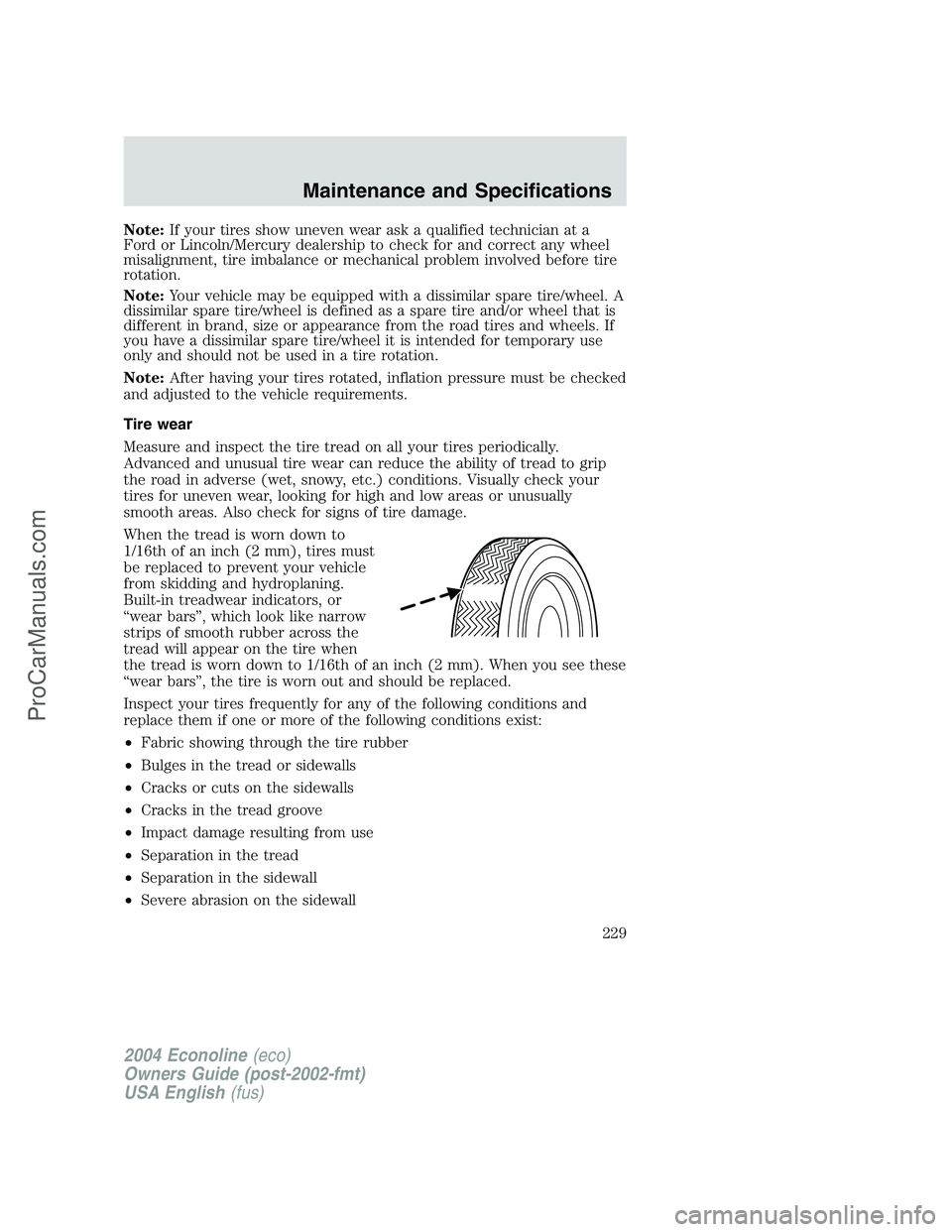
Built-in treadwear indicators, or
“wear bars”, which look like narrow
strips of smooth rubber across the
tread will appear on the tire when
the tread is worn down to 1/16th of an inch (2 mm). When you see these
“wear bars”, the tire is worn out and should be replaced.
Inspect your tires frequently for any of the following conditions and
replace them if one or more of the following conditions exist:
•Fabric showing through the tire rubber
•Bulges in the tread or sidewalls
•Cracks or cuts on the sidewalls
•Cracks in the tread groove
•Impact damage resulting from use
•Separation in the tread
•Separation in the sidewall
•Severe abrasion on the sidewall
2004 Econoline(eco)
Owners Guide (post-2002-fmt)
USA English(fus)
Maintenance and Specifications
229
ProCarManuals.com
Page 255 of 256
safety belt maintenance ...........95
warning light and chime ..........91
Safety seats for children ..........104
Seat belts
(see Safety restraints) ...............86
Seats ............................................80
child safety seats ....................104
front seats .................................80
Servicing your vehicle ..............188
Setting the clock
AM/FM stereo ...........................19
AM/FM/CD .................................23
AM/FM/In-dash 6 CD ................27
AM/FM/Tape ..............................20
Spare tire (see
Changing the Tire) ...................158
Spark plugs,
specifications .............232, 241–242
Special notice
ambulance conversions ..............8
diesel-powered vehicles .............7
utility-type vehicles ....................7
Specification chart,
lubricants ...........................238, 241
Speed control ..............................72
Starting your
vehicle ........................116–117, 119
jump starting ..........................166
Steering wheel
tilting .........................................66
T
Temperature control
(see Climate control) ...........52, 54
Tilt steering wheel ......................66
Tires ...................................217–219alignment ................................227
care ..........................................224
changing ..........................158–159
checking the pressure ............224
label .........................................224
replacing ..........................162, 230
rotating ....................................227
safety practices .......................230
sidewall information ...............220
snow tires and chains ............231
spare tire .................................157
terminology .............................219
tire grades ...............................218
treadwear ........................218, 229
Towing .......................................133
recreational towing .................145
trailer towing ..........................133
wrecker ....................................172
Traction-lok rear axle ...............122
Transmission .............................123
brake-shift interlock (BSI) ....123
fluid, checking and adding
(automatic) .............................213
fluid, refill capacities ..............233
lubricant specifications ..238, 241
Turn signal ..................................59
V
Vehicle dimensions ...................242
Vehicle Identification Number
(VIN) ..........................................245
Vehicle loading ..........................130
Ventilating your vehicle ...........119
W
Warning lights (see Lights) .......12
Washer fluid ..............................191
Water, Driving through .............129
2004 Econoline(eco)
Owners Guide (post-2002-fmt)
USA English(fus)
Index
255
ProCarManuals.com