light FORD E-150 2004 Repair Manual
[x] Cancel search | Manufacturer: FORD, Model Year: 2004, Model line: E-150, Model: FORD E-150 2004Pages: 256, PDF Size: 2.42 MB
Page 210 of 256
applicable exhaust emission standards. To make sure that the catalytic
converter and other emission control components continue to work
properly:
•Use only the specified fuel listed.
•Avoid running out of fuel.
•Do not turn off the ignition while your vehicle is moving, especially at
high speeds.
•Have the items listed in yourScheduled Maintenance Guide
performed according to the specified schedule.
The scheduled maintenance items listed in theScheduled Maintenance
Guideare essential to the life and performance of your vehicle and to its
emissions system.
If other than Ford, Motorcraft or Ford-authorized parts are used for
maintenance replacements or for service of components affecting
emission control, such non-Ford parts should be equivalent to genuine
Ford Motor Company parts in performance and durability.
Do not park, idle, or drive your vehicle in dry grass or other dry
ground cover. The emission system heats up the engine
compartment and exhaust system, which can start a fire.
Illumination of the
indicator, charging system warning light, fluid
leaks, strange odors, smoke or loss of engine power, could indicate that
the emission control system is not working properly.
Exhaust leaks may result in entry of harmful and potentially
lethal fumes into the passenger compartment.
Do not make any unauthorized changes to your vehicle or engine. By
law, vehicle owners and anyone who manufactures, repairs, services,
sells, leases, trades vehicles, or supervises a fleet of vehicles are not
permitted to intentionally remove an emission control device or prevent
it from working. Information about your vehicle’s emission system is on
the Vehicle Emission Control Information Decal located on or near the
engine. This decal identifies engine displacement and gives some tune up
specifications.
Please consult yourWarranty Guidefor complete emission warranty
information.
2004 Econoline(eco)
Owners Guide (post-2002-fmt)
USA English(fus)
Maintenance and Specifications
210
ProCarManuals.com
Page 211 of 256
On board diagnostics (OBD-II)
Your vehicle is equipped with a computer that monitors the engine’s
emission control system. This system is commonly known as the On
Board Diagnostics System (OBD-II). This OBD-II system protects the
environment by ensuring that your vehicle continues to meet
government emission standards. The OBD-II system also assists the
service technician in properly servicing your vehicle. When theCheck
engine/Service engine soonlight illuminates, the OBD-II system has
detected a malfunction. Temporary malfunctions may cause yourCheck
engine/Service engine soonlight to illuminate. Examples are:
1. The vehicle has run out of fuel. (The engine may misfire or run
poorly.)
2. Poor fuel quality or water in the fuel.
3. The fuel cap may not have been securely tightened.
These temporary malfunctions can be corrected by filling the fuel tank
with good quality fuel and/or properly tightening the fuel cap. After three
driving cycles without these or any other temporary malfunctions
present, theCheck engine/Service engine soonlight should turn off. (A
driving cycle consists of a cold engine startup followed by mixed
city/highway driving.) No additional vehicle service is required.
If theCheck engine/Service engine soonlight remains on, have your
vehicle serviced at the first available opportunity.
Readiness for Inspection/Maintenance (I/M) testing
In some localities, it may be a legal requirement to pass an I/M test of
the on-board diagnostics system. If yourCheck engine/Service engine
soonlight is on, refer to the description in theWarning lights and
chimessection of theInstrument Clusterchapter. Your vehicle may not
pass the I/M test with theCheck engine/Service engine soonlight on.
If the vehicle’s powertrain system or its battery has just been serviced,
the on-board diagnostics system is reset to a“not ready for I/M test”
condition. To ready the on-board diagnostics system for I/M testing, a
minimum of 30 minutes of city and highway driving is necessary as
described below:
•First, at least 10 minutes of driving on an expressway or highway.
•Next, at least 20 minutes driving in stop-and-go, city-type traffic with
at least four idle periods.
Allow the vehicle to sit for at least eight hours without starting the
engine. Then, start the engine and complete the above driving cycle. The
2004 Econoline(eco)
Owners Guide (post-2002-fmt)
USA English(fus)
Maintenance and Specifications
211
ProCarManuals.com
Page 220 of 256
INFORMATION CONTAINED ON THE TIRE SIDEWALL
Federal law requires tire manufacturers to place standardized
information on the sidewall of all tires. This information identifies and
describes the fundamental characteristics of the tire and also provides a
U.S. DOT Tire Identification Number for safety standard certification and
in case of a recall.
Information on“P”type tires
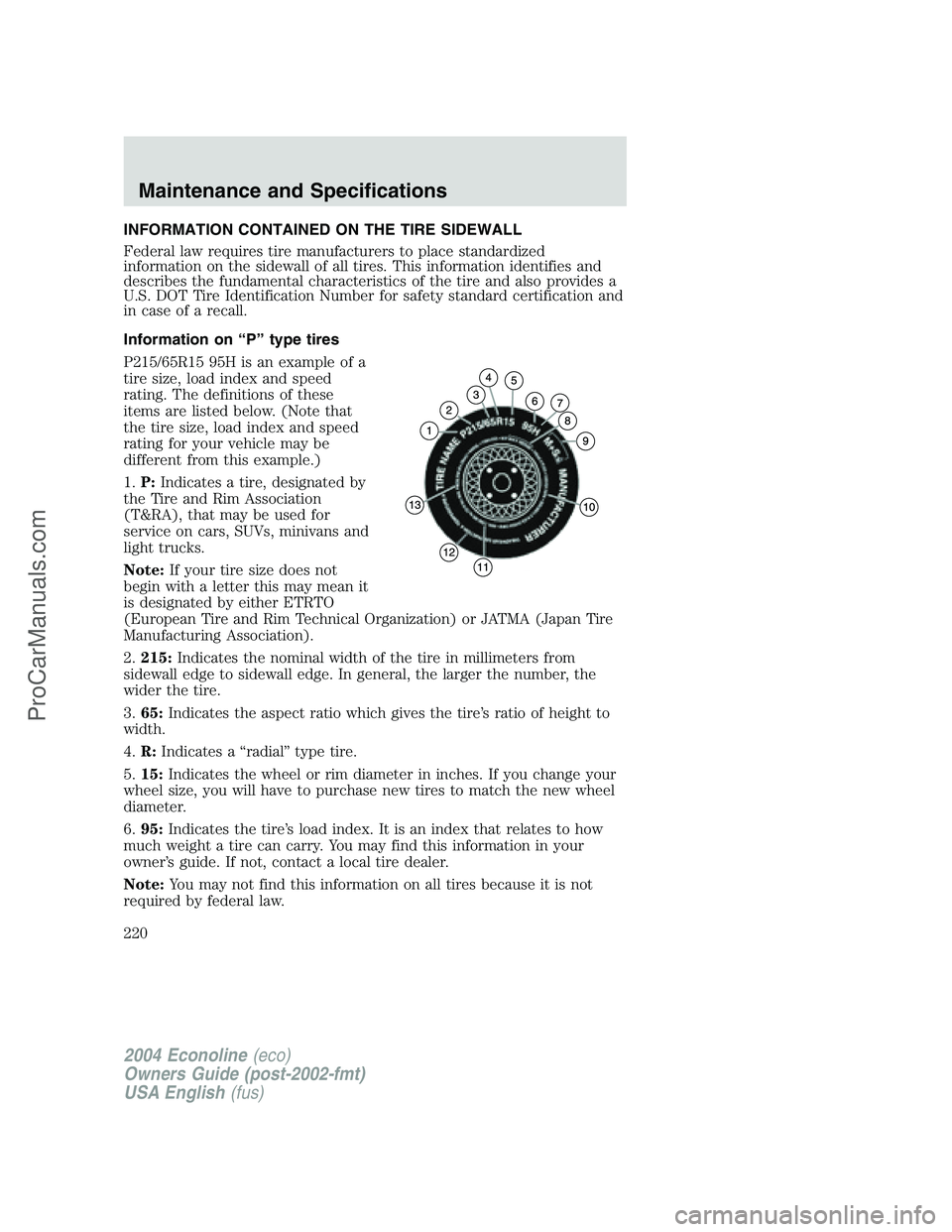
P215/65R15 95H is an example of a
tire size, load index and speed
rating. The definitions of these
items are listed below. (Note that
the tire size, load index and speed
rating for your vehicle may be
different from this example.)
1.P:Indicates a tire, designated by
the Tire and Rim Association
(T&RA), that may be used for
service on cars, SUVs, minivans and
light trucks.
Note:If your tire size does not
begin with a letter this may mean it
is designated by either ETRTO
(European Tire and Rim Technical Organization) or JATMA (Japan Tire
Manufacturing Association).
2.215:Indicates the nominal width of the tire in millimeters from
sidewall edge to sidewall edge. In general, the larger the number, the
wider the tire.
3.65:Indicates the aspect ratio which gives the tire’s ratio of height to
width.
4.R:Indicates a“radial”type tire.
5.15:Indicates the wheel or rim diameter in inches. If you change your
wheel size, you will have to purchase new tires to match the new wheel
diameter.
6.95:Indicates the tire’s load index. It is an index that relates to how
much weight a tire can carry. You may find this information in your
owner’s guide. If not, contact a local tire dealer.
Note:You may not find this information on all tires because it is not
required by federal law.
2004 Econoline(eco)
Owners Guide (post-2002-fmt)
USA English(fus)
Maintenance and Specifications
220
ProCarManuals.com
Page 223 of 256
Additional information contained on the tire sidewall for“LT”type
tires
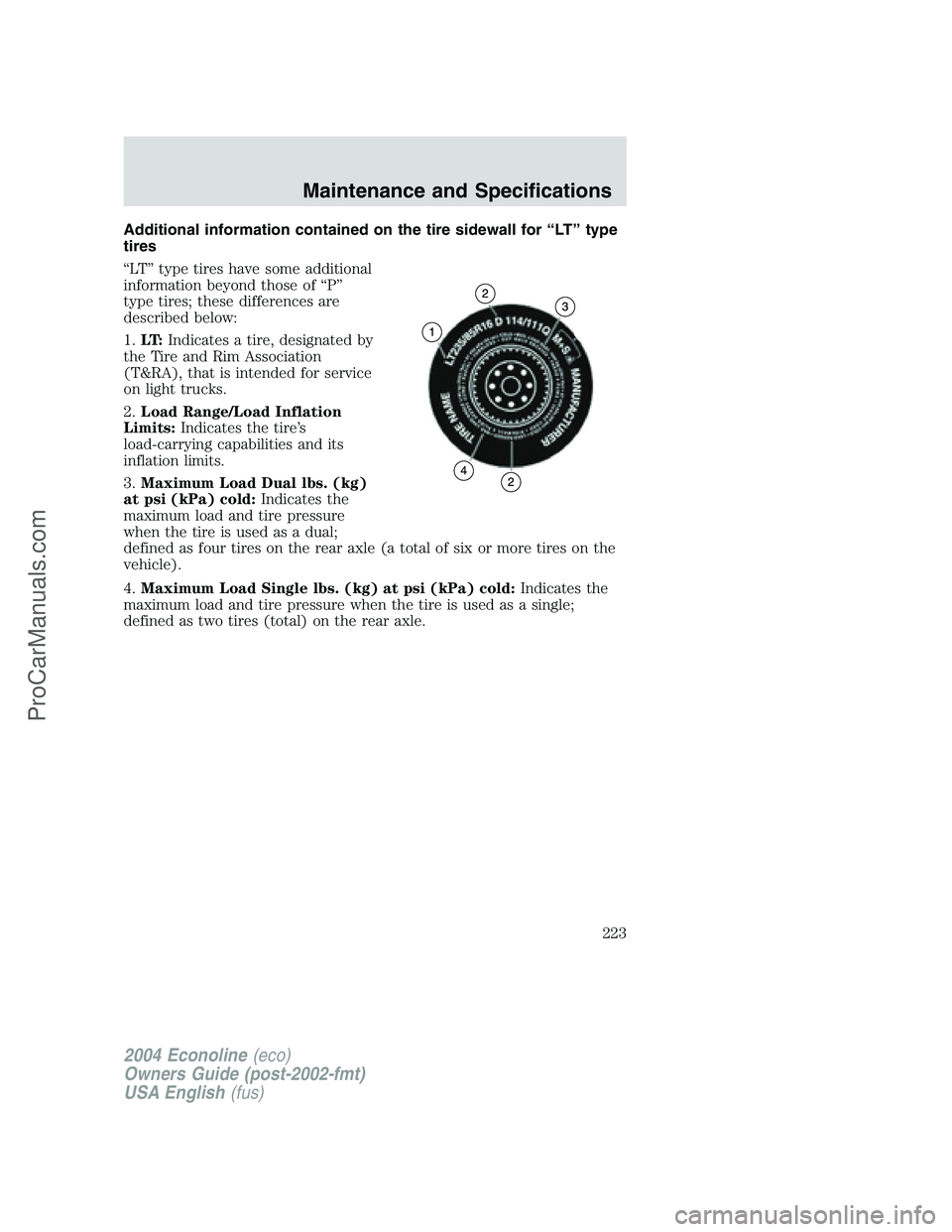
“LT”type tires have some additional
information beyond those of“P”
type tires; these differences are
described below:
1.LT:Indicates a tire, designated by
the Tire and Rim Association
(T&RA), that is intended for service
on light trucks.
2.Load Range/Load Inflation
Limits:Indicates the tire’s
load-carrying capabilities and its
inflation limits.
3.Maximum Load Dual lbs. (kg)
at psi (kPa) cold:Indicates the
maximum load and tire pressure
when the tire is used as a dual;
defined as four tires on the rear axle (a total of six or more tires on the
vehicle).
4.Maximum Load Single lbs. (kg) at psi (kPa) cold:Indicates the
maximum load and tire pressure when the tire is used as a single;
defined as two tires (total) on the rear axle.
2004 Econoline(eco)
Owners Guide (post-2002-fmt)
USA English(fus)
Maintenance and Specifications
223
ProCarManuals.com
Page 224 of 256
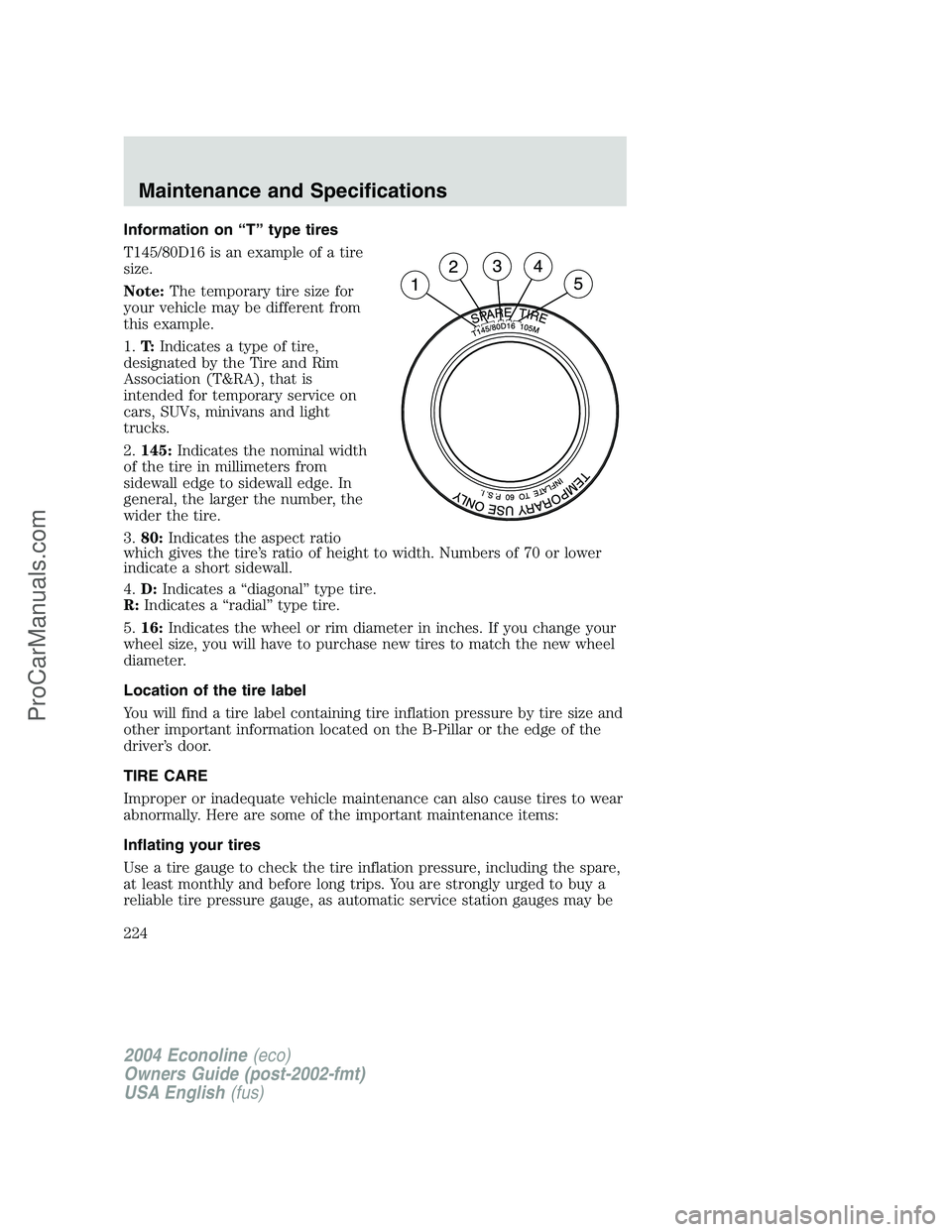
Information on“T”type tires
T145/80D16 is an example of a tire
size.
Note:The temporary tire size for
your vehicle may be different from
this example.
1.T:Indicates a type of tire,
designated by the Tire and Rim
Association (T&RA), that is
intended for temporary service on
cars, SUVs, minivans and light
trucks.
2.145:Indicates the nominal width
of the tire in millimeters from
sidewall edge to sidewall edge. In
general, the larger the number, the
wider the tire.
3.80:Indicates the aspect ratio
which gives the tire’s ratio of height to width. Numbers of 70 or lower
indicate a short sidewall.
4.D:Indicates a“diagonal”type tire.
R:Indicates a“radial”type tire.
5.16:Indicates the wheel or rim diameter in inches. If you change your
wheel size, you will have to purchase new tires to match the new wheel
diameter.
Location of the tire label
You will find a tire label containing tire inflation pressure by tire size and
other important information located on the B-Pillar or the edge of the
driver’s door.
TIRE CARE
Improper or inadequate vehicle maintenance can also cause tires to wear
abnormally. Here are some of the important maintenance items:
Inflating your tires
Use a tire gauge to check the tire inflation pressure, including the spare,
at least monthly and before long trips. You are strongly urged to buy a
reliable tire pressure gauge, as automatic service station gauges may be
2004 Econoline(eco)
Owners Guide (post-2002-fmt)
USA English(fus)
Maintenance and Specifications
224
ProCarManuals.com
Page 226 of 256
5. Repeat this procedure for each tire, including the spare.
Note:Some spare tires require higher inflation pressure than the other
tires. Check the tire label on the B pillar or the edge of the driver’s door
for the recommended spare tire pressure.
6. Visually inspect the tires to make sure there are no nails or other
objects embedded that could poke a hole in the tire and cause an air
leak.
7. Check the sidewalls to make sure there are no gouges, cuts or bulges.
Tire inflation information
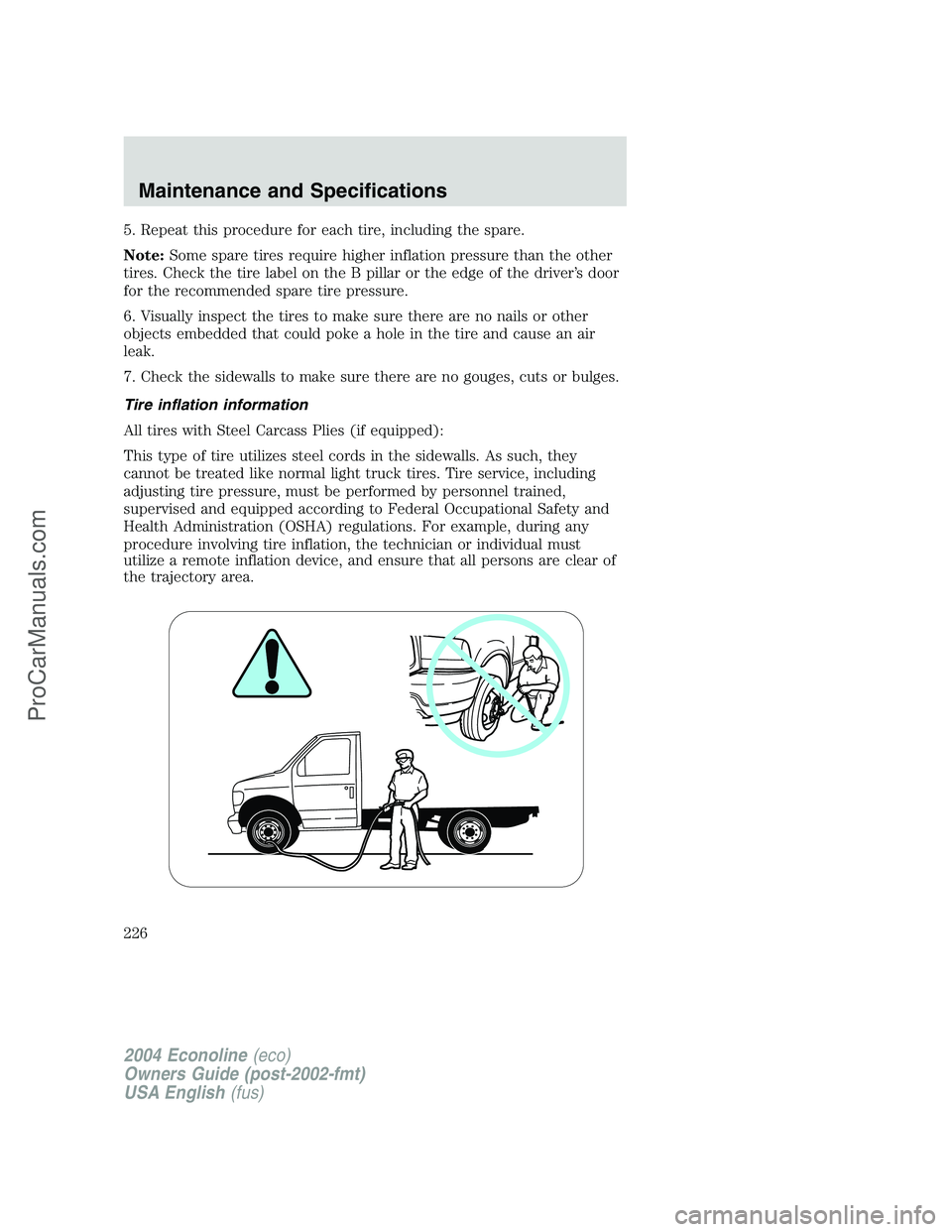
All tires with Steel Carcass Plies (if equipped):
This type of tire utilizes steel cords in the sidewalls. As such, they
cannot be treated like normal light truck tires. Tire service, including
adjusting tire pressure, must be performed by personnel trained,
supervised and equipped according to Federal Occupational Safety and
Health Administration (OSHA) regulations. For example, during any
procedure involving tire inflation, the technician or individual must
utilize a remote inflation device, and ensure that all persons are clear of
the trajectory area.
2004 Econoline(eco)
Owners Guide (post-2002-fmt)
USA English(fus)
Maintenance and Specifications
226
ProCarManuals.com
Page 248 of 256
GENUINE FORD ACCESSORIES FOR YOUR VEHICLE
A wide selection of Genuine Ford Accessories are available for your
vehicle through your local authorized Ford or Ford of Canada dealer.
These quality accessories have been specifically engineered to fulfill your
automotive needs; they are custom designed to complement the style
and aerodynamic appearance of your vehicle. In addition, each accessory
is made from high quality materials and meets or exceeds Ford’s rigorous
engineering and safety specifications. Ford Motor Company will repair or
replace any properly dealer-installed Genuine Ford Accessory found to
be defective in factory-supplied materials or workmanship during the
warranty period, as well as any component damaged by the defective
accessory. The accessory will be warranted for whichever provides you
the greatest benefit:
•12 months or 12,000 miles (20,000 km) (whichever occurs first), or
•the remainder of your new vehicle limited warranty.
This means that Genuine Ford Accessories purchased along with your
new vehicle and installed by the dealer are covered for the full length of
your New Vehicle’s Limited Warranty—3 years or 36,000 miles (60,000 km)(whichever occurs first). Contact your dealer for details and a copy of
the warranty.
Not all accessories are available for all models.
The following is a list of several Genuine Ford Accessory products for
your vehicle. Not all accessories are available for all models. For a
complete listing of the accessories that are available for your vehicle,
please contact your dealer or visit our online store at:
www.fordaccessoriesstore.com.
Exterior style
Bug shields
Deflectors
Exterior trim
Fender flares
Front end covers
Grille inserts
Headlamps, taillamps, fog lights and Daytime Running Lamps (DRLs)
Running boards
Sliding rear windows - manual and power
2004 Econoline(eco)
Owners Guide (post-2002-fmt)
USA English(fus)
Accessories
Accessories
248
ProCarManuals.com
Page 251 of 256
A
Accessory delay ..........................70
Air bag supplemental
restraint system ..................96, 101
and child safety seats ..............98
description ........................96, 101
disposal ....................................100
driver air bag ............................98
indicator light .........................100
operation ...................................98
passenger air bag .....................98
Air cleaner filter .......216–217, 232
Ambulance packages ....................8
Antifreeze
(see Engine coolant) ................196
Anti-lock brake system
(see Brakes) ..............................120
Audio system
(see Radio) ................18, 20, 22, 25
Automatic transmission
driving an automatic
overdrive .........................124, 127
fluid, adding ............................213
fluid, checking ........................213
fluid, refill capacities ..............233
fluid, specification ..................241
Auxiliary power point .................69
Axle
lubricant specifications ..238, 241
refill capacities ........................233
traction lok ..............................122
B
Battery .......................................194
acid, treating emergencies .....194
jumping a disabled battery ....166
maintenance-free ....................194replacement, specifications ...232
servicing ..................................194
BeltMinder ...................................91
Brakes ........................................120
anti-lock ...................................120
anti-lock brake system
(ABS) warning light ...............120
fluid, checking and adding ....213
fluid, refill capacities ..............233
fluid, specifications .........238, 241
lubricant specifications ..238, 241
parking ....................................121
shift interlock ..........................123
Break-in period .............................5
Bulbs ............................................60
C
Calculating load ........................133
Capacities for refilling fluids ....233
Cell phone use ............................69
Child safety restraints ..............102
child safety belts ....................102
Child safety seats ......................104
in front seat ............................106
in rear seat ..............................106
tether anchorage hardware ...108
Cleaning your vehicle
engine compartment ..............183
exterior ....................................186
instrument panel ....................185
interior .....................................185
interior trim ............................185
plastic parts ............................184
safety belts ..............................185
washing ....................................182
waxing .....................................182
wheels ......................................183
wiper blades ............................184
2004 Econoline(eco)
Owners Guide (post-2002-fmt)
USA English(fus)
Index
Index
251
ProCarManuals.com
Page 253 of 256
refill capacities ........................233
specifications ..................238, 241
Exhaust fumes ..........................119
F
Fail safe cooling ........................201
Fluid capacities .........................233
Four-Wheel Drive vehicles
preparing to drive your
vehicle .....................................122
Fuel ............................................202
calculating fuel economy .......206
cap ...........................................204
capacity ...................................233
choosing the right fuel ...........205
comparisons with EPA fuel
economy estimates .................209
detergent in fuel .....................206
filling your vehicle
with fuel ..................202, 204, 207
filter, specifications ........206, 232
fuel pump shut-off switch .....147
improving fuel economy ........206
octane rating ...........205, 241–242
quality ......................................205
running out of fuel .................206
safety information relating to
automotive fuels .....................202
Fuses ..........................................149
G
Garage door opener ....................66
Gas cap (see Fuel cap) ............204
Gas mileage
(see Fuel economy) .................206
Gauges .........................................15GAWR (Gross Axle Weight
Rating)
calculating ...............................133
GVWR (Gross Vehicle Weight
Rating)
calculating ...............................133
H
Hazard flashers .........................147
Headlamps ...................................55
bulb specifications ....................60
daytime running lights .............55
flash to pass ..............................56
high beam .................................56
replacing bulbs ...................61–62
turning on and off ....................55
Heating
heater only system .............52, 54
heating and air conditioning
system .......................................53
Hood ..........................................189
I
Ignition .......................116, 241–242
Infant seats
(see Safety seats) .....................104
Inspection/maintenance
(I/M) testing ..............................211
Instrument panel
cleaning ...................................185
cluster ........................................12
lighting up panel and
interior .......................................56
J
Jump-starting your vehicle ......166
2004 Econoline(eco)
Owners Guide (post-2002-fmt)
USA English(fus)
Index
253
ProCarManuals.com
Page 254 of 256
K
Keys
positions of the ignition .........116
L
Lamps
bulb replacement
specifications chart ..................60
daytime running light ...............55
headlamps .................................55
headlamps, flash to pass ..........56
instrument panel, dimming .....56
interior lamps ...........................59
replacing bulbs ...................60–64
Lane change indicator
(see Turn signal) ........................59
Lights, warning and indicator ....12
anti-lock brakes (ABS) ..........120
Load limits .................................130
Loading instructions .................133
Lubricant specifications ...238, 241
Lug nuts ....................................165
Lumbar support, seats ...............81
M
Mirrors
fold away ...................................71
side view mirrors (power) .......70
Motorcraft parts ................206, 232
O
Octane rating ............................205
Oil (see Engine oil) ..................191
P
Parking brake ............................121Parts (see Motorcraft parts) ....232
Power distribution box
(see Fuses) ...............................153
Power door locks ........................75
Power mirrors .............................70
Power point .................................69
Power steering ..........................121
fluid, checking and adding ....212
fluid, refill capacity ................233
fluid, specifications .........238, 241
Power Windows ...........................70
Preparing to drive
your vehicle ...............................122
R
Radio ..........................18, 20, 22, 25
Rear seat entertainment
system ..........................................30
Relays ................................149, 156
Remote entry system
illuminated entry ................55, 79
locking/unlocking doors ...........75
Roadside assistance ..................146
S
Safety Belt Maintenance ............95
Safety belts (see
Safety restraints) ............86–88, 90
Safety defects, reporting ..........181
Safety restraints ....................86–90
belt minder ...............................91
extension assembly ..................95
for adults .............................87–88
for children .....................100, 102
lap belt ......................................90
2004 Econoline(eco)
Owners Guide (post-2002-fmt)
USA English(fus)
Index
254
ProCarManuals.com