ignition FORD E-150 2008 Workshop Manual
[x] Cancel search | Manufacturer: FORD, Model Year: 2008, Model line: E-150, Model: FORD E-150 2008Pages: 285, PDF Size: 2.81 MB
Page 259 of 285
•Adding certain accessories to your vehicle (for example bug
deflectors, rollbars/light bars, running boards, ski/luggage racks) may
reduce fuel economy.
•Using fuel blended with alcohol may lower fuel economy.
•Fuel economy may decrease with lower temperatures during the first
8–10 miles (12–16 km) of driving.
•Driving on flat terrain offers improved fuel economy as compared to
driving on hilly terrain.
•Transmissions give their best fuel economy when operated in the top
cruise gear and with steady pressure on the gas pedal.
•Close windows for high speed driving.
EPA fuel economy estimates
Every new vehicle should have a window sticker containing EPA fuel
economy estimates. Contact your authorized dealer if the window sticker
is not supplied with your vehicle. The EPA fuel economy estimates
should be your guide for the fuel economy comparisons with other
vehicles. Your fuel economy may vary depending upon the method of
operation and conditions.
Note:Vehicles over 8,500 GVW (Gross Vehicle Weight) will not have fuel
economy information printed on the EPA window sticker.
EMISSION CONTROL SYSTEM
Your vehicle is equipped with various emission control components and a
catalytic converter which will enable your vehicle to comply with applicable
exhaust emission standards. To make sure that the catalytic converter and
other emission control components continue to work properly:
•Use only the specified fuel listed.
•Avoid running out of fuel.
•Do not turn off the ignition while your vehicle is moving, especially at
high speeds.
•Have the items listed inscheduled maintenance information
performed according to the specified schedule.
The scheduled maintenance items listed inscheduled maintenance
informationare essential to the life and performance of your vehicle
and to its emissions system.
If other than Ford, Motorcraft or Ford-authorized parts are used for
maintenance replacements or for service of components affecting
emission control, such non-Ford parts should be equivalent to genuine
Ford Motor Company parts in performance and durability.
2008 Econoline(eco)
Owners Guide (post-2002-fmt)
USA(fus)
Maintenance and Specifications
259
ProCarManuals.com
Page 261 of 285
These temporary malfunctions can be corrected by filling the fuel tank
with good quality fuel, properly tightening the fuel cap or letting the
electrical system dry out. After three driving cycles without these or any
other temporary malfunctions present, theService engine soon
indicator should stay off the next time the engine is started. A driving
cycle consists of a cold engine startup followed by mixed city/highway
driving. No additional vehicle service is required.
If theService engine soon
indicator remains on, have your vehicle
serviced at the first available opportunity. Although some malfunctions
detected by the OBD-II may not have symptoms that are apparent,
continued driving with theService engine soon
indicator on can
result in increased emissions, lower fuel economy, reduced engine and
transmission smoothness, and lead to more costly repairs.
Readiness for Inspection/Maintenance (I/M) testing
Some state/provincial and local governments may have
Inspection/Maintenance (I/M) programs to inspect the emission control
equipment on your vehicle. Failure to pass this inspection could prevent
you from getting a vehicle registration. Your vehicle may not pass the I/M
test if theService engine soon
indicator is on or not working
properly (bulb is burned out), or if the OBD-II system has determined
that some of the emission control systems have not been properly
checked. In this case, the vehicle is considered not ready for I/M testing.
If theService engine soon
indicator is on or the bulb does not
work, the vehicle may need to be serviced. Refer to the On board
diagnostics (OBD-II) description in this chapter.
If the vehicle’s engine or transmission has just been serviced, or the
battery has recently run down or been replaced, the OBD-II system may
indicate that the vehicle is not ready for I/M testing. To determine if the
vehicle is ready for I/M testing, turn the ignition key to the on position
for 15 seconds without cranking the engine. If theService engine
soon
indicator blinks eight times, it means that the vehicle is not
ready for I/M testing; if theService engine soon
indicator stays on
solid, it means that the vehicle is ready for I/M testing.
The OBD-II system is designed to check the emission control system
during normal driving. A complete check may take several days. If the
vehicle is not ready for I/M testing, the following driving cycle consisting
of mixed city and highway driving may be performed:
15 minutes of steady driving on an expressway/highway followed by
20 minutes of stop-and-go driving with at least four 30-second idle periods.
2008 Econoline(eco)
Owners Guide (post-2002-fmt)
USA(fus)
Maintenance and Specifications
261
ProCarManuals.com
Page 274 of 285
ENGINE DATA
Engine14.6L V8 engine 5.4L V8 engine 6.8L V10 engine
Cubic inches 281 330 415
Required fuel87 octane or
(E-85)
287 octane 87 octane
Firing order 1-3-7-2-6-5-4-8 1-3-7-2-6-5-4-8 1-6-5-10-2-7-3-8-4-9
Ignition
systemCoil on plug Coil on plug Coil on plug
Spark plug gap0.052–0.056 inch
(1.32–1.42mm)0.052–0.056 inch
(1.32–1.42mm)0.052–0.056 inch
(1.32–1.42mm)
Compression
ratio9.4:1 9.0:1 9.0:1
1Refer to the6.0 and 6.4 Liter Power Stroke Direct Injection Turbo
Diesel Owner’s Guide Supplementfor diesel engine information.
24.6L V8 FFV engines only.
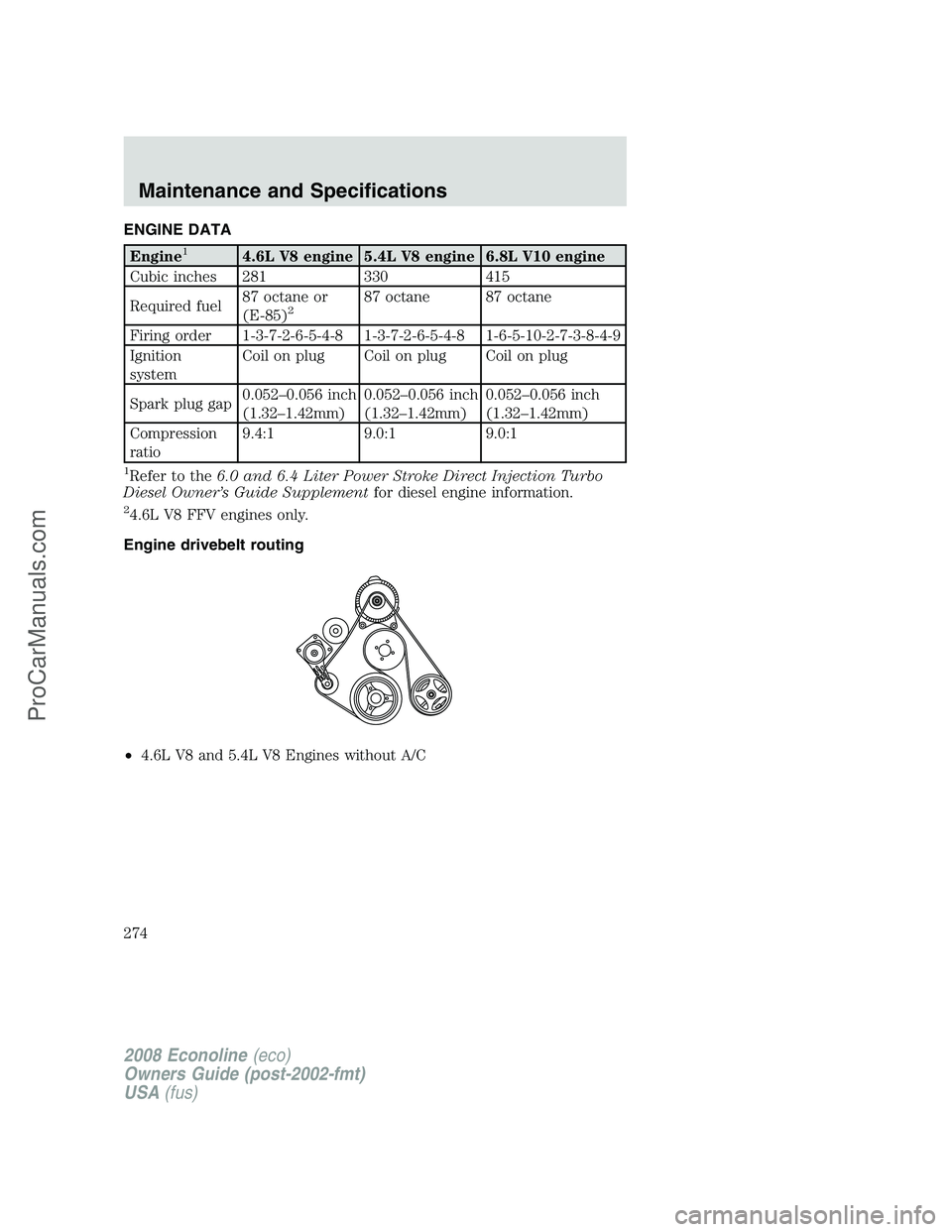
Engine drivebelt routing
•4.6L V8 and 5.4L V8 Engines without A/C
2008 Econoline(eco)
Owners Guide (post-2002-fmt)
USA(fus)
Maintenance and Specifications
274
ProCarManuals.com
Page 282 of 285
Flexible Fuel Vehicle (FFV) ....249
Fluid capacities .........................271
Four-Wheel Drive vehicles
preparing to drive your
vehicle .....................................174
Fuel ............................................249
calculating fuel economy .......256
cap ...........................................252
capacity ...................................271
choosing the right fuel ...........254
comparisons with EPA fuel
economy estimates .................259
detergent in fuel .....................254
filling your vehicle with
fuel ...........................249, 252, 256
filter, specifications ........249, 270
fuel pump shut-off switch .....191
improving fuel economy ........256
octane rating ...................254, 274
quality ......................................255
running out of fuel .................256
safety information relating to
automotive fuels .....................249
Fuel - flex fuel vehicle
(FFV) .................................249, 254
Fuses ..................................192–193
G
Garage door opener ....................49
Gas cap (see Fuel cap) ............252
Gas mileage
(see Fuel economy) .................256
Gauges .........................................17
H
Hazard flashers .........................190
Headlamps ...................................35aiming ........................................38
bulb specifications ....................41
daytime running lights .............36
flash to pass ..............................36
high beam .................................36
replacing bulbs .........................42
turning on and off ....................35
Heating
heater only system .............32, 34
heating and air conditioning
system .......................................33
Hood ..........................................234
I
Ignition ...............................162, 274
Illuminated visor mirror .............48
Infant seats
(see Safety seats) .....................101
Inspection/maintenance (I/M)
testing ........................................261
Instrument panel
cleaning ...................................230
cluster ........................................12
lighting up panel and
interior .......................................37
J
Jack ............................................200
positioning ...............................200
storage .....................................200
Jump-starting your vehicle ......210
K
Keyless entry system
autolock .....................................58
Keys .............................................68
positions of the ignition .........162
2008 Econoline(eco)
Owners Guide (post-2002-fmt)
USA(fus)
Index
282
ProCarManuals.com