air condition FORD E-250 2004 User Guide
[x] Cancel search | Manufacturer: FORD, Model Year: 2004, Model line: E-250, Model: FORD E-250 2004Pages: 256, PDF Size: 2.42 MB
Page 129 of 256
Forced downshifts
•Allowed in D (Drive) with Overdrive or D (Drive) without Overdrive.
•Depress the accelerator to the floor.
•Allows transmission to select an appropriate gear.
DRIVING THROUGH WATER
If driving through deep or standing water is unavoidable, proceed very
slowly especially when the depth is not known. Never drive through
water that is higher than the bottom of the hubs (for trucks) or the
bottom of the wheel rims (for cars). When driving through water,
traction or brake capability may be limited. Also, water may enter your
engine’s air intake and severely damage your engine or your vehicle may
stall.Driving through deep water where the transmission vent
tube is submerged may allow water into the transmission and
cause internal transmission damage.
Once through the water, always dry the brakes by moving your
vehicle slowly while applying light pressure on the brake pedal.
Wet brakes do not stop the vehicle as quickly as dry brakes.
EMERGENCY MANEUVERS
•In an unavoidable emergency situation where a sudden sharp turn
must be made, remember to avoid“over-driving”your vehicle, i.e.,
turn the steering wheel only as rapidly and as far as required to avoid
the emergency. Excessive steering will result in less vehicle control,
not more. Additionally, smooth variations of the accelerator and/or
brake pedal pressure should be utilized if changes in vehicle speed are
called for. Avoid abrupt steering, acceleration or braking which could
result in an increased risk of loss of vehicle control, vehicle rollover
and/or personal injury. Use all available road surface to return the
vehicle to a safe direction of travel.
•In the event of an emergency stop, avoid skidding the tires and do not
attempt any sharp steering wheel movements.
Vehicles with a higher center of gravity such as utility and
four-wheel drive vehicles handle differently than vehicles with a
lower center of gravity. Utility and four-wheel drive vehicles arenot
designed for cornering at speeds as high as passenger cars any more
than low-slung sports cars are designed to perform satisfactorily under
off-road conditions. Avoid sharp turns, excessive speed and abrupt
maneuvers in these vehicles. Failure to drive cautiously could result in
an increased risk of loss of vehicle control, vehicle rollover, personal
injury and death.
2004 Econoline(eco)
Owners Guide (post-2002-fmt)
USA English(fus)
Driving
129
ProCarManuals.com
Page 144 of 256
•Allow more distance for stopping with a trailer attached.
•The trailer tongue weight should be 10–15% of the loaded trailer
weight.
•If you will be towing a trailer frequently in hot weather, hilly
conditions, at GCW, or any combination of these factors, consider
refilling your rear axle with synthetic gear lube. Refer to the
Maintenance and specificationschapter for the lubricant
specification.
•Do not tow a trailer for the first 500 miles (800 km) after changing
the rear axle lube
•Do not exceed 50 mph (80 km/h) for the first 500 miles (800 km) of
towing and do not perform and fast accelerations from a stop during
this time.
•After you have traveled 50 miles (80 km), thoroughly check your
hitch, electrical connections and trailer wheel lug nuts.
•When stopped in traffic for long periods of time in hot weather, place
the gearshift in P (Park) and increase idle speed. This aids engine
cooling and air conditioner efficiency.
•Vehicles with trailers should not be parked on a grade. If you must
park on a grade, place wheel chocks under the trailer’s wheels.
Launching or retrieving a boat
Disconnect the wiring to the trailer before backing the trailer
into the water. Reconnect the wiring to the trailer after the
trailer is removed from the water.
When backing down a ramp during boat launching or retrieval:
•do not allow the static water level to rise above the bottom edge of
the rear bumper.
•do not allow waves to break higher than 6 inches (15 cm) above the
bottom edge of the rear bumper.
Exceeding these limits may allow water to enter vehicle components:
•causing internal damage to the components.
•affecting driveability, emissions and reliability.
Replace the rear axle lubricant any time the axle has been submerged in
water. Rear axle lubricant quantities are not to be checked or changed
unless a leak is suspected or repair required.
2004 Econoline(eco)
Owners Guide (post-2002-fmt)
USA English(fus)
Driving
144
ProCarManuals.com
Page 180 of 256
ORDERING ADDITIONAL OWNER’S LITERATURE
To order the publications in this portfolio, contact Helm, Incorporated at:
HELM, INCORPORATED
P.O. Box 07150
Detroit, Michigan 48207
Or call:
For a free publication catalog, order toll free: 1-800-782-4356
Monday-Friday 8:00 a.m. - 6:00 p.m. EST
Helm, Incorporated can also be reached by their website:
www.helminc.com.
(Items in this catalog may be purchased by credit card, check or
money order.)
Obtaining a French owner’s guide
French Owner’s Guides can be obtained from your dealer or by writing to
Ford Motor Company of Canada, Limited, Service Publications, P.O. Box
1580, Station B, Mississauga, Ontario L4Y 4G3.
IN CALIFORNIA (U.S. ONLY)
California Civil Code Section 1793.2(d) requires that, if a manufacturer
or its representative is unable to repair a motor vehicle to conform to the
vehicle’s applicable express warranty after a reasonable number of
attempts, the manufacturer shall be required to either replace the
vehicle with one substantially identical or repurchase the vehicle and
reimburse the buyer in an amount equal to the actual price paid or
payable by the consumer (less a reasonable allowance for consumer
use). The consumer has the right to choose whether to receive a refund
or replacement vehicle.
California Civil Code Section 1793.22(b) presumes that the manufacturer
has had a reasonable number of attempts to conform the vehicle to its
applicable express warranties if, within the first 18 months of ownership
of a new vehicle or the first 18,000 miles (29,000 km), whichever occurs
first:
1. Two or more repair attempts are made on the same non-conformity
likely to cause death or serious bodily injury OR
2. Four or more repair attempts are made on the same nonconformity (a
defect or condition that substantially impairs the use, value or safety of
the vehicle) OR
2004 Econoline(eco)
Owners Guide (post-2002-fmt)
USA English(fus)
Customer Assistance
180
ProCarManuals.com
Page 201 of 256
What you should know about fail-safe cooling (if equipped)
If the engine coolant supply is depleted, this feature allows the vehicle to
be driven temporarily before incremental component damage is incurred.
The“fail-safe”distance depends on ambient temperatures, vehicle load
and terrain.
How fail-safe cooling works
If the engine begins to overheat:
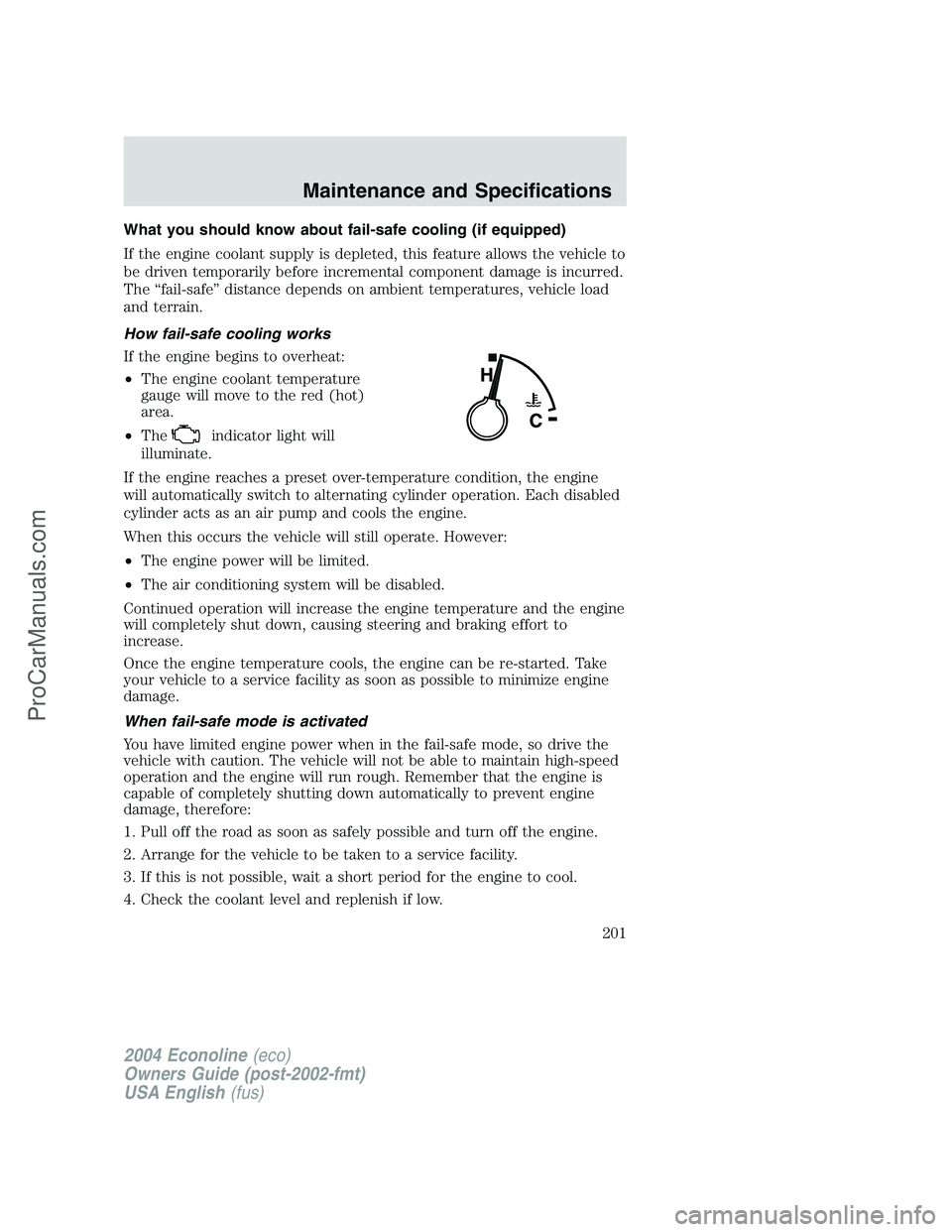
•The engine coolant temperature
gauge will move to the red (hot)
area.
•The
indicator light will
illuminate.
If the engine reaches a preset over-temperature condition, the engine
will automatically switch to alternating cylinder operation. Each disabled
cylinder acts as an air pump and cools the engine.
When this occurs the vehicle will still operate. However:
•The engine power will be limited.
•The air conditioning system will be disabled.
Continued operation will increase the engine temperature and the engine
will completely shut down, causing steering and braking effort to
increase.
Once the engine temperature cools, the engine can be re-started. Take
your vehicle to a service facility as soon as possible to minimize engine
damage.
When fail-safe mode is activated
You have limited engine power when in the fail-safe mode, so drive the
vehicle with caution. The vehicle will not be able to maintain high-speed
operation and the engine will run rough. Remember that the engine is
capable of completely shutting down automatically to prevent engine
damage, therefore:
1. Pull off the road as soon as safely possible and turn off the engine.
2. Arrange for the vehicle to be taken to a service facility.
3. If this is not possible, wait a short period for the engine to cool.
4. Check the coolant level and replenish if low.
2004 Econoline(eco)
Owners Guide (post-2002-fmt)
USA English(fus)
Maintenance and Specifications
201
ProCarManuals.com
Page 205 of 256
Choosing the right fuel
Use only UNLEADED FUEL. The use of leaded fuel is prohibited by law
and could damage your vehicle.
Your vehicle was not designed to use fuel or fuel additives with metallic
compounds, including manganese-based additives. Studies indicate that
these additives can cause your vehicle’s emission control system to
deteriorate more rapidly. In Canada, premium grade fuel generally
contains more metallic additives than regular fuel. We recommend using
regular grade fuel. In Canada, many fuels contain metallic additives, but
fuels free of such additives may be available; check with your local fuel
dealer.
Do not use fuel containing methanol. It can damage critical fuel system
components.
Repairs to correct the effects of using a fuel for which your vehicle was
not designed may not be covered by your warranty.
Octane recommendations
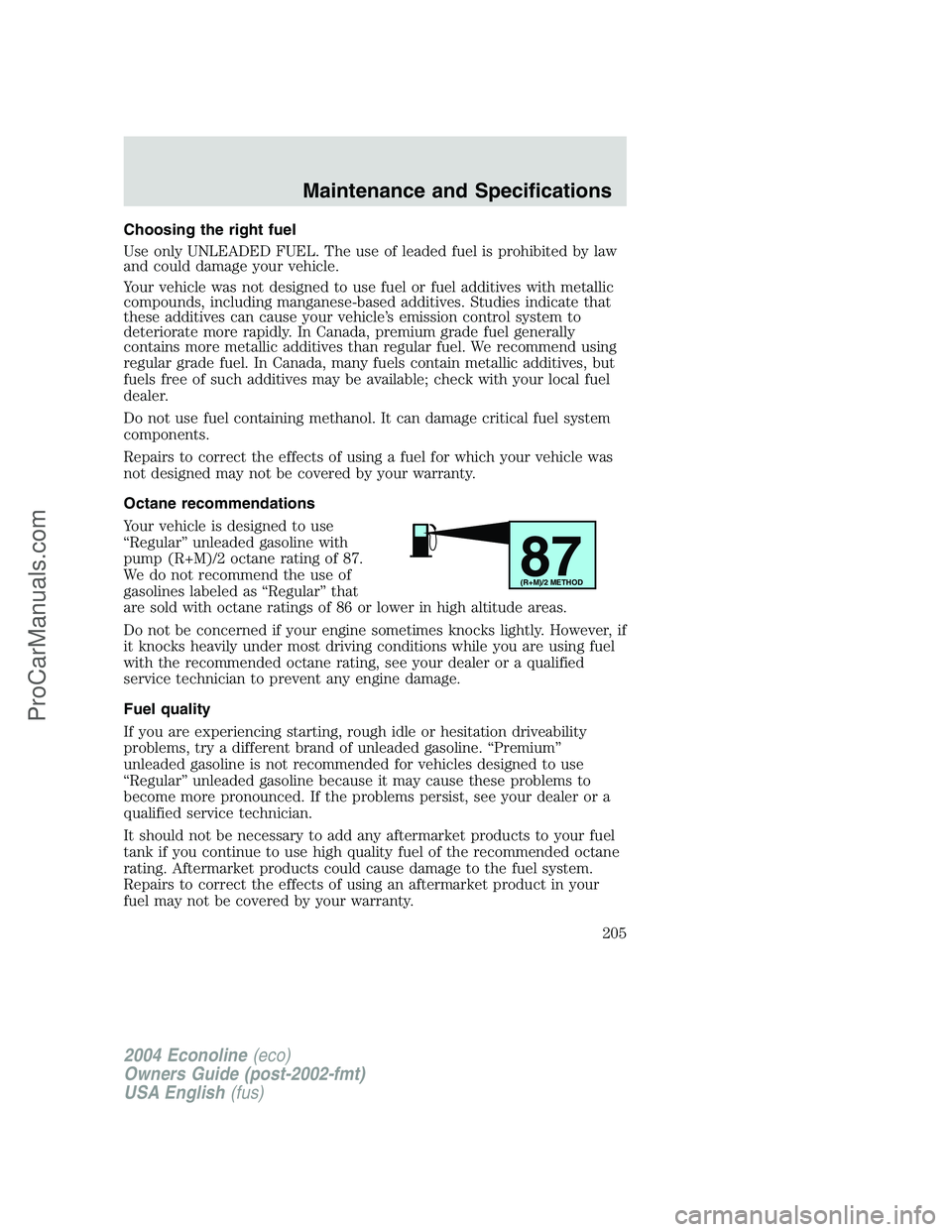
Your vehicle is designed to use
“Regular”unleaded gasoline with
pump (R+M)/2 octane rating of 87.
We do not recommend the use of
gasolines labeled as“Regular”that
are sold with octane ratings of 86 or lower in high altitude areas.
Do not be concerned if your engine sometimes knocks lightly. However, if
it knocks heavily under most driving conditions while you are using fuel
with the recommended octane rating, see your dealer or a qualified
service technician to prevent any engine damage.
Fuel quality
If you are experiencing starting, rough idle or hesitation driveability
problems, try a different brand of unleaded gasoline.“Premium”
unleaded gasoline is not recommended for vehicles designed to use
“Regular”unleaded gasoline because it may cause these problems to
become more pronounced. If the problems persist, see your dealer or a
qualified service technician.
It should not be necessary to add any aftermarket products to your fuel
tank if you continue to use high quality fuel of the recommended octane
rating. Aftermarket products could cause damage to the fuel system.
Repairs to correct the effects of using an aftermarket product in your
fuel may not be covered by your warranty.
87(R+M)/2 METHOD
2004 Econoline(eco)
Owners Guide (post-2002-fmt)
USA English(fus)
Maintenance and Specifications
205
ProCarManuals.com
Page 208 of 256
Calculation 1:Multiply liters used by 100, then divide by total
kilometers traveled.
Calculation 2:Divide total miles traveled by total gallons used.
Keep a record for at least one month and record the type of driving (city
or highway). This will provide an accurate estimate of the vehicle’s fuel
economy under current driving conditions. Additionally, keeping records
during summer and winter will show how temperature impacts fuel
economy. In general, lower temperatures give lower fuel economy.
Driving style—good driving and fuel economy habits
Give consideration to the lists that follow and you may be able to change
a number of variables and improve your fuel economy.
Habits
•Smooth, moderate operation can yield up to 10% savings in fuel.
•Steady speeds without stopping will usually give the best fuel
economy.
•Idling for long periods of time (greater than one minute) may waste
fuel.
•Anticipate stopping; slowing down may eliminate the need to stop.
•Sudden or hard accelerations may reduce fuel economy.
•Slow down gradually.
•Driving at reasonable speeds (traveling at 88 km/h [55 mph] uses 15%
less fuel than traveling at 105 km/h [65 mph]).
•Revving the engine before turning it off may reduce fuel economy.
•Using the air conditioner or defroster may reduce fuel economy.
•You may want to turn off the speed control in hilly terrain if
unnecessary shifting between third and fourth gear occurs.
Unnecessary shifting of this type could result in reduced fuel
economy.
•Warming up a vehicle on cold mornings is not required and may
reduce fuel economy.
•Resting your foot on the brake pedal while driving may reduce fuel
economy.
•Combine errands and minimize stop-and-go driving.
Maintenance
•Keep tires properly inflated and use only recommended size.
2004 Econoline(eco)
Owners Guide (post-2002-fmt)
USA English(fus)
Maintenance and Specifications
208
ProCarManuals.com
Page 252 of 256
Climate control (see Air
conditioning or Heating) ......52, 54
Clock adjust
6-CD in dash .............................27
AM/FM .......................................19
AM/FM/CD .................................23
AM/FM/Tape
..............................20
Compass, electronic
....................67
calibration
.................................68
set zone adjustment
.................68
Console
overhead
....................................66
Controls
power seat
.................................81
Coolant
checking and adding
..............196
refill capacities
................200, 233
specifications
..................238, 241
Cruise control
(see Speed control)
....................72
Customer Assistance
................146
Ford accessories for your
vehicle
.....................................186
Ford Extended Service
Plan
..........................................175
Getting assistance outside
the U.S. and Canada
..............179
Getting roadside assistance
...146
Getting the service
you need
.................................173
Ordering additional owner’s
literature
.................................180
The Dispute Settlement
Board
.......................................175
Utilizing the Mediation/
Arbitration Program
...............178D
Daytime running lamps
(see Lamps) ................................55
Dipstick
automatic transmission
fluid ..........................................213
engine oil .................................191
Doors
lubricant specifications ..........238
Driveline universal joint and
slip yoke ....................................213
Driving under special
conditions ..................................127
through water .........................129
E
Emergencies, roadside
jump-starting ..........................166
Emergency Flashers .................147
Emission control system ..........209
Engine ................................241–242
cleaning ...................................183
coolant .....................................196
diesel ...........................................7
fail-safe coolant ......................201
idle speed control ...................194
lubrication
specifications ..................238, 241
refill capacities ........................233
service points ..........................190
starting after a collision .........147
Engine block heater .................119
Engine oil ..................................191
checking and adding ..............191
dipstick ....................................191
filter, specifications ........193, 232
recommendations ...................193
2004 Econoline(eco)
Owners Guide (post-2002-fmt)
USA English(fus)
Index
252
ProCarManuals.com
Page 253 of 256
refill capacities ........................233
specifications ..................238, 241
Exhaust fumes ..........................119
F
Fail safe cooling ........................201
Fluid capacities .........................233
Four-Wheel Drive vehicles
preparing to drive your
vehicle .....................................122
Fuel ............................................202
calculating fuel economy .......206
cap ...........................................204
capacity ...................................233
choosing the right fuel ...........205
comparisons with EPA fuel
economy estimates .................209
detergent in fuel .....................206
filling your vehicle
with fuel ..................202, 204, 207
filter, specifications ........206, 232
fuel pump shut-off switch .....147
improving fuel economy ........206
octane rating ...........205, 241–242
quality ......................................205
running out of fuel .................206
safety information relating to
automotive fuels .....................202
Fuses ..........................................149
G
Garage door opener ....................66
Gas cap (see Fuel cap) ............204
Gas mileage
(see Fuel economy) .................206
Gauges .........................................15GAWR (Gross Axle Weight
Rating)
calculating ...............................133
GVWR (Gross Vehicle Weight
Rating)
calculating ...............................133
H
Hazard flashers .........................147
Headlamps ...................................55
bulb specifications ....................60
daytime running lights .............55
flash to pass ..............................56
high beam .................................56
replacing bulbs ...................61–62
turning on and off ....................55
Heating
heater only system .............52, 54
heating and air conditioning
system .......................................53
Hood ..........................................189
I
Ignition .......................116, 241–242
Infant seats
(see Safety seats) .....................104
Inspection/maintenance
(I/M) testing ..............................211
Instrument panel
cleaning ...................................185
cluster ........................................12
lighting up panel and
interior .......................................56
J
Jump-starting your vehicle ......166
2004 Econoline(eco)
Owners Guide (post-2002-fmt)
USA English(fus)
Index
253
ProCarManuals.com