trailer FORD E-350 2000 User Guide
[x] Cancel search | Manufacturer: FORD, Model Year: 2000, Model line: E-350, Model: FORD E-350 2000Pages: 232, PDF Size: 2.75 MB
Page 126 of 232
Disconnect the wiring to the trailer before backing the trailer into the
water. Reconnect the wiring to the trailer after the trailer is removed
from the water.
Recreational towing (all wheels on the ground)
An example of recreational towing would be towing your vehicle on a
trip behind a Motorhome. Follow these guidelines if you have the need
for recreational towing your vehicle with all four wheels on the ground.
These guidelines are designed to ensure that your transmission is not
damaged.
2WD vehicles (with automatic transmissions)
²Place the transmission in N (Neutral)
²Maximum speed is 56 km (35 mph)
²Maximum distance is 80 km (50 miles)
If a distance of 80 km (50 miles) or a speed of 56 km (35 mph) must be
exceeded, the drive shaft will have to be removed.
Ford recommends the driveshaft be removed/installed only by a qualified
technician. See your local dealer for driveshaft removal/installation.
Improper removal/installation of the driveshaft can cause
transmission fluid loss, damage to the driveshaft and internal
transmission components.
DRIVING THROUGH WATER
Do not drive quickly through standing water, especially if the depth is
unknown. Traction or brake capability may be limited and if the ignition
system gets wet, your engine may stall. Water may also enter your
engine's air intake and severely damage your engine.
If driving through deep or standing water is unavoidable, proceed very
slowly. Never drive through water that is higher than the bottom of the
hubs (for trucks) or the bottom of the wheel rims (for cars).
Once through the water, always try the brakes. Wet brakes do not stop
the vehicle as effectively as dry brakes. Drying can be improved by
moving your vehicle slowly while applying light pressure on the brake
pedal.
Driving through deep water where the transmission/transmission
vent tube is submerged may allow water into the transmission
and cause internal transmission damage.
Driving
126
ProCarManuals.com
Page 133 of 232
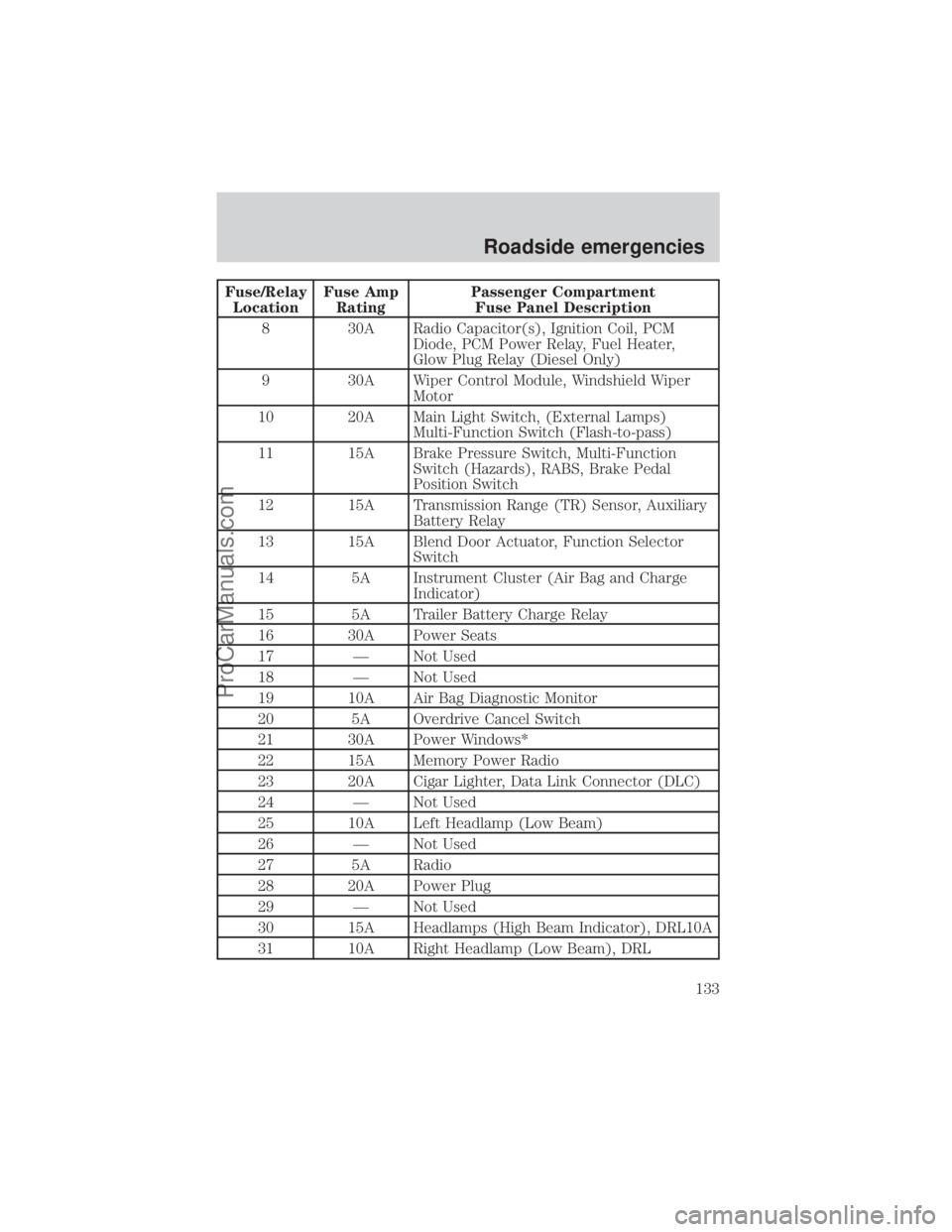
Fuse/Relay
LocationFuse Amp
RatingPassenger Compartment
Fuse Panel Description
8 30A Radio Capacitor(s), Ignition Coil, PCM
Diode, PCM Power Relay, Fuel Heater,
Glow Plug Relay (Diesel Only)
9 30A Wiper Control Module, Windshield Wiper
Motor
10 20A Main Light Switch, (External Lamps)
Multi-Function Switch (Flash-to-pass)
11 15A Brake Pressure Switch, Multi-Function
Switch (Hazards), RABS, Brake Pedal
Position Switch
12 15A Transmission Range (TR) Sensor, Auxiliary
Battery Relay
13 15A Blend Door Actuator, Function Selector
Switch
14 5A Instrument Cluster (Air Bag and Charge
Indicator)
15 5A Trailer Battery Charge Relay
16 30A Power Seats
17 Ð Not Used
18 Ð Not Used
19 10A Air Bag Diagnostic Monitor
20 5A Overdrive Cancel Switch
21 30A Power Windows*
22 15A Memory Power Radio
23 20A Cigar Lighter, Data Link Connector (DLC)
24 Ð Not Used
25 10A Left Headlamp (Low Beam)
26 Ð Not Used
27 5A Radio
28 20A Power Plug
29 Ð Not Used
30 15A Headlamps (High Beam Indicator), DRL10A
31 10A Right Headlamp (Low Beam), DRL
Roadside emergencies
133
ProCarManuals.com
Page 135 of 232
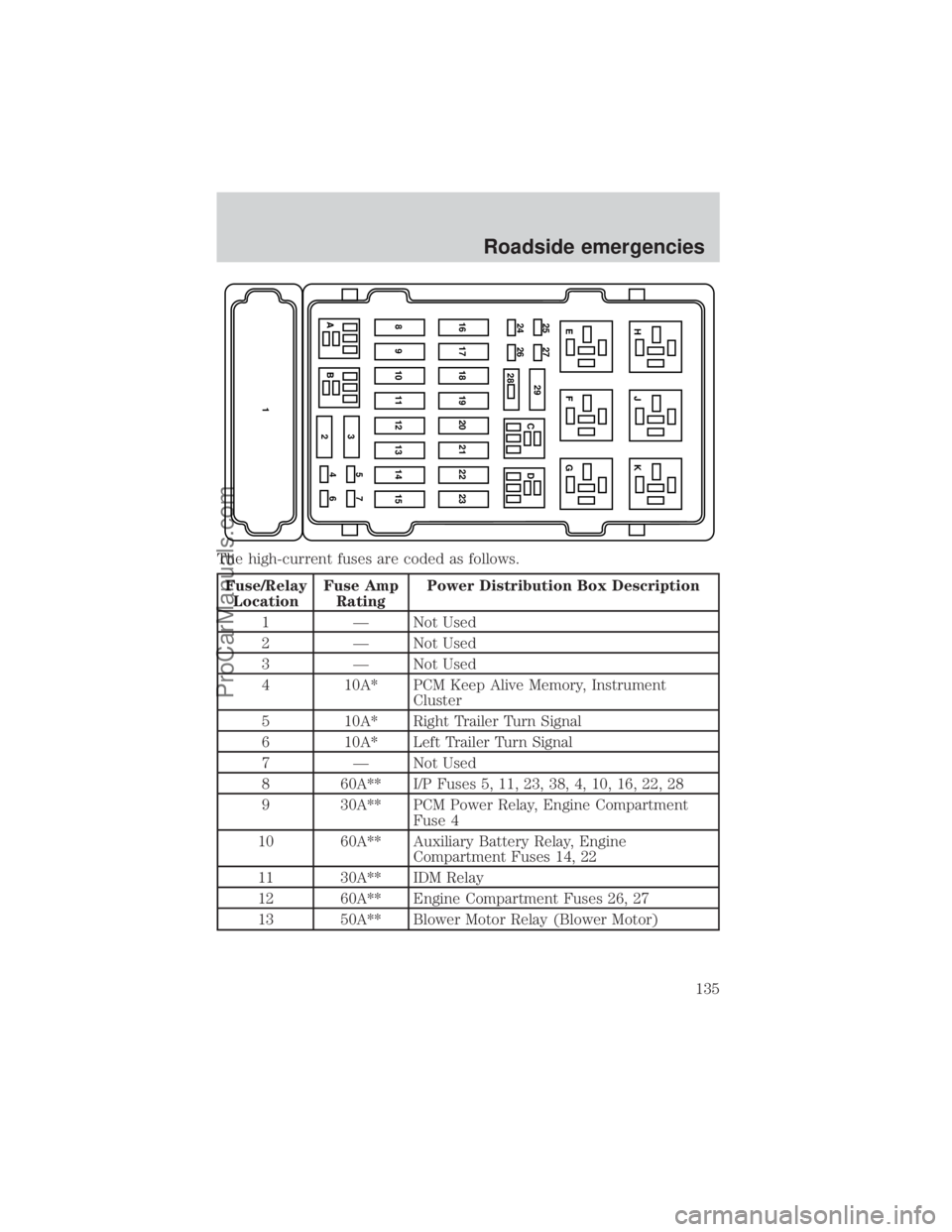
The high-current fuses are coded as follows.
Fuse/Relay
LocationFuse Amp
RatingPower Distribution Box Description
1 Ð Not Used
2 Ð Not Used
3 Ð Not Used
4 10A* PCM Keep Alive Memory, Instrument
Cluster
5 10A* Right Trailer Turn Signal
6 10A* Left Trailer Turn Signal
7 Ð Not Used
8 60A** I/P Fuses 5, 11, 23, 38, 4, 10, 16, 22, 28
9 30A** PCM Power Relay, Engine Compartment
Fuse 4
10 60A** Auxiliary Battery Relay, Engine
Compartment Fuses 14, 22
11 30A** IDM Relay
12 60A** Engine Compartment Fuses 26, 27
13 50A** Blower Motor Relay (Blower Motor)
AB3
2
146 5715 14 13 12 11 10 9 823 22 21 20 19 18 17 1624 26 25 27
29
CDG F EK J H
28
Roadside emergencies
135
ProCarManuals.com
Page 136 of 232
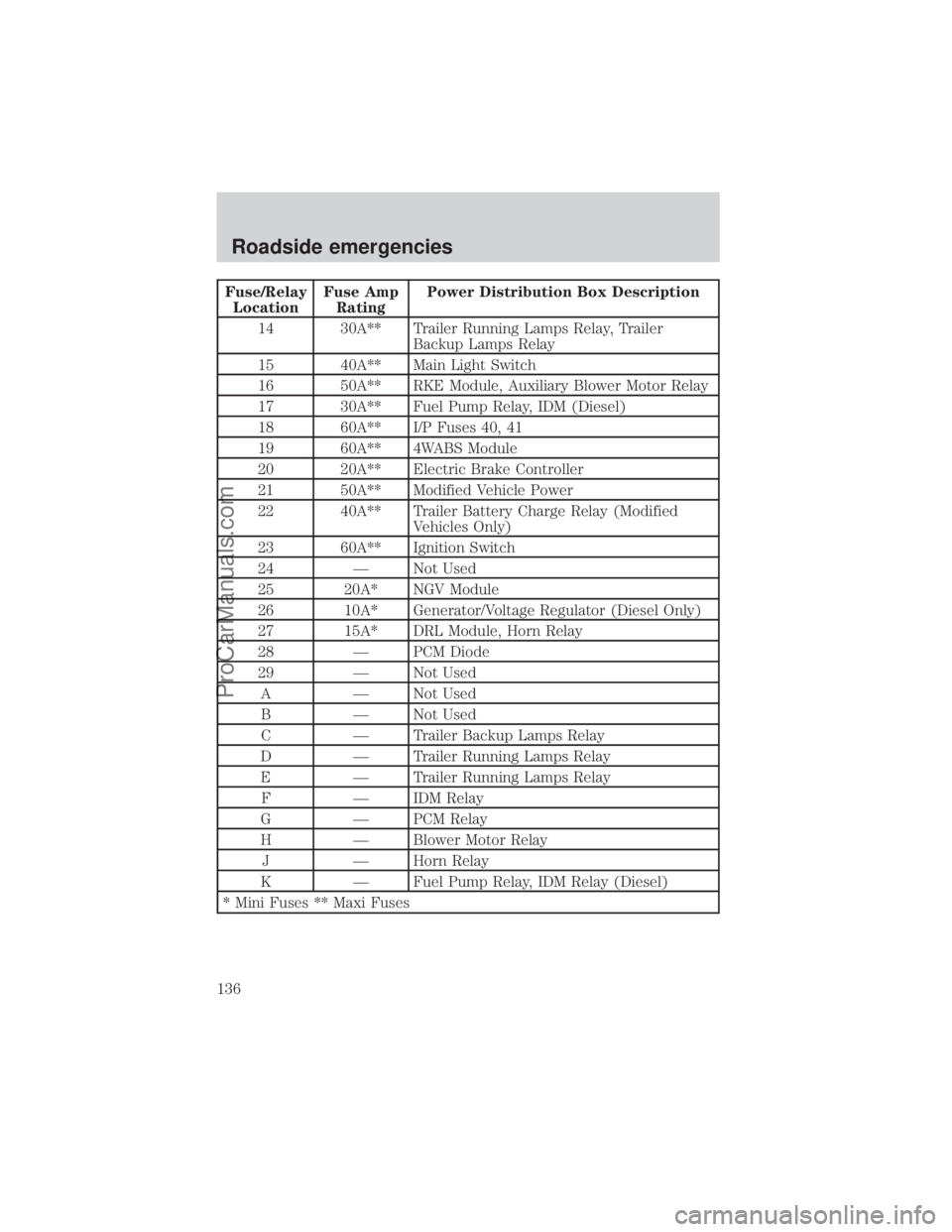
Fuse/Relay
LocationFuse Amp
RatingPower Distribution Box Description
14 30A** Trailer Running Lamps Relay, Trailer
Backup Lamps Relay
15 40A** Main Light Switch
16 50A** RKE Module, Auxiliary Blower Motor Relay
17 30A** Fuel Pump Relay, IDM (Diesel)
18 60A** I/P Fuses 40, 41
19 60A** 4WABS Module
20 20A** Electric Brake Controller
21 50A** Modified Vehicle Power
22 40A** Trailer Battery Charge Relay (Modified
Vehicles Only)
23 60A** Ignition Switch
24 Ð Not Used
25 20A* NGV Module
26 10A* Generator/Voltage Regulator (Diesel Only)
27 15A* DRL Module, Horn Relay
28 Ð PCM Diode
29 Ð Not Used
A Ð Not Used
B Ð Not Used
C Ð Trailer Backup Lamps Relay
D Ð Trailer Running Lamps Relay
E Ð Trailer Running Lamps Relay
F Ð IDM Relay
G Ð PCM Relay
H Ð Blower Motor Relay
J Ð Horn Relay
K Ð Fuel Pump Relay, IDM Relay (Diesel)
* Mini Fuses ** Maxi Fuses
Roadside emergencies
136
ProCarManuals.com
Page 165 of 232
For E-SuperDuty vehicles with the Hydro-Boost Brake System,
do not press the brake pedal after the engine has been turned
off.
5. Recheck the fluid level on the dipstick. Do not add fluid if the level is
between the arrows in the FULL COLD range.
6. If the fluid is low, add fluid in small amounts, continuously checking
the level until it reaches the FULL COLD range. Be sure to put the
dipstick back in the reservoir.
TRANSMISSION FLUID
Checking automatic transmission fluid
Refer to your Scheduled Maintenance Guide for scheduled intervals for
fluid checks and changes. Your transmission does not consume fluid.
However, the fluid level should be checked if the transmission is not
working properly, i.e., if the transmission slips or shifts slowly or if you
notice some sign of fluid leakage.
Automatic transmission fluid expands when warmed. To obtain an
accurate fluid check, drive the vehicle until it is at normal operating
temperature (approximately 30 km [20 miles]). If your vehicle has been
operated for an extended period at high speeds, in city traffic during hot
weather or pulling a trailer, the vehicle should be turned off for about 30
minutes to allow fluid to cool before checking.
1. Drive the vehicle 30 km (20 miles) or until it reaches normal operating
temperature.
2. Park the vehicle on a level surface and engage the parking brake.
3. With the parking brake engaged and your foot on the brake pedal,
start the engine and move the gearshift lever through all of the gear
ranges. Allow sufficient time for each gear to engage.
4. Latch the gearshift lever in P (Park) and leave the engine running.
5. Remove the dipstick, wiping it clean with a clean, dry lint free rag. If
necessary, refer toIdentifying components in the engine compartment
in this chapter for the location of the dipstick.
6. Install the dipstick making sure it is fully seated in the filler tube.
Maintenance and care
165
ProCarManuals.com
Page 186 of 232
![FORD E-350 2000 User Guide Conditions
²Heavily loading a vehicle or towing a trailer may reduce fuel economy
at any speed.
²Carrying unnecessary weight may reduce fuel economy (approximately
0.4 km/L [1 mpg] is lost for every](/img/11/57774/w960_57774-185.png "FORD E-350 2000 User Guide Conditions
²Heavily loading a vehicle or towing a trailer may reduce fuel economy
at any speed.
²Carrying unnecessary weight may reduce fuel economy (approximately
0.4 km/L [1 mpg] is lost for every")
Conditions
²Heavily loading a vehicle or towing a trailer may reduce fuel economy
at any speed.
²Carrying unnecessary weight may reduce fuel economy (approximately
0.4 km/L [1 mpg] is lost for every 180 kg [400 lb] of weight carried).
²Adding certain accessories to your vehicle (for example bug
deflectors, rollbars/light bars, running boards, ski/luggage racks) may
reduce fuel economy.
²Using fuel blended with alcohol may lower fuel economy.
²Fuel economy may decrease with lower temperatures during the first
12±16 km (8±10 miles) of driving.
²Driving on flat terrain offers improved fuel economy as compared to
driving on hilly terrain.
²Transmissions give their best fuel economy when operated in the top
cruise gear and with steady pressure on the gas pedal.
²Close windows for high speed driving.
EPA window sticker
Every new vehicle should have the EPA window sticker. Contact your
dealer if the window sticker is not supplied with your vehicle. The EPA
window sticker should be your guide for the fuel economy comparisons
with other vehicles.
It is important to note the box in the lower left corner of the window
sticker. These numbers represent the Range of L/100 km (MPG)
expected on the vehicle under optimum conditions. Your fuel economy
may vary depending upon the method of operation and conditions.
EMISSION CONTROL SYSTEM
Your vehicle is equipped with various emission control components and a
catalytic converter which will enable your vehicle to comply with
applicable exhaust emission standards. To make sure that the catalytic
converter and other emission control components continue to work
properly:
²Use only the specified fuel listed.
²Avoid running out of fuel.
²Do not turn off the ignition while your vehicle is moving, especially at
high speeds.
Maintenance and care
186
ProCarManuals.com
Page 219 of 232
Comfort and convenience
Air conditioner
Engine block heaters
Tire step
Travel equipment
Console (Engine cover)
Daytime running lights
Heavy-duty battery
Inside mirror, electrochromic with compass (with and without
temperature display)
Removable luggage rack
Removable luggage rack adapters
Running boards
Soft luggage cover
Speed control
Trailer hitch
Trailer hitch bars and balls
Trailer hitch wiring adaptor
Protection and appearance equipment
Air bag anti-theft locks
Carpet floor mats
Cleaners, waxes and polishes
Flat splash guards
Front end covers (full)
Hood deflectors
Lubricants and oils
Side window air deflectors
Step bumpers
Touch-up paint
Customer assistance
219
ProCarManuals.com
Page 225 of 232
engine coolant
temperature gauge ...................15
engine oil pressure gauge ........15
fuel gauge ..................................14
odometer ...................................16
speedometer .............................14
trip odometer ............................16
GAWR
(Gross Axle Weight Rating) .....118
calculating ...............................120
definition .................................118
driving with a heavy load ......118
location ....................................118
GVWR (Gross
Vehicle Weight Rating) .............118
calculating ........................118,120
definition .................................118
driving with a heavy load ......118
location ....................................118
Hazard flashers .........................128
Headlamps ...................................17
aiming ......................................193
bulb specifications ..................193
daytime running lights .............17
flash to pass ..............................18
high beam ............................13,17
replacing bulbs ................188,190
turning on and off ....................17
warning chime ..........................14
Heating ........................................18
auxiliary heater and air
conditioner ................................23
heater only system ...................18
heating and
air conditioning system ............20
Hood ..........................................151
Ignition .......................................206
positions of the ignition ...........58
Infant seats (see Safety seats) ..95
Inspection/maintenance
(I/M) testing ..............................187Instrument panel
cleaning ...................................197
cluster .................................10,197
lighting up
panel and interior .....................18
location of components ............10
Jump-starting your vehicle ......144
Keys
key in ignition chime ...............14
positions of the ignition ...........58
Lamps
bulb replacement
specifications chart ................193
cargo lamps ...............................18
daytime running light ...............17
headlamps .................................17
headlamps, flash to pass ..........18
instrument panel, dimming .....18
interior lamps ...........................65
replacing bulbs ..188,190,191,192
Lane change indicator
(see Turn signal) ........................59
Lights, warning and indicator ....10
air bag ........................................12
anti-lock brakes (ABS) .....10,110
brake ..........................................10
charging system ........................12
check coolant ............................13
engine oil pressure ...................13
high beam .................................13
safety belt .................................12
service engine soon ..................10
turn signal indicator .................13
Load limits .................................118
GAWR ......................................118
GVWR ......................................118
trailer towing ..........................118
Loading instructions .................119
Lubricant specifications ....203,206
Lumbar support, seats ...............73
Mirrors
side view mirrors (power) .......67
Index
225
ProCarManuals.com
Page 226 of 232
Motorcraft parts .................183,199
Octane rating ............................181
Odometer .....................................16
Oil (see Engine oil) ..................152
Overdrive .....................................64
Panic alarm feature, remote
entry system ................................68
Parking brake ............................111
Parts (see Motorcraft parts) ....199
Power distribution box
(see Fuses) ...............................134
Power door locks ........................66
Power steering ..........................112
fluid, checking and adding ....164
fluid, refill capacity ................200
fluid, specifications ..........203,206
Preparing to
drive your vehicle .....................113
Radio ............................................25
Relays .................................130,137
Remote entry system ............67,68
illuminated entry ......................70
locking/unlocking doors ...........68
panic alarm ...............................68
replacement/additional
transmitters ...............................70
replacing the batteries .............69
Safety belts (see Safety
restraints) ................13,77,79,80,81
Safety defects, reporting ..........222
Safety restraints ...........77,79,80,81
belt minder ...............................84
cleaning the safety belts ...87,198
extension assembly ..................83
for adults .........................79,80,81
for children ..........................93,94
lap belt ......................................82
warning
light and chime ...............12,13,83
Safety seats for children ............95
Seat belts
(see Safety restraints) ...............77Seats ............................................71
child safety seats ......................95
Servicing your vehicle ..............150
Spark plugs,
specifications ......................199,206
Special notice ................................3
ambulance conversions ..............4
diesel-powered vehicles .............5
utility-type vehicles ....................3
Specification chart,
lubricants ............................203,206
Speed control ..............................59
Speedometer ...............................14
Starting your vehicle .........104,106
jump starting ..........................144
Steering wheel
tilting .........................................63
Tilt steering wheel ......................63
Tires ......................137,174,175,176
changing ...........................137,138
checking the pressure ............176
replacing ...........................140,177
rotating ....................................176
snow tires and chains ............178
tire grades ...............................175
treadwear ................................175
Towing ................................120,176
recreational towing .................126
trailer towing ..........................120
wrecker ....................................149
Traction-lok rear axle ...............113
Transmission .............................114
fluid, checking and adding
(automatic) .............................165
fluid, refill capacities ..............200
lubricant specifications ...203,206
Transmission
control indicator light .................12
Trip odometer .............................16
Turn signal .............................13,59
Vehicle dimensions ...................206
Index
226
ProCarManuals.com