ignition FORD E-350 2003 Owner's Guide
[x] Cancel search | Manufacturer: FORD, Model Year: 2003, Model line: E-350, Model: FORD E-350 2003Pages: 232, PDF Size: 3.56 MB
Page 194 of 232
Many of the world’s automakers issued the World-wide Fuel Charter that
recommends gasoline specifications to provide improved performance
and emission control system protection for your vehicle. Gasolines that
meet the World-wide Fuel Charter should be used when available. Ask
your fuel supplier about gasolines that meet the World-wide Fuel
Charter.
Cleaner air
Ford endorses the use of reformulated“cleaner-burning”gasolines to
improve air quality.
Running out of fuel
Avoid running out of fuel because this situation may have an adverse
affect on powertrain components.
If you have run out of fuel:
•You may need to cycle the ignition from OFF to ON several times after
refueling, to allow the fuel system to pump the fuel from the tank to
the engine.
•Your“Service Engine Soon”indicator may come on. For more
information on the“Service Engine Soon”indicator, refer to the
Instrument clusterchapter.
Fuel Filter
For fuel filter replacement, see your dealer or a qualified service
technician. Refer to the scheduled maintenance guide for the appropriate
intervals for changing the fuel filter.
Replace the fuel filter with an authorized Motorcraft part. The
customer warranty may be void for any damage to the fuel system
if an authorized Motorcraft fuel filter is not used.
ESSENTIALS OF GOOD FUEL ECONOMY
Measuring techniques
Your best source of information about actual fuel economy is you, the
driver. You must gather information as accurately and consistently as
possible. Fuel expense, frequency of fill-ups or fuel gauge readings are
NOT accurate as a measure of fuel economy. We do not recommend
taking fuel economy measurements during the first 1,600 km (1,000
miles) of driving (engine break-in period). You will get a more accurate
measurement after 3,000 km–5,000 km (2,000 miles-3,000 miles).
2003 Econoline(eco)
Owners Guide (post-2002-fmt)
USA English(fus)
Maintenance and Specifications
194
ProCarManuals.com
Page 195 of 232
Filling the tank
The advertised fuel capacity of the fuel tank on your vehicle is equal to
the rated refill capacity of the fuel tank as listed in theRefill capacities
section of this chapter.
The advertised capacity is the amount of the indicated capacity and the
empty reserve combined. Indicated capacity is the difference in the
amount of fuel in a full tank and a tank when the fuel gauge indicates
empty. Empty reserve is the small amount of fuel remaining in the fuel
tank after the fuel gauge indicates empty.
The amount of usable fuel in the empty reserve varies and should
not be relied upon to increase driving range. When refueling your
vehicle after the fuel gauge indicates empty, you might not be
able to refuel the full amount of the advertised capacity of the
fuel tank due to the empty reserve still present in the tank.
For consistent results when filling the fuel tank:
•Turn the engine/ignition switch to the off position prior to refueling,
an error in the reading will result if the engine is left running.
•Use the same filling rate setting (low—medium—high) each time
the tank is filled.
•Allow no more than 2 automatic click-offs when filling.
•Always use fuel with the recommended octane rating.
•Use a known quality gasoline, preferably a national brand.
•Use the same side of the same pump and have the vehicle facing the
same direction each time you fill up.
•Have the vehicle loading and distribution the same every time.
Your results will be most accurate if your filling method is consistent.
Calculating fuel economy
1. Fill the fuel tank completely and record the initial odometer reading
(in kilometers or miles).
2. Each time you fill the tank, record the amount of fuel added (in liters
or gallons).
3. After at least three to five tank fill-ups, fill the fuel tank and record
the current odometer reading.
4. Subtract your initial odometer reading from the current odometer
reading.
2003 Econoline(eco)
Owners Guide (post-2002-fmt)
USA English(fus)
Maintenance and Specifications
195
ProCarManuals.com
Page 198 of 232
EMISSION CONTROL SYSTEM
Your vehicle is equipped with various emission control components and a
catalytic converter which will enable your vehicle to comply with
applicable exhaust emission standards. To make sure that the catalytic
converter and other emission control components continue to work
properly:
•Use only the specified fuel listed.
•Avoid running out of fuel.
•Do not turn off the ignition while your vehicle is moving, especially at
high speeds.
•Have the items listed in your scheduled maintenance guide performed
according to the specified schedule.
The scheduled maintenance items listed in the scheduled maintenance
guide are essential to the life and performance of your vehicle and to its
emissions system.
If other than Ford, Motorcraft or Ford-authorized parts are used for
maintenance replacements or for service of components affecting
emission control, such non-Ford parts should be equivalent to genuine
Ford Motor Company parts in performance and durability.
Do not park, idle, or drive your vehicle in dry grass or other dry
ground cover. The emission system heats up the engine
compartment and exhaust system, which can start a fire.
Illumination of the“Service Engine Soon”light, charging system warning
light or the temperature warning light, fluid leaks, strange odors, smoke
or loss of engine power, could indicate that the emission control system
is not working properly.
Exhaust leaks may result in entry of harmful and potentially
lethal fumes into the passenger compartment.
Do not make any unauthorized changes to your vehicle or engine. By
law, vehicle owners and anyone who manufactures, repairs, services,
sells, leases, trades vehicles, or supervises a fleet of vehicles are not
permitted to intentionally remove an emission control device or prevent
it from working. Information about your vehicle’s emission system is on
the Vehicle Emission Control Information Decal located on or near the
engine. This decal identifies engine displacement and gives some tune up
specifications.
2003 Econoline(eco)
Owners Guide (post-2002-fmt)
USA English(fus)
Maintenance and Specifications
198
ProCarManuals.com
Page 218 of 232
3Add 237 ml (8 oz.) of Additive Friction Modifier C8AZ-19B546-A or
equivalent meeting Ford specification EST-M2C118-A for complete refill
of Dana Traction-Lok rear axles.
ENGINE DATA
Engine*4.2L V6
engine4.6L V8
engine5.4L V8
engine6.8L V10
engine
Cubic inches 256 281 330 415
Required fuel 87 octane 87 octane 87 octane 87 octane
Firing order1-4-2-5-3-6
1-3-7-2-6-5-4-8 1-3-7-2-6-5-4-81-6-5-10-2-7-
3-8-4-9
Spark plug
gap1.3-1.4 mm
(0.052-0.056
inch)1.3-1.4 mm
(0.052-0.056
inch)1.3-1.4 mm
(0.052-0.056
inch)1.3-1.4 mm
(0.052-0.056
inch)
Ignition
systemEDIS Coil on plug Coil on plug Coil on plug
Compression
ratio9.3:1 9.4:1 9.0:1 9.0:1
*Refer to the7.3 Liter Power Stroke Direct Injection Turbo Diesel
Owner’s Guide Supplementfor diesel engine information.
VEHICLE DIMENSIONS
Van/wagon models
E-150 E-250 E-350
(1) Overall height 2050 mm (80.7
in)2118 mm (83.4
in)2136 mm
(84.1 in)
(2) Track front/rear 1763 mm (69.4 in)/ 1 702 mm (67.0 in)
(3) Overall width
(excluding mirrors)2014 mm (79.3 in)
(4) Wheelbase 3505 mm (138 in)
(5) Overall length Regular van, 5382 mm (211.9 in)
Extended, 5890 mm (231.9 in)
2003 Econoline(eco)
Owners Guide (post-2002-fmt)
USA English(fus)
Maintenance and Specifications
218
ProCarManuals.com
Page 227 of 232
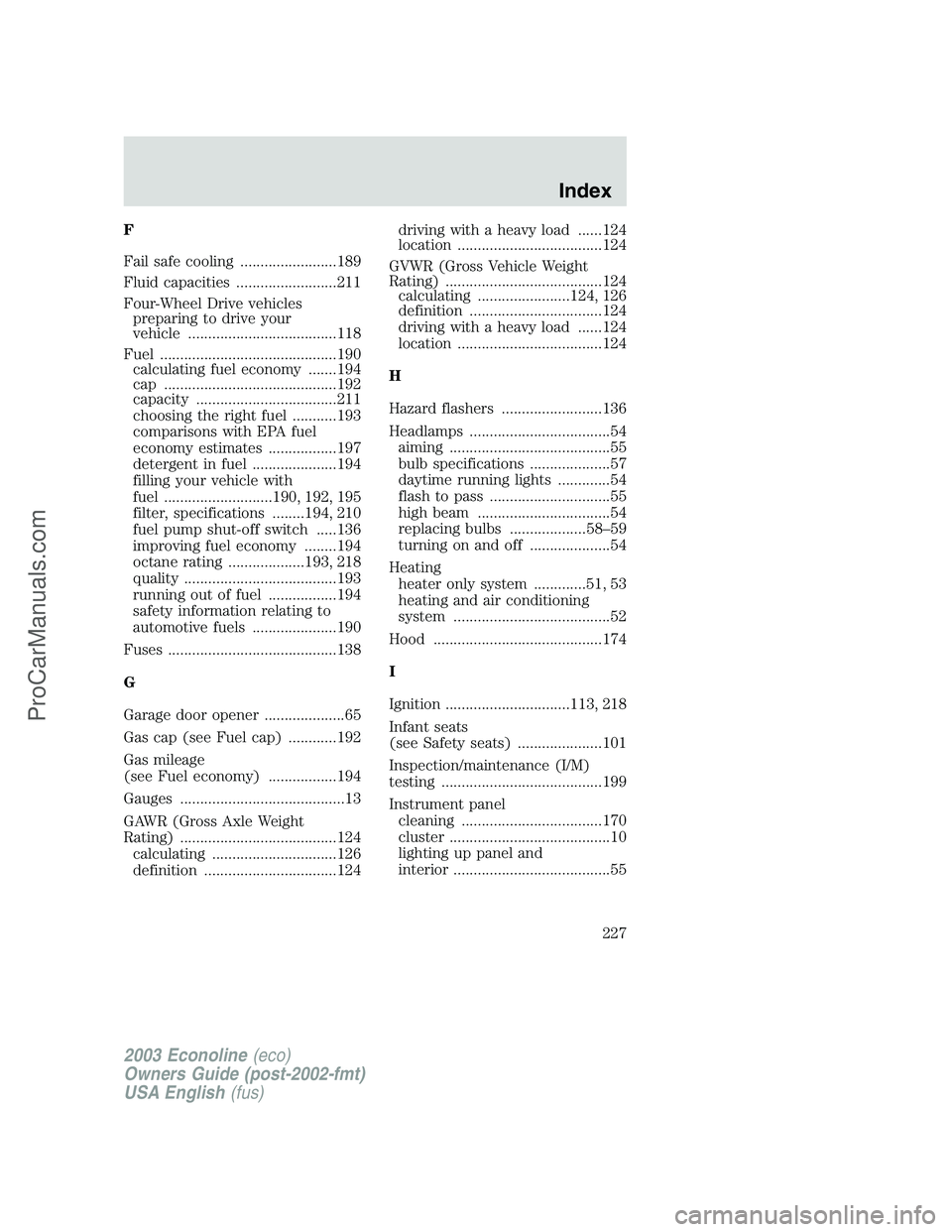
F
Fail safe cooling ........................189
Fluid capacities .........................211
Four-Wheel Drive vehicles
preparing to drive your
vehicle .....................................118
Fuel ............................................190
calculating fuel economy .......194
cap ...........................................192
capacity ...................................211
choosing the right fuel ...........193
comparisons with EPA fuel
economy estimates .................197
detergent in fuel .....................194
filling your vehicle with
fuel ...........................190, 192, 195
filter, specifications ........194, 210
fuel pump shut-off switch .....136
improving fuel economy ........194
octane rating ...................193, 218
quality ......................................193
running out of fuel .................194
safety information relating to
automotive fuels .....................190
Fuses ..........................................138
G
Garage door opener ....................65
Gas cap (see Fuel cap) ............192
Gas mileage
(see Fuel economy) .................194
Gauges .........................................13
GAWR (Gross Axle Weight
Rating) .......................................124
calculating ...............................126
definition .................................124driving with a heavy load ......124
location ....................................124
GVWR (Gross Vehicle Weight
Rating) .......................................124
calculating .......................124, 126
definition .................................124
driving with a heavy load ......124
location ....................................124
H
Hazard flashers .........................136
Headlamps ...................................54
aiming ........................................55
bulb specifications ....................57
daytime running lights .............54
flash to pass ..............................55
high beam .................................54
replacing bulbs ...................58–59
turning on and off ....................54
Heating
heater only system .............51, 53
heating and air conditioning
system .......................................52
Hood ..........................................174
I
Ignition ...............................113, 218
Infant seats
(see Safety seats) .....................101
Inspection/maintenance (I/M)
testing ........................................199
Instrument panel
cleaning ...................................170
cluster ........................................10
lighting up panel and
interior .......................................55
2003 Econoline(eco)
Owners Guide (post-2002-fmt)
USA English(fus)
Index
227
ProCarManuals.com
Page 228 of 232
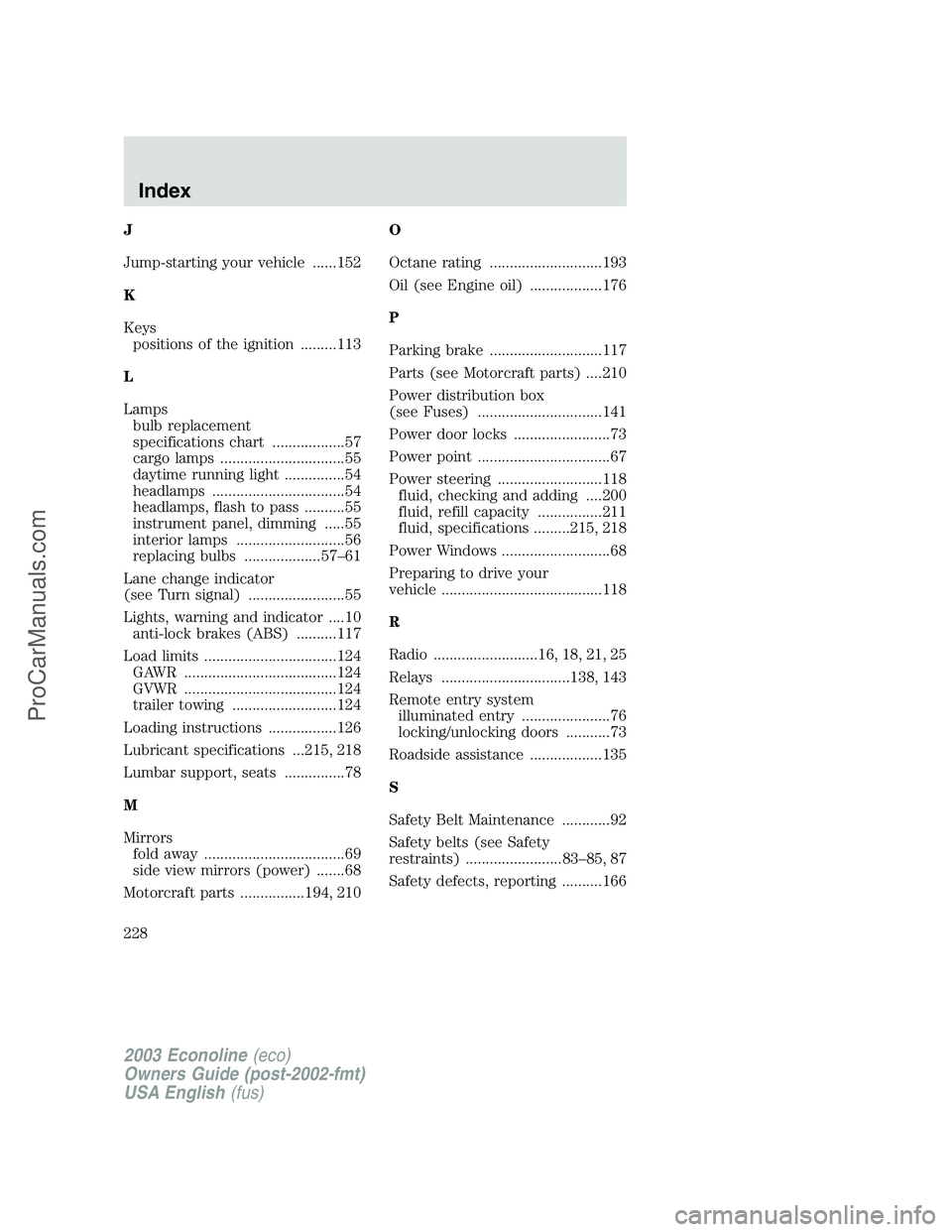
J
Jump-starting your vehicle ......152
K
Keys
positions of the ignition .........113
L
Lamps
bulb replacement
specifications chart ..................57
cargo lamps ...............................55
daytime running light ...............54
headlamps .................................54
headlamps, flash to pass ..........55
instrument panel, dimming .....55
interior lamps ...........................56
replacing bulbs ...................57–61
Lane change indicator
(see Turn signal) ........................55
Lights, warning and indicator ....10
anti-lock brakes (ABS) ..........117
Load limits .................................124
GAWR ......................................124
GVWR ......................................124
trailer towing ..........................124
Loading instructions .................126
Lubricant specifications ...215, 218
Lumbar support, seats ...............78
M
Mirrors
fold away ...................................69
side view mirrors (power) .......68
Motorcraft parts ................194, 210O
Octane rating ............................193
Oil (see Engine oil) ..................176
P
Parking brake ............................117
Parts (see Motorcraft parts) ....210
Power distribution box
(see Fuses) ...............................141
Power door locks ........................73
Power point .................................67
Power steering ..........................118
fluid, checking and adding ....200
fluid, refill capacity ................211
fluid, specifications .........215, 218
Power Windows ...........................68
Preparing to drive your
vehicle ........................................118
R
Radio ..........................16, 18, 21, 25
Relays ................................138, 143
Remote entry system
illuminated entry ......................76
locking/unlocking doors ...........73
Roadside assistance ..................135
S
Safety Belt Maintenance ............92
Safety belts (see Safety
restraints) ........................83–85, 87
Safety defects, reporting ..........166
2003 Econoline(eco)
Owners Guide (post-2002-fmt)
USA English(fus)
Index
228
ProCarManuals.com