warning FORD E-350 2004 Owner's Manual
[x] Cancel search | Manufacturer: FORD, Model Year: 2004, Model line: E-350, Model: FORD E-350 2004Pages: 256, PDF Size: 2.42 MB
Page 211 of 256
On board diagnostics (OBD-II)
Your vehicle is equipped with a computer that monitors the engine’s
emission control system. This system is commonly known as the On
Board Diagnostics System (OBD-II). This OBD-II system protects the
environment by ensuring that your vehicle continues to meet
government emission standards. The OBD-II system also assists the
service technician in properly servicing your vehicle. When theCheck
engine/Service engine soonlight illuminates, the OBD-II system has
detected a malfunction. Temporary malfunctions may cause yourCheck
engine/Service engine soonlight to illuminate. Examples are:
1. The vehicle has run out of fuel. (The engine may misfire or run
poorly.)
2. Poor fuel quality or water in the fuel.
3. The fuel cap may not have been securely tightened.
These temporary malfunctions can be corrected by filling the fuel tank
with good quality fuel and/or properly tightening the fuel cap. After three
driving cycles without these or any other temporary malfunctions
present, theCheck engine/Service engine soonlight should turn off. (A
driving cycle consists of a cold engine startup followed by mixed
city/highway driving.) No additional vehicle service is required.
If theCheck engine/Service engine soonlight remains on, have your
vehicle serviced at the first available opportunity.
Readiness for Inspection/Maintenance (I/M) testing
In some localities, it may be a legal requirement to pass an I/M test of
the on-board diagnostics system. If yourCheck engine/Service engine
soonlight is on, refer to the description in theWarning lights and
chimessection of theInstrument Clusterchapter. Your vehicle may not
pass the I/M test with theCheck engine/Service engine soonlight on.
If the vehicle’s powertrain system or its battery has just been serviced,
the on-board diagnostics system is reset to a“not ready for I/M test”
condition. To ready the on-board diagnostics system for I/M testing, a
minimum of 30 minutes of city and highway driving is necessary as
described below:
•First, at least 10 minutes of driving on an expressway or highway.
•Next, at least 20 minutes driving in stop-and-go, city-type traffic with
at least four idle periods.
Allow the vehicle to sit for at least eight hours without starting the
engine. Then, start the engine and complete the above driving cycle. The
2004 Econoline(eco)
Owners Guide (post-2002-fmt)
USA English(fus)
Maintenance and Specifications
211
ProCarManuals.com
Page 213 of 256
6. If the fluid is low, add fluid in small amounts, continuously checking
the level until it reaches the FULL COLD range. Be sure to put the
dipstick back in the reservoir.
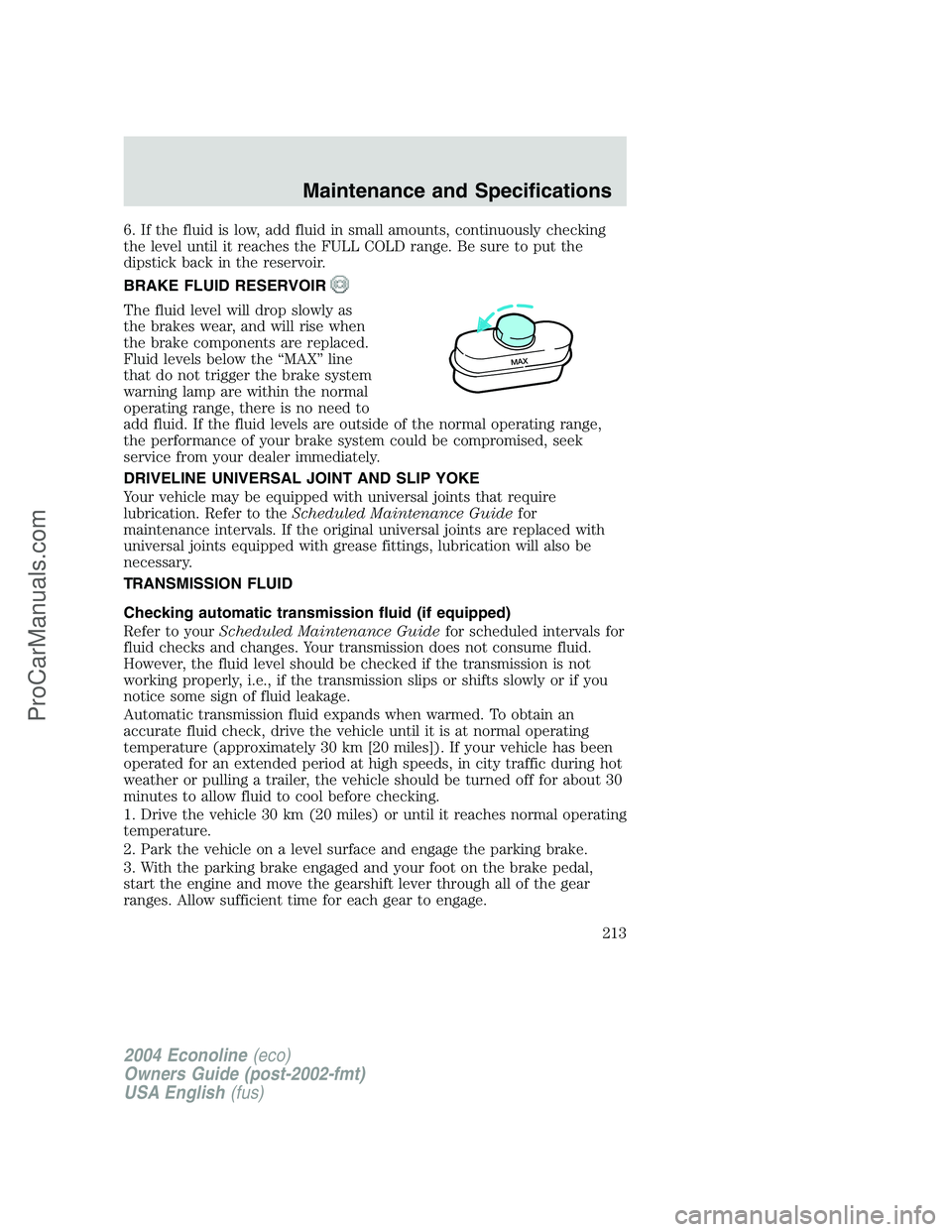
BRAKE FLUID RESERVOIR
The fluid level will drop slowly as
the brakes wear, and will rise when
the brake components are replaced.
Fluid levels below the“MAX”line
that do not trigger the brake system
warning lamp are within the normal
operating range, there is no need to
add fluid. If the fluid levels are outside of the normal operating range,
the performance of your brake system could be compromised, seek
service from your dealer immediately.
DRIVELINE UNIVERSAL JOINT AND SLIP YOKE
Your vehicle may be equipped with universal joints that require
lubrication. Refer to theScheduled Maintenance Guidefor
maintenance intervals. If the original universal joints are replaced with
universal joints equipped with grease fittings, lubrication will also be
necessary.
TRANSMISSION FLUID
Checking automatic transmission fluid (if equipped)
Refer to yourScheduled Maintenance Guidefor scheduled intervals for
fluid checks and changes. Your transmission does not consume fluid.
However, the fluid level should be checked if the transmission is not
working properly, i.e., if the transmission slips or shifts slowly or if you
notice some sign of fluid leakage.
Automatic transmission fluid expands when warmed. To obtain an
accurate fluid check, drive the vehicle until it is at normal operating
temperature (approximately 30 km [20 miles]). If your vehicle has been
operated for an extended period at high speeds, in city traffic during hot
weather or pulling a trailer, the vehicle should be turned off for about 30
minutes to allow fluid to cool before checking.
1. Drive the vehicle 30 km (20 miles) or until it reaches normal operating
temperature.
2. Park the vehicle on a level surface and engage the parking brake.
3. With the parking brake engaged and your foot on the brake pedal,
start the engine and move the gearshift lever through all of the gear
ranges. Allow sufficient time for each gear to engage.
MAX
2004 Econoline(eco)
Owners Guide (post-2002-fmt)
USA English(fus)
Maintenance and Specifications
213
ProCarManuals.com
Page 222 of 256
11.Maximum Load:Indicates the maximum load in kilograms and
pounds that can be carried by the tire. Refer to the tire label or the
safety certification label, which is located on the B-Pillar or the edge of
the driver’s door, for the correct tire pressure for your vehicle
12.Treadwear, Traction and Temperature Grades
•Treadwear:The treadwear grade is a comparative rating based on the
wear rate of the tire when tested under controlled conditions on a
specified government test course. For example, a tire graded 150
would wear one and one-half (1
12) times as well on the government
course as a tire graded 100.
•Traction:The traction grades, from highest to lowest are AA, A, B,
and C. The grades represent the tire’s ability to stop on wet pavement
as measured under controlled conditions on specified government test
surfaces of asphalt and concrete. A tire marked C may have poor
traction performance.
•Temperature:The temperature grades are A (the highest), B and C,
representing the tire’s resistance to the generation of heat and its
ability to dissipate heat when tested under controlled conditions on a
specified indoor laboratory test wheel.
13.Maximum Permissible Inflation Pressure:Indicates the tire
manufacturers’maximum permissible pressure and/or the pressure at
which the maximum load can be carried by the tire. This pressure is
normally higher than the manufacturer’s recommended cold inflation
pressure which can be found on either the tire label or certification label
which is located on the B-Pillar or the edge of the driver’s door. The cold
inflation pressure should never be set lower than the recommended
pressure on the vehicle label.
The tire suppliers may have additional markings, notes or warnings such
as standard load, radial tubeless, etc.
2004 Econoline(eco)
Owners Guide (post-2002-fmt)
USA English(fus)
Maintenance and Specifications
222
ProCarManuals.com
Page 227 of 256
WARNINGAn inflated tire and rim can be very dangerous if
improperly used, serviced or maintained. To reduce the risk of
serious injury, never attempt to re-inflate a tire which has been run flat
or seriously under-inflated without first removing the tire from the
wheel assembly for inspection. Do not attempt to add air to tires or
replace tires or wheels without first taking precautions to protect
persons and property.
Tire and wheel alignment
A bad jolt from hitting a curb or pothole can cause the front end of your
vehicle to become misaligned or cause damage to your tires. If your
vehicle seems to pull to one side when you’re driving, the wheels may be
out of alignment. Have a qualified technician at a Ford or
Lincoln/Mercury dealer check the wheel alignment periodically.
Wheel misalignment in the front or the rear can cause uneven and rapid
treadwear of your tires and should be corrected by a qualified technician
at a Ford or Lincoln/Mercury dealer. Front wheel drive (FWD) vehicles
and those with an independent rear suspension (if equipped) may
require alignment of all four wheels.
The tires should also be balanced periodically. An unbalanced tire and
wheel assembly may result in irregular tire wear.
Tire rotation
Rotating your tires at the recommended interval (as indicated in the
Scheduled Maintenance Guidethat comes with your vehicle) will help
your tires wear more evenly, providing better tire performance and
longer tire life. Unless otherwise specified, rotate the tires approximately
every 5,000 miles (8,000 km).
2004 Econoline(eco)
Owners Guide (post-2002-fmt)
USA English(fus)
Maintenance and Specifications
227
ProCarManuals.com
Page 251 of 256
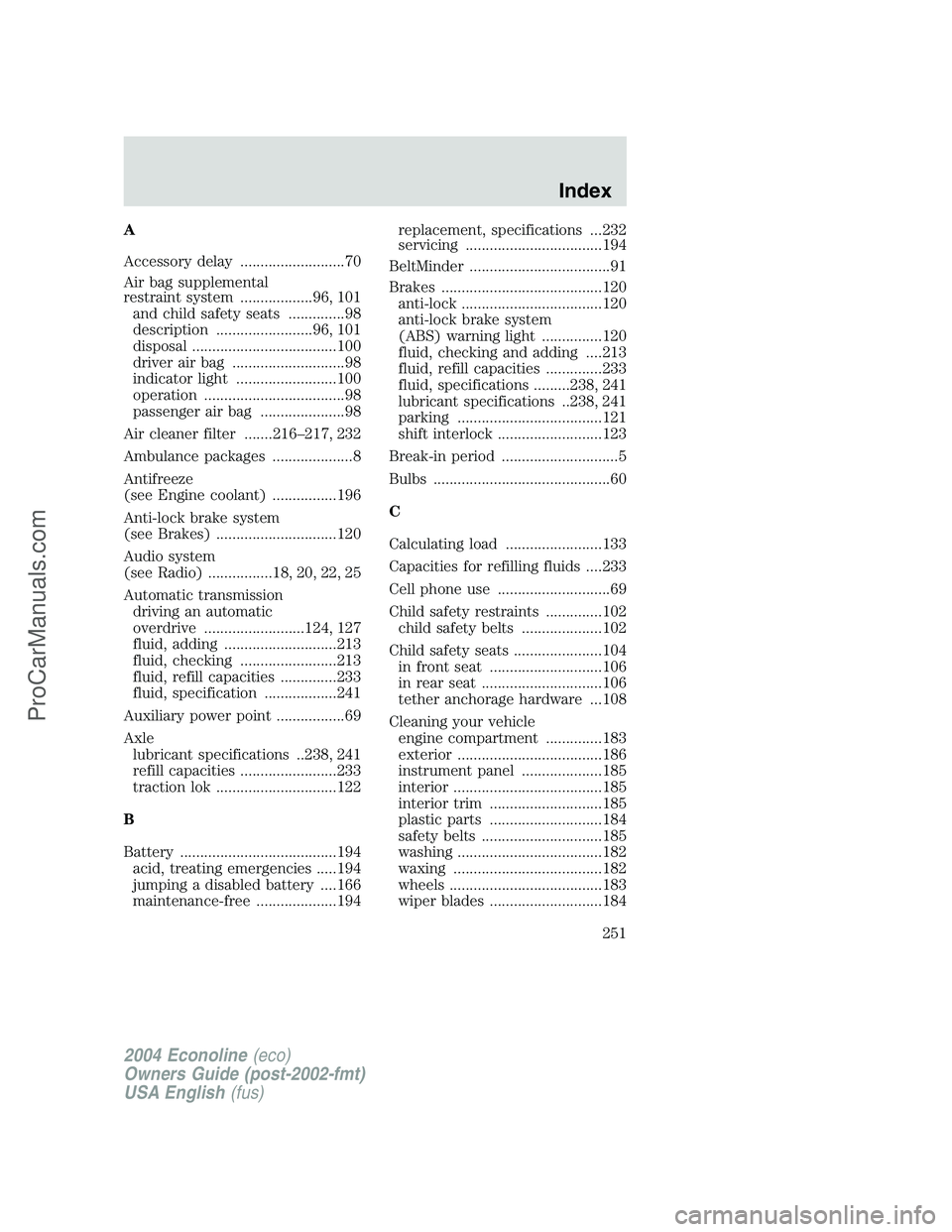
A
Accessory delay ..........................70
Air bag supplemental
restraint system ..................96, 101
and child safety seats ..............98
description ........................96, 101
disposal ....................................100
driver air bag ............................98
indicator light .........................100
operation ...................................98
passenger air bag .....................98
Air cleaner filter .......216–217, 232
Ambulance packages ....................8
Antifreeze
(see Engine coolant) ................196
Anti-lock brake system
(see Brakes) ..............................120
Audio system
(see Radio) ................18, 20, 22, 25
Automatic transmission
driving an automatic
overdrive .........................124, 127
fluid, adding ............................213
fluid, checking ........................213
fluid, refill capacities ..............233
fluid, specification ..................241
Auxiliary power point .................69
Axle
lubricant specifications ..238, 241
refill capacities ........................233
traction lok ..............................122
B
Battery .......................................194
acid, treating emergencies .....194
jumping a disabled battery ....166
maintenance-free ....................194replacement, specifications ...232
servicing ..................................194
BeltMinder ...................................91
Brakes ........................................120
anti-lock ...................................120
anti-lock brake system
(ABS) warning light ...............120
fluid, checking and adding ....213
fluid, refill capacities ..............233
fluid, specifications .........238, 241
lubricant specifications ..238, 241
parking ....................................121
shift interlock ..........................123
Break-in period .............................5
Bulbs ............................................60
C
Calculating load ........................133
Capacities for refilling fluids ....233
Cell phone use ............................69
Child safety restraints ..............102
child safety belts ....................102
Child safety seats ......................104
in front seat ............................106
in rear seat ..............................106
tether anchorage hardware ...108
Cleaning your vehicle
engine compartment ..............183
exterior ....................................186
instrument panel ....................185
interior .....................................185
interior trim ............................185
plastic parts ............................184
safety belts ..............................185
washing ....................................182
waxing .....................................182
wheels ......................................183
wiper blades ............................184
2004 Econoline(eco)
Owners Guide (post-2002-fmt)
USA English(fus)
Index
Index
251
ProCarManuals.com
Page 254 of 256
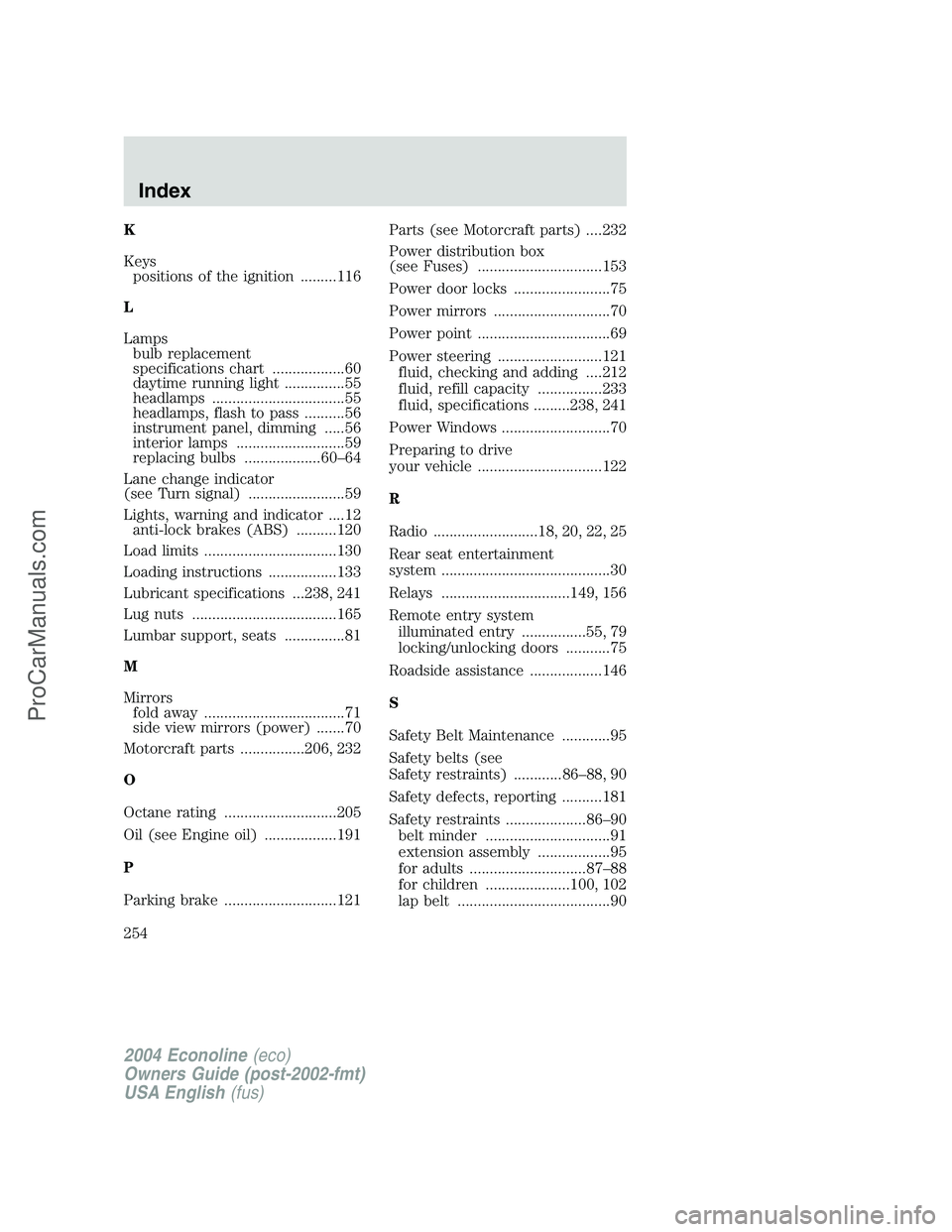
K
Keys
positions of the ignition .........116
L
Lamps
bulb replacement
specifications chart ..................60
daytime running light ...............55
headlamps .................................55
headlamps, flash to pass ..........56
instrument panel, dimming .....56
interior lamps ...........................59
replacing bulbs ...................60–64
Lane change indicator
(see Turn signal) ........................59
Lights, warning and indicator ....12
anti-lock brakes (ABS) ..........120
Load limits .................................130
Loading instructions .................133
Lubricant specifications ...238, 241
Lug nuts ....................................165
Lumbar support, seats ...............81
M
Mirrors
fold away ...................................71
side view mirrors (power) .......70
Motorcraft parts ................206, 232
O
Octane rating ............................205
Oil (see Engine oil) ..................191
P
Parking brake ............................121Parts (see Motorcraft parts) ....232
Power distribution box
(see Fuses) ...............................153
Power door locks ........................75
Power mirrors .............................70
Power point .................................69
Power steering ..........................121
fluid, checking and adding ....212
fluid, refill capacity ................233
fluid, specifications .........238, 241
Power Windows ...........................70
Preparing to drive
your vehicle ...............................122
R
Radio ..........................18, 20, 22, 25
Rear seat entertainment
system ..........................................30
Relays ................................149, 156
Remote entry system
illuminated entry ................55, 79
locking/unlocking doors ...........75
Roadside assistance ..................146
S
Safety Belt Maintenance ............95
Safety belts (see
Safety restraints) ............86–88, 90
Safety defects, reporting ..........181
Safety restraints ....................86–90
belt minder ...............................91
extension assembly ..................95
for adults .............................87–88
for children .....................100, 102
lap belt ......................................90
2004 Econoline(eco)
Owners Guide (post-2002-fmt)
USA English(fus)
Index
254
ProCarManuals.com
Page 255 of 256
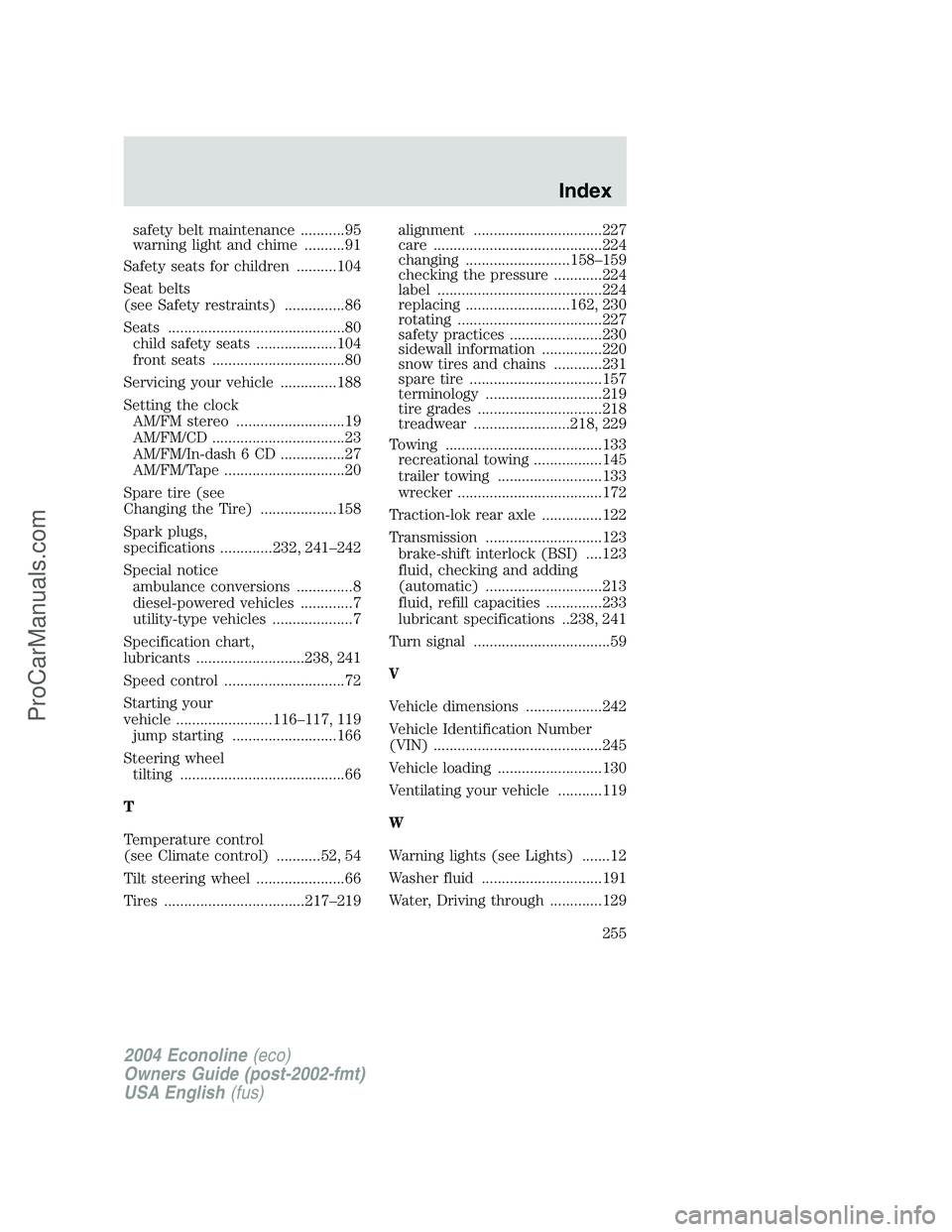
safety belt maintenance ...........95
warning light and chime ..........91
Safety seats for children ..........104
Seat belts
(see Safety restraints) ...............86
Seats ............................................80
child safety seats ....................104
front seats .................................80
Servicing your vehicle ..............188
Setting the clock
AM/FM stereo ...........................19
AM/FM/CD .................................23
AM/FM/In-dash 6 CD ................27
AM/FM/Tape ..............................20
Spare tire (see
Changing the Tire) ...................158
Spark plugs,
specifications .............232, 241–242
Special notice
ambulance conversions ..............8
diesel-powered vehicles .............7
utility-type vehicles ....................7
Specification chart,
lubricants ...........................238, 241
Speed control ..............................72
Starting your
vehicle ........................116–117, 119
jump starting ..........................166
Steering wheel
tilting .........................................66
T
Temperature control
(see Climate control) ...........52, 54
Tilt steering wheel ......................66
Tires ...................................217–219alignment ................................227
care ..........................................224
changing ..........................158–159
checking the pressure ............224
label .........................................224
replacing ..........................162, 230
rotating ....................................227
safety practices .......................230
sidewall information ...............220
snow tires and chains ............231
spare tire .................................157
terminology .............................219
tire grades ...............................218
treadwear ........................218, 229
Towing .......................................133
recreational towing .................145
trailer towing ..........................133
wrecker ....................................172
Traction-lok rear axle ...............122
Transmission .............................123
brake-shift interlock (BSI) ....123
fluid, checking and adding
(automatic) .............................213
fluid, refill capacities ..............233
lubricant specifications ..238, 241
Turn signal ..................................59
V
Vehicle dimensions ...................242
Vehicle Identification Number
(VIN) ..........................................245
Vehicle loading ..........................130
Ventilating your vehicle ...........119
W
Warning lights (see Lights) .......12
Washer fluid ..............................191
Water, Driving through .............129
2004 Econoline(eco)
Owners Guide (post-2002-fmt)
USA English(fus)
Index
255
ProCarManuals.com