air condition FORD E-450 1999 User Guide
[x] Cancel search | Manufacturer: FORD, Model Year: 1999, Model line: E-450, Model: FORD E-450 1999Pages: 208, PDF Size: 2.09 MB
Page 172 of 208
Octane recommendations
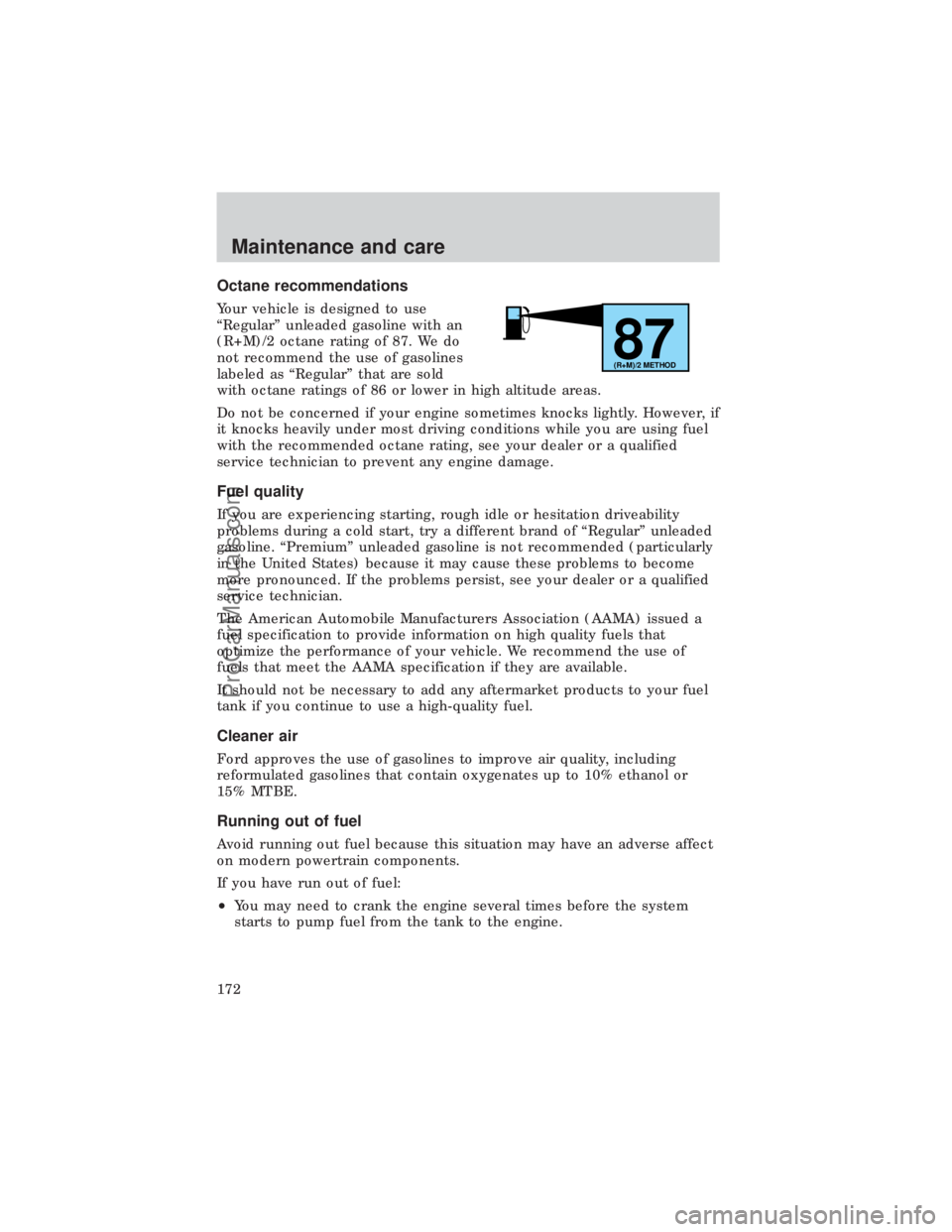
Your vehicle is designed to use
ªRegularº unleaded gasoline with an
(R+M)/2 octane rating of 87. We do
not recommend the use of gasolines
labeled as ªRegularº that are sold
with octane ratings of 86 or lower in high altitude areas.
Do not be concerned if your engine sometimes knocks lightly. However, if
it knocks heavily under most driving conditions while you are using fuel
with the recommended octane rating, see your dealer or a qualified
service technician to prevent any engine damage.
Fuel quality
If you are experiencing starting, rough idle or hesitation driveability
problems during a cold start, try a different brand of ªRegularº unleaded
gasoline. ªPremiumº unleaded gasoline is not recommended (particularly
in the United States) because it may cause these problems to become
more pronounced. If the problems persist, see your dealer or a qualified
service technician.
The American Automobile Manufacturers Association (AAMA) issued a
fuel specification to provide information on high quality fuels that
optimize the performance of your vehicle. We recommend the use of
fuels that meet the AAMA specification if they are available.
It should not be necessary to add any aftermarket products to your fuel
tank if you continue to use a high-quality fuel.
Cleaner air
Ford approves the use of gasolines to improve air quality, including
reformulated gasolines that contain oxygenates up to 10% ethanol or
15% MTBE.
Running out of fuel
Avoid running out fuel because this situation may have an adverse affect
on modern powertrain components.
If you have run out of fuel:
²You may need to crank the engine several times before the system
starts to pump fuel from the tank to the engine.
87(R+M)/2 METHOD
Maintenance and care
172
ProCarManuals.com
Page 176 of 208
Habits
²Smooth, moderate operation can yield up to 10% savings in fuel.
²Steady speeds without stopping will usually give the best fuel
economy.
²Idling for long periods of time (greater than one minute) may waste
fuel.
²Anticipate stopping; slowing down may eliminate the need to stop.
²Sudden or hard accelerations may reduce fuel economy.
²Slow down gradually.
²Drive at reasonable speeds (traveling at 105 km/h [65 mph] uses 15%
more fuel than traveling at 88 km/h [55 mph]).
²Revving the engine before turning it off may reduce fuel economy.
²Use of the air conditioner or defroster may reduce fuel economy.
²Use of speed control (if equipped) may improve fuel economy. Speed
control can help maintain a constant speed and reduce speed changes.
You may want to turn off the speed control in hilly terrain as
unnecessary shifting between third and fourth gears may occur and
could result in reduced fuel economy.
²Warming up a vehicle on cold mornings is not required and may
reduce fuel economy.
²Resting your foot on the brake pedal while driving may reduce fuel
economy.
²Combine errands and minimize stop-and-go driving.
Maintenance
²Keep tires properly inflated and use only recommended size.
²Operating a vehicle with the wheels out of alignment will reduce fuel
economy.
²Use recommended engine oil. Refer toLubricant Specifications.
²Perform all regularly scheduled maintenance items. Follow the
recommended maintenance schedule and owner maintenance checks
found in your vehicle maintenance guide and or service guide.
Maintenance and care
176
ProCarManuals.com
Page 184 of 208
Washing your vehicle
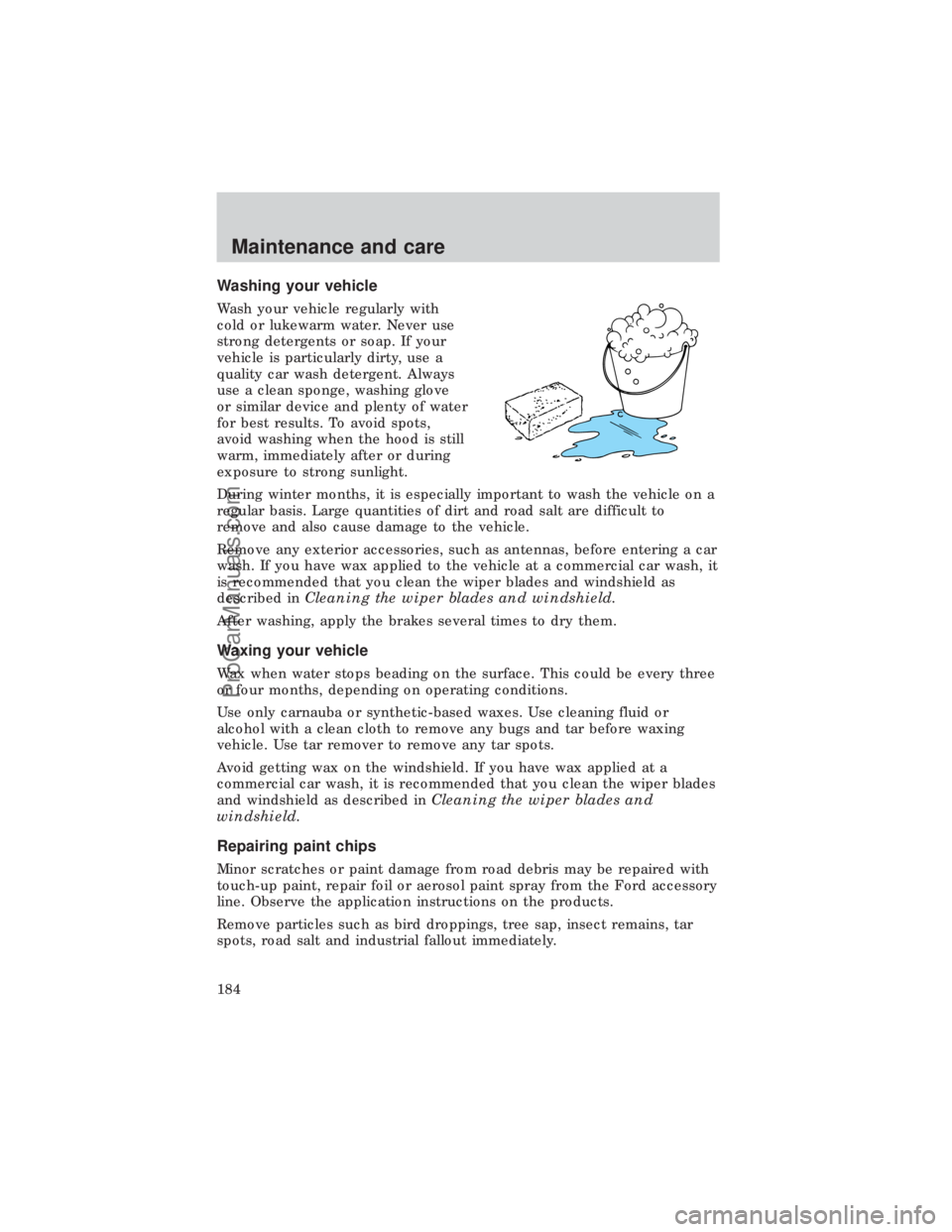
Wash your vehicle regularly with
cold or lukewarm water. Never use
strong detergents or soap. If your
vehicle is particularly dirty, use a
quality car wash detergent. Always
use a clean sponge, washing glove
or similar device and plenty of water
for best results. To avoid spots,
avoid washing when the hood is still
warm, immediately after or during
exposure to strong sunlight.
During winter months, it is especially important to wash the vehicle on a
regular basis. Large quantities of dirt and road salt are difficult to
remove and also cause damage to the vehicle.
Remove any exterior accessories, such as antennas, before entering a car
wash. If you have wax applied to the vehicle at a commercial car wash, it
is recommended that you clean the wiper blades and windshield as
described inCleaning the wiper blades and windshield.
After washing, apply the brakes several times to dry them.
Waxing your vehicle
Wax when water stops beading on the surface. This could be every three
or four months, depending on operating conditions.
Use only carnauba or synthetic-based waxes. Use cleaning fluid or
alcohol with a clean cloth to remove any bugs and tar before waxing
vehicle. Use tar remover to remove any tar spots.
Avoid getting wax on the windshield. If you have wax applied at a
commercial car wash, it is recommended that you clean the wiper blades
and windshield as described inCleaning the wiper blades and
windshield.
Repairing paint chips
Minor scratches or paint damage from road debris may be repaired with
touch-up paint, repair foil or aerosol paint spray from the Ford accessory
line. Observe the application instructions on the products.
Remove particles such as bird droppings, tree sap, insect remains, tar
spots, road salt and industrial fallout immediately.
Maintenance and care
184
ProCarManuals.com
Page 201 of 208
bulb specifications ..................183
high beam ............................11,15
warning chime ..........................11
Heating ........................................16
auxiliary heater and air
conditioner ...........................21,22
heater only system .........16,17,18
heating and air conditioning
system .............................18,19,20
Hood ..........................................146
Ignition .......................................195
Inspection/maintenance
(I/M) testing ..............................179
Instrument panel
cleaning ...................................186
Keys
key in ignition chime ...............11
positions of the ignition ...........56
Lamps
daytime running light ...............15
headlamps .................................15
headlamps, flash to pass ..........16
instrument panel, dimming .....16
interior lamps ...........................63
replacing bulbs ..179,180,181,182
Lane change indicator
(see Turn signal) ........................57
Lights, warning and indicator
air bag ........................................10
anti-lock brakes (ABS) ..............8
brake ............................................8
charging system ........................10
engine oil pressure ...................11
safety belt .................................10
service engine soon .................8,9
turn signal indicator .................10
Lumbar support,
seats ..............................73,74,75,76
Mirrors
side view mirrors (power) .......65
Motorcraft parts ........................174
Octane rating ............................172Odometer .....................................14
Overdrive .....................................62
Panic alarm feature, remote
entry system ................................67
Parking brake ............................105
Power distribution box
(see Fuses) ...............................129
Power door locks ........................64
Power steering ..........................107
fluid, checking and adding ....156
Radio ...................23,24,25,26,27,28
29,30,31,32,33,34,35,36,37
Relays .................................125,131
Remote entry system .................65
illuminated entry ......................70
locking/unlocking doors ......65,66
replacement/additional
transmitters ...............................69
replacing the batteries .............67
Safety belts (see Safety
restraints) ....................................11
Safety restraints
cleaning the safety belts ...82,187
extension assembly ..................81
for children ..........................87,88
lap belt ......................................80
warning light and chime .....11,82
Seat belts (see Safety
restraints) ................76,77,78,79,80
Seats ............................................71
child safety seats ......................89
Servicing your vehicle ..............145
Spark plugs, specifications .......188
Special notice ................................3
ambulance conversions ..............3
diesel-powered vehicles .............4
Specification chart, lubricants .193
Speed control ..............................57
Speedometer ...............................12
Starting your vehicle ...........98,100
jump starting ............139,140,142
Index
201
ProCarManuals.com