tow FORD E-450 1999 User Guide
[x] Cancel search | Manufacturer: FORD, Model Year: 1999, Model line: E-450, Model: FORD E-450 1999Pages: 208, PDF Size: 2.09 MB
Page 75 of 208
Always latch the vehicle seat to the floor, whether the seat is
occupied or empty. If not latched, the seat may cause injury
during a sudden stop.
Quick release captains chair
To remove the seats:
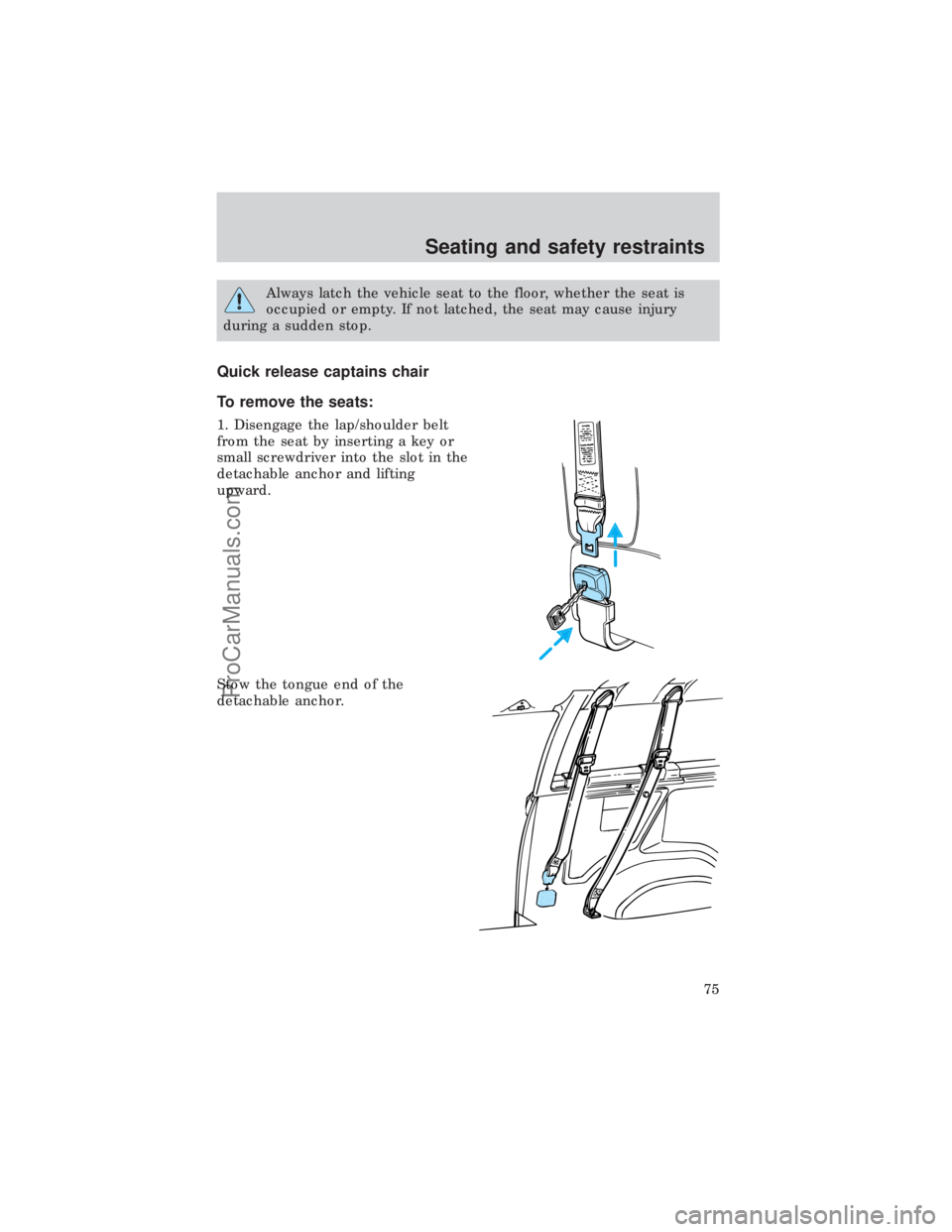
1. Disengage the lap/shoulder belt
from the seat by inserting a key or
small screwdriver into the slot in the
detachable anchor and lifting
upward.
Stow the tongue end of the
detachable anchor.
Seating and safety restraints
75
ProCarManuals.com
Page 76 of 208
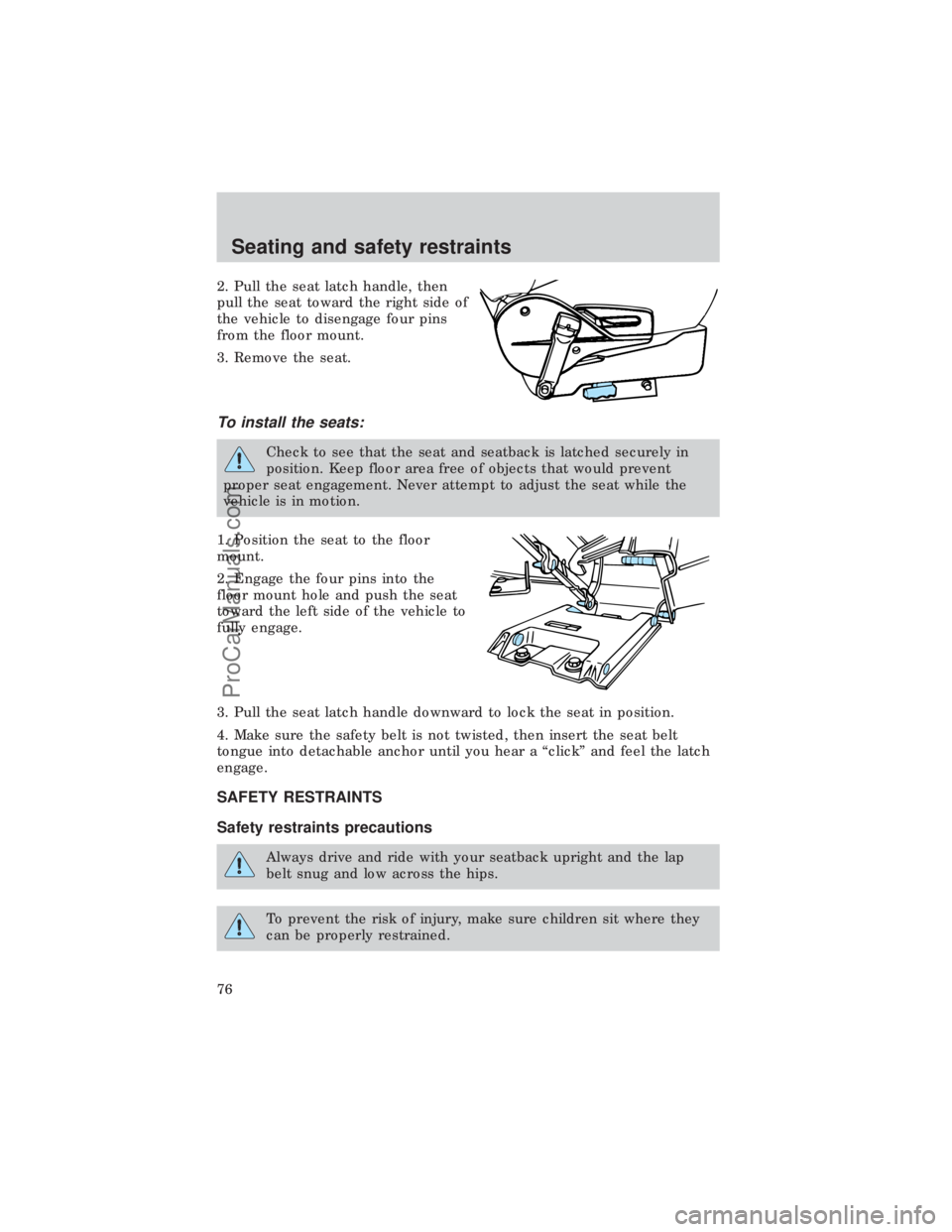
2. Pull the seat latch handle, then
pull the seat toward the right side of
the vehicle to disengage four pins
from the floor mount.
3. Remove the seat.
To install the seats:
Check to see that the seat and seatback is latched securely in
position. Keep floor area free of objects that would prevent
proper seat engagement. Never attempt to adjust the seat while the
vehicle is in motion.
1. Position the seat to the floor
mount.
2. Engage the four pins into the
floor mount hole and push the seat
toward the left side of the vehicle to
fully engage.
3. Pull the seat latch handle downward to lock the seat in position.
4. Make sure the safety belt is not twisted, then insert the seat belt
tongue into detachable anchor until you hear a ªclickº and feel the latch
engage.
SAFETY RESTRAINTS
Safety restraints precautions
Always drive and ride with your seatback upright and the lap
belt snug and low across the hips.
To prevent the risk of injury, make sure children sit where they
can be properly restrained.
Seating and safety restraints
76
ProCarManuals.com
Page 92 of 208
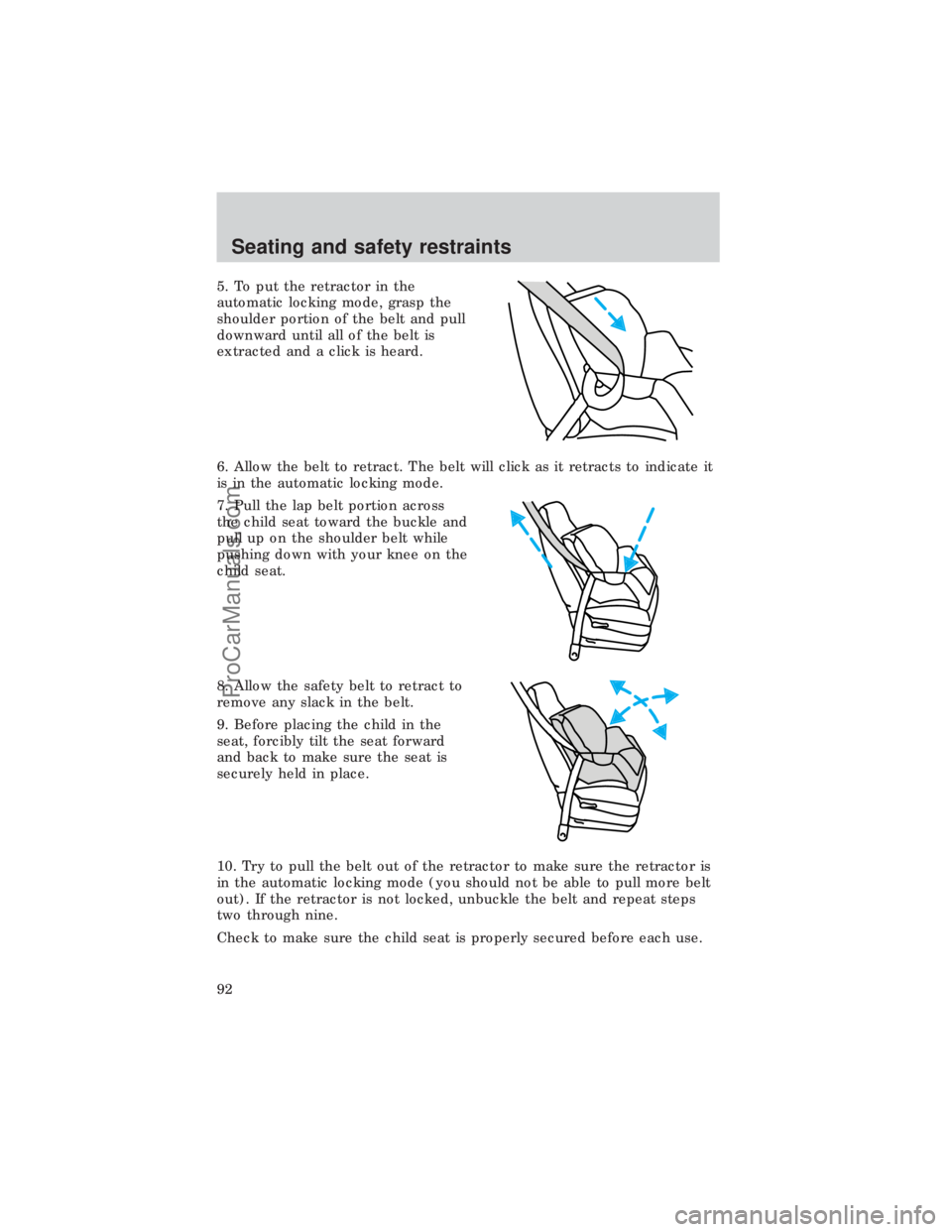
5. To put the retractor in the
automatic locking mode, grasp the
shoulder portion of the belt and pull
downward until all of the belt is
extracted and a click is heard.
6. Allow the belt to retract. The belt will click as it retracts to indicate it
is in the automatic locking mode.
7. Pull the lap belt portion across
the child seat toward the buckle and
pull up on the shoulder belt while
pushing down with your knee on the
child seat.
8. Allow the safety belt to retract to
remove any slack in the belt.
9. Before placing the child in the
seat, forcibly tilt the seat forward
and back to make sure the seat is
securely held in place.
10. Try to pull the belt out of the retractor to make sure the retractor is
in the automatic locking mode (you should not be able to pull more belt
out). If the retractor is not locked, unbuckle the belt and repeat steps
two through nine.
Check to make sure the child seat is properly secured before each use.
Seating and safety restraints
92
ProCarManuals.com
Page 109 of 208
Do not rock the vehicle for more than a few minutes. The
transmission and tires may be damaged or the engine may
overheat.
Always set the parking brake fully and make sure the gearshift is
latched in P (Park). Turn off the ignition whenever you leave
your vehicle.
If the parking brake is fully released, but the brake warning lamp
remains illuminated, the brakes may not be working properly.
See your dealer or a qualified service technician.
Driving with a 4±speed automatic transmission
Understanding gearshift positions
Pull the gearshift lever towards you and downward to move the
automatic gearshift.
Hold the brake pedal down while you move the gearshift lever
from P (Park) to another position. If you do not hold the brake
pedal down, your vehicle may move unexpectedly and injure someone.
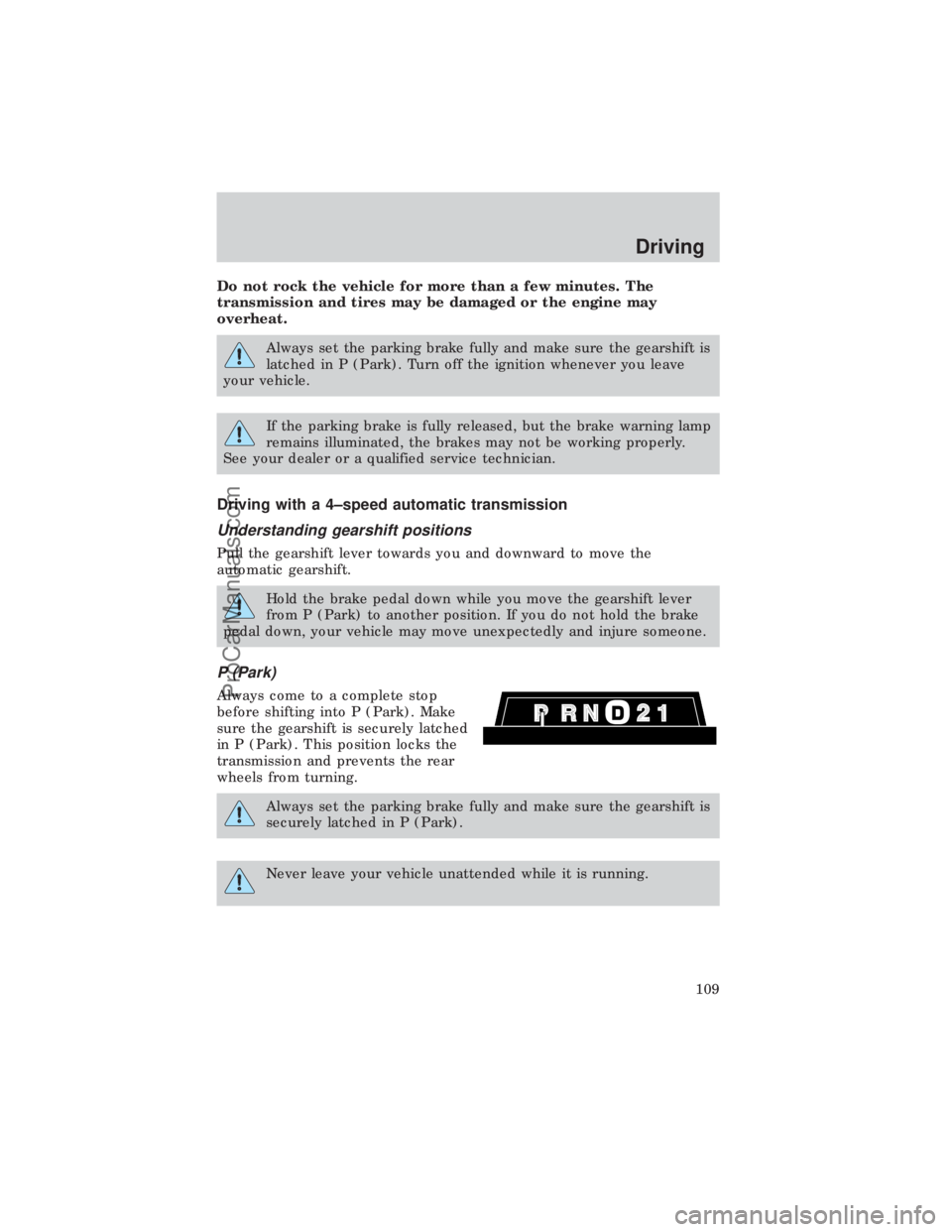
P (Park)
Always come to a complete stop
before shifting into P (Park). Make
sure the gearshift is securely latched
in P (Park). This position locks the
transmission and prevents the rear
wheels from turning.
Always set the parking brake fully and make sure the gearshift is
securely latched in P (Park).
Never leave your vehicle unattended while it is running.
Driving
109
ProCarManuals.com
Page 110 of 208
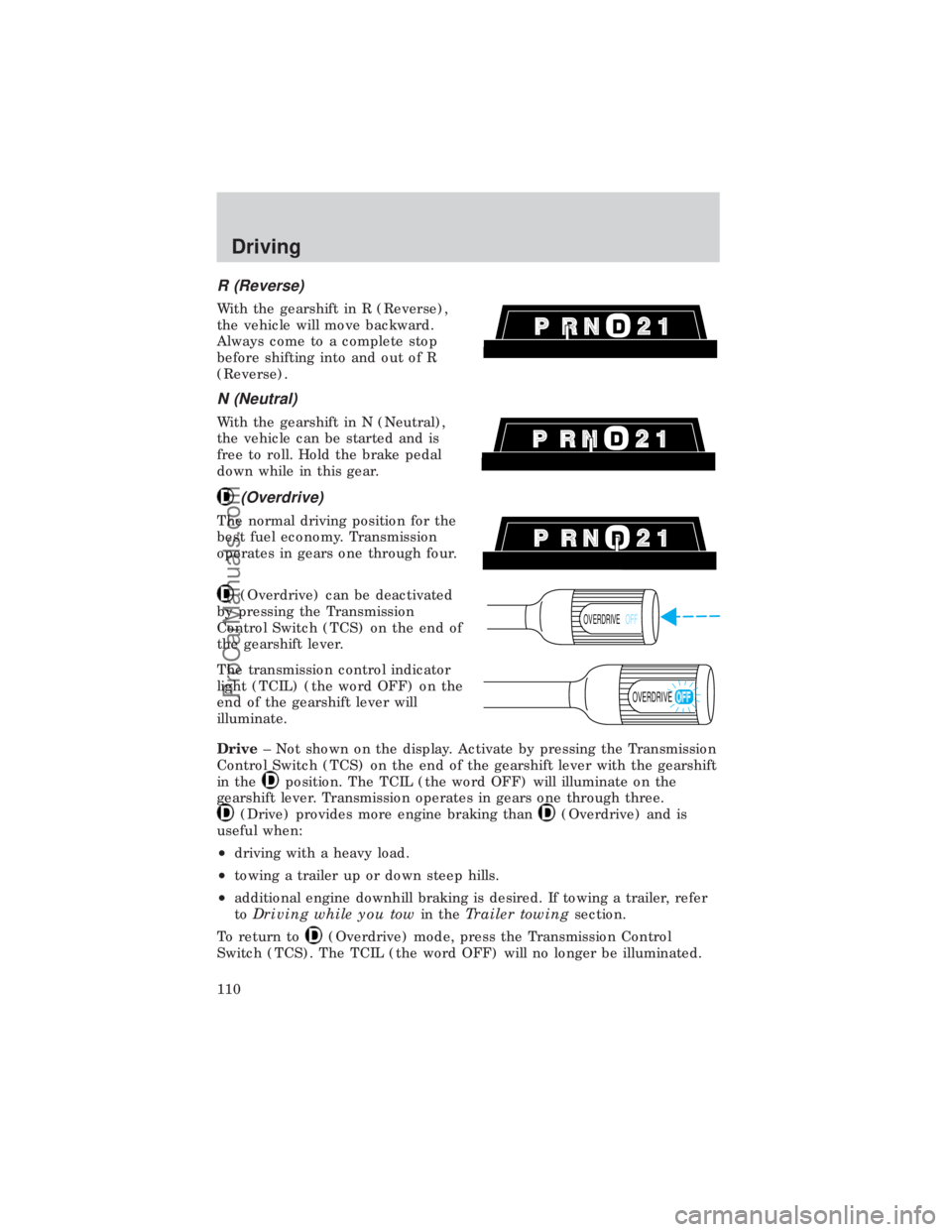
R (Reverse)
With the gearshift in R (Reverse),
the vehicle will move backward.
Always come to a complete stop
before shifting into and out of R
(Reverse).
N (Neutral)
With the gearshift in N (Neutral),
the vehicle can be started and is
free to roll. Hold the brake pedal
down while in this gear.
(Overdrive)
The normal driving position for the
best fuel economy. Transmission
operates in gears one through four.
(Overdrive) can be deactivated
by pressing the Transmission
Control Switch (TCS) on the end of
the gearshift lever.
The transmission control indicator
light (TCIL) (the word OFF) on the
end of the gearshift lever will
illuminate.
Drive± Not shown on the display. Activate by pressing the Transmission
Control Switch (TCS) on the end of the gearshift lever with the gearshift
in the
position. The TCIL (the word OFF) will illuminate on the
gearshift lever. Transmission operates in gears one through three.
(Drive) provides more engine braking than(Overdrive) and is
useful when:
²driving with a heavy load.
²towing a trailer up or down steep hills.
²additional engine downhill braking is desired. If towing a trailer, refer
toDriving while you towin theTrailer towingsection.
To return to
(Overdrive) mode, press the Transmission Control
Switch (TCS). The TCIL (the word OFF) will no longer be illuminated.
OVERDRIVEOFF
OVERDRIVE
Driving
110
ProCarManuals.com
Page 112 of 208
²GCWR (Gross Combined Weight Rating): Maximum combined
weight of towing vehicle (including passengers and cargo) and the
trailer. The GCWR indicates the maximum loaded weight that the
vehicle is designed to tow.
²Maximum Trailer Weight Rating: Maximum weight of a trailer the
vehicle is permitted to tow. The maximum trailer weight rating is
determined by subtracting the vehicle curb weight for each
engine/transmission combination, any required option weight for trailer
towing and the weight of the driver from the GCWR for the towing
vehicle.
²Maximum Trailer Weight: maximum weight of a trailer the loaded
vehicle (including passengers and cargo) is permitted to tow. It is
determined by subtracting the weight of the loaded trailer towing
vehicle from the GCWR for the towing vehicle.
²Trailer Weight Range: Specified weight range that the trailer must
fall within that ranges from zero to the maximum trailer weight rating.
Remember to figure in the tongue load of your loaded trailer when
figuring the total weight.
Do not exceed the GVWR or the GAWR specified on the Safety
Compliance Certification Label.
Do not use replacement tires with lower load carrying capacities than the
originals because they may lower the vehicle's GVWR and GAWR
limitations. Replacement tires with a higher limit than the originals do
not increase the GVWR and GAWR limitations.
The Certification Label, found on the inside pillar of the driver's door,
lists several important vehicle weight rating limitations. Before adding
any additional equipment, refer to these limitations. If you are adding
weight to the front of your vehicle, (potentially including weight added
to the cab), the weight added should not exceed the Front Axle Reserve
Capacity (FARC). Additional frontal weight may be added to the front
axle reserve capacity provided you limit your payload in other ways (i.e.
restrict the number of passengers or amount of cargo carried).
You may add equipment throughout your vehicle if the total weight
added is equal to or less than the Total Axle Reserve Capacity (TARC)
weight. You should NEVER exceed the Total Axle Reserve Capacity.
Always ensure that the weight of passengers, cargo and equipment being
carried is within the weight limitations that have been established for
Driving
112
ProCarManuals.com
Page 113 of 208
your vehicle including both Gross Vehicle Weight and Front and Rear
Gross Axle Weight Rating limits. Under no circumstance should these
limitations be exceeded. Exceeding any vehicle weight rating limitation
could result in serious damage to the vehicle and/or personal injury.
Calculating the load your vehicle can carry/tow
1. Use the appropriate maximum gross combined weight rating (GCWR)
chart to find the maximum GCWR for your type engine and rear axle
ratio.
2. Weigh your vehicle as you customarily operate the vehicle without
cargo. To obtain correct weights, try taking your vehicle to a shipping
company or an inspection station for trucks.
3. Subtract your loaded vehicle weight from the maximum GCWR on the
following charts. This is the maximum trailer weight your vehicle can tow
and must fall below the maximum shown under maximum trailer weight
on the chart.
DRIVING THROUGH WATER
Do not drive quickly through standing water, especially if the depth is
unknown. Traction or brake capability may be limited and if the ignition
system gets wet, your engine may stall. Water may also enter your
engine's air intake and severely damage your engine.
If driving through deep or standing water is unavoidable, proceed very
slowly. Never drive through water that is higher than the bottom of the
hubs.
Once through the water, always try the brakes. Wet brakes do not stop
the vehicle as effectively as dry brakes. Drying can be improved by
moving your vehicle slowly while applying light pressure on the brake
pedal.
Driving through deep water where the transmission is submerged
may allow water into the transmission and cause internal
transmission damage.
TRAILER TOWING
Refer to7.3 Liter Power Stroke Direct Injection Turbo Diesel Owner's
Guide Supplementfor diesel engine towing information.
Your vehicle may tow a class I, II or III trailer provided the maximum
trailer weight is less than or equal to the maximum trailer weight listed
for your engine and rear axle ratio on the following charts.
Driving
113
ProCarManuals.com
Page 114 of 208

Trailer Towing Table
GCWR (Gross Combined Weight Rating)/Trailer Weights
EngineRear
axle
ratioMaximum
GCWR-kg
(lbs.)Trailer weight
range-kg
(lbs.)
(0-Maximum)Maximum
Frontal Area
Of Trailer-m
2
(ft2)
Regular Van E-150
4.2L 3.554 536
(10 000)2 313 (5 100) 5.52 (60)
4.6L 3.555 216
(11 500)2 993 (6 600) 5.52 (60)
5.4L 3.555 443
(12 000)3 130 (6 900) 5.52 (60)
Regular Van E-250
4.2L 3.734 763
(10 500)2 359 (5 200) 5.52 (60)
5.4L 3.735 897
(13 000)3 402 (7 500) 5.52 (60)
Regular Van E-250 HD
(3 901 kg [8 600 lb.]-3 924 kg [8 650 lb.] GVW)
4.2L 4.094 990
(11 000)2 586 (5 700) 5.52 (60)
5.4L 3.735 897
(13 000)3 402 (7 500) 5.52 (60)
Super Van E-250
4.2L 3.734 763
(10 500)2 313 (5 100) 5.52 (60)
5.4L 3.735 897
(13 000)3 357 (7 400) 5.52 (60)
Super Van E-250 HD
(3 901 kg [8 600 lb.]-3 924 kg [8 650 lb.] GVW)
4.2L 4.094 990
(11 000)2 540 (5 600) 5.52 (60)
Driving
114
ProCarManuals.com
Page 115 of 208
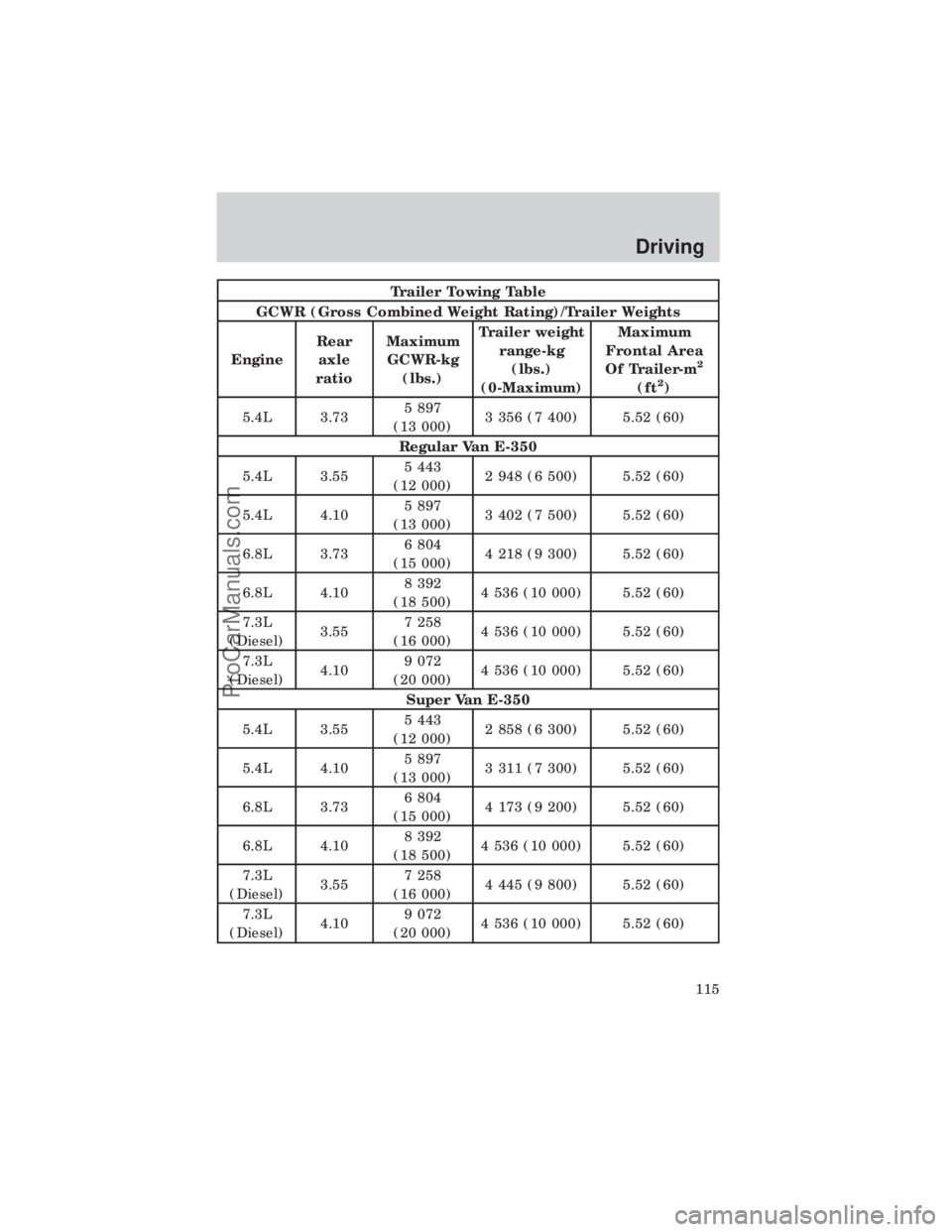
Trailer Towing Table
GCWR (Gross Combined Weight Rating)/Trailer Weights
EngineRear
axle
ratioMaximum
GCWR-kg
(lbs.)Trailer weight
range-kg
(lbs.)
(0-Maximum)Maximum
Frontal Area
Of Trailer-m
2
(ft2)
5.4L 3.735 897
(13 000)3 356 (7 400) 5.52 (60)
Regular Van E-350
5.4L 3.555 443
(12 000)2 948 (6 500) 5.52 (60)
5.4L 4.105 897
(13 000)3 402 (7 500) 5.52 (60)
6.8L 3.736 804
(15 000)4 218 (9 300) 5.52 (60)
6.8L 4.108 392
(18 500)4 536 (10 000) 5.52 (60)
7.3L
(Diesel)3.557 258
(16 000)4 536 (10 000) 5.52 (60)
7.3L
(Diesel)4.109 072
(20 000)4 536 (10 000) 5.52 (60)
Super Van E-350
5.4L 3.555 443
(12 000)2 858 (6 300) 5.52 (60)
5.4L 4.105 897
(13 000)3 311 (7 300) 5.52 (60)
6.8L 3.736 804
(15 000)4 173 (9 200) 5.52 (60)
6.8L 4.108 392
(18 500)4 536 (10 000) 5.52 (60)
7.3L
(Diesel)3.557 258
(16 000)4 445 (9 800) 5.52 (60)
7.3L
(Diesel)4.109 072
(20 000)4 536 (10 000) 5.52 (60)
Driving
115
ProCarManuals.com
Page 116 of 208
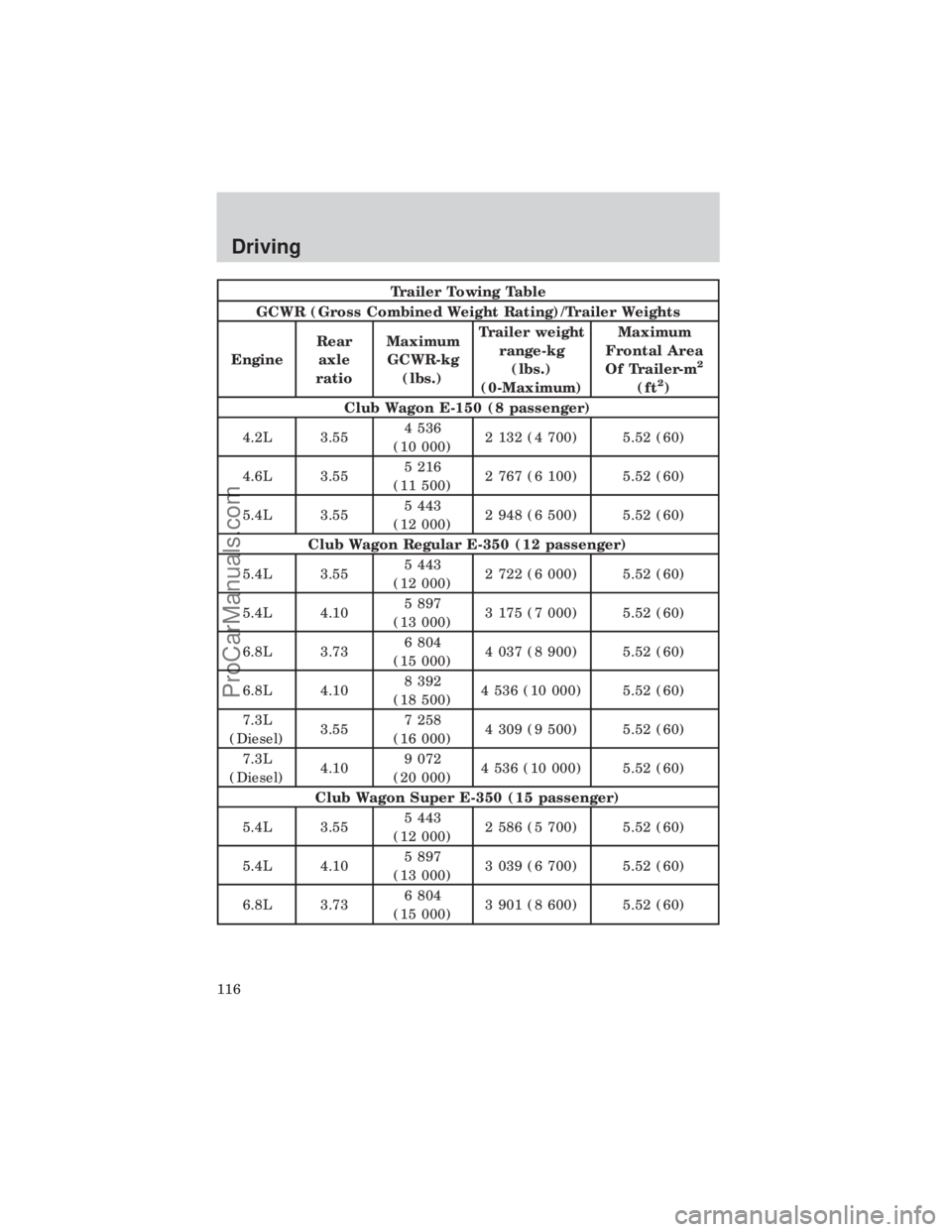
Trailer Towing Table
GCWR (Gross Combined Weight Rating)/Trailer Weights
EngineRear
axle
ratioMaximum
GCWR-kg
(lbs.)Trailer weight
range-kg
(lbs.)
(0-Maximum)Maximum
Frontal Area
Of Trailer-m
2
(ft2)
Club Wagon E-150 (8 passenger)
4.2L 3.554 536
(10 000)2 132 (4 700) 5.52 (60)
4.6L 3.555 216
(11 500)2 767 (6 100) 5.52 (60)
5.4L 3.555 443
(12 000)2 948 (6 500) 5.52 (60)
Club Wagon Regular E-350 (12 passenger)
5.4L 3.555 443
(12 000)2 722 (6 000) 5.52 (60)
5.4L 4.105 897
(13 000)3 175 (7 000) 5.52 (60)
6.8L 3.736 804
(15 000)4 037 (8 900) 5.52 (60)
6.8L 4.108 392
(18 500)4 536 (10 000) 5.52 (60)
7.3L
(Diesel)3.557 258
(16 000)4 309 (9 500) 5.52 (60)
7.3L
(Diesel)4.109 072
(20 000)4 536 (10 000) 5.52 (60)
Club Wagon Super E-350 (15 passenger)
5.4L 3.555 443
(12 000)2 586 (5 700) 5.52 (60)
5.4L 4.105 897
(13 000)3 039 (6 700) 5.52 (60)
6.8L 3.736 804
(15 000)3 901 (8 600) 5.52 (60)
Driving
116
ProCarManuals.com