ignition FORD E-450 1999 Owner's Manual
[x] Cancel search | Manufacturer: FORD, Model Year: 1999, Model line: E-450, Model: FORD E-450 1999Pages: 208, PDF Size: 2.09 MB
Page 106 of 208
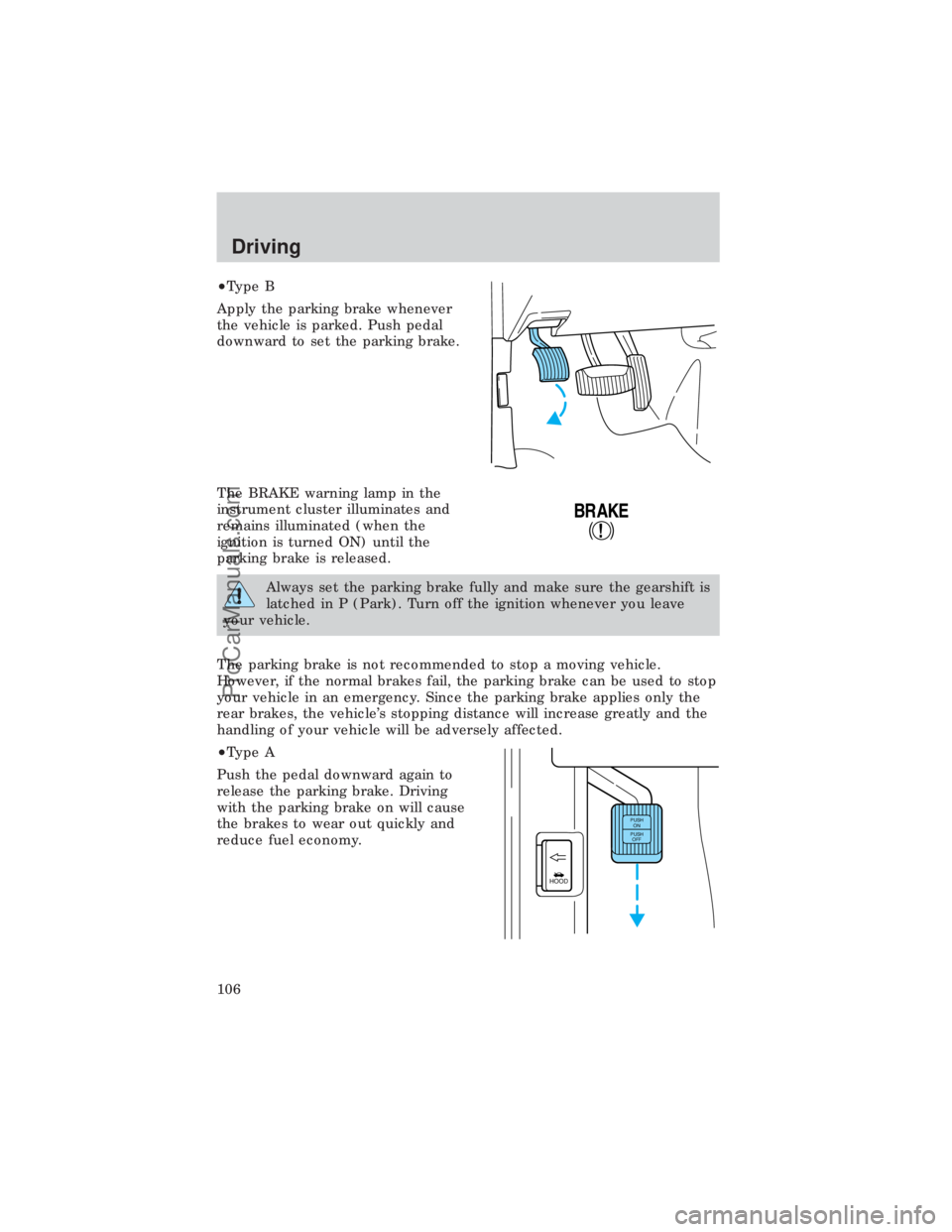
²Type B
Apply the parking brake whenever
the vehicle is parked. Push pedal
downward to set the parking brake.
The BRAKE warning lamp in the
instrument cluster illuminates and
remains illuminated (when the
ignition is turned ON) until the
parking brake is released.
Always set the parking brake fully and make sure the gearshift is
latched in P (Park). Turn off the ignition whenever you leave
your vehicle.
The parking brake is not recommended to stop a moving vehicle.
However, if the normal brakes fail, the parking brake can be used to stop
your vehicle in an emergency. Since the parking brake applies only the
rear brakes, the vehicle's stopping distance will increase greatly and the
handling of your vehicle will be adversely affected.
²Type A
Push the pedal downward again to
release the parking brake. Driving
with the parking brake on will cause
the brakes to wear out quickly and
reduce fuel economy.
!
BRAKE
HOOD
PUSH
ON
PUSH
OFF
Driving
106
ProCarManuals.com
Page 108 of 208
TRACTION-LOK AXLE (IF EQUIPPED)
This axle provides added traction on slippery surfaces, particularly when
one wheel is on a poor traction surface. Under normal conditions, the
Traction-Lok axle functions like a standard rear axle.
Extended use of other than the manufacturer's specified size tires on a
Traction-Lok rear axle could result in a permanent reduction in
effectiveness. This loss of effectiveness does not affect normal driving
and should not be noticeable to the driver.
To avoid injury, never run the engine with one wheel off the
ground, such as when changing a tire.
TRANSMISSION OPERATION
Brake-shift interlock
This vehicle is equipped with a brake-shift interlock feature that prevents
the gearshift from being moved from P (Park) unless the brake pedal is
depressed.
If you cannot move the gearshift out of P (Park) with the brake pedal
depressed:
1. Apply the parking brake, turn ignition key to LOCK, then remove the
key.
2. Insert the key and turn it to OFF. Apply the brake pedal and shift to N
(Neutral).
3. Start the vehicle.
If it is necessary to use the above procedure to move the gearshift, it is
possible that a fuse has blown or the vehicle's brakelamps are not
operating properly. Refer toFuses and relaysin theRoadside
emergencieschapter.
Do not drive your vehicle until you verify that the brakelamps
are working.
If your vehicle gets stuck in mud or snow it may be rocked out by
shifting from forward and reverse gears, stopping between shifts, in a
steady pattern. Press lightly on the accelerator in each gear.
Driving
108
ProCarManuals.com
Page 109 of 208
Do not rock the vehicle for more than a few minutes. The
transmission and tires may be damaged or the engine may
overheat.
Always set the parking brake fully and make sure the gearshift is
latched in P (Park). Turn off the ignition whenever you leave
your vehicle.
If the parking brake is fully released, but the brake warning lamp
remains illuminated, the brakes may not be working properly.
See your dealer or a qualified service technician.
Driving with a 4±speed automatic transmission
Understanding gearshift positions
Pull the gearshift lever towards you and downward to move the
automatic gearshift.
Hold the brake pedal down while you move the gearshift lever
from P (Park) to another position. If you do not hold the brake
pedal down, your vehicle may move unexpectedly and injure someone.
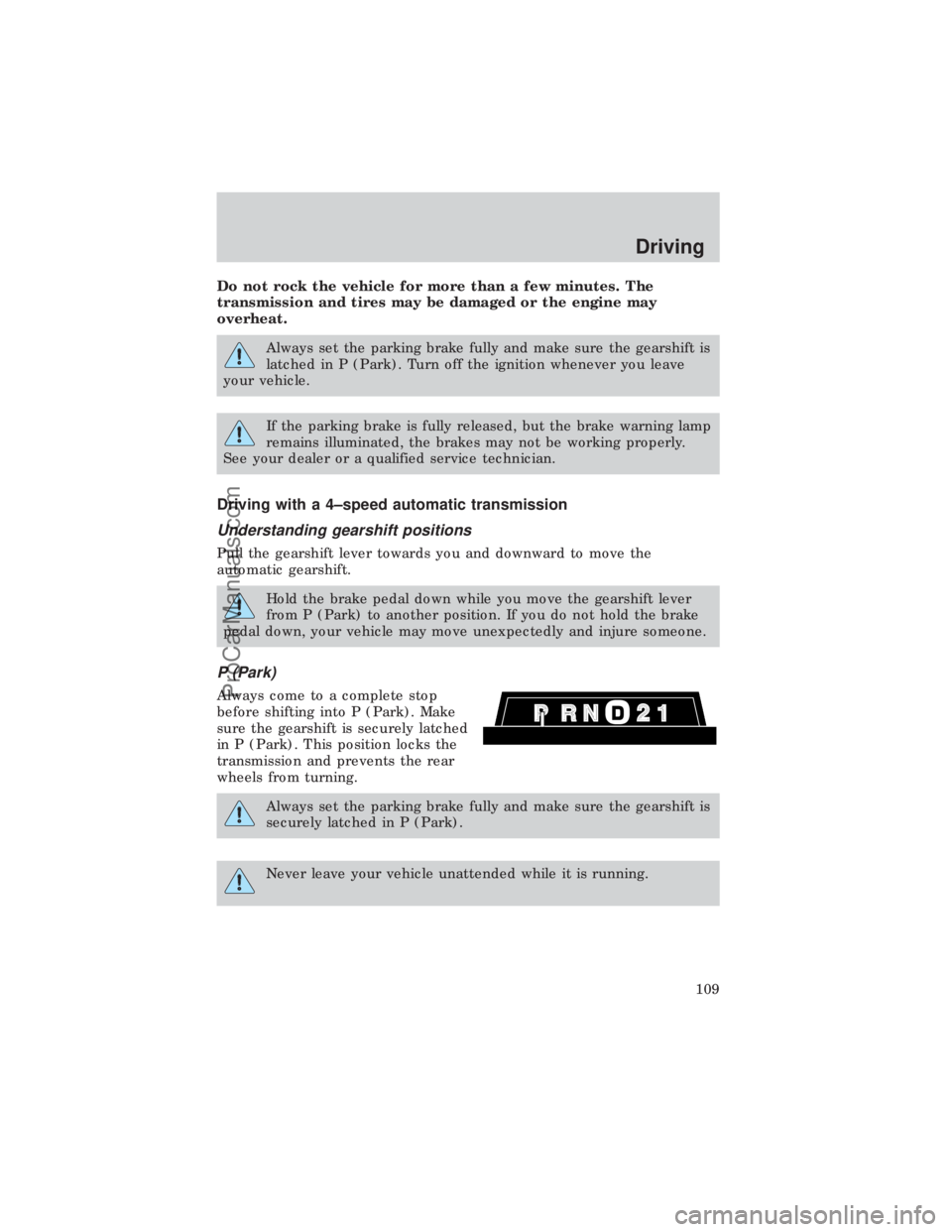
P (Park)
Always come to a complete stop
before shifting into P (Park). Make
sure the gearshift is securely latched
in P (Park). This position locks the
transmission and prevents the rear
wheels from turning.
Always set the parking brake fully and make sure the gearshift is
securely latched in P (Park).
Never leave your vehicle unattended while it is running.
Driving
109
ProCarManuals.com
Page 113 of 208
your vehicle including both Gross Vehicle Weight and Front and Rear
Gross Axle Weight Rating limits. Under no circumstance should these
limitations be exceeded. Exceeding any vehicle weight rating limitation
could result in serious damage to the vehicle and/or personal injury.
Calculating the load your vehicle can carry/tow
1. Use the appropriate maximum gross combined weight rating (GCWR)
chart to find the maximum GCWR for your type engine and rear axle
ratio.
2. Weigh your vehicle as you customarily operate the vehicle without
cargo. To obtain correct weights, try taking your vehicle to a shipping
company or an inspection station for trucks.
3. Subtract your loaded vehicle weight from the maximum GCWR on the
following charts. This is the maximum trailer weight your vehicle can tow
and must fall below the maximum shown under maximum trailer weight
on the chart.
DRIVING THROUGH WATER
Do not drive quickly through standing water, especially if the depth is
unknown. Traction or brake capability may be limited and if the ignition
system gets wet, your engine may stall. Water may also enter your
engine's air intake and severely damage your engine.
If driving through deep or standing water is unavoidable, proceed very
slowly. Never drive through water that is higher than the bottom of the
hubs.
Once through the water, always try the brakes. Wet brakes do not stop
the vehicle as effectively as dry brakes. Drying can be improved by
moving your vehicle slowly while applying light pressure on the brake
pedal.
Driving through deep water where the transmission is submerged
may allow water into the transmission and cause internal
transmission damage.
TRAILER TOWING
Refer to7.3 Liter Power Stroke Direct Injection Turbo Diesel Owner's
Guide Supplementfor diesel engine towing information.
Your vehicle may tow a class I, II or III trailer provided the maximum
trailer weight is less than or equal to the maximum trailer weight listed
for your engine and rear axle ratio on the following charts.
Driving
113
ProCarManuals.com
Page 123 of 208
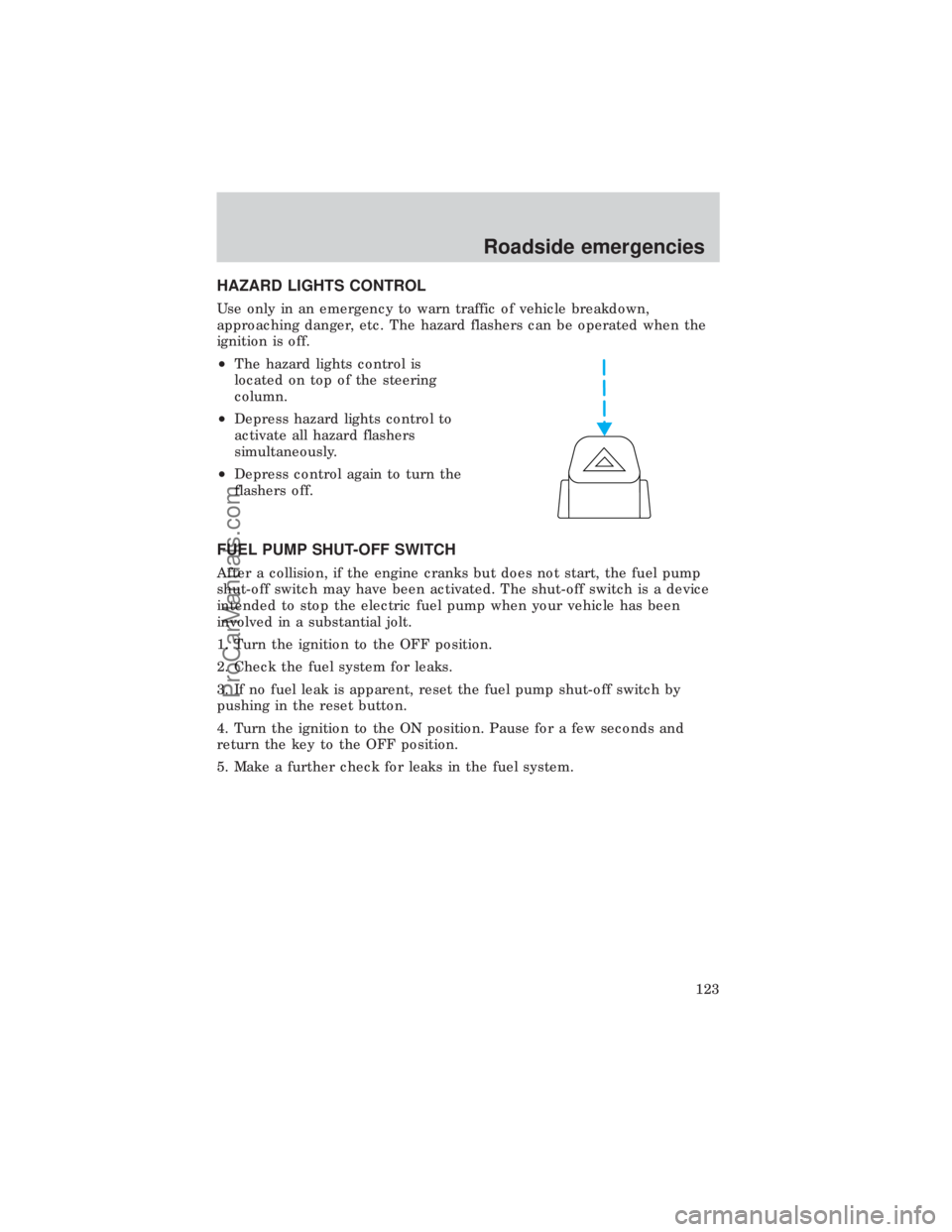
HAZARD LIGHTS CONTROL
Use only in an emergency to warn traffic of vehicle breakdown,
approaching danger, etc. The hazard flashers can be operated when the
ignition is off.
²The hazard lights control is
located on top of the steering
column.
²Depress hazard lights control to
activate all hazard flashers
simultaneously.
²Depress control again to turn the
flashers off.
FUEL PUMP SHUT-OFF SWITCH
After a collision, if the engine cranks but does not start, the fuel pump
shut-off switch may have been activated. The shut-off switch is a device
intended to stop the electric fuel pump when your vehicle has been
involved in a substantial jolt.
1. Turn the ignition to the OFF position.
2. Check the fuel system for leaks.
3. If no fuel leak is apparent, reset the fuel pump shut-off switch by
pushing in the reset button.
4. Turn the ignition to the ON position. Pause for a few seconds and
return the key to the OFF position.
5. Make a further check for leaks in the fuel system.
Roadside emergencies
123
ProCarManuals.com
Page 128 of 208
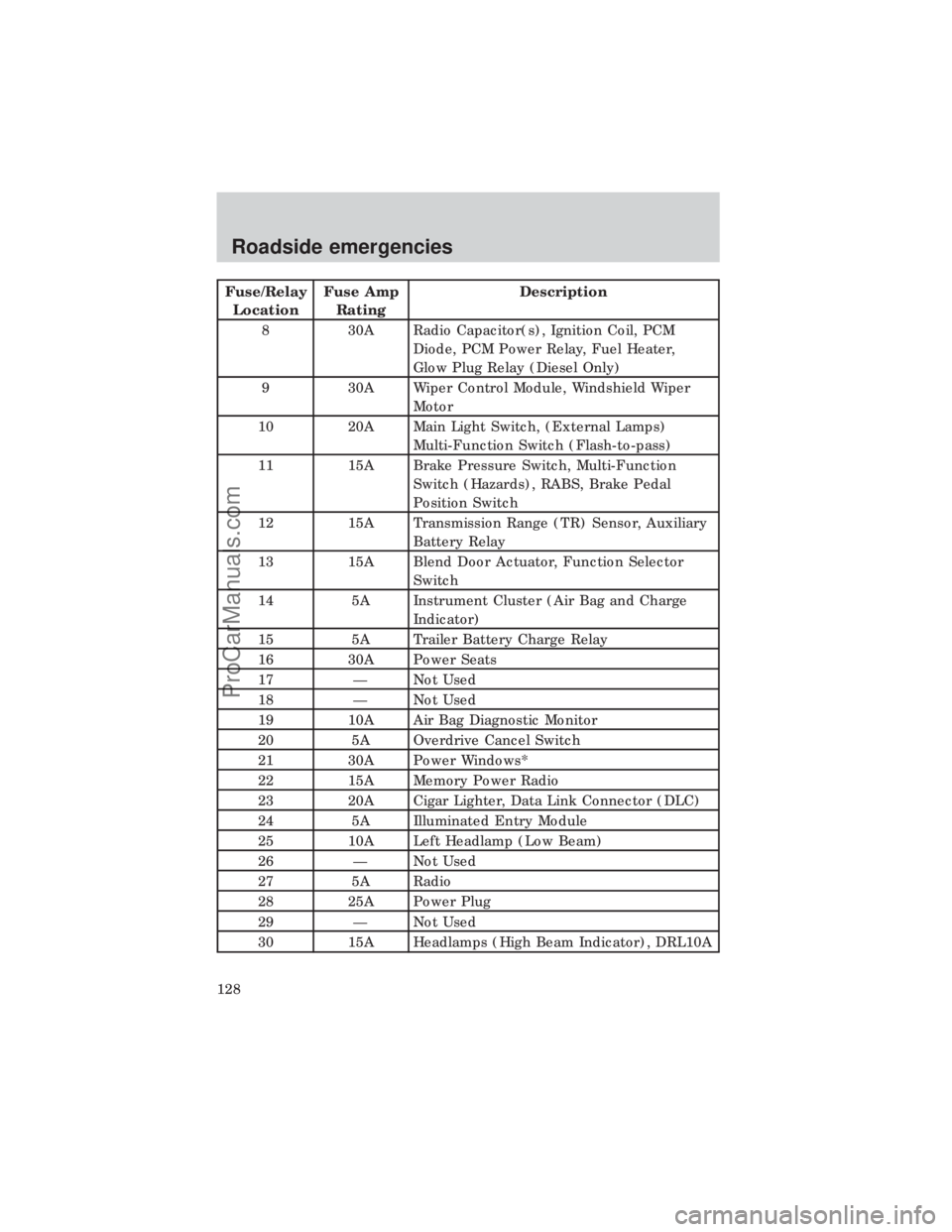
Fuse/Relay
LocationFuse Amp
RatingDescription
8 30A Radio Capacitor(s), Ignition Coil, PCM
Diode, PCM Power Relay, Fuel Heater,
Glow Plug Relay (Diesel Only)
9 30A Wiper Control Module, Windshield Wiper
Motor
10 20A Main Light Switch, (External Lamps)
Multi-Function Switch (Flash-to-pass)
11 15A Brake Pressure Switch, Multi-Function
Switch (Hazards), RABS, Brake Pedal
Position Switch
12 15A Transmission Range (TR) Sensor, Auxiliary
Battery Relay
13 15A Blend Door Actuator, Function Selector
Switch
14 5A Instrument Cluster (Air Bag and Charge
Indicator)
15 5A Trailer Battery Charge Relay
16 30A Power Seats
17 Ð Not Used
18 Ð Not Used
19 10A Air Bag Diagnostic Monitor
20 5A Overdrive Cancel Switch
21 30A Power Windows*
22 15A Memory Power Radio
23 20A Cigar Lighter, Data Link Connector (DLC)
24 5A Illuminated Entry Module
25 10A Left Headlamp (Low Beam)
26 Ð Not Used
27 5A Radio
28 25A Power Plug
29 Ð Not Used
30 15A Headlamps (High Beam Indicator), DRL10A
Roadside emergencies
128
ProCarManuals.com
Page 131 of 208
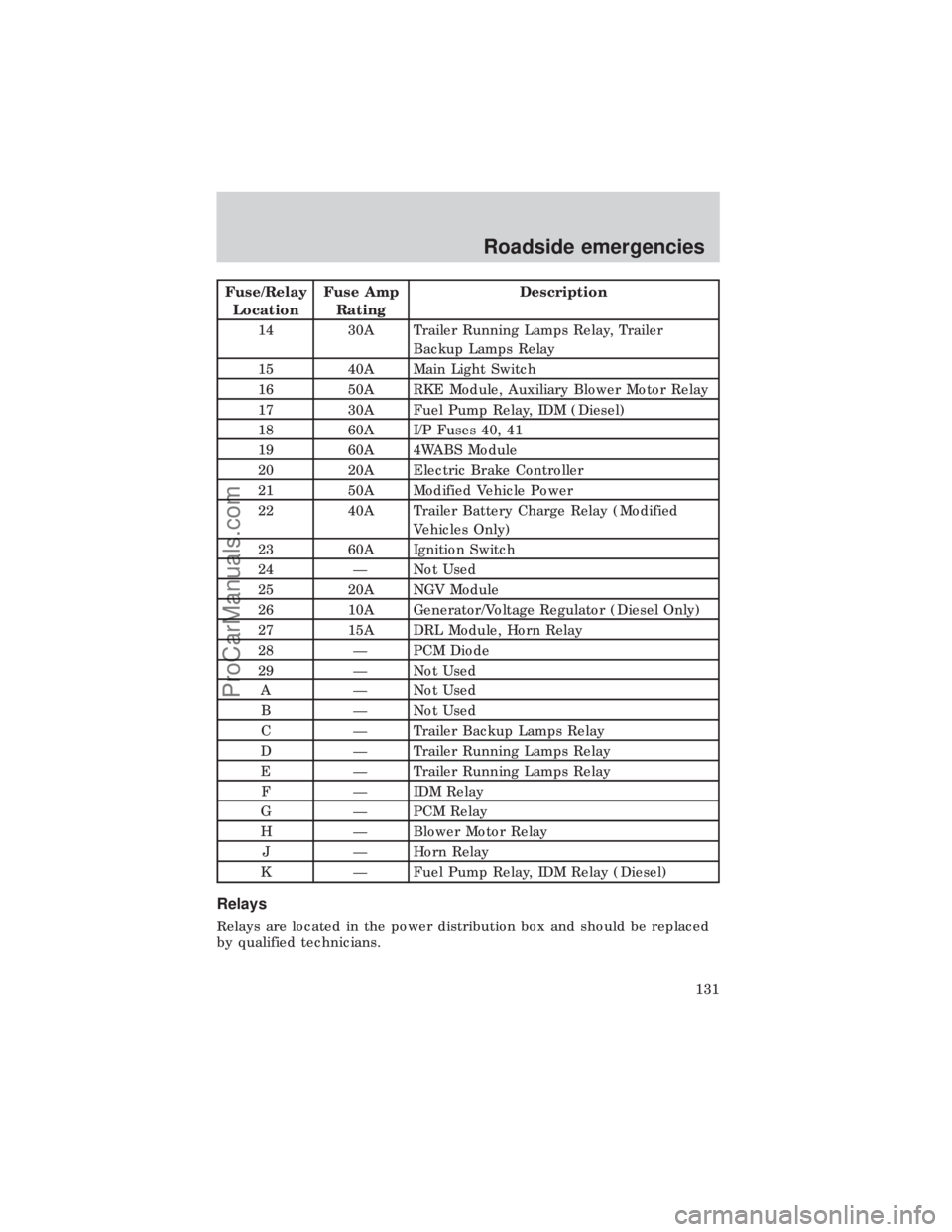
Fuse/Relay
LocationFuse Amp
RatingDescription
14 30A Trailer Running Lamps Relay, Trailer
Backup Lamps Relay
15 40A Main Light Switch
16 50A RKE Module, Auxiliary Blower Motor Relay
17 30A Fuel Pump Relay, IDM (Diesel)
18 60A I/P Fuses 40, 41
19 60A 4WABS Module
20 20A Electric Brake Controller
21 50A Modified Vehicle Power
22 40A Trailer Battery Charge Relay (Modified
Vehicles Only)
23 60A Ignition Switch
24 Ð Not Used
25 20A NGV Module
26 10A Generator/Voltage Regulator (Diesel Only)
27 15A DRL Module, Horn Relay
28 Ð PCM Diode
29 Ð Not Used
A Ð Not Used
B Ð Not Used
C Ð Trailer Backup Lamps Relay
D Ð Trailer Running Lamps Relay
E Ð Trailer Running Lamps Relay
F Ð IDM Relay
G Ð PCM Relay
H Ð Blower Motor Relay
J Ð Horn Relay
K Ð Fuel Pump Relay, IDM Relay (Diesel)
Relays
Relays are located in the power distribution box and should be replaced
by qualified technicians.
Roadside emergencies
131
ProCarManuals.com
Page 178 of 208
EMISSION CONTROL SYSTEM
Your vehicle is equipped with various emission control components and a
catalytic converter which will enable your vehicle to comply with
applicable exhaust emission standards. To make sure that the catalytic
converter and other emission control components continue to work
properly:
²Use only unleaded fuel.
²Avoid running out of fuel.
²Do not turn off the ignition while your vehicle is moving, especially at
high speeds.
²Have the items listed in your maintenance guide and or service guide
performed according to the specified schedule.
The scheduled maintenance items listed in the maintenance guide and or
service guide are essential to the life and performance of your vehicle
and to its emissions system.
If other than Ford, Motorcraft or Ford-authorized parts are used for
maintenance replacements or for service of components affecting
emission control, such non-Ford parts should be equivalent to genuine
Ford Motor Company parts in performance and durability.
Do not park, idle, or drive your vehicle in dry grass or other dry
ground cover. The emission system heats up the engine
compartment and exhaust system, which can start a fire.
Illumination of the charging system warning light, ªService Engine Soonº
light or the temperature warning light, fluid leaks, strange odors, smoke
or loss of oil pressure, could indicate that the emission control system is
not working properly.
Exhaust leaks may result in entry of harmful and potentially
lethal fumes into the passenger compartment.
Do not make any unauthorized changes to your vehicle or engine. By
law, vehicle owners and anyone who manufactures, repairs, items, sells,
leases, trades vehicles, or supervises a fleet of vehicles are not permitted
to intentionally remove an emission control device or prevent it from
working. Information about your vehicle's emission system is on the
Vehicle Emission Control Information Decal located on or near the
Maintenance and care
178
ProCarManuals.com
Page 195 of 208
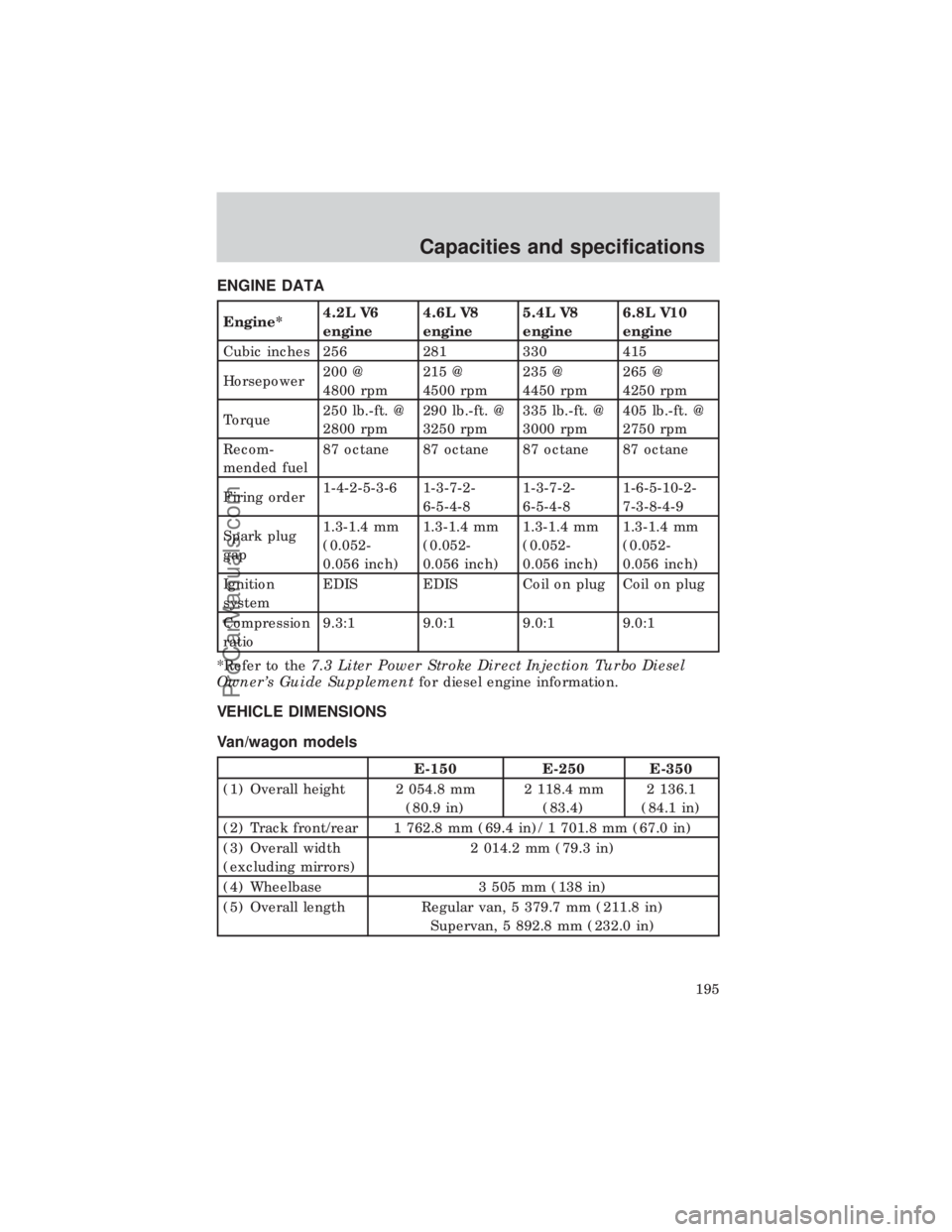
ENGINE DATA
Engine*4.2L V6
engine4.6L V8
engine5.4L V8
engine6.8L V10
engine
Cubic inches 256 281 330 415
Horsepower200 @
4800 rpm215 @
4500 rpm235 @
4450 rpm265 @
4250 rpm
Torque250 lb.-ft. @
2800 rpm290 lb.-ft. @
3250 rpm335 lb.-ft. @
3000 rpm405 lb.-ft. @
2750 rpm
Recom-
mended fuel87 octane 87 octane 87 octane 87 octane
Firing order1-4-2-5-3-6 1-3-7-2-
6-5-4-81-3-7-2-
6-5-4-81-6-5-10-2-
7-3-8-4-9
Spark plug
gap1.3-1.4 mm
(0.052-
0.056 inch)1.3-1.4 mm
(0.052-
0.056 inch)1.3-1.4 mm
(0.052-
0.056 inch)1.3-1.4 mm
(0.052-
0.056 inch)
Ignition
systemEDIS EDIS Coil on plug Coil on plug
Compression
ratio9.3:1 9.0:1 9.0:1 9.0:1
*Refer to the7.3 Liter Power Stroke Direct Injection Turbo Diesel
Owner's Guide Supplementfor diesel engine information.
VEHICLE DIMENSIONS
Van/wagon models
E-150 E-250 E-350
(1) Overall height 2 054.8 mm
(80.9 in)2 118.4 mm
(83.4)2 136.1
(84.1 in)
(2) Track front/rear 1 762.8 mm (69.4 in)/ 1 701.8 mm (67.0 in)
(3) Overall width
(excluding mirrors)2 014.2 mm (79.3 in)
(4) Wheelbase 3 505 mm (138 in)
(5) Overall length Regular van, 5 379.7 mm (211.8 in)
Supervan, 5 892.8 mm (232.0 in)
Capacities and specifications
195
ProCarManuals.com
Page 201 of 208
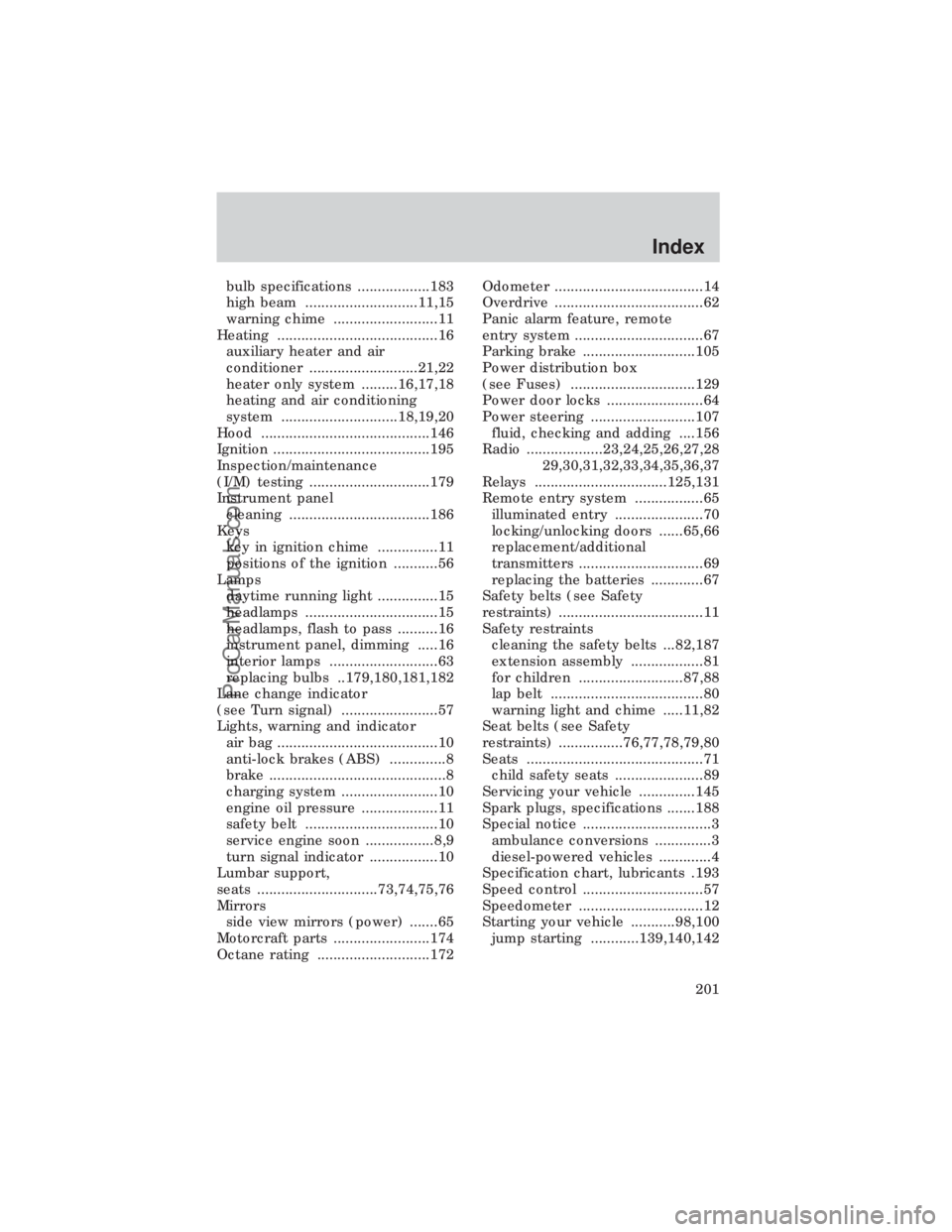
bulb specifications ..................183
high beam ............................11,15
warning chime ..........................11
Heating ........................................16
auxiliary heater and air
conditioner ...........................21,22
heater only system .........16,17,18
heating and air conditioning
system .............................18,19,20
Hood ..........................................146
Ignition .......................................195
Inspection/maintenance
(I/M) testing ..............................179
Instrument panel
cleaning ...................................186
Keys
key in ignition chime ...............11
positions of the ignition ...........56
Lamps
daytime running light ...............15
headlamps .................................15
headlamps, flash to pass ..........16
instrument panel, dimming .....16
interior lamps ...........................63
replacing bulbs ..179,180,181,182
Lane change indicator
(see Turn signal) ........................57
Lights, warning and indicator
air bag ........................................10
anti-lock brakes (ABS) ..............8
brake ............................................8
charging system ........................10
engine oil pressure ...................11
safety belt .................................10
service engine soon .................8,9
turn signal indicator .................10
Lumbar support,
seats ..............................73,74,75,76
Mirrors
side view mirrors (power) .......65
Motorcraft parts ........................174
Octane rating ............................172Odometer .....................................14
Overdrive .....................................62
Panic alarm feature, remote
entry system ................................67
Parking brake ............................105
Power distribution box
(see Fuses) ...............................129
Power door locks ........................64
Power steering ..........................107
fluid, checking and adding ....156
Radio ...................23,24,25,26,27,28
29,30,31,32,33,34,35,36,37
Relays .................................125,131
Remote entry system .................65
illuminated entry ......................70
locking/unlocking doors ......65,66
replacement/additional
transmitters ...............................69
replacing the batteries .............67
Safety belts (see Safety
restraints) ....................................11
Safety restraints
cleaning the safety belts ...82,187
extension assembly ..................81
for children ..........................87,88
lap belt ......................................80
warning light and chime .....11,82
Seat belts (see Safety
restraints) ................76,77,78,79,80
Seats ............................................71
child safety seats ......................89
Servicing your vehicle ..............145
Spark plugs, specifications .......188
Special notice ................................3
ambulance conversions ..............3
diesel-powered vehicles .............4
Specification chart, lubricants .193
Speed control ..............................57
Speedometer ...............................12
Starting your vehicle ...........98,100
jump starting ............139,140,142
Index
201
ProCarManuals.com