tires FORD E-450 2002 User Guide
[x] Cancel search | Manufacturer: FORD, Model Year: 2002, Model line: E-450, Model: FORD E-450 2002Pages: 256, PDF Size: 3.52 MB
Page 231 of 256
Treadwear
The treadwear grade is a comparative rating based on the wear rate of
the tire when tested under controlled conditions on a specified
government test course. For example, a tire graded 150 would wear one
and one-half (1 1/2) times as well on the government course as a tire
graded 100. The relative performance of tires depends upon the actual
conditions of their use, however, and may depart significantly from the
norm due to variations in driving habits, service practices, and
differences in road characteristics and climates.
Traction AA A B C
The traction grades, from highest to lowest are AA, A, B, and C. The
grades represent the tire’s ability to stop on wet pavement as measured
under controlled conditions on specified government test surfaces of
asphalt and concrete. A tire marked C may have poor traction
performance.
The traction grade assigned to this tire is based on
straight-ahead braking traction tests, and does not include
acceleration, cornering, hydroplaning or peak traction characteristics.
Temperature A B C
The temperature grades are A (the highest), B and C, representing the
tire’s resistance to the generation of heat and its ability to dissipate heat
when tested under controlled conditions on a specified indoor laboratory
test wheel. Sustained high temperature can cause the material of the tire
to degenerate and reduce tire life, and excessive temperature can lead to
sudden tire failure. The grade C corresponds to a level of performance
which all passenger car tires must meet under the Federal Motor Vehicle
Safety Standard No. 109. Grades B and A represent higher levels of
performance on the laboratory test wheel than the minimum required by
law.
The temperature grade for this tire is established for a tire that
is properly inflated and not overloaded. Excessive speed,
underinflation, or excessive loading, either separately or in
combination, can cause heat buildup and possible tire failure.
Maintenance and Specifications
231
ProCarManuals.com
Page 232 of 256
SERVICING YOUR TIRES
Tire inflation information
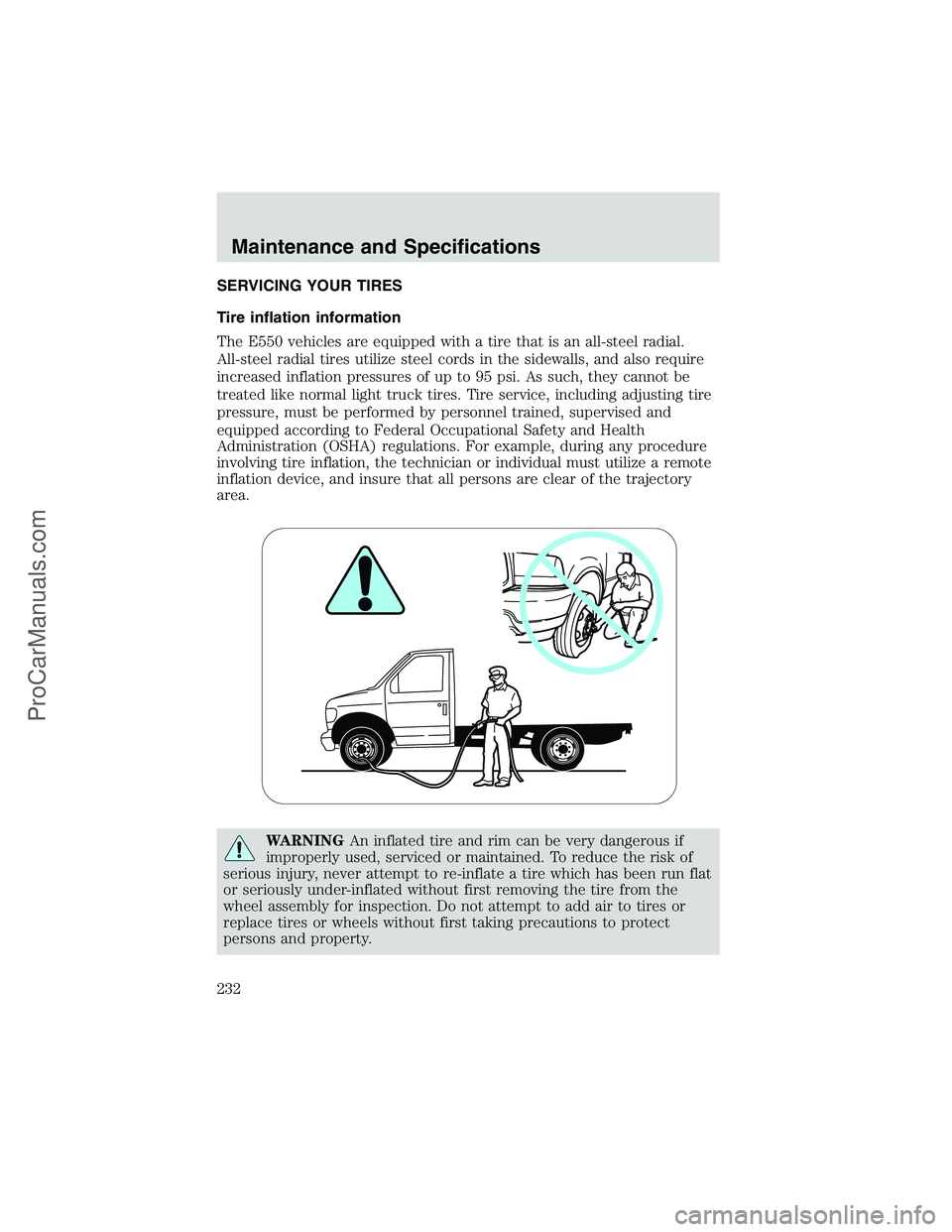
The E550 vehicles are equipped with a tire that is an all-steel radial.
All-steel radial tires utilize steel cords in the sidewalls, and also require
increased inflation pressures of up to 95 psi. As such, they cannot be
treated like normal light truck tires. Tire service, including adjusting tire
pressure, must be performed by personnel trained, supervised and
equipped according to Federal Occupational Safety and Health
Administration (OSHA) regulations. For example, during any procedure
involving tire inflation, the technician or individual must utilize a remote
inflation device, and insure that all persons are clear of the trajectory
area.
WARNINGAn inflated tire and rim can be very dangerous if
improperly used, serviced or maintained. To reduce the risk of
serious injury, never attempt to re-inflate a tire which has been run flat
or seriously under-inflated without first removing the tire from the
wheel assembly for inspection. Do not attempt to add air to tires or
replace tires or wheels without first taking precautions to protect
persons and property.
Maintenance and Specifications
232
ProCarManuals.com
Page 233 of 256
Tire rotation
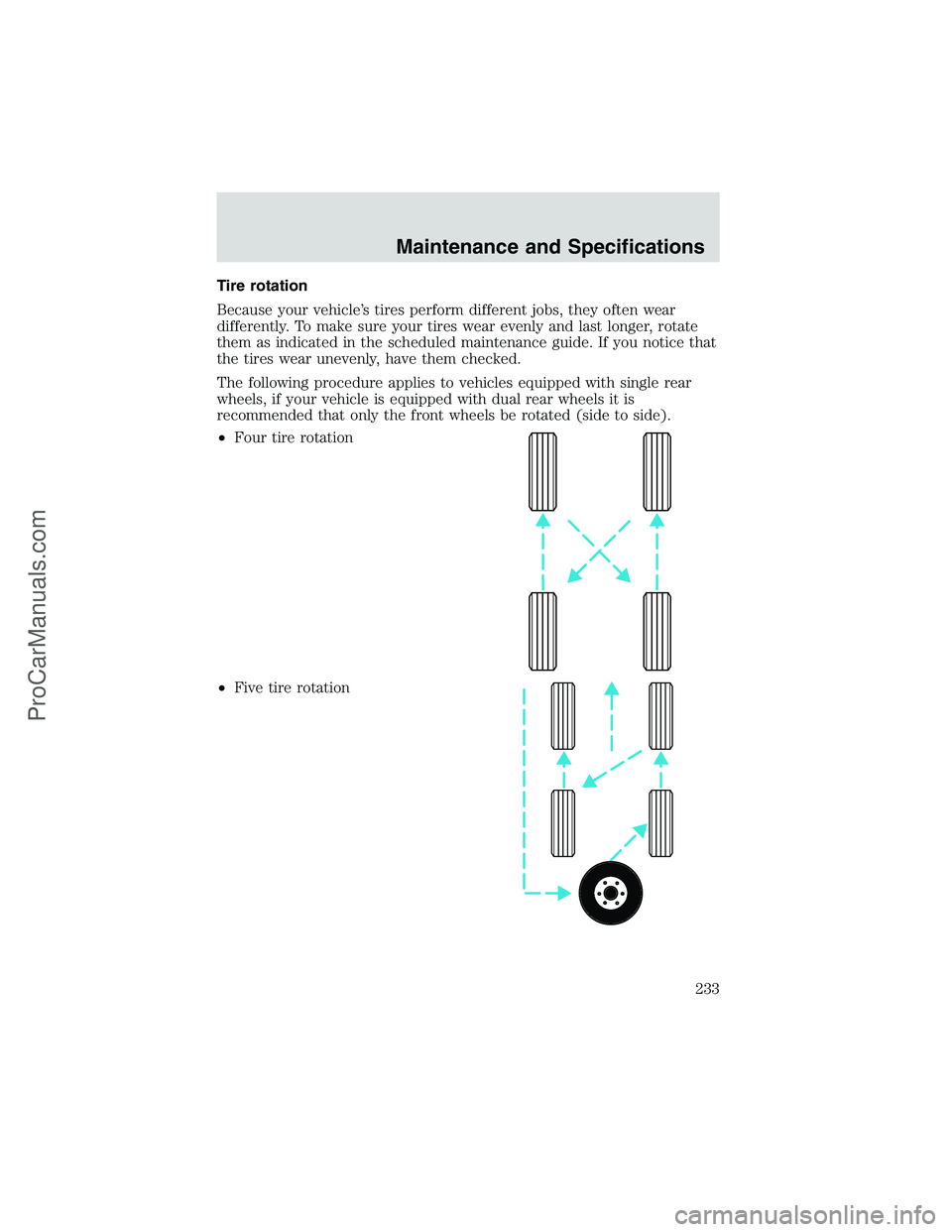
Because your vehicle’s tires perform different jobs, they often wear
differently. To make sure your tires wear evenly and last longer, rotate
them as indicated in the scheduled maintenance guide. If you notice that
the tires wear unevenly, have them checked.
The following procedure applies to vehicles equipped with single rear
wheels, if your vehicle is equipped with dual rear wheels it is
recommended that only the front wheels be rotated (side to side).
•Four tire rotation
•Five tire rotation
Maintenance and Specifications
233
ProCarManuals.com
Page 234 of 256
Replacing the tires
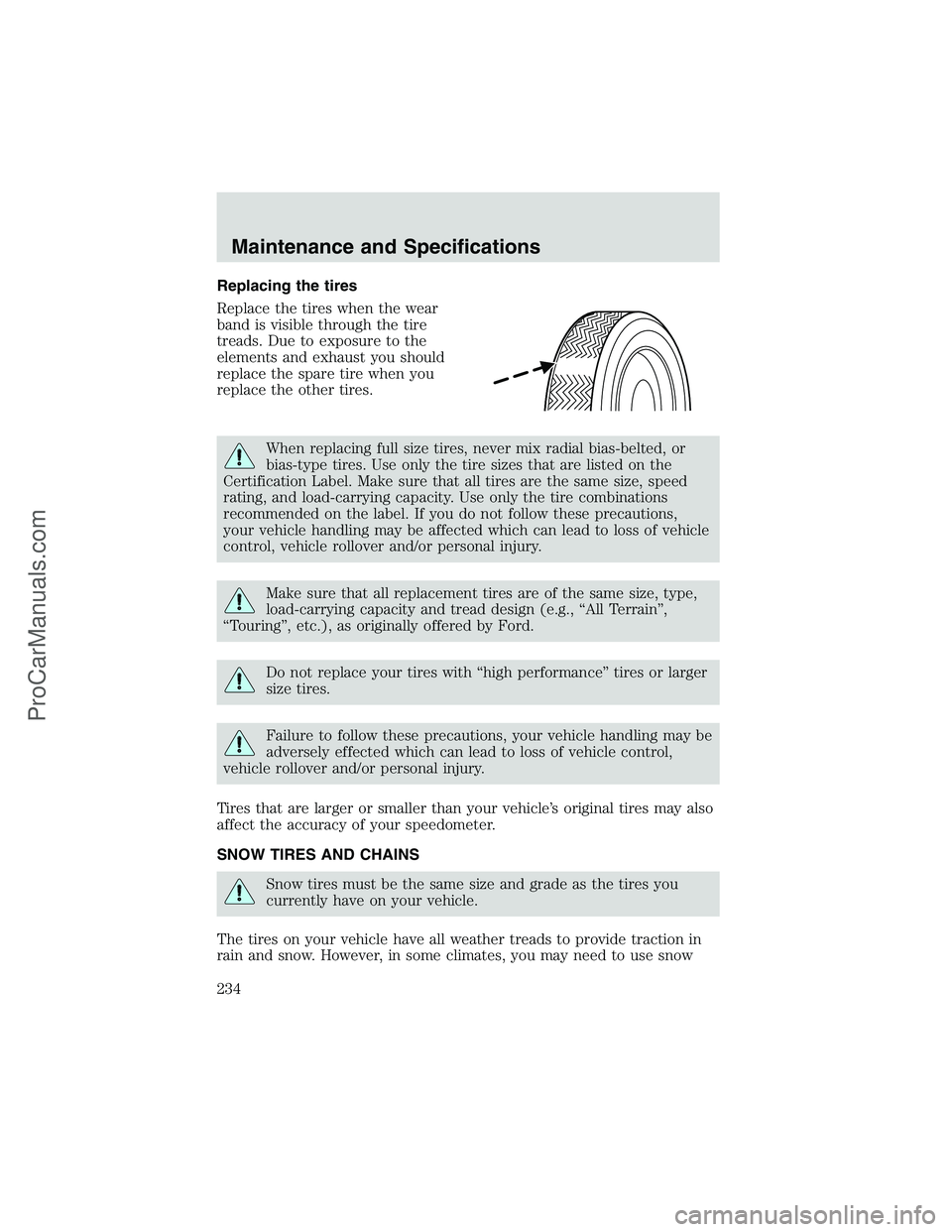
Replace the tires when the wear
band is visible through the tire
treads. Due to exposure to the
elements and exhaust you should
replace the spare tire when you
replace the other tires.
When replacing full size tires, never mix radial bias-belted, or
bias-type tires. Use only the tire sizes that are listed on the
Certification Label. Make sure that all tires are the same size, speed
rating, and load-carrying capacity. Use only the tire combinations
recommended on the label. If you do not follow these precautions,
your vehicle handling may be affected which can lead to loss of vehicle
control, vehicle rollover and/or personal injury.
Make sure that all replacement tires are of the same size, type,
load-carrying capacity and tread design (e.g.,“All Terrain”,
“Touring”, etc.), as originally offered by Ford.
Do not replace your tires with“high performance”tires or larger
size tires.
Failure to follow these precautions, your vehicle handling may be
adversely effected which can lead to loss of vehicle control,
vehicle rollover and/or personal injury.
Tires that are larger or smaller than your vehicle’s original tires may also
affect the accuracy of your speedometer.
SNOW TIRES AND CHAINS
Snow tires must be the same size and grade as the tires you
currently have on your vehicle.
The tires on your vehicle have all weather treads to provide traction in
rain and snow. However, in some climates, you may need to use snow
Maintenance and Specifications
234
ProCarManuals.com
Page 235 of 256
tires and chains. If you need to use chains, it is recommended that steel
wheels (of the same size and specifications) be used, as chains may chip
aluminum wheels.
Follow these guidelines when using snow tires and chains:
•Use only SAE Class S chains.
•Install chains securely, verifying that the chains do not touch any
wiring, brake lines or fuel lines.
•Drive cautiously. If you hear the chains rub or bang against your
vehicle, stop and re-tighten the chains. If this does not work, remove
the chains to prevent damage to your vehicle.
•If possible, avoid fully loading your vehicle.
•Remove the tire chains when they are no longer needed. Do not use
tire chains on dry roads.
•The suspension insulation and bumpers will help prevent vehicle
damage. Do not remove these components from your vehicle when
using snow tires and chains.
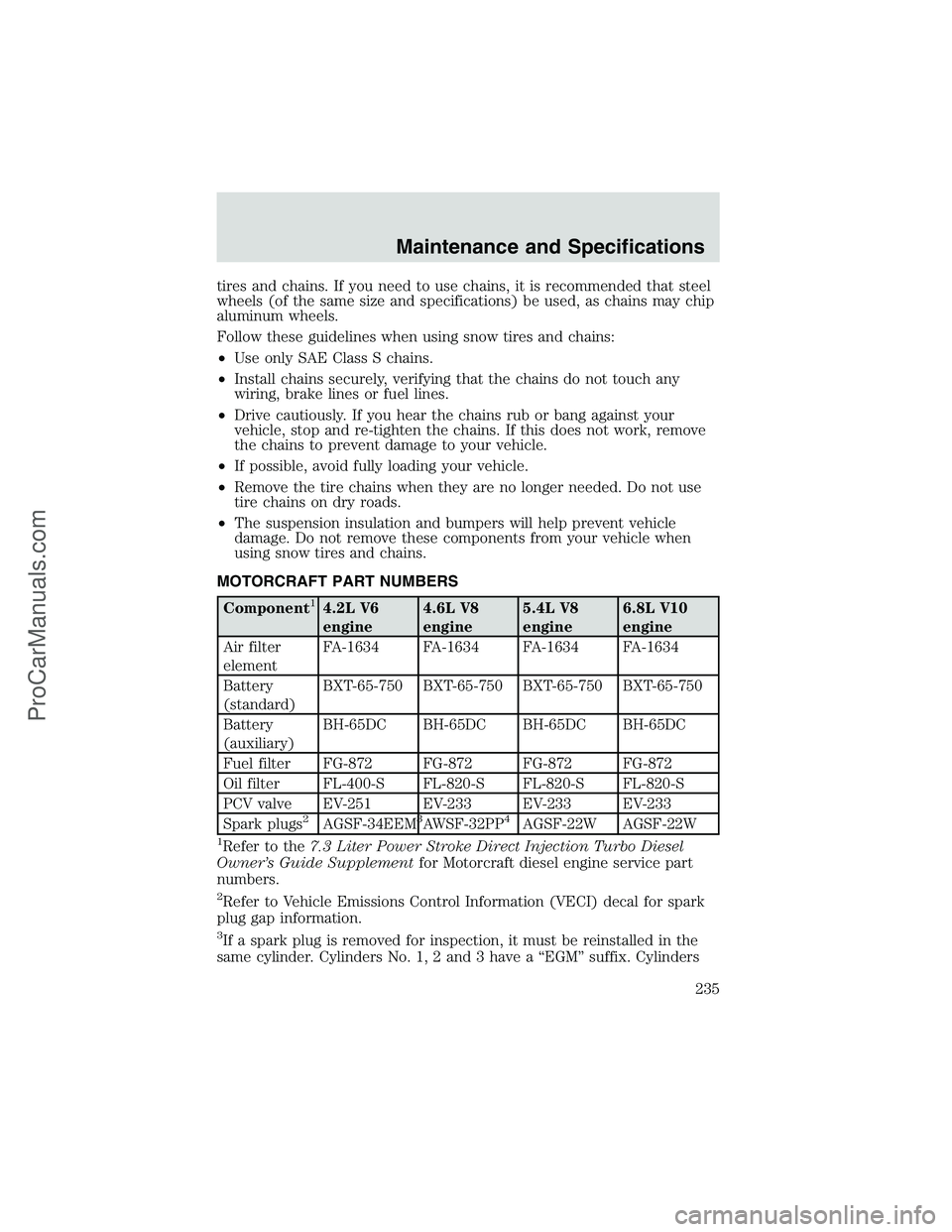
MOTORCRAFT PART NUMBERS
Component14.2L V6
engine4.6L V8
engine5.4L V8
engine6.8L V10
engine
Air filter
elementFA-1634 FA-1634 FA-1634 FA-1634
Battery
(standard)BXT-65-750 BXT-65-750 BXT-65-750 BXT-65-750
Battery
(auxiliary)BH-65DC BH-65DC BH-65DC BH-65DC
Fuel filter FG-872 FG-872 FG-872 FG-872
Oil filter FL-400-S FL-820-S FL-820-S FL-820-S
PCV valve EV-251 EV-233 EV-233 EV-233
Spark plugs
2AGSF-34EEM3AWSF-32PP4AGSF-22W AGSF-22W
1Refer to the7.3 Liter Power Stroke Direct Injection Turbo Diesel
Owner’s Guide Supplementfor Motorcraft diesel engine service part
numbers.
2Refer to Vehicle Emissions Control Information (VECI) decal for spark
plug gap information.
3If a spark plug is removed for inspection, it must be reinstalled in the
same cylinder. Cylinders No. 1, 2 and 3 have a“EGM”suffix. Cylinders
Maintenance and Specifications
235
ProCarManuals.com
Page 255 of 256
Parts (see Motorcraft parts) ....235
Power distribution box
(see Fuses) ...............................165
Power door locks ........................97
Power mirrors .............................87
Power point .................................86
Power steering ..........................143
fluid, checking and adding ....225
fluid, refill capacity ................236
fluid, specifications .........240, 243
Power Windows ...........................86
Preparing to drive your
vehicle ........................................144
R
Radio ..........................17, 22, 28, 36
Radio reception ...........................69
Relays ................................161, 168
Remote entry system ...........97, 99
illuminated entry ....................100
locking/unlocking doors .....97–98
panic alarm ...............................99
replacement/additional
transmitters .............................100
replacing the batteries .............99
Roadside assistance ..................158
S
Safety belts (see Safety
restraints) ....................14, 109–113
Safety defects, reporting ..........190
Safety restraints ................109–113
belt minder .............................115
cleaning the safety belts ........118
extension assembly ................118
for adults .........................110–112for children .....................124–125
lap belt ....................................113
warning light and
chime ...........................12–14, 114
Safety seats for children ..........127
Seat belts (see Safety
restraints) ..................................109
Seats ..........................................101
child safety seats ....................127
Servicing your vehicle ..............198
Spare tire (see Changing the
Tire) ...........................................168
Spark plugs,
specifications .............235, 243–244
Special notice
ambulance conversions ..............6
diesel-powered vehicles .............6
utility-type vehicles ....................6
Specification chart,
lubricants ...........................240, 243
Speed control ..............................88
Speedometer ...............................16
Starting your vehicle ........136–138
jump starting ..........................175
Steering wheel
controls ................................85, 88
tilting .........................................85
T
Temperature control
(see Climate control) .................70
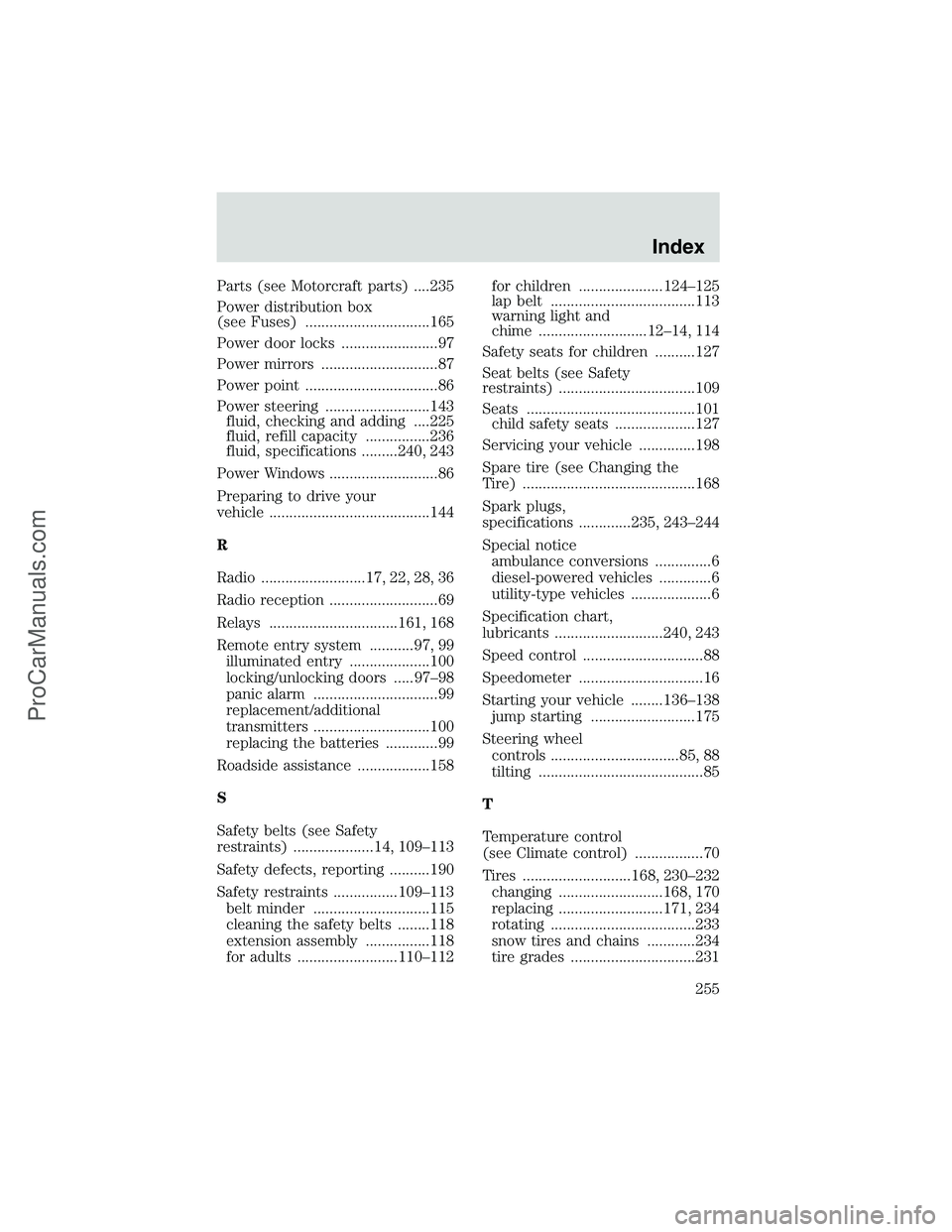
Tires ...........................168, 230–232
changing ..........................168, 170
replacing ..........................171, 234
rotating ....................................233
snow tires and chains ............234
tire grades ...............................231
Index
255
ProCarManuals.com