air condition FORD E-450 2005 User Guide
[x] Cancel search | Manufacturer: FORD, Model Year: 2005, Model line: E-450, Model: FORD E-450 2005Pages: 248, PDF Size: 2.55 MB
Page 208 of 248
What you should know about fail-safe cooling (if equipped)
If the engine coolant supply is depleted, this feature allows the vehicle to
be driven temporarily before incremental component damage is incurred.
The “fail-safe” distance depends on ambient temperatures, vehicle load
and terrain.
How fail-safe cooling works
If the engine begins to overheat:
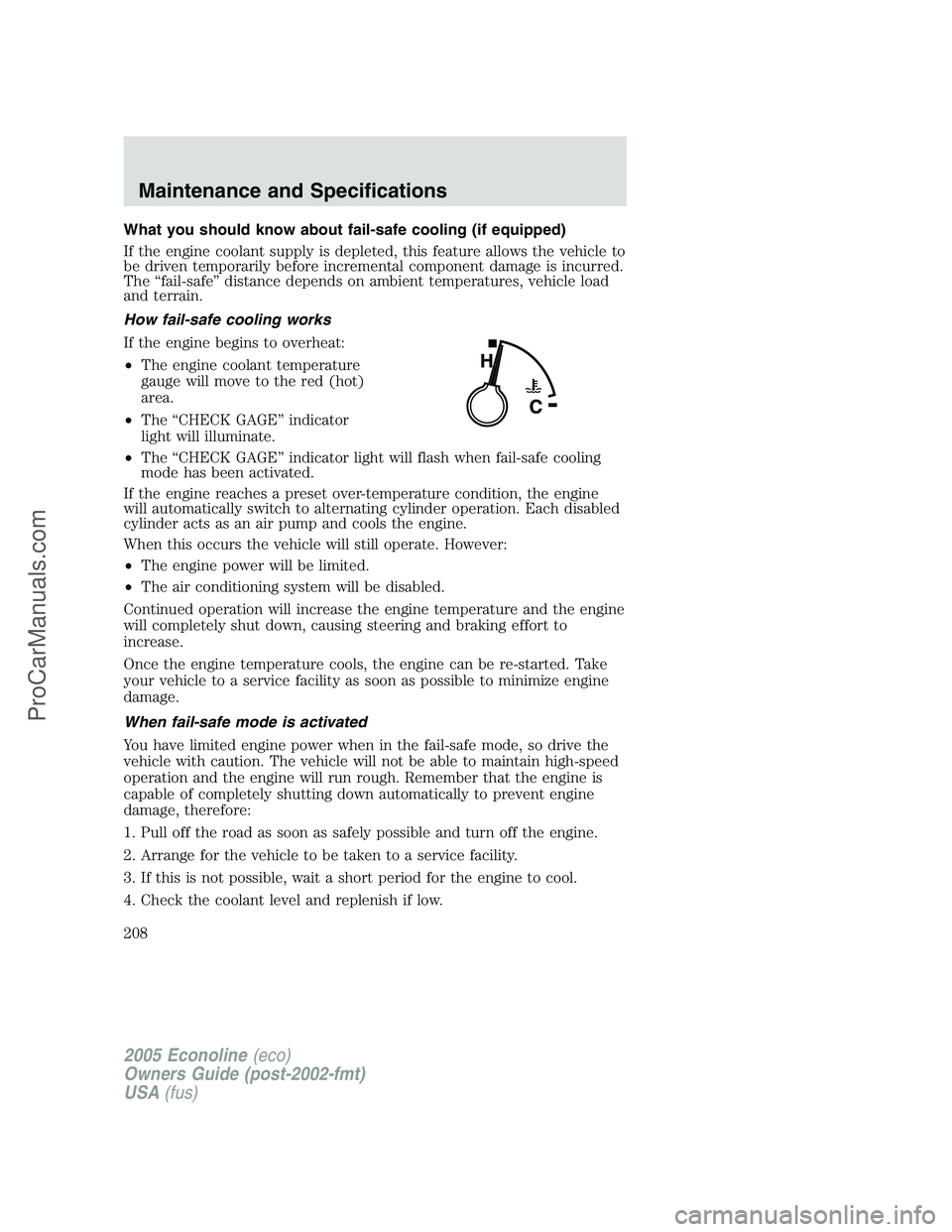
•The engine coolant temperature
gauge will move to the red (hot)
area.
•The “CHECK GAGE” indicator
light will illuminate.
•The “CHECK GAGE” indicator light will flash when fail-safe cooling
mode has been activated.
If the engine reaches a preset over-temperature condition, the engine
will automatically switch to alternating cylinder operation. Each disabled
cylinder acts as an air pump and cools the engine.
When this occurs the vehicle will still operate. However:
•The engine power will be limited.
•The air conditioning system will be disabled.
Continued operation will increase the engine temperature and the engine
will completely shut down, causing steering and braking effort to
increase.
Once the engine temperature cools, the engine can be re-started. Take
your vehicle to a service facility as soon as possible to minimize engine
damage.
When fail-safe mode is activated
You have limited engine power when in the fail-safe mode, so drive the
vehicle with caution. The vehicle will not be able to maintain high-speed
operation and the engine will run rough. Remember that the engine is
capable of completely shutting down automatically to prevent engine
damage, therefore:
1. Pull off the road as soon as safely possible and turn off the engine.
2. Arrange for the vehicle to be taken to a service facility.
3. If this is not possible, wait a short period for the engine to cool.
4. Check the coolant level and replenish if low.
2005 Econoline(eco)
Owners Guide (post-2002-fmt)
USA(fus)
Maintenance and Specifications
208
ProCarManuals.com
Page 212 of 248
If you must replace the fuel filler cap, replace it with a fuel filler
cap that is designed for your vehicle. The customer warranty may
be void for any damage to the fuel tank or fuel system if the
correct genuine Ford or Motorcraft fuel filler cap is not used.
The fuel system may be under pressure. If the fuel filler cap is
venting vapor or if you hear a hissing sound, wait until it stops
before completely removing the fuel filler cap. Otherwise, fuel may
spray out and injure you or others.
If you do not use the proper fuel filler cap, excessive pressure or
vacuum in the fuel tank may damage the fuel system or cause
the fuel cap to disengage in a collision, which may result in possible
personal injury.
Choosing the right fuel
Use only UNLEADED FUEL. The use of leaded fuel is prohibited by law
and could damage your vehicle.
Your vehicle was not designed to use fuel or fuel additives with metallic
compounds, including manganese-based additives. Studies indicate that
these additives can cause your vehicle’s emission control system to
deteriorate more rapidly. In Canada, premium grade fuel generally
contains more metallic additives than regular fuel. We recommend using
regular grade fuel. In Canada, many fuels contain metallic additives, but
fuels free of such additives may be available; check with your local fuel
dealer.
Do not use fuel containing methanol. It can damage critical fuel system
components.
Repairs to correct the effects of using a fuel for which your vehicle was
not designed may not be covered by your warranty.
Octane recommendations
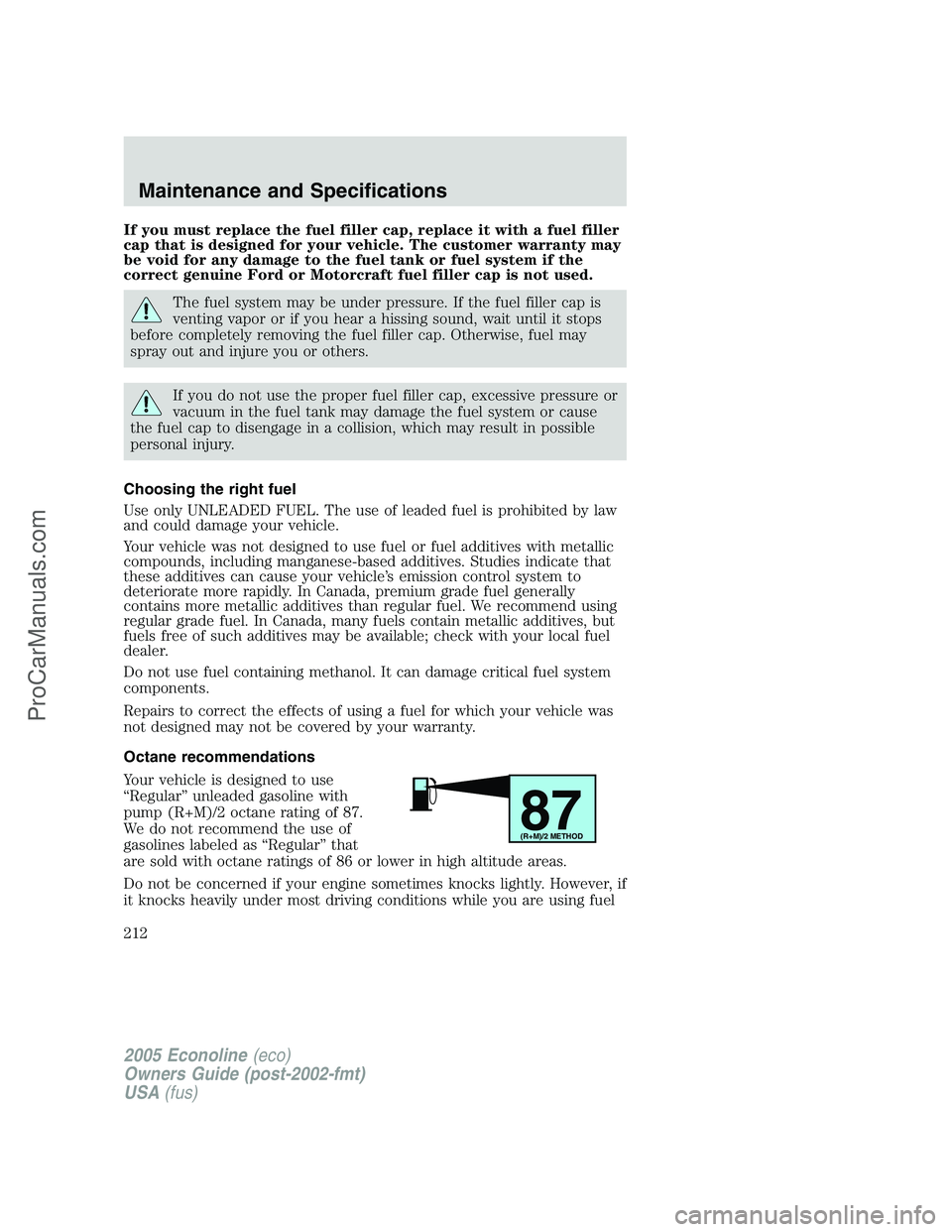
Your vehicle is designed to use
“Regular” unleaded gasoline with
pump (R+M)/2 octane rating of 87.
We do not recommend the use of
gasolines labeled as “Regular” that
are sold with octane ratings of 86 or lower in high altitude areas.
Do not be concerned if your engine sometimes knocks lightly. However, if
it knocks heavily under most driving conditions while you are using fuel
87(R+M)/2 METHOD
2005 Econoline(eco)
Owners Guide (post-2002-fmt)
USA(fus)
Maintenance and Specifications
212
ProCarManuals.com
Page 216 of 248
•Revving the engine before turning it off may reduce fuel economy.
•Using the air conditioner or defroster may reduce fuel economy.
•You may want to turn off the speed control in hilly terrain if
unnecessary shifting between third and fourth gear occurs.
Unnecessary shifting of this type could result in reduced fuel
economy.
•Warming up a vehicle on cold mornings is not required and may
reduce fuel economy.
•Resting your foot on the brake pedal while driving may reduce fuel
economy.
•Combine errands and minimize stop-and-go driving.
Maintenance
•Keep tires properly inflated and use only recommended size.
•Operating a vehicle with the wheels out of alignment will reduce fuel
economy.
•Use recommended engine oil. Refer toLubricant specificationsin
this chapter.
•Perform all regularly scheduled maintenance items. Follow the
recommended maintenance schedule and owner maintenance checks
found inscheduled maintenance information.
Conditions
•Heavily loading a vehicle or towing a trailer may reduce fuel economy
at any speed.
•Carrying unnecessary weight may reduce fuel economy (approximately
1 mpg [0.4 km/L] is lost for every 400 lb [180 kg] of weight carried).
•Adding certain accessories to your vehicle (for example bug
deflectors, rollbars/light bars, running boards, ski/luggage racks) may
reduce fuel economy.
•Using fuel blended with alcohol may lower fuel economy.
•Fuel economy may decrease with lower temperatures during the first
8–10 miles (12–16 km) of driving.
•Driving on flat terrain offers improved fuel economy as compared to
driving on hilly terrain.
•Transmissions give their best fuel economy when operated in the top
cruise gear and with steady pressure on the gas pedal.
2005 Econoline(eco)
Owners Guide (post-2002-fmt)
USA(fus)
Maintenance and Specifications
216
ProCarManuals.com
Page 241 of 248
Climate control (see Air
conditioning or Heating) ......38, 40
Clock adjust
6-CD in dash .................26, 30, 34
AM/FM .......................................19
AM/FM/Cassette ........................20
AM/FM/CD .................................22
Compass, electronic ....................53
calibration .................................54
set zone adjustment .................54
Console
overhead ....................................52
Controls
power seat .................................67
Coolant
checking and adding ..............203
refill capacities ................207, 226
specifications ..................230, 233
Cruise control
(see Speed control) ....................58
Customer Assistance ................163
Ford accessories for your
vehicle .....................................193
Ford Extended Service
Plan ..........................................186
Getting assistance outside
the U.S. and Canada ..............186
Getting roadside assistance ...163
Getting the service you
need .........................................180
Ordering additional owner’s
literature .................................187
The Dispute Settlement
Board .......................................182
Utilizing the
Mediation/Arbitration
Program ...................................185D
Daytime running lamps
(see Lamps) ................................42
Dipstick
automatic transmission
fluid ..........................................220
engine oil .................................198
Doors
lubricant specifications ..........230
Driveline universal joint and
slip yoke ....................................220
Driving under special
conditions
through water .........................162
E
Emergencies, roadside
jump-starting ..........................174
Emergency Flashers .................164
Emission control system ..........217
Engine ................................233–234
cleaning ...................................190
coolant .....................................203
diesel ...........................................8
fail-safe cooling .......................208
idle speed control ...................201
lubrication
specifications ..................230, 233
refill capacities ........................226
service points ..........................197
starting after a collision .........164
Engine block heater .................148
Engine oil ..................................198
change oil soon warning,
message center .......................198
checking and adding ..............198
dipstick ....................................198
2005 Econoline(eco)
Owners Guide (post-2002-fmt)
USA(fus)
Index
241
ProCarManuals.com
Page 242 of 248
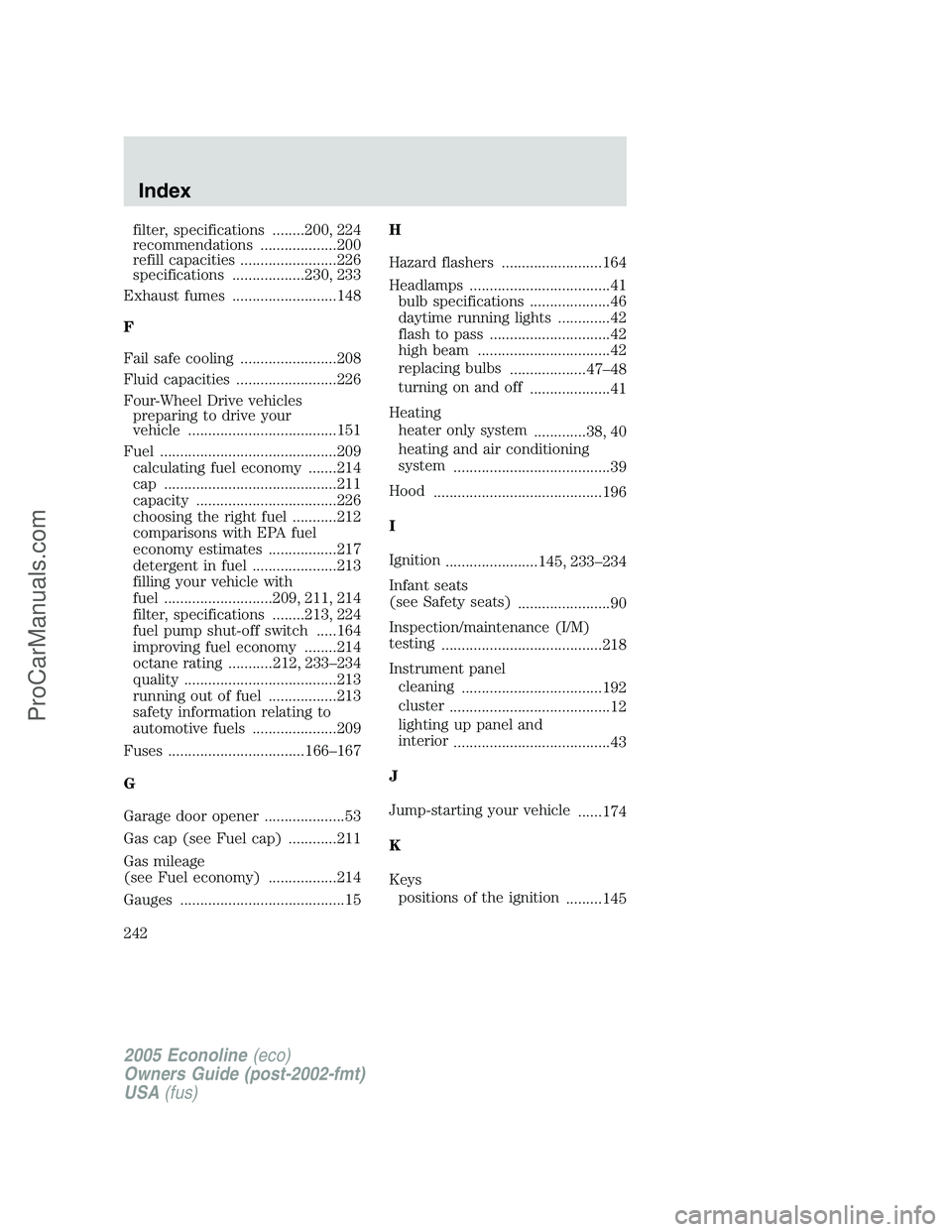
filter, specifications ........200, 224
recommendations ...................200
refill capacities ........................226
specifications ..................230, 233
Exhaust fumes ..........................148
F
Fail safe cooling ........................208
Fluid capacities .........................226
Four-Wheel Drive vehicles
preparing to drive your
vehicle .....................................151
Fuel ............................................209
calculating fuel economy .......214
cap ...........................................211
capacity ...................................226
choosing the right fuel ...........212
comparisons with EPA fuel
economy estimates .................217
detergent in fuel .....................213
filling your vehicle with
fuel ...........................209, 211, 214
filter, specifications ........213, 224
fuel pump shut-off switch .....164
improving fuel economy ........214
octane rating ...........212, 233–234
quality ......................................213
running out of fuel .................213
safety information relating to
automotive fuels .....................209
Fuses ..................................166–167
G
Garage door opener ....................53
Gas cap (see Fuel cap) ............211
Gas mileage
(see Fuel economy) .................214
Gauges .........................................15H
Hazard flashers .........................164
Headlamps ...................................41
bulb specifications ....................46
daytime running lights .............42
flash to pass ..............................42
high beam .................................42
replacing bulbs
...................47–48
turning on and off
....................41
Heating
heater only system
.............38, 40
heating and air conditioning
system
.......................................39
Hood
..........................................196
I
Ignition
.......................145, 233–234
Infant seats
(see Safety seats)
.......................90
Inspection/maintenance (I/M)
testing
........................................218
Instrument panel
cleaning
...................................192
cluster
........................................12
lighting up panel and
interior
.......................................43
J
Jump-starting your vehicle
......174
K
Keys
positions of the ignition
.........145
2005 Econoline(eco)
Owners Guide (post-2002-fmt)
USA(fus)
Index
242
ProCarManuals.com