tires FORD E-450 2008 Repair Manual
[x] Cancel search | Manufacturer: FORD, Model Year: 2008, Model line: E-450, Model: FORD E-450 2008Pages: 285, PDF Size: 2.81 MB
Page 200 of 285
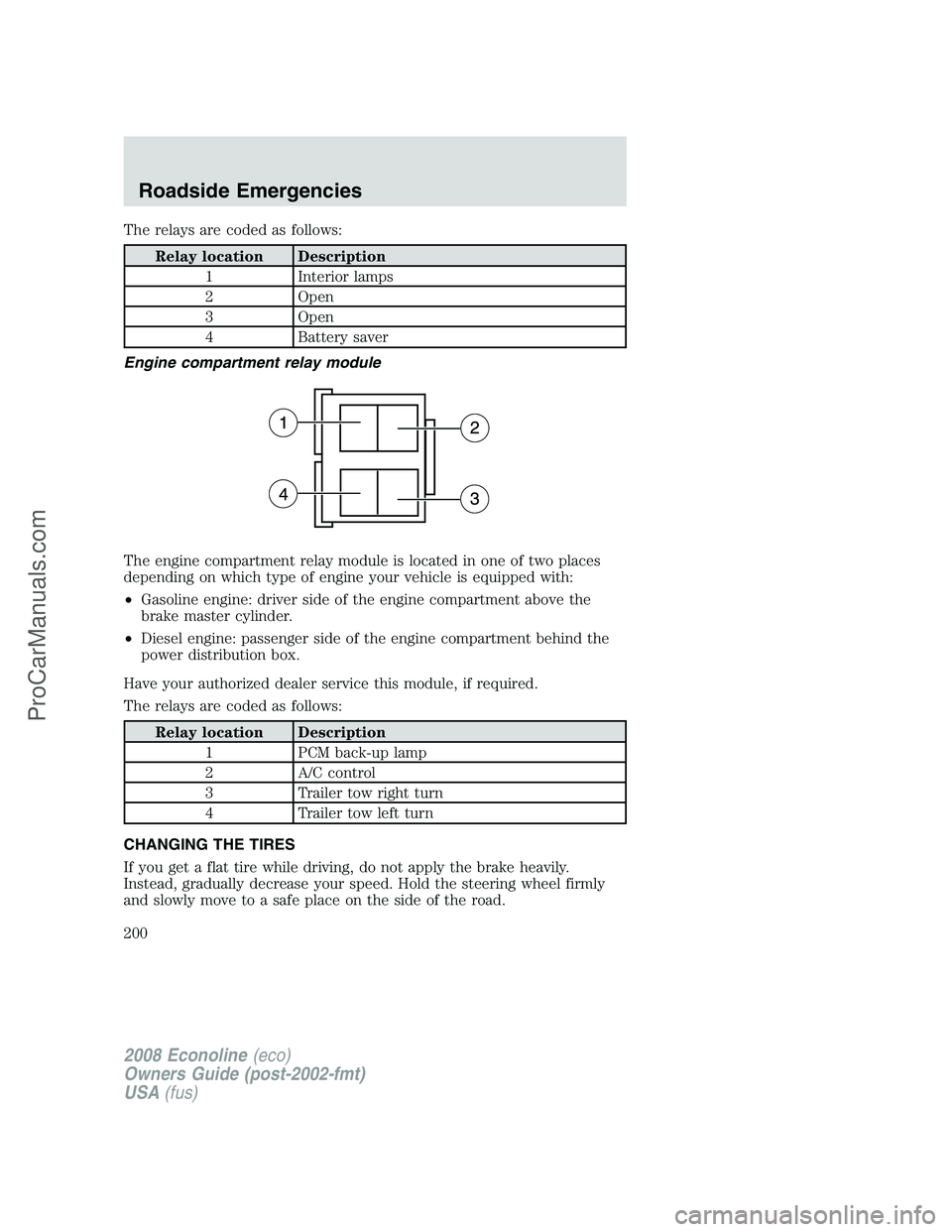
The relays are coded as follows:
Relay location Description
1 Interior lamps
2 Open
3 Open
4 Battery saver
Engine compartment relay module
The engine compartment relay module is located in one of two places
depending on which type of engine your vehicle is equipped with:
•Gasoline engine: driver side of the engine compartment above the
brake master cylinder.
•Diesel engine: passenger side of the engine compartment behind the
power distribution box.
Have your authorized dealer service this module, if required.
The relays are coded as follows:
Relay location Description
1 PCM back-up lamp
2 A/C control
3 Trailer tow right turn
4 Trailer tow left turn
CHANGING THE TIRES
If you get a flat tire while driving, do not apply the brake heavily.
Instead, gradually decrease your speed. Hold the steering wheel firmly
and slowly move to a safe place on the side of the road.
2008 Econoline(eco)
Owners Guide (post-2002-fmt)
USA(fus)
Roadside Emergencies
200
ProCarManuals.com
Page 201 of 285
Note:The tire pressure monitoring system (TPMS) indicator light will
illuminate when the spare tire is in use. To restore the full functionality
of the monitoring system, all road wheels equipped with tire pressure
monitoring sensors must be mounted on the vehicle.
Have a flat serviced by an authorized dealer in order to prevent damage
to the TPMS sensors, refer toTire pressure monitoring system
(TPMS)in theTires, Wheels and Loadingchapter. Replace the spare
tire with a road tire as soon as possible. During repairing or replacing of
the flat tire, have the authorized dealer inspect the TPMS sensor for
damage.
WARNING:The use of tire sealants may damage your Tire
Pressure Monitoring System and should not be used.
WARNING:Refer toTire pressure monitoring system (TPMS)
in theTires, Wheels and Loadingchapter for important
information. If the tire pressure monitor sensor becomes damaged, it
will no longer function.
Dissimilar spare tire/wheel information
WARNING:Failure to follow these guidelines could result in an
increased risk of loss of vehicle control, injury or death.
If you have a dissimilar spare tire/wheel, then it is intended for
temporary use only. This means that if you need to use it, you should
replace it as soon as possible with a road tire/wheel that is the same size
and type as the road tires and wheels that were originally provided by
Ford. If the dissimilar spare tire or wheel is damaged, it should be
replaced rather than repaired.
A dissimilar spare tire/wheel is defined as a spare tire and/or wheel that
is different in brand, size or appearance from the road tires and wheels
and can be one of three types:
1.T-type mini-spare:This spare tire begins with the letter “T” for tire
size and may have “Temporary Use Only” molded in the sidewall
2.Full-size dissimilar spare with label on wheel:This spare tire has
a label on the wheel that states: “THIS TIRE AND WHEEL FOR
TEMPORARY USE ONLY”
2008 Econoline(eco)
Owners Guide (post-2002-fmt)
USA(fus)
Roadside Emergencies
201
ProCarManuals.com
Page 202 of 285
When driving with one of the dissimilar spare tires listed above,do not:
•Exceed 50 mph (80 km/h)
•Load the vehicle beyond maximum vehicle load rating listed on the
Safety Compliance Label
•Tow a trailer
•Use snow chains on the end of the vehicle with the dissimilar spare
tire
•Use more than one dissimilar spare tire at a time
•Use commercial car washing equipment
•Try to repair the dissimilar spare tire
Use of one of the dissimilar spare tires listed above at any one wheel
location can lead to impairment of the following:
•Handling, stability and braking performance
•Comfort and noise
•Ground clearance and parking at curbs
•Winter weather driving capability
•Wet weather driving capability
3.Full-size dissimilar spare without label on wheel
When driving with the full-size dissimilar spare tire/wheel,do not:
•Exceed 70 mph (113 km/h)
•Use more than one dissimilar spare tire/wheel at a time
•Use commercial car washing equipment
•Use snow chains on the end of the vehicle with the dissimilar spare
tire/wheel
The usage of a full-size dissimilar spare tire/wheel can lead to
impairment of the following:
•Handling, stability and braking performance
•Comfort and noise
•Ground clearance and parking at curbs
•Winter weather driving capability
•Wet weather driving capability
•All-Wheel driving capability (if applicable)
•Load leveling adjustment (if applicable)
2008 Econoline(eco)
Owners Guide (post-2002-fmt)
USA(fus)
Roadside Emergencies
202
ProCarManuals.com
Page 258 of 285
Habits
•Smooth, moderate operation can yield up to 10% savings in fuel.
•Steady speeds without stopping will usually give the best fuel
economy.
•Idling for long periods of time (greater than one minute) may waste
fuel.
•Anticipate stopping; slowing down may eliminate the need to stop.
•Sudden or hard accelerations may reduce fuel economy.
•Slow down gradually.
•Driving at reasonable speeds (traveling at 55 mph [88 km/h] uses 15%
less fuel than traveling at 65 mph [105 km/h]).
•Revving the engine before turning it off may reduce fuel economy.
•Using the air conditioner or defroster may reduce fuel economy.
•You may want to turn off the speed control in hilly terrain if
unnecessary shifting between the top gears occurs. Unnecessary
shifting of this type could result in reduced fuel economy.
•Warming up a vehicle on cold mornings is not required and may
reduce fuel economy.
•Resting your foot on the brake pedal while driving may reduce fuel
economy.
•Combine errands and minimize stop-and-go driving.
Maintenance
•Keep tires properly inflated and use only recommended size.
•Operating a vehicle with the wheels out of alignment will reduce fuel
economy.
•Use recommended engine oil. Refer toMaintenance product
specifications and capacitiesin this chapter.
•Perform all regularly scheduled maintenance items. Follow the
recommended maintenance schedule and owner maintenance checks
found inscheduled maintenance information.
Conditions
•Heavily loading a vehicle or towing a trailer may reduce fuel economy
at any speed.
•Carrying unnecessary weight may reduce fuel economy (approximately
1 mpg [0.4 km/L] is lost for every 400 lb [180 kg] of weight carried).
2008 Econoline(eco)
Owners Guide (post-2002-fmt)
USA(fus)
Maintenance and Specifications
258
ProCarManuals.com
Page 284 of 285
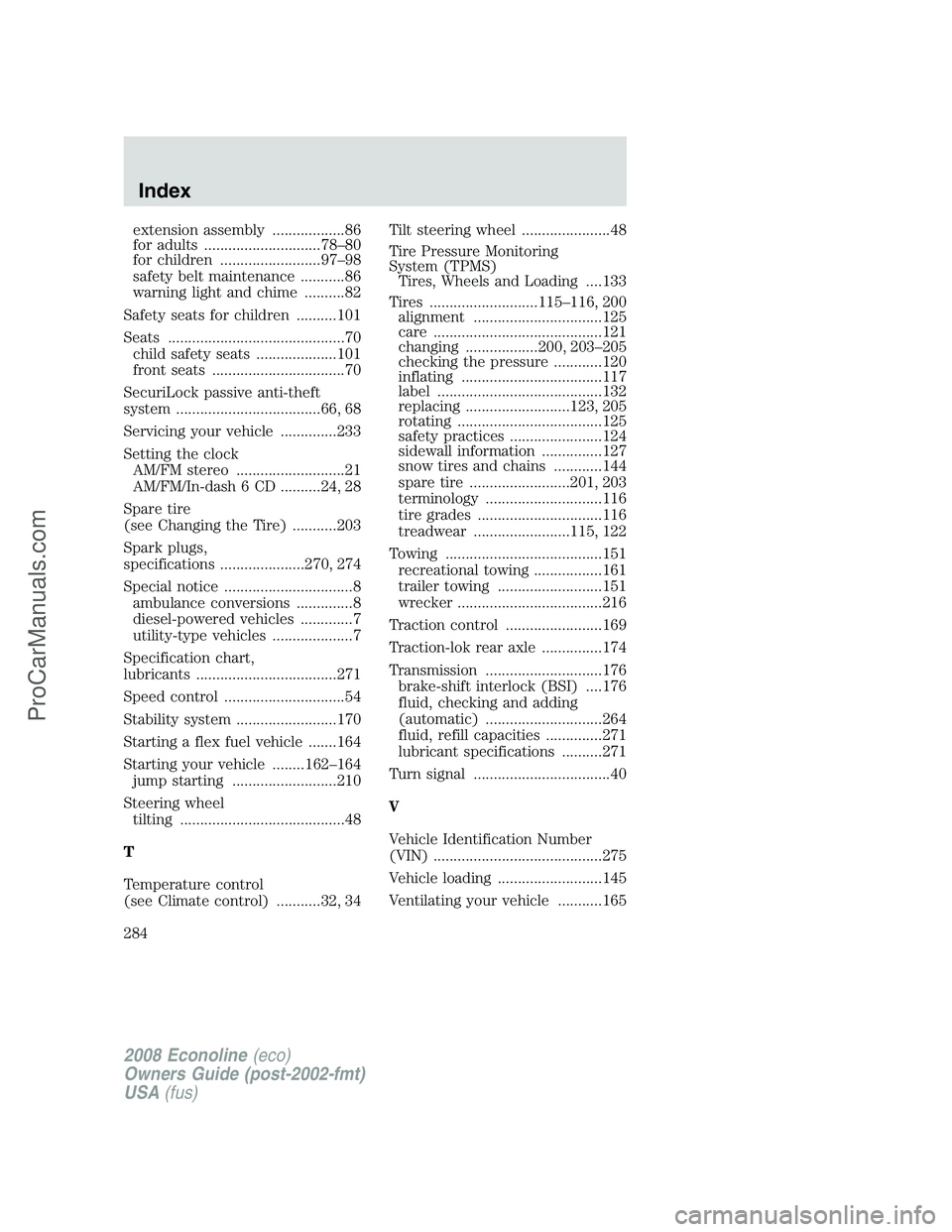
extension assembly ..................86
for adults .............................78–80
for children .........................97–98
safety belt maintenance ...........86
warning light and chime ..........82
Safety seats for children ..........101
Seats ............................................70
child safety seats ....................101
front seats .................................70
SecuriLock passive anti-theft
system ....................................66, 68
Servicing your vehicle ..............233
Setting the clock
AM/FM stereo ...........................21
AM/FM/In-dash 6 CD ..........24, 28
Spare tire
(see Changing the Tire) ...........203
Spark plugs,
specifications .....................270, 274
Special notice ................................8
ambulance conversions ..............8
diesel-powered vehicles .............7
utility-type vehicles ....................7
Specification chart,
lubricants ...................................271
Speed control ..............................54
Stability system .........................170
Starting a flex fuel vehicle .......164
Starting your vehicle ........162–164
jump starting ..........................210
Steering wheel
tilting .........................................48
T
Temperature control
(see Climate control) ...........32, 34Tilt steering wheel ......................48
Tire Pressure Monitoring
System (TPMS)
Tires, Wheels and Loading ....133
Tires ...........................115–116, 200
alignment ................................125
care ..........................................121
changing ..................200, 203–205
checking the pressure ............120
inflating ...................................117
label .........................................132
replacing ..........................123, 205
rotating ....................................125
safety practices .......................124
sidewall information ...............127
snow tires and chains ............144
spare tire .........................201, 203
terminology .............................116
tire grades ...............................116
treadwear ........................115, 122
Towing .......................................151
recreational towing .................161
trailer towing ..........................151
wrecker ....................................216
Traction control ........................169
Traction-lok rear axle ...............174
Transmission .............................176
brake-shift interlock (BSI) ....176
fluid, checking and adding
(automatic) .............................264
fluid, refill capacities ..............271
lubricant specifications ..........271
Turn signal ..................................40
V
Vehicle Identification Number
(VIN) ..........................................275
Vehicle loading ..........................145
Ventilating your vehicle ...........165
2008 Econoline(eco)
Owners Guide (post-2002-fmt)
USA(fus)
Index
284
ProCarManuals.com