door lock FORD E-450 2018 User Guide
[x] Cancel search | Manufacturer: FORD, Model Year: 2018, Model line: E-450, Model: FORD E-450 2018Pages: 323, PDF Size: 6.2 MB
Page 76 of 323
GENERAL INFORMATION
WARNINGS
Extended idling at high engine
speeds can produce very high
temperatures in the engine and
exhaust system, creating the risk of fire or
other damage. Do not park, idle or drive your vehicle
on dry grass or other dry ground
cover. The emission system heats up
the engine compartment and exhaust
system, creating the risk of fire. Do not start the engine in a closed
garage or in other enclosed areas.
Exhaust fumes can be toxic. Always
open the garage door before you start the
engine. Exhaust leaks may result in entry of
harmful and potentially lethal fumes
into the passenger compartment. If
you smell exhaust fumes inside your
vehicle, have your vehicle inspected
immediately. Do not drive if you smell
exhaust fumes. If you disconnect the battery, your vehicle
may exhibit some unusual driving
characteristics for approximately 5 mi
(8 km) after you reconnect it. This is
because the engine management system
must realign itself with the engine. You
can disregard any unusual driving
characteristics during this period.
The powertrain control system meets all
Canadian interference-causing equipment
standard requirements regulating the
impulse electrical field or radio noise.
When you start the engine, avoid pressing
the accelerator pedal before and during
operation. Only use the accelerator pedal
when you have difficulty starting the
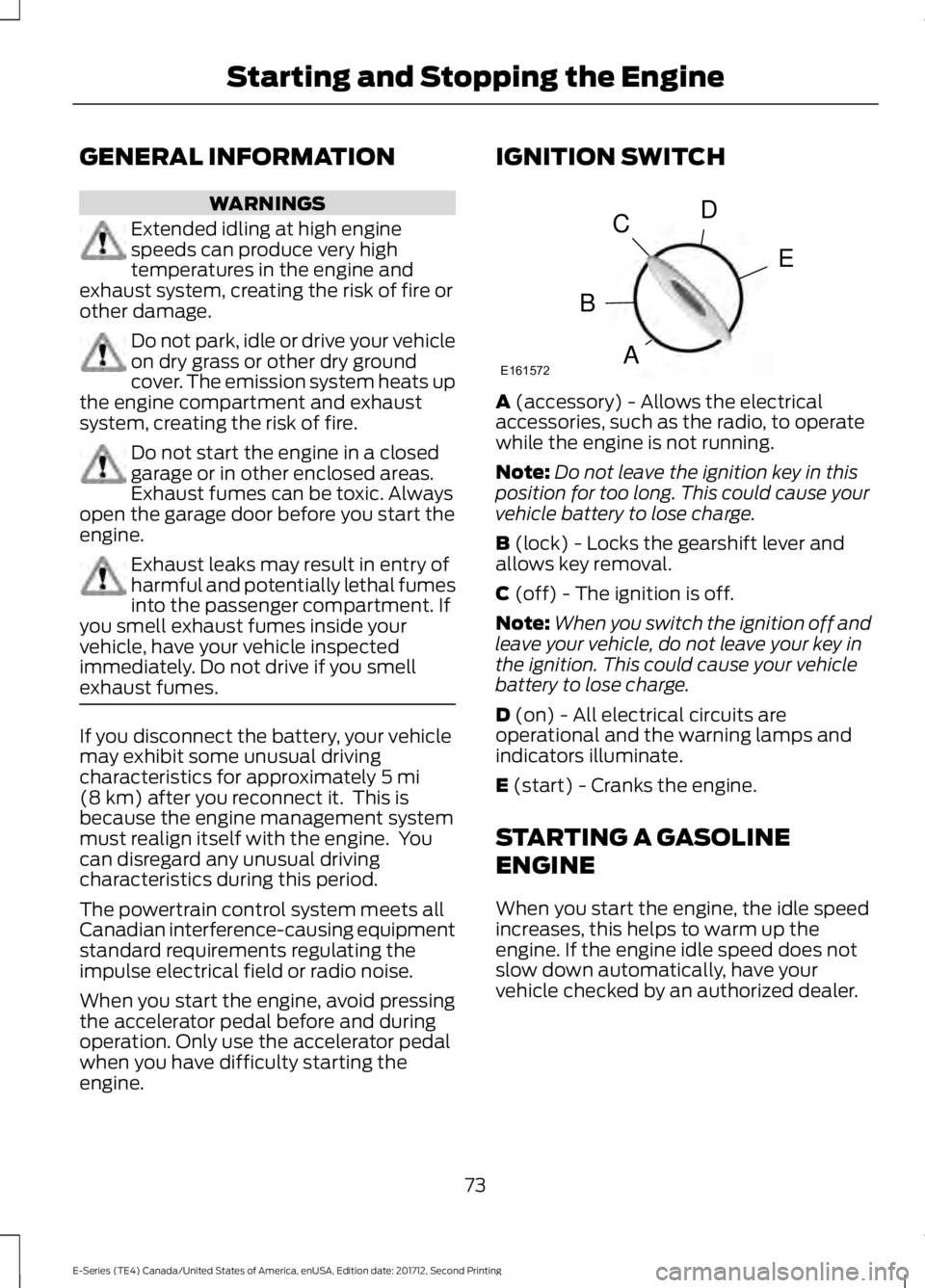
engine. IGNITION SWITCH
A
(accessory) - Allows the electrical
accessories, such as the radio, to operate
while the engine is not running.
Note: Do not leave the ignition key in this
position for too long. This could cause your
vehicle battery to lose charge.
B
(lock) - Locks the gearshift lever and
allows key removal.
C
(off) - The ignition is off.
Note: When you switch the ignition off and
leave your vehicle, do not leave your key in
the ignition. This could cause your vehicle
battery to lose charge.
D
(on) - All electrical circuits are
operational and the warning lamps and
indicators illuminate.
E
(start) - Cranks the engine.
STARTING A GASOLINE
ENGINE
When you start the engine, the idle speed
increases, this helps to warm up the
engine. If the engine idle speed does not
slow down automatically, have your
vehicle checked by an authorized dealer.
73
E-Series (TE4) Canada/United States of America, enUSA, Edition date: 201712, Second Printing Starting and Stopping the EngineE161572
D
E
C
B
A
Page 78 of 323
ENGINE BLOCK HEATER (If
Equipped) WARNINGS
Failure to follow engine block heater
instructions could result in property
damage or serious personal injury.
Do not use your heater with
ungrounded electrical systems or
two-pronged adapters. There is a risk
of electrical shock. Do not fully close the hood, or allow
it to drop under its own weight when
using the engine block heater. This
could damage the power cable and may
cause an electrical short resulting in fire,
injury and property damage. Note:
The heater is most effective when
outdoor temperatures are below
0°F
(-18°C).
The heater acts as a starting aid by
warming the engine coolant. This allows
the climate control system to respond
quickly. The equipment includes a heater
element (installed in the engine block) and
a wire harness. You can connect the
system to a grounded 120-volt AC
electrical source.
We recommend that you do the following
for a safe and correct operation:
• Use a 16-gauge outdoor extension cord
that is product certified by
Underwriter ’s Laboratory (UL) or
Canadian Standards Association
(CSA). This extension cord must be
suitable for use outdoors, in cold temperatures, and be clearly marked
Suitable for Use with Outdoor
Appliances. Do not use an indoor
extension cord outdoors. This could
result in an electric shock or become a
fire hazard.
• Use as short an extension cord as
possible.
• Do not use multiple extension cords.
• Make sure that when in operation, the
extension cord plug and heater cord
plug connections are free and clear of
water. This could cause an electric
shock or fire.
• Make sure your vehicle is parked in a
clean area, clear of combustibles.
• Make sure the heater, heater cord and
extension cord are firmly connected.
• Check for heat anywhere in the
electrical hookup once the system has
been operating for approximately 30
minutes.
• Make sure the system is unplugged and
properly stowed before starting and
driving your vehicle. Make sure the
protective cover seals the prongs of the
block heater cord plug when not in use.
• Make sure the heater system is
checked for proper operation before
winter.
Using the Engine Block Heater
Make sure the receptacle terminals are
clean and dry prior to use. Clean them with
a dry cloth if necessary.
The heater uses 0.4 to 1.0 kilowatt-hours
of energy per hour of use. The system does
not have a thermostat. It achieves
maximum temperature after
approximately three hours of operation.
Using the heater longer than three hours
does not improve system performance and
unnecessarily uses electricity.
75
E-Series (TE4) Canada/United States of America, enUSA, Edition date: 201712, Second Printing Starting and Stopping the Engine
Page 138 of 323
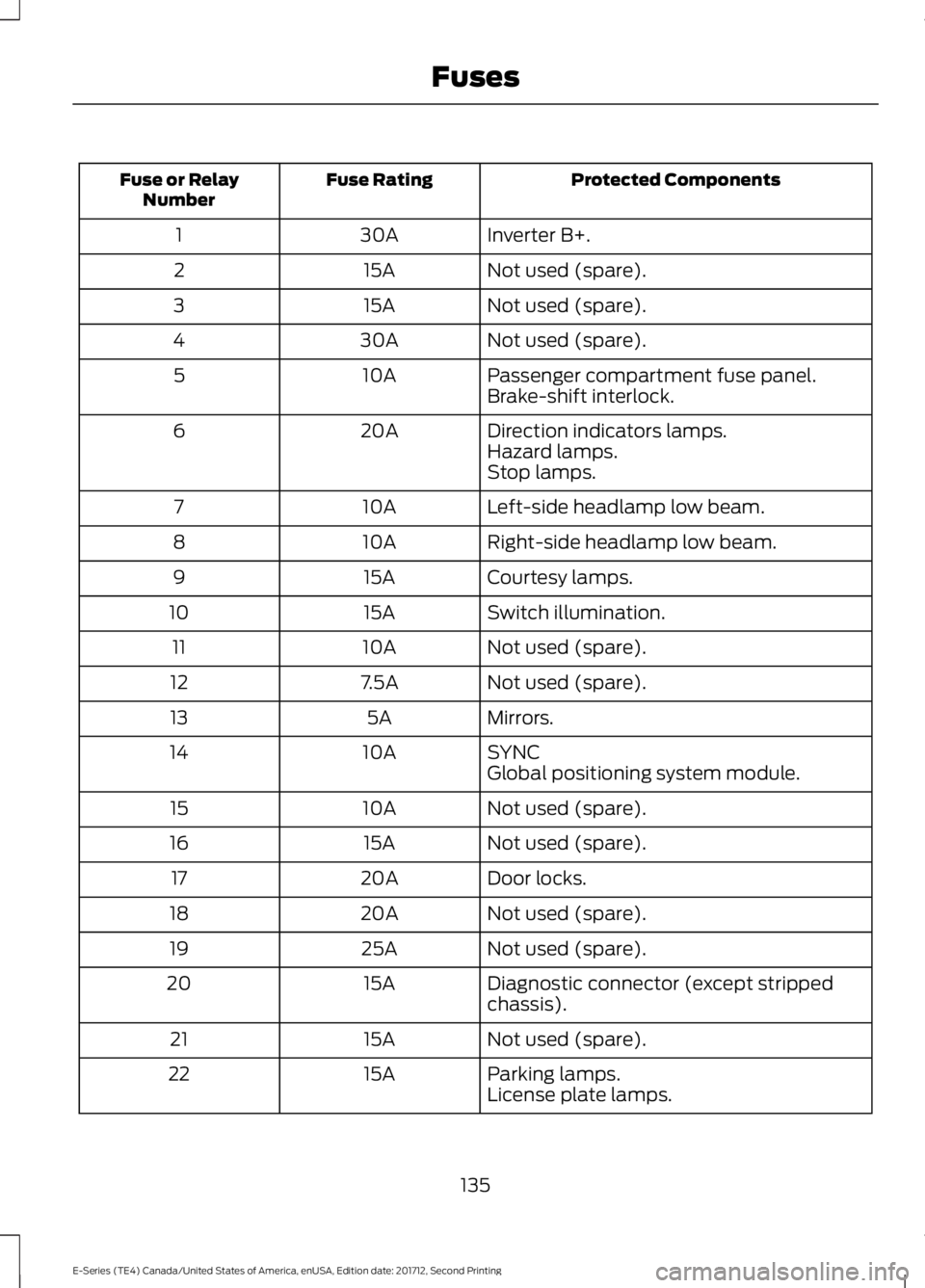
Protected Components
Fuse Rating
Fuse or Relay
Number
Inverter B+.
30A
1
Not used (spare).
15A
2
Not used (spare).
15A
3
Not used (spare).
30A
4
Passenger compartment fuse panel.
10A
5
Brake-shift interlock.
Direction indicators lamps.
20A
6
Hazard lamps.
Stop lamps.
Left-side headlamp low beam.
10A
7
Right-side headlamp low beam.
10A
8
Courtesy lamps.
15A
9
Switch illumination.
15A
10
Not used (spare).
10A
11
Not used (spare).
7.5A
12
Mirrors.
5A
13
SYNC
10A
14
Global positioning system module.
Not used (spare).
10A
15
Not used (spare).
15A
16
Door locks.
20A
17
Not used (spare).
20A
18
Not used (spare).
25A
19
Diagnostic connector (except stripped
chassis).
15A
20
Not used (spare).
15A
21
Parking lamps.
15A
22
License plate lamps.
135
E-Series (TE4) Canada/United States of America, enUSA, Edition date: 201712, Second Printing Fuses
Page 164 of 323
WAXING
Regular waxing is necessary to protect your
car's paint from the elements. We
recommend that you wash and wax the
painted surface once or twice a year.
When washing and waxing, park your
vehicle in a shaded area out of direct
sunlight. Always wash your vehicle before
applying wax.
•
Use a quality wax that does not contain
abrasives.
• Follow the manufacturer ’s instructions
to apply and remove the wax.
• Apply a small amount of wax in a
back-and-forth motion, not in circles.
• Do not allow wax to come in contact
with any non-body (low-gloss black)
colored trim. The wax will discolor or
stain the parts over time.
•Roof racks.
• Bumpers.
• Grained door handles.
• Side moldings.
• Mirror housings.
• Windshield cowl area.
• Do not apply wax to glass areas.
• After waxing, your car's paint should
feel smooth, and be free of streaks and
smudges.
CLEANING THE ENGINE
Engines are more efficient when they are
clean because grease and dirt buildup keep
the engine warmer than normal. When washing:
•
Take care when using a power washer
to clean the engine. The high-pressure
fluid could penetrate the sealed parts
and cause damage.
• Do not spray a hot engine with cold
water to avoid cracking the engine
block or other engine components.
• Spray Motorcraft Engine Shampoo and
Degreaser on all parts that require
cleaning and pressure rinse clean. In
Canada, use Motorcraft Engine
Shampoo.
• Never wash or rinse the engine while it
is hot or running; water in the running
engine may cause internal damage.
• Never wash or rinse any ignition coil,
spark plug wire or spark plug well, or
the area in and around these locations.
• Cover the battery, power distribution
box, and air filter assembly to prevent
water damage when cleaning the
engine.
CLEANING THE WINDOWS AND
WIPER BLADES
Car wash chemicals and environmental
fallout can result in windshield and wiper
blade contamination. Dirty windshield and
wipers will result in poor windshield wiper
operation. Keep the windshield and wiper
blades clean to maintain windshield wiper
performance.
161
E-Series (TE4) Canada/United States of America, enUSA, Edition date: 201712, Second Printing Vehicle Care
Page 205 of 323
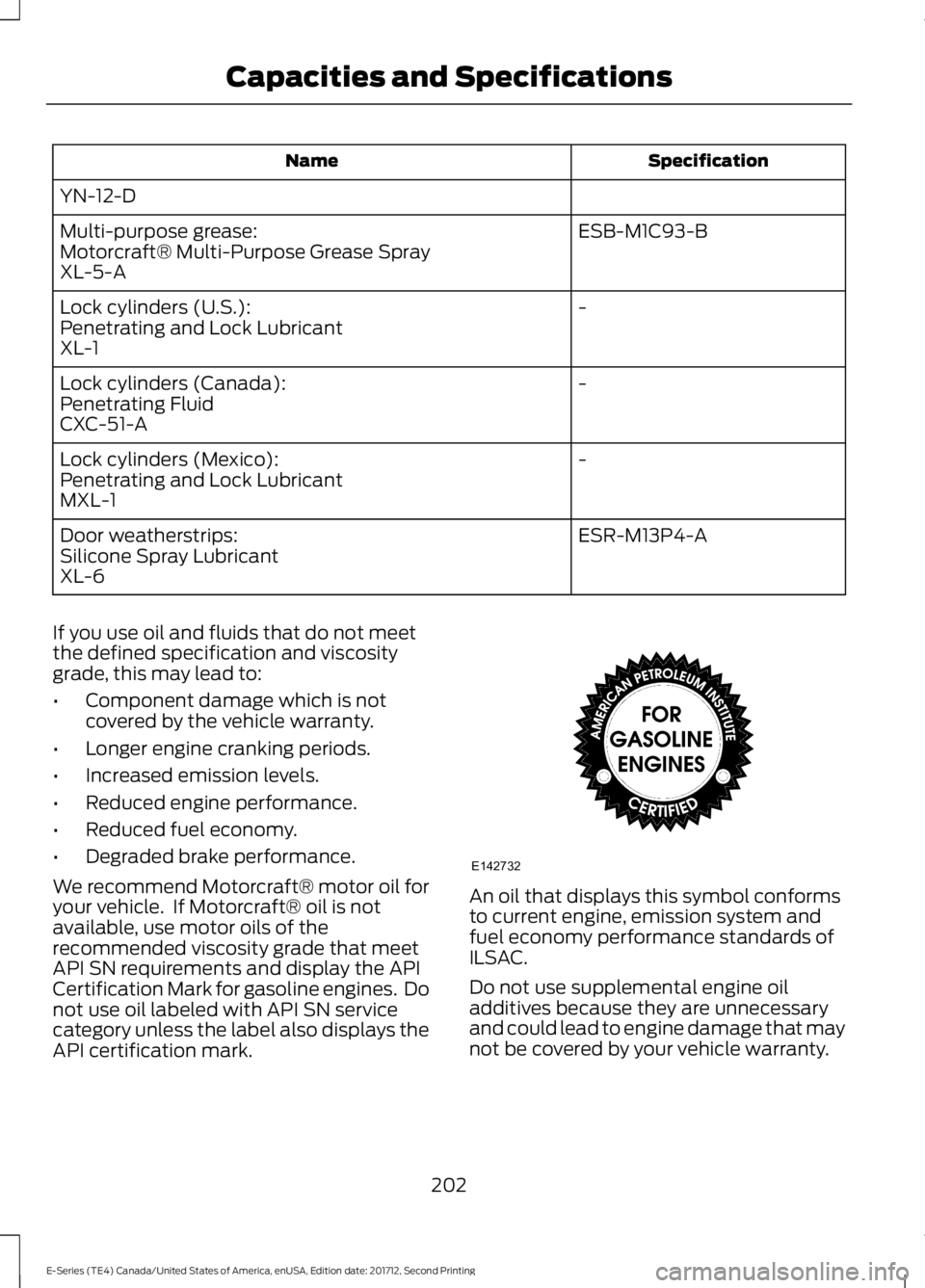
Specification
Name
YN-12-D ESB-M1C93-B
Multi-purpose grease:
Motorcraft® Multi-Purpose Grease Spray
XL-5-A
-
Lock cylinders (U.S.):
Penetrating and Lock Lubricant
XL-1
-
Lock cylinders (Canada):
Penetrating Fluid
CXC-51-A
-
Lock cylinders (Mexico):
Penetrating and Lock Lubricant
MXL-1
ESR-M13P4-A
Door weatherstrips:
Silicone Spray Lubricant
XL-6
If you use oil and fluids that do not meet
the defined specification and viscosity
grade, this may lead to:
• Component damage which is not
covered by the vehicle warranty.
• Longer engine cranking periods.
• Increased emission levels.
• Reduced engine performance.
• Reduced fuel economy.
• Degraded brake performance.
We recommend Motorcraft® motor oil for
your vehicle. If Motorcraft® oil is not
available, use motor oils of the
recommended viscosity grade that meet
API SN requirements and display the API
Certification Mark for gasoline engines. Do
not use oil labeled with API SN service
category unless the label also displays the
API certification mark. An oil that displays this symbol conforms
to current engine, emission system and
fuel economy performance standards of
ILSAC.
Do not use supplemental engine oil
additives because they are unnecessary
and could lead to engine damage that may
not be covered by your vehicle warranty.
202
E-Series (TE4) Canada/United States of America, enUSA, Edition date: 201712, Second Printing Capacities and SpecificationsE142732
Page 210 of 323
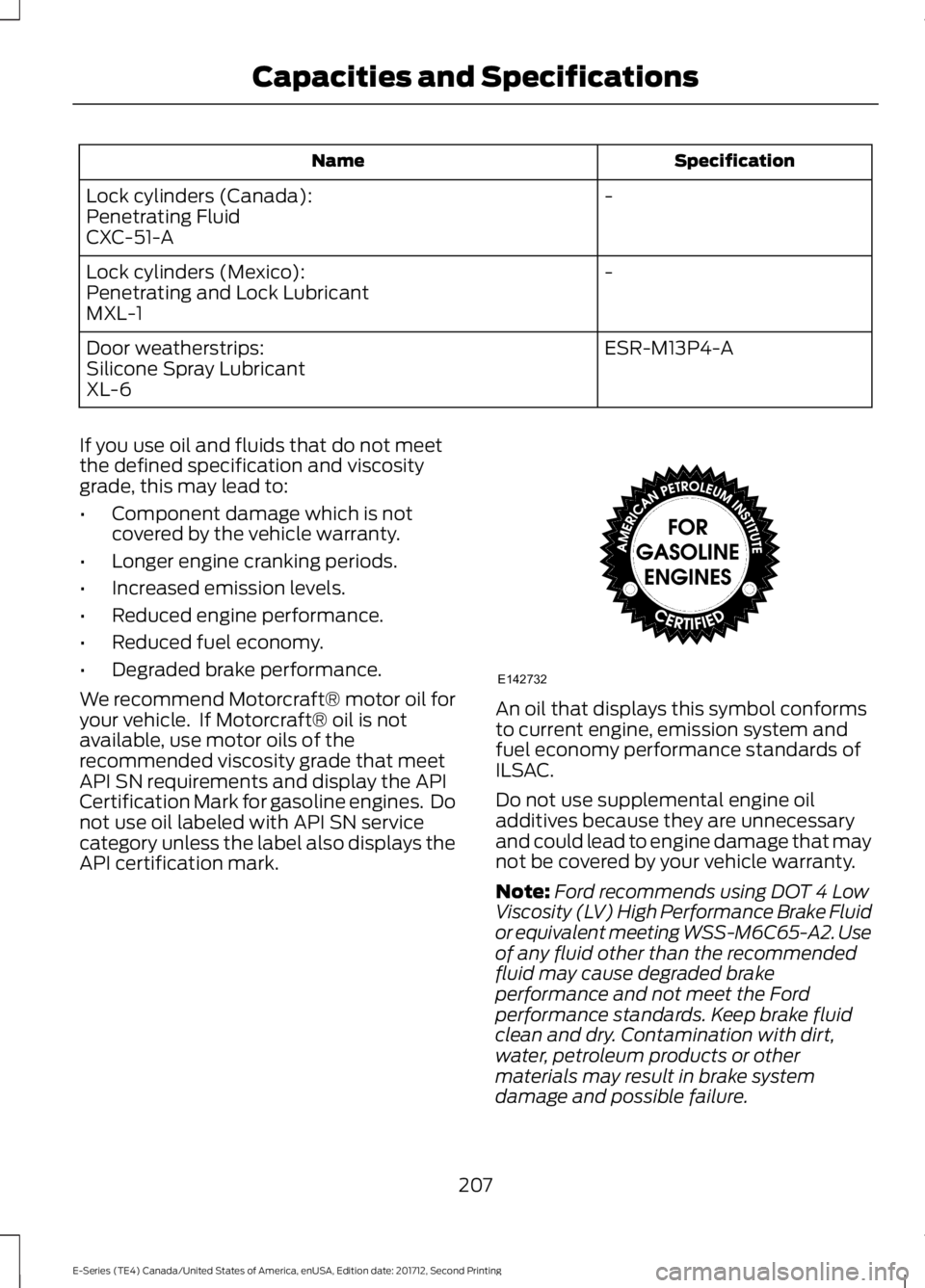
Specification
Name
-
Lock cylinders (Canada):
Penetrating Fluid
CXC-51-A
-
Lock cylinders (Mexico):
Penetrating and Lock Lubricant
MXL-1
ESR-M13P4-A
Door weatherstrips:
Silicone Spray Lubricant
XL-6
If you use oil and fluids that do not meet
the defined specification and viscosity
grade, this may lead to:
• Component damage which is not
covered by the vehicle warranty.
• Longer engine cranking periods.
• Increased emission levels.
• Reduced engine performance.
• Reduced fuel economy.
• Degraded brake performance.
We recommend Motorcraft® motor oil for
your vehicle. If Motorcraft® oil is not
available, use motor oils of the
recommended viscosity grade that meet
API SN requirements and display the API
Certification Mark for gasoline engines. Do
not use oil labeled with API SN service
category unless the label also displays the
API certification mark. An oil that displays this symbol conforms
to current engine, emission system and
fuel economy performance standards of
ILSAC.
Do not use supplemental engine oil
additives because they are unnecessary
and could lead to engine damage that may
not be covered by your vehicle warranty.
Note:
Ford recommends using DOT 4 Low
Viscosity (LV) High Performance Brake Fluid
or equivalent meeting WSS-M6C65-A2. Use
of any fluid other than the recommended
fluid may cause degraded brake
performance and not meet the Ford
performance standards. Keep brake fluid
clean and dry. Contamination with dirt,
water, petroleum products or other
materials may result in brake system
damage and possible failure.
207
E-Series (TE4) Canada/United States of America, enUSA, Edition date: 201712, Second Printing Capacities and SpecificationsE142732
Page 317 of 323

Changing a Fuse............................................137
Fuses........................................................................\
137
Changing a Road Wheel............................189 Dissimilar Spare Wheel and Tire Assembly
Information...................................................... 189
Tire Change Procedure.................................... 190
Changing the 12V Battery...........................151 Dual Batteries....................................................... 152
Reconnecting the Battery................................. 151
Changing the Engine Air Filter.................158
Changing the Wiper Blades
......................152
Checking the Wiper Blades.......................152
Child Restraint and Seatbelt Maintenance.................................................28
Child Restraint Positioning
..........................22
Child Safety.......................................................15
General Information............................................. 15
Cleaning Products
........................................159
Materials................................................................ 159
Cleaning the Engine......................................161
Cleaning the Exterior...................................159 Cleaning the Headlamps................................ 160
Exterior Chrome Parts...................................... 160
Exterior Plastic Parts......................................... 160
Stripes or Graphics............................................ 160
Underbody............................................................ 160
Under Hood.......................................................... 160
Cleaning the Instrument Panel and Instrument Cluster Lens
..........................162
Cleaning the Interior....................................162
Cleaning the Wheels
...................................163
Cleaning the Windows and Wiper Blades.............................................................161
Climate Control
..............................................64
Coolant Check See: Engine Coolant Check............................. 142
Crash Sensors and Airbag Indicator........36
Cruise Control
..................................................45
Principle of Operation........................................ 95
Cruise control See: Using Cruise Control................................. 95
Customer Assistance..................................122
D
Data Recording
..................................................7
Event Data Recording........................................... 8
Service Data Recording......................................... 7Daytime Running Lamps............................48
Digital Radio
...................................................213
HD Radio Reception and Station
Troubleshooting............................................. 214
Direction Indicators.......................................48
Doors and Locks.............................................40
Driver and Passenger Airbags.....................31 Children and Airbags........................................... 35
Passenger Airbag On and Off Switch ...........31
Proper Driver and Front Passenger Seating Adjustment........................................................ 35
Driving Aids
......................................................96
Driving Hints....................................................114
Driving Through Water
.................................115
DRL See: Daytime Running Lamps......................... 48
E
Economical Driving.......................................114
Electromagnetic Compatibility
..............288
Emission Law...................................................82
Noise Emissions Warranty, Prohibited
Tampering Acts and Maintenance...........83
Tampering With a Noise Control System................................................................ 82
End User License Agreement.................290 SYNC End User License Agreement
(EULA)............................................................. 290
Engine Block Heater......................................75 Using the Engine Block Heater........................ 75
Engine Coolant Check
.................................142
Adding Coolant.................................................... 143
Coolant Change.................................................. 145
Engine Coolant Temperature Management
................................................... 146
Fail-Safe Cooling................................................ 145
Recycled Coolant............................................... 144
Severe Climates.................................................. 144
Engine Emission Control.............................82
Engine Immobilizer See: Passive Anti-Theft System..................... 43
Engine Oil Check............................................141 Adding Engine Oil................................................ 141
Engine Oil Dipstick
........................................141
Engine Specifications - 6.2L.....................194 Drivebelt Routing................................................ 194
314
E-Series (TE4) Canada/United States of America, enUSA, Edition date: 201712, Second Printing Index
Page 319 of 323
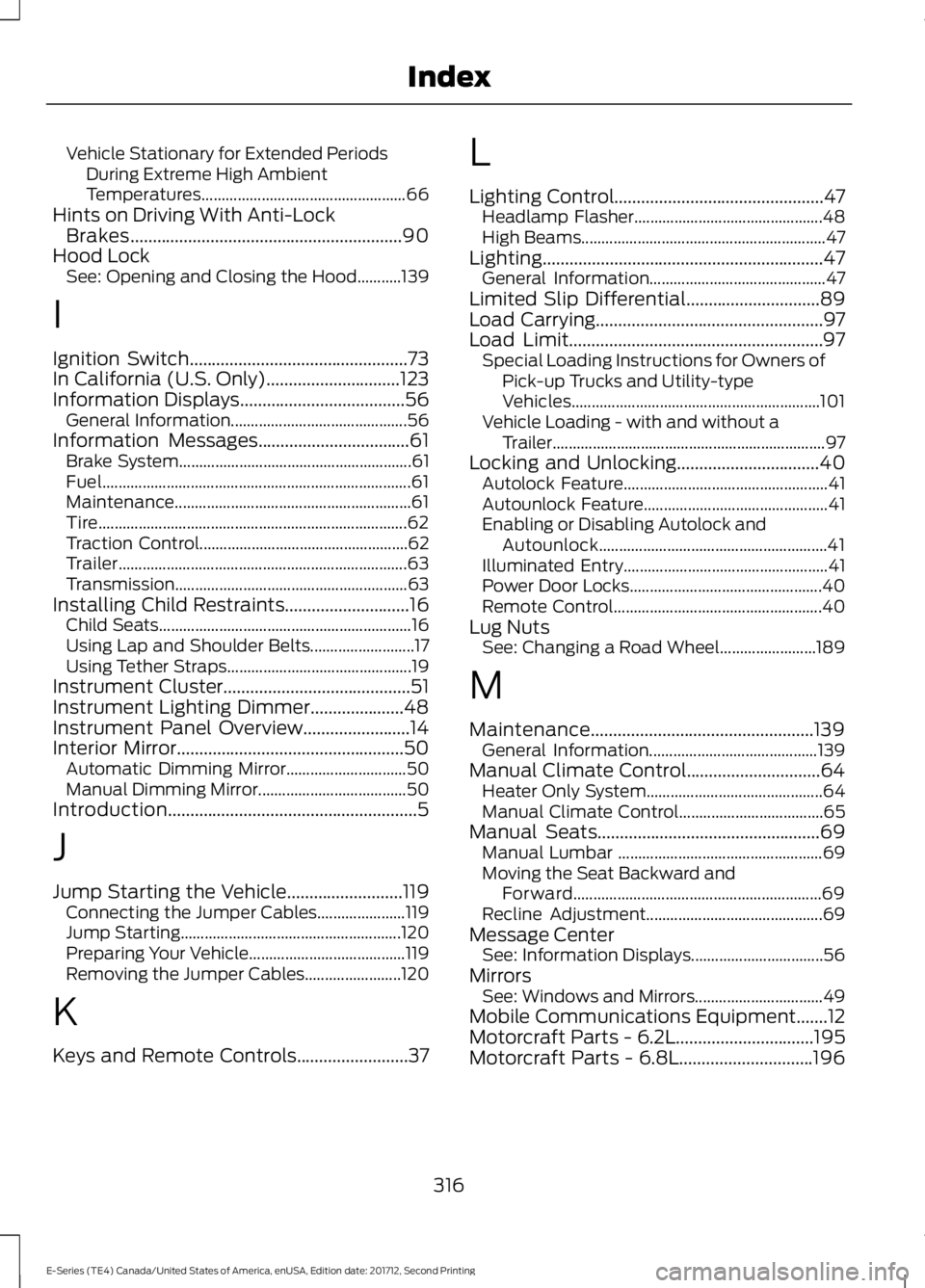
Vehicle Stationary for Extended Periods
During Extreme High Ambient
Temperatures................................................... 66
Hints on Driving With Anti-Lock Brakes.............................................................90
Hood Lock See: Opening and Closing the Hood...........139
I
Ignition Switch.................................................73
In California (U.S. Only)..............................123
Information Displays
.....................................56
General Information............................................ 56
Information Messages
..................................61
Brake System.......................................................... 61
Fuel........................................................................\
..... 61
Maintenance........................................................... 61
Tire........................................................................\
..... 62
Traction Control.................................................... 62
Trailer........................................................................\
63
Transmission.......................................................... 63
Installing Child Restraints
............................16
Child Seats............................................................... 16
Using Lap and Shoulder Belts.......................... 17
Using Tether Straps.............................................. 19
Instrument Cluster
..........................................51
Instrument Lighting Dimmer.....................48
Instrument Panel Overview........................14
Interior Mirror
...................................................50
Automatic Dimming Mirror.............................. 50
Manual Dimming Mirror..................................... 50
Introduction........................................................5
J
Jump Starting the Vehicle..........................119 Connecting the Jumper Cables...................... 119
Jump Starting....................................................... 120
Preparing Your Vehicle....................................... 119
Removing the Jumper Cables........................ 120
K
Keys and Remote Controls.........................37 L
Lighting Control
...............................................47
Headlamp Flasher............................................... 48
High Beams............................................................. 47
Lighting...............................................................47 General Information............................................ 47
Limited Slip Differential..............................89
Load Carrying
...................................................97
Load Limit.........................................................97 Special Loading Instructions for Owners of
Pick-up Trucks and Utility-type
Vehicles.............................................................. 101
Vehicle Loading - with and without a Trailer.................................................................... 97
Locking and Unlocking
................................40
Autolock Feature................................................... 41
Autounlock Feature.............................................. 41
Enabling or Disabling Autolock and Autounlock......................................................... 41
Illuminated Entry................................................... 41
Power Door Locks................................................ 40
Remote Control.................................................... 40
Lug Nuts See: Changing a Road Wheel........................ 189
M
Maintenance..................................................139 General Information.......................................... 139
Manual Climate Control..............................64 Heater Only System............................................ 64
Manual Climate Control.................................... 65
Manual Seats..................................................69 Manual Lumbar ................................................... 69
Moving the Seat Backward and Forward.............................................................. 69
Recline Adjustment............................................ 69
Message Center See: Information Displays................................. 56
Mirrors See: Windows and Mirrors................................ 49
Mobile Communications Equipment
.......12
Motorcraft Parts - 6.2L...............................195
Motorcraft Parts - 6.8L..............................196
316
E-Series (TE4) Canada/United States of America, enUSA, Edition date: 201712, Second Printing Index
Page 320 of 323
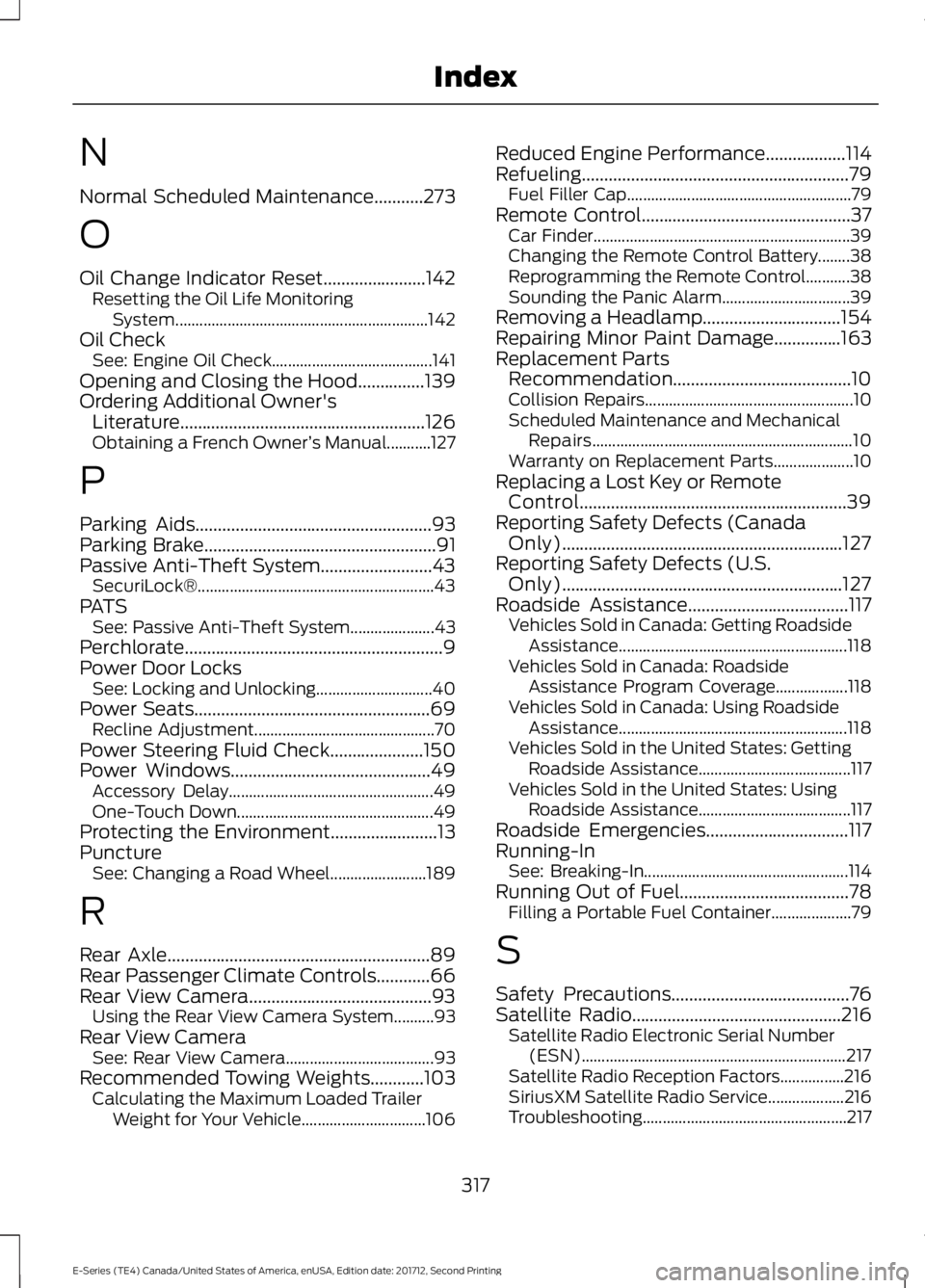
N
Normal Scheduled Maintenance...........273
O
Oil Change Indicator Reset.......................142
Resetting the Oil Life Monitoring
System............................................................... 142
Oil Check See: Engine Oil Check........................................ 141
Opening and Closing the Hood...............139
Ordering Additional Owner's Literature.......................................................126
Obtaining a French Owner ’s Manual...........127
P
Parking Aids.....................................................93
Parking Brake....................................................91
Passive Anti-Theft System.........................43 SecuriLock®........................................................... 43
PATS See: Passive Anti-Theft System..................... 43
Perchlorate..........................................................9
Power Door Locks See: Locking and Unlocking............................. 40
Power Seats
.....................................................69
Recline Adjustment............................................. 70
Power Steering Fluid Check
.....................150
Power Windows.............................................49
Accessory Delay................................................... 49
One-Touch Down................................................. 49
Protecting the Environment
........................13
Puncture See: Changing a Road Wheel........................ 189
R
Rear Axle...........................................................89
Rear Passenger Climate Controls
............66
Rear View Camera.........................................93 Using the Rear View Camera System..........93
Rear View Camera See: Rear View Camera..................................... 93
Recommended Towing Weights............103 Calculating the Maximum Loaded Trailer
Weight for Your Vehicle............................... 106Reduced Engine Performance..................114
Refueling............................................................79
Fuel Filler Cap........................................................ 79
Remote Control
...............................................37
Car Finder................................................................ 39
Changing the Remote Control Battery........38
Reprogramming the Remote Control...........38
Sounding the Panic Alarm................................ 39
Removing a Headlamp...............................154
Repairing Minor Paint Damage...............163
Replacement Parts Recommendation........................................10
Collision Repairs.................................................... 10
Scheduled Maintenance and Mechanical Repairs................................................................. 10
Warranty on Replacement Parts.................... 10
Replacing a Lost Key or Remote Control............................................................39
Reporting Safety Defects (Canada Only)...............................................................127
Reporting Safety Defects (U.S. Only)...............................................................127
Roadside Assistance
....................................117
Vehicles Sold in Canada: Getting Roadside
Assistance......................................................... 118
Vehicles Sold in Canada: Roadside Assistance Program Coverage.................. 118
Vehicles Sold in Canada: Using Roadside Assistance......................................................... 118
Vehicles Sold in the United States: Getting Roadside Assistance...................................... 117
Vehicles Sold in the United States: Using Roadside Assistance...................................... 117
Roadside Emergencies
................................117
Running-In See: Breaking-In................................................... 114
Running Out of Fuel......................................78 Filling a Portable Fuel Container.................... 79
S
Safety Precautions
........................................76
Satellite Radio...............................................216
Satellite Radio Electronic Serial Number
(ESN).................................................................. 217
Satellite Radio Reception Factors................216
SiriusXM Satellite Radio Service................... 216
Troubleshooting................................................... 217
317
E-Series (TE4) Canada/United States of America, enUSA, Edition date: 201712, Second Printing Index