fuel pressure FORD E-450 2021 User Guide
[x] Cancel search | Manufacturer: FORD, Model Year: 2021, Model line: E-450, Model: FORD E-450 2021Pages: 301, PDF Size: 3.83 MB
Page 184 of 301
•
Dry your vehicle with a chamois or soft
terry cloth towel to eliminate water
spotting.
• Immediately remove fuel spillages, bird
droppings, insect deposits and road tar.
These may cause damage to your
vehicle ’s paintwork or trim over time.
We recommend Motorcraft Bug and
Tar Remover.
• Remove any exterior accessories, for
example antennas, before entering a
car wash.
• When filling with AdBlue®, remove any
residue on painted surfaces
immediately.
Note: Suntan lotions and insect repellents
can damage painted surfaces. If these
substances come in contact with your
vehicle, wash the affected area as soon as
possible.
Cleaning the Headlamps
Note: Do not scrape the headlamp lenses
or use abrasives, alcoholic solvents or
chemical solvents to clean them.
Note: Do not wipe the headlamps when
they are dry.
Exterior Chrome Parts
• Apply a high quality-cleaning product
to bumpers and other chrome parts.
Follow the manufacturer ’s instructions.
We recommend Motorcraft Custom
Bright Metal Cleaner.
• Do not apply the cleaning product to
hot surfaces. Do not leave the cleaning
product on chrome surfaces longer
than the time recommended.
• Using non-recommended cleaners can
result in severe and permanent
cosmetic damage.
Note: Never use abrasive materials, for
example steel wool or plastic pads as they
can scratch the chrome surface. Note:
Do not use chrome cleaner, metal
cleaner or polish on wheels or wheel covers.
Exterior Plastic Parts
For routine cleaning we recommend
Motorcraft Detail Wash. If tar or grease
spots are present, we recommend
Motorcraft Bug and Tar Remover.
Stripes or Graphics (If Equipped)
Hand washing your vehicle is preferred
however, pressure washing may be used
under the following conditions:
• Do not use water pressure higher than
2,000 psi (14,000 kPa)
.
• Do not use water hotter than
179°F
(82°C).
• Use a spray with a
40° wide spray
angle pattern.
• Keep the nozzle at a
12 in (305 mm)
distance and 90° angle to your
vehicle's surface.
Note: Holding the pressure washer nozzle
at an angle to the vehicle's surface may
damage graphics and cause the edges to
peel away from the vehicle's surface.
Underbody
Regularly clean the underside of your
vehicle using water. Keep body and door
drain holes free of debris or foreign
material.
Under Hood
For removing black rubber marks from
under the hood we recommend Motorcraft
Wheel and Tire Cleaner or Motorcraft Bug
and Tar Remover.
181
E-Series (TE4) Canada/United States of America, enUSA, Edition date: 201910, First-Printing Vehicle Care
Page 189 of 301
•
Cover interior trim to prevent fading.
• Keep all rubber parts free from oil and
solvents.
Engine
• Change the engine oil and filter prior to
storage because used engine oil
contains contaminates which may
cause engine damage.
• Start the engine every 15 days for a
minimum of 15 minutes. Run at fast
idle with the climate controls set to
defrost until the engine reaches normal
operating temperature.
• With your foot on the brake, shift
through all the gears while the engine
is running.
• We recommend that you change the
engine oil before you use your vehicle
again.
Fuel system
• Fill the fuel tank with high-quality fuel
until the first automatic shutoff of the
fuel pump nozzle.
Cooling system
• Protect against freezing temperatures.
• When removing your vehicle from
storage, check coolant fluid level.
Confirm that there are no cooling
system leaks and that fluid is at the
recommended level.
Disconnecting Your 12 Volt Battery
• Check and recharge as necessary. Keep
connections clean.
• If storing your vehicle for more than 30
days without recharging the battery,
we recommend that you disconnect
the battery cables to maintain battery
charge for quick starting. Note:
It is necessary to reset memory
features if you disconnect the battery
cables.
Brakes
• Make sure the brakes and parking brake
release fully.
Tires
• Maintain recommended air pressure.
Miscellaneous
• Make sure all linkages, cables, levers
and pins under your vehicle are covered
with grease to prevent rust.
• Move vehicles at least 25 ft (7.5 m)
every 15 days to lubricate working parts
and prevent corrosion.
Removing Vehicle From Storage
When your vehicle is ready to come out of
storage, do the following:
• Wash your vehicle to remove any dirt
or grease film build-up on window
surfaces.
• Check windshield wipers for any
deterioration.
• Check under the hood for any foreign
material that may have collected
during storage such as mice or squirrel
nests.
• Check the exhaust for any foreign
material that may have collected
during storage.
• Check tire pressures and set tire
inflation per the Tire Label.
• Check brake pedal operation. Drive
your vehicle
15 ft (4.5 m) back and
forth to remove rust build-up.
186
E-Series (TE4) Canada/United States of America, enUSA, Edition date: 201910, First-Printing Vehicle Care
Page 207 of 301
WARNING: For a mounting
pressure more than 20 psi
(1.38 bar) greater than the
maximum pressure, a Ford
dealer or other tire service
professional should do the
mounting. WARNING:
Always inflate
steel carcass tires with a remote
air fill with the person inflating
standing at a minimum of
12 ft
(3.66 m) away from the wheel
and tire assembly. WARNING:
When inflating
the tire for mounting pressures
up to
20 psi (1.38 bar) greater
than the maximum pressure on
the tire sidewall, the following
precautions must be taken to
protect the person mounting the
tire:
• Make sure that you have the
correct tire and wheel size.
• Lubricate the tire bead and
wheel bead seat area again.
• Stand at a minimum of
12 ft
(3.6 m) away from the wheel
and tire assembly.
• Use both eye and ear
protection.
Important: Remember to replace
the wheel valve stems when the
road tires are replaced on your
vehicle The two front tires or two rear tires
should generally be replaced as a
pair.
The tire pressure sensors mounted
in the wheels are not designed to
be used in aftermarket wheels.
The use of wheels or tires not
recommended by Ford Motor
Company may affect the
operation of your tire pressure
monitoring system.
If the tire pressure monitoring
system indicator is flashing, the
system is malfunctioning. Your
replacement tire might be
incompatible with your tire
pressure monitoring system, or
some component of the system
may be damaged.
Replacing a Tire That is
Greenhouse Gas Certified
The tires installed on this vehicle
at the factory as original
equipment are certified for
Greenhouse Gas and Fuel
Efficiency regulations.
Replacement tires must be of
equal or lower rolling resistance
level (TRRL or Crr). Consult with
your tire supplier(s) for
appropriate replacement tires.
204
E-Series (TE4) Canada/United States of America, enUSA, Edition date: 201910, First-Printing Wheels and Tires
Page 211 of 301
•
If possible, avoid fully loading your
vehicle.
• Use only SAE Class S chains.
• Install chains securely, verifying that
the chains do not touch any wiring,
brake lines or fuel lines.
• Drive cautiously. If you hear the chains
rub or bang against your vehicle, stop
and retighten the chains. If this does
not work, remove the chains to prevent
damage to your vehicle.
• Remove the tire chains when they are
no longer needed. Do not use tire
chains on dry roads.
If you have any questions regarding snow
chains or cables, please contact your
authorized dealer.
TIRE PRESSURE MONITORING
SYSTEM (IF EQUIPPED) WARNING:
The tire pressure
monitoring system is not a substitute for
manually checking tire pressures. You
should periodically check tire pressures
using a pressure gauge. Failure to
correctly maintain tire pressures could
increase the risk of tire failure, loss of
control, vehicle rollover and personal
injury.
Note: You should only use tire sealants in
roadside emergencies as they may cause
damage to the tire pressure monitoring
system sensor.
Note: If the tire pressure monitoring system
sensor becomes damaged, it may not
function. Each tire, including the spare, if
provided, should be checked
monthly when cold and inflated
to the inflation pressure recommended by
the vehicle manufacturer on the vehicle
placard or tire inflation pressure label. If
your vehicle has tires of a different size
than the size indicated on the vehicle
placard or tire inflation pressure label, you
should determine the proper tire inflation
pressure for those tires.
As an added safety feature, your vehicle
has been equipped with a Tire Pressure
Monitoring System (TPMS) that
illuminates a low tire pressure telltale
when one or more of your tires is
significantly under-inflated. Accordingly,
when the low tire pressure telltale
illuminates, you should stop and check
your tires as soon as possible, and inflate
them to the proper pressure. Driving on a
significantly under-inflated tire causes the
tire to overheat and can lead to tire failure.
Under-inflation also reduces fuel efficiency
and tire tread life, and may affect the
vehicle ’s handling and stopping ability.
Please note that the TPMS is not a
substitute for proper tire maintenance, and
it is the driver's responsibility to maintain
correct tire pressure, even if under-inflation
has not reached the level to trigger
illumination of the TPMS low tire pressure
telltale.
Your vehicle has a TPMS malfunction
indicator to indicate when the system is
not operating properly. The TPMS
malfunction indicator is combined with the
low tire pressure telltale. When the system
detects a malfunction, the telltale flashes
for approximately one minute and then
remains continuously illuminated. This
sequence continues upon subsequent
vehicle start-ups as long as the
malfunction exists.
208
E-Series (TE4) Canada/United States of America, enUSA, Edition date: 201910, First-Printing Wheels and Tires
Page 226 of 301
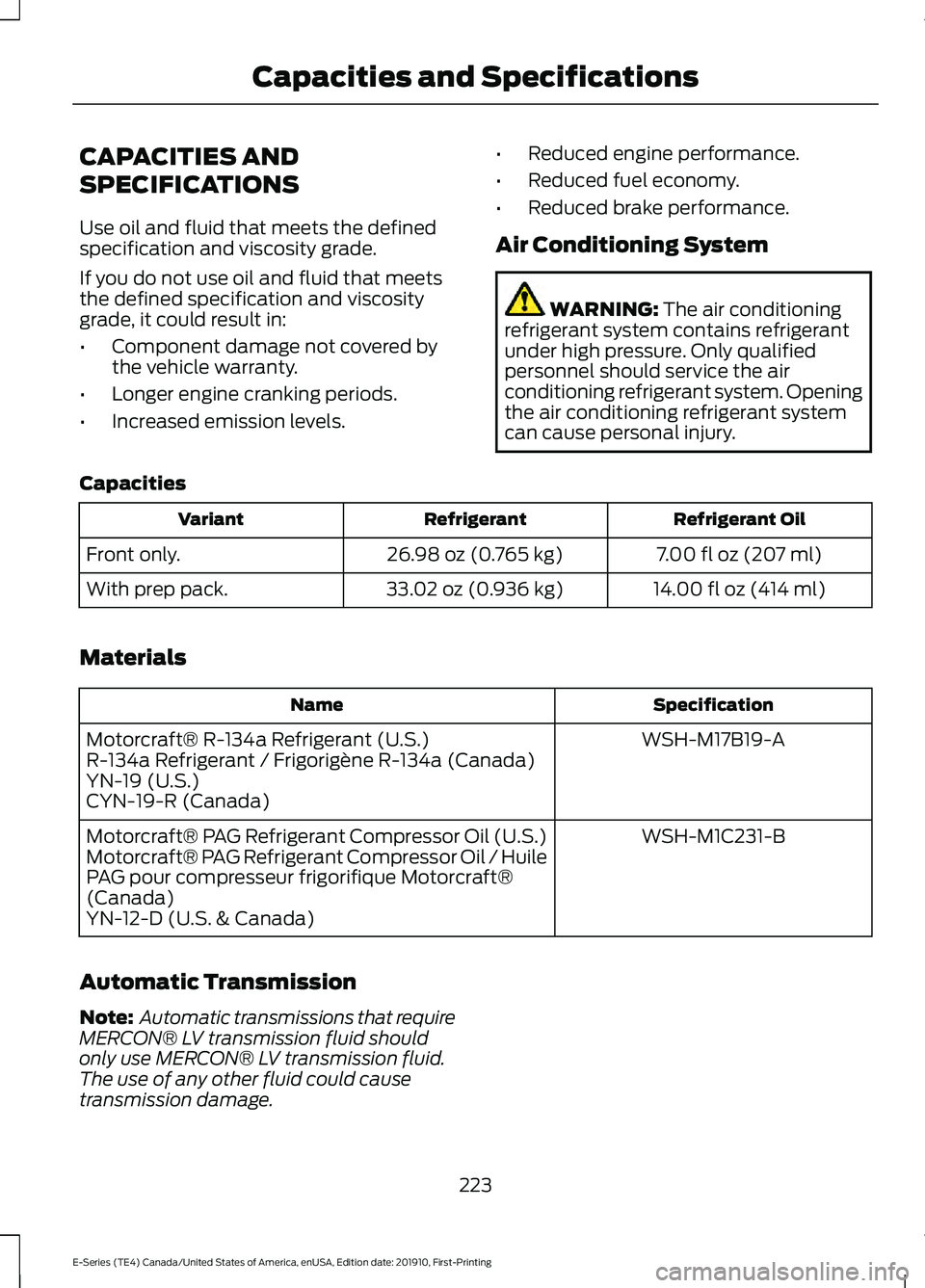
CAPACITIES AND
SPECIFICATIONS
Use oil and fluid that meets the defined
specification and viscosity grade.
If you do not use oil and fluid that meets
the defined specification and viscosity
grade, it could result in:
•
Component damage not covered by
the vehicle warranty.
• Longer engine cranking periods.
• Increased emission levels. •
Reduced engine performance.
• Reduced fuel economy.
• Reduced brake performance.
Air Conditioning System WARNING: The air conditioning
refrigerant system contains refrigerant
under high pressure. Only qualified
personnel should service the air
conditioning refrigerant system. Opening
the air conditioning refrigerant system
can cause personal injury.
Capacities Refrigerant Oil
Refrigerant
Variant
7.00 fl oz (207 ml)
26.98 oz (0.765 kg)
Front only.
14.00 fl oz (414 ml)
33.02 oz (0.936 kg)
With prep pack.
Materials Specification
Name
WSH-M17B19-A
Motorcraft® R-134a Refrigerant (U.S.)
R-134a Refrigerant / Frigorigène R-134a (Canada)
YN-19 (U.S.)
CYN-19-R (Canada)
WSH-M1C231-B
Motorcraft® PAG Refrigerant Compressor Oil (U.S.)
Motorcraft® PAG Refrigerant Compressor Oil / Huile
PAG pour compresseur frigorifique Motorcraft®
(Canada)
YN-12-D (U.S. & Canada)
Automatic Transmission
Note: Automatic transmissions that require
MERCON® LV transmission fluid should
only use MERCON® LV transmission fluid.
The use of any other fluid could cause
transmission damage.
223
E-Series (TE4) Canada/United States of America, enUSA, Edition date: 201910, First-Printing Capacities and Specifications
Page 297 of 301
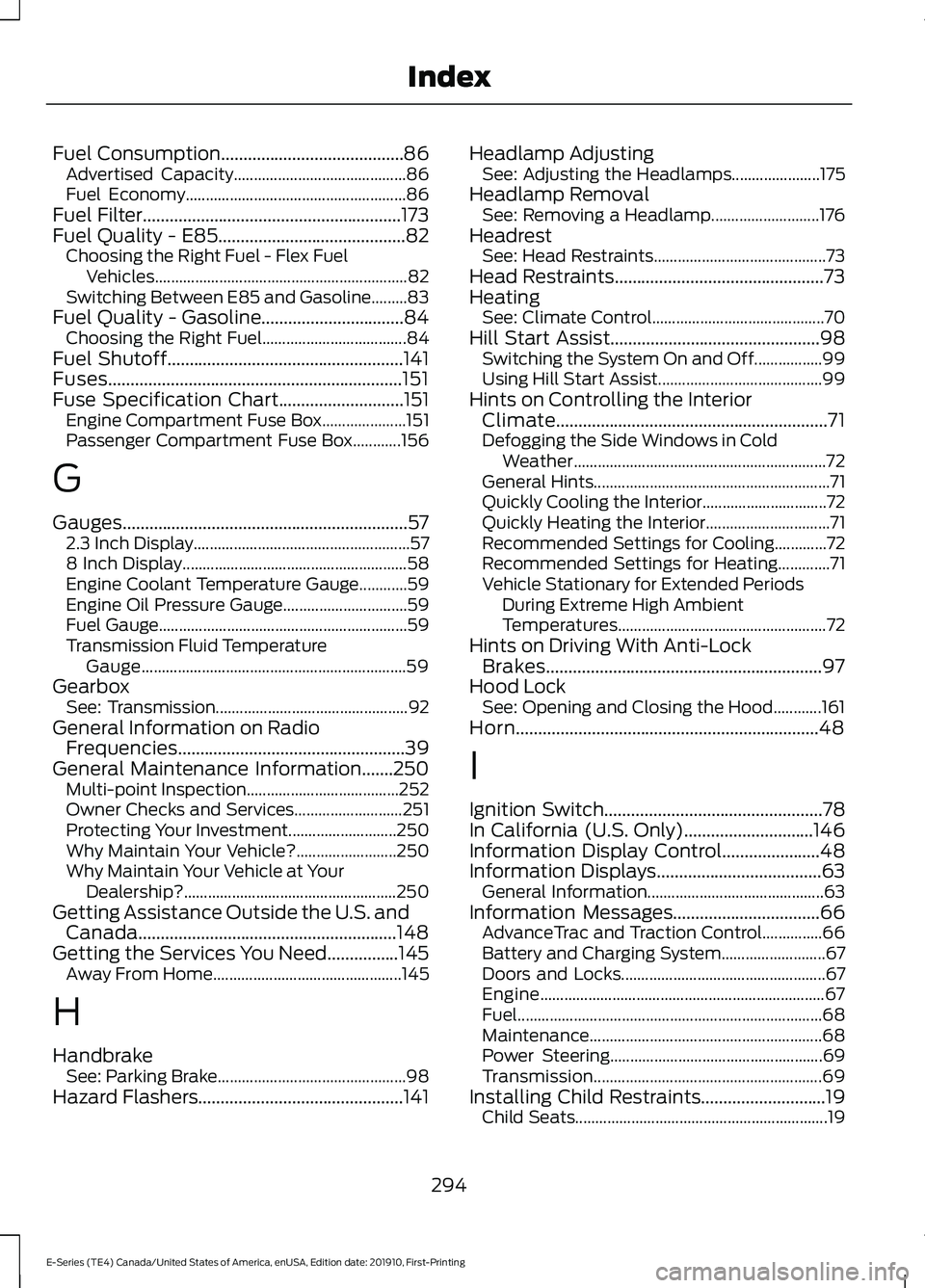
Fuel Consumption.........................................86
Advertised Capacity........................................... 86
Fuel Economy....................................................... 86
Fuel Filter..........................................................173
Fuel Quality - E85..........................................82 Choosing the Right Fuel - Flex Fuel
Vehicles............................................................... 82
Switching Between E85 and Gasoline.........83
Fuel Quality - Gasoline................................84 Choosing the Right Fuel.................................... 84
Fuel Shutoff
.....................................................141
Fuses..................................................................151
Fuse Specification Chart............................151 Engine Compartment Fuse Box..................... 151
Passenger Compartment Fuse Box............156
G
Gauges................................................................57 2.3 Inch Display...................................................... 57
8 Inch Display........................................................ 58
Engine Coolant Temperature Gauge............59
Engine Oil Pressure Gauge............................... 59
Fuel Gauge.............................................................. 59
Transmission Fluid Temperature Gauge.................................................................. 59
Gearbox See: Transmission................................................ 92
General Information on Radio Frequencies
...................................................39
General Maintenance Information.......250 Multi-point Inspection...................................... 252
Owner Checks and Services........................... 251
Protecting Your Investment........................... 250
Why Maintain Your Vehicle?......................... 250
Why Maintain Your Vehicle at Your Dealership?..................................................... 250
Getting Assistance Outside the U.S. and Canada..........................................................148
Getting the Services You Need................145 Away From Home............................................... 145
H
Handbrake See: Parking Brake............................................... 98
Hazard Flashers
..............................................141 Headlamp Adjusting
See: Adjusting the Headlamps...................... 175
Headlamp Removal See: Removing a Headlamp........................... 176
Headrest See: Head Restraints........................................... 73
Head Restraints...............................................73
Heating See: Climate Control........................................... 70
Hill Start Assist...............................................98 Switching the System On and Off.................99
Using Hill Start Assist......................................... 99
Hints on Controlling the Interior Climate.............................................................71
Defogging the Side Windows in Cold Weather............................................................... 72
General Hints........................................................... 71
Quickly Cooling the Interior............................... 72
Quickly Heating the Interior............................... 71
Recommended Settings for Cooling.............72
Recommended Settings for Heating.............71
Vehicle Stationary for Extended Periods During Extreme High Ambient
Temperatures.................................................... 72
Hints on Driving With Anti-Lock Brakes..............................................................97
Hood Lock See: Opening and Closing the Hood............161
Horn....................................................................48
I
Ignition Switch.................................................78
In California (U.S. Only).............................146
Information Display Control......................48
Information Displays
.....................................63
General Information............................................ 63
Information Messages
.................................66
AdvanceTrac and Traction Control...............66
Battery and Charging System.......................... 67
Doors and Locks................................................... 67
Engine....................................................................... 67
Fuel........................................................................\
.... 68
Maintenance.......................................................... 68
Power Steering..................................................... 69
Transmission......................................................... 69
Installing Child Restraints............................19 Child Seats............................................................... 19
294
E-Series (TE4) Canada/United States of America, enUSA, Edition date: 201910, First-Printing Index
Page 301 of 301
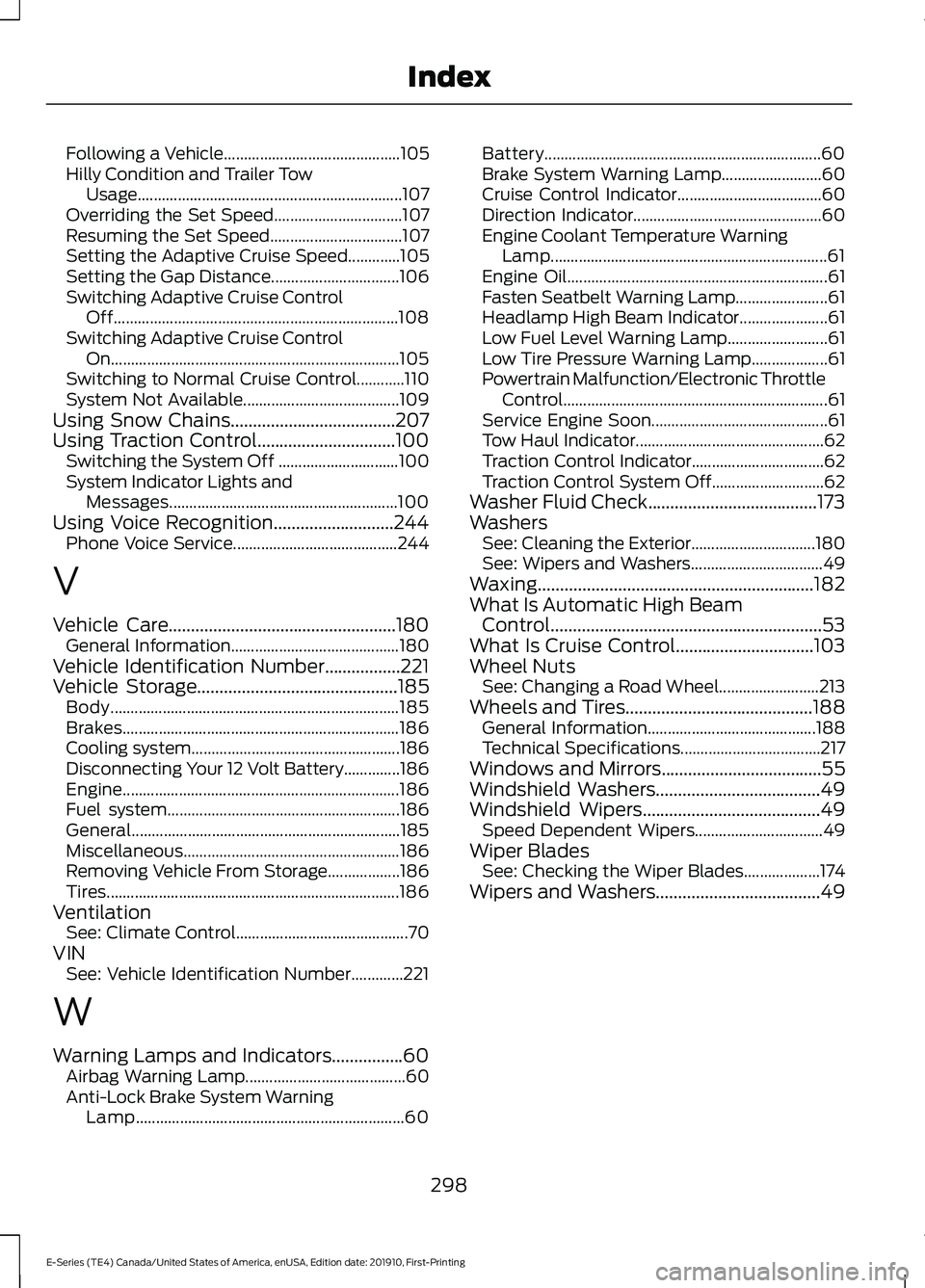
Following a Vehicle............................................
105
Hilly Condition and Trailer Tow Usage.................................................................. 107
Overriding the Set Speed................................ 107
Resuming the Set Speed................................. 107
Setting the Adaptive Cruise Speed.............105
Setting the Gap Distance................................ 106
Switching Adaptive Cruise Control Off....................................................................... 108
Switching Adaptive Cruise Control On........................................................................\
105
Switching to Normal Cruise Control............110
System Not Available....................................... 109
Using Snow Chains.....................................207
Using Traction Control...............................100 Switching the System Off .............................. 100
System Indicator Lights and Messages......................................................... 100
Using Voice Recognition...........................244 Phone Voice Service......................................... 244
V
Vehicle Care...................................................180 General Information.......................................... 180
Vehicle Identification Number
.................221
Vehicle Storage.............................................185
Body........................................................................\
185
Brakes..................................................................... 186
Cooling system.................................................... 186
Disconnecting Your 12 Volt Battery..............186
Engine..................................................................... 186
Fuel system.......................................................... 186
General................................................................... 185
Miscellaneous...................................................... 186
Removing Vehicle From Storage.................. 186
Tires........................................................................\
. 186
Ventilation See: Climate Control........................................... 70
VIN See: Vehicle Identification Number.............221
W
Warning Lamps and Indicators................60 Airbag Warning Lamp........................................ 60
Anti-Lock Brake System Warning Lamp
................................................................... 60Battery.....................................................................
60
Brake System Warning Lamp......................... 60
Cruise Control Indicator.................................... 60
Direction Indicator............................................... 60
Engine Coolant Temperature Warning Lamp..................................................................... 61
Engine Oil................................................................. 61
Fasten Seatbelt Warning Lamp....................... 61
Headlamp High Beam Indicator...................... 61
Low Fuel Level Warning Lamp......................... 61
Low Tire Pressure Warning Lamp................... 61
Powertrain Malfunction/Electronic Throttle Control.................................................................. 61
Service Engine Soon............................................ 61
Tow Haul Indicator............................................... 62
Traction Control Indicator................................. 62
Traction Control System Off............................ 62
Washer Fluid Check
......................................173
Washers See: Cleaning the Exterior............................... 180
See: Wipers and Washers................................. 49
Waxing..............................................................182
What Is Automatic High Beam Control.............................................................53
What Is Cruise Control
...............................103
Wheel Nuts See: Changing a Road Wheel......................... 213
Wheels and Tires..........................................188 General Information.......................................... 188
Technical Specifications................................... 217
Windows and Mirrors....................................55
Windshield Washers.....................................49
Windshield Wipers
........................................49
Speed Dependent Wipers................................ 49
Wiper Blades See: Checking the Wiper Blades................... 174
Wipers and Washers.....................................49
298
E-Series (TE4) Canada/United States of America, enUSA, Edition date: 201910, First-Printing Index