spare wheel FORD E-450 2021 User Guide
[x] Cancel search | Manufacturer: FORD, Model Year: 2021, Model line: E-450, Model: FORD E-450 2021Pages: 301, PDF Size: 3.83 MB
Page 213 of 301
When Your Temporary Spare Tire is
Installed
When you replace one of the road tires
with the temporary spare, the system
continues to identify an issue to remind
you that you need to repair and put back
on the damaged road wheel and tire
assembly on your vehicle.
To restore the full function of the tire
pressure monitoring system, have the
damaged road wheel and tire assembly
repaired and remounted on your vehicle.
When You Believe Your System is Not
Operating Properly
The main function of the tire pressure
monitoring system is to warn you when
your tires need air. It can also warn you in
the event the system is no longer capable
of functioning as intended. See the
following chart for information concerning
your tire pressure monitoring system:
210
E-Series (TE4) Canada/United States of America, enUSA, Edition date: 201910, First-Printing Wheels and Tires
Page 214 of 301
Customer Action Required
Possible Cause
Low Tire Pressure
Warning Light
Make sure tires are at the proper pres-
sure. See Inflating your tires in this
chapter. After inflating your tires to the
manufacturer’s recommended pressure
as shown on the Tire Label, located on
the edge of driver door or the B-Pillar, the
vehicle must be driven for at least two
minutes over 20 mph (32 km/h) before
the light turns off.
Tire(s) under-inflated
Solid warning light
Repair the damaged road wheel and tire
assembly and reinstall it on the vehicle
to restore system function. For a
description on how the system functions,
see
When your temporary spare tire
is installed in this section.
Spare tire in use
If the tires are properly inflated and the
spare tire is not in use but the light
remains on, contact your authorized
dealer as soon as possible.
TPMS malfunction
Repair the damaged road wheel and tire
assembly and reinstall it on the vehicle
to restore system function. For a
description on how the system functions,
see
When your temporary spare tire
is installed in this section.
Spare tire in use
Flashing warning
light
If the tires are properly inflated and the
spare tire is not in use but the light
remains on, contact your authorized
dealer as soon as possible.
TPMS malfunction
When Inflating Your Tires
When putting air into your tires, such as at
a gas station or in your garage, the tire
pressure monitoring system may not
respond immediately to the air added to
your tires. It may take up to two minutes of driving
over 20 mph (32 km/h) for the light to turn
off after you have filled your tires to the
recommended inflation pressure.
211
E-Series (TE4) Canada/United States of America, enUSA, Edition date: 201910, First-Printing Wheels and Tires
Page 217 of 301
Note:
The tire pressure monitoring system
indicator light illuminates when the spare
tire is in use. To restore the full function of
the monitoring system, all road wheels
equipped with tire pressure monitoring
sensors must be mounted on the vehicle.
Note: Do not use wheels or lug nuts
different than the original equipment, as this
may damage the wheel or mounting system.
If you get a flat tire when driving, do not
apply the brake heavily. Instead, gradually
decrease your speed. Hold the steering
wheel firmly and slowly move to a safe
place on the side of the road.
Have a flat serviced by an authorized
dealer in order to prevent damage to the
tire pressure monitoring system sensors.
See Tire Pressure Monitoring System
(page 208). Replace the spare tire with a
road tire as soon as possible. During
repairing or replacing of the flat tire, have
the authorized dealer inspect the tire
pressure monitoring system sensor for
damage.
Dissimilar Spare Wheel and Tire
Assembly Information WARNING:
Failure to follow these
guidelines could result in an increased
risk of loss of vehicle control, injury or
death.
If you have a dissimilar spare wheel and
tire, then it is intended for temporary use
only. This means that if you need to use it,
you should replace it as soon as possible
with a road wheel and tire assembly that
is the same size and type as the road tires
and wheels that were originally provided
by Ford. If the dissimilar spare tire or wheel
is damaged, it should be replaced rather
than repaired. A dissimilar spare wheel and tire assembly
is defined as a spare wheel and tire
assembly that is different in brand, size or
appearance from the road tires and wheels
and can be one of three types:
1.
T-type mini-spare:
This spare tire
begins with the letter T for tire size and
may have Temporary Use Only molded in
the sidewall.
2. Full-size dissimilar spare with label
on wheel:
This spare tire has a label on
the wheel that states: THIS WHEEL AND
TIRE ASSEMBLY FOR TEMPORARY USE
ONLY.
When driving with one of the dissimilar
spare tires listed above, do not:
• Exceed
50 mph (80 km/h).
• Load the vehicle beyond maximum
vehicle load rating listed on the Safety
Compliance Label.
• Tow a trailer.
• Use snow chains on the end of the
vehicle with the dissimilar spare tire.
• Use more than one dissimilar spare tire
at a time.
• Use commercial car washing
equipment.
• Try to repair the dissimilar spare tire.
Use of one of the dissimilar spare tires
listed above at any one wheel location can
lead to impairment of the following:
• Handling, stability and braking
performance.
• Comfort and noise.
• Ground clearance and parking at curbs.
• Winter weather driving capability.
• Wet weather driving capability.
• All-wheel driving capability.
3. Full-size dissimilar spare without
label on wheel
214
E-Series (TE4) Canada/United States of America, enUSA, Edition date: 201910, First-Printing Wheels and Tires
Page 218 of 301
When driving with the full-size dissimilar
spare wheel and tire assembly, do not:
•
Exceed 70 mph (113 km/h).
• Use more than one dissimilar spare
wheel and tire assembly at a time.
• Use commercial car washing
equipment.
• Use snow chains on the end of the
vehicle with the dissimilar spare wheel
and tire assembly.
The usage of a full-size dissimilar spare
wheel and tire assembly can lead to
impairment of the following:
• Handling, stability and braking
performance.
• Comfort and noise.
• Ground clearance and parking at curbs.
• Winter weather driving capability.
• Wet weather driving capability.
• All-wheel driving capability.
When driving with the full-size dissimilar
spare wheel and tire assembly additional
caution should be given to:
• Towing a trailer.
• Driving vehicles equipped with a
camper body.
• Driving vehicles with a load on the
cargo rack.
Drive cautiously when using a full-size
dissimilar spare wheel and tire assembly
and seek service as soon as possible.
Tire Change Procedure WARNING:
When one of the front
wheels is off the ground, the
transmission alone will not prevent the
vehicle from moving or slipping off the
jack, even if the transmission is in park
(P). WARNING:
To help prevent your
vehicle from moving when changing a
wheel, shift the transmission into park
(P), set the parking brake and use an
appropriate block or wheel chock to
secure the wheel diagonally opposite to
the wheel being changed. For example,
when changing the front left wheel,
place an appropriate block or wheel
chock on the right rear wheel. WARNING:
Do not get under a
vehicle that is only supported by a
vehicle jack. WARNING:
Do not attempt to
change a tire on the side of the vehicle
close to moving traffic. Pull far enough
off the road to avoid the danger of being
hit when operating the jack or changing
the wheel. WARNING:
Always use the jack
provided as original equipment with your
vehicle. If using a jack other than the one
provided, make sure the jack capacity is
adequate for the vehicle weight,
including any vehicle cargo or
modifications. If you are unsure if the jack
capacity is adequate, contact the
authorized dealer.
Note: Passengers should not remain in your
vehicle when the vehicle is being jacked.
Removing the flat wheel and tire
1. Park on a level surface, set the parking
brake and activate the hazard flashers.
2. Place the transmission in park (P) and
turn the engine off.
215
E-Series (TE4) Canada/United States of America, enUSA, Edition date: 201910, First-Printing Wheels and Tires
Page 219 of 301
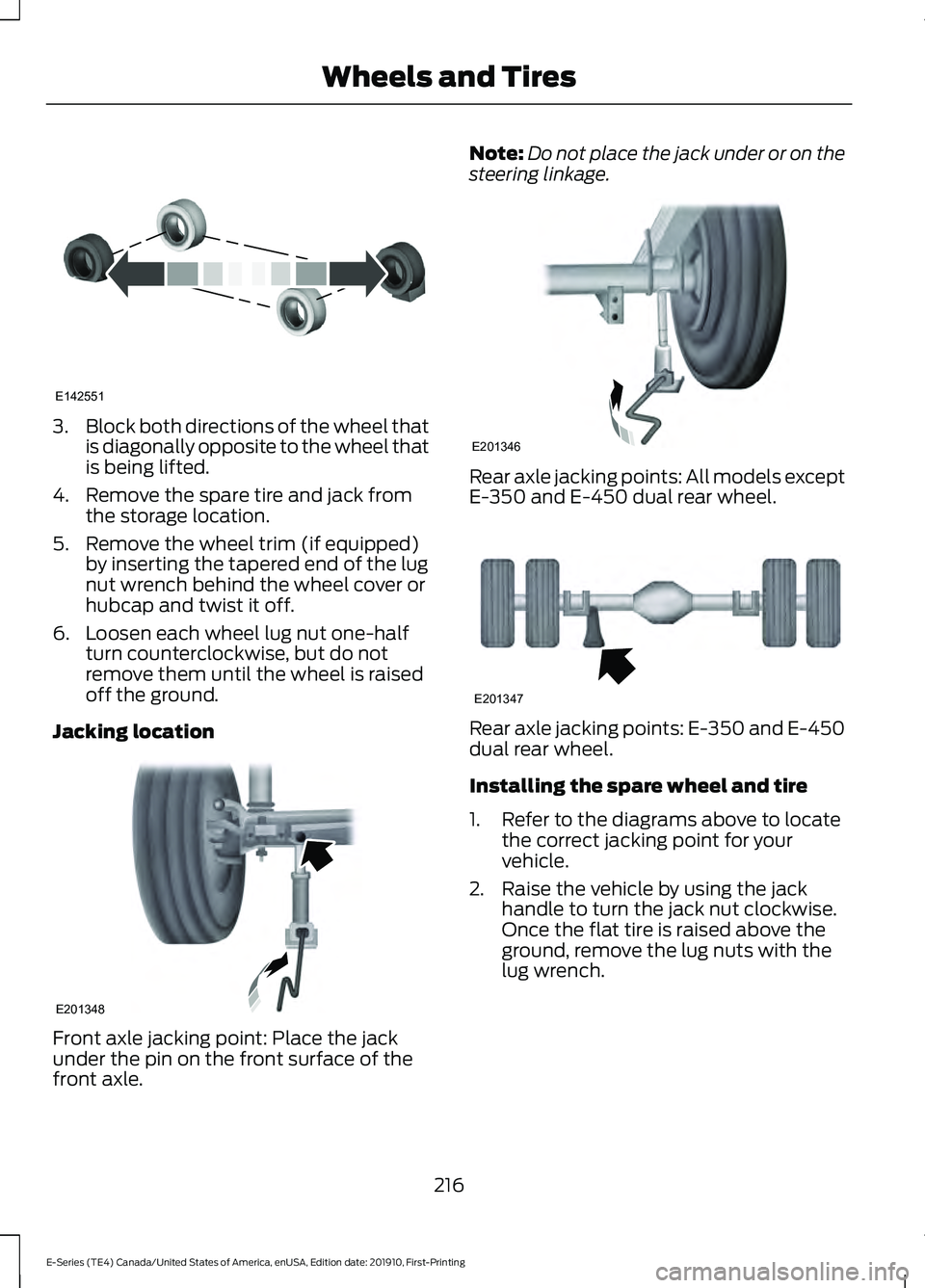
3.
Block both directions of the wheel that
is diagonally opposite to the wheel that
is being lifted.
4. Remove the spare tire and jack from the storage location.
5. Remove the wheel trim (if equipped) by inserting the tapered end of the lug
nut wrench behind the wheel cover or
hubcap and twist it off.
6. Loosen each wheel lug nut one-half turn counterclockwise, but do not
remove them until the wheel is raised
off the ground.
Jacking location Front axle jacking point: Place the jack
under the pin on the front surface of the
front axle. Note:
Do not place the jack under or on the
steering linkage. Rear axle jacking points: All models except
E-350 and E-450 dual rear wheel.
Rear axle jacking points: E-350 and E-450
dual rear wheel.
Installing the spare wheel and tire
1. Refer to the diagrams above to locate
the correct jacking point for your
vehicle.
2. Raise the vehicle by using the jack handle to turn the jack nut clockwise.
Once the flat tire is raised above the
ground, remove the lug nuts with the
lug wrench.
216
E-Series (TE4) Canada/United States of America, enUSA, Edition date: 201910, First-Printing Wheels and TiresE142551 E201348 E201346 E201347
Page 220 of 301
3. Replace the flat tire with the spare,
making sure the valve stem of the
spare is facing outward when replacing
a front wheel or the rear wheel position
on vehicles with single rear wheel
fitments. For vehicles with dual rear
wheels, the valve stem of the spare
must face outward when replacing an
inner wheel, but must face inward
when replacing an outboard wheel.
4. Reinstall the lug nuts until the wheel is
snug against the hub. Do not fully
tighten the lug nuts until the vehicle
has been lowered
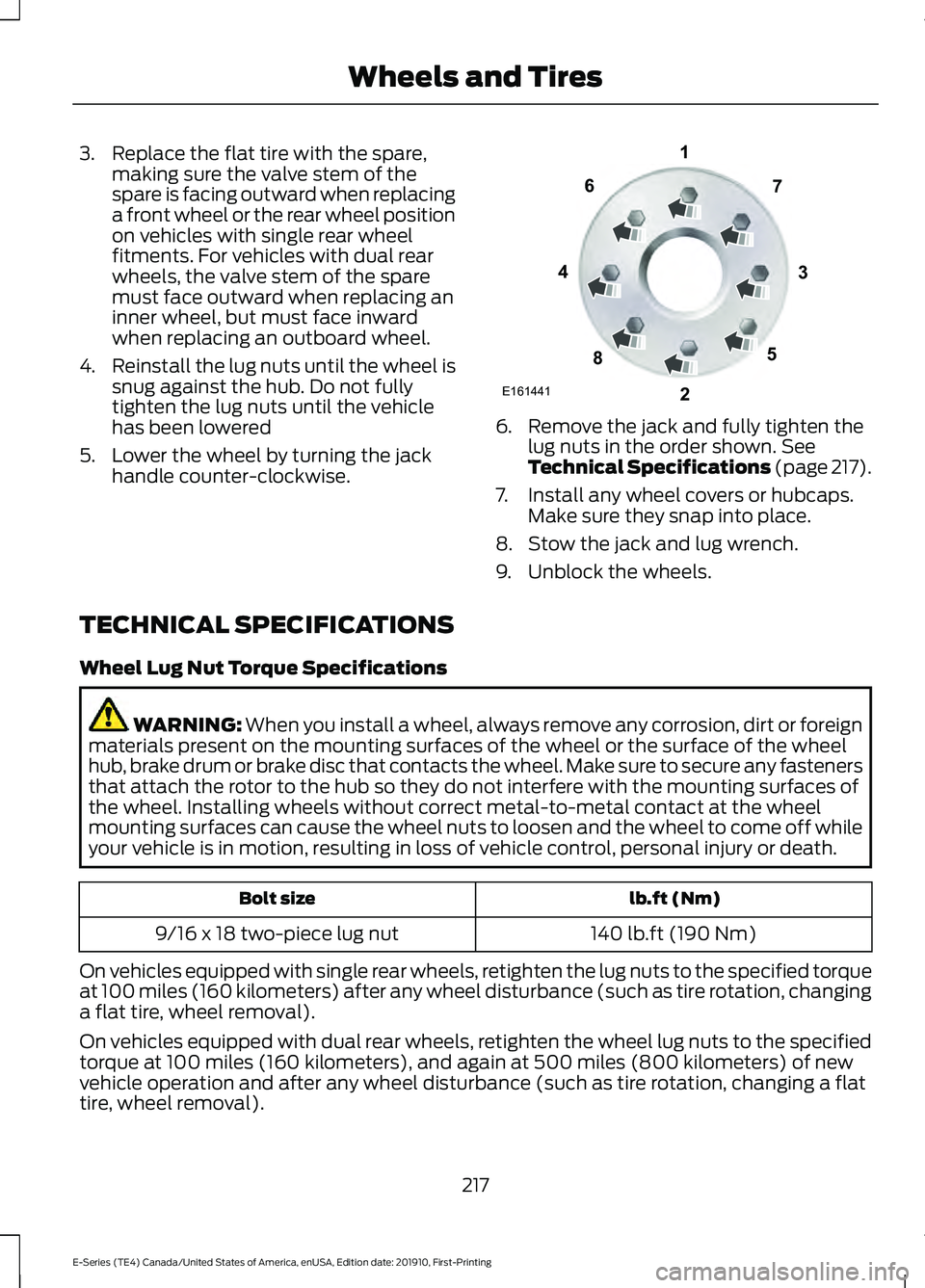
5. Lower the wheel by turning the jack handle counter-clockwise. 6. Remove the jack and fully tighten the
lug nuts in the order shown. See
Technical Specifications (page 217).
7. Install any wheel covers or hubcaps. Make sure they snap into place.
8. Stow the jack and lug wrench.
9. Unblock the wheels.
TECHNICAL SPECIFICATIONS
Wheel Lug Nut Torque Specifications WARNING: When you install a wheel, always remove any corrosion, dirt or foreign
materials present on the mounting surfaces of the wheel or the surface of the wheel
hub, brake drum or brake disc that contacts the wheel. Make sure to secure any fasteners
that attach the rotor to the hub so they do not interfere with the mounting surfaces of
the wheel. Installing wheels without correct metal-to-metal contact at the wheel
mounting surfaces can cause the wheel nuts to loosen and the wheel to come off while
your vehicle is in motion, resulting in loss of vehicle control, personal injury or death. lb.ft (Nm)
Bolt size
140 lb.ft (190 Nm)
9/16 x 18 two-piece lug nut
On vehicles equipped with single rear wheels, retighten the lug nuts to the specified torque
at 100 miles (160 kilometers) after any wheel disturbance (such as tire rotation, changing
a flat tire, wheel removal).
On vehicles equipped with dual rear wheels, retighten the wheel lug nuts to the specified
torque at 100 miles (160 kilometers), and again at 500 miles (800 kilometers) of new
vehicle operation and after any wheel disturbance (such as tire rotation, changing a flat
tire, wheel removal).
217
E-Series (TE4) Canada/United States of America, enUSA, Edition date: 201910, First-Printing Wheels and TiresE161441
13
4
27
6
5
8
Page 295 of 301
Automatic Transmission.................................
223
Dana Conventional Axle M70FF (M267FF)......................................................... 230
Dana Conventional Axle M70HD (M273HD)......................................................... 231
Dana Limited Slip Axle M70FF (M267FF)......................................................... 229
Dana Limited Slip Axle M70HD (M273HD)........................................................ 230
Door Weatherstrips........................................... 229
Engine Coolant................................................... 224
Engine Oil.............................................................. 225
Fuel Tank............................................................... 226
Grease.................................................................... 226
Hydroboost Brake System............................. 228
Locks....................................................................... 229
Power Steering System................................... 228
Vacuum Brake System..................................... 227
Washer Reservoir................................................ 231
Car Wash See: Cleaning the Exterior............................... 180
Catalytic Converter.......................................89
On-Board Diagnostics (OBD-II)..................... 90
Readiness for Inspection and Maintenance (I/M) Testing.................................................... 90
Changing a Bulb
.............................................177
Lamp Assembly Condensation...................... 177
Replacing Brake/Tail/Turn/Reverse Lamp Bulbs (Cut-Away Only)............................... 178
Replacing Front Parking Lamp and Direction Indicator Bulbs................................................ 178
Replacing Headlamp Bulbs............................. 177
Replacing Side Marker Bulbs.......................... 178
Changing a Fuse...........................................159 Fuses....................................................................... 159
Changing a Road Wheel
.............................213
Dissimilar Spare Wheel and Tire Assembly
Information...................................................... 214
Tire Change Procedure..................................... 215
Changing the 12V Battery...........................173 Dual Batteries....................................................... 174
Reconnecting the Battery................................ 174
Changing the Engine Air Filter..................178
Changing the Wiper Blades
......................175
Checking the Wiper Blades.......................174
Child Restraint and Seatbelt Maintenance..................................................31
Child Restraint Positioning.........................25 Child Safety
........................................................17
General Information............................................. 17
Cleaning Leather Seats
..............................184
Cleaning Products.......................................180 Materials................................................................ 180
Cleaning the Engine.....................................182
Cleaning the Exterior..................................180 Cleaning the Headlamps.................................. 181
Exterior Chrome Parts....................................... 181
Exterior Plastic Parts.......................................... 181
Stripes or Graphics..............................................181
Underbody............................................................. 181
Under Hood........................................................... 181
Cleaning the Instrument Panel and Instrument Cluster Lens.........................183
Cleaning the Interior....................................183 Mirrors..................................................................... 183
Cleaning the Wheels...................................185
Cleaning the Windows and Wiper Blades............................................................182
Climate Control...............................................70
Connected Vehicle
......................................234
Connecting the Vehicle to a Mobile
Network............................................................ 234
Connected Vehicle Limitations..............234
Connected Vehicle Requirements.........234
Connected Vehicle – Troubleshooting........................................234
Connecting a Bluetooth Device.............240 Pairing a Device.................................................. 240
Connecting the Vehicle to a Mobile Network........................................................234
Connecting FordPass to the Connectivity Device................................................................ 234
Disabling the Connectivity Device...............234
What Is the Connectivity Device.................. 234
Coolant Check See: Engine Coolant Check............................ 165
Crash Sensors and Airbag Indicator........37
Cruise Control................................................103
Cruise Control Indicators...........................104
Cruise Control - Vehicles With: Adaptive Cruise Control
...............................................47
Cruise Control - Vehicles With: Cruise Control............................................................48
Customer Assistance
..................................145
292
E-Series (TE4) Canada/United States of America, enUSA, Edition date: 201910, First-Printing Index
Page 300 of 301
Sitting in the Correct Position....................73
Snow Chains
See: Using Snow Chains................................. 207
Spare Wheel See: Changing a Road Wheel......................... 213
Special Notices................................................12 Fleet Telematics Modem.................................... 13
FordPass Connect................................................. 13
New Vehicle Limited Warranty......................... 12
Notice to Owners of Pickup Trucks and Utility Type Vehicles........................................ 13
On Board Diagnostics Data Link Connector............................................................ 13
Special Instructions.............................................. 12
Using your Vehicle as an Ambulance............14
Special Operating Conditions Scheduled Maintenance...............................................255
Exceptions............................................................ 256
Speed Control See: Cruise Control............................................ 103
Starter Switch See: Ignition Switch............................................. 78
Starting a Gasoline Engine.........................78
Failure to Start....................................................... 79
Guarding Against Exhaust Fumes.................. 79
Important Ventilating Information.................79
Stopping the Engine When Your Vehicle is Moving................................................................. 79
Stopping the Engine When Your Vehicle is Stationary........................................................... 79
Starting and Stopping the Engine...........78 General Information............................................ 78
Steering.............................................................115 Hydraulic Power Steering................................. 115
Steering Wheel
................................................47
Streaming Bluetooth Audio.....................243 Selecting a Bluetooth Source....................... 243
Sun Visors.........................................................56 Illuminated Vanity Mirror................................... 56
Supplementary Restraints System
.........32
Principle of Operation......................................... 32
Switching Automatic High Beam Control On and Off.....................................................53
Activating the Automatic High Beam Control................................................................. 53
Switching Cruise Control On and Off...................................................................103
Switching Cruise Control Off......................... 103Switching Cruise Control On..........................
103
Symbols Glossary.............................................5
T
Technical Specifications See: Capacities and Specifications.............219
The Better Business Bureau (BBB) Auto Line Program (U.S. Only)........................147
Tire Care...........................................................189 Glossary of Tire Terminology.......................... 191
Information About Uniform Tire Quality Grading.............................................................. 189
Information Contained on the Tire Sidewall............................................................. 192
Temperature A B C............................................ 190
Traction AA A B C............................................... 190
Treadwear............................................................. 190
Tire Pressure Monitoring System..........208 Changing Tires With a Tire Pressure
Monitoring System....................................... 209
Understanding Your Tire Pressure Monitoring System ...................................... 209
Tires See: Wheels and Tires...................................... 188
Towing a Trailer..............................................125 Load Placement.................................................. 125
Towing the Vehicle on Four Wheels...........................................................136
Emergency Towing............................................. 136
Recreational Towing.......................................... 136
Towing...............................................................125
Traction Control
............................................100
Principle of Operation...................................... 100
Transmission Code Designation.............222
Transmission....................................................92
Transporting the Vehicle............................143
U
Under Hood Overview
................................162
USB Port.........................................................244
Using Adaptive Cruise Control................104 Automatic Cancellation................................... 107
Blocked Sensor................................................... 109
Canceling the Set Speed................................. 107
Changing the Set Speed.................................. 107
Detection Issues................................................. 108
297
E-Series (TE4) Canada/United States of America, enUSA, Edition date: 201910, First-Printing Index