steering wheel FORD E-450 2021 Owner's Manual
[x] Cancel search | Manufacturer: FORD, Model Year: 2021, Model line: E-450, Model: FORD E-450 2021Pages: 301, PDF Size: 3.83 MB
Page 175 of 301
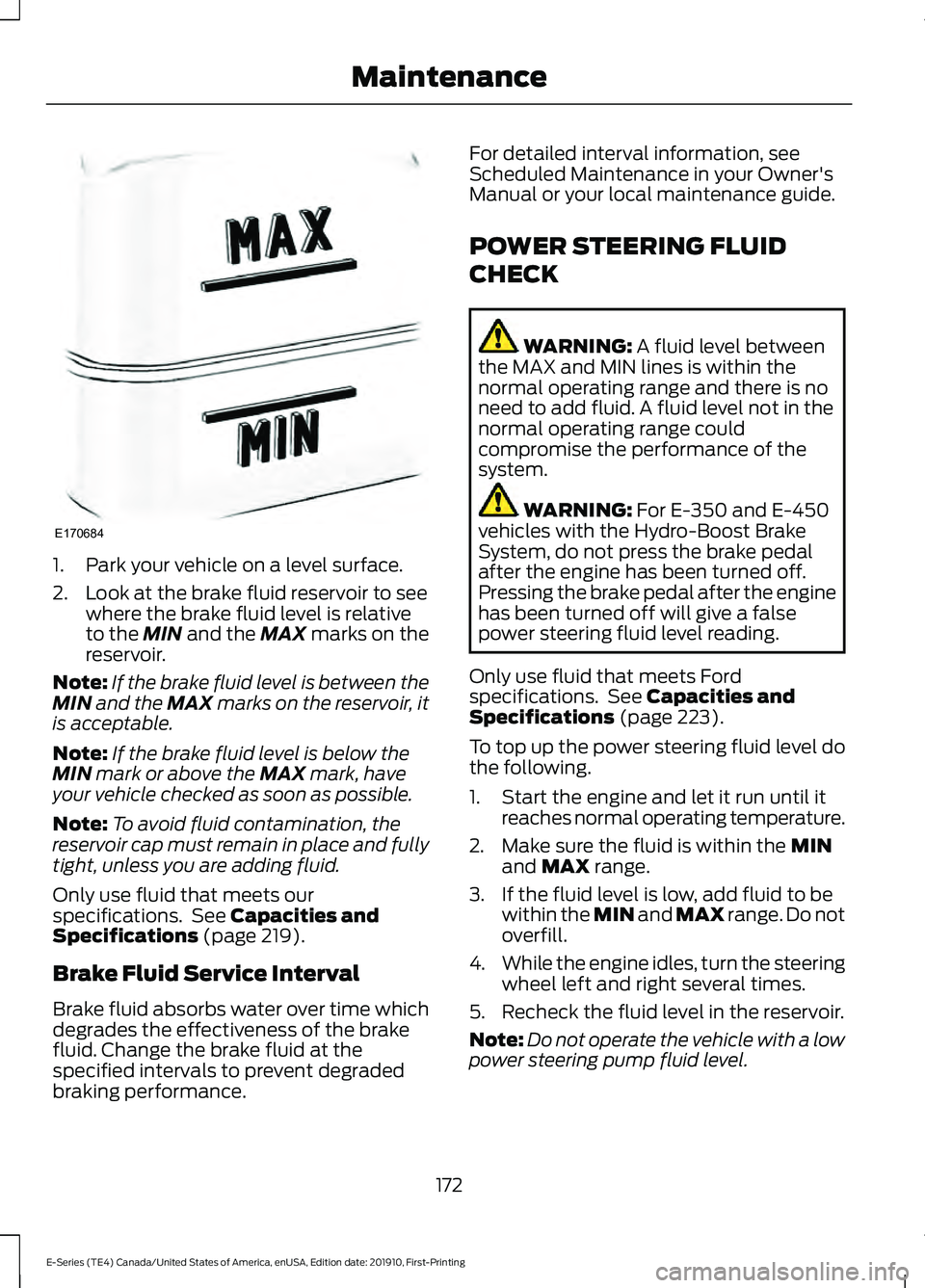
1. Park your vehicle on a level surface.
2. Look at the brake fluid reservoir to see
where the brake fluid level is relative
to the MIN and the MAX marks on the
reservoir.
Note: If the brake fluid level is between the
MIN
and the MAX marks on the reservoir, it
is acceptable.
Note: If the brake fluid level is below the
MIN
mark or above the MAX mark, have
your vehicle checked as soon as possible.
Note: To avoid fluid contamination, the
reservoir cap must remain in place and fully
tight, unless you are adding fluid.
Only use fluid that meets our
specifications. See
Capacities and
Specifications (page 219).
Brake Fluid Service Interval
Brake fluid absorbs water over time which
degrades the effectiveness of the brake
fluid. Change the brake fluid at the
specified intervals to prevent degraded
braking performance. For detailed interval information, see
Scheduled Maintenance in your Owner's
Manual or your local maintenance guide.
POWER STEERING FLUID
CHECK
WARNING:
A fluid level between
the MAX and MIN lines is within the
normal operating range and there is no
need to add fluid. A fluid level not in the
normal operating range could
compromise the performance of the
system. WARNING:
For E-350 and E-450
vehicles with the Hydro-Boost Brake
System, do not press the brake pedal
after the engine has been turned off.
Pressing the brake pedal after the engine
has been turned off will give a false
power steering fluid level reading.
Only use fluid that meets Ford
specifications. See
Capacities and
Specifications (page 223).
To top up the power steering fluid level do
the following.
1. Start the engine and let it run until it reaches normal operating temperature.
2. Make sure the fluid is within the
MIN
and MAX range.
3. If the fluid level is low, add fluid to be within the
MIN and MAX range. Do not
overfill.
4. While the engine idles, turn the steering
wheel left and right several times.
5. Recheck the fluid level in the reservoir.
Note: Do not operate the vehicle with a low
power steering pump fluid level.
172
E-Series (TE4) Canada/United States of America, enUSA, Edition date: 201910, First-Printing MaintenanceE170684
Page 186 of 301
To clean the windshield and wiper blades:
•
Clean the windshield with a
non-abrasive glass cleaner. When
cleaning the interior of the windshield,
avoid getting any glass cleaner on the
instrument panel or door panels. Wipe
any glass cleaner off these surfaces
immediately.
• For windshields contaminated with
tree sap, chemicals, wax or bugs, clean
the entire windshield using steel wool
(no greater than 0000 grade) in a
circular motion and rinse with water.
• Clean the wiper blades with isopropyl
rubbing alcohol or windshield washer
concentrate.
Note: Do not use razor blades or other
sharp objects to clean or remove decals
from the inside of the heated rear window.
The vehicle warranty does not cover
damage caused to the heated rear window
grid lines.
CLEANING THE INTERIOR WARNING: Do not use cleaning
solvents, bleach or dye on the vehicle's
seatbelts, as these actions may weaken
the belt webbing. WARNING:
On vehicles equipped
with seat-mounted airbags, do not use
chemical solvents or strong detergents.
Such products could contaminate the
side airbag system and affect
performance of the side airbag in a crash.
For fabric, carpets, cloth seats and seats
equipped with side airbags:
• Remove dust and loose dirt with a
vacuum cleaner.
• Remove light stains and soil with
Motorcraft Professional Strength
Carpet & Upholstery Cleaner. •
If grease or tar is present on the
material, spot-clean the area first with
Motorcraft Spot and Stain Remover. In
Canada, use Motorcraft Multi-Purpose
Cleaner.
• If a ring forms on the fabric after spot
cleaning, clean the entire area
immediately (but do not oversaturate)
or the ring will set.
• Do not use household cleaning
products or glass cleaners, which can
stain and discolor the fabric and affect
the flame retardant abilities of the seat
materials.
Mirrors
Do not clean the housing or glass of any
mirror with harsh abrasives, fuel or other
petroleum or ammonia-based cleaning
products.
CLEANING THE INSTRUMENT
PANEL AND INSTRUMENT
CLUSTER LENS WARNING:
Do not use chemical
solvents or strong detergents when
cleaning the steering wheel or
instrument panel to avoid contamination
of the airbag system.
Note: Follow the same procedure as
cleaning leather seats for cleaning leather
instrument panels and leather interior trim
surfaces. See
Cleaning Leather Seats
(page 184).
Clean the instrument panel and cluster
lens with a clean, damp and soft cloth,
then use a clean, dry and soft cloth to dry
these areas.
183
E-Series (TE4) Canada/United States of America, enUSA, Edition date: 201910, First-Printing Vehicle Care
Page 192 of 301
•
Higher - to allow higher load carrying
capacity and to allow it to travel over
rough terrain without getting hung up
or damaging underbody components.
• Shorter - to give it the capability to
approach inclines and drive over the
crest of a hill without getting hung up
or damaging underbody components.
All other things held equal, a shorter
wheelbase may make your vehicle
quicker to respond to steering inputs
than a vehicle with a longer wheelbase.
• Narrower - to provide greater
maneuverability in tight spaces,
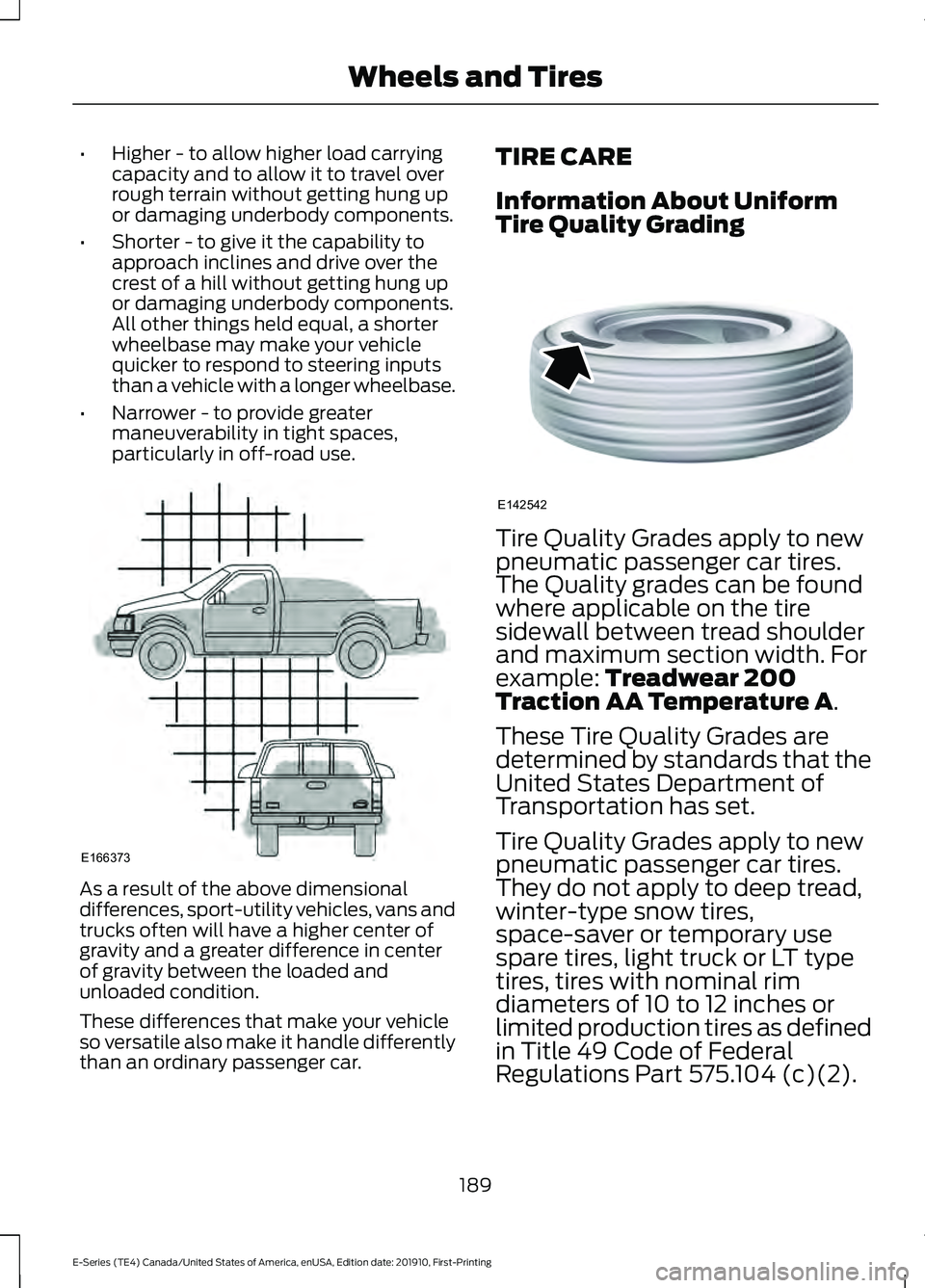
particularly in off-road use. As a result of the above dimensional
differences, sport-utility vehicles, vans and
trucks often will have a higher center of
gravity and a greater difference in center
of gravity between the loaded and
unloaded condition.
These differences that make your vehicle
so versatile also make it handle differently
than an ordinary passenger car. TIRE CARE
Information About Uniform
Tire Quality Grading
Tire Quality Grades apply to new
pneumatic passenger car tires.
The Quality grades can be found
where applicable on the tire
sidewall between tread shoulder
and maximum section width. For
example: Treadwear 200
Traction AA Temperature A.
These Tire Quality Grades are
determined by standards that the
United States Department of
Transportation has set.
Tire Quality Grades apply to new
pneumatic passenger car tires.
They do not apply to deep tread,
winter-type snow tires,
space-saver or temporary use
spare tires, light truck or LT type
tires, tires with nominal rim
diameters of 10 to 12 inches or
limited production tires as defined
in Title 49 Code of Federal
Regulations Part 575.104 (c)(2).
189
E-Series (TE4) Canada/United States of America, enUSA, Edition date: 201910, First-Printing Wheels and TiresE166373 E142542
Page 200 of 301
You are strongly urged to buy a
reliable tire pressure gauge, as
automatic service station gauges
may be inaccurate. Ford
recommends the use of a digital
or dial-type tire pressure gauge
rather than a stick-type tire
pressure gauge.
Use the recommended cold
inflation pressure for optimum tire
performance and wear.
Under-inflation or over-inflation
may cause uneven treadwear
patterns
WARNING: Under-inflation
is the most common cause of
tire failures and may result in
severe tire cracking, tread
separation or blowout, with
unexpected loss of vehicle
control and increased risk of
injury. Under-inflation increases
sidewall flexing and rolling
resistance, resulting in heat
buildup and internal damage to
the tire. It also may result in
unnecessary tire stress, irregular
wear, loss of vehicle control and
accidents. A tire can lose up to
half of its air pressure and not
appear to be flat!
Always inflate your tires to the
Ford recommended inflation
pressure even if it is less than the
maximum inflation pressure
information found on the tire. The
Ford recommended tire inflation
pressure is found on the Safety
Compliance Certification Label or Tire Label (affixed to either the
door hinge pillar, door-latch post,
or the door edge that meets the
door-latch post, next to the
driver's seating position), or Tire
Label located on the B-pillar or
the edge of the driver's door.
Failure to follow the tire pressure
recommendations can cause
uneven treadwear patterns and
adversely affect the way your
vehicle handles
Note:
Do not reduce tire pressure
to change the ride characteristics
of the vehicle. If you do not
maintain the inflation pressure at
the levels specified by Ford, your
vehicle may experience a condition
known as shimmy. Shimmy is a
severe vibration and oscillation in
the steering wheel after the vehicle
travels over a bump or dip in the
road that does not dampen out by
itself. Shimmy may result from
significant under-inflation of the
tires, improper tires (load range,
size, or type), or vehicle
modifications such as lift-kits. In
the event that your vehicle
experiences shimmy, you should
slowly reduce speed by either lifting
off the accelerator pedal or lightly
applying the brakes. The shimmy
ceases as the vehicle speed
decreases.
Maximum Inflation Pressure is
the tire manufacturer's maximum
permissible pressure and the
pressure at which the maximum
load can be carried by the tire. This
pressure is normally higher than
197
E-Series (TE4) Canada/United States of America, enUSA, Edition date: 201910, First-Printing Wheels and Tires
Page 210 of 301
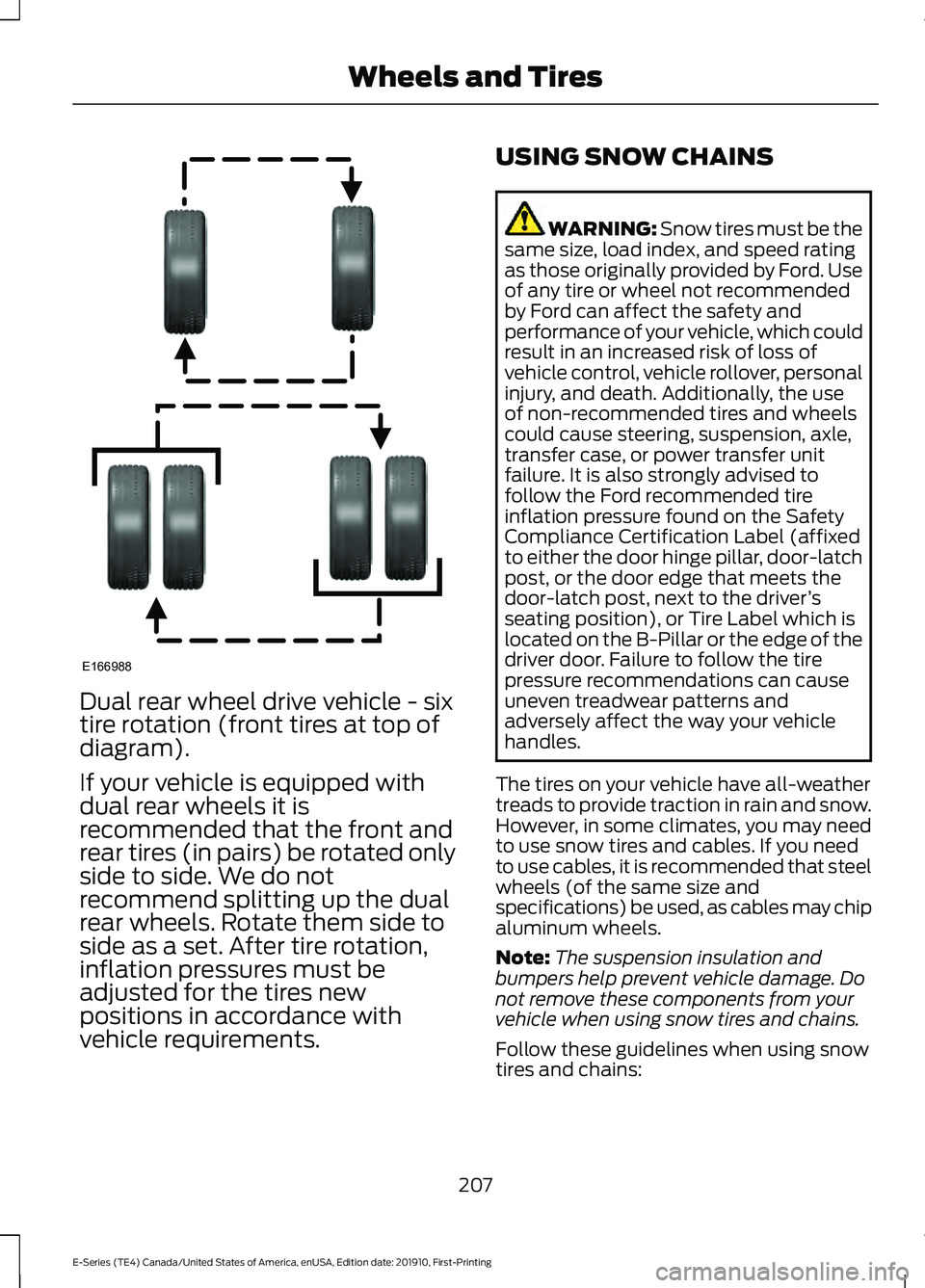
Dual rear wheel drive vehicle - six
tire rotation (front tires at top of
diagram).
If your vehicle is equipped with
dual rear wheels it is
recommended that the front and
rear tires (in pairs) be rotated only
side to side. We do not
recommend splitting up the dual
rear wheels. Rotate them side to
side as a set. After tire rotation,
inflation pressures must be
adjusted for the tires new
positions in accordance with
vehicle requirements. USING SNOW CHAINS WARNING: Snow tires must be the
same size, load index, and speed rating
as those originally provided by Ford. Use
of any tire or wheel not recommended
by Ford can affect the safety and
performance of your vehicle, which could
result in an increased risk of loss of
vehicle control, vehicle rollover, personal
injury, and death. Additionally, the use
of non-recommended tires and wheels
could cause steering, suspension, axle,
transfer case, or power transfer unit
failure. It is also strongly advised to
follow the Ford recommended tire
inflation pressure found on the Safety
Compliance Certification Label (affixed
to either the door hinge pillar, door-latch
post, or the door edge that meets the
door-latch post, next to the driver ’s
seating position), or Tire Label which is
located on the B-Pillar or the edge of the
driver door. Failure to follow the tire
pressure recommendations can cause
uneven treadwear patterns and
adversely affect the way your vehicle
handles.
The tires on your vehicle have all-weather
treads to provide traction in rain and snow.
However, in some climates, you may need
to use snow tires and cables. If you need
to use cables, it is recommended that steel
wheels (of the same size and
specifications) be used, as cables may chip
aluminum wheels.
Note: The suspension insulation and
bumpers help prevent vehicle damage. Do
not remove these components from your
vehicle when using snow tires and chains.
Follow these guidelines when using snow
tires and chains:
207
E-Series (TE4) Canada/United States of America, enUSA, Edition date: 201910, First-Printing Wheels and TiresE166988
Page 217 of 301
Note:
The tire pressure monitoring system
indicator light illuminates when the spare
tire is in use. To restore the full function of
the monitoring system, all road wheels
equipped with tire pressure monitoring
sensors must be mounted on the vehicle.
Note: Do not use wheels or lug nuts
different than the original equipment, as this
may damage the wheel or mounting system.
If you get a flat tire when driving, do not
apply the brake heavily. Instead, gradually
decrease your speed. Hold the steering
wheel firmly and slowly move to a safe
place on the side of the road.
Have a flat serviced by an authorized
dealer in order to prevent damage to the
tire pressure monitoring system sensors.
See Tire Pressure Monitoring System
(page 208). Replace the spare tire with a
road tire as soon as possible. During
repairing or replacing of the flat tire, have
the authorized dealer inspect the tire
pressure monitoring system sensor for
damage.
Dissimilar Spare Wheel and Tire
Assembly Information WARNING:
Failure to follow these
guidelines could result in an increased
risk of loss of vehicle control, injury or
death.
If you have a dissimilar spare wheel and
tire, then it is intended for temporary use
only. This means that if you need to use it,
you should replace it as soon as possible
with a road wheel and tire assembly that
is the same size and type as the road tires
and wheels that were originally provided
by Ford. If the dissimilar spare tire or wheel
is damaged, it should be replaced rather
than repaired. A dissimilar spare wheel and tire assembly
is defined as a spare wheel and tire
assembly that is different in brand, size or
appearance from the road tires and wheels
and can be one of three types:
1.
T-type mini-spare:
This spare tire
begins with the letter T for tire size and
may have Temporary Use Only molded in
the sidewall.
2. Full-size dissimilar spare with label
on wheel:
This spare tire has a label on
the wheel that states: THIS WHEEL AND
TIRE ASSEMBLY FOR TEMPORARY USE
ONLY.
When driving with one of the dissimilar
spare tires listed above, do not:
• Exceed
50 mph (80 km/h).
• Load the vehicle beyond maximum
vehicle load rating listed on the Safety
Compliance Label.
• Tow a trailer.
• Use snow chains on the end of the
vehicle with the dissimilar spare tire.
• Use more than one dissimilar spare tire
at a time.
• Use commercial car washing
equipment.
• Try to repair the dissimilar spare tire.
Use of one of the dissimilar spare tires
listed above at any one wheel location can
lead to impairment of the following:
• Handling, stability and braking
performance.
• Comfort and noise.
• Ground clearance and parking at curbs.
• Winter weather driving capability.
• Wet weather driving capability.
• All-wheel driving capability.
3. Full-size dissimilar spare without
label on wheel
214
E-Series (TE4) Canada/United States of America, enUSA, Edition date: 201910, First-Printing Wheels and Tires
Page 219 of 301
3.
Block both directions of the wheel that
is diagonally opposite to the wheel that
is being lifted.
4. Remove the spare tire and jack from the storage location.
5. Remove the wheel trim (if equipped) by inserting the tapered end of the lug
nut wrench behind the wheel cover or
hubcap and twist it off.
6. Loosen each wheel lug nut one-half turn counterclockwise, but do not
remove them until the wheel is raised
off the ground.
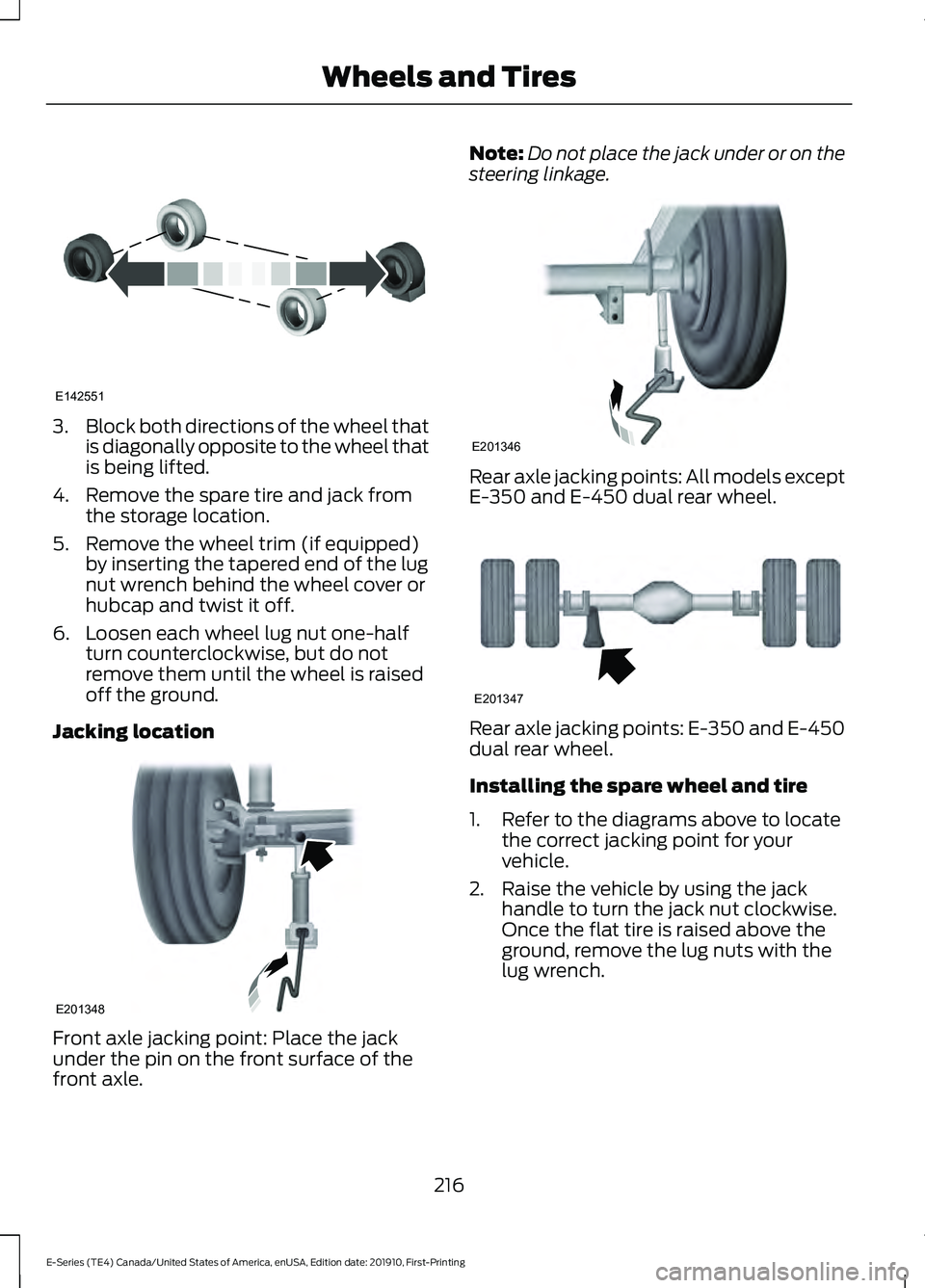
Jacking location Front axle jacking point: Place the jack
under the pin on the front surface of the
front axle. Note:
Do not place the jack under or on the
steering linkage. Rear axle jacking points: All models except
E-350 and E-450 dual rear wheel.
Rear axle jacking points: E-350 and E-450
dual rear wheel.
Installing the spare wheel and tire
1. Refer to the diagrams above to locate
the correct jacking point for your
vehicle.
2. Raise the vehicle by using the jack handle to turn the jack nut clockwise.
Once the flat tire is raised above the
ground, remove the lug nuts with the
lug wrench.
216
E-Series (TE4) Canada/United States of America, enUSA, Edition date: 201910, First-Printing Wheels and TiresE142551 E201348 E201346 E201347
Page 256 of 301
Be sure to ask your dealership service
advisor or technician about the multi-point
vehicle inspection. It is a comprehensive
way to perform a thorough inspection of
your vehicle. Your checklist gives you
immediate feedback on the overall
condition of your vehicle.
NORMAL SCHEDULED MAINTENANCE
Note: Do not exceed the mileage or time intervals. Maintenance
Rotate the tires, inspect tire wear and measure tread depth. 1
Every
7,500 mi
(12,000 km) Inspect the wheels and related components for abnormal noise, wear,
looseness or drag.
Perform a multi-point inspection.
Change the engine oil and filter.
Every
10,000 mi
(16,000 km) /12 months or 450
engine hours,
whichever
comes first
1 Rotate the front wheels on vehicles with dual rear wheels when specified. Only rotate
the rear wheels if you notice unusual wear. Maintenance
Inspect the automatic transmission fluid level. Consult dealer for require-
ments.
Every
15,000 mi
(24,000 km) Inspect the brake pads, rotors, hoses and parking brake.
Inspect the engine cooling system strength and hoses.
Inspect the exhaust system and heat shields.
Inspect the steering linkage, ball joints, suspension, tie-rod ends, driveshaft
and the U-joints.
253
E-Series (TE4) Canada/United States of America, enUSA, Edition date: 201910, First-Printing Scheduled Maintenance
Page 294 of 301
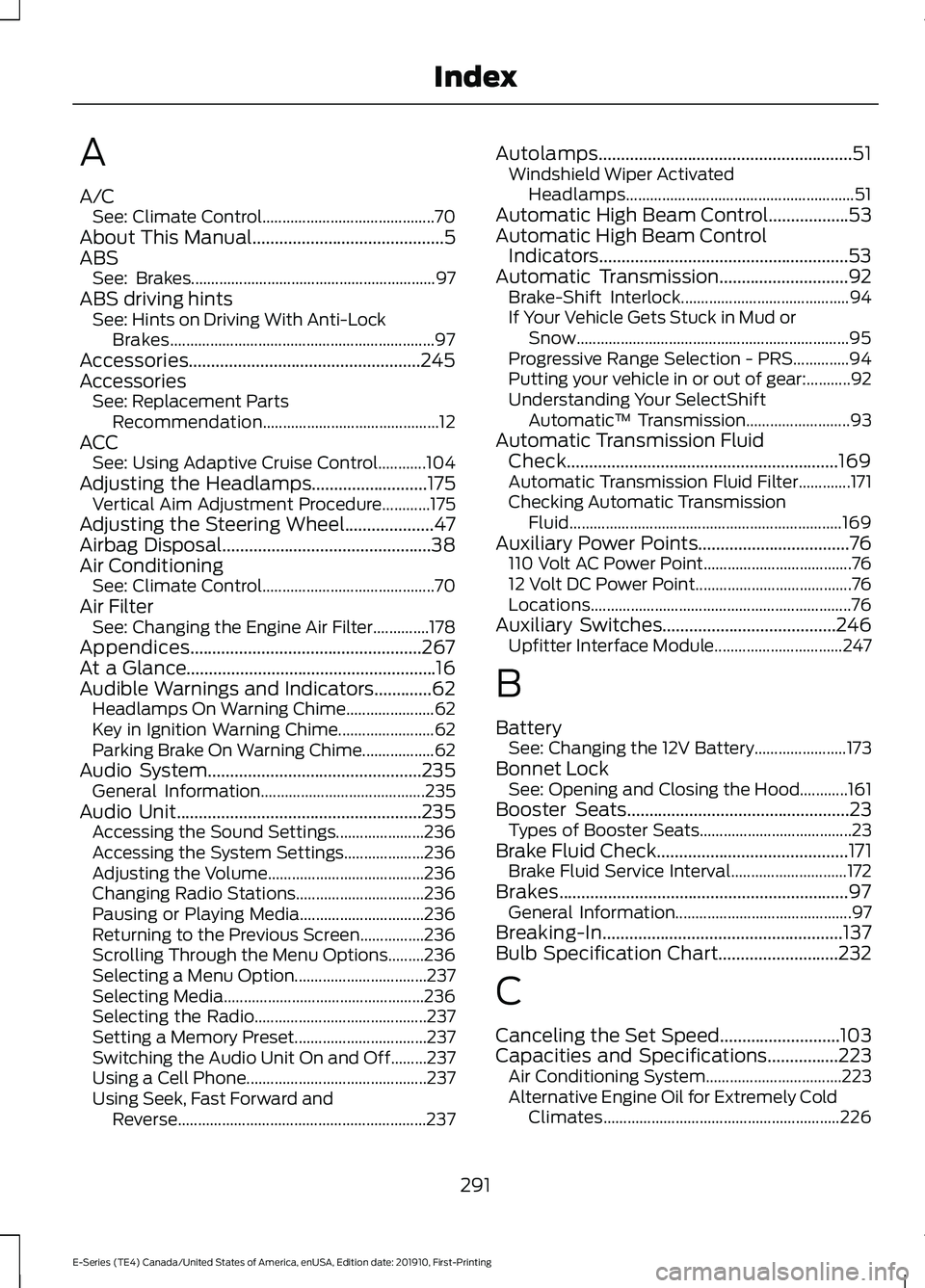
A
A/C
See: Climate Control........................................... 70
About This Manual...........................................5
ABS See: Brakes............................................................. 97
ABS driving hints See: Hints on Driving With Anti-Lock
Brakes.................................................................. 97
Accessories....................................................245
Accessories See: Replacement Parts
Recommendation............................................ 12
ACC See: Using Adaptive Cruise Control............104
Adjusting the Headlamps..........................175 Vertical Aim Adjustment Procedure............175
Adjusting the Steering Wheel....................47
Airbag Disposal...............................................38
Air Conditioning See: Climate Control........................................... 70
Air Filter See: Changing the Engine Air Filter..............178
Appendices....................................................267
At a Glance........................................................16
Audible Warnings and Indicators.............62 Headlamps On Warning Chime...................... 62
Key in Ignition Warning Chime........................ 62
Parking Brake On Warning Chime.................. 62
Audio System
................................................235
General Information......................................... 235
Audio Unit.......................................................235 Accessing the Sound Settings...................... 236
Accessing the System Settings.................... 236
Adjusting the Volume....................................... 236
Changing Radio Stations................................ 236
Pausing or Playing Media............................... 236
Returning to the Previous Screen................236
Scrolling Through the Menu Options.........236
Selecting a Menu Option................................. 237
Selecting Media.................................................. 236
Selecting the Radio........................................... 237
Setting a Memory Preset................................. 237
Switching the Audio Unit On and Off.........237
Using a Cell Phone............................................. 237
Using Seek, Fast Forward and Reverse.............................................................. 237Autolamps.........................................................51
Windshield Wiper Activated
Headlamps......................................................... 51
Automatic High Beam Control
..................53
Automatic High Beam Control Indicators........................................................53
Automatic Transmission
.............................92
Brake-Shift Interlock.......................................... 94
If Your Vehicle Gets Stuck in Mud or Snow.................................................................... 95
Progressive Range Selection - PRS..............94
Putting your vehicle in or out of gear:...........92
Understanding Your SelectShift Automatic ™ Transmission.......................... 93
Automatic Transmission Fluid Check.............................................................169
Automatic Transmission Fluid Filter.............171
Checking Automatic Transmission Fluid.................................................................... 169
Auxiliary Power Points
..................................76
110 Volt AC Power Point..................................... 76
12 Volt DC Power Point....................................... 76
Locations................................................................. 76
Auxiliary Switches.......................................246 Upfitter Interface Module................................ 247
B
Battery See: Changing the 12V Battery....................... 173
Bonnet Lock See: Opening and Closing the Hood............161
Booster Seats
..................................................23
Types of Booster Seats...................................... 23
Brake Fluid Check...........................................171 Brake Fluid Service Interval............................. 172
Brakes.................................................................97 General Information............................................ 97
Breaking-In......................................................137
Bulb Specification Chart...........................232
C
Canceling the Set Speed...........................103
Capacities and Specifications................223 Air Conditioning System.................................. 223
Alternative Engine Oil for Extremely Cold Climates........................................................... 226
291
E-Series (TE4) Canada/United States of America, enUSA, Edition date: 201910, First-Printing Index
Page 295 of 301
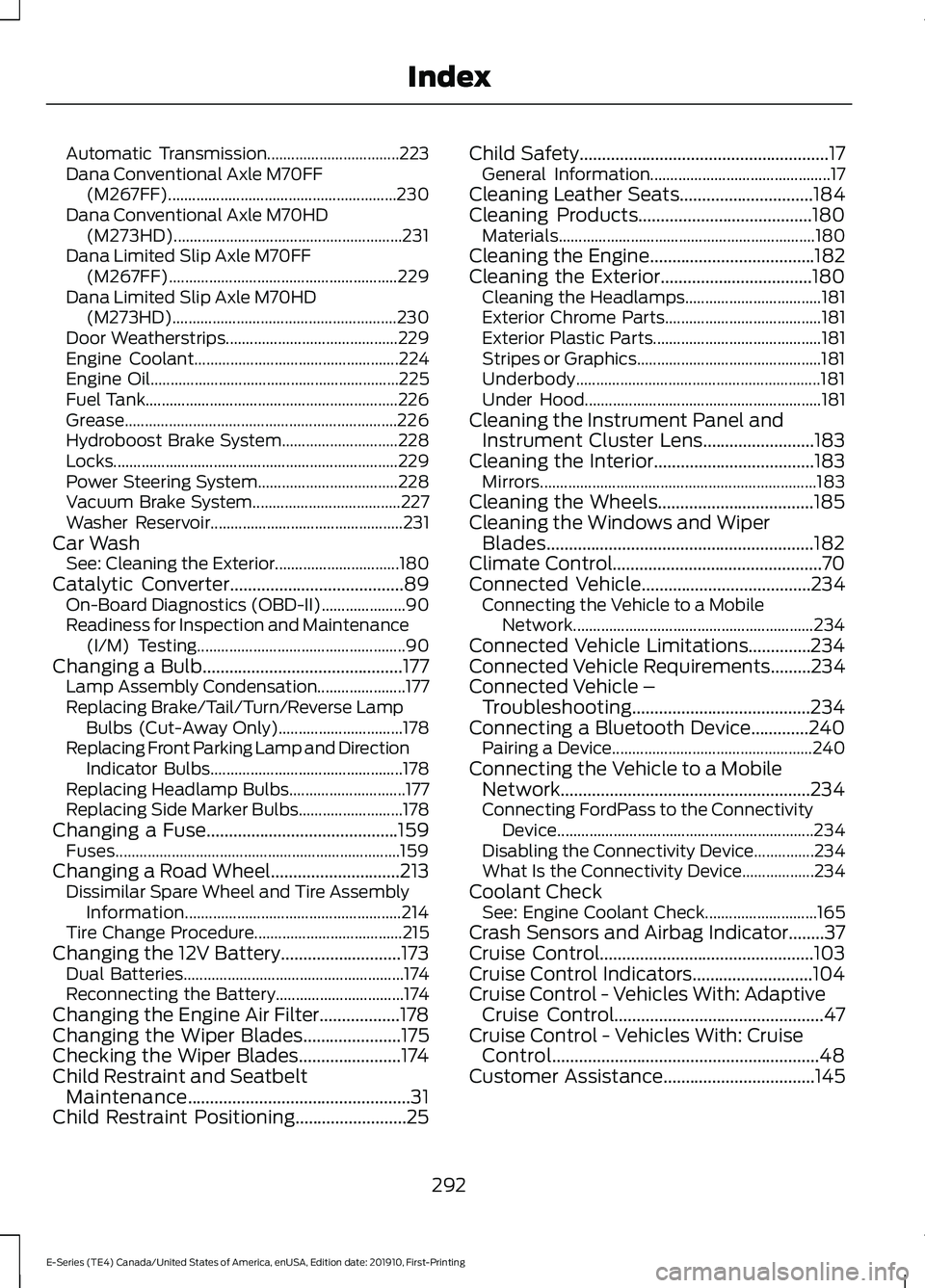
Automatic Transmission.................................
223
Dana Conventional Axle M70FF (M267FF)......................................................... 230
Dana Conventional Axle M70HD (M273HD)......................................................... 231
Dana Limited Slip Axle M70FF (M267FF)......................................................... 229
Dana Limited Slip Axle M70HD (M273HD)........................................................ 230
Door Weatherstrips........................................... 229
Engine Coolant................................................... 224
Engine Oil.............................................................. 225
Fuel Tank............................................................... 226
Grease.................................................................... 226
Hydroboost Brake System............................. 228
Locks....................................................................... 229
Power Steering System................................... 228
Vacuum Brake System..................................... 227
Washer Reservoir................................................ 231
Car Wash See: Cleaning the Exterior............................... 180
Catalytic Converter.......................................89
On-Board Diagnostics (OBD-II)..................... 90
Readiness for Inspection and Maintenance (I/M) Testing.................................................... 90
Changing a Bulb
.............................................177
Lamp Assembly Condensation...................... 177
Replacing Brake/Tail/Turn/Reverse Lamp Bulbs (Cut-Away Only)............................... 178
Replacing Front Parking Lamp and Direction Indicator Bulbs................................................ 178
Replacing Headlamp Bulbs............................. 177
Replacing Side Marker Bulbs.......................... 178
Changing a Fuse...........................................159 Fuses....................................................................... 159
Changing a Road Wheel
.............................213
Dissimilar Spare Wheel and Tire Assembly
Information...................................................... 214
Tire Change Procedure..................................... 215
Changing the 12V Battery...........................173 Dual Batteries....................................................... 174
Reconnecting the Battery................................ 174
Changing the Engine Air Filter..................178
Changing the Wiper Blades
......................175
Checking the Wiper Blades.......................174
Child Restraint and Seatbelt Maintenance..................................................31
Child Restraint Positioning.........................25 Child Safety
........................................................17
General Information............................................. 17
Cleaning Leather Seats
..............................184
Cleaning Products.......................................180 Materials................................................................ 180
Cleaning the Engine.....................................182
Cleaning the Exterior..................................180 Cleaning the Headlamps.................................. 181
Exterior Chrome Parts....................................... 181
Exterior Plastic Parts.......................................... 181
Stripes or Graphics..............................................181
Underbody............................................................. 181
Under Hood........................................................... 181
Cleaning the Instrument Panel and Instrument Cluster Lens.........................183
Cleaning the Interior....................................183 Mirrors..................................................................... 183
Cleaning the Wheels...................................185
Cleaning the Windows and Wiper Blades............................................................182
Climate Control...............................................70
Connected Vehicle
......................................234
Connecting the Vehicle to a Mobile
Network............................................................ 234
Connected Vehicle Limitations..............234
Connected Vehicle Requirements.........234
Connected Vehicle – Troubleshooting........................................234
Connecting a Bluetooth Device.............240 Pairing a Device.................................................. 240
Connecting the Vehicle to a Mobile Network........................................................234
Connecting FordPass to the Connectivity Device................................................................ 234
Disabling the Connectivity Device...............234
What Is the Connectivity Device.................. 234
Coolant Check See: Engine Coolant Check............................ 165
Crash Sensors and Airbag Indicator........37
Cruise Control................................................103
Cruise Control Indicators...........................104
Cruise Control - Vehicles With: Adaptive Cruise Control
...............................................47
Cruise Control - Vehicles With: Cruise Control............................................................48
Customer Assistance
..................................145
292
E-Series (TE4) Canada/United States of America, enUSA, Edition date: 201910, First-Printing Index