transmission fluid FORD E-450 2022 User Guide
[x] Cancel search | Manufacturer: FORD, Model Year: 2022, Model line: E-450, Model: FORD E-450 2022Pages: 296, PDF Size: 3.91 MB
Page 177 of 296
Checking Automatic Transmission
Fluid
For scheduled intervals of the fluid checks
and changes, See Scheduled
Maintenance (page 251). Your
transmission does not consume fluid.
However, if the transmission is not working
properly, for example, if the transmission
slips or shifts slowly, or if you notice some
sign of fluid leakage, check the fluid level
as soon as possible.
Automatic transmission fluid expands
when warmed. To obtain an accurate fluid
check, drive the vehicle until it is at normal
operating temperature, approximately
19 mi (30 km). Verify that the transmission
fluid temperature gauge on the instrument
cluster is within normal range.
1. Drive the vehicle
19 mi (30 km) until it
reaches normal operating temperature.
2. Park the vehicle on a level surface and
engage the parking brake.
3. With the engine running, parking brake
engaged and your foot on the brake
pedal, move the gearshift lever through
all of the gear ranges. Allow sufficient
time for each gear to engage.
4. Put the transmission in park (P) and leave the engine running.
5. Remove the dipstick, wiping it clean with a clean, dry, lint free rag.
6. Install the dipstick, fully seating it in the
filler tube.
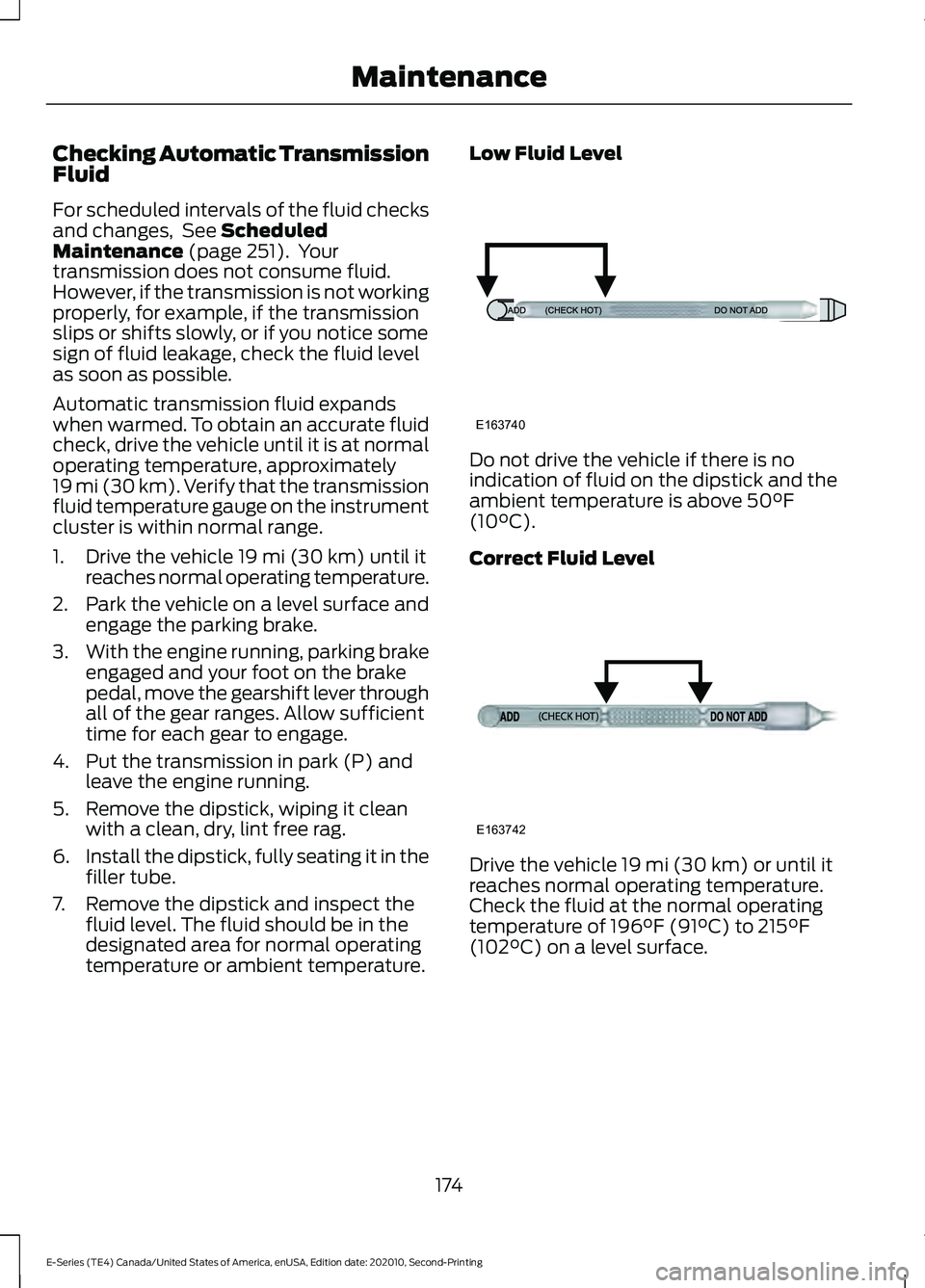
7. Remove the dipstick and inspect the fluid level. The fluid should be in the
designated area for normal operating
temperature or ambient temperature. Low Fluid Level
Do not drive the vehicle if there is no
indication of fluid on the dipstick and the
ambient temperature is above
50°F
(10°C).
Correct Fluid Level Drive the vehicle
19 mi (30 km) or until it
reaches normal operating temperature.
Check the fluid at the normal operating
temperature of
196°F (91°C) to 215°F
(102°C) on a level surface.
174
E-Series (TE4) Canada/United States of America, enUSA, Edition date: 202010, Second-Printing MaintenanceE163740 E163742
Page 178 of 296
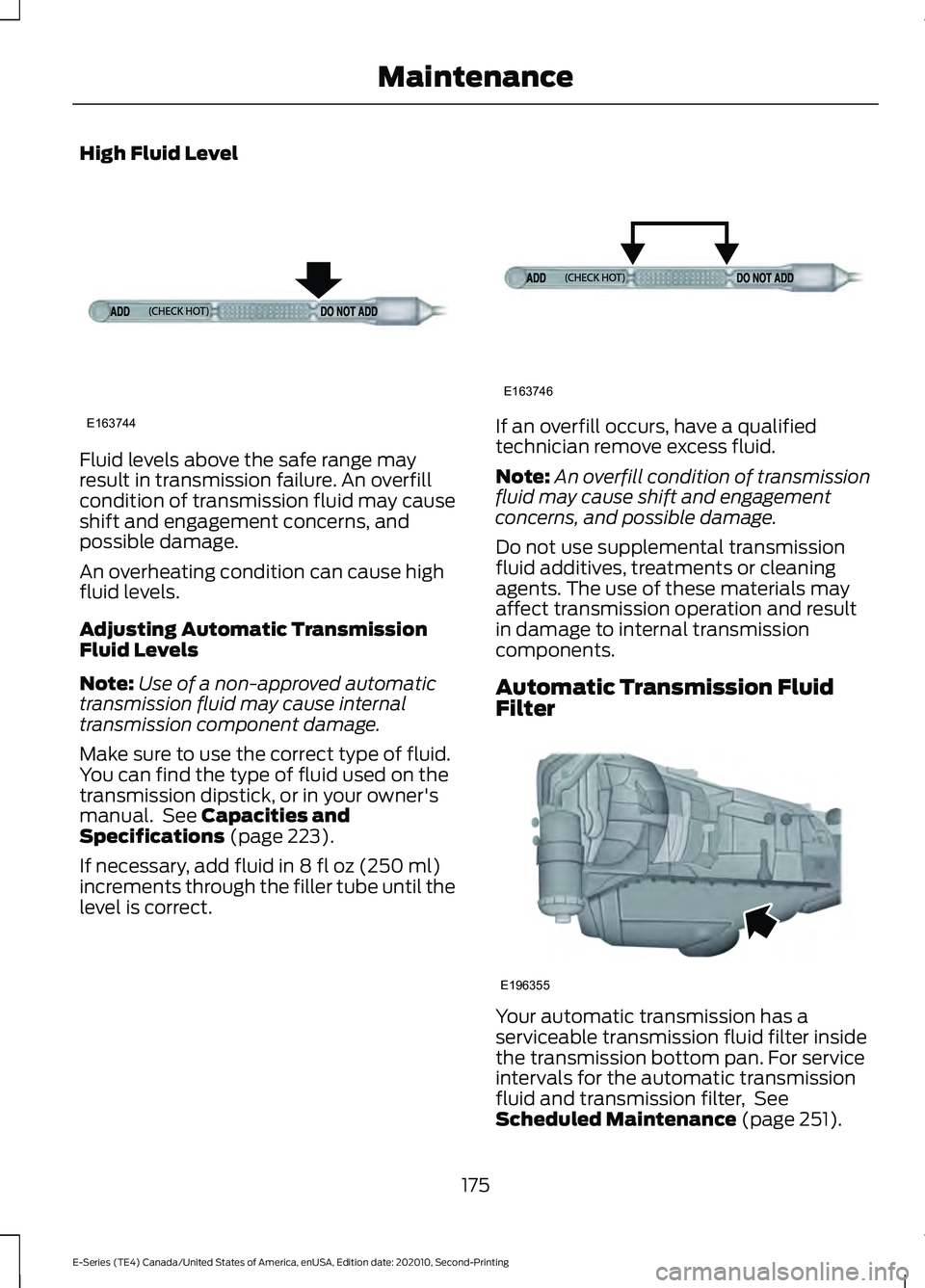
High Fluid Level
Fluid levels above the safe range may
result in transmission failure. An overfill
condition of transmission fluid may cause
shift and engagement concerns, and
possible damage.
An overheating condition can cause high
fluid levels.
Adjusting Automatic Transmission
Fluid Levels
Note:
Use of a non-approved automatic
transmission fluid may cause internal
transmission component damage.
Make sure to use the correct type of fluid.
You can find the type of fluid used on the
transmission dipstick, or in your owner's
manual. See Capacities and
Specifications (page 223).
If necessary, add fluid in
8 fl oz (250 ml)
increments through the filler tube until the
level is correct. If an overfill occurs, have a qualified
technician remove excess fluid.
Note:
An overfill condition of transmission
fluid may cause shift and engagement
concerns, and possible damage.
Do not use supplemental transmission
fluid additives, treatments or cleaning
agents. The use of these materials may
affect transmission operation and result
in damage to internal transmission
components.
Automatic Transmission Fluid
Filter Your automatic transmission has a
serviceable transmission fluid filter inside
the transmission bottom pan. For service
intervals for the automatic transmission
fluid and transmission filter, See
Scheduled Maintenance
(page 251).
175
E-Series (TE4) Canada/United States of America, enUSA, Edition date: 202010, Second-Printing MaintenanceE163744 E163746 E196355
Page 179 of 296
For transmission filter maintenance, see
your authorized dealer.
BRAKE FLUID CHECK
WARNING: Do not use any fluid
other than the recommended brake fluid
as this will reduce brake efficiency. Use
of incorrect fluid could result in the loss
of vehicle control, serious personal injury
or death. WARNING:
Only use brake fluid
from a sealed container. Contamination
with dirt, water, petroleum products or
other materials may result in brake
system damage or failure. Failure to
adhere to this warning could result in the
loss of vehicle control, serious personal
injury or death. WARNING:
Do not allow the fluid
to touch your skin or eyes. If this
happens, rinse the affected areas
immediately with plenty of water and
contact your physician. WARNING:
The brake system
could be affected if the brake fluid level
is below the MIN mark or above the MAX
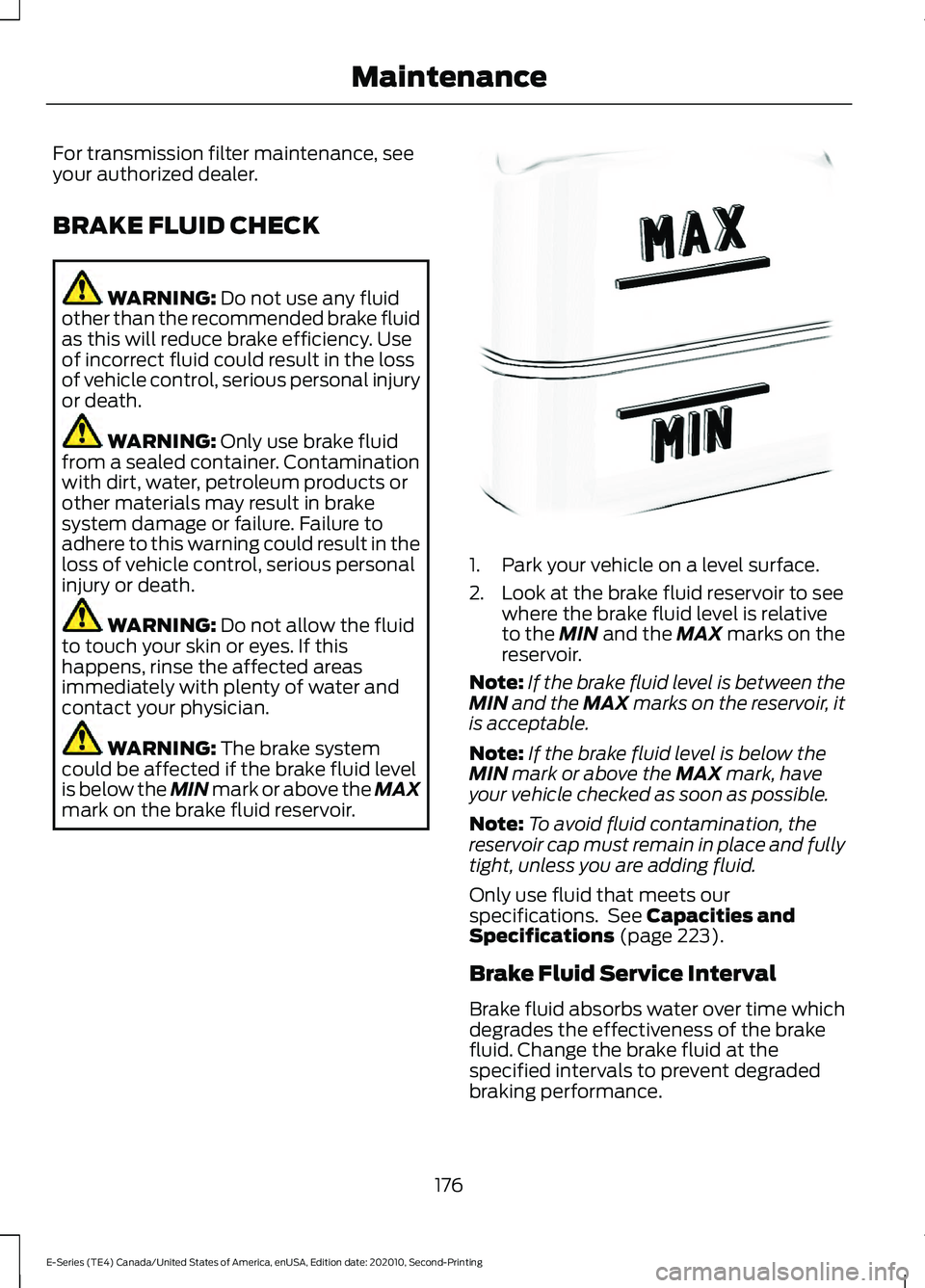
mark on the brake fluid reservoir. 1. Park your vehicle on a level surface.
2. Look at the brake fluid reservoir to see
where the brake fluid level is relative
to the
MIN and the MAX marks on the
reservoir.
Note: If the brake fluid level is between the
MIN
and the MAX marks on the reservoir, it
is acceptable.
Note: If the brake fluid level is below the
MIN
mark or above the MAX mark, have
your vehicle checked as soon as possible.
Note: To avoid fluid contamination, the
reservoir cap must remain in place and fully
tight, unless you are adding fluid.
Only use fluid that meets our
specifications. See
Capacities and
Specifications (page 223).
Brake Fluid Service Interval
Brake fluid absorbs water over time which
degrades the effectiveness of the brake
fluid. Change the brake fluid at the
specified intervals to prevent degraded
braking performance.
176
E-Series (TE4) Canada/United States of America, enUSA, Edition date: 202010, Second-Printing MaintenanceE170684
Page 227 of 296
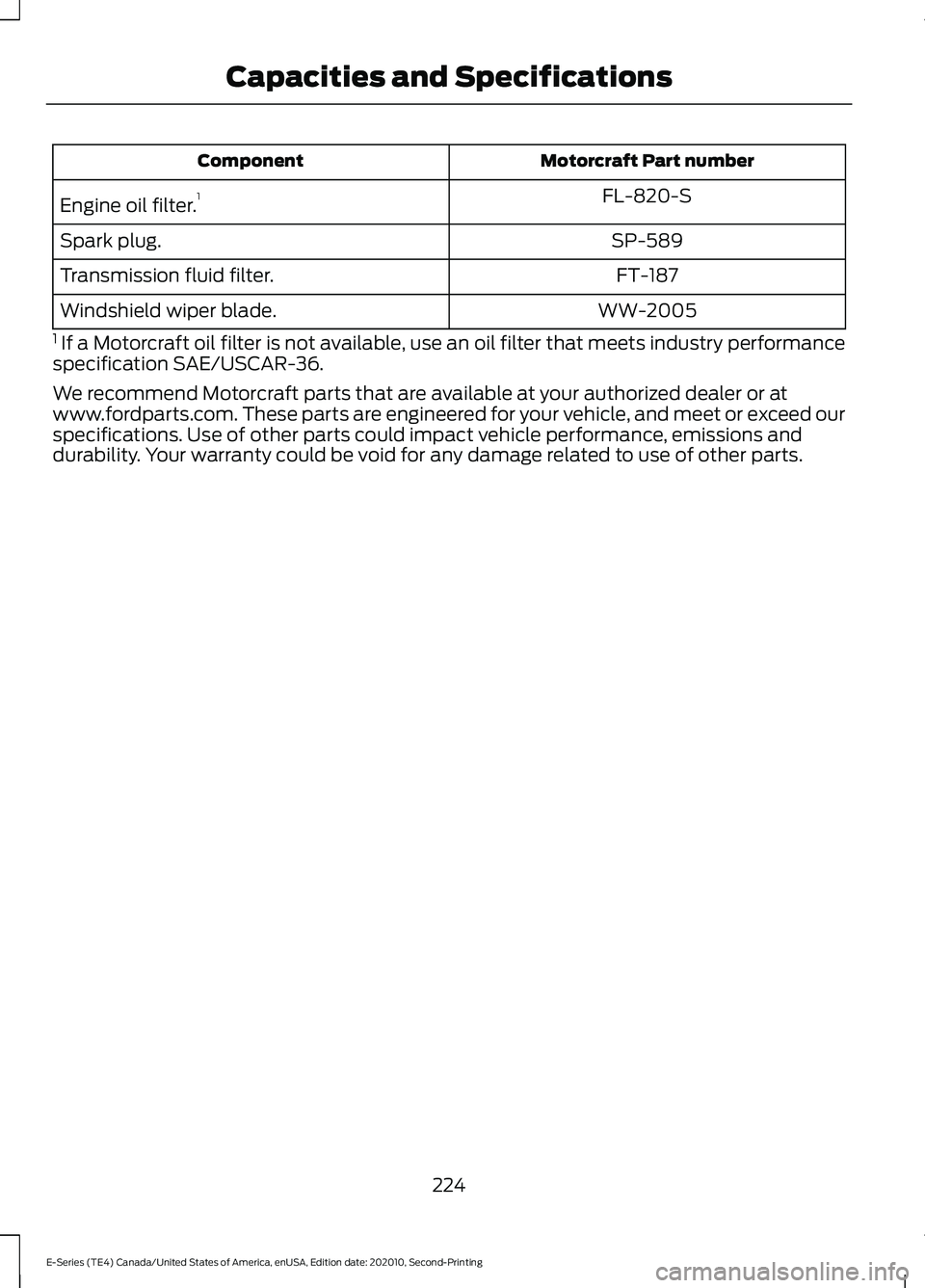
Motorcraft Part number
Component
FL-820-S
Engine oil filter. 1
SP-589
Spark plug.
FT-187
Transmission fluid filter.
WW-2005
Windshield wiper blade.
1 If a Motorcraft oil filter is not available, use an oil filter that meets industry performance
specification SAE/USCAR-36.
We recommend Motorcraft parts that are available at your authorized dealer or at
www.fordparts.com. These parts are engineered for your vehicle, and meet or exceed our
specifications. Use of other parts could impact vehicle performance, emissions and
durability. Your warranty could be void for any damage related to use of other parts.
224
E-Series (TE4) Canada/United States of America, enUSA, Edition date: 202010, Second-Printing Capacities and Specifications
Page 233 of 296
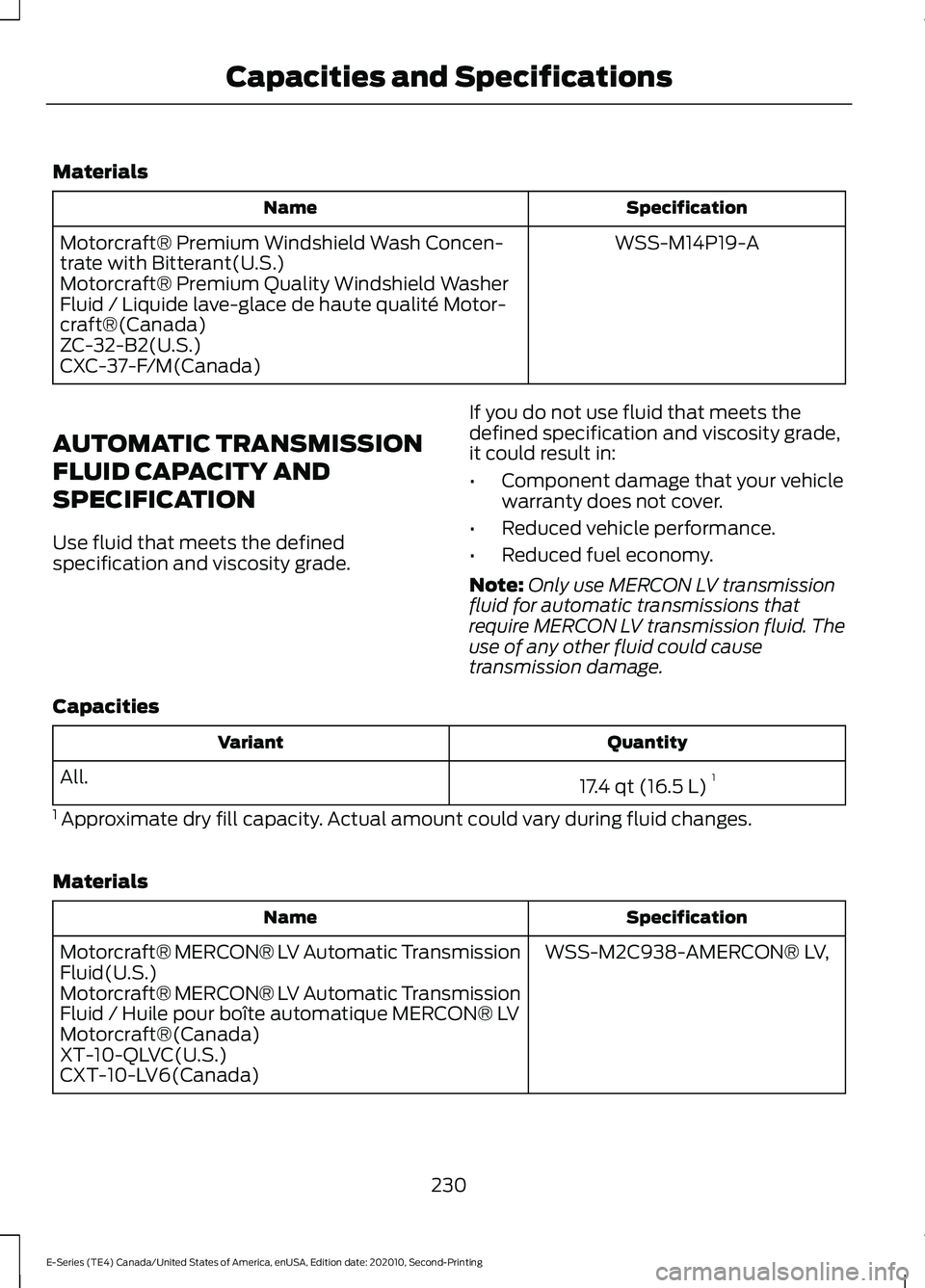
Materials
Specification
Name
WSS-M14P19-A
Motorcraft® Premium Windshield Wash Concen-
trate with Bitterant(U.S.)
Motorcraft® Premium Quality Windshield Washer
Fluid / Liquide lave-glace de haute qualité Motor-
craft®(Canada)
ZC-32-B2(U.S.)
CXC-37-F/M(Canada)
AUTOMATIC TRANSMISSION
FLUID CAPACITY AND
SPECIFICATION
Use fluid that meets the defined
specification and viscosity grade. If you do not use fluid that meets the
defined specification and viscosity grade,
it could result in:
•
Component damage that your vehicle
warranty does not cover.
• Reduced vehicle performance.
• Reduced fuel economy.
Note: Only use MERCON LV transmission
fluid for automatic transmissions that
require MERCON LV transmission fluid. The
use of any other fluid could cause
transmission damage.
Capacities Quantity
Variant
17.4 qt (16.5 L)1
All.
1 Approximate dry fill capacity. Actual amount could vary during fluid changes.
Materials Specification
Name
WSS-M2C938-AMERCON® LV,
Motorcraft® MERCON® LV Automatic Transmission
Fluid(U.S.)
Motorcraft® MERCON® LV Automatic Transmission
Fluid / Huile pour boîte automatique MERCON® LV
Motorcraft®(Canada)
XT-10-QLVC(U.S.)
CXT-10-LV6(Canada)
230
E-Series (TE4) Canada/United States of America, enUSA, Edition date: 202010, Second-Printing Capacities and Specifications
Page 236 of 296
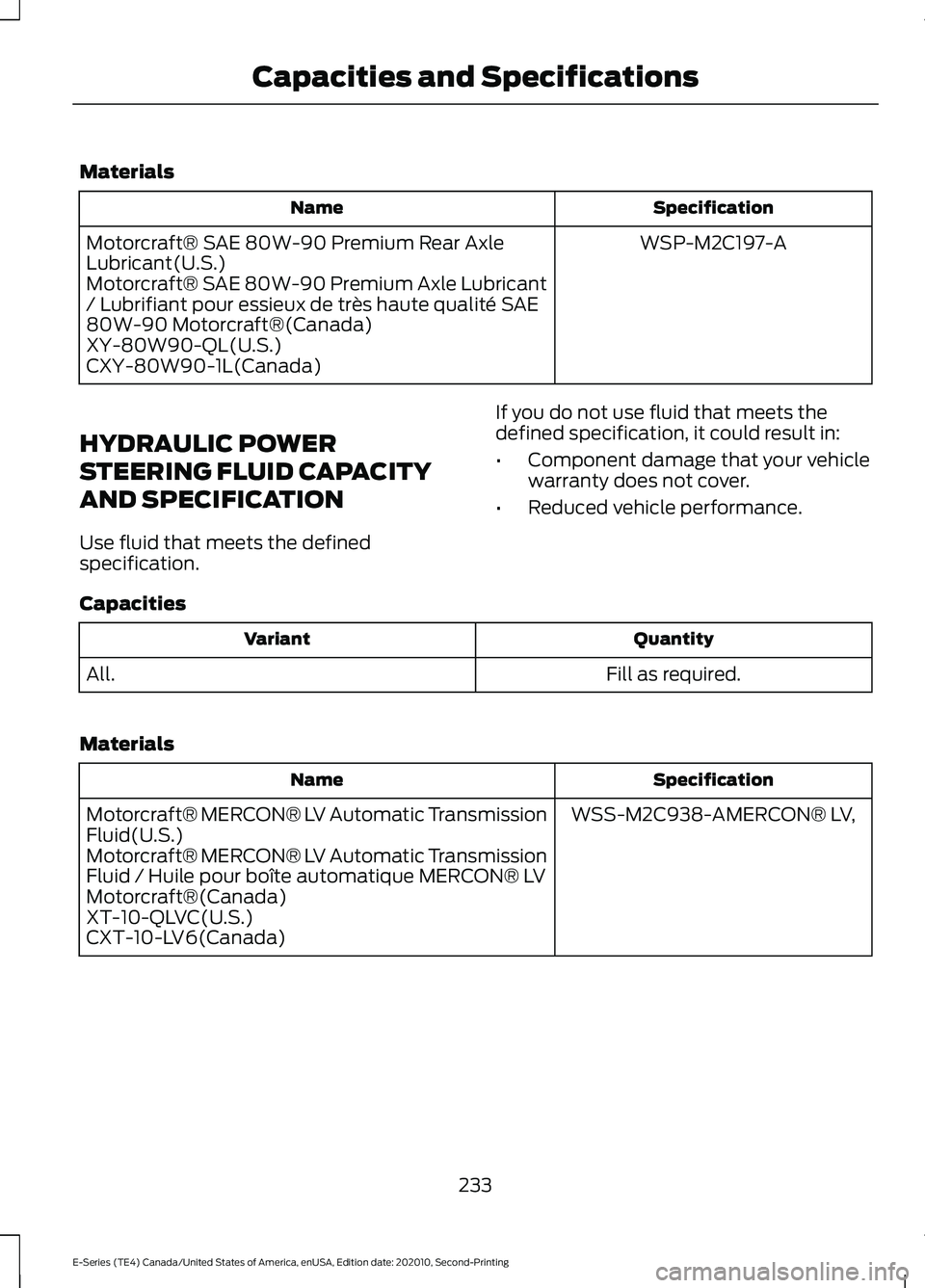
Materials
Specification
Name
WSP-M2C197-A
Motorcraft® SAE 80W-90 Premium Rear Axle
Lubricant(U.S.)
Motorcraft® SAE 80W-90 Premium Axle Lubricant
/ Lubrifiant pour essieux de très haute qualité SAE
80W-90 Motorcraft®(Canada)
XY-80W90-QL(U.S.)
CXY-80W90-1L(Canada)
HYDRAULIC POWER
STEERING FLUID CAPACITY
AND SPECIFICATION
Use fluid that meets the defined
specification. If you do not use fluid that meets the
defined specification, it could result in:
•
Component damage that your vehicle
warranty does not cover.
• Reduced vehicle performance.
Capacities Quantity
Variant
Fill as required.
All.
Materials Specification
Name
WSS-M2C938-AMERCON® LV,
Motorcraft® MERCON® LV Automatic Transmission
Fluid(U.S.)
Motorcraft® MERCON® LV Automatic Transmission
Fluid / Huile pour boîte automatique MERCON® LV
Motorcraft®(Canada)
XT-10-QLVC(U.S.)
CXT-10-LV6(Canada)
233
E-Series (TE4) Canada/United States of America, enUSA, Edition date: 202010, Second-Printing Capacities and Specifications
Page 256 of 296
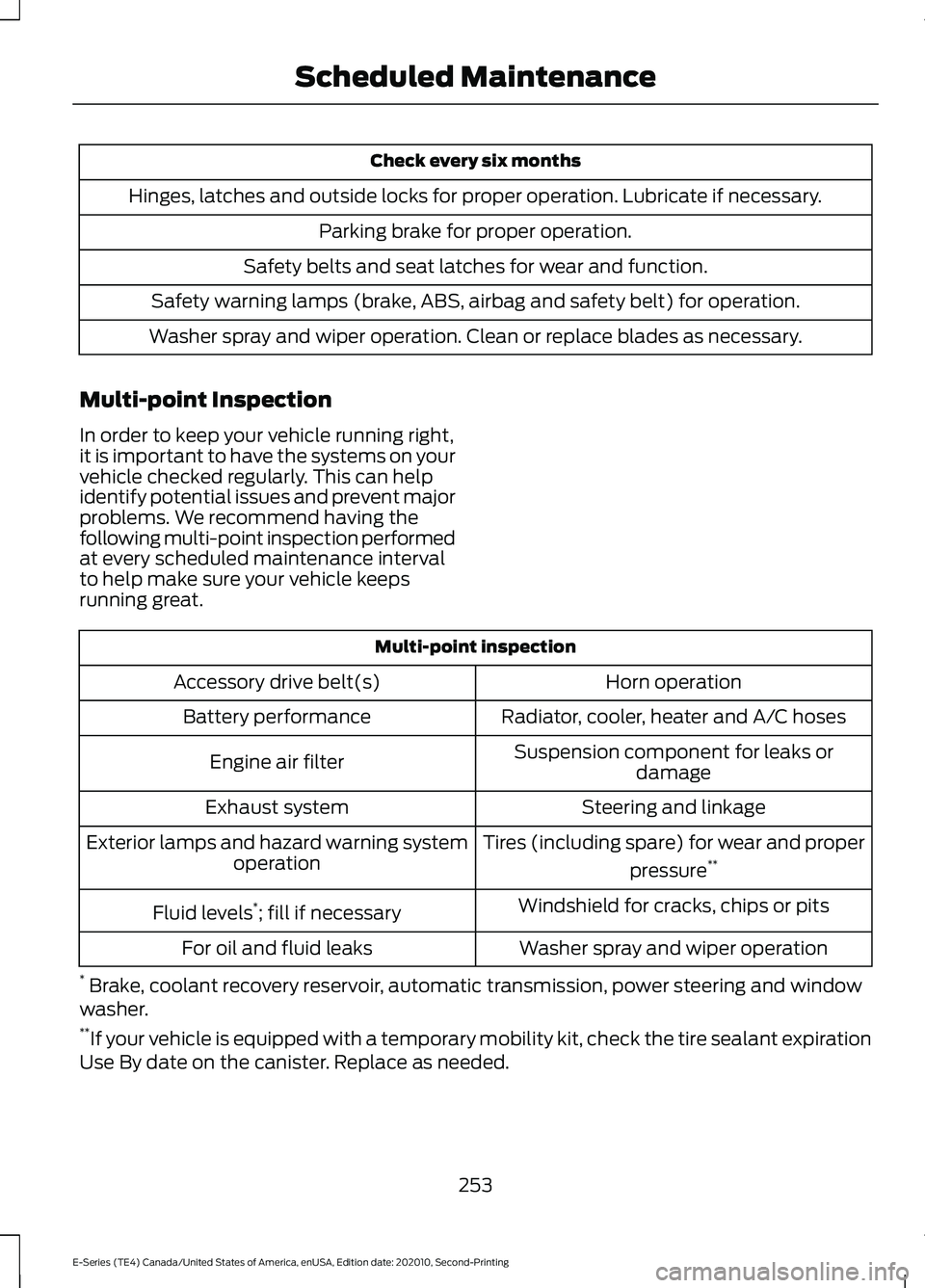
Check every six months
Hinges, latches and outside locks for proper operation. Lubricate if necessary. Parking brake for proper operation.
Safety belts and seat latches for wear and function.
Safety warning lamps (brake, ABS, airbag and safety belt) for operation.
Washer spray and wiper operation. Clean or replace blades as necessary.
Multi-point Inspection
In order to keep your vehicle running right,
it is important to have the systems on your
vehicle checked regularly. This can help
identify potential issues and prevent major
problems. We recommend having the
following multi-point inspection performed
at every scheduled maintenance interval
to help make sure your vehicle keeps
running great. Multi-point inspection
Horn operation
Accessory drive belt(s)
Radiator, cooler, heater and A/C hoses
Battery performance
Suspension component for leaks ordamage
Engine air filter
Steering and linkage
Exhaust system
Tires (including spare) for wear and properpressure**
Exterior lamps and hazard warning system
operation
Windshield for cracks, chips or pits
Fluid levels *
; fill if necessary
Washer spray and wiper operation
For oil and fluid leaks
* Brake, coolant recovery reservoir, automatic transmission, power steering and window
washer.
** If your vehicle is equipped with a temporary mobility kit, check the tire sealant expiration
Use By date on the canister. Replace as needed.
253
E-Series (TE4) Canada/United States of America, enUSA, Edition date: 202010, Second-Printing Scheduled Maintenance
Page 257 of 296
Be sure to ask your dealership service
advisor or technician about the multi-point
vehicle inspection. It is a comprehensive
way to perform a thorough inspection of
your vehicle. Your checklist gives you
immediate feedback on the overall
condition of your vehicle.
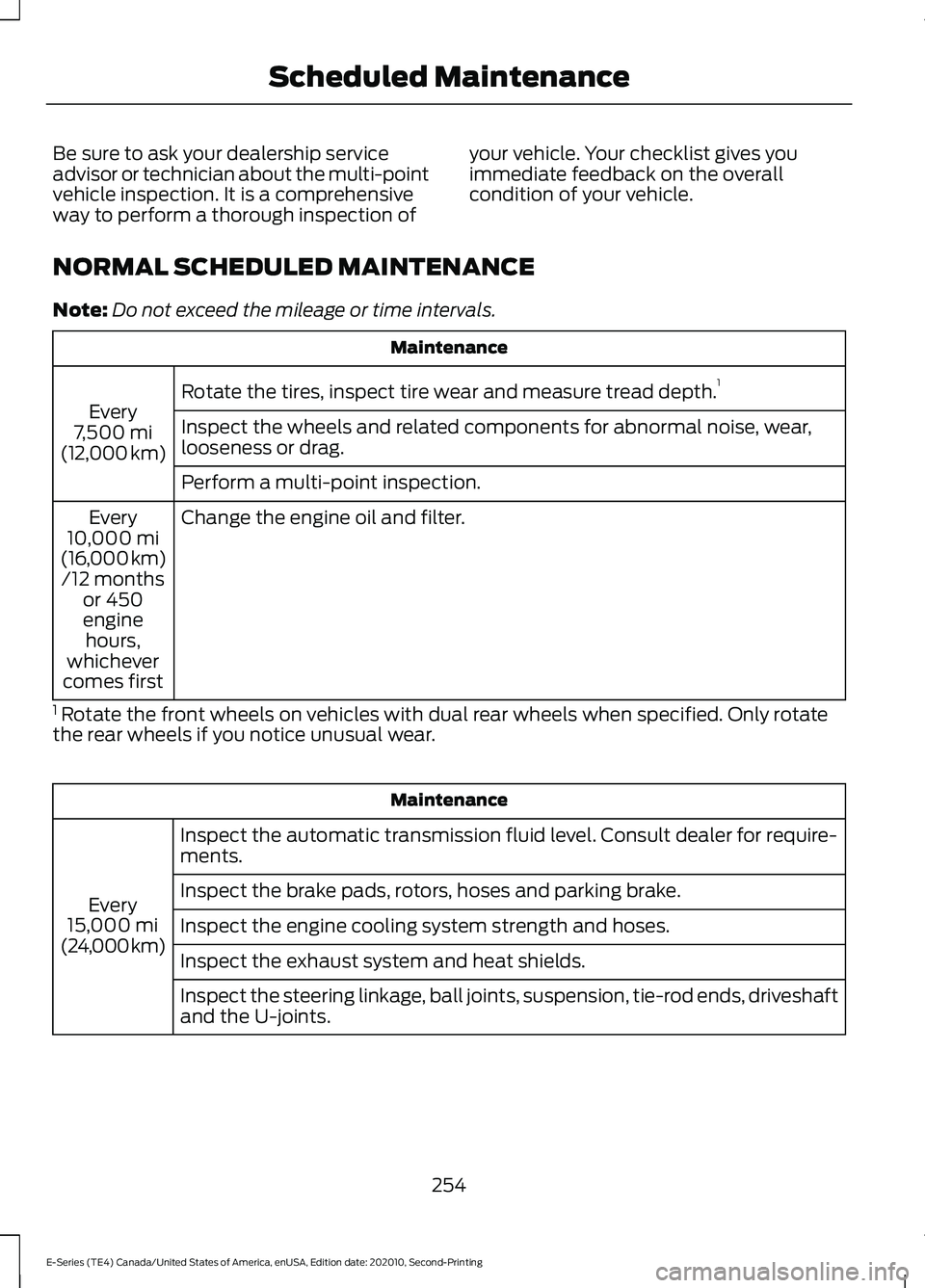
NORMAL SCHEDULED MAINTENANCE
Note: Do not exceed the mileage or time intervals. Maintenance
Rotate the tires, inspect tire wear and measure tread depth. 1
Every
7,500 mi
(12,000 km) Inspect the wheels and related components for abnormal noise, wear,
looseness or drag.
Perform a multi-point inspection.
Change the engine oil and filter.
Every
10,000 mi
(16,000 km) /12 months or 450
engine hours,
whichever
comes first
1 Rotate the front wheels on vehicles with dual rear wheels when specified. Only rotate
the rear wheels if you notice unusual wear. Maintenance
Inspect the automatic transmission fluid level. Consult dealer for require-
ments.
Every
15,000 mi
(24,000 km) Inspect the brake pads, rotors, hoses and parking brake.
Inspect the engine cooling system strength and hoses.
Inspect the exhaust system and heat shields.
Inspect the steering linkage, ball joints, suspension, tie-rod ends, driveshaft
and the U-joints.
254
E-Series (TE4) Canada/United States of America, enUSA, Edition date: 202010, Second-Printing Scheduled Maintenance
Page 258 of 296
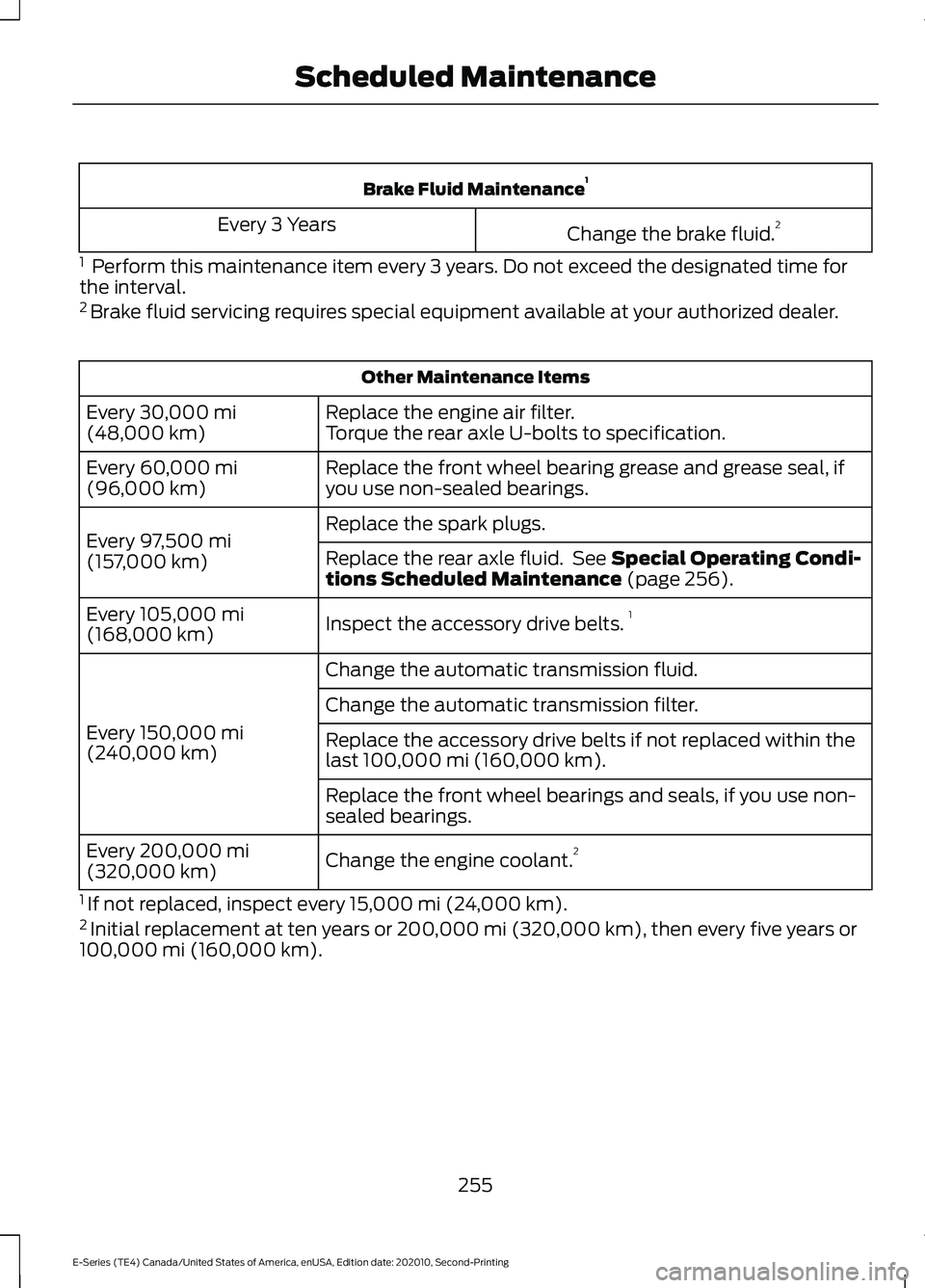
Brake Fluid Maintenance
1
Change the brake fluid. 2
Every 3 Years
1 Perform this maintenance item every 3 years. Do not exceed the designated time for
the interval.
2 Brake fluid servicing requires special equipment available at your authorized dealer. Other Maintenance Items
Replace the engine air filter.
Every 30,000 mi
(48,000 km) Torque the rear axle U-bolts to specification.
Replace the front wheel bearing grease and grease seal, if
you use non-sealed bearings.
Every
60,000 mi
(96,000 km)
Replace the spark plugs.
Every
97,500 mi
(157,000 km) Replace the rear axle fluid. See Special Operating Condi-
tions Scheduled Maintenance (page 256).
Inspect the accessory drive belts. 1
Every
105,000 mi
(168,000 km)
Change the automatic transmission fluid.
Every
150,000 mi
(240,000 km) Change the automatic transmission filter.
Replace the accessory drive belts if not replaced within the
last
100,000 mi (160,000 km).
Replace the front wheel bearings and seals, if you use non-
sealed bearings.
Change the engine coolant. 2
Every
200,000 mi
(320,000 km)
1 If not replaced, inspect every 15,000 mi (24,000 km).
2 Initial replacement at ten years or 200,000 mi (320,000 km), then every five years or
100,000 mi (160,000 km).
255
E-Series (TE4) Canada/United States of America, enUSA, Edition date: 202010, Second-Printing Scheduled Maintenance
Page 292 of 296
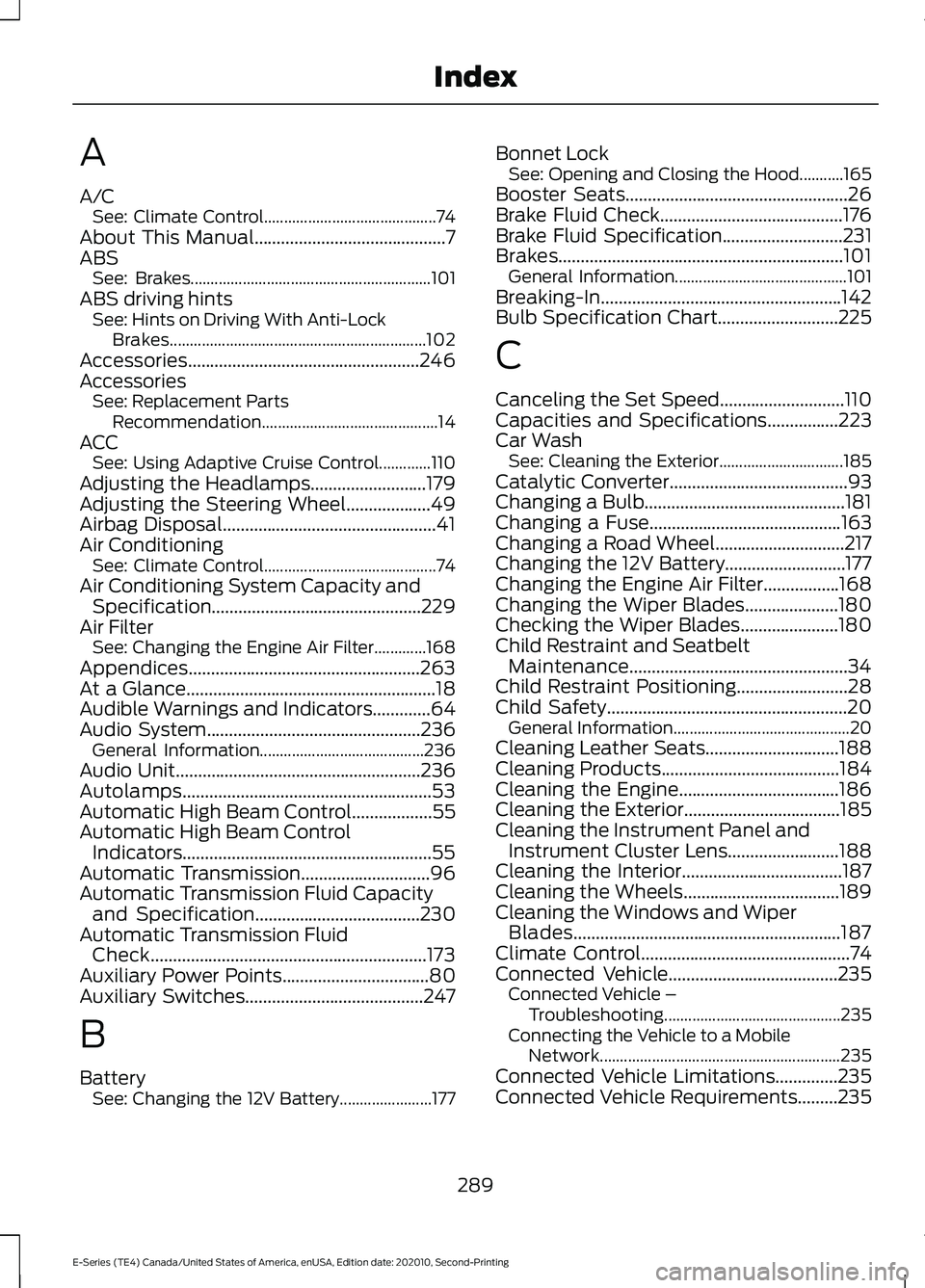
A
A/C
See: Climate Control........................................... 74
About This Manual...........................................7
ABS See: Brakes............................................................ 101
ABS driving hints See: Hints on Driving With Anti-Lock
Brakes................................................................ 102
Accessories....................................................246
Accessories See: Replacement Parts
Recommendation............................................ 14
ACC See: Using Adaptive Cruise Control.............110
Adjusting the Headlamps
..........................179
Adjusting the Steering Wheel...................49
Airbag Disposal................................................41
Air Conditioning See: Climate Control........................................... 74
Air Conditioning System Capacity and Specification...............................................229
Air Filter See: Changing the Engine Air Filter.............168
Appendices....................................................263
At a Glance........................................................18
Audible Warnings and Indicators.............64
Audio System................................................236 General Information......................................... 236
Audio Unit
.......................................................236
Autolamps........................................................53
Automatic High Beam Control
..................55
Automatic High Beam Control Indicators........................................................55
Automatic Transmission.............................96
Automatic Transmission Fluid Capacity and Specification
.....................................230
Automatic Transmission Fluid Check..............................................................173
Auxiliary Power Points.................................80
Auxiliary Switches
........................................247
B
Battery See: Changing the 12V Battery....................... 177Bonnet Lock
See: Opening and Closing the Hood...........165
Booster Seats..................................................26
Brake Fluid Check.........................................176
Brake Fluid Specification
...........................231
Brakes................................................................101 General Information........................................... 101
Breaking-In......................................................142
Bulb Specification Chart
...........................225
C
Canceling the Set Speed............................110
Capacities and Specifications................223
Car Wash See: Cleaning the Exterior............................... 185
Catalytic Converter
........................................93
Changing a Bulb.............................................181
Changing a Fuse
...........................................163
Changing a Road Wheel.............................217
Changing the 12V Battery...........................177
Changing the Engine Air Filter
.................168
Changing the Wiper Blades.....................180
Checking the Wiper Blades......................180
Child Restraint and Seatbelt Maintenance.................................................34
Child Restraint Positioning.........................28
Child Safety......................................................20 General Information............................................ 20
Cleaning Leather Seats
..............................188
Cleaning Products........................................184
Cleaning the Engine....................................186
Cleaning the Exterior...................................185
Cleaning the Instrument Panel and Instrument Cluster Lens.........................188
Cleaning the Interior....................................187
Cleaning the Wheels...................................189
Cleaning the Windows and Wiper Blades............................................................187
Climate Control
...............................................74
Connected Vehicle......................................235
Connected Vehicle –
Troubleshooting............................................ 235
Connecting the Vehicle to a Mobile Network............................................................ 235
Connected Vehicle Limitations
..............235
Connected Vehicle Requirements.........235
289
E-Series (TE4) Canada/United States of America, enUSA, Edition date: 202010, Second-Printing Index