engine FORD E-450 2022 Owners Manual
[x] Cancel search | Manufacturer: FORD, Model Year: 2022, Model line: E-450, Model: FORD E-450 2022Pages: 296, PDF Size: 3.91 MB
Page 2 of 296
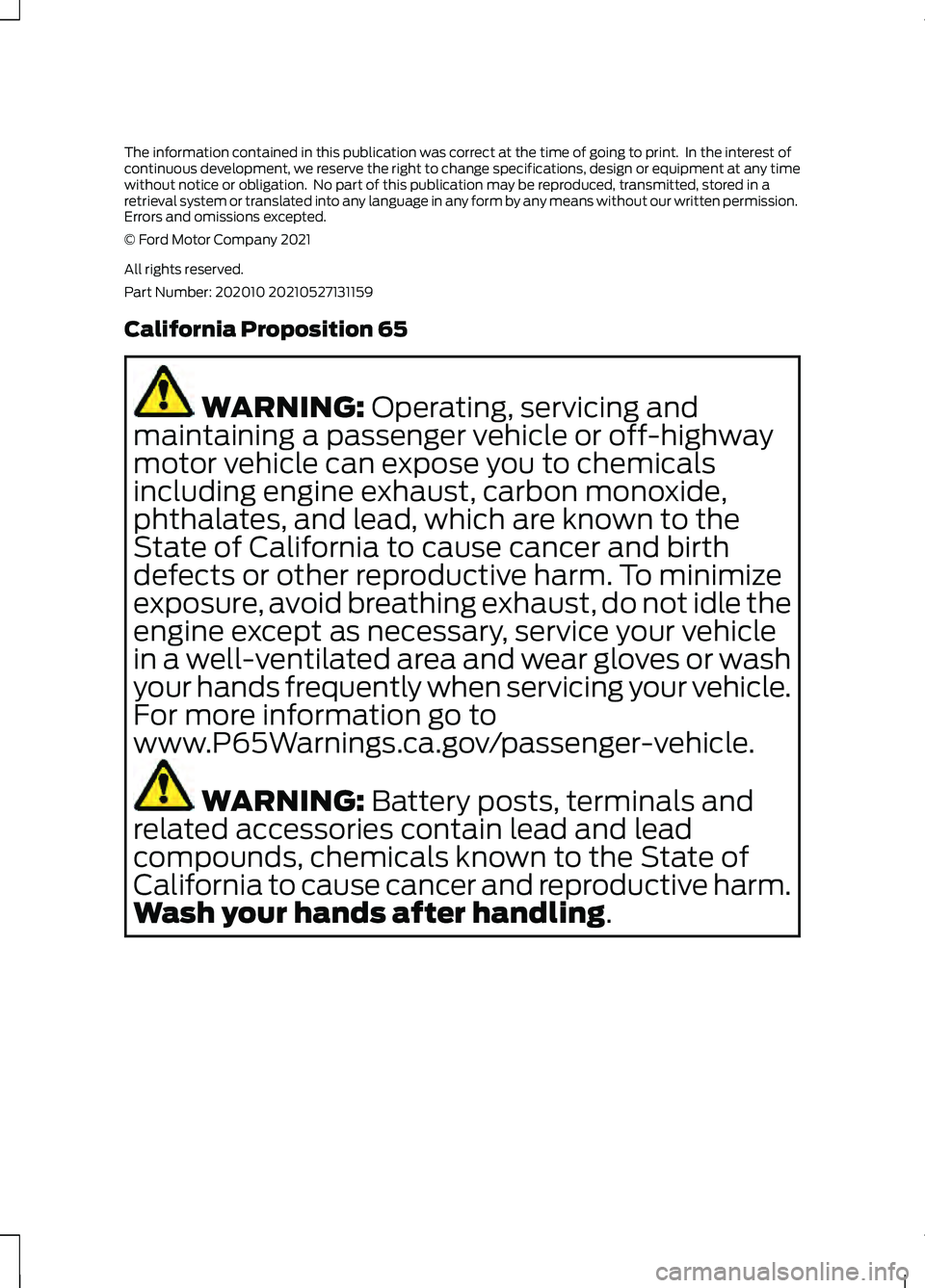
The information contained in this publication was correct at the time of going to print. In the interest of
continuous development, we reserve the right to change specifications, design or equipment at any time
without notice or obligation. No part of this publication may be reproduced, transmitted, stored in a
retrieval system or translated into any language in any form by any means without our written permission.
Errors and omissions excepted.
© Ford Motor Company 2021
All rights reserved.
Part Number: 202010 20210527131159
California Proposition 65
WARNING: Operating, servicing and
maintaining a passenger vehicle or off-highway
motor vehicle can expose you to chemicals
including engine exhaust, carbon monoxide,
phthalates, and lead, which are known to the
State of California to cause cancer and birth
defects or other reproductive harm. To minimize
exposure, avoid breathing exhaust, do not idle the
engine except as necessary, service your vehicle
in a well-ventilated area and wear gloves or wash
your hands frequently when servicing your vehicle.
For more information go to
www.P65Warnings.ca.gov/passenger-vehicle. WARNING:
Battery posts, terminals and
related accessories contain lead and lead
compounds, chemicals known to the State of
California to cause cancer and reproductive harm.
Wash your hands after handling
.
Page 5 of 296
Switching Automatic High Beam Control
On and Off ...................................................55
Automatic High Beam Control Indicators ........................................................................\
..
55
Overriding Automatic High Beam Control ........................................................................\
..
56
Windows and Mirrors
Power Windows .............................................
57
Exterior Mirrors ................................................
57
Interior Mirror ..................................................
58
Instrument Cluster
Gauges ..............................................................
59
Warning Lamps and Indicators ................
62
Audible Warnings and Indicators ............
64
Information Displays
General Information .....................................
65
Information Messages ................................
69
Climate Control
Manual Climate Control ..............................
74
Hints on Controlling the Interior Climate ........................................................................\
...
75
Rear Passenger Climate Controls ...........
76
Seats
Sitting in the Correct Position ...................
77
Head Restraints ..............................................
77
Manual Seats ..................................................
78
Power Seats ....................................................
79
Auxiliary Power Points
Auxiliary Power Points ................................
80
Starting and Stopping the Engine
General Information .....................................
82
Ignition Switch ................................................
82Starting a Gasoline Engine
........................
82
Engine Block Heater ....................................
84
Fuel and Refueling
Safety Precautions .......................................
86
Fuel Quality - E85 .........................................
86
Fuel Quality - Gasoline ...............................
88
Running Out of Fuel .....................................
88
Refueling ..........................................................
89
Fuel Consumption ........................................
90
Engine Emission Control
Emission Law ..................................................
92
Catalytic Converter .......................................
93
Transmission
Automatic Transmission ............................
96
Rear Axle
Limited Slip Differential ...........................
100
Brakes
General Information ....................................
101
Hints on Driving With Anti-Lock Brakes ........................................................................\
.
102
Parking Brake ................................................
102
Hill Start Assist .............................................
103
Traction Control
Principle of Operation ...............................
104
Using Traction Control ..............................
104
Stability Control
Principle of Operation ...............................
105
Using Stability Control ..............................
106
Parking Aids
Rear View Camera .......................................
107
2
E-Series (TE4) Canada/United States of America, enUSA, Edition date: 202010, Second-Printing Table of Contents
Page 6 of 296

Cruise Control
What Is Cruise Control
..............................109
Switching Cruise Control On and Off ........................................................................\
109
Setting the Cruise Control Speed .........
109
Canceling the Set Speed ...........................
110
Resuming the Set Speed ...........................
110
Cruise Control Indicators ...........................
110
Using Adaptive Cruise Control ................
110
Driving Aids
Driver Alert ......................................................
118
Lane Keeping System .................................
119
Steering ............................................................
122
Pre-Collision Assist .....................................
123
Load Carrying
Load Limit .......................................................
127
Towing
Towing a Trailer .............................................
132
Recommended Towing Weights ............
133
Essential Towing Checks ..........................
134
Towing the Vehicle on Four Wheels ......
140
Driving Hints
Reduced Engine Performance .................
141
Economical Driving ......................................
141
Breaking-In .....................................................
142
Driving Through Water ...............................
142
Floor Mats .......................................................
142
Roadside Emergencies
Roadside Assistance ..................................
144
Hazard Flashers ...........................................
145
Fuel Shutoff ...................................................
145
Jump Starting the Vehicle ........................
146
Transporting the Vehicle ...........................
147Customer Assistance
Getting the Services You Need
..............
149
In California (U.S. Only) ............................
150
The Better Business Bureau (BBB) Auto Line Program (U.S. Only) .......................
151
Getting Assistance Outside the U.S. and Canada ........................................................
152
Ordering Additional Owner's Literature ........................................................................\
.
153
Reporting Safety Defects (U.S. Only) ........................................................................\
.
153
Reporting Safety Defects (Canada Only) ........................................................................\
.
154
Fuses
Fuse Specification Chart ..........................
155
Changing a Fuse ..........................................
163
Maintenance
General Information ...................................
165
Opening and Closing the Hood ..............
165
Under Hood Overview ...............................
166
Engine Oil Dipstick .......................................
167
Engine Oil Check ..........................................
167
Oil Change Indicator Reset ......................
168
Changing the Engine Air Filter ................
168
Engine Coolant Check ...............................
169
Automatic Transmission Fluid Check ........................................................................\
.
173
Brake Fluid Check ........................................
176
Power Steering Fluid Check ......................
177
Changing the 12V Battery ..........................
177
Adjusting the Headlamps .........................
179
Washer Fluid Check ...................................
180
Fuel Filter ........................................................
180
Checking the Wiper Blades .....................
180
Changing the Wiper Blades ....................
180
Removing a Headlamp ...............................
181
Changing a Bulb ............................................
181
3
E-Series (TE4) Canada/United States of America, enUSA, Edition date: 202010, Second-Printing Table of Contents
Page 7 of 296
Vehicle Care
General Information
...................................184
Cleaning Products .......................................
184
Cleaning the Exterior ..................................
185
Waxing .............................................................
186
Cleaning the Engine ...................................
186
Cleaning the Windows and Wiper Blades ........................................................................\
.
187
Cleaning the Interior ...................................
187
Cleaning the Instrument Panel and Instrument Cluster Lens .......................
188
Cleaning Leather Seats .............................
188
Repairing Minor Paint Damage ..............
189
Cleaning the Wheels ..................................
189
Vehicle Storage ............................................
189
Wheels and Tires
General Information ...................................
192
Tire Care ..........................................................
193
Using Snow Chains ......................................
211
Tire Pressure Monitoring System ...........
212
Changing a Road Wheel ............................
217
Technical Specifications ...........................
221
Capacities and Specifications
Engine Specifications ................................
223
Motorcraft Parts ..........................................
223
Bulb Specification Chart ..........................
225
Engine Oil Capacity and Specification ........................................................................\
226
Cooling System Capacity and Specification .............................................
227
Fuel Tank Capacity .....................................
228
Air Conditioning System Capacity and Specification ............................................
229
Washer Fluid Specification .....................
229
Automatic Transmission Fluid Capacity and Specification ...................................
230
Brake Fluid Specification ..........................
231Rear Axle Fluid Capacity and
Specification ..............................................
231
Hydraulic Power Steering Fluid Capacity and Specification ....................................
233
Vehicle Identification
Vehicle Identification Number ...............
234
Connected Vehicle
Connected Vehicle Requirements ........
235
Connected Vehicle Limitations .............
235
Connecting the Vehicle to a Mobile Network ......................................................
235
Connected Vehicle – Troubleshooting ........................................................................\
235
Audio System
General Information ..................................
236
Audio Unit ......................................................
236
Digital Radio .................................................
239
Connecting a Bluetooth® Device ..........
241
Satellite Radio .............................................
242
Streaming Bluetooth Audio ....................
244
Playing Media From a USB Device .......
244
USB Port ........................................................
245
Using Voice Recognition ..........................
245
Accessories
Accessories ...................................................
246
Auxiliary Switches .......................................
247
Ford Protect
Ford Protect ..................................................
249
Scheduled Maintenance
General Maintenance Information ........
251
Normal Scheduled Maintenance .........
254
Special Operating Conditions Scheduled Maintenance ............................................
256
4
E-Series (TE4) Canada/United States of America, enUSA, Edition date: 202010, Second-Printing Table of Contents
Page 11 of 296
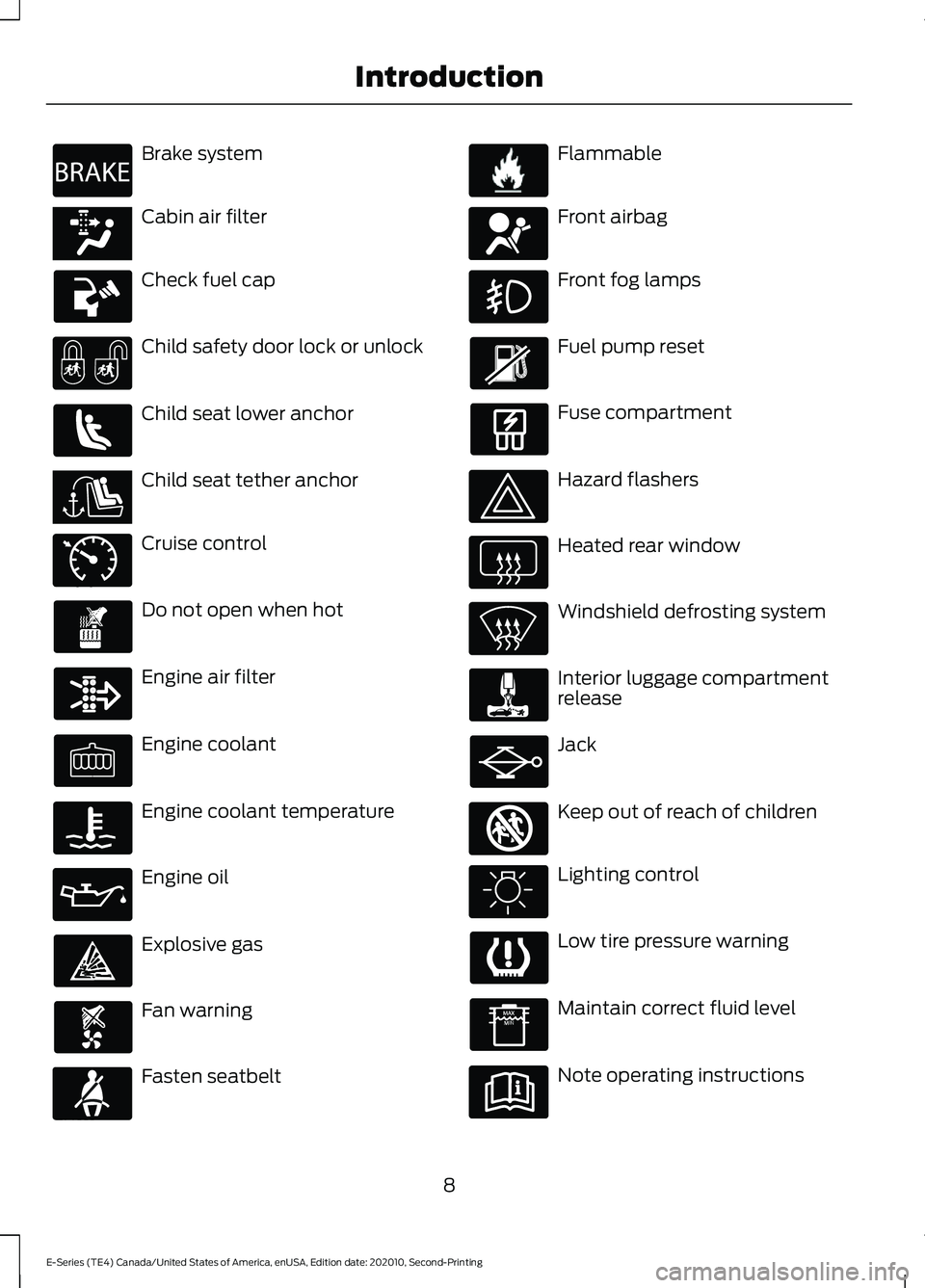
Brake system
Cabin air filter
Check fuel cap
Child safety door lock or unlock
Child seat lower anchor
Child seat tether anchor
Cruise control
Do not open when hot
Engine air filter
Engine coolant
Engine coolant temperature
Engine oil
Explosive gas
Fan warning
Fasten seatbelt Flammable
Front airbag
Front fog lamps
Fuel pump reset
Fuse compartment
Hazard flashers
Heated rear window
Windshield defrosting system
Interior luggage compartment
release
Jack
Keep out of reach of children
Lighting control
Low tire pressure warning
Maintain correct fluid level
Note operating instructions
8
E-Series (TE4) Canada/United States of America, enUSA, Edition date: 202010, Second-Printing IntroductionE270480 E139223 E141128 E71340 E71880 E231160 E67017 E161353
Page 13 of 296
Your vehicle has electronic control units
that have data recording functionality and
the ability to permanently or temporarily
store data. This data could include
information on the condition and status of
your vehicle, vehicle maintenance
requirements, events and malfunctions.
The types of data that can be recorded are
described in this section. Some of the data
recorded is stored in event logs or error
logs.
Note:
Error logs are reset following a service
or repair.
Note: We may provide information in
response to requests from law enforcement,
other government authorities and third
parties acting with lawful authority or
through a legal process. Such information
could be used by them in legal proceedings.
Data recorded includes, for example:
• Operating states of system
components, for example, fuel level,
tire pressure and battery charge level.
• Vehicle and component status, for
example, wheel speed, deceleration,
lateral acceleration and seatbelt
status.
• Events or errors in essential systems,
for example, headlamps and brakes.
• System responses to driving situations,
for example, airbag deployment and
stability control.
• Environmental conditions, for example,
temperature.
Some of this data, when used in
combination with other information, for
example, an accident report, damage to a
vehicle or eyewitness statements, could
be associated with a specific person. Service Data
Service data recorders in your vehicle are
capable of collecting and storing
diagnostic information about your vehicle.
This potentially includes information about
the performance or status of various
systems and modules in the vehicle, such
as engine, throttle, steering or brake
systems. In order to properly diagnose and
service your vehicle, Ford Motor Company
(Ford of Canada in Canada), and service
and repair facilities may access or share
among them vehicle diagnostic
information received through a direct
connection to your vehicle when
diagnosing or servicing your vehicle.
Additionally, Ford Motor Company (Ford
of Canada, in Canada) may, where
permitted by law, use vehicle diagnostic
information for vehicle improvement or
with other information we may have about
you, for example, your contact information,
to offer you products or services that may
interest you. Data may be provided to our
service providers such as part suppliers
that may help diagnose malfunctions, and
who are similarly obligated to protect data.
We retain this data only as long as
necessary to perform these functions or to
comply with law. We may provide
information where required in response to
official requests to law enforcement or
other government authorities or third
parties acting with lawful authority or court
order, and such information may be used
in legal proceedings. For U.S. only (if
equipped), if you choose to use connected
apps and services, you consent that certain
diagnostic information may also be
accessed electronically by Ford Motor
Company and Ford authorized service
facilities, and that the diagnostic
information may be used to provide
services to you, personalizing your
experience, troubleshoot, and to improve
products and services and offer you
products and services that may interest
10
E-Series (TE4) Canada/United States of America, enUSA, Edition date: 202010, Second-Printing Introduction
Page 51 of 296
PASSIVE ANTI-THEFT
SYSTEM
Note:
The system is not compatible with
non-Ford aftermarket remote start systems.
Use of these systems could result in engine
starting problems and a loss of security
protection.
Note: Prevent these objects from touching
the coded key when starting your vehicle.
Metallic objects, electronic devices or a
second coded key on the same key chain
could result in vehicle starting problems,
especially if they are too close to the key
when starting your vehicle. Switch the
ignition off, move all objects on the key
chain away from the coded key and restart
your vehicle if a problem occurs.
Note: Do not leave a duplicate coded key
in your vehicle. Always take your keys and
lock all doors when leaving your vehicle.
SecuriLock®
The system helps prevent the engine from
starting unless you use a coded key
programmed to your vehicle. Using the
wrong key may prevent your vehicle from
starting. A message may appear in the
information display.
If you are unable to start your vehicle with
a coded key, it is not operating correctly.
A message may appear in the information
display.
Automatic Arming
The system arms when you switch the
ignition off.
Automatic Disarming
The system disarms when you switch the
ignition on with a coded key. Replacement Keys
Your vehicle may have two integrated
keyhead transmitters.
The integrated keyhead transmitter
functions as a programmed ignition key
that starts your vehicle.
If your programmed transmitters or
standard SecuriLock coded keys become
lost or stolen and you do not have an extra
coded key, you need to have your vehicle
towed to an authorized dealer. You need
to erase the key codes from your vehicle
and program new coded keys.
Store an extra programmed key away from
your vehicle in a safe place. To purchase
additional spare or replacement keys,
contact an authorized dealer.
If you have a spare key, you need to
program it. See Replacing a Lost Key or
Remote Control (page 44).
48
E-Series (TE4) Canada/United States of America, enUSA, Edition date: 202010, Second-Printing Security
Page 62 of 296
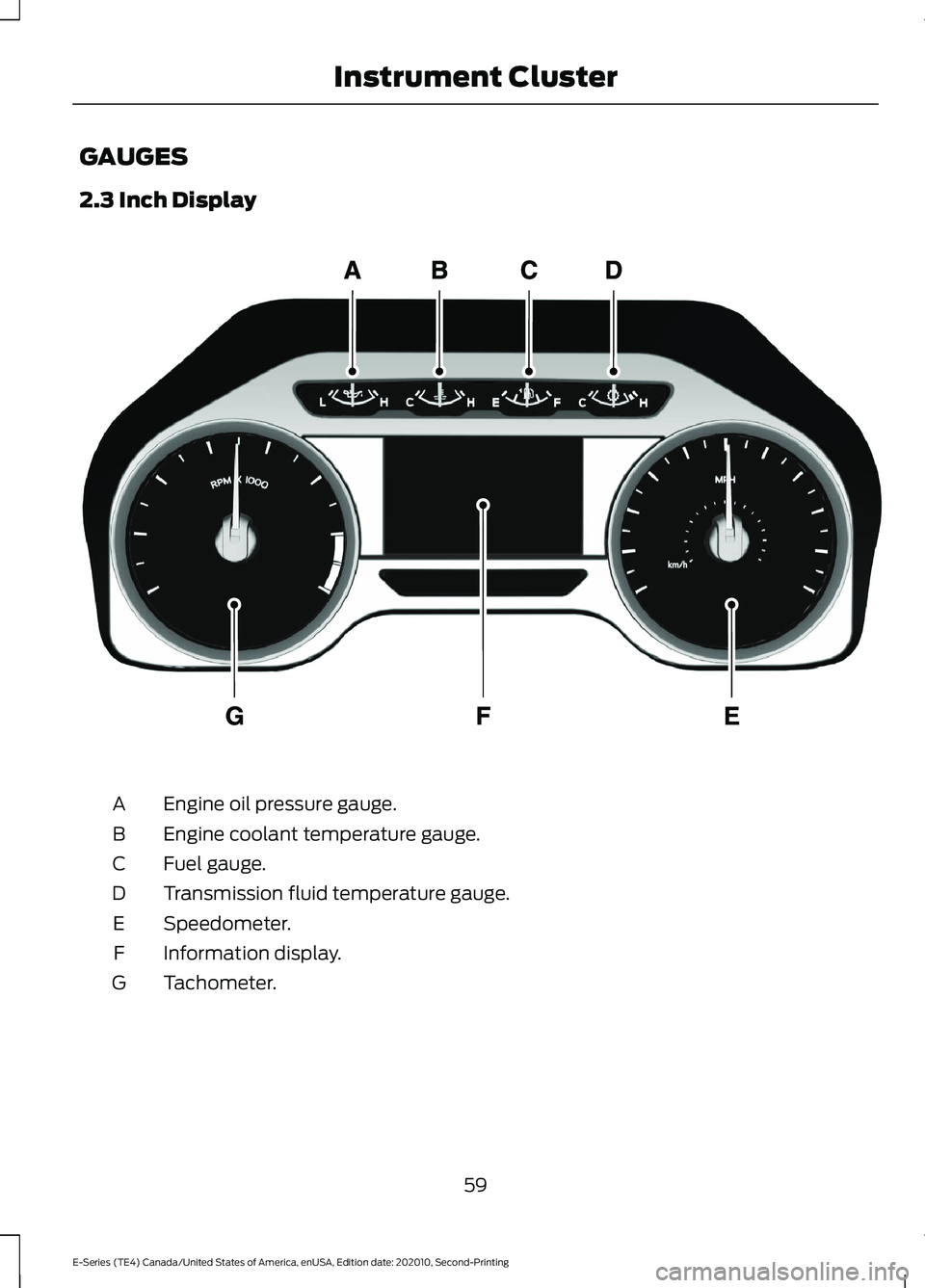
GAUGES
2.3 Inch Display
Engine oil pressure gauge.
A
Engine coolant temperature gauge.
B
Fuel gauge.
C
Transmission fluid temperature gauge.
D
Speedometer.
E
Information display.
F
Tachometer.
G
59
E-Series (TE4) Canada/United States of America, enUSA, Edition date: 202010, Second-Printing Instrument ClusterE219638
Page 63 of 296
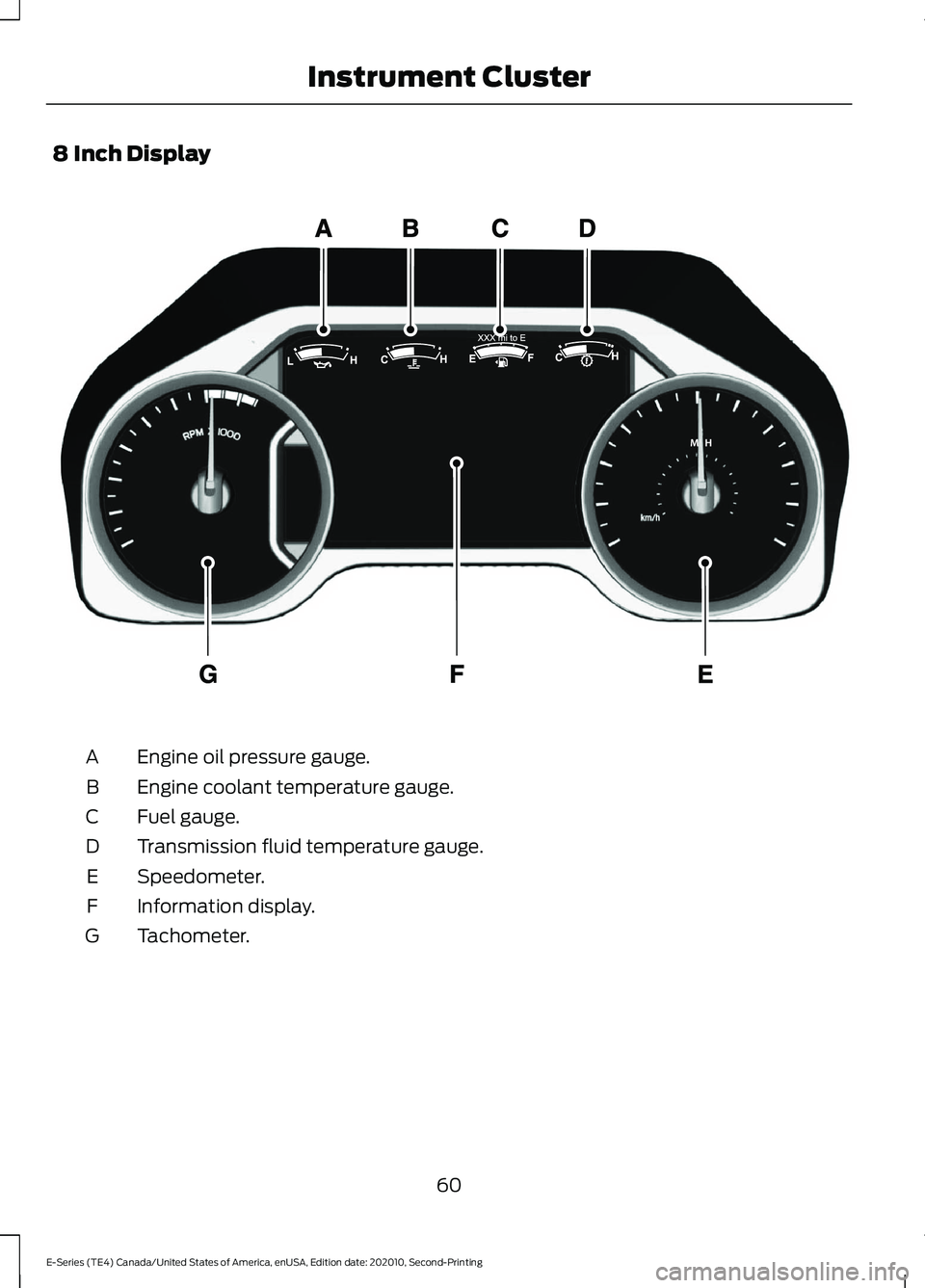
8 Inch Display
Engine oil pressure gauge.
A
Engine coolant temperature gauge.
B
Fuel gauge.
C
Transmission fluid temperature gauge.
D
Speedometer.
E
Information display.
F
Tachometer.
G
60
E-Series (TE4) Canada/United States of America, enUSA, Edition date: 202010, Second-Printing Instrument ClusterE299699
Page 64 of 296
Engine Oil Pressure Gauge
Indicates engine oil pressure. At normal
operating temperature, the level indicator
is in the normal range. If the pressure gauge
falls below the normal range, stop your
vehicle, switch off the engine and check
the engine oil level. Add oil if needed. If the
oil level is correct, have your vehicle
checked by an authorized dealer.
Engine Coolant Temperature
Gauge
WARNING: Do not remove the
coolant reservoir cap when the engine is
on or the cooling system is hot. Wait 10
minutes for the cooling system to cool
down. Cover the coolant reservoir cap
with a thick cloth to prevent the
possibility of scalding and slowly remove
the cap. Failure to follow this instruction
could result in personal injury.
Indicates engine coolant temperature. At
normal operating temperature, the level
indicator is in the normal range. If the
engine coolant temperature exceeds the
normal range, stop your vehicle as soon as
possible, switch off the engine and let the
engine cool.
Fuel Gauge
The fuel gauge indicates about how much
fuel is in the fuel tank.
The arrow adjacent to the fuel pump
symbol indicates on which side of your
vehicle the fuel filler door is located.
Note: The fuel gauge may vary slightly
when your vehicle is moving or on a slope. Low Fuel Reminder
A low fuel level reminder displays and
sounds when the distance to empty
reaches
50 mi (80 km), 25 mi (40 km),
10 mi (20 km) and 0 mi (0 km) for all
vehicle keys.
Note: The low fuel reminder can appear at
different fuel gauge positions depending on
fuel economy conditions. This variation is
normal.
Distance to Empty
Indicates the approximate distance your
vehicle can travel on the fuel remaining in
the tank. Changes in driving pattern can
cause the value to not only decrease but
also increase or stay constant for periods
of time.
Transmission Fluid Temperature
Gauge
Indicates transmission fluid temperature.
At normal operating temperature, the level
indicator is in the normal range. If the
transmission fluid temperature exceeds
the normal range, stop your vehicle as soon
as possible and verify the airflow is not
restricted by snow or debris blocking
airflow through the grille.
Special operating conditions such as
snowplowing, towing, or off-road use may
cause higher than normal operating
temperatures. See
Special Operating
Conditions Scheduled Maintenance
(page
256).
To lower the transmission temperature
into the normal range, alter the severity of
your driving conditions. Operating the
transmission for extended periods with the
gauge in the higher than normal area may
cause internal transmission damage. If the
gauge continues to show high
temperatures, see an authorized dealer.
61
E-Series (TE4) Canada/United States of America, enUSA, Edition date: 202010, Second-Printing Instrument Cluster