battery FORD E SERIES 1997 4.G User Guide
[x] Cancel search | Manufacturer: FORD, Model Year: 1997, Model line: E SERIES, Model: FORD E SERIES 1997 4.GPages: 192, PDF Size: 3.44 MB
Page 125 of 192
The cooling fan is
automatic and may come
on at any time. Always
disconnect the negative terminal
of the battery before working
near the fan.
²If you must work with the
engine running, avoid wearing
loose clothing or jewelry that
could get caught in moving
parts. Take precautions with
long hair.
²Do not work on a vehicle with
the engine running in an
enclosed space, unless you are
sure you have enough
ventilation.
²Keep all lit cigarettes, open
flames and other lit material
away from the battery and all
fuel related parts.
If you disconnect the battery, the
engine must ªrelearnº its idle
conditions before your vehicle will
drive properly, as explained in
Batteryin this chapter.
com_working_off.01
Maintenance and care
125
Page 129 of 192
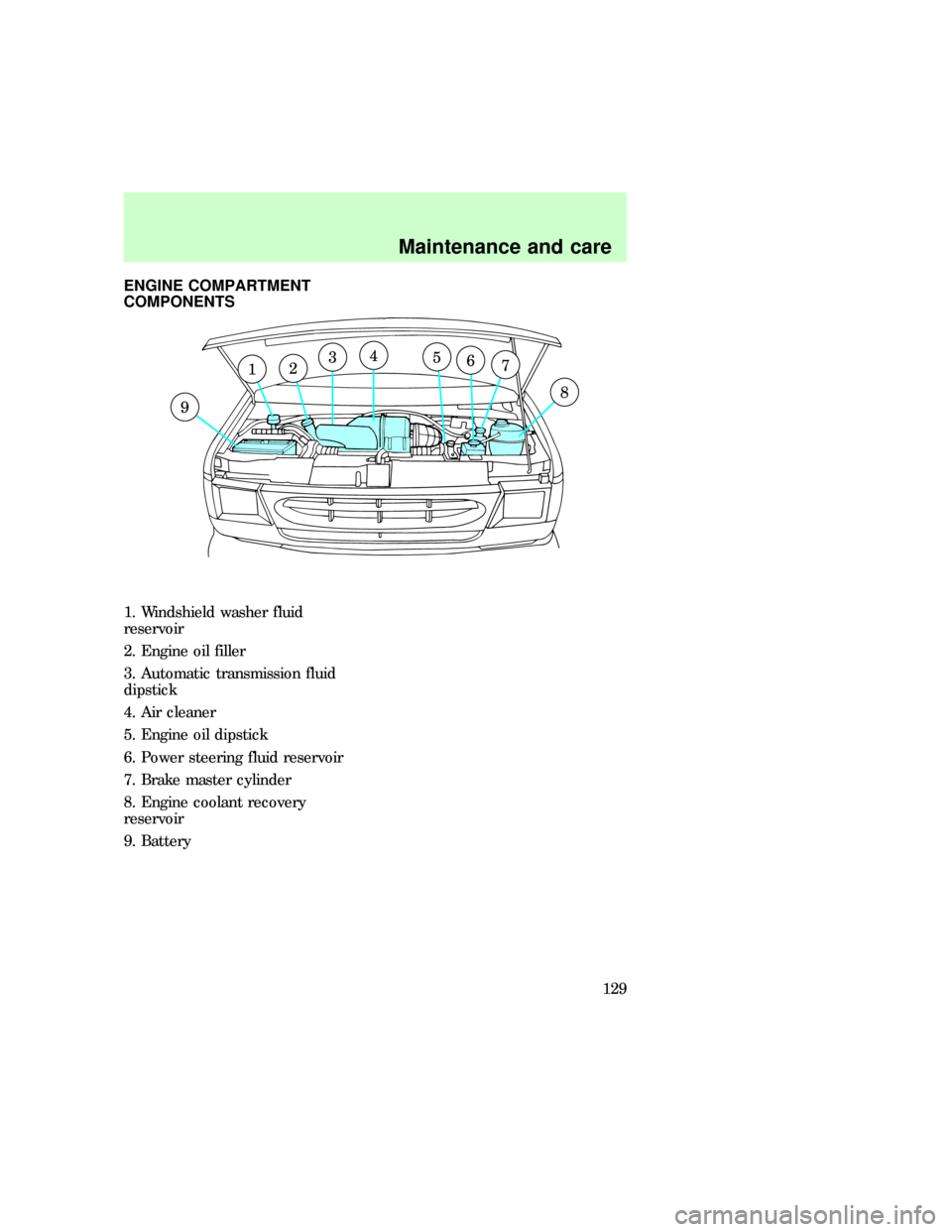
ENGINE COMPARTMENT
COMPONENTS
1. Windshield washer fluid
reservoir
2. Engine oil filler
3. Automatic transmission fluid
dipstick
4. Air cleaner
5. Engine oil dipstick
6. Power steering fluid reservoir
7. Brake master cylinder
8. Engine coolant recovery
reservoir
9. Battery
91234
5
6
7
8
com_check-add_oil.01
Maintenance and care
129
Page 144 of 192
DRIVELINE UNIVERSAL JOINT
AND SLIP YOKE
The universal joints standard with
your vehicle do not require
lubrication. If the original
equipment universal joints are
replaced with universal joints
equipped with grease fittings,
lubrication will be necessary at the
intervals shown in the ªService
Guideº supplement.
BATTERY
If the original equipment
maintenance-free battery needs
replacing, it may be replaced with
a low-maintenance battery. For
information on replacement
batteries, refer toMotorcraft part
numbersin theCapacities and
specificationschapter.
The gases around the
battery can explode if
exposed to flames, sparks, or lit
cigarettes. An explosion could
result in injury or vehicle
damage.
Batteries contain sulfuric
acid which burns skin,
eyes, and clothing.
eco_battery1
eco_servicing_battery1
Maintenance and care
144
Page 145 of 192
Servicing your battery
The low-maintenance battery has
removable vent caps for checking
the electrolyte level and adding
water. Check the electrolyte level
every 24 months or 40,000 km
(24,000 miles) in average
temperatures below 32ÉC (90ÉF).
Keep the electrolyte level in each
cell up to the level indicator. Do
not overfill.
If the level gets low, refill the
battery with distilled water. If the
battery needs water quite often,
have the charging system checked
for a possible malfunction.
Relearning idle conditions
Because your vehicle's engine is
electronically controlled by a
computer, some control conditions
are maintained by power from the
battery. When the battery is
disconnected or a new battery is
installed, the computer must
ªrelearnº its idle conditions before
your vehicle will drive properly. To
complete this process:
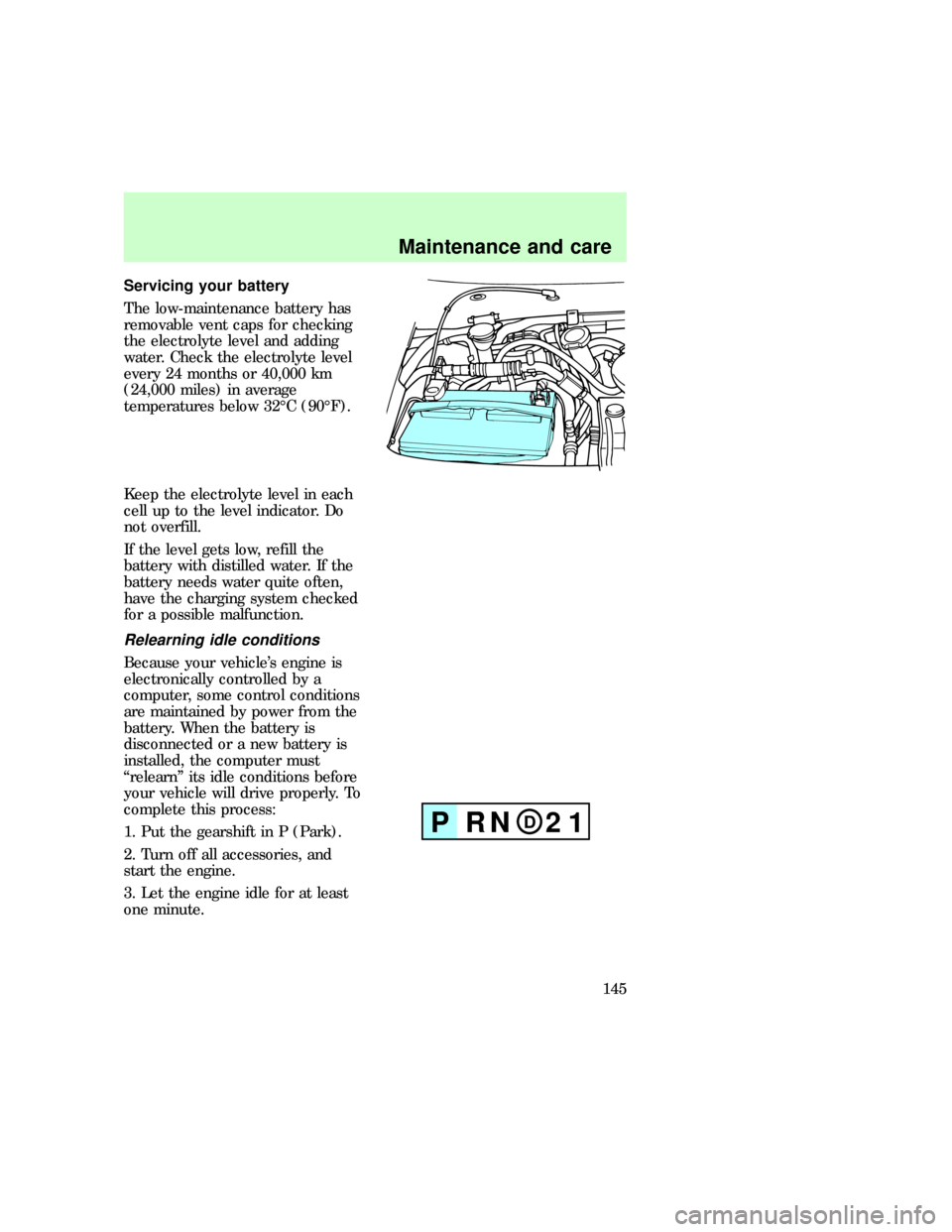
1. Put the gearshift in P (Park).
2. Turn off all accessories, and
start the engine.
3. Let the engine idle for at least
one minute.
DPRN 21
Maintenance and care
145
Page 146 of 192
4. The relearning process will
automatically complete as you
drive the vehicle.
²If you do not allow the engine to
relearn its idle, the idle quality
of your vehicle may be adversely
affected until the idle is
eventually relearned.
²If the battery has been
disconnected or a new battery
has been installed, the clock and
preset radio stations must be
reset once the battery is
reconnected.
²Always dispose of used
automotive batteries in a
responsible manner. Follow your
community's standards for
disposal. Call your local
recycling center to find out
more about recycling automotive
batteries.
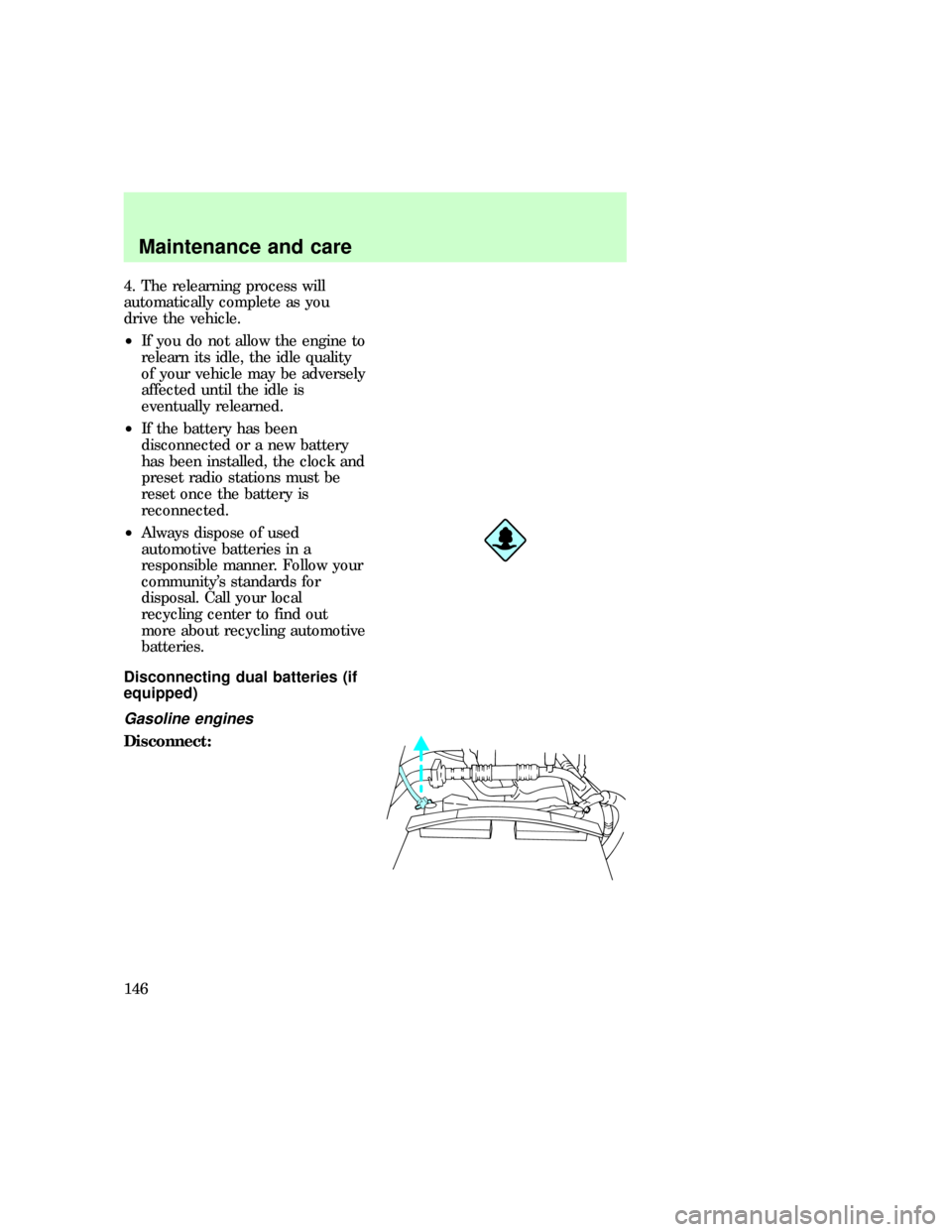
Disconnecting dual batteries (if
equipped)
Gasoline engines
Disconnect:
eco_battery_disconnect
eco_battery_gas_disconnect
Maintenance and care
146
Page 147 of 192
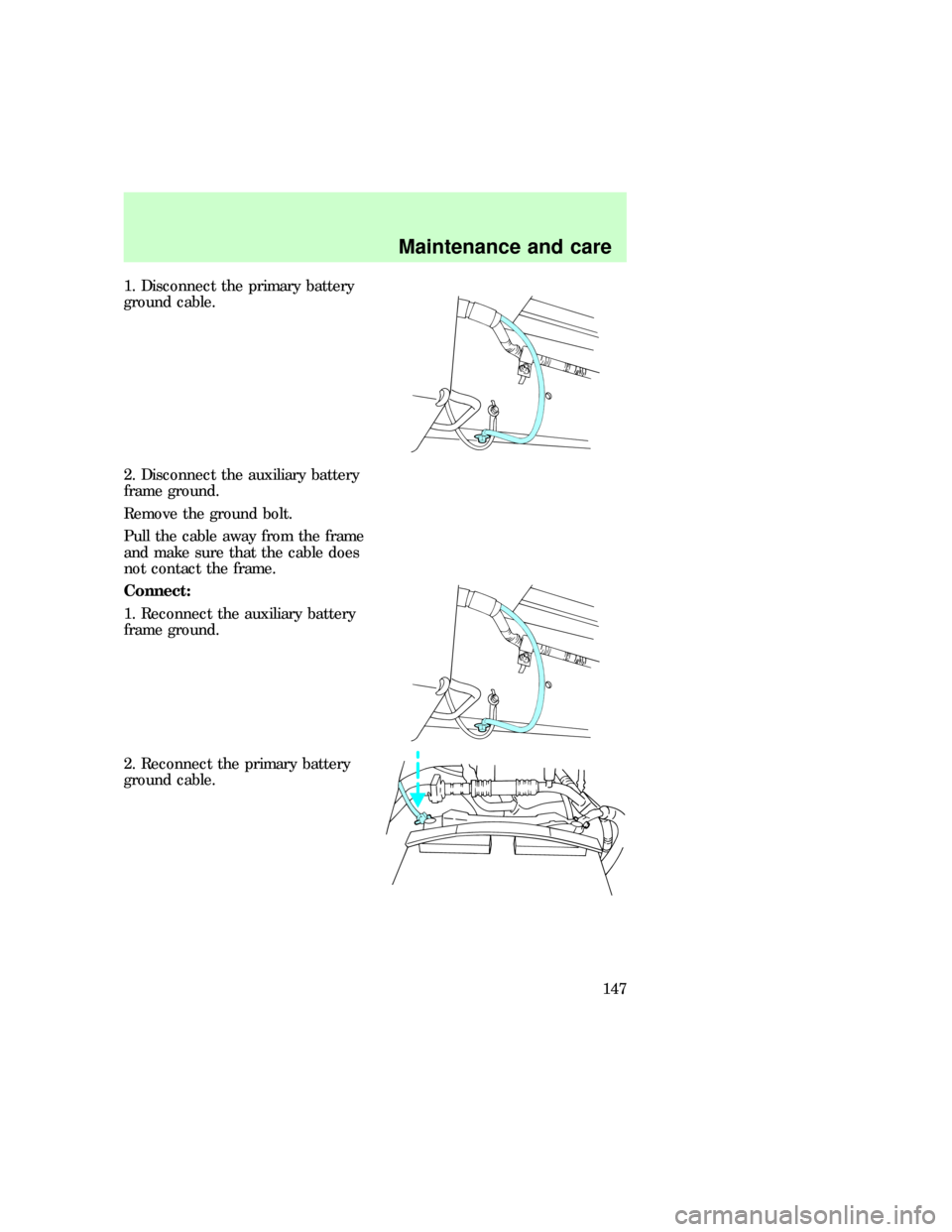
1. Disconnect the primary battery
ground cable.
2. Disconnect the auxiliary battery
frame ground.
Remove the ground bolt.
Pull the cable away from the frame
and make sure that the cable does
not contact the frame.
Connect:
1. Reconnect the auxiliary battery
frame ground.
2. Reconnect the primary battery
ground cable.
eco_battery_diesel_disconnect
Maintenance and care
147
Page 148 of 192
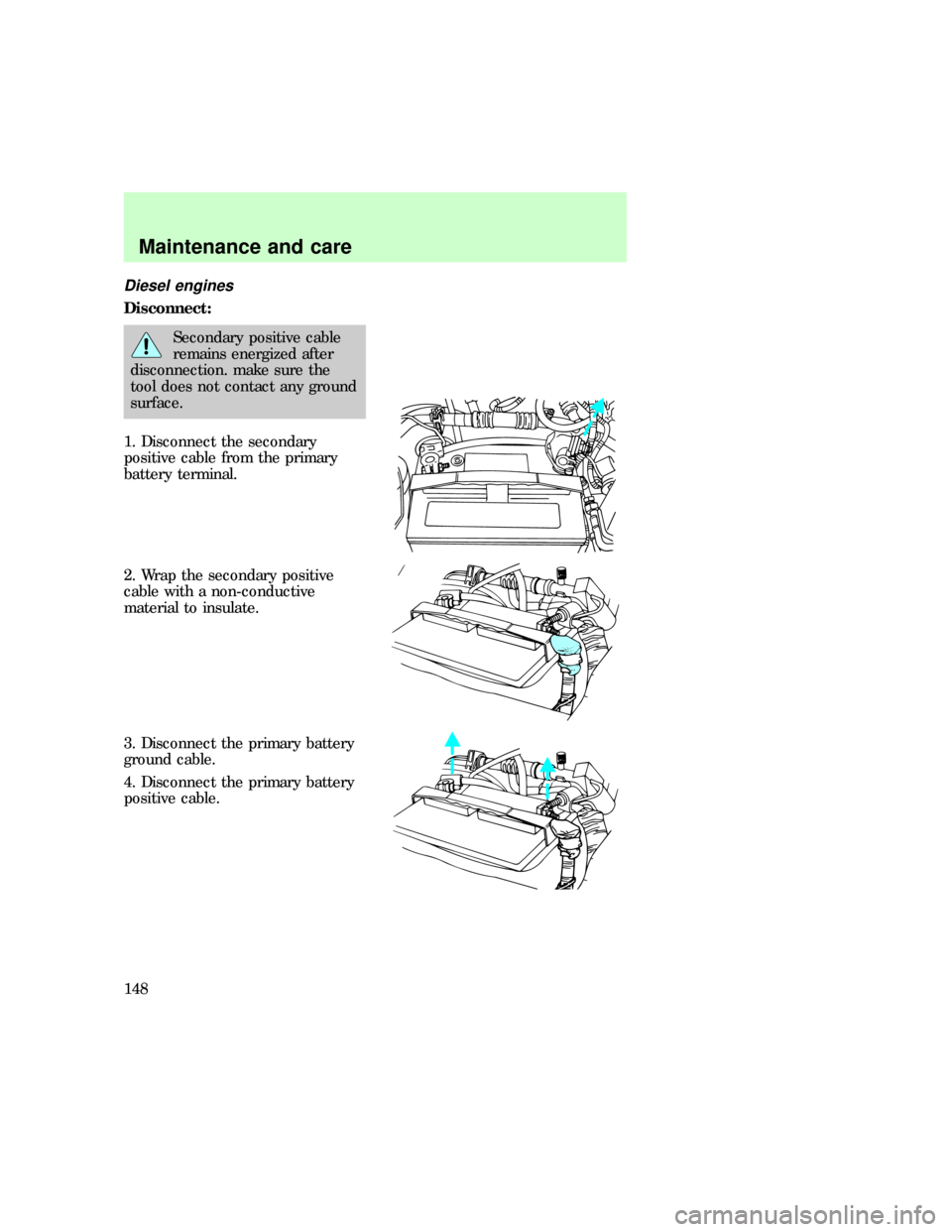
Diesel engines
Disconnect:
Secondary positive cable
remains energized after
disconnection. make sure the
tool does not contact any ground
surface.
1. Disconnect the secondary
positive cable from the primary
battery terminal.
2. Wrap the secondary positive
cable with a non-conductive
material to insulate.
3. Disconnect the primary battery
ground cable.
4. Disconnect the primary battery
positive cable.
Maintenance and care
148
Page 149 of 192
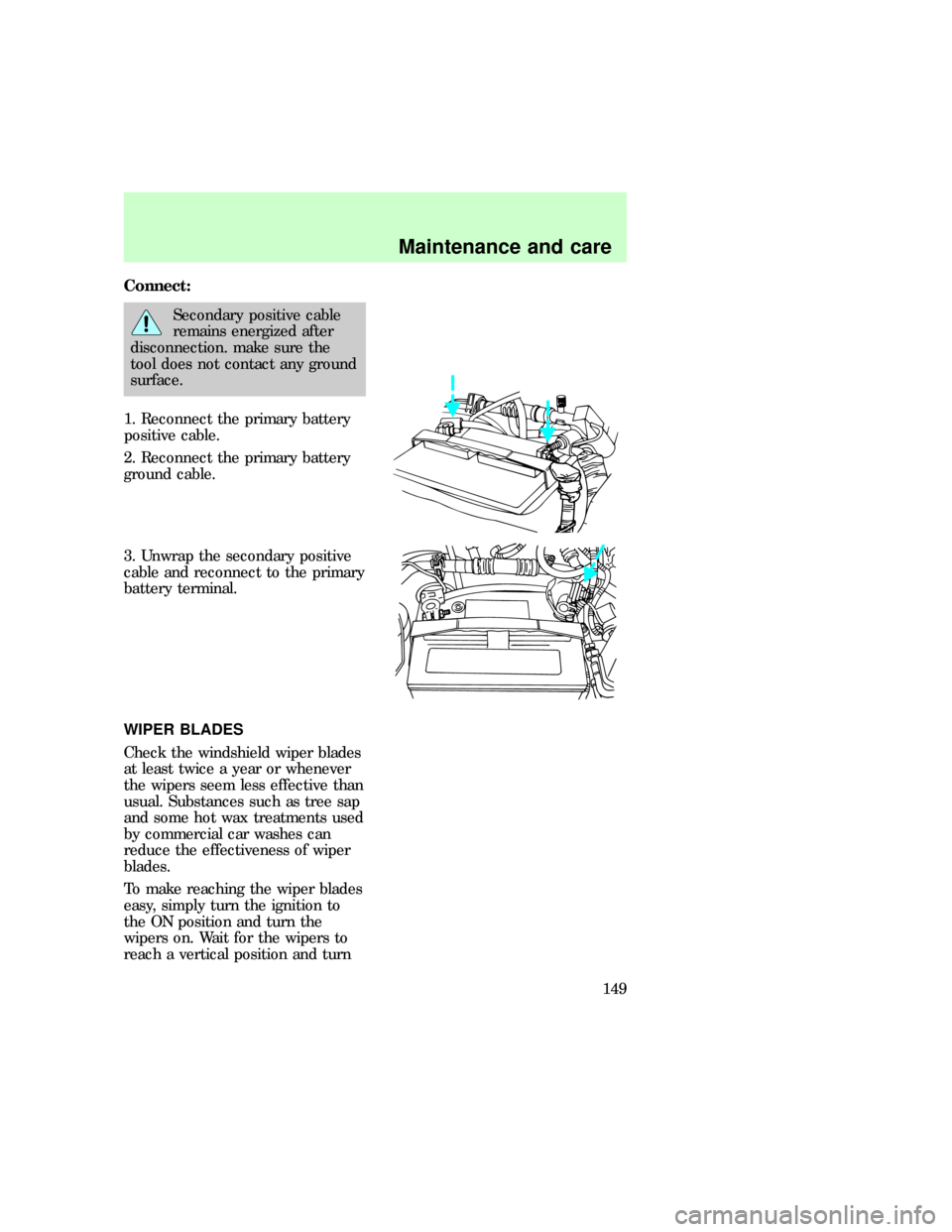
Connect:
Secondary positive cable
remains energized after
disconnection. make sure the
tool does not contact any ground
surface.
1. Reconnect the primary battery
positive cable.
2. Reconnect the primary battery
ground cable.
3. Unwrap the secondary positive
cable and reconnect to the primary
battery terminal.
WIPER BLADES
Check the windshield wiper blades
at least twice a year or whenever
the wipers seem less effective than
usual. Substances such as tree sap
and some hot wax treatments used
by commercial car washes can
reduce the effectiveness of wiper
blades.
To make reaching the wiper blades
easy, simply turn the ignition to
the ON position and turn the
wipers on. Wait for the wipers to
reach a vertical position and turn
eco_wipers
Maintenance and care
149
Page 164 of 192

Preparing your vehicle for
inspection/maintenance (I/M)
testing
In some localities it may be a legal
requirement to pass an I/M test of
the on-board diagnostic (OBD) II
system. If your vehicle's powertrain
system or battery has just been
serviced, the OBD II system is
reset to a condition unready for
I/M testing. To ready the OBD II
system for I/M testing, the law
specifies that additional city and
highway driving is necessary to
complete the check of the OBD II
system.
The driving modes required to
reach the ready condition consist
of a minimum of 30 minutes of city
and highway driving:
²At least 20 minutes driving in
stop and go city-type traffic with
at least four idle periods.
²At least ten minutes of driving
on an expressway or highway.
Before completing the above
driving modes, the engine must be
warmed up and at operating
temperature. Once started, the
vehicle must not be turned off
during these modes.
eco_bulbs_replace
Maintenance and care
164
Page 173 of 192

MOTORCRAFT PART NUMBERS
Component Engine application
4.2L 4.6L 5.4L 6.8L
Spark plug AWSF-42EE AWSF-32PP AWSF-22E AWSF-22E
Air filter FA-1632 FA-1632 FA-1632 FA-1632
Oil filter FL-400-S FL-820-S FL-820-S FL-820-S
Fuel filter FG-872 FG-872 FG-872 FG-872
Battery
Standard BXT-65-650 BXT-65-650 BXT-65-650 BXT-65-650
Optional BXT-65-750 BXT-65-750 BXT-65-750 BXT-65-750
Auxiliary BH-65DC BH-65DC BH-65DC BH-65DC
P.C.V. valve EV-152 EV-233 EV-233 EV-233
REFILL CAPACITIES
Fluid Application Capacity
Engine oil (includes
filter change)4.2L engine 5.7L (6.0 qts.)
4.6L engine 5.7L (6.0 qts.)
5.4L engine 5.7L (6.0 qts.)
6.8L engine 5.7L (6.0 qts.)
Engine coolant 4.2L engine 22.0L (23.2 qts.)
4.6L engine 23.7L (25.0 qts.)
5.4L engine 27.4L (29.0 qts.)
6.8L engine 29.0L (30.6 qts.)
Rear axle Ford 8.8º/9.75º
conventional and
Traction-Lok2.6L (5.5 pints)
1
Dana 9.75º (M60-IU) 3.0L (6.3 pints)2
Dana 10.5º (M70-2U) 3.1L (6.6 pints)2
Dana 10.5º M70-1HD) 3.5L (7.5 pints)2
Dana 11.25º (model
80)3.5L (7.5 pints)2
eco_motorcraft_part_numbers
eco_refill_capacities
Capacities and specifications
173