fuel FORD E SERIES 1997 4.G User Guide
[x] Cancel search | Manufacturer: FORD, Model Year: 1997, Model line: E SERIES, Model: FORD E SERIES 1997 4.GPages: 192, PDF Size: 3.44 MB
Page 101 of 192
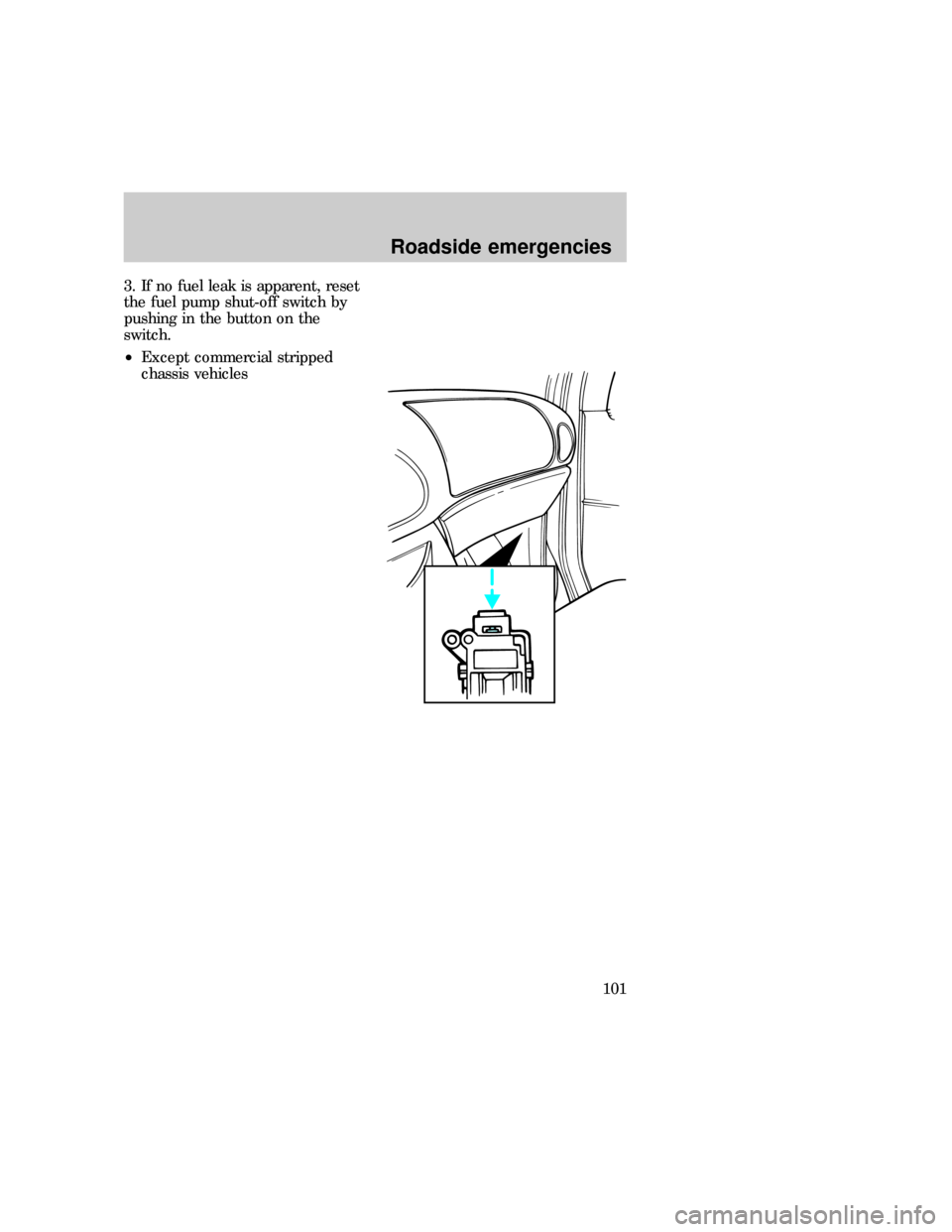
3. If no fuel leak is apparent, reset
the fuel pump shut-off switch by
pushing in the button on the
switch.
²Except commercial stripped
chassis vehicles
Roadside emergencies
101
Page 102 of 192
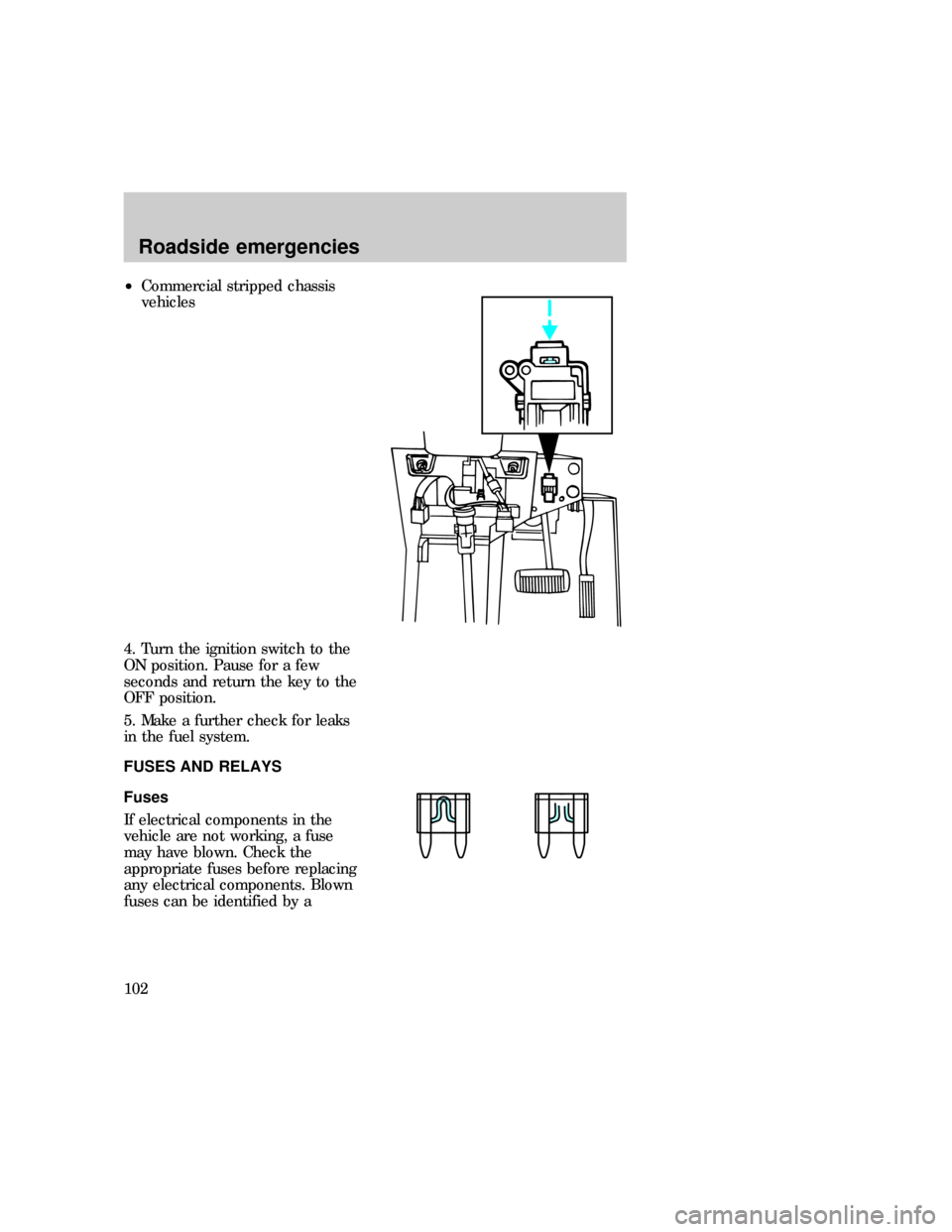
²Commercial stripped chassis
vehicles
4. Turn the ignition switch to the
ON position. Pause for a few
seconds and return the key to the
OFF position.
5. Make a further check for leaks
in the fuel system.
FUSES AND RELAYS
Fuses
If electrical components in the
vehicle are not working, a fuse
may have blown. Check the
appropriate fuses before replacing
any electrical components. Blown
fuses can be identified by a
eco_fuse-relay_intro
eco_fuses
Roadside emergencies
102
Page 106 of 192

Number Fuse amperage
ratingCircuits protected
8 30 amp Noise supression
capacitor, ignition coil
positive feed, PCM
relay diode/PCM
power relay, fuel
heater (diesel), glow
plug relay (diesel)
9 30 amp Wiper control module,
wiper motor
10 20 amp Headlamp switch
(exterior lamps),
Multi-function switch
(flash-to-pass)
11 15 amp Stoplight switch, brake
pressure switch,
multi-function switch
12 15 amp Digital transmission
range sensor (backup
lamps), auxiliary
battery relay
13 15 amp A/C mode switch,
blend door actuator
14 5 amp Instrument cluster (air
bag and charge
indicator lamps)
15 5 amp Trailer tow battery
charge relay (coil)
16 30 amp Power seats
17 - Not used
18 - Not used
19 10 amp Air bag module
20 5 amp Overdrive cancel
switch
Roadside emergencies
106
Page 109 of 192

Number Fuse amperage
ratingCircuits protected
4 5 amp PCM keep alive
memory
5 10 amp Right trailer turn
signal
6 10 amp Left trailer turn signal
7 - Not used
8 60 amp Instrument panel
fuses
9 30 amp PCM power relay
10 60 amp Auxiliary battery
11 - Not used
12 60 amp Misc.
13 50 amp Blower motor relay
14 30 amp Trailer running lamps,
trailer backup lamps
15 40 amp Headlamp switch
16 50 amp Auxiliary A/C, remote
keyless entry module
17 30 amp Fuel pump relay
(gasoline), injector
driver module relay
(diesel)
18 60 amp Modified vehicle
power
19 60 amp Anti-lock brake
system (4WABS)
20 20 amp Electric brake
controller (trailer tow)
21 50 amp Modified vehicle
power
22 40 amp Trailer battery charge
(relay)
Roadside emergencies
109
Page 112 of 192
Position Circuit
J Horn
K Fuel pump or IDM
CHANGING TIRES
Spare tire location
The spare tire is stowed under the
rear of your vehicle (except
cutaway and stripped chassis
models).
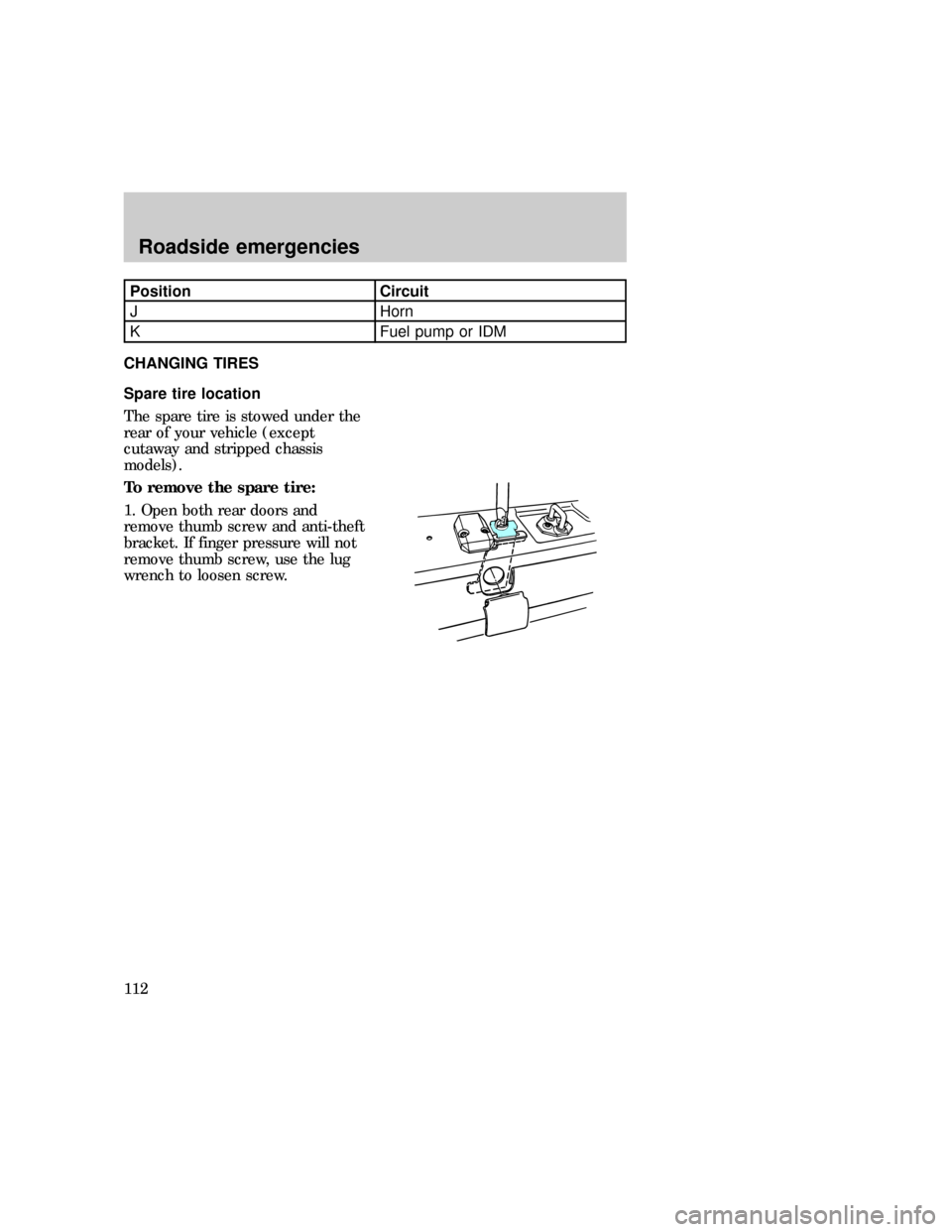
To remove the spare tire:
1. Open both rear doors and
remove thumb screw and anti-theft
bracket. If finger pressure will not
remove thumb screw, use the lug
wrench to loosen screw.
eco_tire_location
Roadside emergencies
112
Page 124 of 192

SERVICE RECOMMENDATIONS
To help you service your vehicle:
²We highlight do-it-yourself items
in the engine compartment for
easy location.
²As possible, we design parts that
can be replaced without tools.
²We provide you with a ªService
Guideº which makes tracking
routine service for your vehicle
easy.
If your vehicle requires
professional service, your
dealership can provide necessary
parts and service. Check your
ªWarranty Information Bookletº to
find out which parts and services
are covered.
Use only recommended fuels,
lubricants, fluids and service parts
conforming to specifications.
Motorcraft parts are designed and
built to provide the best
performance in your vehicle.
Precautions when servicing
your vehicle
Be especially careful when
inspecting or servicing your
vehicle. Here are some general
precautions for your safety:
²Do not work on a hot engine.
com_precautions_servicing.01
Maintenance and care
124
Page 125 of 192
The cooling fan is
automatic and may come
on at any time. Always
disconnect the negative terminal
of the battery before working
near the fan.
²If you must work with the
engine running, avoid wearing
loose clothing or jewelry that
could get caught in moving
parts. Take precautions with
long hair.
²Do not work on a vehicle with
the engine running in an
enclosed space, unless you are
sure you have enough
ventilation.
²Keep all lit cigarettes, open
flames and other lit material
away from the battery and all
fuel related parts.
If you disconnect the battery, the
engine must ªrelearnº its idle
conditions before your vehicle will
drive properly, as explained in
Batteryin this chapter.
com_working_off.01
Maintenance and care
125
Page 130 of 192
CHECKING AND ADDING
ENGINE OIL
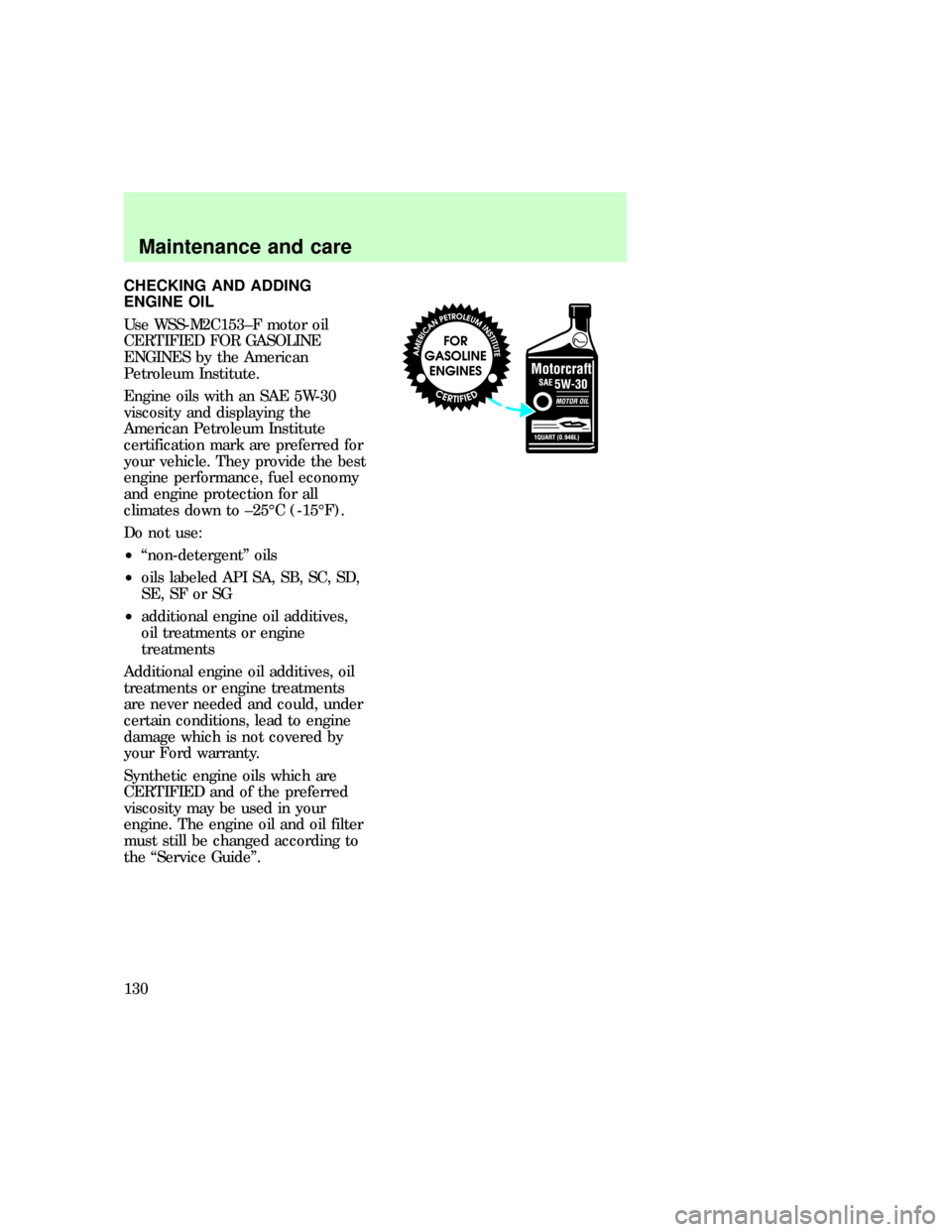
Use WSS-M2C153±F motor oil
CERTIFIED FOR GASOLINE
ENGINES by the American
Petroleum Institute.
Engine oils with an SAE 5W-30
viscosity and displaying the
American Petroleum Institute
certification mark are preferred for
your vehicle. They provide the best
engine performance, fuel economy
and engine protection for all
climates down to ±25ÉC (-15ÉF).
Do not use:
²ªnon-detergentº oils
²oils labeled API SA, SB, SC, SD,
SE, SF or SG
²additional engine oil additives,
oil treatments or engine
treatments
Additional engine oil additives, oil
treatments or engine treatments
are never needed and could, under
certain conditions, lead to engine
damage which is not covered by
your Ford warranty.
Synthetic engine oils which are
CERTIFIED and of the preferred
viscosity may be used in your
engine. The engine oil and oil filter
must still be changed according to
the ªService Guideº.
eco_checking_engine_oil
Maintenance and care
130
Page 131 of 192
Checking the engine oil
Check the engine oil each time you
fuel your vehicle.
To check the oil:
1. Make sure the vehicle is on level
ground. If the engine is warm, turn
the engine off and wait a few
minutes for the oil to drain into
the oil pan.
2. Set the parking brake and
ensure the gearshift is securely
latched in P (Park).
3. Open the hood. Protect yourself
from engine heat.
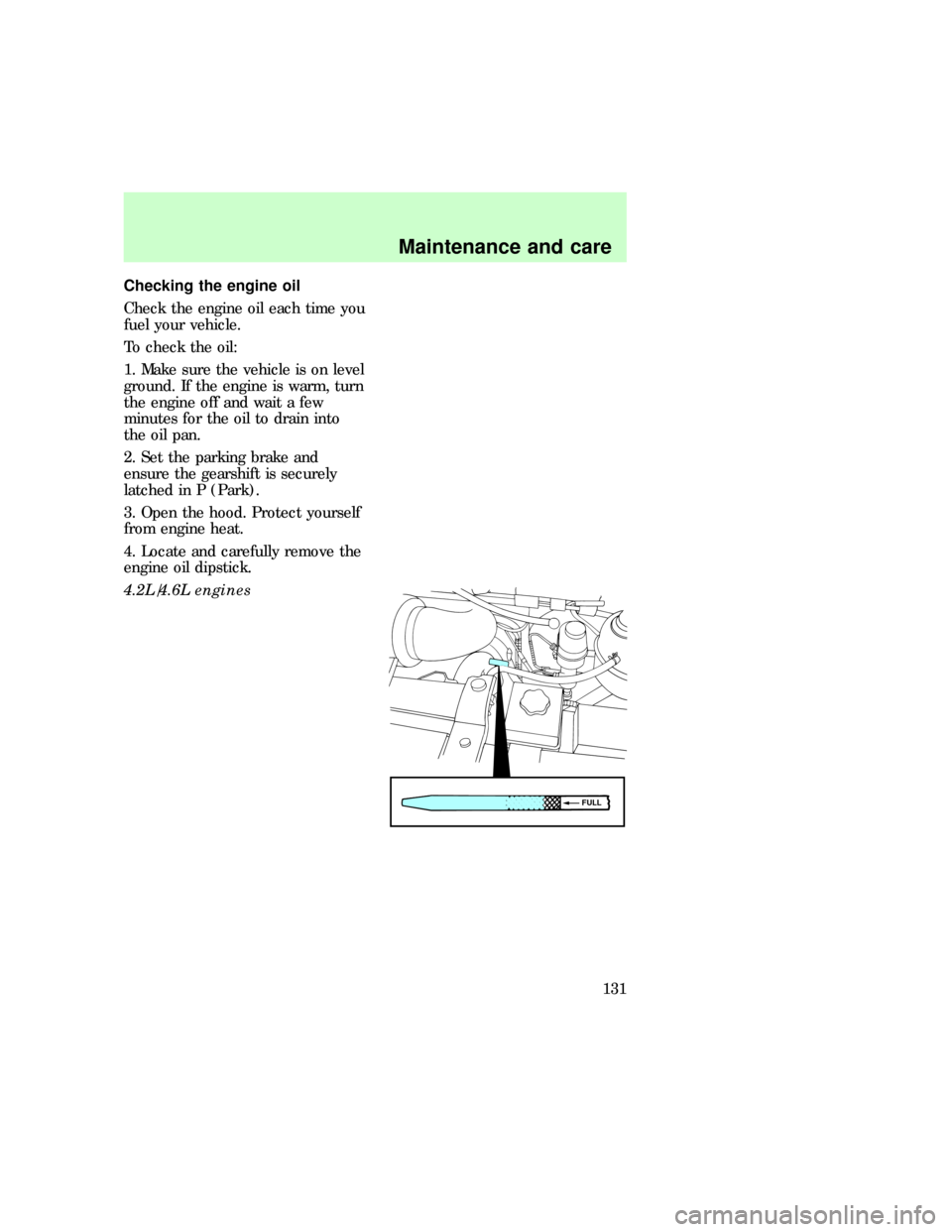
4. Locate and carefully remove the
engine oil dipstick.
4.2L/4.6L engines
ADDFULL
Maintenance and care
131
Page 156 of 192
Using snow tires and chains
Snow tires must be the
same size and grade as the
tires you currently have on your
vehicle.
The tires on your vehicle have
allÐweather treads to provide
traction in rain and snow. However,
in some climates, using snow tires
and chains may be necessary. Ford
offers tire cables as a Ford
approved accessory and
recommends use of these or their
equivalents. See your dealer or
qualified service technician for
more information on tire cables for
your vehicle. Follow these
guidelines when using snow tires
and chains:
²Install chains securely, verifying
that the chains do not touch any
wiring, brake lines or fuel lines.
²Install the chains on the rear
tires only.
²Drive cautiously. If you hear the
chains rub or bang against the
vehicle, stop and retighten
them. If this does not work,
remove the chains to prevent
vehicle damage.
²Avoid overloading your vehicle.
²Remove the tire chains when
they are no longer needed. Do
not use chains on dry roads.
²The suspension insulation and
bumpers will help prevent
vehicle damage. Do not remove
Maintenance and care
156