seats FORD E SERIES 1997 4.G User Guide
[x] Cancel search | Manufacturer: FORD, Model Year: 1997, Model line: E SERIES, Model: FORD E SERIES 1997 4.GPages: 192, PDF Size: 3.44 MB
Page 54 of 192
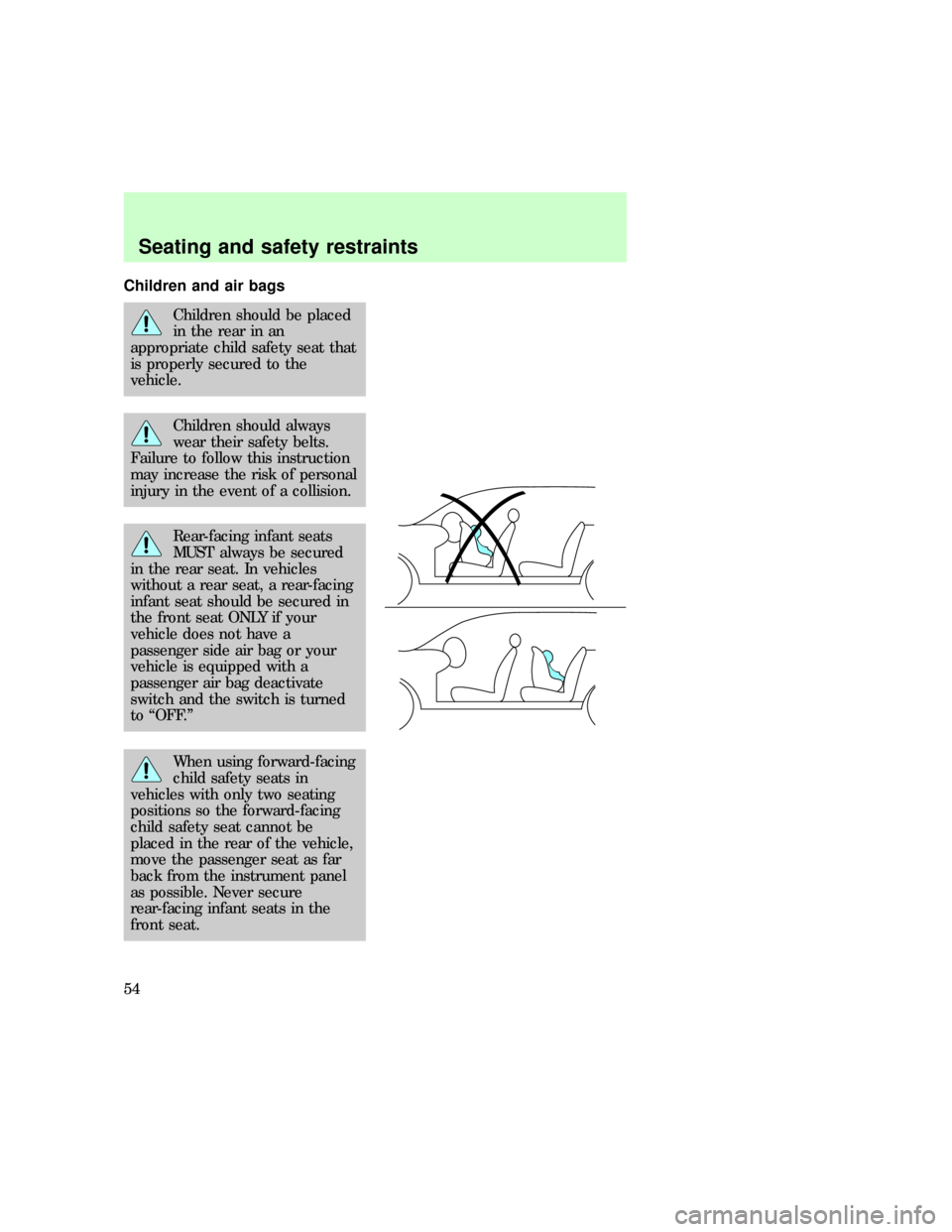
Children and air bags
Children should be placed
in the rear in an
appropriate child safety seat that
is properly secured to the
vehicle.
Children should always
wear their safety belts.
Failure to follow this instruction
may increase the risk of personal
injury in the event of a collision.
Rear-facing infant seats
MUST always be secured
in the rear seat. In vehicles
without a rear seat, a rear-facing
infant seat should be secured in
the front seat ONLY if your
vehicle does not have a
passenger side air bag or your
vehicle is equipped with a
passenger air bag deactivate
switch and the switch is turned
to ªOFF.º
When using forward-facing
child safety seats in
vehicles with only two seating
positions so the forward-facing
child safety seat cannot be
placed in the rear of the vehicle,
move the passenger seat as far
back from the instrument panel
as possible. Never secure
rear-facing infant seats in the
front seat.
Seating and safety restraints
54
Page 55 of 192
For additional important safety
information on the proper use of
seat belts, child seats and infant
seats, please read the entire
Seating and safety restraints
chapter in this owner's guide.
How does the air bag
supplemental restraint system
work?
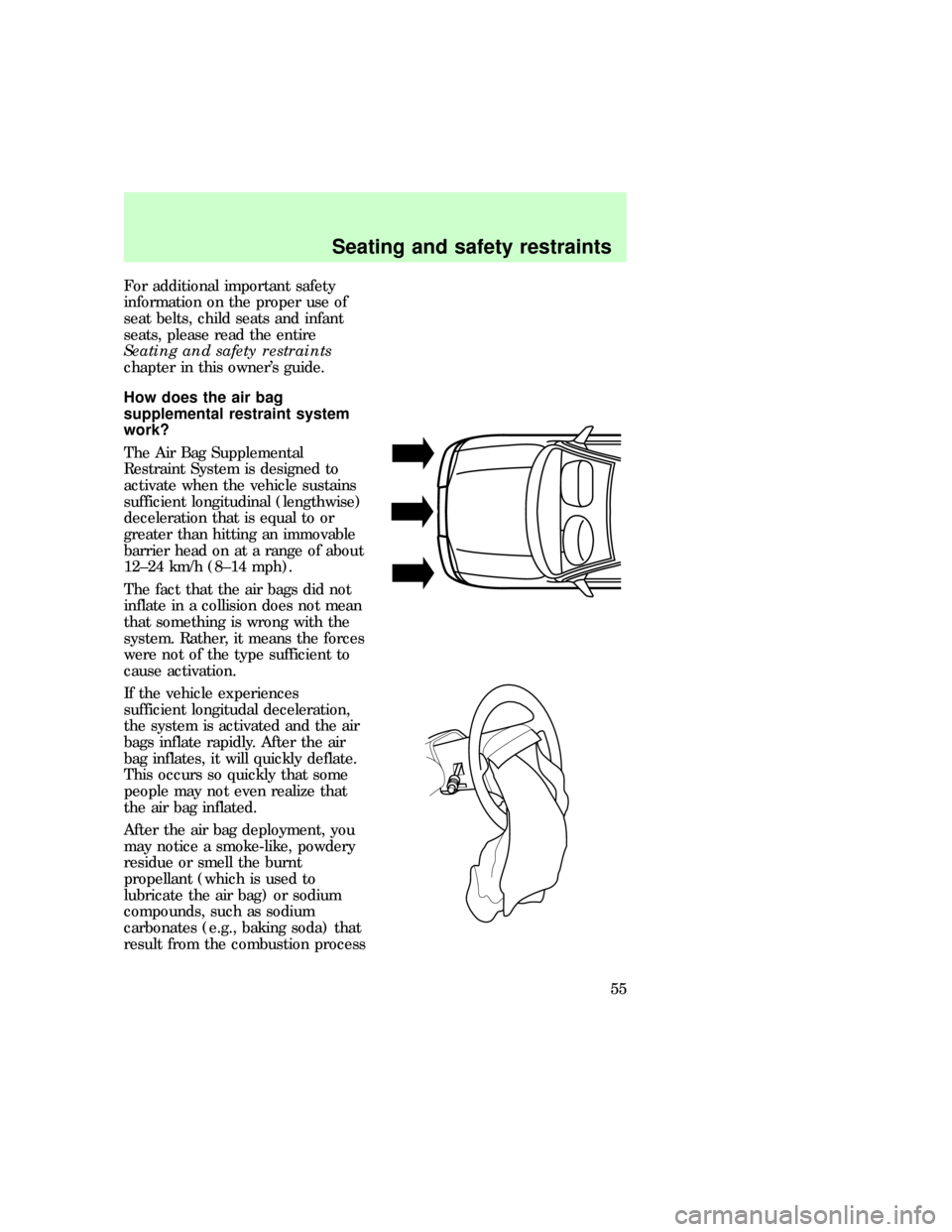
The Air Bag Supplemental
Restraint System is designed to
activate when the vehicle sustains
sufficient longitudinal (lengthwise)
deceleration that is equal to or
greater than hitting an immovable
barrier head on at a range of about
12±24 km/h (8±14 mph).
The fact that the air bags did not
inflate in a collision does not mean
that something is wrong with the
system. Rather, it means the forces
were not of the type sufficient to
cause activation.
If the vehicle experiences
sufficient longitudal deceleration,
the system is activated and the air
bags inflate rapidly. After the air
bag inflates, it will quickly deflate.
This occurs so quickly that some
people may not even realize that
the air bag inflated.
After the air bag deployment, you
may notice a smoke-like, powdery
residue or smell the burnt
propellant (which is used to
lubricate the air bag) or sodium
compounds, such as sodium
carbonates (e.g., baking soda) that
result from the combustion process
eco_how_work
Seating and safety restraints
55
Page 58 of 192
If any of these things happen, even
intermittently, have the SRS
serviced at your dealership or by a
qualified technician immediately.
Unless serviced, the system may
not function properly in the event
of a collision.
Disposal of air bags and air bag
equipped vehicles
For disposal of air bags or air bag
equipped vehicles, see your local
dealership or qualified technician.
Air bags MUST BE disposed of by
qualified personnel.
SAFETY RESTRAINTS FOR
CHILDREN
Important child restraint
precautions
You are required by law to use
safety restraints for children in the
U.S. and Canada. If small children
ride in your vehicle (generally
children who are four years old or
younger and who weigh 18 kg [40
lbs] or less), you must put them in
safety seats made especially for
children. Check your local and
state laws for specific
requirements regarding the safety
of children in your vehicle.
Never let a passenger hold
a child on his or her lap
while the vehicle is moving. The
passenger cannot protect the
child from injury in a collision.
com_disposal.01
eco_child_restraints
eco_important_precautions
Seating and safety restraints
58
Page 59 of 192
Always follow the instructions and
warnings that come with any infant
or child restraint you might use.
Children should be placed in the
rear seat of your vehicle. Accident
statistics suggest that children are
safer when properly restrained in
the rear seating positions than in
the front seating position.
Install forward-facing convertible
safety seats only in vehicle seating
positions equipped with
lap-shoulder belts. Forward facing
convertible safety seats can be
used in the center of the
three-passenger second row bench
seat only if a top tether strap is
used. Ford recommends placing
forward-facing safety seats in the
second row and using safety seats
with top tether straps for added
protection. For more information
on top tether straps seeattaching
safety seats with tether strapsin
this section.
Any booster seat that places the
vehicle's lap belt or shoulder belt
around a shield above and ahead
of the child's hips should not be
used in this vehicle.
Do notuse a
forward-facing safety seat
or an infant seat in the last row
of a 12- or 15-passenger Club
Wagon.
eco_safety_belts
Seating and safety restraints
59
Page 60 of 192
Children and safety belts
Children who are too large for
child safety seats (as specified by
your child safety seat
manufacturer) should always wear
safety belts.
Follow all the important safety
restraint and air bag precautions
that apply to adult passengers in
your vehicle.
If the shoulder belt portion of a
combination lap and shoulder belt
can be positioned so it does not
cross or rest in front of the child's
face or neck, the child should wear
the lap and shoulder belt. Moving
the child closer to the center of
the vehicle may help provide a
good shoulder belt fit.
To improve the fit of lap and
shoulder belts on children who
have outgrown child safety seats,
Ford recommends use of a
belt-positioning booster seat that is
labelled as conforming to all
Federal motor vehicle safety
standards. Belt-positioning booster
seats raise the child and provide a
shorter, firmer seating cushion that
encourages safer seating posture
and better fit of lap and shoulder
belts on the child. A
belt-positioning booster should be
used if the shoulder belt rests in
front of the child's face or neck, or
if the lap belt does not fit snugly
on both thighs, or if the thighs are
too short to let the child sit all the
way back on the seat cushion
when the lower legs hang over the
Seating and safety restraints
60
Page 61 of 192
edge of the seat cushion. You may
wish to discuss the special needs
of your child with your
pediatrician.
Child and infant or child safety
seats
Carefully follow all of the
manufacturer's instructions
included with the safety seat you
put in your vehicle. If you do not
install and use the safety seat
properly, the child may be
injured in a sudden stop or
collision.
Ford recommends the use of a
child safety seat having a top
tether strap. Install the child safety
seat in a seating position which is
capable of providing a tether
anchorage. For more information
on top tether straps seeAttaching
safety seats with tether strapsin
this chapter.
When installing a child safety seat:
²Use the correct safety belt
buckle for that seating position.
²Make sure the tongue is
securely fastened in the buckle.
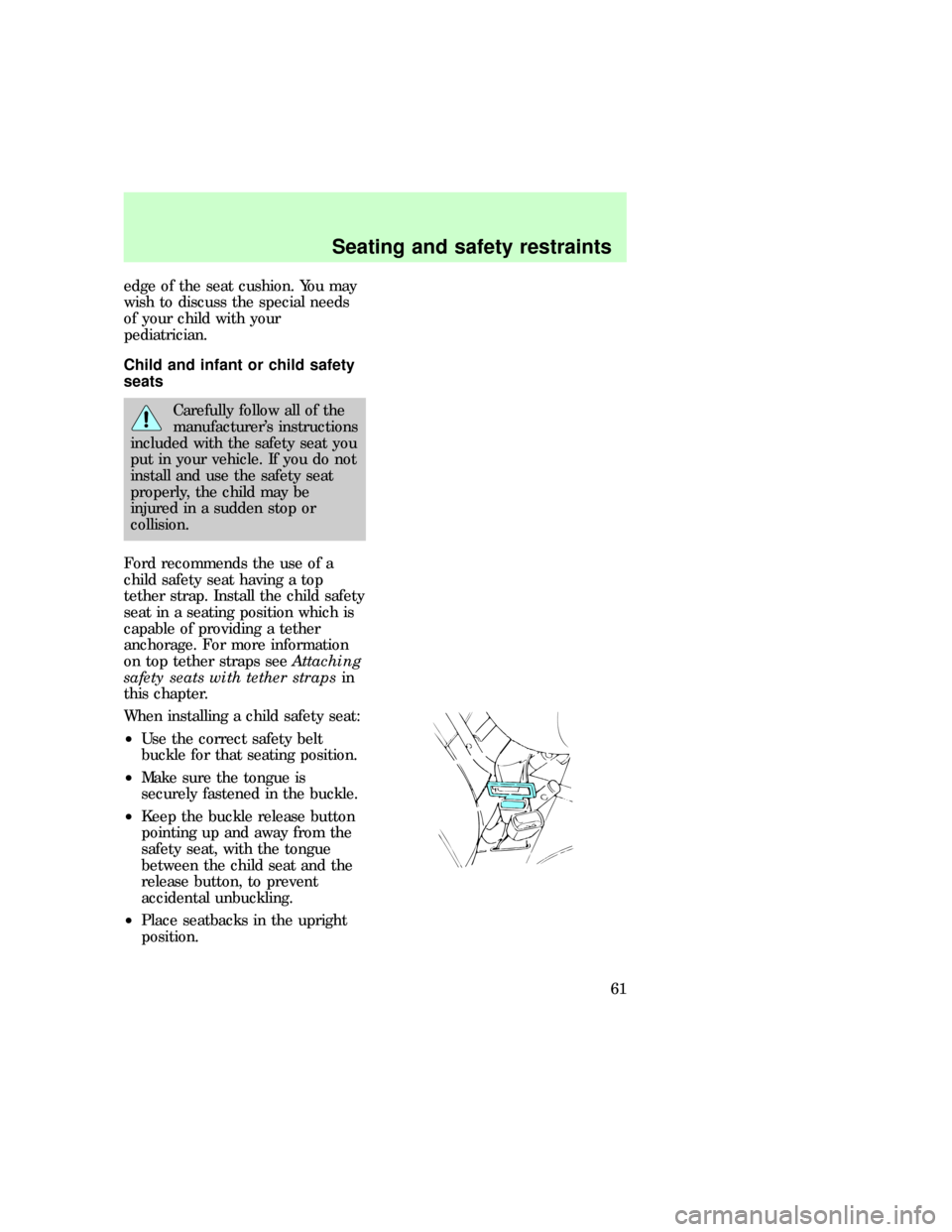
²Keep the buckle release button
pointing up and away from the
safety seat, with the tongue
between the child seat and the
release button, to prevent
accidental unbuckling.
²Place seatbacks in the upright
position.
com_safety_seats.01
Seating and safety restraints
61
Page 62 of 192
²Put the safety belt in the
automatic locking mode. Refer
toUsing the automatic locking
modein this chapter.
Installing child safety seats in
combination lap and shoulder
belt seating positions
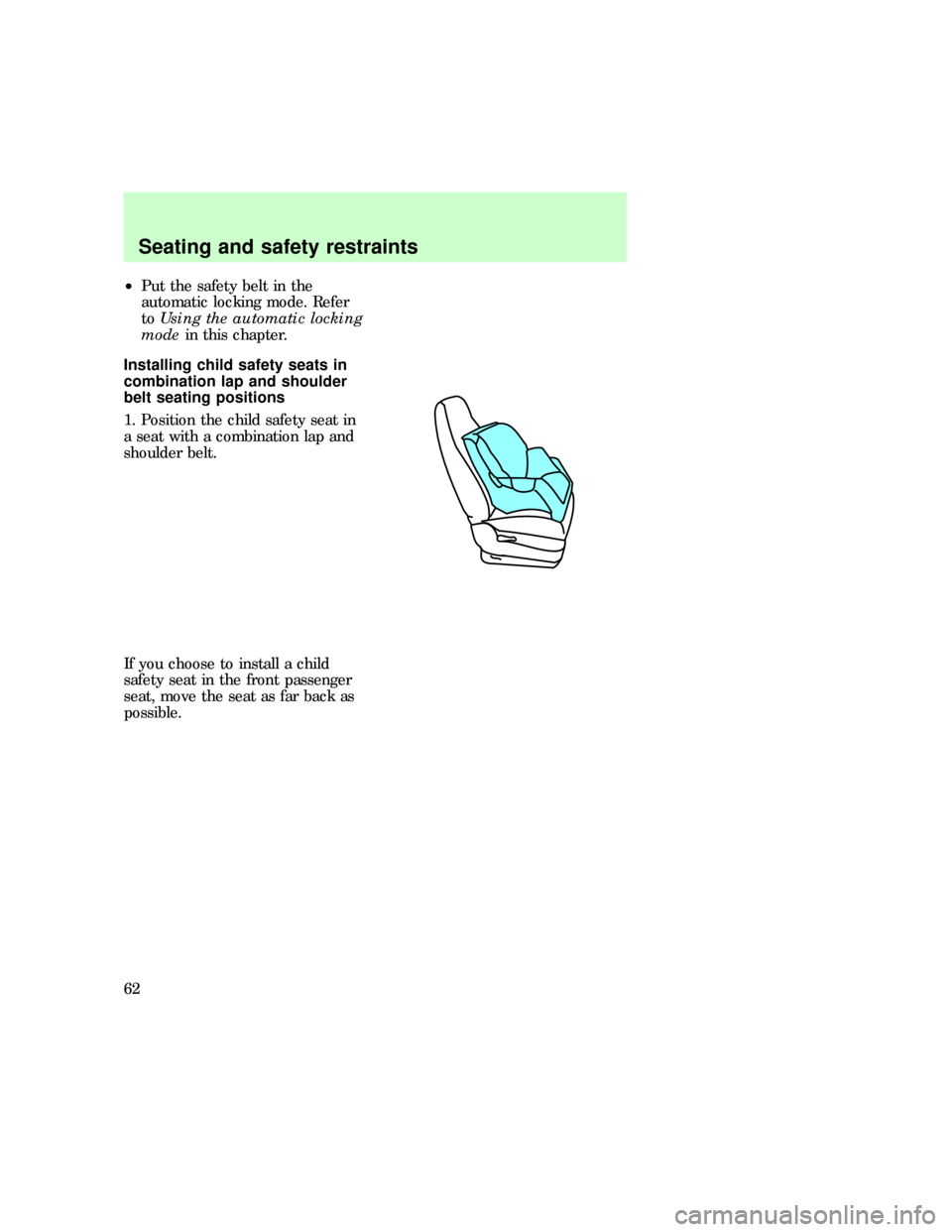
1. Position the child safety seat in
a seat with a combination lap and
shoulder belt.
If you choose to install a child
safety seat in the front passenger
seat, move the seat as far back as
possible.
com_installing_seats.01
Seating and safety restraints
62
Page 63 of 192
Rear-facing child seats or
infant carriers should
never be placed in the front
seats.
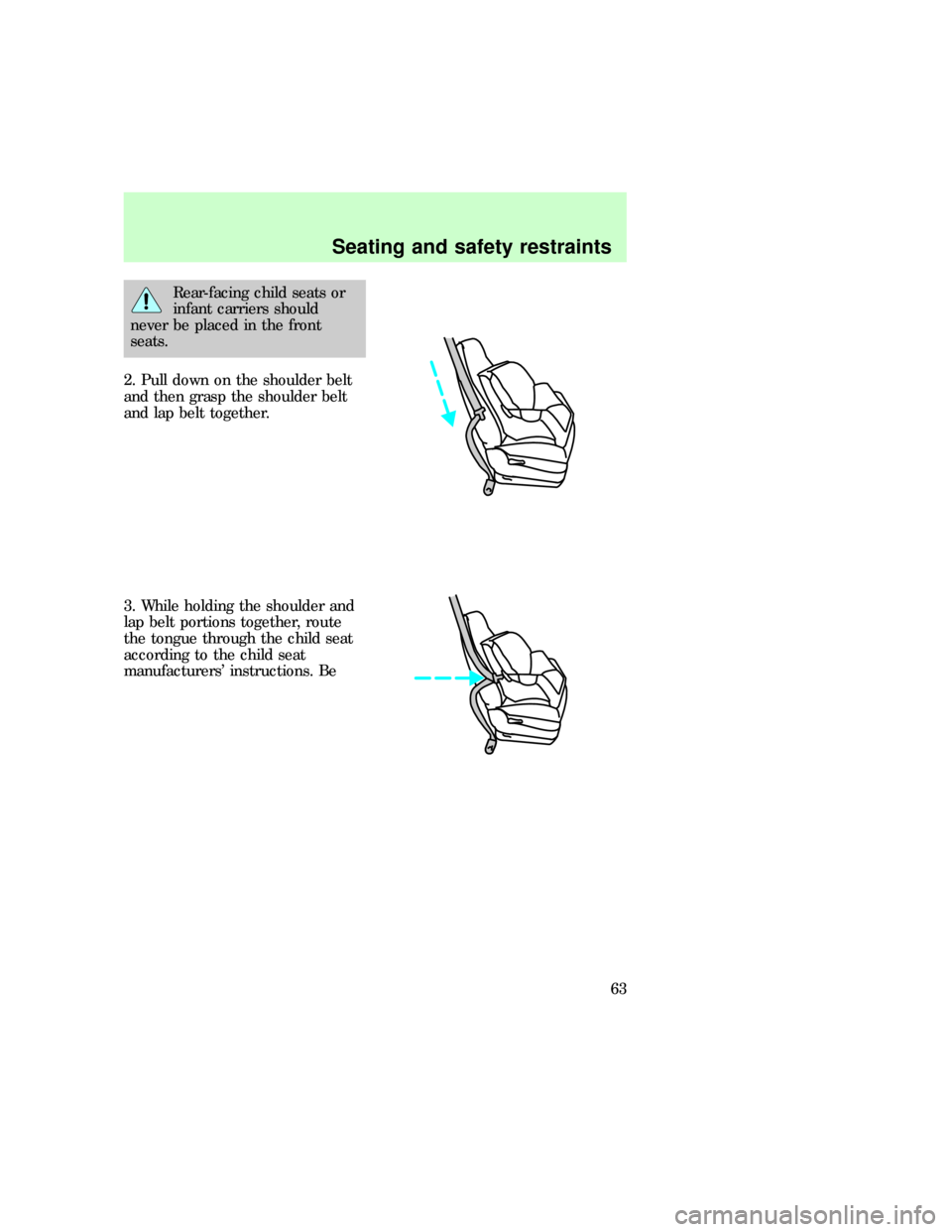
2. Pull down on the shoulder belt
and then grasp the shoulder belt
and lap belt together.
3. While holding the shoulder and
lap belt portions together, route
the tongue through the child seat
according to the child seat
manufacturers' instructions. Be
Seating and safety restraints
63
Page 67 of 192
repeat steps 5 and 6, or properly
install the child seat in a different
seating position.
Attaching safety seats with
tether straps
Some manufacturers make safety
seats that include a tether strap
that goes over the back of the
vehicle seat and attaches to an
anchoring point. Other
manufacturers offer the tether
strap as an accessory. Contact the
manufacturer of your child safety
seat for information about ordering
a tether strap.
Tether anchorage
Children should be placed
in the rear in an
appropriate child safety seat that
is properly secured to the
vehicle.
Rear-facing infant seats
must always be secured in
the rear seat. In vehicles without
a rear seat, a rear-facing infant
seat should be secured in the
front seat only if your vehicle
does not have a passenger side
air bag or your vehicle is
equipped with a passenger air
bag deactivate switch and the
switch is turned to ªOFF.º
eco_tether-straps
eco_tether_anchorage
Seating and safety restraints
67
Page 68 of 192
When using forward-facing
child safety seats in
vehicles with only two seating
positions so the forward-facing
child safety seat cannot be
placed in the rear of the vehicle,
move the passenger seat as far
back from the instrument panel
as possible.
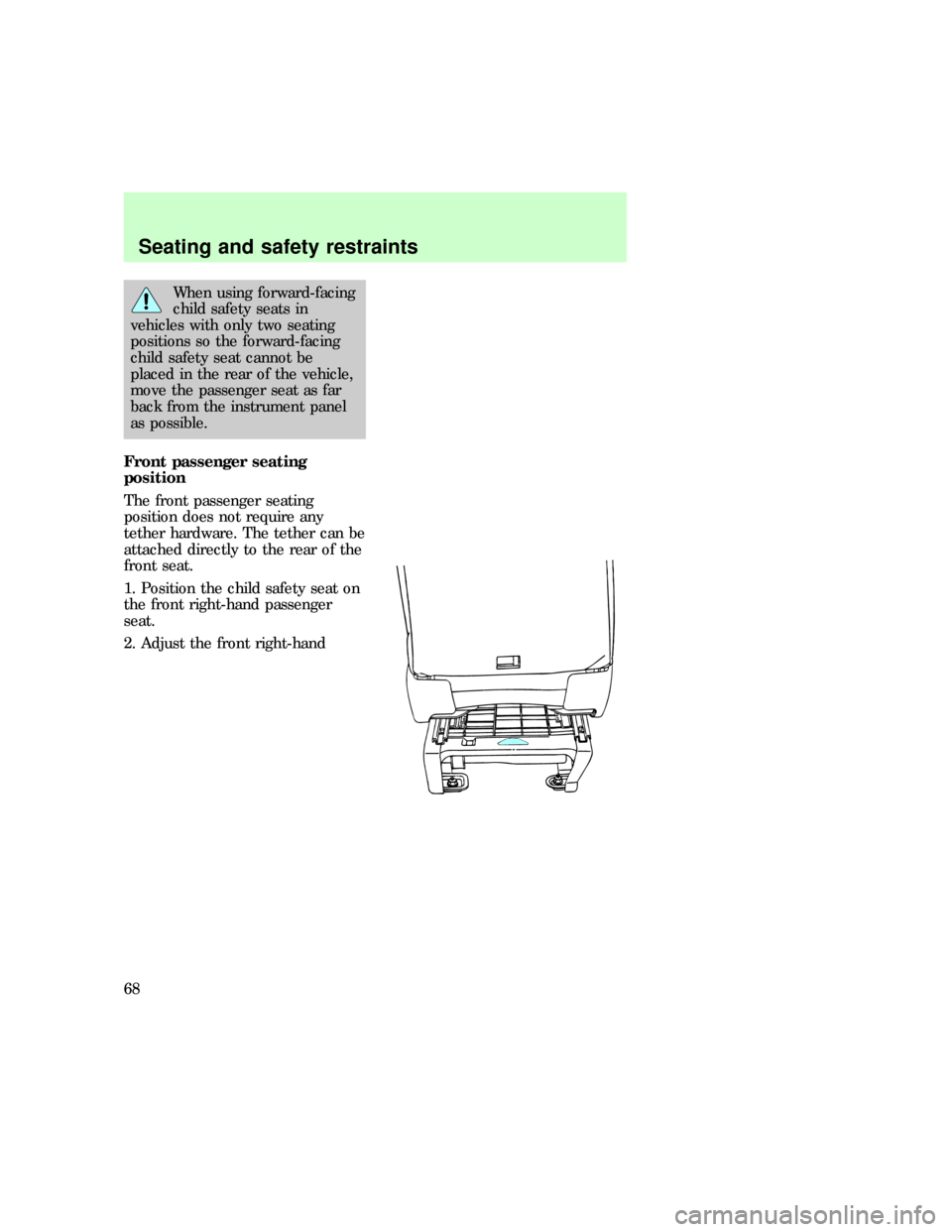
Front passenger seating
position
The front passenger seating
position does not require any
tether hardware. The tether can be
attached directly to the rear of the
front seat.
1. Position the child safety seat on
the front right-hand passenger
seat.
2. Adjust the front right-hand
Seating and safety restraints
68