service FORD E SERIES 1997 4.G User Guide
[x] Cancel search | Manufacturer: FORD, Model Year: 1997, Model line: E SERIES, Model: FORD E SERIES 1997 4.GPages: 192, PDF Size: 3.44 MB
Page 98 of 192

must park on a grade, place
wheel chocks under the trailer's
wheels.
²After you have travelled about
80 km (50 miles), thoroughly
check your hitch, electrical
connections and trailer wheel
lug nuts.
Launching or retrieving a boat
When backing down a ramp during
boat launching or retrieval,
²Do not allow the static water
level to rise above the bottom
edge of the rear bumper and
²Do not allow waves to break
higher than 15 cm (six inches)
above the bottom edge of the
rear bumper.
Exceeding these limits may allow
water to enter critical vehicle
components, adversely affecting
driveability, emissions and
reliability.
Servicing when towing
If you tow a trailer for long
distances, your vehicle will require
more frequent service intervals.
Follow the severe duty
maintenance schedule outlined in
the ªService Guide.º
com_launch-retrieving_boat.01
eco_service_when_towing
com_fuel_consumption.01
Driving
98
Page 120 of 192
On vehicles equipped with dual
rear wheels retighten the wheel
lug nuts to the specified torque at
160 km (100 miles), and again at
800 km (500 miles) of new vehicle
operation and at intervals specified
in the ªService Guide.º
On vehicles equipped with single
rear wheels retighten the lug nuts
to the specified torque at 800 km
(500 miles) of operation after any
wheel change or any time the lug
nuts are loosened.
Model Bolt Size Wheel Lug nut Torque*
N²M Ft-Lb
E-150 1/2-20 135 100
E-250, E-350
and E-Super
Duty9/16-18 190 140
* Torque specifications are for nut and bolt threads free of dirt and
rust. Do not use oil or grease on threads. Use only Ford recommened
replacement fasteners.
JUMP STARTING YOUR
VEHICLE
The gases around the
battery can explode if
exposed to flames, sparks, or lit
cigarettes. An explosion could
result in injury or vehicle
damage.
com_jump-starting.01
Roadside emergencies
120
Page 124 of 192

SERVICE RECOMMENDATIONS
To help you service your vehicle:
²We highlight do-it-yourself items
in the engine compartment for
easy location.
²As possible, we design parts that
can be replaced without tools.
²We provide you with a ªService
Guideº which makes tracking
routine service for your vehicle
easy.
If your vehicle requires
professional service, your
dealership can provide necessary
parts and service. Check your
ªWarranty Information Bookletº to
find out which parts and services
are covered.
Use only recommended fuels,
lubricants, fluids and service parts
conforming to specifications.
Motorcraft parts are designed and
built to provide the best
performance in your vehicle.
Precautions when servicing
your vehicle
Be especially careful when
inspecting or servicing your
vehicle. Here are some general
precautions for your safety:
²Do not work on a hot engine.
com_precautions_servicing.01
Maintenance and care
124
Page 130 of 192
CHECKING AND ADDING
ENGINE OIL
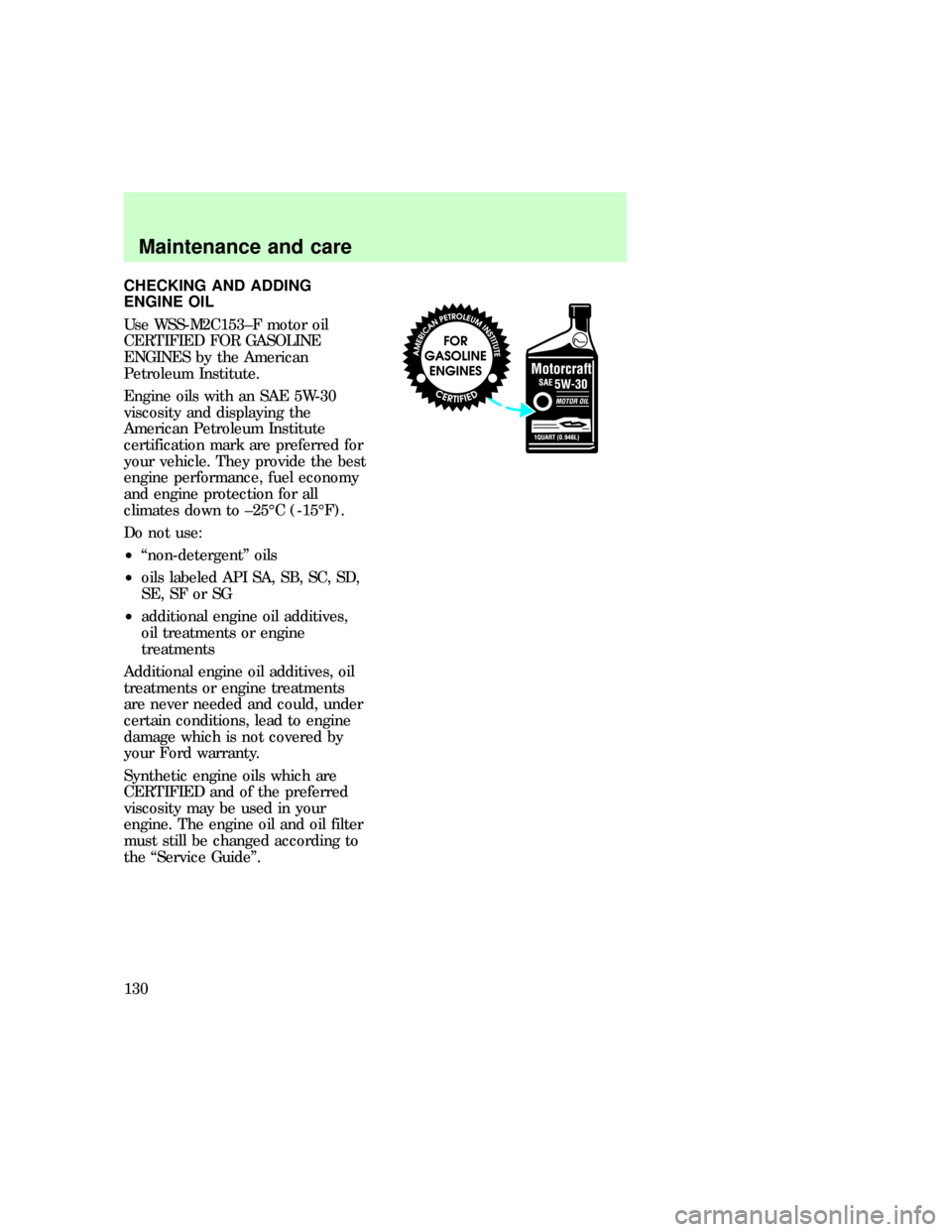
Use WSS-M2C153±F motor oil
CERTIFIED FOR GASOLINE
ENGINES by the American
Petroleum Institute.
Engine oils with an SAE 5W-30
viscosity and displaying the
American Petroleum Institute
certification mark are preferred for
your vehicle. They provide the best
engine performance, fuel economy
and engine protection for all
climates down to ±25ÉC (-15ÉF).
Do not use:
²ªnon-detergentº oils
²oils labeled API SA, SB, SC, SD,
SE, SF or SG
²additional engine oil additives,
oil treatments or engine
treatments
Additional engine oil additives, oil
treatments or engine treatments
are never needed and could, under
certain conditions, lead to engine
damage which is not covered by
your Ford warranty.
Synthetic engine oils which are
CERTIFIED and of the preferred
viscosity may be used in your
engine. The engine oil and oil filter
must still be changed according to
the ªService Guideº.
eco_checking_engine_oil
Maintenance and care
130
Page 132 of 192
5.4L/6.8L engines
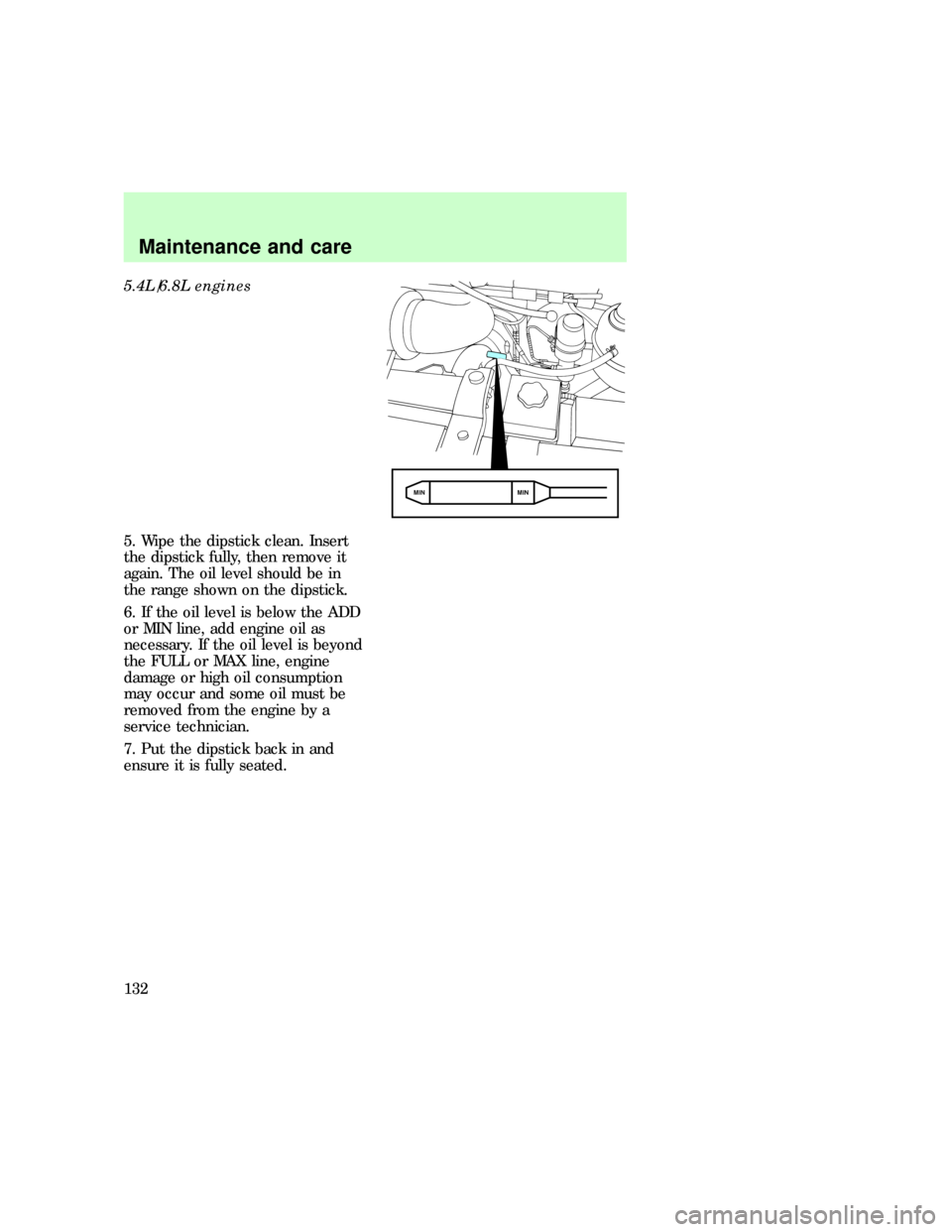
5. Wipe the dipstick clean. Insert
the dipstick fully, then remove it
again. The oil level should be in
the range shown on the dipstick.
6. If the oil level is below the ADD
or MIN line, add engine oil as
necessary. If the oil level is beyond
the FULL or MAX line, engine
damage or high oil consumption
may occur and some oil must be
removed from the engine by a
service technician.
7. Put the dipstick back in and
ensure it is fully seated.
MIN MIN
com_adding_engine_oil.01
Maintenance and care
132
Page 133 of 192
Adding engine oil
1. Check the engine oil. For
instructions, refer toChecking the
engine oilin this chapter.
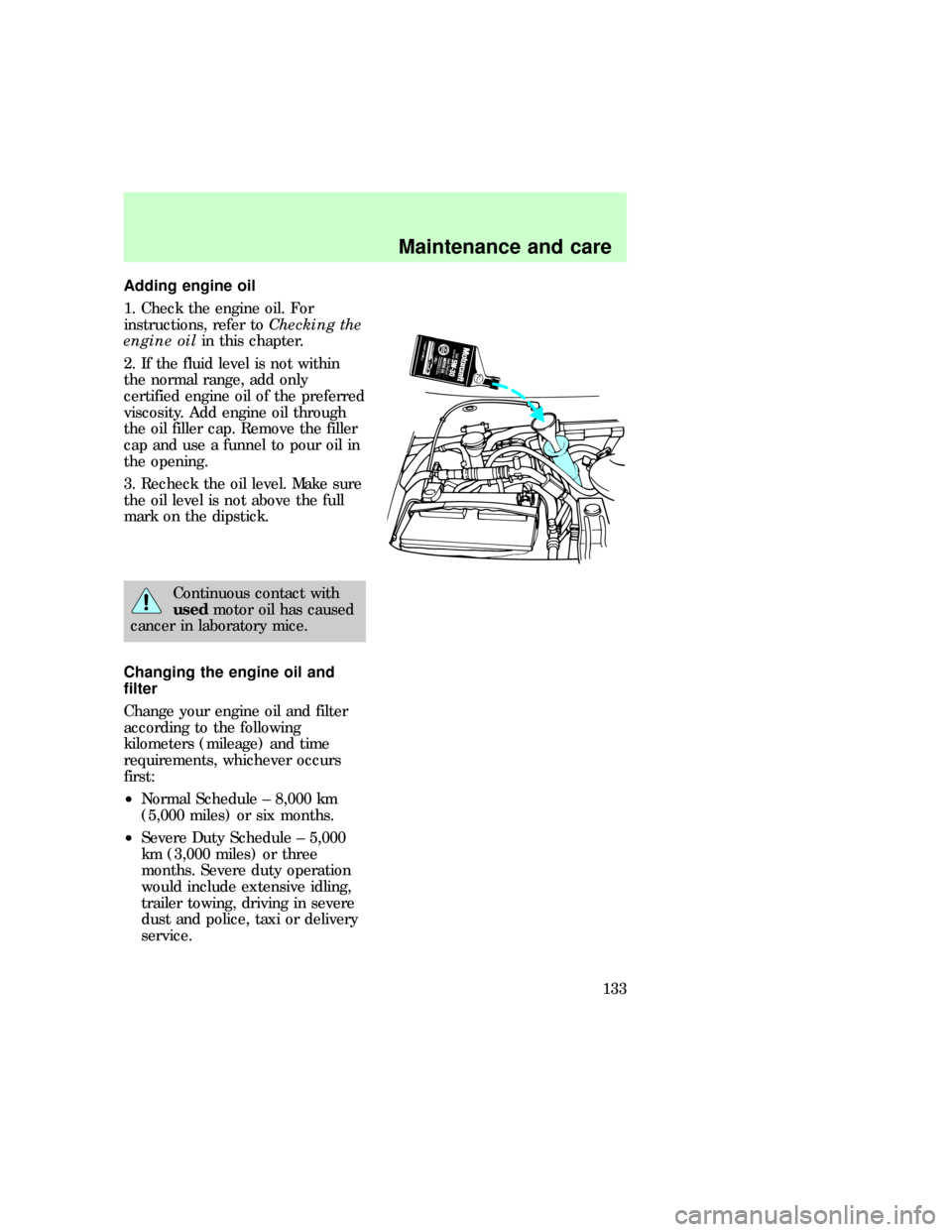
2. If the fluid level is not within
the normal range, add only
certified engine oil of the preferred
viscosity. Add engine oil through
the oil filler cap. Remove the filler
cap and use a funnel to pour oil in
the opening.
3. Recheck the oil level. Make sure
the oil level is not above the full
mark on the dipstick.
Continuous contact with
usedmotor oil has caused
cancer in laboratory mice.
Changing the engine oil and
filter
Change your engine oil and filter
according to the following
kilometers (mileage) and time
requirements, whichever occurs
first:
²Normal Schedule ± 8,000 km
(5,000 miles) or six months.
²Severe Duty Schedule ± 5,000
km (3,000 miles) or three
months. Severe duty operation
would include extensive idling,
trailer towing, driving in severe
dust and police, taxi or delivery
service.
com_oil_and_filter_change.01
Maintenance and care
133
Page 138 of 192
standards for disposing of these
types of fluids. Call your local
recycling center to find out more
about recycling automotive fluids.
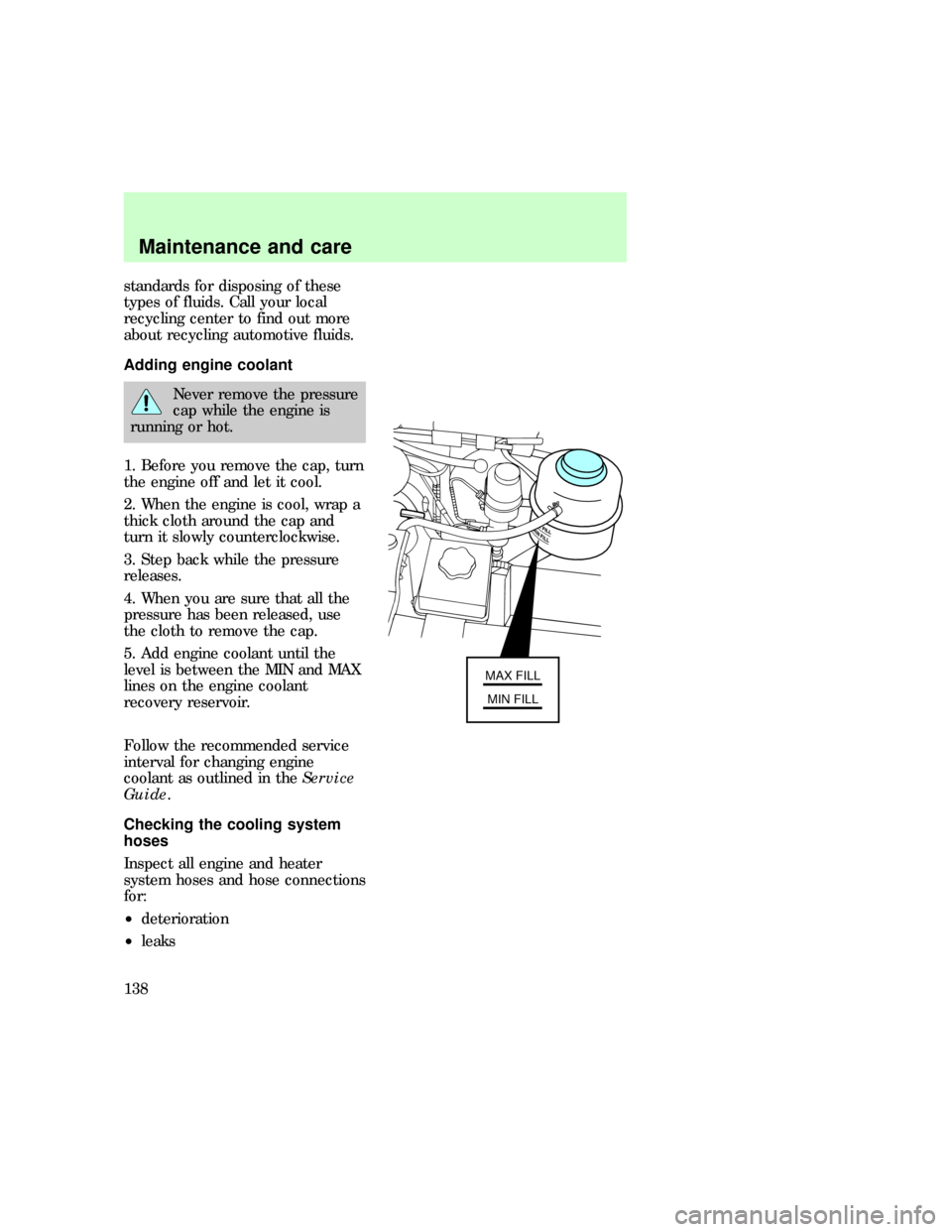
Adding engine coolant
Never remove the pressure
cap while the engine is
running or hot.
1. Before you remove the cap, turn
the engine off and let it cool.
2. When the engine is cool, wrap a
thick cloth around the cap and
turn it slowly counterclockwise.
3. Step back while the pressure
releases.
4. When you are sure that all the
pressure has been released, use
the cloth to remove the cap.
5. Add engine coolant until the
level is between the MIN and MAX
lines on the engine coolant
recovery reservoir.
Follow the recommended service
interval for changing engine
coolant as outlined in theService
Guide.
Checking the cooling system
hoses
Inspect all engine and heater
system hoses and hose connections
for:
²deterioration
²leaks
MAX FILL
MIN FILL
eco_adding_coolant
eco_checking_hoses
Maintenance and care
138
Page 139 of 192
²loose hose clamps
What you should know about
fail-safe cooling (if equipped)
If the engine coolant supply is
depleted, this feature allows the
vehicle to be driven temporarily
before incremental component
damage is incurred. The ªfail safeº
distance depends on ambient
temperatures, vehicle load and
terrain.
How fail-safe cooling works
If the engine overheats, the engine
will automatically switch from
eight to alternating four cylinder
operation. Each disabled cylinder
acts as an air pump and cools the
engine.
When this occurs, the engine
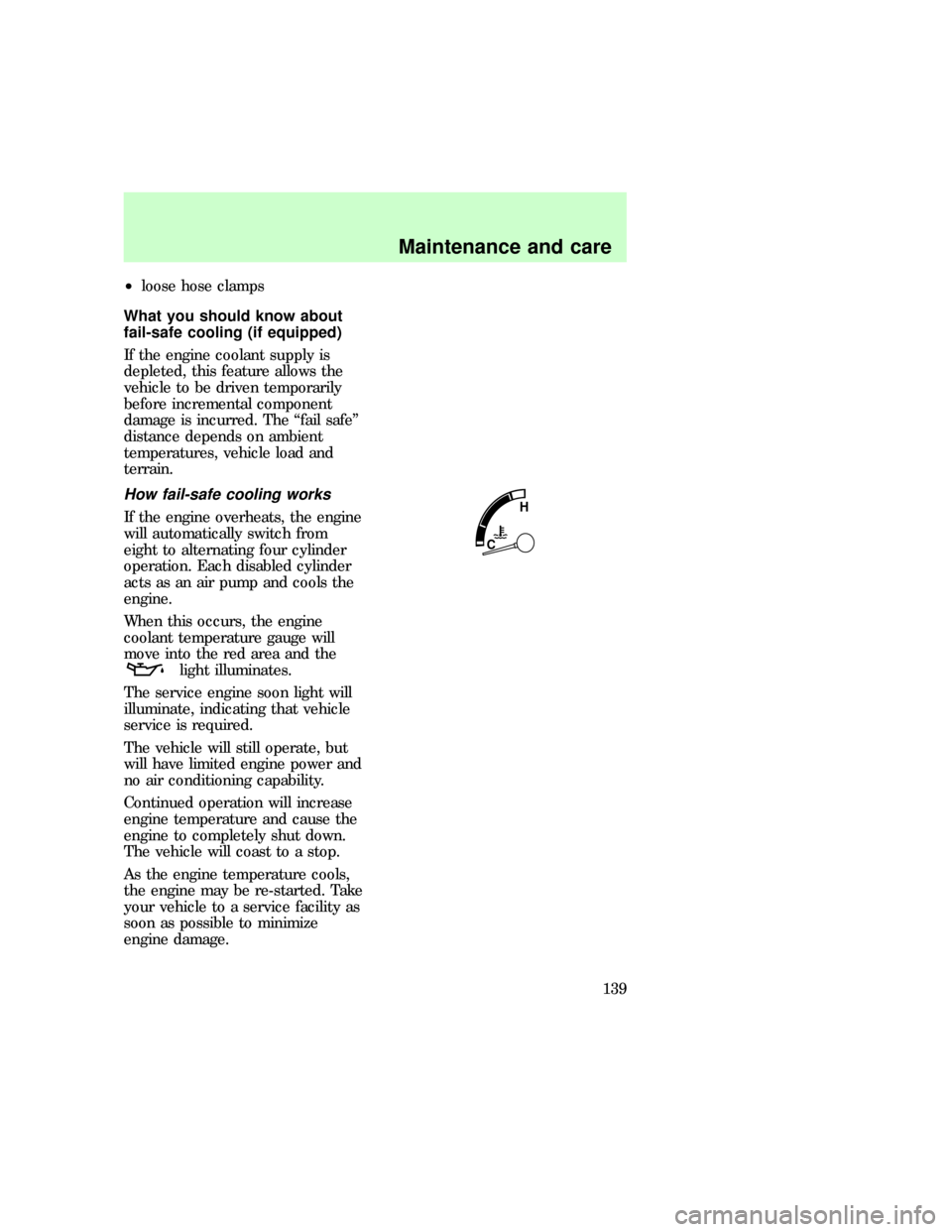
coolant temperature gauge will
move into the red area and the
light illuminates.
The service engine soon light will
illuminate, indicating that vehicle
service is required.
The vehicle will still operate, but
will have limited engine power and
no air conditioning capability.
Continued operation will increase
engine temperature and cause the
engine to completely shut down.
The vehicle will coast to a stop.
As the engine temperature cools,
the engine may be re-started. Take
your vehicle to a service facility as
soon as possible to minimize
engine damage.
H
C
eco_failsafe_cooling
eco_failsafe_works
eco_failsafe_activated
Maintenance and care
139
Page 141 of 192
CHECKING AND ADDING
AUTOMATIC TRANSMISSION
FLUID
Service the automatic transmission
according to the scheduled
intervals in the9Service Guide.9
Before adding any fluid, make sure
the correct type will be used. This
information is indicated on the
dipstick.
Do not drive the vehicle if the fluid
level is below the bottom hole on
the blade type dipstick (4R70W
transmission) or below the COLD
area on the bullet type dipstick
(E4OD transmission) and outside
temperatures are above 10ÉC
(50ÉF).
Your vehicle does not use up
transmission fluid. However, it is
recommended that you check the
transmission fluid at least twice a
year. The fluid level should be
checked if the transmission is not
working properly, i.e., if the
transmission slips or shifts slowly
or if you notice some sign of fluid
leakage.
It is preferable to check the
transmission fluid level at normal
operating temperature, after
approximately 32 km (20 miles) of
driving. However, you can check
the fluid level without driving to
obtain a normal operating
temperature if the outside
temperature is above 10ÉC (50ÉF).
If your vehicle has been operated
for an extended period at high
Maintenance and care
141
Page 144 of 192
DRIVELINE UNIVERSAL JOINT
AND SLIP YOKE
The universal joints standard with
your vehicle do not require
lubrication. If the original
equipment universal joints are
replaced with universal joints
equipped with grease fittings,
lubrication will be necessary at the
intervals shown in the ªService
Guideº supplement.
BATTERY
If the original equipment
maintenance-free battery needs
replacing, it may be replaced with
a low-maintenance battery. For
information on replacement
batteries, refer toMotorcraft part
numbersin theCapacities and
specificationschapter.
The gases around the
battery can explode if
exposed to flames, sparks, or lit
cigarettes. An explosion could
result in injury or vehicle
damage.
Batteries contain sulfuric
acid which burns skin,
eyes, and clothing.
eco_battery1
eco_servicing_battery1
Maintenance and care
144