trailer FORD E SERIES 1997 4.G User Guide
[x] Cancel search | Manufacturer: FORD, Model Year: 1997, Model line: E SERIES, Model: FORD E SERIES 1997 4.GPages: 192, PDF Size: 3.44 MB
Page 96 of 192
![FORD E SERIES 1997 4.G User Guide bumpers have a Class III capability
(2,270 kg [5,000 lb] trailer weight
and 227 kg [500 lb] tongue weight.
Safety chains
Always use safety chains between
your vehicle and trailer. Cross
chains under t](/img/11/4790/w960_4790-95.png "FORD E SERIES 1997 4.G User Guide bumpers have a Class III capability
(2,270 kg [5,000 lb] trailer weight
and 227 kg [500 lb] tongue weight.
Safety chains
Always use safety chains between
your vehicle and trailer. Cross
chains under t")
bumpers have a Class III capability
(2,270 kg [5,000 lb] trailer weight
and 227 kg [500 lb] tongue weight.
Safety chains
Always use safety chains between
your vehicle and trailer. Cross
chains under the trailer tongue and
allow slack for turning corners.
Connect safety chains to the
vehicle frame or hook retainers.
Never attach chains to the bumper.
Trailer brakes
Trailer brakes are required on
most towed vehicles weighing over
680 kg (1,500 lbs)
Do not connect a trailer's
hydraulic brake system
directly to your vehicle's brake
system. Your vehicle may not
have enough braking power and
your chances of having a
collision greatly increase.
Trailer lamps
Trailer lamps are required on most
towed vehicles. Make sure your
trailer lamps conform to Federal
and local regulations. See your
dealer or trailer rental agency for
the proper instructions and
equipment for hooking up trailer
lamps.
Driving while you tow
Do not drive faster than 88 km/h
(55 mph) while towing a trailer. Do
not drive faster than 72 km/h (45
mph) with a trailer while towing in
eco_safety_chains
eco_trailer_brakes
eco_trailer_lamps
eco_driving_towing
Driving
96
Page 97 of 192

hilly country or on hot days.
Speed control may shut off if you
are towing on very long, steep
grades.
When towing a trailer
If towing a trailer and your vehicle
is not equipped with the Ford
trailer tow package, an auxiliary
transmission fluid cooler is
recommended.
²Use D (Drive) rather than
D(Overdrive) while towing up
or down steep hills. This will
eliminate excessive downshifting
and upshifting for optimum fuel
economy and transmission
cooling.
²Anticipate stops and brake
gradually.
²Allow more room for stopping
with a trailer attached.
²Practice turning, stopping and
backing in an area before
starting on a trip to get the feel
of the vehicle/trailer
combination.
²When turning, drive slightly
beyond the normal turning point
so the trailer wheels will clear
curbs and other obstacles.
²When stopped in traffic for long
periods of time in hot weather,
place the gearshift in P (Park)
to increase idle speed. This aids
engine cooling and air
conditioner efficiency.
²Vehicles with trailers should not
be parked on a grade. If you
eco_when_towing
Driving
97
Page 98 of 192

must park on a grade, place
wheel chocks under the trailer's
wheels.
²After you have travelled about
80 km (50 miles), thoroughly
check your hitch, electrical
connections and trailer wheel
lug nuts.
Launching or retrieving a boat
When backing down a ramp during
boat launching or retrieval,
²Do not allow the static water
level to rise above the bottom
edge of the rear bumper and
²Do not allow waves to break
higher than 15 cm (six inches)
above the bottom edge of the
rear bumper.
Exceeding these limits may allow
water to enter critical vehicle
components, adversely affecting
driveability, emissions and
reliability.
Servicing when towing
If you tow a trailer for long
distances, your vehicle will require
more frequent service intervals.
Follow the severe duty
maintenance schedule outlined in
the ªService Guide.º
com_launch-retrieving_boat.01
eco_service_when_towing
com_fuel_consumption.01
Driving
98
Page 106 of 192

Number Fuse amperage
ratingCircuits protected
8 30 amp Noise supression
capacitor, ignition coil
positive feed, PCM
relay diode/PCM
power relay, fuel
heater (diesel), glow
plug relay (diesel)
9 30 amp Wiper control module,
wiper motor
10 20 amp Headlamp switch
(exterior lamps),
Multi-function switch
(flash-to-pass)
11 15 amp Stoplight switch, brake
pressure switch,
multi-function switch
12 15 amp Digital transmission
range sensor (backup
lamps), auxiliary
battery relay
13 15 amp A/C mode switch,
blend door actuator
14 5 amp Instrument cluster (air
bag and charge
indicator lamps)
15 5 amp Trailer tow battery
charge relay (coil)
16 30 amp Power seats
17 - Not used
18 - Not used
19 10 amp Air bag module
20 5 amp Overdrive cancel
switch
Roadside emergencies
106
Page 109 of 192

Number Fuse amperage
ratingCircuits protected
4 5 amp PCM keep alive
memory
5 10 amp Right trailer turn
signal
6 10 amp Left trailer turn signal
7 - Not used
8 60 amp Instrument panel
fuses
9 30 amp PCM power relay
10 60 amp Auxiliary battery
11 - Not used
12 60 amp Misc.
13 50 amp Blower motor relay
14 30 amp Trailer running lamps,
trailer backup lamps
15 40 amp Headlamp switch
16 50 amp Auxiliary A/C, remote
keyless entry module
17 30 amp Fuel pump relay
(gasoline), injector
driver module relay
(diesel)
18 60 amp Modified vehicle
power
19 60 amp Anti-lock brake
system (4WABS)
20 20 amp Electric brake
controller (trailer tow)
21 50 amp Modified vehicle
power
22 40 amp Trailer battery charge
(relay)
Roadside emergencies
109
Page 111 of 192
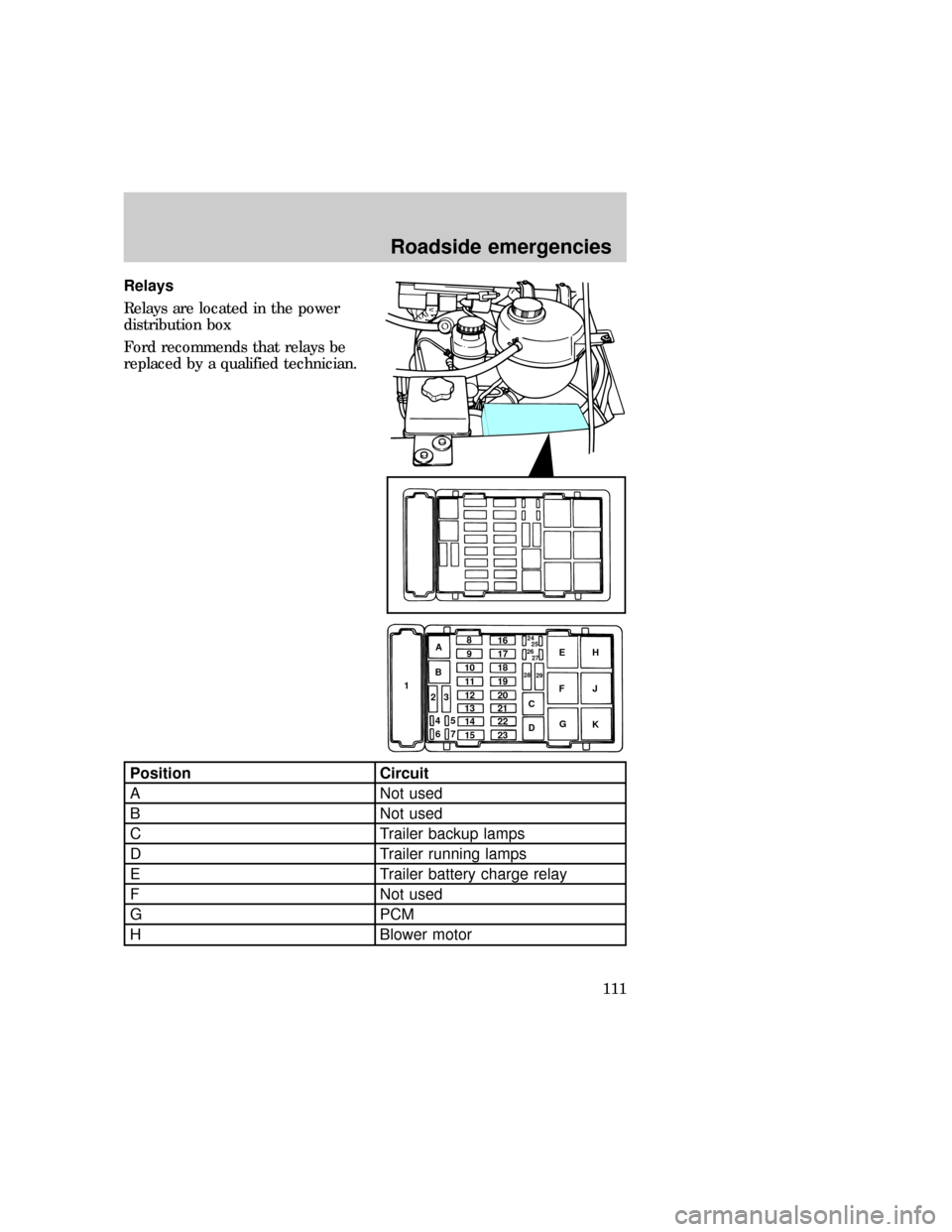
Relays
Relays are located in the power
distribution box
Ford recommends that relays be
replaced by a qualified technician.
Position Circuit
A Not used
B Not used
C Trailer backup lamps
D Trailer running lamps
E Trailer battery charge relay
F Not used
G PCM
H Blower motor
1A
B
23
4
65
78
9
10
11
12
13
14
1516
17
18
19
20
21
22
23
E
H
J F
G
K24
25
26
27
28
29
C
D
eco_relays
Roadside emergencies
111
Page 133 of 192
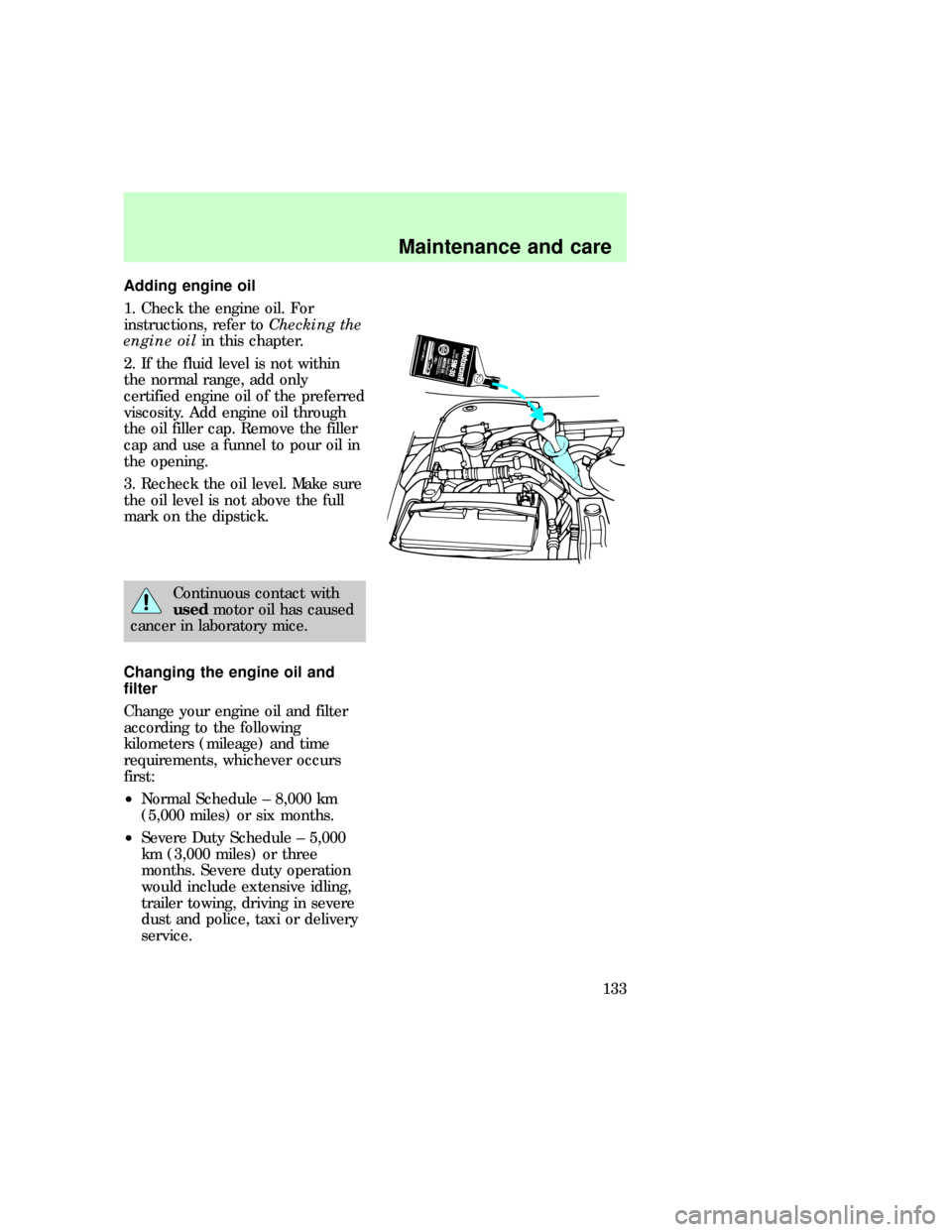
Adding engine oil
1. Check the engine oil. For
instructions, refer toChecking the
engine oilin this chapter.
2. If the fluid level is not within
the normal range, add only
certified engine oil of the preferred
viscosity. Add engine oil through
the oil filler cap. Remove the filler
cap and use a funnel to pour oil in
the opening.
3. Recheck the oil level. Make sure
the oil level is not above the full
mark on the dipstick.
Continuous contact with
usedmotor oil has caused
cancer in laboratory mice.
Changing the engine oil and
filter
Change your engine oil and filter
according to the following
kilometers (mileage) and time
requirements, whichever occurs
first:
²Normal Schedule ± 8,000 km
(5,000 miles) or six months.
²Severe Duty Schedule ± 5,000
km (3,000 miles) or three
months. Severe duty operation
would include extensive idling,
trailer towing, driving in severe
dust and police, taxi or delivery
service.
com_oil_and_filter_change.01
Maintenance and care
133
Page 142 of 192
speeds, in city traffic during hot
weather or pulling a trailer, the
vehicle should be turned off for
about 30 minutes to allow the fluid
to cool before checking.
1. Park the vehicle on a level
surface.
2. Start the engine and move the
gearshift lever through all of the
gear ranges. Allow sufficient time
for each gear to engage.
3. Latch the gearshift lever in P
(Park), set the parking brake and
leave the engine running.
4. Remove the dipstick, wiping it
clean with a clean, dry rag.
5. Install the dipstick.
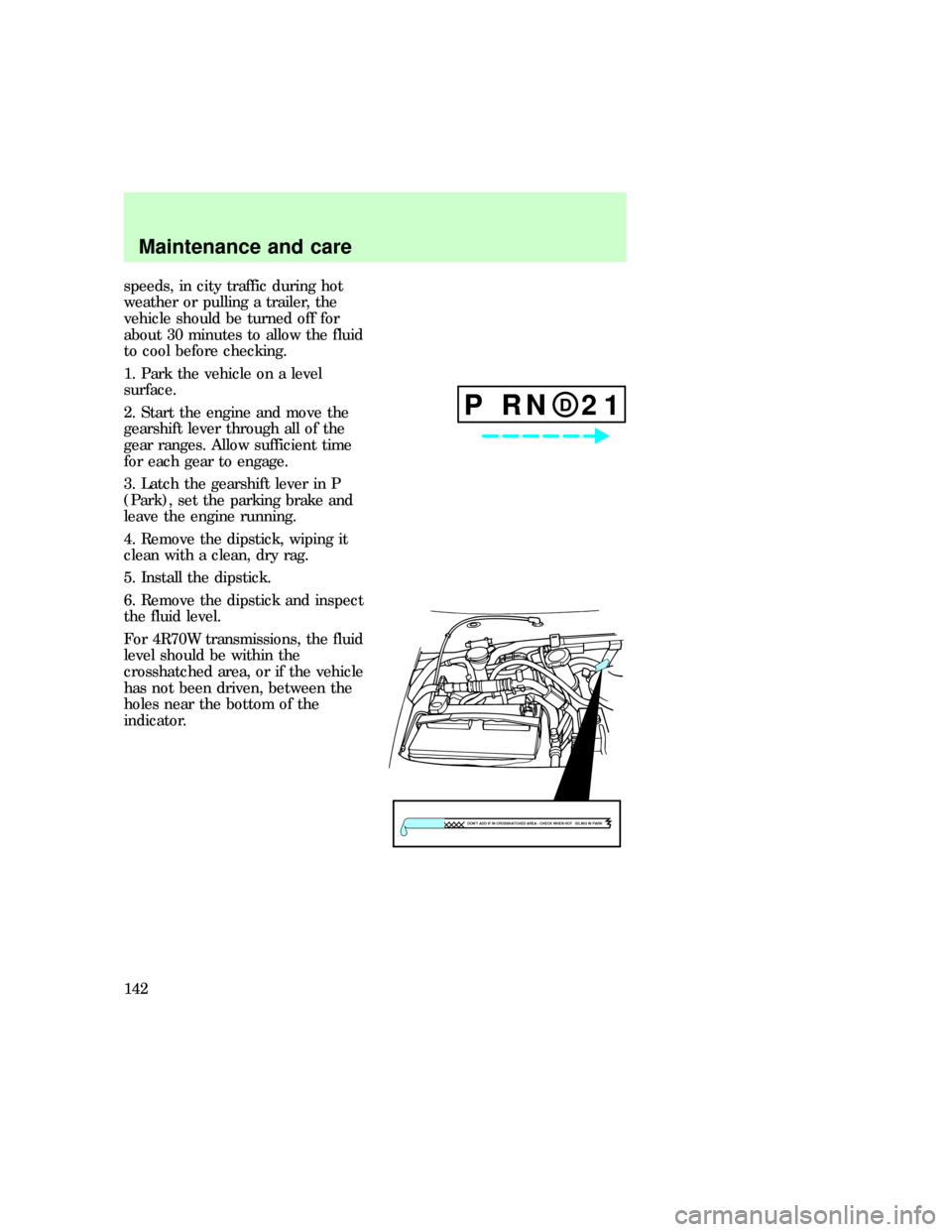
6. Remove the dipstick and inspect
the fluid level.
For 4R70W transmissions, the fluid
level should be within the
crosshatched area, or if the vehicle
has not been driven, between the
holes near the bottom of the
indicator.
P RN 21D
DON'T ADD IF IN CROSSHATCHED AREA - CHECK WHEN HOT IDLING IN PARK
Maintenance and care
142
Page 184 of 192

Idle
relearning ................................145
Ignition .........................................23
Inspection
maintenance testing ...............164
Jump-starting your vehicle 120,122
attaching cables ......................121
disconnecting cables ..............122
Lamps
cargo lamps ...............................30
courtesy lamps ..........................31
Lights, warning and indicator
air bag ..........................................9
anti-lock brakes (ABS) ..............8
brake ............................................8
charging system ..........................9
check engine ...............................8
door ajar ....................................10
engine oil pressure ...................10
high beam .................................10
safety belt ...................................9
Load limits
trailer towing ............................89
Lubricant specifications ...........175
Odometer .....................................13
Overdrive .....................................24
Parking brake
operation ..............................81,82
Parts (see Motorcraft parts) ....174
Power features
door locks ..................................32
mirrors .......................................31
Power point electrical outlet .....17
Power steering
fluid, checking and adding ....140
Refill capacities for fluids ........174
Relays .................................102,111
Remote entry system .................34
locking/unlocking doors ...........34
panic alarm ...............................35
replacement/additional
transmitters ...............................36replacing the batteries .............35
Reporting safety defects ..........183
Safety restraints
adjusting the safety belts .........49
automatic locking mode
(retractor) .................................47
extension assembly ..................50
for children ...............................58
lap and shoulder belts .............45
maintenance ..............................51
proper use .................................43
warning light and chime ..........51
Safety seats for children
automatic locking mode
(retractor) .......................61,62,66
Seats ............................................37
adjusting the seat, manual .......37
adjusting the seat, power ........38
bench seat .................................39
lumbar support .........................39
quick release rear captain's
chair ...........................................41
Servicing your vehicle ..............124
precautions when servicing ...124
Special notice ................................2
ambulance conversions ..............2
diesel-powered vehicles .............3
Speed control ..............................28
accelerating ...............................29
resetting ....................................29
resuming a set speed ...............30
turning off .................................28
Speedometer ...............................12
Starting your vehicle ..................73
preparing to start your
vehicle .......................................74
starting a warm engine ............77
Steering, power ...........................82
Steering wheel
tilting .........................................26
Tires ...........................................153
changing ...........................112,114
Index
184
Page 185 of 192

checking the pressure ............153
replacing ...........................116,155
rotating ....................................155
snow tires and chains ............156
spare tire .................................112
tire grades ...............................151
treadwear ................................151
Towing your vehicle .................123
Trailer towing ..............................94
safety chains .............................96
tips .............................................97
trailer brakes .............................96
trailer lamps ..............................96
Transmission
automatic operation .................83
fluid, checking and adding
(automatic) .............................141
Trip odometer .............................14Turn signal
indicator lights ..........................10
Vehicle Identification Number
(VIN) ..........................................181
Ventilating your vehicle .............79
Voltmeter (see Battery voltage
gauge) ..........................................13
Warning chimes ...........................11
headlamps on ............................11
key in ignition ...........................11
safety belt .................................11
Warning lights (see Lights) .........8
Washer fluid ..............................135
Windshield washer fluid and
wipers ........................................149
checking and replacing wiper
blades ......................................150
operation ...................................27
Index
185