light FORD E SERIES 1997 4.G Owner's Manual
[x] Cancel search | Manufacturer: FORD, Model Year: 1997, Model line: E SERIES, Model: FORD E SERIES 1997 4.GPages: 192, PDF Size: 3.44 MB
Page 82 of 192
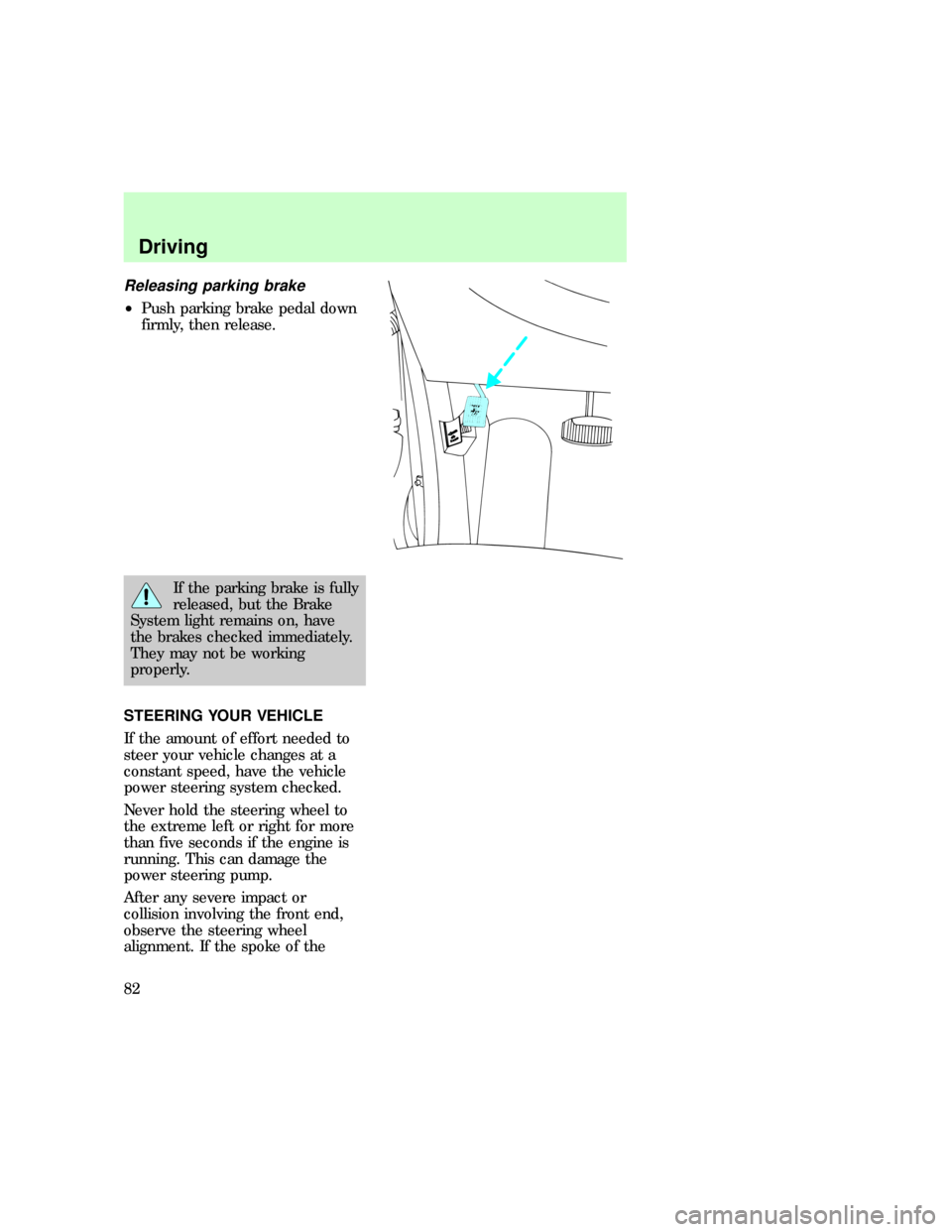
Releasing parking brake
²Push parking brake pedal down
firmly, then release.
If the parking brake is fully
released, but the Brake
System light remains on, have
the brakes checked immediately.
They may not be working
properly.
STEERING YOUR VEHICLE
If the amount of effort needed to
steer your vehicle changes at a
constant speed, have the vehicle
power steering system checked.
Never hold the steering wheel to
the extreme left or right for more
than five seconds if the engine is
running. This can damage the
power steering pump.
After any severe impact or
collision involving the front end,
observe the steering wheel
alignment. If the spoke of the
eco_steeing_vehicle
Driving
82
Page 84 of 192
N (Neutral)Ð Vehicle is free to
roll.
D(Overdrive)Ð The normal
driving position for the best fuel
economy. Transmission operates
automatically in gears one through
four.
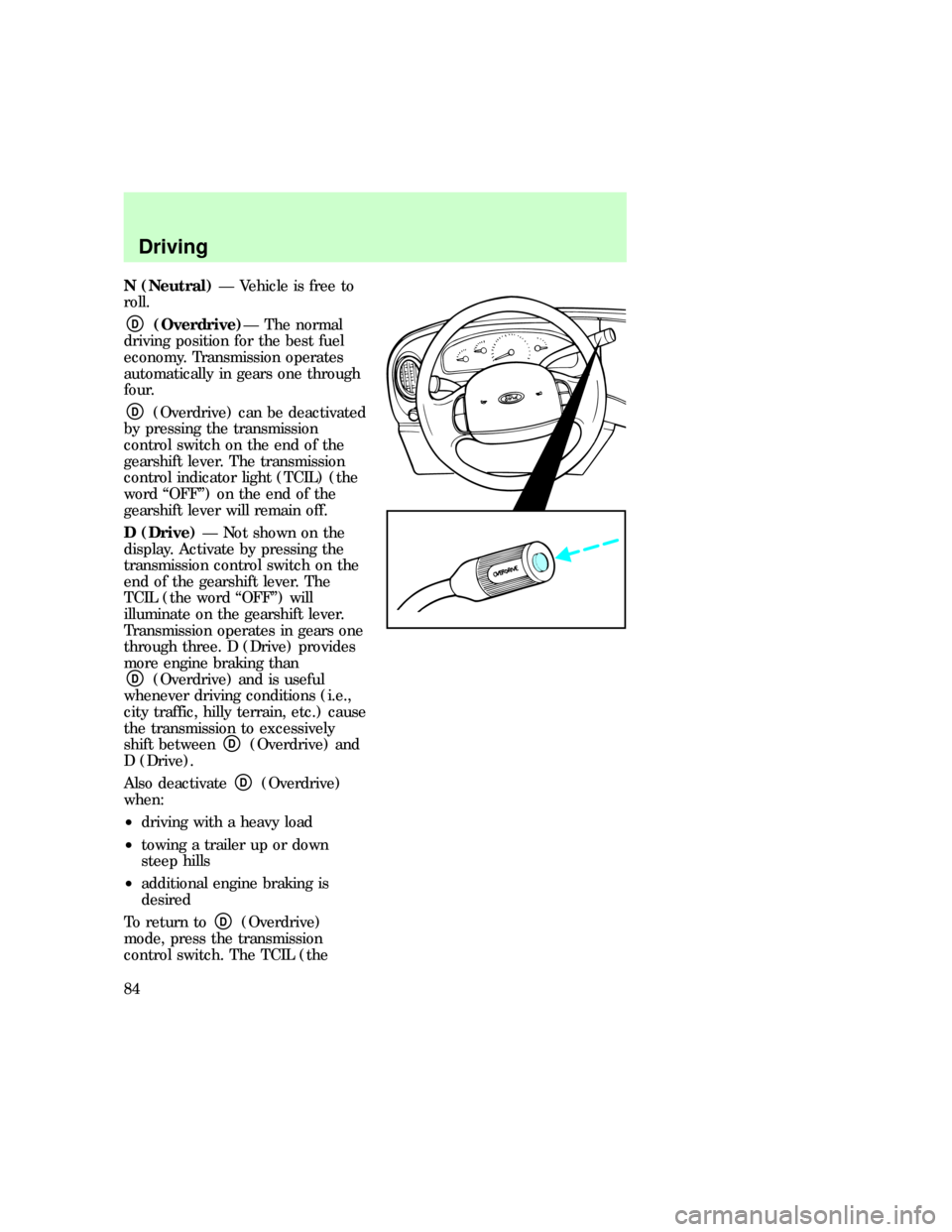
D(Overdrive) can be deactivated
by pressing the transmission
control switch on the end of the
gearshift lever. The transmission
control indicator light (TCIL) (the
word ªOFFº) on the end of the
gearshift lever will remain off.
D (Drive)Ð Not shown on the
display. Activate by pressing the
transmission control switch on the
end of the gearshift lever. The
TCIL (the word ªOFFº) will
illuminate on the gearshift lever.
Transmission operates in gears one
through three. D (Drive) provides
more engine braking than
D(Overdrive) and is useful
whenever driving conditions (i.e.,
city traffic, hilly terrain, etc.) cause
the transmission to excessively
shift between
D(Overdrive) and
D (Drive).
Also deactivate
D(Overdrive)
when:
²driving with a heavy load
²towing a trailer up or down
steep hills
²additional engine braking is
desired
To return to
D(Overdrive)
mode, press the transmission
control switch. The TCIL (the
Driving
84
Page 97 of 192

hilly country or on hot days.
Speed control may shut off if you
are towing on very long, steep
grades.
When towing a trailer
If towing a trailer and your vehicle
is not equipped with the Ford
trailer tow package, an auxiliary
transmission fluid cooler is
recommended.
²Use D (Drive) rather than
D(Overdrive) while towing up
or down steep hills. This will
eliminate excessive downshifting
and upshifting for optimum fuel
economy and transmission
cooling.
²Anticipate stops and brake
gradually.
²Allow more room for stopping
with a trailer attached.
²Practice turning, stopping and
backing in an area before
starting on a trip to get the feel
of the vehicle/trailer
combination.
²When turning, drive slightly
beyond the normal turning point
so the trailer wheels will clear
curbs and other obstacles.
²When stopped in traffic for long
periods of time in hot weather,
place the gearshift in P (Park)
to increase idle speed. This aids
engine cooling and air
conditioner efficiency.
²Vehicles with trailers should not
be parked on a grade. If you
eco_when_towing
Driving
97
Page 100 of 192
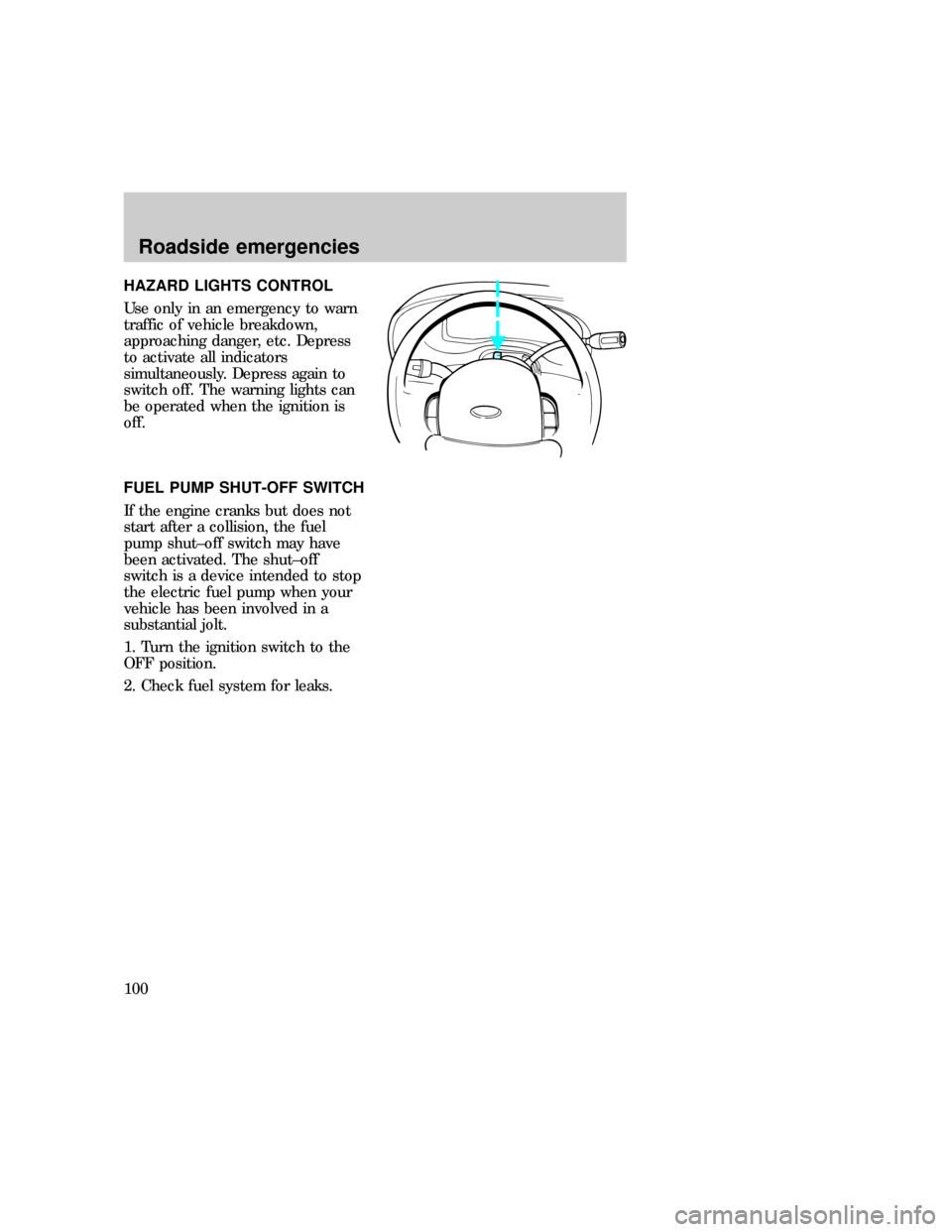
HAZARD LIGHTS CONTROL
Use only in an emergency to warn
traffic of vehicle breakdown,
approaching danger, etc. Depress
to activate all indicators
simultaneously. Depress again to
switch off. The warning lights can
be operated when the ignition is
off.
FUEL PUMP SHUT-OFF SWITCH
If the engine cranks but does not
start after a collision, the fuel
pump shut±off switch may have
been activated. The shut±off
switch is a device intended to stop
the electric fuel pump when your
vehicle has been involved in a
substantial jolt.
1. Turn the ignition switch to the
OFF position.
2. Check fuel system for leaks.com_hazard_switch.01
eco_fuel_shut-off
Roadside emergencies
100
Page 103 of 192
separation in the metal wire inside
the fuse.
Always replace a fuse with
one that has the specified
amperage rating. Using a fuse
with a higher amperage rating
can cause severe wire damage
and could start a fire.
Even after a fuse is replaced, it
will continue to blow if the cause
of the overload is not identified
and corrected. If a fuse continues
to blow, have the vehicle's
electrical system checked.
Standard fuse amperage rating
and color
Fuse rating Color
3 amp Violet
4 amp Pink
5 amp Beige
10 amp Red
15 amp Blue
20 amp Yellow
25 amp Natural
30 amp Light Green
High current fuse amperage
rating and color
Fuse rating Color
30 amp Light Green
40 amp Amber
50 amp Red
60 amp Blue
eco_fuse_id-chart
eco_fuse_id-chart2
Roadside emergencies
103
Page 105 of 192

Number Fuse amperage
ratingCircuits protected
1 20 amp 4WABS or RABS
module
2 15 amp 4WABS relay (coil),
RABS (diode/resistor),
instrument cluster,
warning chime
3 15 amp Headlamp switch,
radio sense, rear
radio control, Remote
keyless entry module
4 15 amp Power mirrors,
modified vehicle,
power locks w/RKE,
Headlamp switch
(dome), illuminated
entry, Courtesy lamp
switches, Radio
(KAP), Cluster (KAP),
warning chime
5 20 amp Remote keyless entry
module, power door
lock switches,
memory lock
6 10 amp Brake shift interlock,
speed control,
daytime running light
module
7 10 amp Multi-function switch
Roadside emergencies
105
Page 106 of 192

Number Fuse amperage
ratingCircuits protected
8 30 amp Noise supression
capacitor, ignition coil
positive feed, PCM
relay diode/PCM
power relay, fuel
heater (diesel), glow
plug relay (diesel)
9 30 amp Wiper control module,
wiper motor
10 20 amp Headlamp switch
(exterior lamps),
Multi-function switch
(flash-to-pass)
11 15 amp Stoplight switch, brake
pressure switch,
multi-function switch
12 15 amp Digital transmission
range sensor (backup
lamps), auxiliary
battery relay
13 15 amp A/C mode switch,
blend door actuator
14 5 amp Instrument cluster (air
bag and charge
indicator lamps)
15 5 amp Trailer tow battery
charge relay (coil)
16 30 amp Power seats
17 - Not used
18 - Not used
19 10 amp Air bag module
20 5 amp Overdrive cancel
switch
Roadside emergencies
106
Page 107 of 192

Number Fuse amperage
ratingCircuits protected
21 30 amp Power windows
22 - Not used
23 20 amp Cigar lighter, data link
connector
24 5 amp Illuminated entry
25 10 amp Left headlamp (low
beam)
26 - Not used
27 - Not used
28 25 amp Instrument panel
power point
29 - Not used
30 15 amp Headlamps (high
beam), Daytime
running lamps (DRL),
high beam indicator
31 10 amp Right headlamp (low
beam), Daytime
running lamps (DRL)
32 - Not used
33 - Not used
34 10 amp Digital transmission
range sensor (start
control)
35 - Not used
36 5 amp Panel illumination
37 - Not used
38 10 amp Air bag module
39 - Not used
40 30 amp Modified vehicle
41 30 amp Modified vehicle
42 - Not used
Roadside emergencies
107
Page 124 of 192

SERVICE RECOMMENDATIONS
To help you service your vehicle:
²We highlight do-it-yourself items
in the engine compartment for
easy location.
²As possible, we design parts that
can be replaced without tools.
²We provide you with a ªService
Guideº which makes tracking
routine service for your vehicle
easy.
If your vehicle requires
professional service, your
dealership can provide necessary
parts and service. Check your
ªWarranty Information Bookletº to
find out which parts and services
are covered.
Use only recommended fuels,
lubricants, fluids and service parts
conforming to specifications.
Motorcraft parts are designed and
built to provide the best
performance in your vehicle.
Precautions when servicing
your vehicle
Be especially careful when
inspecting or servicing your
vehicle. Here are some general
precautions for your safety:
²Do not work on a hot engine.
com_precautions_servicing.01
Maintenance and care
124
Page 139 of 192
²loose hose clamps
What you should know about
fail-safe cooling (if equipped)
If the engine coolant supply is
depleted, this feature allows the
vehicle to be driven temporarily
before incremental component
damage is incurred. The ªfail safeº
distance depends on ambient
temperatures, vehicle load and
terrain.
How fail-safe cooling works
If the engine overheats, the engine
will automatically switch from
eight to alternating four cylinder
operation. Each disabled cylinder
acts as an air pump and cools the
engine.
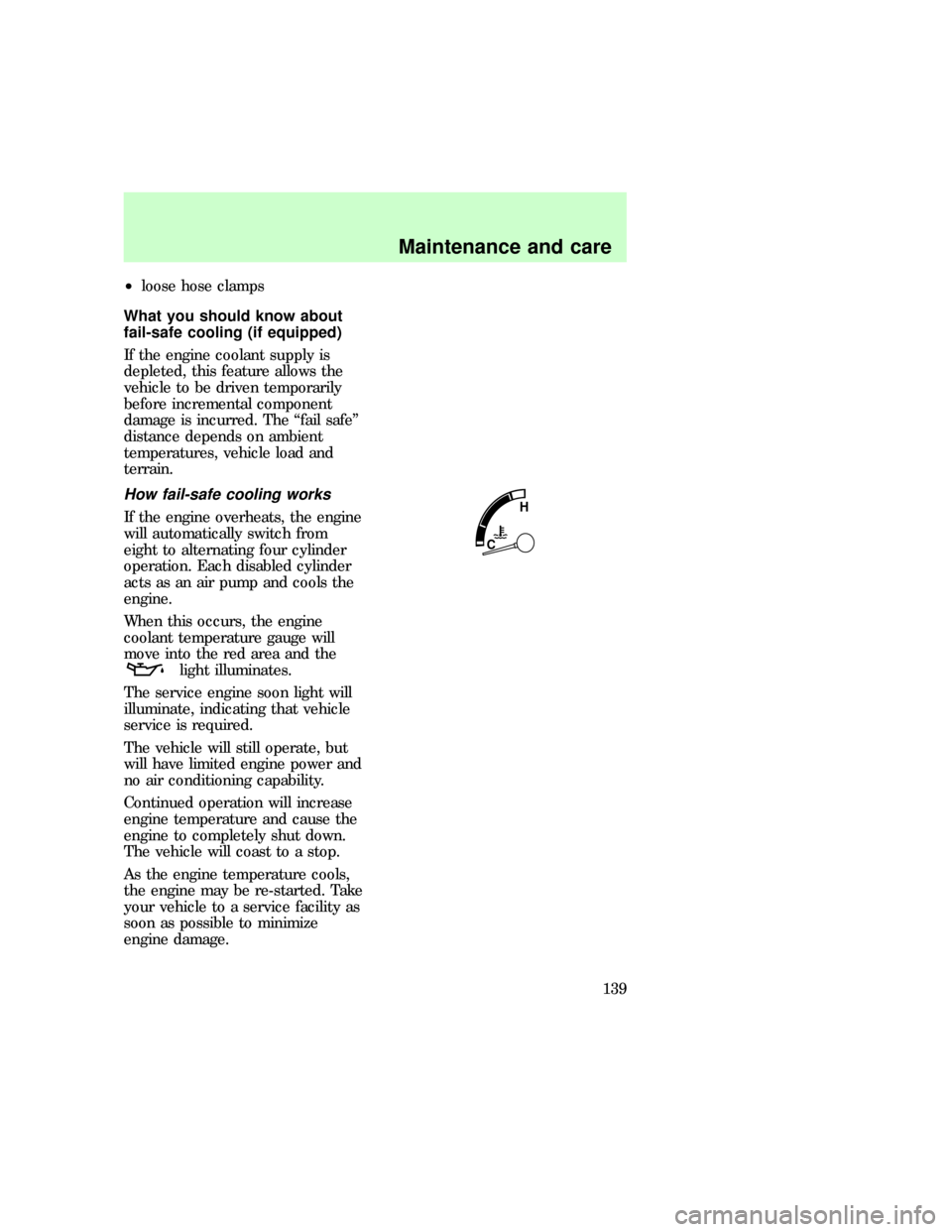
When this occurs, the engine
coolant temperature gauge will
move into the red area and the
light illuminates.
The service engine soon light will
illuminate, indicating that vehicle
service is required.
The vehicle will still operate, but
will have limited engine power and
no air conditioning capability.
Continued operation will increase
engine temperature and cause the
engine to completely shut down.
The vehicle will coast to a stop.
As the engine temperature cools,
the engine may be re-started. Take
your vehicle to a service facility as
soon as possible to minimize
engine damage.
H
C
eco_failsafe_cooling
eco_failsafe_works
eco_failsafe_activated
Maintenance and care
139