maintenance FORD E SERIES 1997 4.G Owner's Guide
[x] Cancel search | Manufacturer: FORD, Model Year: 1997, Model line: E SERIES, Model: FORD E SERIES 1997 4.GPages: 192, PDF Size: 3.44 MB
Page 146 of 192

4. The relearning process will
automatically complete as you
drive the vehicle.
²If you do not allow the engine to
relearn its idle, the idle quality
of your vehicle may be adversely
affected until the idle is
eventually relearned.
²If the battery has been
disconnected or a new battery
has been installed, the clock and
preset radio stations must be
reset once the battery is
reconnected.
²Always dispose of used
automotive batteries in a
responsible manner. Follow your
community's standards for
disposal. Call your local
recycling center to find out
more about recycling automotive
batteries.
Disconnecting dual batteries (if
equipped)
Gasoline engines
Disconnect:
eco_battery_disconnect
eco_battery_gas_disconnect
Maintenance and care
146
Page 147 of 192
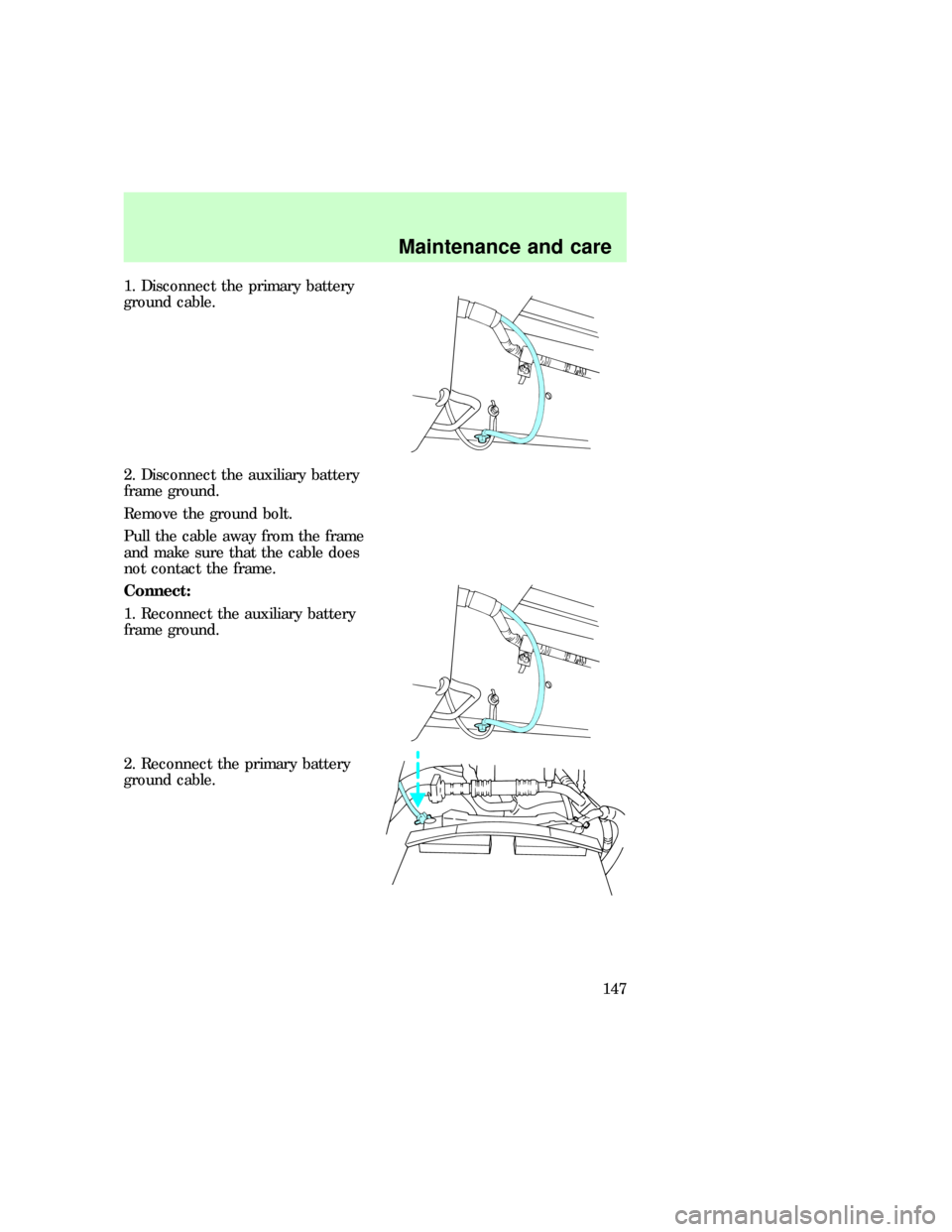
1. Disconnect the primary battery
ground cable.
2. Disconnect the auxiliary battery
frame ground.
Remove the ground bolt.
Pull the cable away from the frame
and make sure that the cable does
not contact the frame.
Connect:
1. Reconnect the auxiliary battery
frame ground.
2. Reconnect the primary battery
ground cable.
eco_battery_diesel_disconnect
Maintenance and care
147
Page 148 of 192
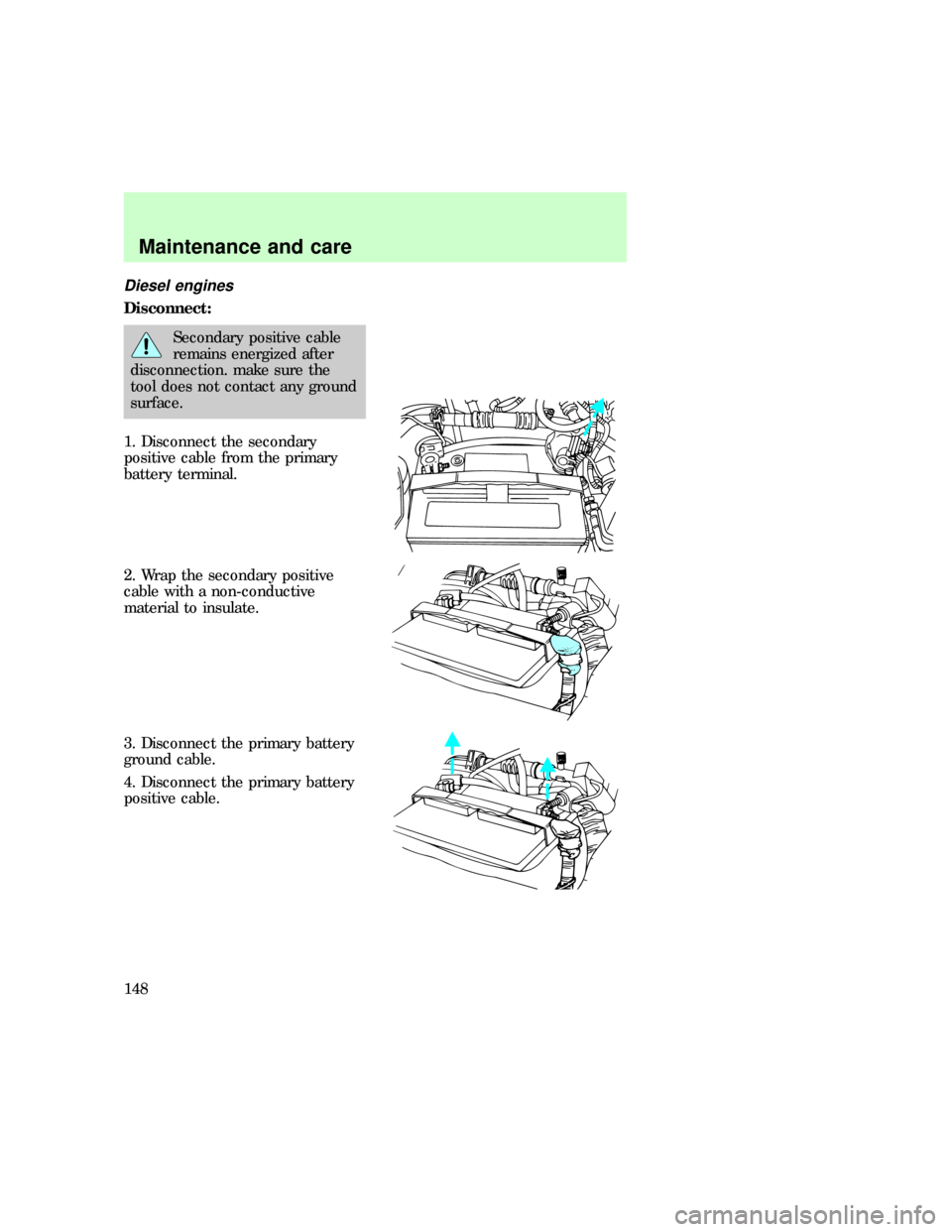
Diesel engines
Disconnect:
Secondary positive cable
remains energized after
disconnection. make sure the
tool does not contact any ground
surface.
1. Disconnect the secondary
positive cable from the primary
battery terminal.
2. Wrap the secondary positive
cable with a non-conductive
material to insulate.
3. Disconnect the primary battery
ground cable.
4. Disconnect the primary battery
positive cable.
Maintenance and care
148
Page 149 of 192
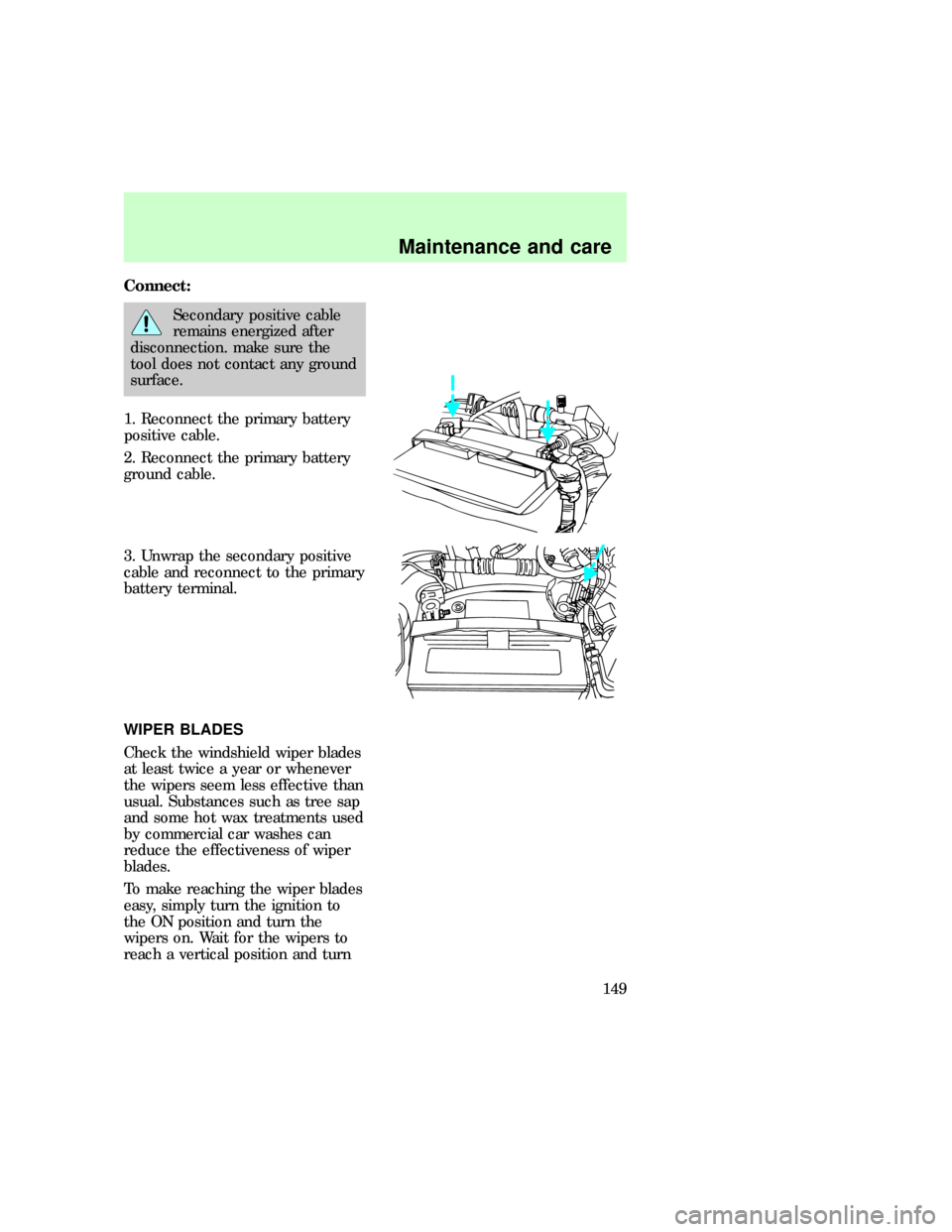
Connect:
Secondary positive cable
remains energized after
disconnection. make sure the
tool does not contact any ground
surface.
1. Reconnect the primary battery
positive cable.
2. Reconnect the primary battery
ground cable.
3. Unwrap the secondary positive
cable and reconnect to the primary
battery terminal.
WIPER BLADES
Check the windshield wiper blades
at least twice a year or whenever
the wipers seem less effective than
usual. Substances such as tree sap
and some hot wax treatments used
by commercial car washes can
reduce the effectiveness of wiper
blades.
To make reaching the wiper blades
easy, simply turn the ignition to
the ON position and turn the
wipers on. Wait for the wipers to
reach a vertical position and turn
eco_wipers
Maintenance and care
149
Page 150 of 192
the ignition to the LOCK position.
Do not move the wipers manually
across the windshield as this may
cause damage to the wiper system.
Inspect the wiper arm pivots on a
regular basis to ensure the wiper
arms move freely. Lubricate the
pivot points as necessary.
Replacing wiper blades
If the wiper blades do not work
properly after cleaning,
replacement of the blade assembly
or the blade element may be
necessary.
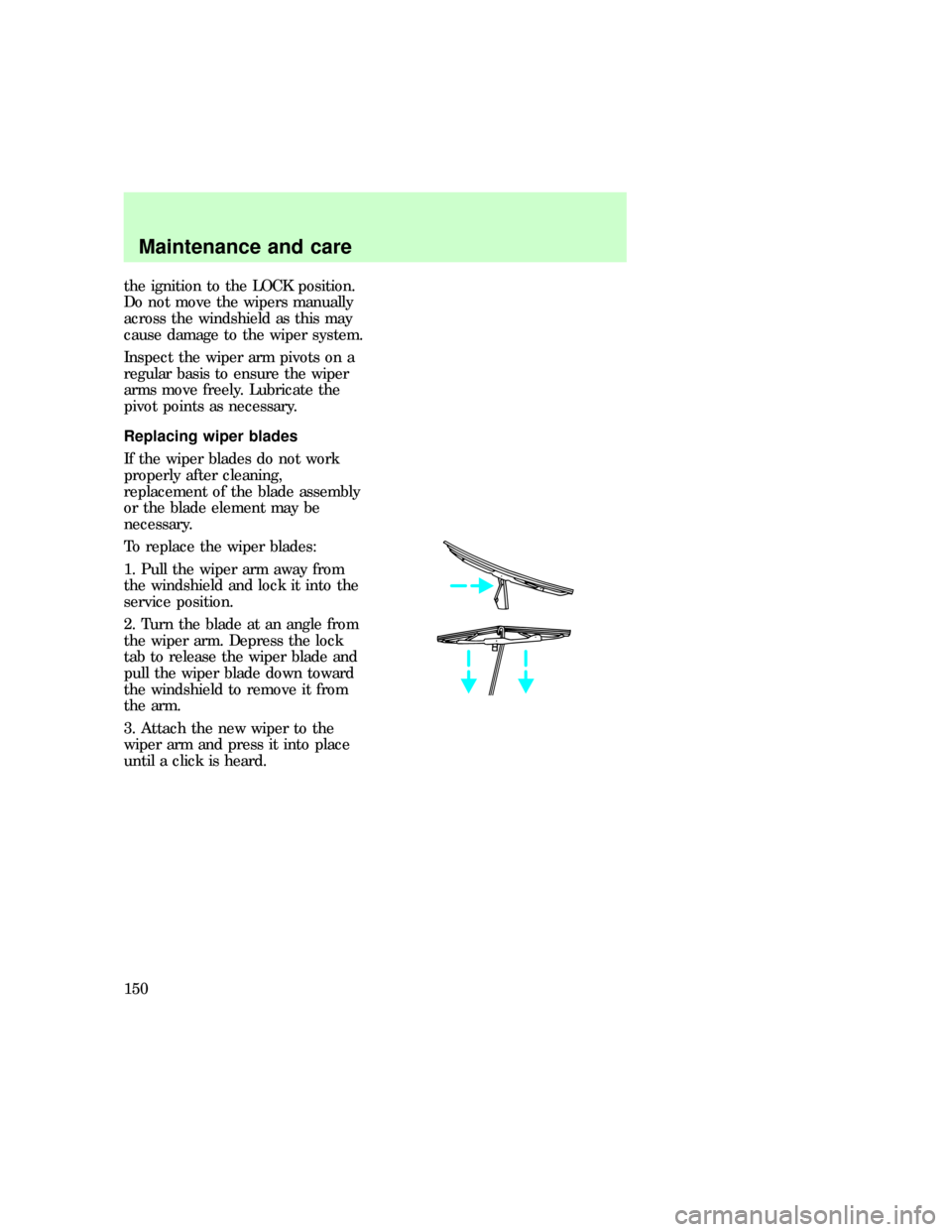
To replace the wiper blades:
1. Pull the wiper arm away from
the windshield and lock it into the
service position.
2. Turn the blade at an angle from
the wiper arm. Depress the lock
tab to release the wiper blade and
pull the wiper blade down toward
the windshield to remove it from
the arm.
3. Attach the new wiper to the
wiper arm and press it into place
until a click is heard.
eco_replacing_wiper_blades
com_about_tire_grades.01
Maintenance and care
150
Page 151 of 192

INFORMATION ABOUT TIRE
QUALITY GRADES
New vehicles are fitted with tires
that have their Tire Quality Grade
(described below) molded into the
tire's sidewall. These Tire Quality
Grades are determined by
standards that the United States
Department of Transportation has
set.
Tire Quality Grades apply to new
pneumatic tires for use on
passenger cars. They do not apply
to deep tread, winter-type snow
tires, space-saver or temporary use
spare tires, tires with nominal rim
diameters of 10 to 12 inches or
limited production tires as defined
in Title 49 Code of Federal
Regulations Part 575.104(c)(2).
U.S. Department of
Transportation-Tire quality
grades:The U.S. Department of
Transportation requires Ford to
give you the following information
about tire grades exactly as the
government has written it.
Treadwear
The treadwear grade is a
comparative rating based on the
wear rate of the tire when tested
under controlled conditions on a
specified government test course.
For example, a tire grade 150
would wear one and one-half (1
1/2) times as well on the
government course as a tire grade
100. The relative performance of
tires depends upon the actual
com_treadwear.01
Maintenance and care
151
Page 152 of 192

conditions of their use, however,
and may depart significantly from
the norm due to variations in
driving habits, service practices,
and differences in road
characteristics and climate.
Traction A B C
The traction grades, from highest
to lowest are A, B, and C, and they
represent the tire's ability to stop
on wet pavement as measured
under test surfaces of asphalt and
concrete. A tire marked C may
have poor traction performance.
Warning: The traction grade
assigned to this tire is based on
braking (straightahead) traction
tests and does not include
cornering (turning) traction.
Temperature A B C
The temperature grades are A (the
highest), B, and C, representing
the tire's resistance to the
generation of heat and its ability to
dissipate heat when tested under
controlled conditions on a
specified indoor laboratory test
wheel. Sustained high temperature
can cause the material of the tire
to degenerate and reduce tire life,
and excessive temperature can
lead to sudden tire failure. The
grade C corresponds to a level of
performance which all passenger
car tires must meet under the
Federal Motor Vehicle Safety
Standard No. 109. Grades B and A
represent higher levels of
performance on the laboratory test
com_traction_abc.01
com_temperature_abc.01
Maintenance and care
152
Page 153 of 192
wheel than the minimum required
by law.
The temperature grade for
this tire is established for a
tire that is properly inflated and
not overloaded. Excessive speed,
underinflation, or excessive
loading, either separately or in
combination, can cause heat
buildup and possible tire failure.
SERVICING YOUR TIRES
Checking the tire pressure
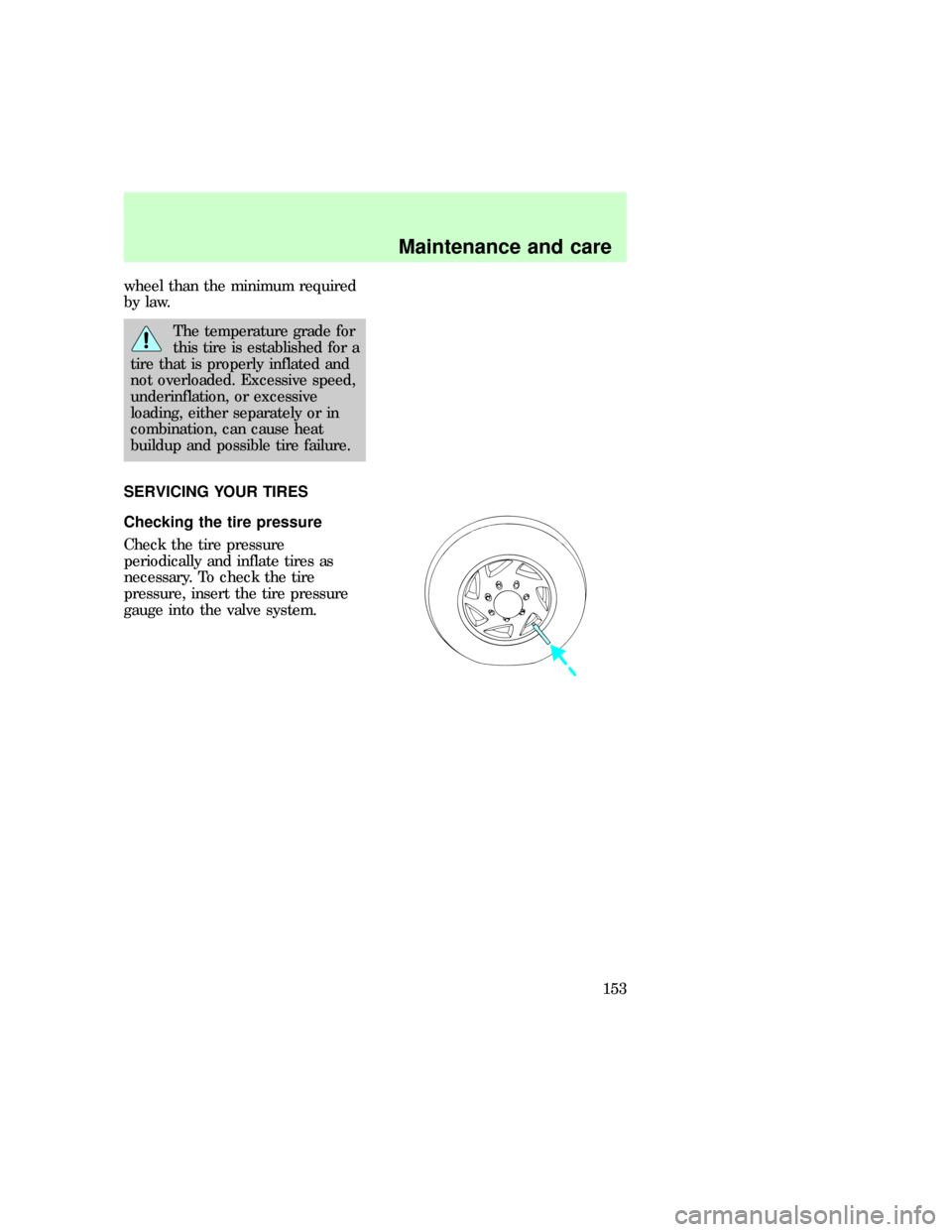
Check the tire pressure
periodically and inflate tires as
necessary. To check the tire
pressure, insert the tire pressure
gauge into the valve system.
eco_tire_service
eco_pressure_checking
Maintenance and care
153
Page 154 of 192
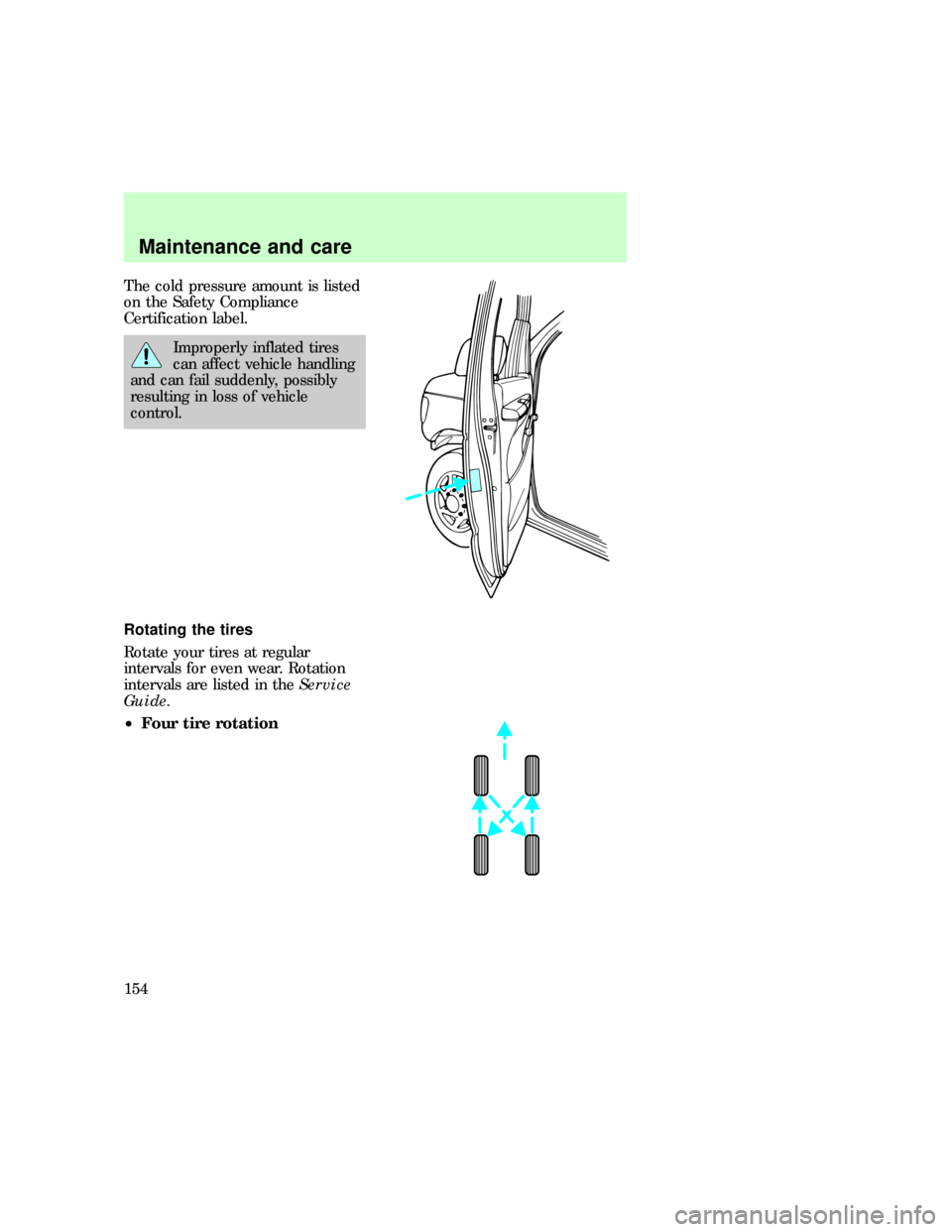
The cold pressure amount is listed
on the Safety Compliance
Certification label.
Improperly inflated tires
can affect vehicle handling
and can fail suddenly, possibly
resulting in loss of vehicle
control.
Rotating the tires
Rotate your tires at regular
intervals for even wear. Rotation
intervals are listed in theService
Guide.
²Four tire rotation
eco_rotating_tiresMaintenance and care
154
Page 155 of 192
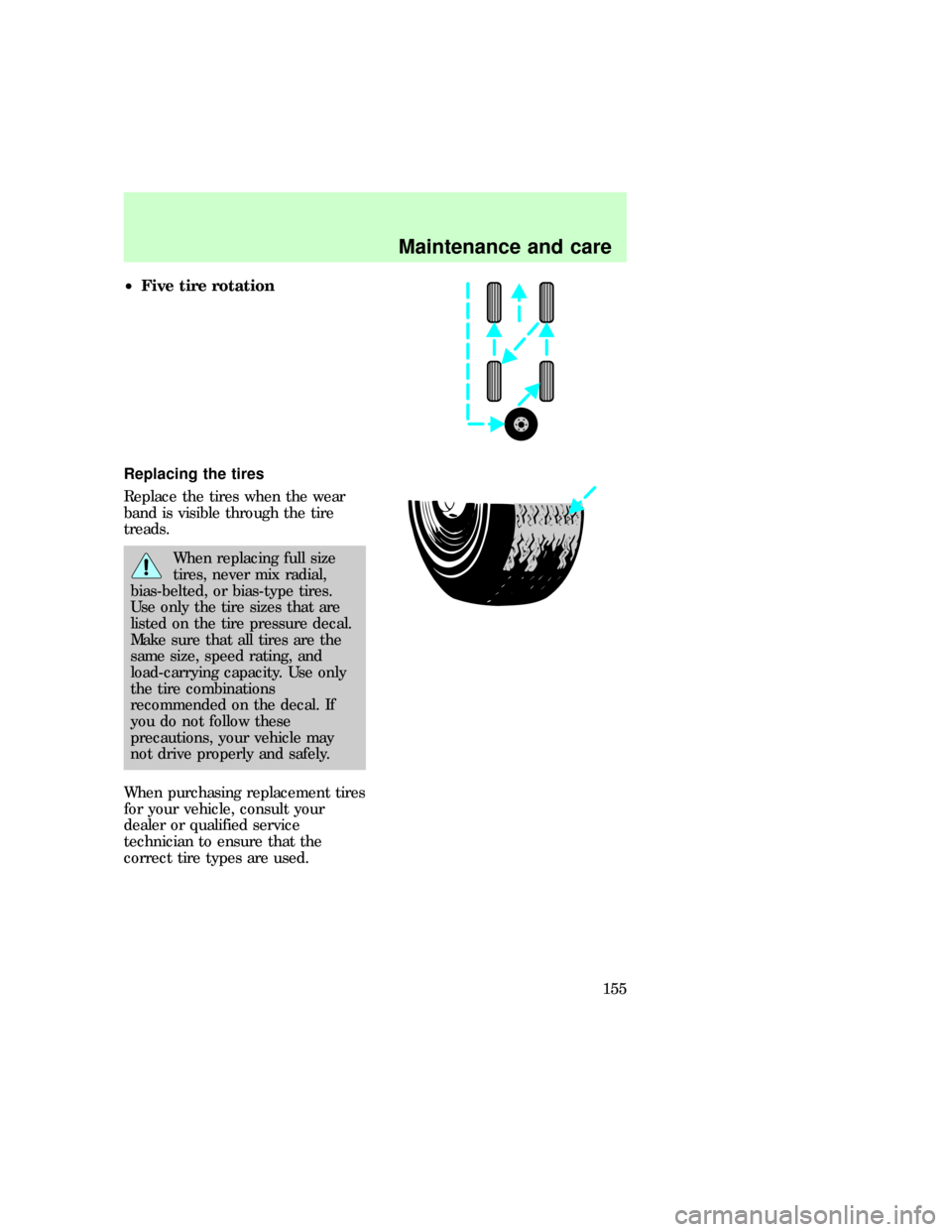
²Five tire rotation
Replacing the tires
Replace the tires when the wear
band is visible through the tire
treads.
When replacing full size
tires, never mix radial,
bias-belted, or bias-type tires.
Use only the tire sizes that are
listed on the tire pressure decal.
Make sure that all tires are the
same size, speed rating, and
load-carrying capacity. Use only
the tire combinations
recommended on the decal. If
you do not follow these
precautions, your vehicle may
not drive properly and safely.
When purchasing replacement tires
for your vehicle, consult your
dealer or qualified service
technician to ensure that the
correct tire types are used.
eco_types_tires
eco_snow_chains
Maintenance and care
155