ABS FORD E SERIES 1997 4.G Owners Manual
[x] Cancel search | Manufacturer: FORD, Model Year: 1997, Model line: E SERIES, Model: FORD E SERIES 1997 4.GPages: 192, PDF Size: 3.44 MB
Page 8 of 192
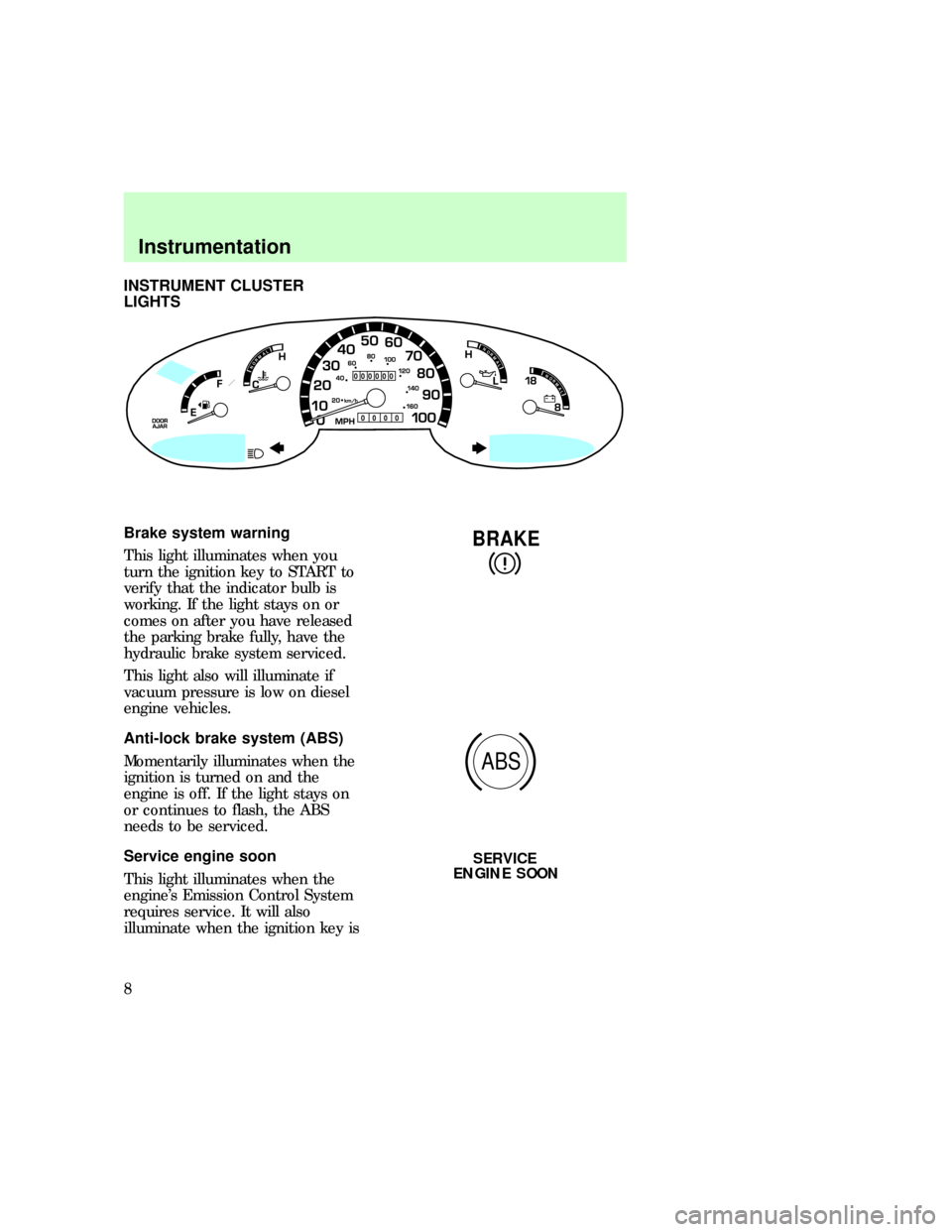
INSTRUMENT CLUSTER
LIGHTS
Brake system warning
This light illuminates when you
turn the ignition key to START to
verify that the indicator bulb is
working. If the light stays on or
comes on after you have released
the parking brake fully, have the
hydraulic brake system serviced.
This light also will illuminate if
vacuum pressure is low on diesel
engine vehicles.
Anti-lock brake system (ABS)
Momentarily illuminates when the
ignition is turned on and the
engine is off. If the light stays on
or continues to flash, the ABS
needs to be serviced.
Service engine soon
This light illuminates when the
engine's Emission Control System
requires service. It will also
illuminate when the ignition key is
000000
0000
BRAKE
NORMALNORMAL
NORMAL
BRAKE
ABS
SERVICE
ENGINE SOON
eco_warn-lights
eco_brake_system
com_anti-lock_brake.01
eco_service_engine
Instrumentation
8
Page 80 of 192

BRAKES
Your brakes are self-adjusting.
Refer to the ªService Guideº for
maintenance scheduling.
Anti-lock brake system (ABS) (if
equipped)
The ABS operates by detecting the
onset of wheel lock up during
brake applications and
compensating for this tendency.
The front wheels are prevented
from locking even when the brakes
are firmly applied. The
accompanying illustration depicts
the advantage of an ABS equipped
vehicle (on bottom) to a non-ABS
equipped vehicle (on top) during
hard braking.
Using ABS
²In an emergency, apply full force
on the brake. The ABS will be
activated immediately, thus
allowing you to retain full
steering control of your vehicle
and, providing there is sufficient
space, will enable you to avoid
obstacles and bring the vehicle
to a quiet stop.
²We recommend that you
familiarize yourself with this
braking technique. However,
avoid taking any unnecessary
risks.
Parking brake
The parking brake should be used
whenever you park your vehicle. It
is not designed to stop a moving
com_brakes.01
com_abs.01
com_using_abs.01
eco_parking_brake
Driving
80
Page 105 of 192

Number Fuse amperage
ratingCircuits protected
1 20 amp 4WABS or RABS
module
2 15 amp 4WABS relay (coil),
RABS (diode/resistor),
instrument cluster,
warning chime
3 15 amp Headlamp switch,
radio sense, rear
radio control, Remote
keyless entry module
4 15 amp Power mirrors,
modified vehicle,
power locks w/RKE,
Headlamp switch
(dome), illuminated
entry, Courtesy lamp
switches, Radio
(KAP), Cluster (KAP),
warning chime
5 20 amp Remote keyless entry
module, power door
lock switches,
memory lock
6 10 amp Brake shift interlock,
speed control,
daytime running light
module
7 10 amp Multi-function switch
Roadside emergencies
105
Page 109 of 192

Number Fuse amperage
ratingCircuits protected
4 5 amp PCM keep alive
memory
5 10 amp Right trailer turn
signal
6 10 amp Left trailer turn signal
7 - Not used
8 60 amp Instrument panel
fuses
9 30 amp PCM power relay
10 60 amp Auxiliary battery
11 - Not used
12 60 amp Misc.
13 50 amp Blower motor relay
14 30 amp Trailer running lamps,
trailer backup lamps
15 40 amp Headlamp switch
16 50 amp Auxiliary A/C, remote
keyless entry module
17 30 amp Fuel pump relay
(gasoline), injector
driver module relay
(diesel)
18 60 amp Modified vehicle
power
19 60 amp Anti-lock brake
system (4WABS)
20 20 amp Electric brake
controller (trailer tow)
21 50 amp Modified vehicle
power
22 40 amp Trailer battery charge
(relay)
Roadside emergencies
109
Page 158 of 192

Observe the following guidelines
when handling automotive fuel:
²Extinguish all smoking materials
and any open flames before
fueling your vehicle.
²Always turn off the vehicle
before fueling.
²Automotive fuels can be harmful
or fatal if swallowed. If fuel is
swallowed, call a physician
immediately, even if no
symptoms are immediately
apparent. The toxic affects of
fuel may not be visible for
hours.
²Fuels can also be harmful if
absorbed through the skin. If
fuel is splashed on the skin,
promptly remove contaminated
clothing and wash skin
thoroughly with soap and water.
²If fuel is splashed in the eyes,
remove contact lenses, flush
with water for 15 minutes and
seek medical attention.
²Be particularly careful if you are
taking ªAntabuseº or other
forms of disulfiram for the
treatment of alcoholism.
Breathing gasoline vapors or
skin contact could cause an
adverse reaction. Consult a
physician immediately.
Choosing the right fuel
Use only UNLEADED FUEL. The
use of leaded fuel is prohibited by
law and could damage your
com_choosing_fuel.01
Maintenance and care
158
Page 184 of 192

Idle
relearning ................................145
Ignition .........................................23
Inspection
maintenance testing ...............164
Jump-starting your vehicle 120,122
attaching cables ......................121
disconnecting cables ..............122
Lamps
cargo lamps ...............................30
courtesy lamps ..........................31
Lights, warning and indicator
air bag ..........................................9
anti-lock brakes (ABS) ..............8
brake ............................................8
charging system ..........................9
check engine ...............................8
door ajar ....................................10
engine oil pressure ...................10
high beam .................................10
safety belt ...................................9
Load limits
trailer towing ............................89
Lubricant specifications ...........175
Odometer .....................................13
Overdrive .....................................24
Parking brake
operation ..............................81,82
Parts (see Motorcraft parts) ....174
Power features
door locks ..................................32
mirrors .......................................31
Power point electrical outlet .....17
Power steering
fluid, checking and adding ....140
Refill capacities for fluids ........174
Relays .................................102,111
Remote entry system .................34
locking/unlocking doors ...........34
panic alarm ...............................35
replacement/additional
transmitters ...............................36replacing the batteries .............35
Reporting safety defects ..........183
Safety restraints
adjusting the safety belts .........49
automatic locking mode
(retractor) .................................47
extension assembly ..................50
for children ...............................58
lap and shoulder belts .............45
maintenance ..............................51
proper use .................................43
warning light and chime ..........51
Safety seats for children
automatic locking mode
(retractor) .......................61,62,66
Seats ............................................37
adjusting the seat, manual .......37
adjusting the seat, power ........38
bench seat .................................39
lumbar support .........................39
quick release rear captain's
chair ...........................................41
Servicing your vehicle ..............124
precautions when servicing ...124
Special notice ................................2
ambulance conversions ..............2
diesel-powered vehicles .............3
Speed control ..............................28
accelerating ...............................29
resetting ....................................29
resuming a set speed ...............30
turning off .................................28
Speedometer ...............................12
Starting your vehicle ..................73
preparing to start your
vehicle .......................................74
starting a warm engine ............77
Steering, power ...........................82
Steering wheel
tilting .........................................26
Tires ...........................................153
changing ...........................112,114
Index
184