seats FORD E SERIES 1998 4.G User Guide
[x] Cancel search | Manufacturer: FORD, Model Year: 1998, Model line: E SERIES, Model: FORD E SERIES 1998 4.GPages: 144, PDF Size: 2.14 MB
Page 50 of 144
Install forward-facing convertible safety seats only in vehicle seating
positions equipped with lap-shoulder belts. Forward facing convertible
safety seats can be used in the center of the three-passenger second row
bench seat only if a top tether strap is used. Ford recommends placing
forward-facing safety seats in the second row and using safety seats with
top tether straps for added protection. For more information on top
tether straps, seeAttaching safety seats with tether strapsin this
section.
Any booster seat that places the vehicle's lap belt or shoulder belt
around a shield above and ahead of the child's hips should not be used in
this vehicle.
Do notuse a forward±facing safety seat or an infant seat in the
last row of a 12± or 15±passenger Club Wagon.
Children and safety belts
Children who are too large for child safety seats (as specified by your
child safety seat manufacturer) should always wear safety belts.
Follow all the important safety restraint and air bag precautions that
apply to adult passengers in your vehicle.
If the shoulder belt portion of a combination lap and shoulder belt can
be positioned so it does not cross or rest in front of the child's face or
neck, the child should wear the lap and shoulder belt. Moving the child
closer to the center of the vehicle may help provide a good shoulder belt
fit.
If the shoulder belt cannot be properly positioned:
²move the child to one of the seats with a lap belt only (if equipped) or
²if the child is the proper size, restrain the child in a safety seat.
Do not leave children, unreliable adults, or pets unattended in
your vehicle.
To improve the fit of lap and shoulder belts on children who have
outgrown child safety seats, Ford recommends use of a belt-positioning
booster seat that is labelled as conforming to all Federal motor vehicle
safety standards. Belt-positioning booster seats raise the child and
provide a shorter, firmer seating cushion that encourages safer seating
posture and better fit of lap and shoulder belts on the child.
Seating and safety restraints
50
Page 51 of 144
A belt-positioning booster should be used if the shoulder belt rests in
front of the child's face or neck, or if the lap belt does not fit snugly on
both thighs, or if the thighs are too short to let the child sit all the way
back on the seat cushion when the lower legs hang over the edge of the
seat cushion. You may wish to discuss the special needs of your child
with your pediatrician.
SAFETY SEATS FOR CHILDREN
Child and infant or child safety seats
Use a safety seat that is recommended for the size and weight of the
child. Carefully follow all of the manufacturer's instructions with the
safety seat you put in your vehicle. If you do not install and use the
safety seat properly, the child may be injured in a sudden stop or
collision.
When installing a child safety seat:
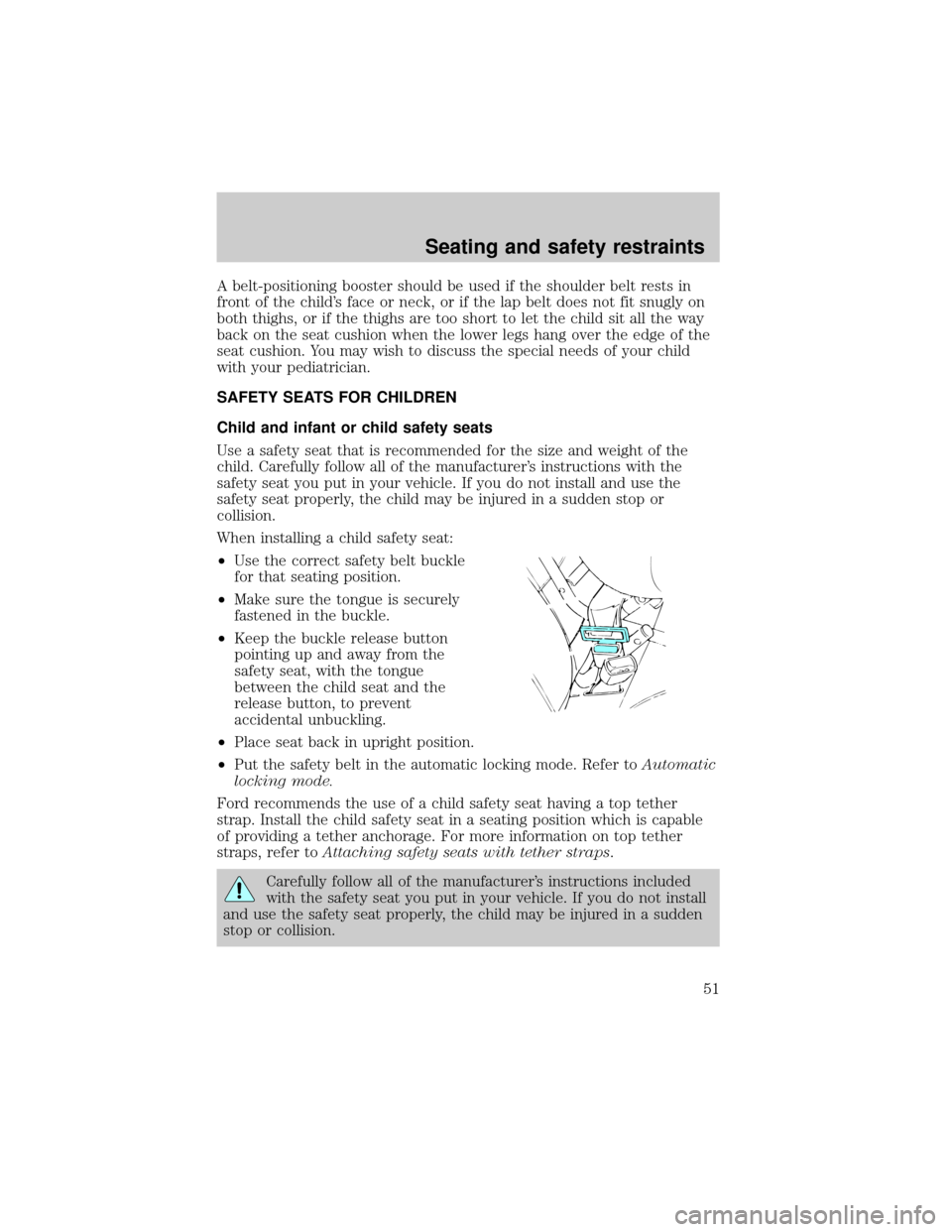
²Use the correct safety belt buckle
for that seating position.
²Make sure the tongue is securely
fastened in the buckle.
²Keep the buckle release button
pointing up and away from the
safety seat, with the tongue
between the child seat and the
release button, to prevent
accidental unbuckling.
²Place seat back in upright position.
²Put the safety belt in the automatic locking mode. Refer toAutomatic
locking mode.
Ford recommends the use of a child safety seat having a top tether
strap. Install the child safety seat in a seating position which is capable
of providing a tether anchorage. For more information on top tether
straps, refer toAttaching safety seats with tether straps.
Carefully follow all of the manufacturer's instructions included
with the safety seat you put in your vehicle. If you do not install
and use the safety seat properly, the child may be injured in a sudden
stop or collision.
Seating and safety restraints
51
Page 54 of 144
8. Allow the safety belt to retract to
remove any slack in the belt.
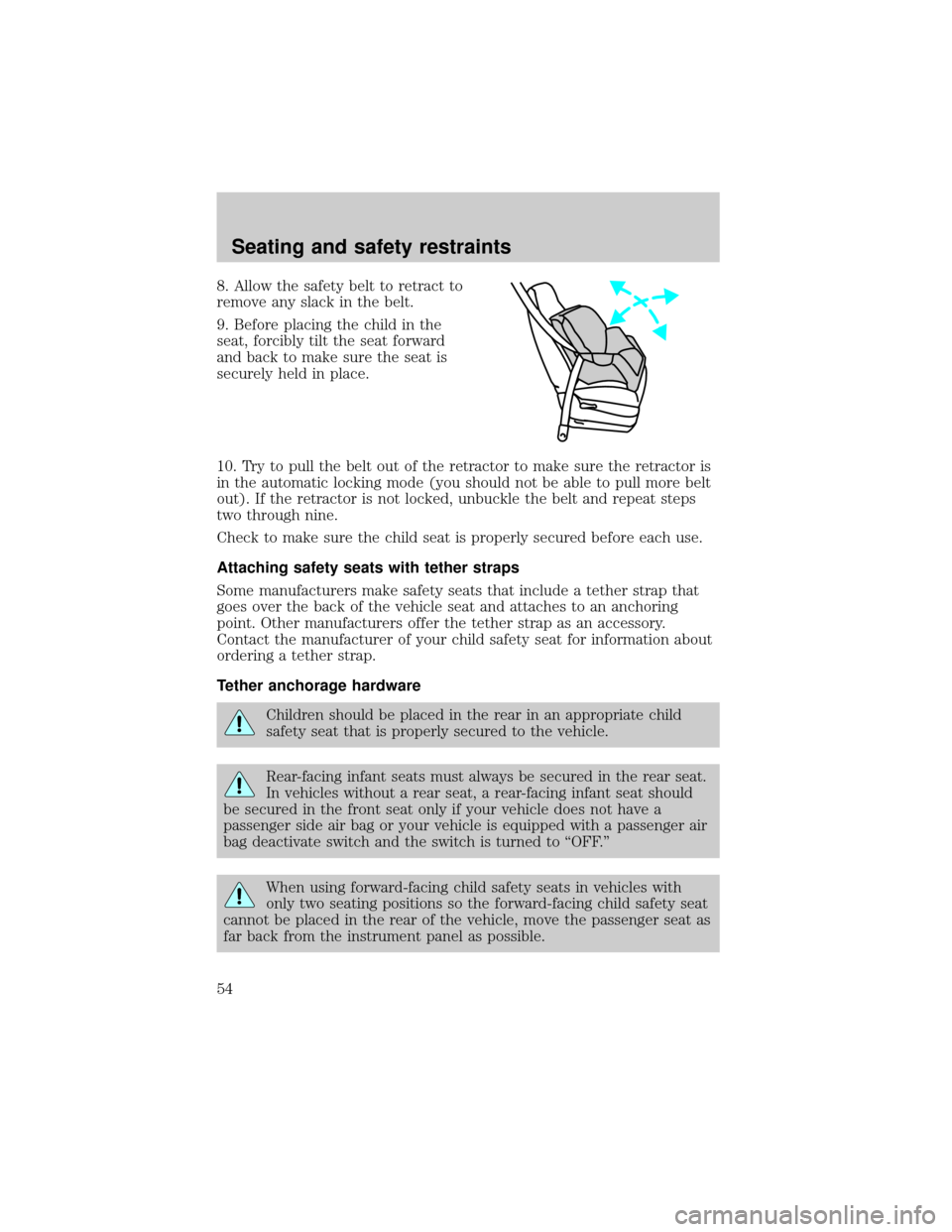
9. Before placing the child in the
seat, forcibly tilt the seat forward
and back to make sure the seat is
securely held in place.
10. Try to pull the belt out of the retractor to make sure the retractor is
in the automatic locking mode (you should not be able to pull more belt
out). If the retractor is not locked, unbuckle the belt and repeat steps
two through nine.
Check to make sure the child seat is properly secured before each use.
Attaching safety seats with tether straps
Some manufacturers make safety seats that include a tether strap that
goes over the back of the vehicle seat and attaches to an anchoring
point. Other manufacturers offer the tether strap as an accessory.
Contact the manufacturer of your child safety seat for information about
ordering a tether strap.
Tether anchorage hardware
Children should be placed in the rear in an appropriate child
safety seat that is properly secured to the vehicle.
Rear-facing infant seats must always be secured in the rear seat.
In vehicles without a rear seat, a rear-facing infant seat should
be secured in the front seat only if your vehicle does not have a
passenger side air bag or your vehicle is equipped with a passenger air
bag deactivate switch and the switch is turned to ªOFF.º
When using forward-facing child safety seats in vehicles with
only two seating positions so the forward-facing child safety seat
cannot be placed in the rear of the vehicle, move the passenger seat as
far back from the instrument panel as possible.
Seating and safety restraints
54
Page 57 of 144
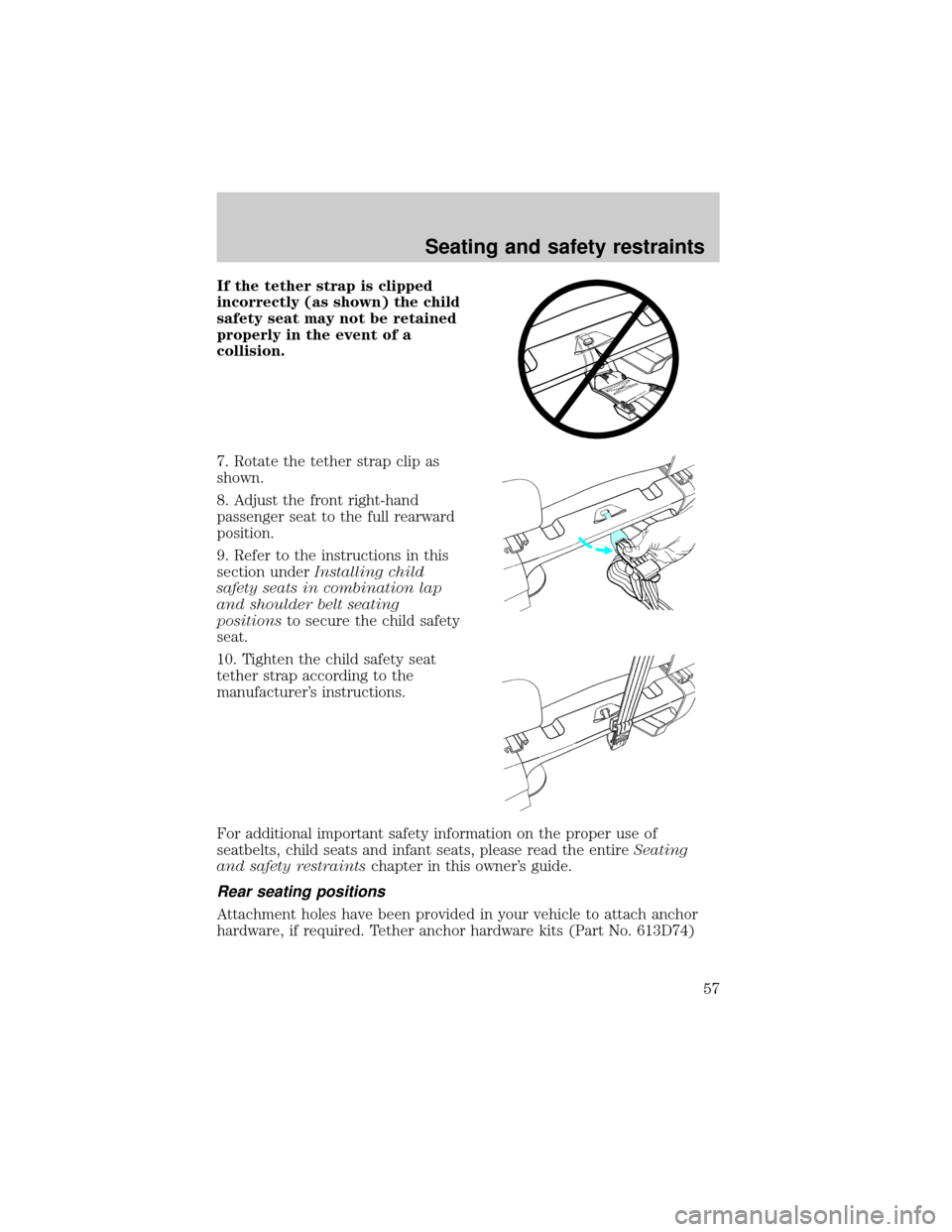
If the tether strap is clipped
incorrectly (as shown) the child
safety seat may not be retained
properly in the event of a
collision.
7. Rotate the tether strap clip as
shown.
8. Adjust the front right-hand
passenger seat to the full rearward
position.
9. Refer to the instructions in this
section underInstalling child
safety seats in combination lap
and shoulder belt seating
positionsto secure the child safety
seat.
10. Tighten the child safety seat
tether strap according to the
manufacturer's instructions.
For additional important safety information on the proper use of
seatbelts, child seats and infant seats, please read the entireSeating
and safety restraintschapter in this owner's guide.
Rear seating positions
Attachment holes have been provided in your vehicle to attach anchor
hardware, if required. Tether anchor hardware kits (Part No. 613D74)
Seating and safety restraints
57
Page 58 of 144
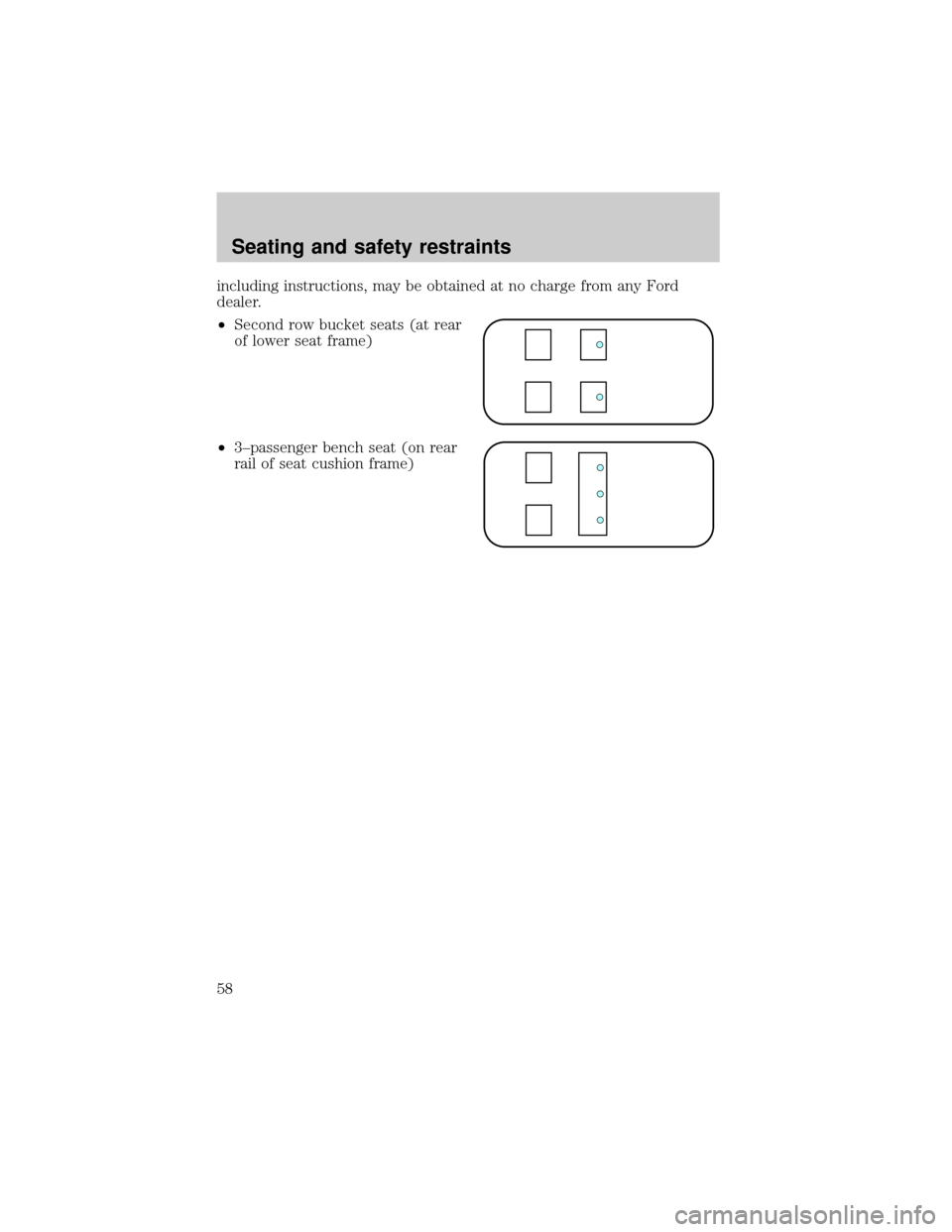
including instructions, may be obtained at no charge from any Ford
dealer.
²Second row bucket seats (at rear
of lower seat frame)
²3±passenger bench seat (on rear
rail of seat cushion frame)
Seating and safety restraints
58
Page 81 of 144

Fuse/Relay
LocationFuse Amp
RatingDescription
6 10A Shift Interlock, Speed Control, DRL Module
7 10A Multi-Function Switch, Turn Signals
8 30A Radio Capacitor(s), Ignition Coil, PCM Diode,
PCM Power Relay, Fuel Heater, Glow Plug
Relay (Diesel)
9 30A Wiper Control Module, Windshield Wiper
Motor
10 20A Main Light Switch, (External Lamps)
Multi-Function Switch (Flash-to-pass)
11 15A Brake Pressure Switch, Multi-Function Switch
(Hazards), RABS, Brake Pedal Position
Switch
12 15A Transmission Range (TR) Sensor, Auxiliary
Battery Relay
13 15A Blend Door Actuator, Function Selector
Switch
14 5A Instrument Cluster (Air Bag and Charge
Indicator)
15 5A Trailer Battery Charge Relay
16 30A Power Seats
17 Ð Not Used
18 Ð Not Used
19 10A Air Bag Diagnostic Monitor
20 5A Overdrive Cancel Switch
21 30A Power Windows*
22 15A Memory Power Radio
23 20A Cigar Lighter, Data Link Connector (DLC)
24 5A Illuminated Entry Module
25 10A Left Headlamp (Low Beam)
26 - Not Used
27 5A Radio
28 25A Power Plug
Roadside emergencies
81
Page 140 of 144

Aiming headlamps ....................125
Air bag supplemental
restraint system ..........................46
and child safety seats ..............47
description ................................46
disposal ......................................49
indicator light ...........................48
passenger air bag .....................47
Air conditioning
manual heating and air
conditioning system .......16,17,18
Anti-lock brake system (ABS)
description ................................64
Battery .......................................108
voltage gauge ............................12
Brake fluid
checking and adding ..............100
Brakes ..........................................63
anti-lock .....................................63
anti-lock brake system (ABS)
warning light .............................63
fluid, checking and adding ....100
Brake-shift interlock ...................65
Break-in period .............................2
Bulbs, replacing ........................122
headlamps ...............................123
specifications ..........................125
Changing a tire ...........................85
Child safety seats ........................51
Chime
headlamps on ..............................9
Cleaning your vehicle ...............125
engine compartment ..............127
fabric ........................................128
instrument panel ....................128
plastic parts ............................127
safety belts ..............................128
tail lamps .................................128
washing ....................................126
waxing .....................................126
wheels ......................................126
windows ..................................128Controls .......................................20
Emission control system ..........121
Engine ........................................134
check engine temperature
warning, message center .........96
service points ............................96
Engine block heater ...................61
Engine coolant
checking and adding .......101,102
disposal ....................................103
refill capacities ........................103
Engine oil ...............................97,99
changing oil and oil filter .........99
checking and adding ...........97,99
Exhaust fumes ............................62
Fail safe cooling ........................103
Fuel
calculating fuel economy .......120
improving fuel economy ..........76
octane rating ...........................119
quality ......................................120
running out of fuel .................120
safety information relating
to automotive fuels ................118
Fuel gauge ...................................10
Fuel pump shut-off switch .........77
Fuse panels
instrument panel ......................79
power distribution box .............82
Fuses ............................................79
Gauges, Mechanical ....................10
engine coolant temperature
gauge .........................................11
Hazard flashers ...........................77
Headlamps ...................................13
daytime running lights .............13
flashing ......................................14
high beam .................................13
Heating ........................................14
High beams
indicator light .............................9
Index
140
Page 141 of 144

Hood
release lever ..............................96
Ignition
positions of the ignition ...........21
Instrument panel
lighting up panel and interior .14
Jump-starting your vehicle ...91,93
attaching cables ........................92
disconnecting cables ................93
Keys
key in ignition chime .................9
Lamps
interior lamps ....................28,124
Lights, warning and indicator
air bag ..........................................8
anti-lock brakes (ABS) ..............6
brake ............................................6
charging system ..........................8
engine oil pressure .....................9
safety belt ...................................8
service engine soon .................6,7
turn signal indicator ...................8
Load limits
trailer towing ............................69
Lubricant specifications ...........132
Mirrors
side view mirrors (power) .......30
Odometer .....................................12
Overdrive .....................................27
Panic alarm feature, remote
entry system ................................31
Parking brake ..............................64
Parts (see Motorcraft parts) ....129
Power door locks ........................29
Power steering
fluid, checking and adding ....105
Refill capacities for fluids ........129
Relays .....................................79,84
Remote entry system .................30
illuminated entry .................33,34
locking/unlocking doors ......30,31replacement/additional
transmitters ...............................32
replacing the batteries .............31
Reporting safety defects ..........139
Safety restraints
extension assembly ..................44
for children ...............................49
lap and shoulder belts ...40,41,42
maintenance ..............................45
proper use .................................39
warning light and chime ..9,44,45
Safety seats for children
attaching with tether straps ....54
tether anchorage
hardware .........................54,55,57
Seats
adjusting the seat, manual .......34
adjusting the seat, power ........35
bench seat ............................36,37
lumbar support .........................36
quick release rear captain's
chair ......................................38,39
Servicing your vehicle ................95
precautions when servicing .....95
Snowplowing .................................3
Special notice
ambulance conversions ..............3
diesel-powered vehicles .............3
Speed control ..............................22
canceling a set speed ...............25
resuming a set speed ...............25
tap up/tap down ..................23,24
turning off .................................22
Speedometer ...............................10
Starting your vehicle .............59,61
Tilt steering wheel ......................26
Tires ....................................114,115
changing ...............................85,86
checking the pressure ............115
replacing .............................88,117
rotating ....................................115
snow tires and chains ............117
Index
141