weight FORD E SERIES 1998 4.G Owners Manual
[x] Cancel search | Manufacturer: FORD, Model Year: 1998, Model line: E SERIES, Model: FORD E SERIES 1998 4.GPages: 144, PDF Size: 2.14 MB
Page 51 of 144
A belt-positioning booster should be used if the shoulder belt rests in
front of the child's face or neck, or if the lap belt does not fit snugly on
both thighs, or if the thighs are too short to let the child sit all the way
back on the seat cushion when the lower legs hang over the edge of the
seat cushion. You may wish to discuss the special needs of your child
with your pediatrician.
SAFETY SEATS FOR CHILDREN
Child and infant or child safety seats
Use a safety seat that is recommended for the size and weight of the
child. Carefully follow all of the manufacturer's instructions with the
safety seat you put in your vehicle. If you do not install and use the
safety seat properly, the child may be injured in a sudden stop or
collision.
When installing a child safety seat:
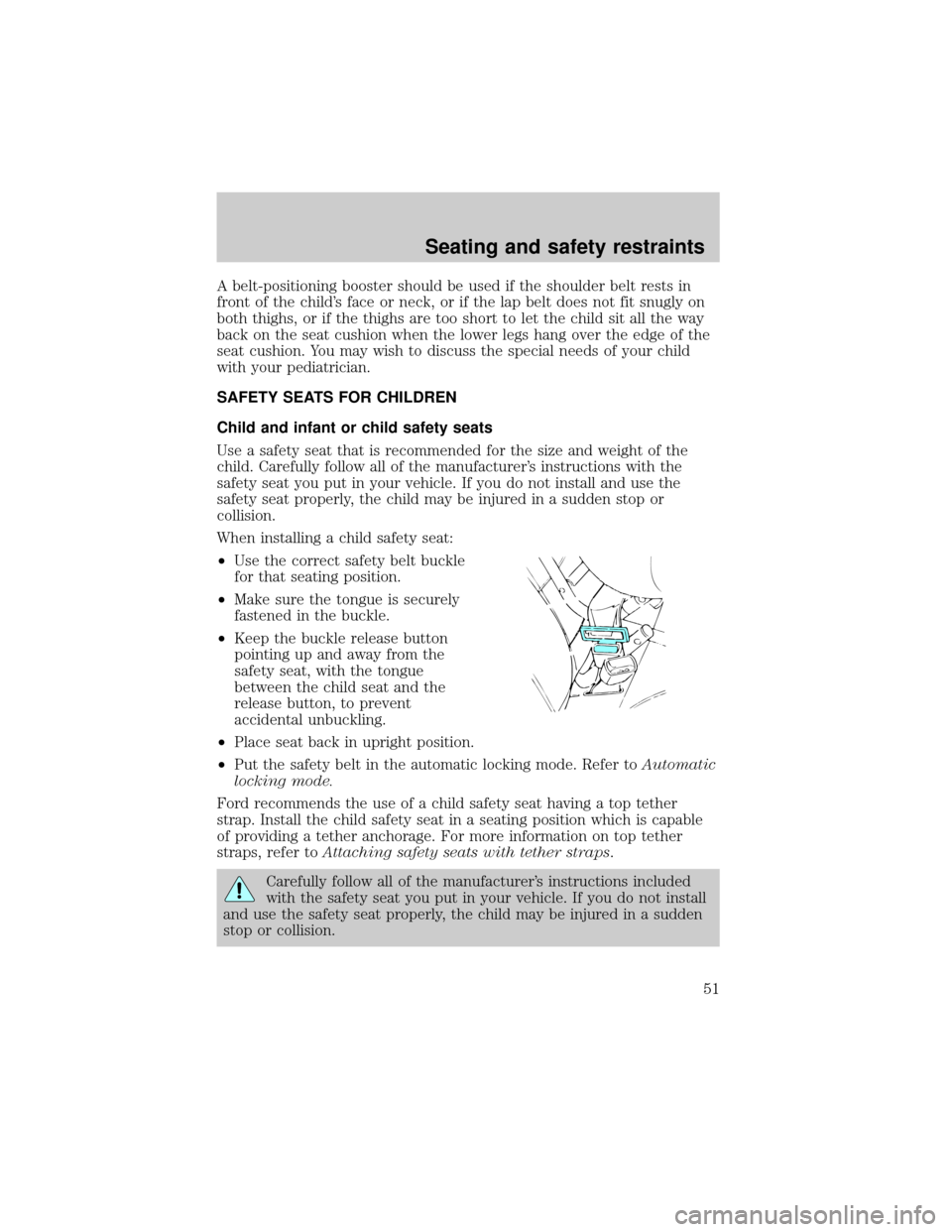
²Use the correct safety belt buckle
for that seating position.
²Make sure the tongue is securely
fastened in the buckle.
²Keep the buckle release button
pointing up and away from the
safety seat, with the tongue
between the child seat and the
release button, to prevent
accidental unbuckling.
²Place seat back in upright position.
²Put the safety belt in the automatic locking mode. Refer toAutomatic
locking mode.
Ford recommends the use of a child safety seat having a top tether
strap. Install the child safety seat in a seating position which is capable
of providing a tether anchorage. For more information on top tether
straps, refer toAttaching safety seats with tether straps.
Carefully follow all of the manufacturer's instructions included
with the safety seat you put in your vehicle. If you do not install
and use the safety seat properly, the child may be injured in a sudden
stop or collision.
Seating and safety restraints
51
Page 68 of 144
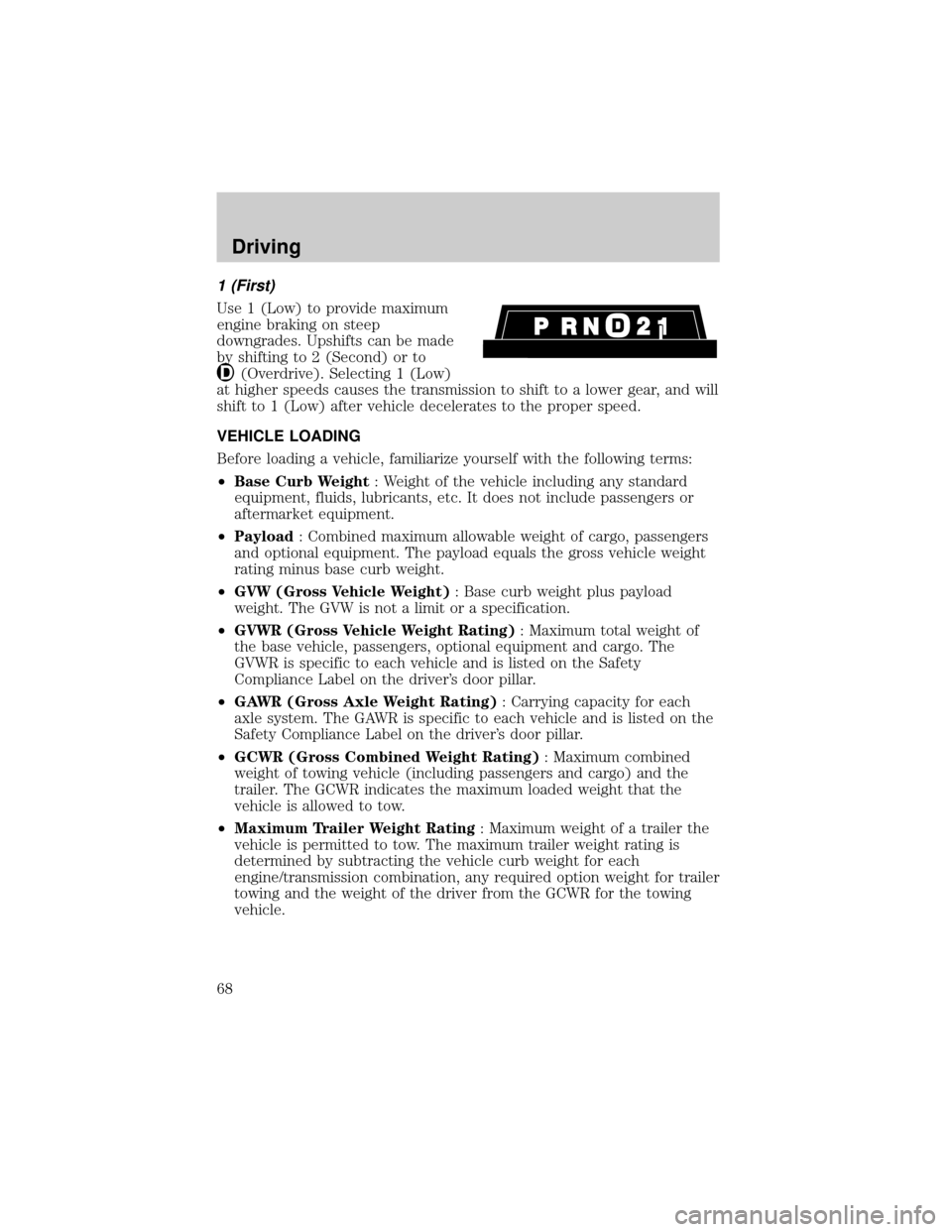
1 (First)
Use 1 (Low) to provide maximum
engine braking on steep
downgrades. Upshifts can be made
by shifting to 2 (Second) or to
(Overdrive). Selecting 1 (Low)
at higher speeds causes the transmission to shift to a lower gear, and will
shift to 1 (Low) after vehicle decelerates to the proper speed.
VEHICLE LOADING
Before loading a vehicle, familiarize yourself with the following terms:
²Base Curb Weight: Weight of the vehicle including any standard
equipment, fluids, lubricants, etc. It does not include passengers or
aftermarket equipment.
²Payload: Combined maximum allowable weight of cargo, passengers
and optional equipment. The payload equals the gross vehicle weight
rating minus base curb weight.
²GVW (Gross Vehicle Weight): Base curb weight plus payload
weight. The GVW is not a limit or a specification.
²GVWR (Gross Vehicle Weight Rating): Maximum total weight of
the base vehicle, passengers, optional equipment and cargo. The
GVWR is specific to each vehicle and is listed on the Safety
Compliance Label on the driver's door pillar.
²GAWR (Gross Axle Weight Rating): Carrying capacity for each
axle system. The GAWR is specific to each vehicle and is listed on the
Safety Compliance Label on the driver's door pillar.
²GCWR (Gross Combined Weight Rating): Maximum combined
weight of towing vehicle (including passengers and cargo) and the
trailer. The GCWR indicates the maximum loaded weight that the
vehicle is allowed to tow.
²Maximum Trailer Weight Rating: Maximum weight of a trailer the
vehicle is permitted to tow. The maximum trailer weight rating is
determined by subtracting the vehicle curb weight for each
engine/transmission combination, any required option weight for trailer
towing and the weight of the driver from the GCWR for the towing
vehicle.
Driving
68
Page 69 of 144

²Maximum Trailer Weight: maximum weight of a trailer the loaded
vehicle (including passengers and cargo) is permitted to tow. It is
determined by subtracting the weight of the loaded trailer towing
vehicle from the GCWR for the towing vehicle.
²Trailer Weight Range: Specified weight range that the trailer must
fall within that ranges from zero to the maximum trailer weight rating.
Remember to figure in the tongue load of your loaded trailer when
figuring the total weight.
Do not exceed the GVWR or the GAWR specified on the Safety
Compliance Certification Label.
Do not use replacement tires with lower weight capacities than the
originals because they may lower the vehicle's GVWR and GAWR
limitations. Replacement tires with a higher weight limit than the
originals do not increase the GVWR and GAWR limitations.
Calculating the load your vehicle can carry/tow
1. Use the Safety Compliance Certification Label to find the axle code
number and engine type for your vehicle.
2. Use the appropriate maximum gross combined weight rating (GCWR)
chart to find the maximum GCWR for your type engine and rear axle
ratio.
3. Weigh your vehicle as you customarily operate the vehicle without
cargo. To obtain correct weights, try taking your vehicle to a shipping
company or an inspection station for trucks.
4. Subtract your loaded vehicle weight from the maximum GCWR on the
following charts. This is the maximum trailer weight your vehicle can tow
and must fall below the maximum shown under maximum trailer weight
on the chart.
Driving
69
Page 70 of 144

DRIVING THROUGH WATER
Do not drive quickly through standing water, especially if the depth is
unknown. Traction or brake capability may be limited and if the ignition
system gets wet, your engine may stall. Water may also enter your
engine's air intake and severely damage your engine.
If driving through deep or standing water is unavoidable, proceed very
slowly. Never drive through water that is higher than the bottom of the
hubs (truck)/wheel rims (car).
Once through the water, always try the brakes. Wet brakes do not stop
the vehicle as effectively as dry brakes. Drying can be improved by
moving your vehicle slowly while applying light pressure on the brake
pedal.
TRAILER TOWING
Your vehicle may tow a class I, II or III trailer provided the maximum
trailer weight is less than or equal to the maximum trailer weight listed
for your engine and rear axle ratio on the following charts.
Trailer Towing Table
GCWR (Gross Combined Weight Rating)/Trailer Weights
EngineRear
axle
ratioMaximum
GCWR-kg
(lbs.)Trailer weight
range-kg (lbs.)
(0-Maximum)Maximum
Frontal Area
Of Trailer-m
2
(ft2)
Regular Van E-150
4.2L 3.31 4 082 (9 000) 1 860 (4 100) 5.52 (60)
4.2L 3.55 4 536 (10 000) 2 313 (5 100) 5.52 (60)
4.6L 3.31 4 990 (11 000) 2 766 (6 100) 5.52 (60)
4.6L 3.55 5 216 (11 500) 2 993 (6 600) 5.52 (60)
5.4L 3.55 5 443 (12 000) 3 130 (6 900) 5.52 (60)
Regular Van E-250
4.2L 3.73 4 763 (10 500) 2 359 (5 200) 5.52 (60)
5.4L 3.73 5 897 (13 000) 3 402 (7 500) 5.52 (60)
Regular Van E-250 HD
4.2L 4.09 4 990 (11 000) 2 586 (5 700) 5.52 (60)
5.4L 3.73 5 897 (13 000) 3 402 (7 500) 5.52 (60)
Driving
70
Page 71 of 144

Trailer Towing Table
GCWR (Gross Combined Weight Rating)/Trailer Weights
EngineRear
axle
ratioMaximum
GCWR-kg
(lbs.)Trailer weight
range-kg (lbs.)
(0-Maximum)Maximum
Frontal Area
Of Trailer-m
2
(ft2)
Super Van E-250
4.2L 3.73 4 763 (10 500) 2 313 (5 100) 5.52 (60)
5.4L 3.73 5 897 (13 000) 3 357 (7 400) 5.52 (60)
Super Van E-250 HD
4.2L 4.09 4 990 (11 000) 2 540 (5 600) 5.52 (60)
5.4L 3.73 5 897 (13 000) 3 356 (7 400) 5.52 (60)
Regular Van E-350
5.4L 3.55 5 443 (12 000) 2 948 (6 500) 5.52 (60)
5.4L 4.10 5 897 (13 000) 3 402 (7 500) 5.52 (60)
6.8L 3.73 6 804 (15 000) 4 218 (9 300) 5.52 (60)
6.8L 4.10 8 392 (18 500) 4 536 (10 000) 5.52 (60)
7.3L
(Diesel)3.55 7 258 (16 000) 4 536 (10 000) 5.52 (60)
7.3L
(Diesel)4.10 9 072 (20 000) 4 536 (10 000) 5.52 (60)
Super Van E-350
5.4L 3.55 5 443 (12 000) 2 858 (6 300) 5.52 (60)
5.4L 4.10 5 897 (13 000) 3 311 (7 300) 5.52 (60)
6.8L 3.73 6 804 (15 000) 4 173 (9 200) 5.52 (60)
6.8L 4.10 8 392 (18 500) 4 536 (10 000) 5.52 (60)
7.3L
(Diesel)3.55 7 258 (16 000) 4 445 (9 800) 5.52 (60)
7.3L
(Diesel)4.10 9 072 (20 000) 4 536 (10 000) 5.52 (60)
Club Wagon E-150 (8 passenger)
4.2L 3.31 4 082 (9 000) 1 678 (3 700) 5.52 (60)
4.2L 3.55 4 536 (10 000) 2 132 (4 700) 5.52 (60)
4.6L 3.31 4 990 (11 000) 2 540 (5 600) 5.52 (60)
Driving
71
Page 72 of 144

Trailer Towing Table
GCWR (Gross Combined Weight Rating)/Trailer Weights
EngineRear
axle
ratioMaximum
GCWR-kg
(lbs.)Trailer weight
range-kg (lbs.)
(0-Maximum)Maximum
Frontal Area
Of Trailer-m
2
(ft2)
4.6L 3.55 5 216 (11 500) 2 767 (6 100) 5.52 (60)
5.4L 3.55 5 443 (12 000) 2 948 (6 500) 5.52 (60)
Club Wagon Regular E-350 (12 passenger)
5.4L 3.55 5 443 (12 000) 2 722 (6 000) 5.52 (60)
5.4L 4.10 5 897 (13 000) 3 175 (7 000) 5.52 (60)
6.8L 3.73 6 804 (15 000) 4 037 (8 900) 5.52 (60)
6.8L 4.10 8 392 (18 500) 4 536 (10 000) 5.52 (60)
7.3L
(Diesel)3.55 7 258 (16 000) 4 309 (9 500) 5.52 (60)
7.3L
(Diesel)4.10 9 072 (20 000) 4 536 (10 000) 5.52 (60)
Club Wagon Super E-350 (15 passenger)
5.4L 3.55 5 443 (12 000) 2 586 (5 700) 5.52 (60)
5.4L 4.10 5 897 (13 000) 3 039 (6 700) 5.52 (60)
6.8L 3.73 6 804 (15 000) 3 901 (8 600) 5.52 (60)
6.8L 4.10 8 392 (18 500) 4 536 (10 000) 5.52 (60)
7.3L
(Diesel)3.55 7 258 (16 000) 4 173 (9 200) 5.52 (60)
7.3L
(Diesel)4.10 9 072 (20 000) 4 536 (10 000) 5.52 (60)
E-350 RV Cutaway (single rear wheel)
7.3L
(Diesel)4.10 9 072 (20 000) 4 717 (10 400)* 5.52 (60)
E-350 RV Cutaway (dual rear wheel)
5.4L 4.10 5 897 (13 000) 1 134 (2 500) 5.52 (60)
6.8L 4.10 8 392 (18 500) 3 629 (8 000) 5.52 (60)
7.3L
(Diesel)4.10 9 072 (20 000) 4 309 (9 500) 5.52 (60)
Driving
72
Page 73 of 144

Trailer Towing Table
GCWR (Gross Combined Weight Rating)/Trailer Weights
EngineRear
axle
ratioMaximum
GCWR-kg
(lbs.)Trailer weight
range-kg (lbs.)
(0-Maximum)Maximum
Frontal Area
Of Trailer-m
2
(ft2)
E-350 Commercial Cutaway (single rear wheel)
7.3L
(Diesel)4.10 9 072 (20 000) 4 717 (10 400)* 5.52 (60)
E-350 Commercial Cutaway (dual rear wheel)
5.4L 4.10 5 897 (13 000) 1 225 (2 700) 5.52 (60)
6.8L 4.10 8 392 (18 500) 3 720 (8 200) 5.52 (60)
7.3L
(Diesel)4.10 9 072 (20 000) 4 400 (9 700) 5.52 (60)
E-Super Duty
6.8L 4.63 9 072 (20 000) 4 536 (10 000) 5.52 (60)
7.3L
(Diesel)4.63 9 072 (20 000) 4 536 (10 000) 5.52 (60)
E-250/350 Stripped Chassis (single rear wheel)
4.2L 4.09 4 990 (11 000) 1 090 (2 400) 5.52 (60)
5.4L 4.10 5 897 (13 000) 1 542 (3 400) 5.52 (60)
6.8L 3.73 6 804 (15 000) 2 540 (5 600) 5.52 (60)
E-250/350 Stripped Chassis (dual rear wheel)
5.4L 4.10 5 897 (13 000) 1 361 (3 000) 5.52 (60)
6.8L 4.10 8 392 (18 500) 3 856 (8 500) 5.52 (60)
Maximum loaded trailer weight of 4 717 kg (10 400 lbs.) on 7.3L E350
RV and commercial cutaways (single rear wheel) applicable to fifth
wheel trailer usage only. Otherwise, maximum trailer weight is 4 536 kg
(10 000 lbs.).
For high altitude operation reduce GCWR by 2% per 300 meters
(1 000 ft) elevation.
To determine the maximum trailer weight designed for you particular
vehicle as equipped, follow the sectionCalculating the load your
vehicle can tow/carryearlier in this chapter.
Driving
73
Page 74 of 144
Your vehicle's load capacity is designated by weight, not by volume, so
you cannot necessarily use all available space when loading a vehicle.
Distribute the load so that only 10 to 15% of the total is on the tongue.
Tie down the load so that it does not shift and change the weight on the
hitch.
Towing a trailer places an additional load on your vehicle's engine,
transmission, axle, brakes, tires and suspension. Inspect these
components carefully after any towing operation.
Do not exceed the GVWR or the GAWR specified on the Safety
Compliance Certification Label.
Towing trailers beyond the maximum recommended gross trailer
weight could result in engine damage, transmission/axle damage,
structural damage, loss of control, and personal injury.
Preparing to tow
Use the proper equipment for towing a trailer, and make sure it is
properly attached to your vehicle. See your dealer or a reliable trailer
dealer if you require assistance.
Hitches
Do not use or install hitches that clamp onto the bumper or to the axle.
Underbody hitches are acceptable if installed properly.
Safety chains
Always connect the trailer's safety chains to the vehicle. To connect the
trailer's safety chains, cross the chains under the trailer tongue and allow
slack for turning corners.
If you use a rental trailer, follow the instructions that the rental agency
gives to you.
Trailer brakes
Electric brakes and manual, automatic or surge-type brakes are safe if
installed properly and adjusted to the manufacturer's specifications. The
trailer brakes must meet local and Federal regulations.
Do not connect a trailer's hydraulic brake system directly to your
vehicle's brake system. Your vehicle may not have enough
braking power and your chances of having a collision greatly increase.
Driving
74
Page 75 of 144

The braking system of the tow vehicle is rated for operation at the
GVWR not GCWR.
Trailer lamps
Trailer lamps are required on most towed vehicles. Make sure your
trailer lamps conform to local and Federal regulations. See your dealer or
trailer rental agency for proper instructions and equipment for hooking
up trailer lamps.
Using a step bumper
The rear bumper is equipped with an integral hitch and requires only a
ball with a 25.4 mm (one inch) shank diameter. The bumper hasa2270
kg (5 000 lb.) trailer weight and 227 kg (500 lb.) tongue weight
capability.
If it is necessary to relocate the trailer hitch ball position, a
frame-mounted trailer hitch must be installed.
Driving while you tow
Do not drive faster than 88 km/h (55 mph) when towing a trailer. Do not
drive faster than 72 km/h (45 mph) with any weight on the trailer while
towing on a hot day or in hilly country.
Speed control may shut off if you are towing on long, steep grades.
When towing a trailer:
²Use D (Drive) or a lower gear when towing up or down steep hills.
This will eliminate excessive downshifting and upshifting for optimum
fuel economy and transmission cooling.
²Anticipate stops and brake gradually.
When descending long, steep downhill grades, always use a lower gear to
provide engine braking to save wear on brakes. Use Drive (Overdrive
OFF) on moderately steep hills, Second (2) on steep hills, and First (1)
on very steep hills.
Servicing after towing
If you tow a trailer for long distances, your vehicle will require more
frequent service intervals. Refer to the Severe Duty Schedule in your
ªService Guideº for more information.
Driving
75
Page 76 of 144

Trailer towing tips
²Practice turning, stopping and backing up in an area before starting on
a trip to get the feel of the vehicle trailer combination. When turning,
make wider turns so the trailer wheels will clear curbs and other
obstacles.
²Allow more distance for stopping with a trailer attached.
²The trailer tongue weight should be 10±15% of the loaded trailer
weight.
²After you have traveled 80 km (50 miles), thoroughly check your
hitch, electrical connections and trailer wheel lug nuts.
²When stopped in traffic for long periods of time in hot weather, place
the gearshift in P (Park) and increase idle speed. This aids engine
cooling and air conditioner efficiency.
²Vehicles with trailers should not be parked on a grade. If you must
park on a grade, place wheel chocks under the trailer's wheels.
Launching or retrieving a boat
When backing down a ramp during boat launching or retrieval,
²Do not allow the static water level to rise above the bottom edge of
the rear bumper and
²Do not allow waves to break higher than 15 cm (six inches) above the
bottom edge of the rear bumper.
Exceeding these limits may allow water to enter critical vehicle
components, adversely affecting driveability, emissions and reliability.
If the rear axle is submerged in water, the rear axle lubricant should be
changed. Axle lubricant quantities are not to be checked unless a leak is
suspected.
FUEL CONSUMPTION
Fuel economy can be improved by avoiding:
²lack of regular, scheduled maintenance.
²excessive speed.
²rapid acceleration.
²extended idle.
Driving
76