weight FORD E SERIES 2003 4.G User Guide
[x] Cancel search | Manufacturer: FORD, Model Year: 2003, Model line: E SERIES, Model: FORD E SERIES 2003 4.GPages: 232, PDF Size: 3.4 MB
Page 129 of 232
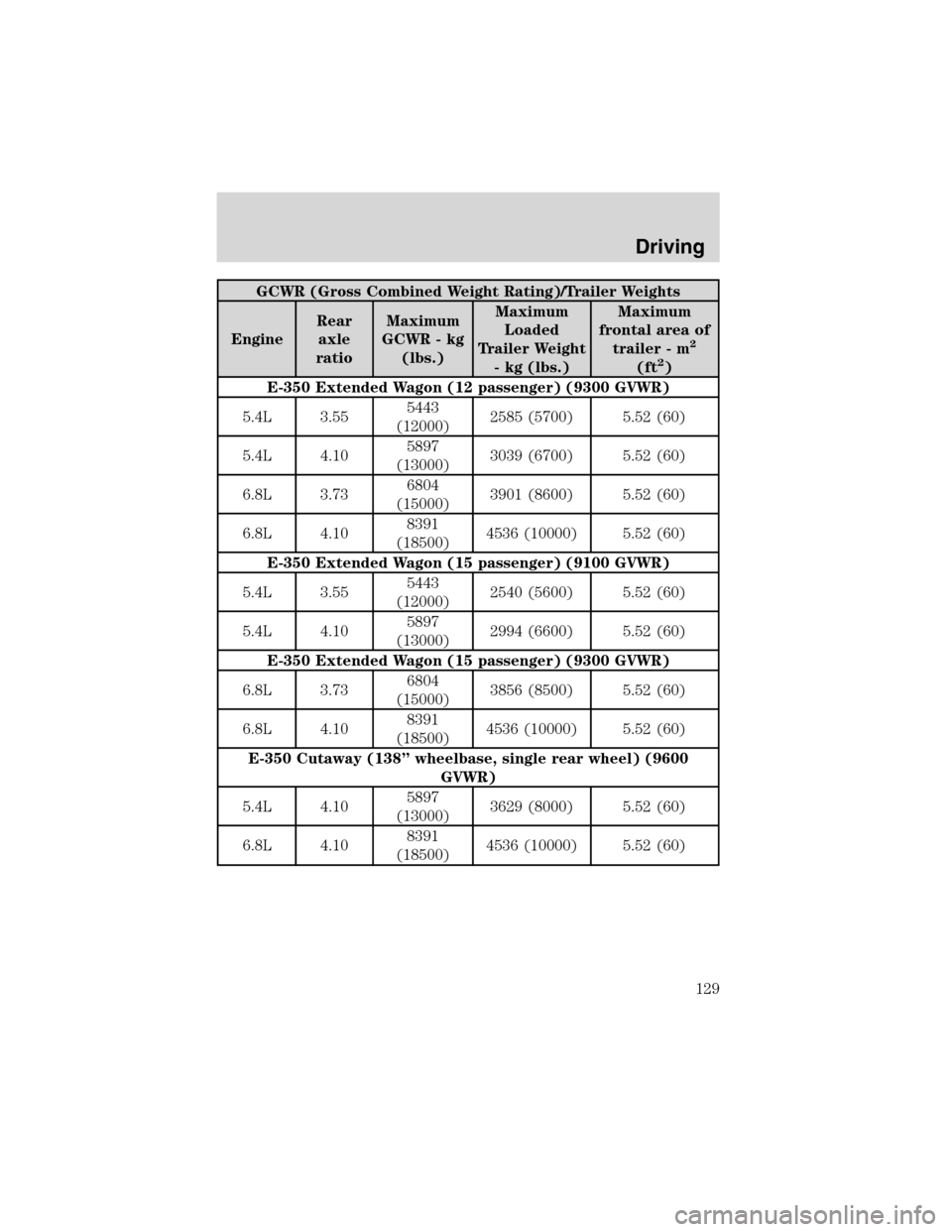
GCWR (Gross Combined Weight Rating)/Trailer Weights
EngineRear
axle
ratioMaximum
GCWR - kg
(lbs.)Maximum
Loaded
Trailer Weight
- kg (lbs.)Maximum
frontal area of
trailer - m
2
(ft2)
E-350 Extended Wagon (12 passenger) (9300 GVWR)
5.4L 3.555443
(12000)2585 (5700) 5.52 (60)
5.4L 4.105897
(13000)3039 (6700) 5.52 (60)
6.8L 3.736804
(15000)3901 (8600) 5.52 (60)
6.8L 4.108391
(18500)4536 (10000) 5.52 (60)
E-350 Extended Wagon (15 passenger) (9100 GVWR)
5.4L 3.555443
(12000)2540 (5600) 5.52 (60)
5.4L 4.105897
(13000)2994 (6600) 5.52 (60)
E-350 Extended Wagon (15 passenger) (9300 GVWR)
6.8L 3.736804
(15000)3856 (8500) 5.52 (60)
6.8L 4.108391
(18500)4536 (10000) 5.52 (60)
E-350 Cutaway (138”wheelbase, single rear wheel) (9600
GVWR)
5.4L 4.105897
(13000)3629 (8000) 5.52 (60)
6.8L 4.108391
(18500)4536 (10000) 5.52 (60)
Driving
129
Page 130 of 232
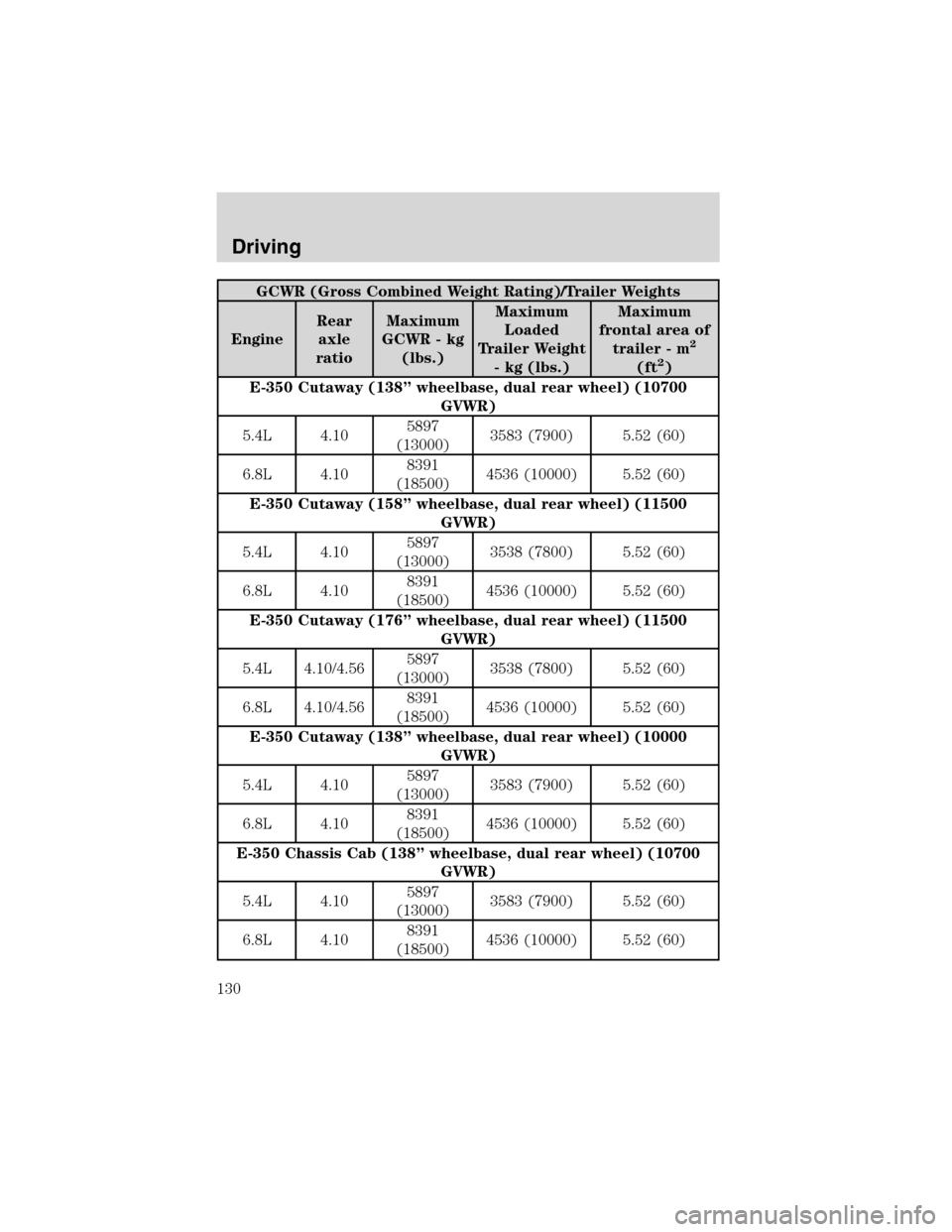
GCWR (Gross Combined Weight Rating)/Trailer Weights
EngineRear
axle
ratioMaximum
GCWR - kg
(lbs.)Maximum
Loaded
Trailer Weight
- kg (lbs.)Maximum
frontal area of
trailer - m
2
(ft2)
E-350 Cutaway (138”wheelbase, dual rear wheel) (10700
GVWR)
5.4L 4.105897
(13000)3583 (7900) 5.52 (60)
6.8L 4.108391
(18500)4536 (10000) 5.52 (60)
E-350 Cutaway (158”wheelbase, dual rear wheel) (11500
GVWR)
5.4L 4.105897
(13000)3538 (7800) 5.52 (60)
6.8L 4.108391
(18500)4536 (10000) 5.52 (60)
E-350 Cutaway (176”wheelbase, dual rear wheel) (11500
GVWR)
5.4L 4.10/4.565897
(13000)3538 (7800) 5.52 (60)
6.8L 4.10/4.568391
(18500)4536 (10000) 5.52 (60)
E-350 Cutaway (138”wheelbase, dual rear wheel) (10000
GVWR)
5.4L 4.105897
(13000)3583 (7900) 5.52 (60)
6.8L 4.108391
(18500)4536 (10000) 5.52 (60)
E-350 Chassis Cab (138”wheelbase, dual rear wheel) (10700
GVWR)
5.4L 4.105897
(13000)3583 (7900) 5.52 (60)
6.8L 4.108391
(18500)4536 (10000) 5.52 (60)
Driving
130
Page 131 of 232
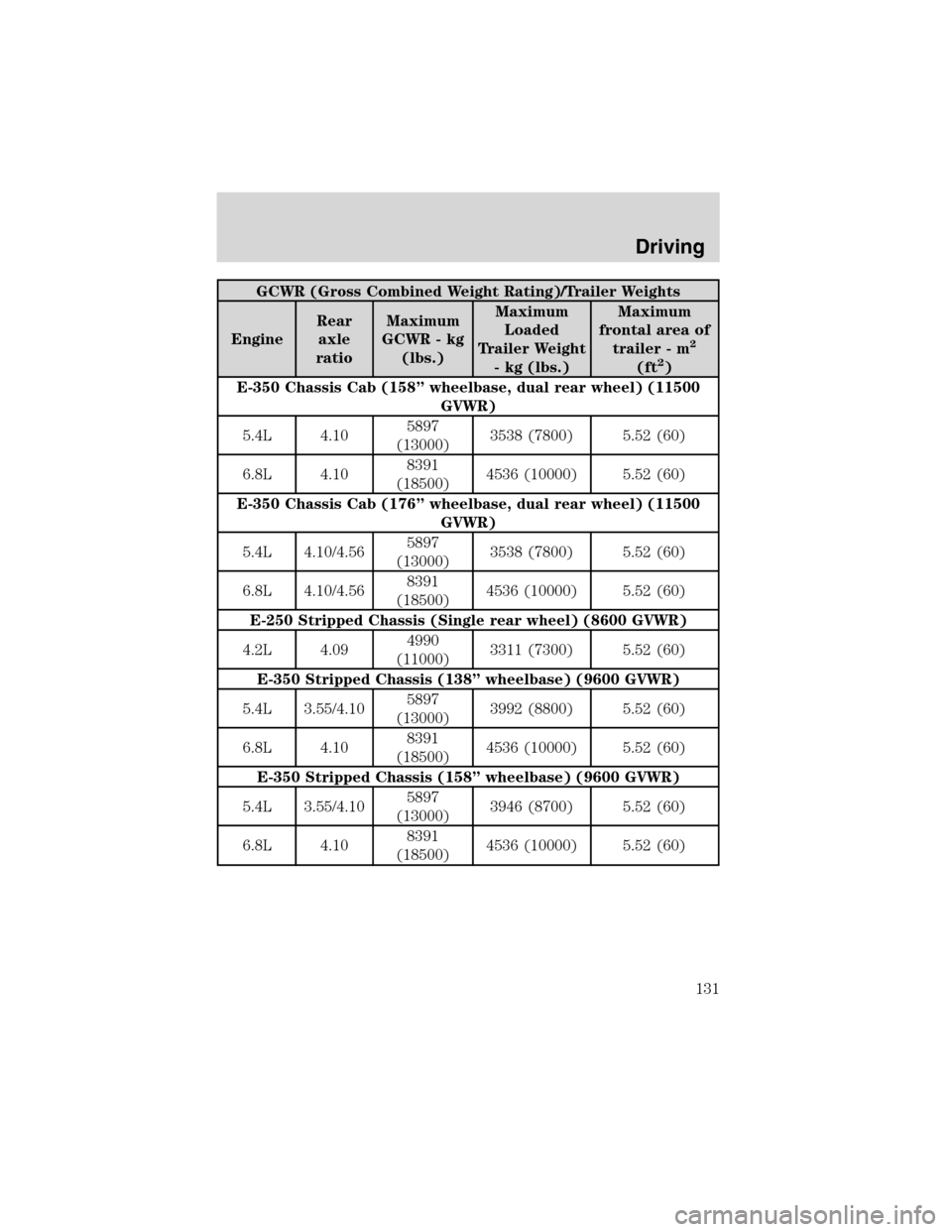
GCWR (Gross Combined Weight Rating)/Trailer Weights
EngineRear
axle
ratioMaximum
GCWR - kg
(lbs.)Maximum
Loaded
Trailer Weight
- kg (lbs.)Maximum
frontal area of
trailer - m
2
(ft2)
E-350 Chassis Cab (158”wheelbase, dual rear wheel) (11500
GVWR)
5.4L 4.105897
(13000)3538 (7800) 5.52 (60)
6.8L 4.108391
(18500)4536 (10000) 5.52 (60)
E-350 Chassis Cab (176”wheelbase, dual rear wheel) (11500
GVWR)
5.4L 4.10/4.565897
(13000)3538 (7800) 5.52 (60)
6.8L 4.10/4.568391
(18500)4536 (10000) 5.52 (60)
E-250 Stripped Chassis (Single rear wheel) (8600 GVWR)
4.2L 4.094990
(11000)3311 (7300) 5.52 (60)
E-350 Stripped Chassis (138”wheelbase) (9600 GVWR)
5.4L 3.55/4.105897
(13000)3992 (8800) 5.52 (60)
6.8L 4.108391
(18500)4536 (10000) 5.52 (60)
E-350 Stripped Chassis (158”wheelbase) (9600 GVWR)
5.4L 3.55/4.105897
(13000)3946 (8700) 5.52 (60)
6.8L 4.108391
(18500)4536 (10000) 5.52 (60)
Driving
131
Page 132 of 232
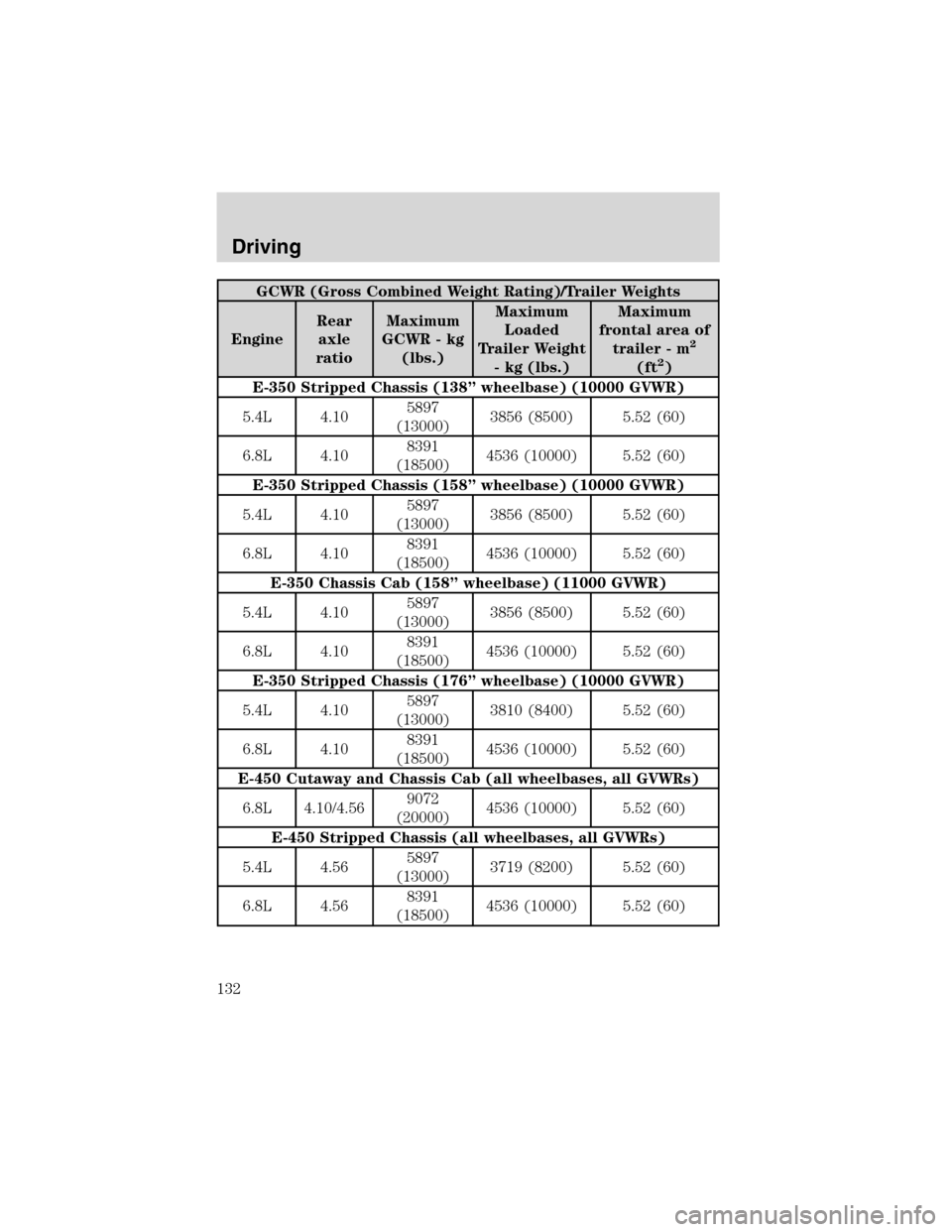
GCWR (Gross Combined Weight Rating)/Trailer Weights
EngineRear
axle
ratioMaximum
GCWR - kg
(lbs.)Maximum
Loaded
Trailer Weight
- kg (lbs.)Maximum
frontal area of
trailer - m
2
(ft2)
E-350 Stripped Chassis (138”wheelbase) (10000 GVWR)
5.4L 4.105897
(13000)3856 (8500) 5.52 (60)
6.8L 4.108391
(18500)4536 (10000) 5.52 (60)
E-350 Stripped Chassis (158”wheelbase) (10000 GVWR)
5.4L 4.105897
(13000)3856 (8500) 5.52 (60)
6.8L 4.108391
(18500)4536 (10000) 5.52 (60)
E-350 Chassis Cab (158”wheelbase) (11000 GVWR)
5.4L 4.105897
(13000)3856 (8500) 5.52 (60)
6.8L 4.108391
(18500)4536 (10000) 5.52 (60)
E-350 Stripped Chassis (176”wheelbase) (10000 GVWR)
5.4L 4.105897
(13000)3810 (8400) 5.52 (60)
6.8L 4.108391
(18500)4536 (10000) 5.52 (60)
E-450 Cutaway and Chassis Cab (all wheelbases, all GVWRs)
6.8L 4.10/4.569072
(20000)4536 (10000) 5.52 (60)
E-450 Stripped Chassis (all wheelbases, all GVWRs)
5.4L 4.565897
(13000)3719 (8200) 5.52 (60)
6.8L 4.568391
(18500)4536 (10000) 5.52 (60)
Driving
132
Page 133 of 232
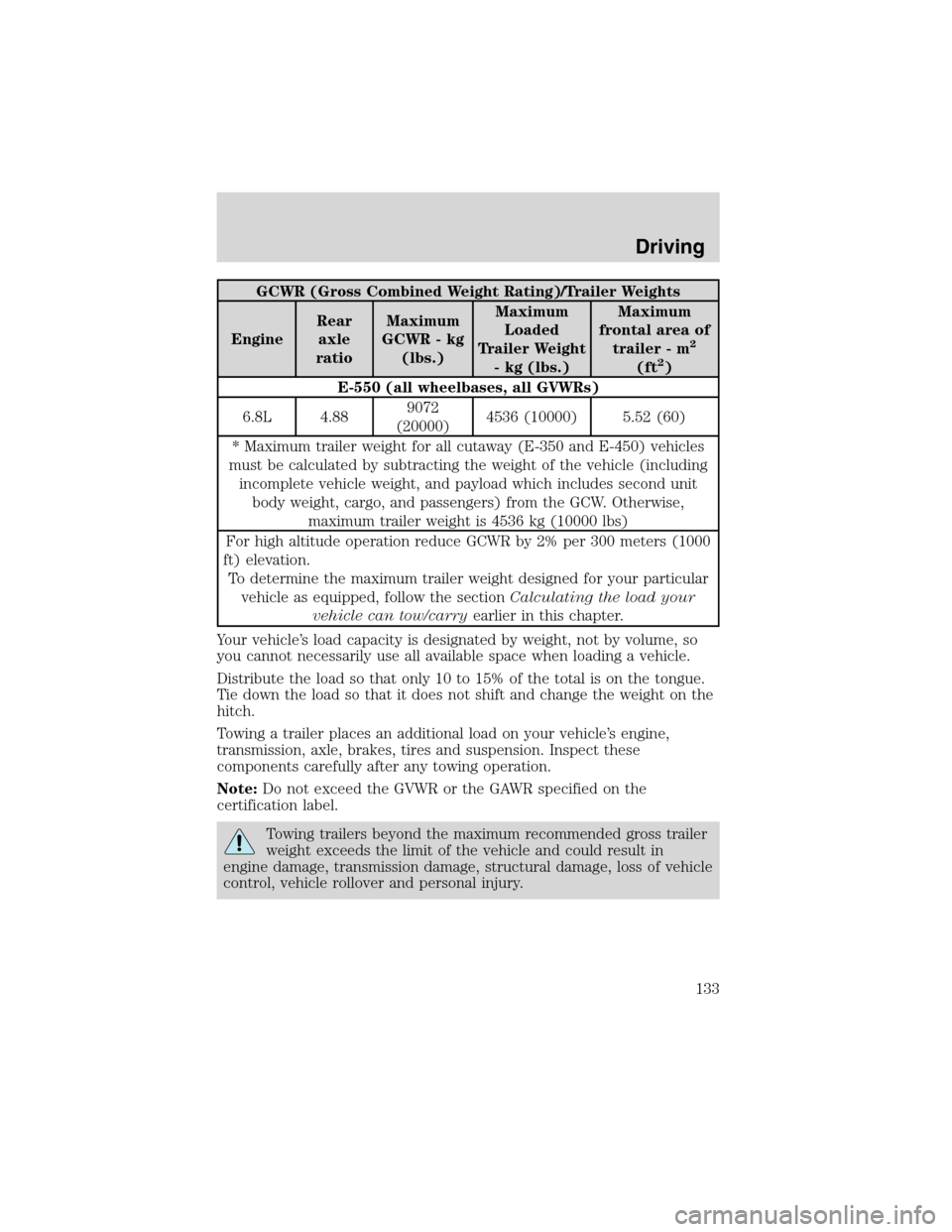
GCWR (Gross Combined Weight Rating)/Trailer Weights
EngineRear
axle
ratioMaximum
GCWR - kg
(lbs.)Maximum
Loaded
Trailer Weight
- kg (lbs.)Maximum
frontal area of
trailer - m
2
(ft2)
E-550 (all wheelbases, all GVWRs)
6.8L 4.889072
(20000)4536 (10000) 5.52 (60)
* Maximum trailer weight for all cutaway (E-350 and E-450) vehicles
must be calculated by subtracting the weight of the vehicle (including
incomplete vehicle weight, and payload which includes second unit
body weight, cargo, and passengers) from the GCW. Otherwise,
maximum trailer weight is 4536 kg (10000 lbs)
For high altitude operation reduce GCWR by 2% per 300 meters (1000
ft) elevation.
To determine the maximum trailer weight designed for your particular
vehicle as equipped, follow the sectionCalculating the load your
vehicle can tow/carryearlier in this chapter.
Your vehicle’s load capacity is designated by weight, not by volume, so
you cannot necessarily use all available space when loading a vehicle.
Distribute the load so that only 10 to 15% of the total is on the tongue.
Tie down the load so that it does not shift and change the weight on the
hitch.
Towing a trailer places an additional load on your vehicle’s engine,
transmission, axle, brakes, tires and suspension. Inspect these
components carefully after any towing operation.
Note:Do not exceed the GVWR or the GAWR specified on the
certification label.
Towing trailers beyond the maximum recommended gross trailer
weight exceeds the limit of the vehicle and could result in
engine damage, transmission damage, structural damage, loss of vehicle
control, vehicle rollover and personal injury.
Driving
133
Page 134 of 232
Preparing to tow
Use the proper equipment for towing a trailer and make sure it is
properly attached to your vehicle. See your dealer or a reliable trailer
dealer if you require assistance.
Hitches
Do not use or install hitches that clamp onto the bumper or to the axle.
Underbody hitches are acceptable if installed properly.
Safety chains
Always connect the trailer’s safety chains to the frame or hook retainers
of the vehicle hitch. To connect the trailer’s safety chains, cross the
chains under the trailer tongue and allow slack for turning corners.
If you use a rental trailer, follow the instructions that the rental agency
gives to you.
Do not attach safety chains to the bumper.
Trailer brakes
Electric brakes and manual, automatic or surge-type trailer brakes are
safe if installed properly and adjusted to the manufacturer’s
specifications. The trailer brakes must meet local and Federal
regulations.
Do not connect a trailer’s hydraulic brake system directly to your
vehicle’s brake system. Your vehicle may not have enough
braking power and your chances of having a collision greatly increase.
The braking system of the tow vehicle is rated for operation at the
GVWR not GCWR.
Trailer lamps
Trailer lamps are required on most towed vehicles. Make sure your
trailer lamps conform to local and Federal regulations. See your dealer or
trailer rental agency for proper instructions and equipment for hooking
up trailer lamps.
Using a step bumper (if equipped)
The rear bumper is equipped with an integral hitch and only requires a
ball with a 25.4 mm (one inch) shank diameter. The bumper has a 2,270
kg (5,000 lb.) trailer weight and 227 kg (500 lb.) tongue weight capacity.
Driving
134
Page 135 of 232
If it is necessary to relocate the trailer hitch ball position, a
frame-mounted trailer hitch must be installed.
Driving while you tow
When towing a trailer:
•Turn off the speed control. The speed control may shut off
automatically when you are towing on long, steep grades.
•Consult your local motor vehicle speed regulations for towing a trailer.
•To eliminate excessive shifting, use a lower gear. This will also assist
in transmission cooling.
•Anticipate stops and brake gradually.
When descending long, steep downhill grades, always use a lower gear to
provide engine braking to save wear on brakes. Use Drive (Overdrive
OFF) on moderately steep hills, Second (2) on steep hills, and First (1)
on very steep hills.Do not apply your brakes continuously, as they
may overheat and become less effective.
Servicing after towing
If you tow a trailer for long distances, your vehicle will require more
frequent service intervals. Refer to your scheduled maintenance guide for
more information.
Trailer towing tips
•Practice turning, stopping and backing up before starting on a trip to
get the feel of the vehicle trailer combination. When turning, make
wider turns so the trailer wheels will clear curbs and other obstacles.
•Allow more distance for stopping with a trailer attached.
•The trailer tongue weight should be 10–15% of the loaded trailer
weight.
•If you will be towing a trailer frequently in hot weather, hilly
conditions, at GCW, or any combination of these factors, consider
refilling your rear axle with synthetic gear lube. Refer to the
Maintenance and specificationschapter for the lubricant
specification.
•After you have traveled 80 km (50 miles), thoroughly check your
hitch, electrical connections and trailer wheel lug nuts.
•When stopped in traffic for long periods of time in hot weather, place
the gearshift in P (Park) and increase idle speed. This aids engine
cooling and air conditioner efficiency.
Driving
135
Page 200 of 232
Habits
•Smooth, moderate operation can yield up to 10% savings in fuel.
•Steady speeds without stopping will usually give the best fuel
economy.
•Idling for long periods of time (greater than one minute) may waste
fuel.
•Anticipate stopping; slowing down may eliminate the need to stop.
•Sudden or hard accelerations may reduce fuel economy.
•Slow down gradually.
•Driving at reasonable speeds (traveling at 88 km/h [55 mph] uses 15%
less fuel than traveling at 105 km/h [65 mph]).
•Revving the engine before turning it off may reduce fuel economy.
•Using the air conditioner or defroster may reduce fuel economy.
•You may want to turn off the speed control in hilly terrain if
unnecessary shifting between third and fourth gear occurs.
Unnecessary shifting of this type could result in reduced fuel
economy.
•Warming up a vehicle on cold mornings is not required and may
reduce fuel economy.
•Resting your foot on the brake pedal while driving may reduce fuel
economy.
•Combine errands and minimize stop-and-go driving.
Maintenance
•Keep tires properly inflated and use only recommended size.
•Operating a vehicle with the wheels out of alignment will reduce fuel
economy.
•Use recommended engine oil. Refer toLubricant specificationsin
this chapter.
•Perform all regularly scheduled maintenance items. Follow the
recommended maintenance schedule and owner maintenance checks
found in your vehicle scheduled maintenance guide.
Conditions
•Heavily loading a vehicle or towing a trailer may reduce fuel economy
at any speed.
•Carrying unnecessary weight may reduce fuel economy (approximately
0.4 km/L [1 mpg] is lost for every 180 kg [400 lb] of weight carried).
Maintenance and Specifications
200
Page 226 of 232
•When adding accessories, equipment, passengers and luggage to your
vehicle, do not exceed the total weight capacity of the vehicle or of
the front or rear axle (GVWR or GAWR as indicated on the Safety
compliance certification label). Consult your dealer for specific weight
information.
•The Federal Communications Commission (FCC) and Canadian Radio
Telecommunications Commission (CRTC) regulate the use of mobile
communications systems - such as two-way radios, telephones and
theft alarms - that are equipped with radio transmitters. Any such
equipment installed in your vehicle should comply with FCC or CRTC
regulations and should be installed only by a qualified service
technician.
•Mobile communications systems may harm the operation of your
vehicle, particularly if they are not properly designed for automotive
use or are not properly installed. When operated, such systems may
cause the engine to stumble or stall or cause the transmission to be
damaged or operate improperly. In addition, such systems may be
damaged or their performance may be affected by operating your
vehicle. (Citizens band [CB] transceivers, garage door openers and
other transmitters with outputs of five watts or less will not ordinarily
affect your vehicle’s operation.)
•Ford cannot assume responsibility for any adverse effects or damage
that may result from the use of such equipment.
Accessories
226
Page 229 of 232
Fluid capacities .........................213
Four-Wheel Drive vehicles
preparing to drive your
vehicle .....................................116
Fuel ............................................194
calculating fuel economy .......198
cap ...........................................196
capacity ...................................213
choosing the right fuel ...........196
comparisons with EPA fuel
economy estimates .................201
detergent in fuel .....................197
filling your vehicle with
fuel ...........................194, 196, 198
filter, specifications ........198, 212
fuel pump shut-off switch .....139
improving fuel economy ........198
octane rating ...................197, 220
quality ......................................197
running out of fuel .................198
safety information relating to
automotive fuels .....................194
Fuses ..................................140–141
G
Garage door opener ....................63
Gas cap (see Fuel cap) ............196
Gas mileage (see Fuel
economy) ...................................198
Gauges .........................................13
GAWR (Gross Axle Weight
Rating) .......................................122
calculating ...............................124
definition .................................122
driving with a heavy load ......122
location ....................................122
GVWR (Gross Vehicle Weight
Rating) .......................................122
calculating .......................122, 124definition .................................122
driving with a heavy load ......122
location ....................................122
H
Headlamps ...................................53
aiming ........................................54
bulb specifications ....................55
daytime running lights .............53
flash to pass ..............................54
high beam .................................53
replacing bulbs ...................56–57
turning on and off ....................53
Heating
heater only system .............50, 52
heating and air conditioning
system .......................................51
Hood ..........................................177
I
Ignition ...............................111, 220
Infant seats (see Safety seats) ..99
Inspection/maintenance (I/M)
testing ........................................202
Instrument panel
cleaning ...................................173
cluster ........................................10
lighting up panel and
interior .......................................54
J
Jump-starting your vehicle ......155
K
Keys
positions of the ignition .........111
Index
229