wheel FORD E SERIES 2003 4.G User Guide
[x] Cancel search | Manufacturer: FORD, Model Year: 2003, Model line: E SERIES, Model: FORD E SERIES 2003 4.GPages: 232, PDF Size: 3.4 MB
Page 121 of 232
•It often may be less risky to strike small objects, such as highway
reflectors, with minor damage to your vehicle rather than attempt a
sudden return to the pavement which could cause the vehicle to slide
sideways out of control or roll over. Remember, your safety and the
safety of others should be your primary concern.
Vehicles with a higher center of gravity such as utility and
four-wheel drive vehicles handle differently than vehicles with a
lower center of gravity. Utility and four-wheel drive vehicles arenot
designed for cornering at speeds as high as passenger cars any more
than low-slung sports cars are designed to perform satisfactorily under
off-road conditions. Avoid sharp turns, excessive speed and abrupt
maneuvers in these vehicles. Failure to drive cautiously could result in
an increased risk of loss of vehicle control, vehicle rollover, personal
injury and death.
If your vehicle gets stuck in mud or snow
If your vehicle gets stuck in mud or snow, it may be rocked out by
shifting from forward and reverse gears, stopping between shifts in a
steady pattern. Press lightly on the accelerator in each gear.
Do not rock the vehicle if the engine is not at normal operating
temperature or damage to the transmission may occur.
Do not rock the vehicle for more than a minute or damage to the
transmission and tires may occur, or the engine may overheat.
DRIVING THROUGH WATER
If driving through deep or standing water is unavoidable, proceed very
slowly especially if the depth is not known. Never drive through water
that is higher than the bottom of the hubs (for trucks) or the bottom of
the wheel rims (for cars). Traction or brake capability may be limited
and your vehicle may stall. Water may also enter your engine’s air intake
and severely damage your engine.
Once through the water, always dry the brakes by moving your vehicle
slowly while applying light pressure on the brake pedal. Wet brakes do
not stop the vehicle as quickly as dry brakes.Driving through deep
water where the transmission vent tube is submerged may allow
water into the transmission and cause internal transmission
damage.
Driving
121
Page 122 of 232
EMERGENCY MANEUVERS
•In an unavoidable emergency situation where a sudden sharp turn
must be made, remember to avoid“over-driving”your vehicle, i.e.,
turn the steering wheel only as rapidly and as far as required to avoid
the emergency. Excessive steering will result in less vehicle control,
not more. Additionally, smooth variations of the accelerator and/or
brake pedal pressure should be utilized if changes in vehicle speed are
called for. Avoid abrupt steering, acceleration or braking which could
result in an increased risk of loss of vehicle control, vehicle rollover
and/or personal injury. Use all available road surface to return the
vehicle to a safe direction of travel.
•In the event of an emergency stop, avoid skidding the tires and do not
attempt any sharp steering wheel movements.
Vehicles with a higher center of gravity such as utility and
four-wheel drive vehicles handle differently than vehicles with a
lower center of gravity. Utility and four-wheel drive vehicles arenot
designed for cornering at speeds as high as passenger cars any more
than low-slung sports cars are designed to perform satisfactorily under
off-road conditions. Avoid sharp turns, excessive speed and abrupt
maneuvers in these vehicles. Failure to drive cautiously could result in
an increased risk of loss of vehicle control, vehicle rollover, personal
injury and death.
•If the vehicle goes from one type of surface to another (i.e., from
concrete to gravel) there will be a change in the way the vehicle
responds to a maneuver (steering, acceleration or braking). Again,
avoid these abrupt inputs.
VEHICLE LOADING
Before loading a vehicle, familiarize yourself with the following terms:
•Base Curb Weight:Weight of the vehicle including any standard
equipment, fluids, lubricants, etc. It does not include occupants or
aftermarket equipment.
•Payload:Combined maximum allowable weight of cargo, occupants
and optional equipment. The payload equals the gross vehicle weight
rating minus base curb weight.
•
GVW (Gross Vehicle Weight):Base curb weight plus payload weight.
Driving
122
Page 129 of 232
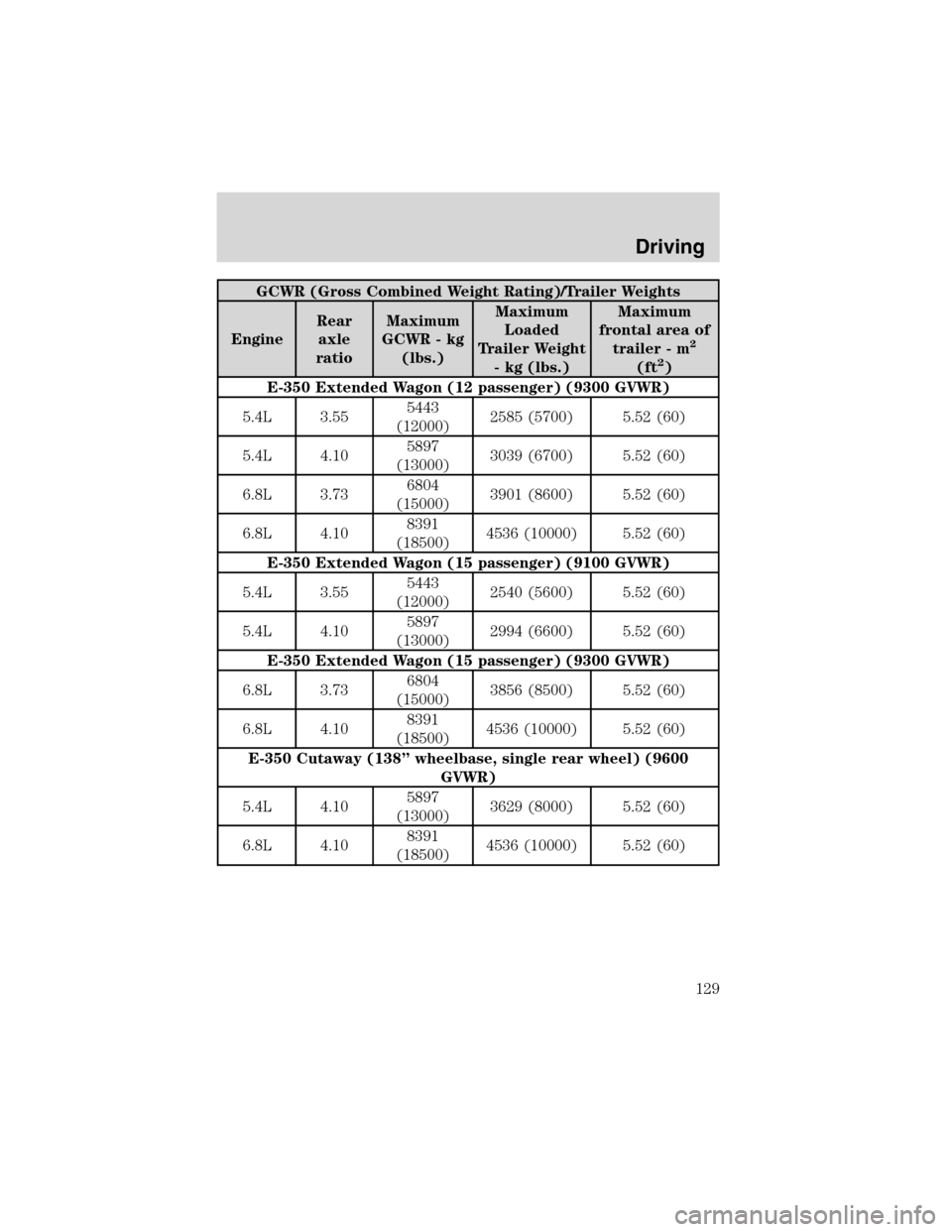
GCWR (Gross Combined Weight Rating)/Trailer Weights
EngineRear
axle
ratioMaximum
GCWR - kg
(lbs.)Maximum
Loaded
Trailer Weight
- kg (lbs.)Maximum
frontal area of
trailer - m
2
(ft2)
E-350 Extended Wagon (12 passenger) (9300 GVWR)
5.4L 3.555443
(12000)2585 (5700) 5.52 (60)
5.4L 4.105897
(13000)3039 (6700) 5.52 (60)
6.8L 3.736804
(15000)3901 (8600) 5.52 (60)
6.8L 4.108391
(18500)4536 (10000) 5.52 (60)
E-350 Extended Wagon (15 passenger) (9100 GVWR)
5.4L 3.555443
(12000)2540 (5600) 5.52 (60)
5.4L 4.105897
(13000)2994 (6600) 5.52 (60)
E-350 Extended Wagon (15 passenger) (9300 GVWR)
6.8L 3.736804
(15000)3856 (8500) 5.52 (60)
6.8L 4.108391
(18500)4536 (10000) 5.52 (60)
E-350 Cutaway (138”wheelbase, single rear wheel) (9600
GVWR)
5.4L 4.105897
(13000)3629 (8000) 5.52 (60)
6.8L 4.108391
(18500)4536 (10000) 5.52 (60)
Driving
129
Page 130 of 232
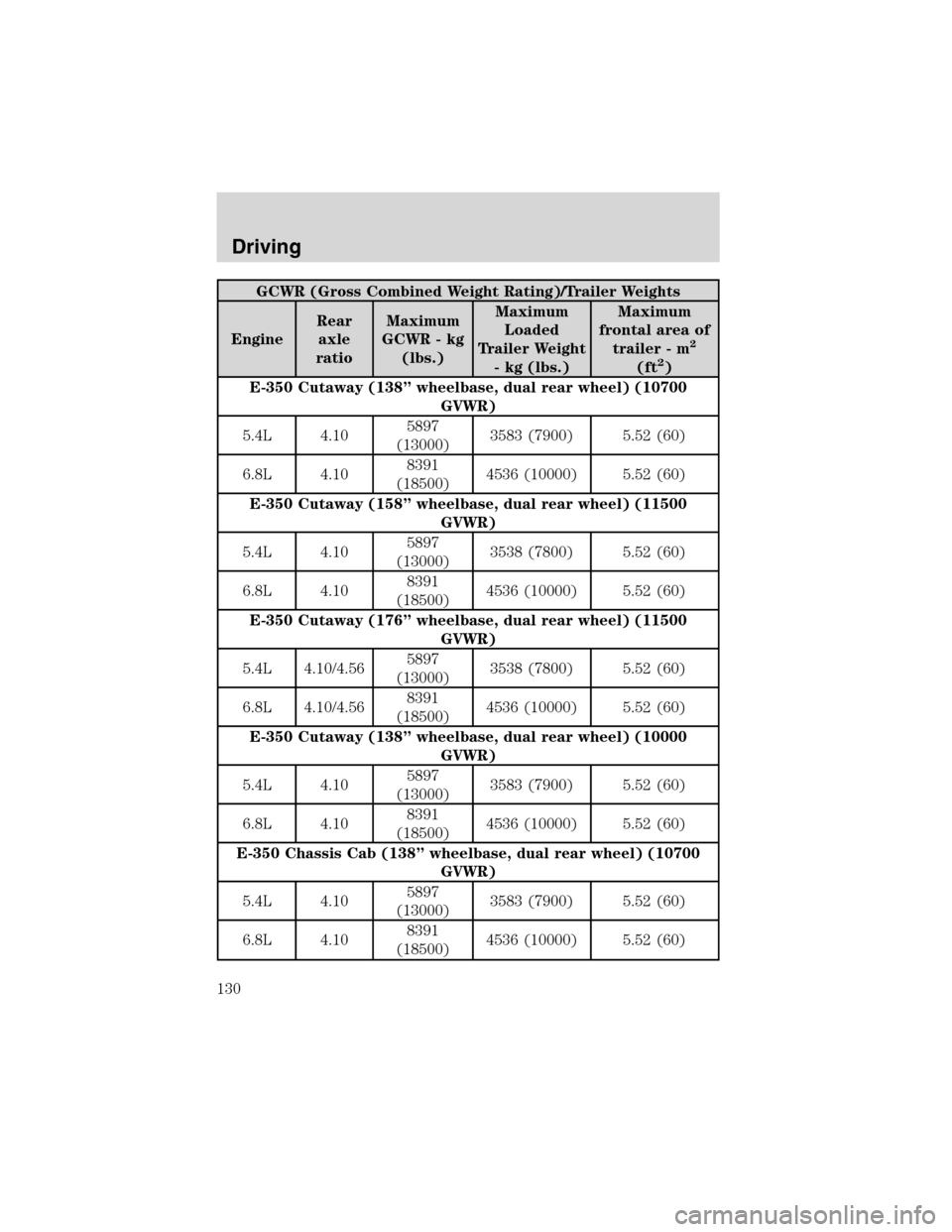
GCWR (Gross Combined Weight Rating)/Trailer Weights
EngineRear
axle
ratioMaximum
GCWR - kg
(lbs.)Maximum
Loaded
Trailer Weight
- kg (lbs.)Maximum
frontal area of
trailer - m
2
(ft2)
E-350 Cutaway (138”wheelbase, dual rear wheel) (10700
GVWR)
5.4L 4.105897
(13000)3583 (7900) 5.52 (60)
6.8L 4.108391
(18500)4536 (10000) 5.52 (60)
E-350 Cutaway (158”wheelbase, dual rear wheel) (11500
GVWR)
5.4L 4.105897
(13000)3538 (7800) 5.52 (60)
6.8L 4.108391
(18500)4536 (10000) 5.52 (60)
E-350 Cutaway (176”wheelbase, dual rear wheel) (11500
GVWR)
5.4L 4.10/4.565897
(13000)3538 (7800) 5.52 (60)
6.8L 4.10/4.568391
(18500)4536 (10000) 5.52 (60)
E-350 Cutaway (138”wheelbase, dual rear wheel) (10000
GVWR)
5.4L 4.105897
(13000)3583 (7900) 5.52 (60)
6.8L 4.108391
(18500)4536 (10000) 5.52 (60)
E-350 Chassis Cab (138”wheelbase, dual rear wheel) (10700
GVWR)
5.4L 4.105897
(13000)3583 (7900) 5.52 (60)
6.8L 4.108391
(18500)4536 (10000) 5.52 (60)
Driving
130
Page 131 of 232
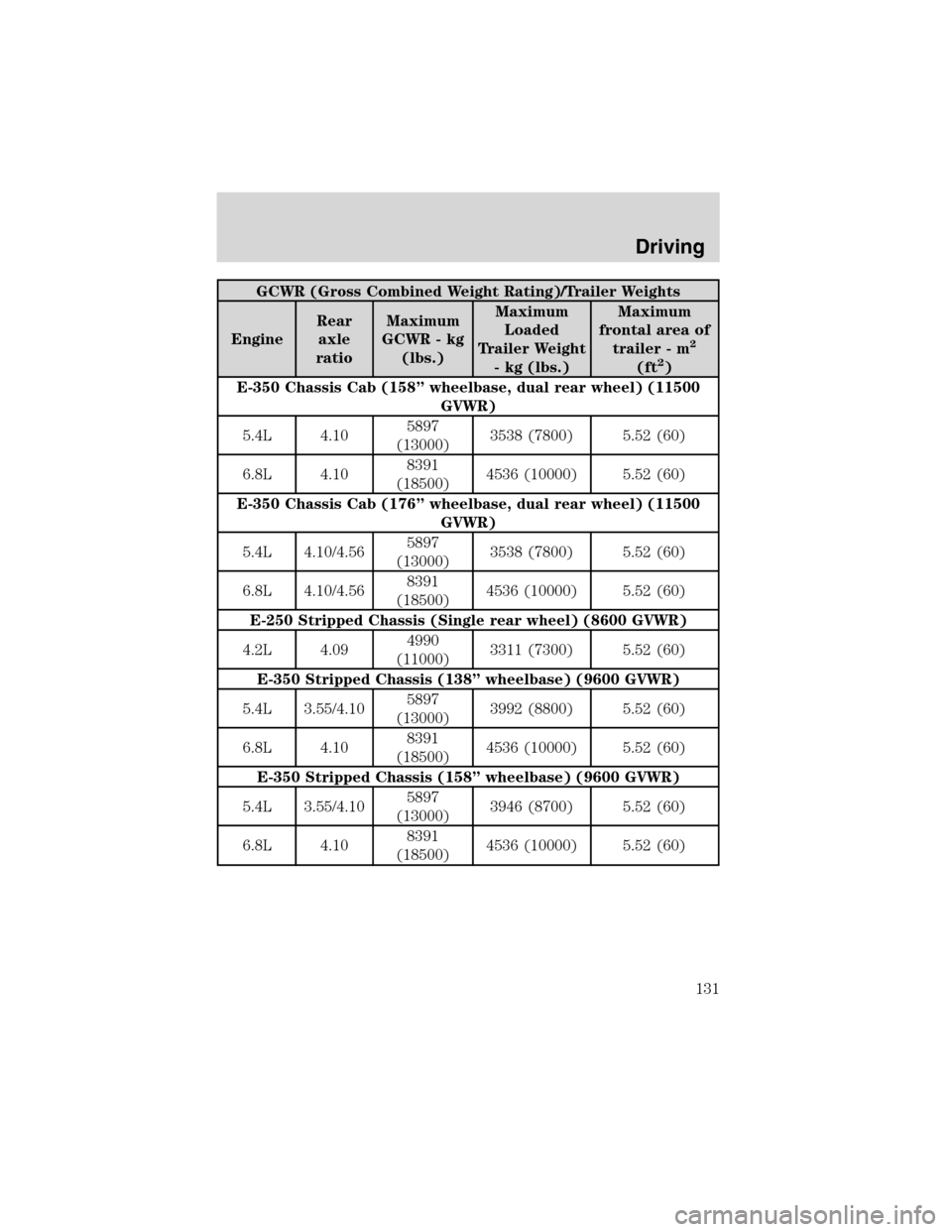
GCWR (Gross Combined Weight Rating)/Trailer Weights
EngineRear
axle
ratioMaximum
GCWR - kg
(lbs.)Maximum
Loaded
Trailer Weight
- kg (lbs.)Maximum
frontal area of
trailer - m
2
(ft2)
E-350 Chassis Cab (158”wheelbase, dual rear wheel) (11500
GVWR)
5.4L 4.105897
(13000)3538 (7800) 5.52 (60)
6.8L 4.108391
(18500)4536 (10000) 5.52 (60)
E-350 Chassis Cab (176”wheelbase, dual rear wheel) (11500
GVWR)
5.4L 4.10/4.565897
(13000)3538 (7800) 5.52 (60)
6.8L 4.10/4.568391
(18500)4536 (10000) 5.52 (60)
E-250 Stripped Chassis (Single rear wheel) (8600 GVWR)
4.2L 4.094990
(11000)3311 (7300) 5.52 (60)
E-350 Stripped Chassis (138”wheelbase) (9600 GVWR)
5.4L 3.55/4.105897
(13000)3992 (8800) 5.52 (60)
6.8L 4.108391
(18500)4536 (10000) 5.52 (60)
E-350 Stripped Chassis (158”wheelbase) (9600 GVWR)
5.4L 3.55/4.105897
(13000)3946 (8700) 5.52 (60)
6.8L 4.108391
(18500)4536 (10000) 5.52 (60)
Driving
131
Page 132 of 232
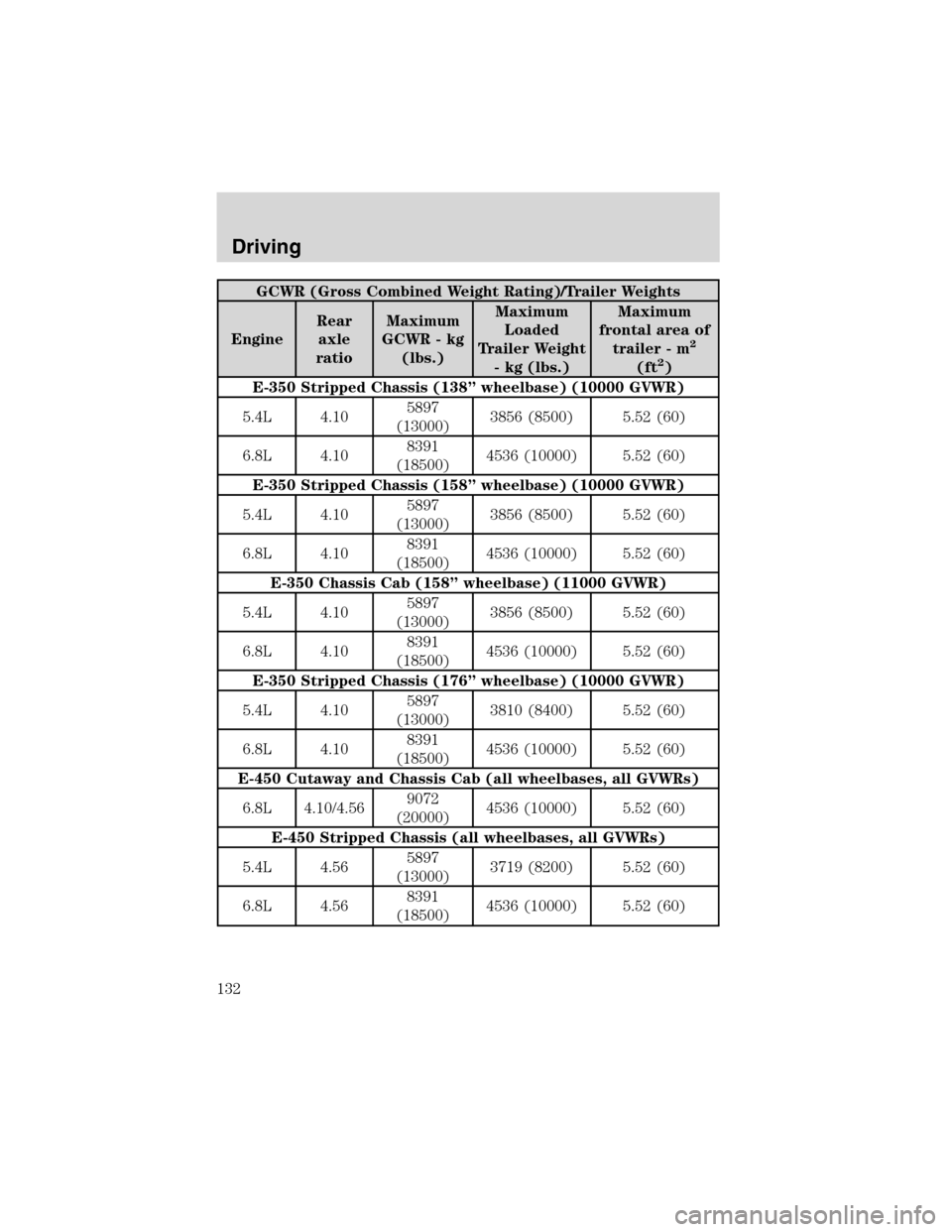
GCWR (Gross Combined Weight Rating)/Trailer Weights
EngineRear
axle
ratioMaximum
GCWR - kg
(lbs.)Maximum
Loaded
Trailer Weight
- kg (lbs.)Maximum
frontal area of
trailer - m
2
(ft2)
E-350 Stripped Chassis (138”wheelbase) (10000 GVWR)
5.4L 4.105897
(13000)3856 (8500) 5.52 (60)
6.8L 4.108391
(18500)4536 (10000) 5.52 (60)
E-350 Stripped Chassis (158”wheelbase) (10000 GVWR)
5.4L 4.105897
(13000)3856 (8500) 5.52 (60)
6.8L 4.108391
(18500)4536 (10000) 5.52 (60)
E-350 Chassis Cab (158”wheelbase) (11000 GVWR)
5.4L 4.105897
(13000)3856 (8500) 5.52 (60)
6.8L 4.108391
(18500)4536 (10000) 5.52 (60)
E-350 Stripped Chassis (176”wheelbase) (10000 GVWR)
5.4L 4.105897
(13000)3810 (8400) 5.52 (60)
6.8L 4.108391
(18500)4536 (10000) 5.52 (60)
E-450 Cutaway and Chassis Cab (all wheelbases, all GVWRs)
6.8L 4.10/4.569072
(20000)4536 (10000) 5.52 (60)
E-450 Stripped Chassis (all wheelbases, all GVWRs)
5.4L 4.565897
(13000)3719 (8200) 5.52 (60)
6.8L 4.568391
(18500)4536 (10000) 5.52 (60)
Driving
132
Page 133 of 232
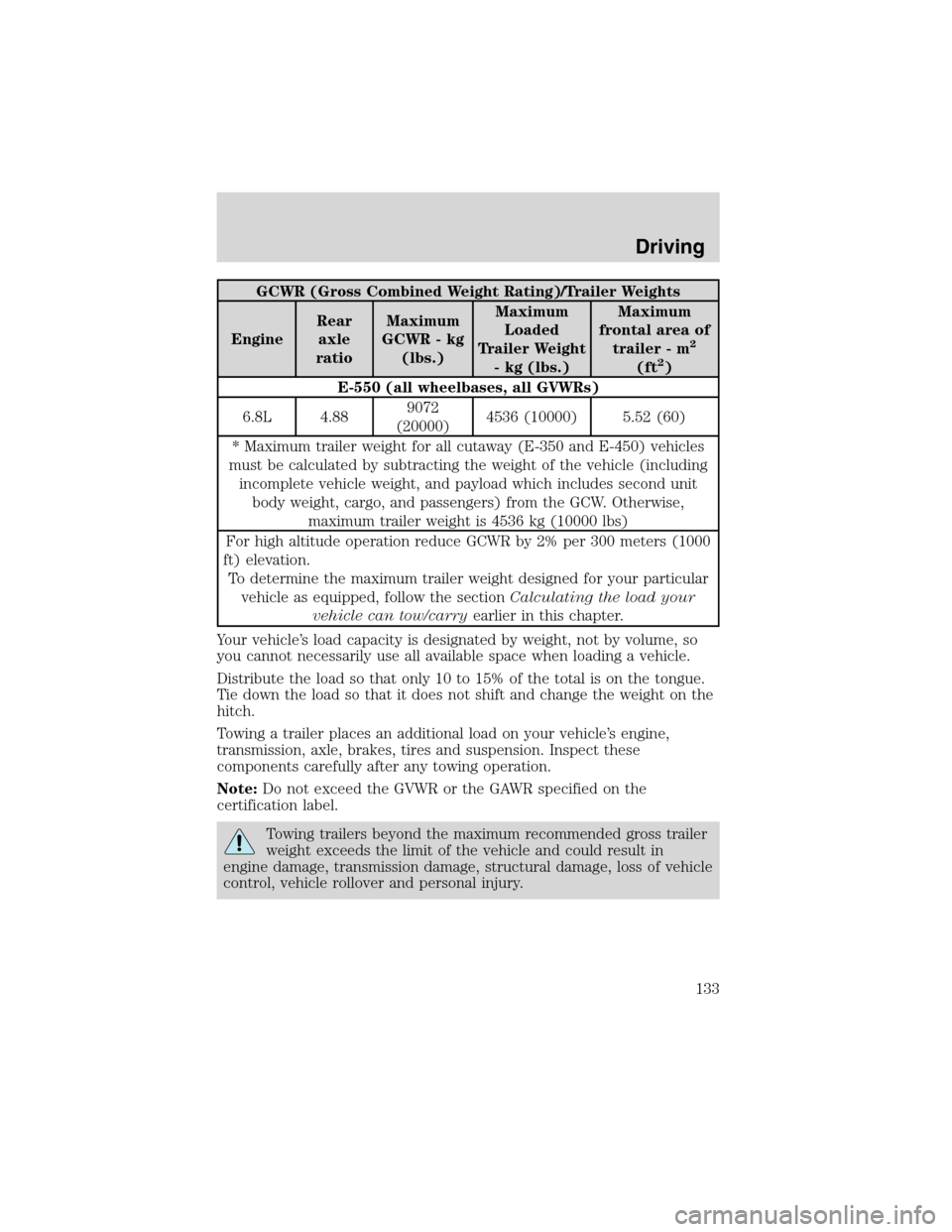
GCWR (Gross Combined Weight Rating)/Trailer Weights
EngineRear
axle
ratioMaximum
GCWR - kg
(lbs.)Maximum
Loaded
Trailer Weight
- kg (lbs.)Maximum
frontal area of
trailer - m
2
(ft2)
E-550 (all wheelbases, all GVWRs)
6.8L 4.889072
(20000)4536 (10000) 5.52 (60)
* Maximum trailer weight for all cutaway (E-350 and E-450) vehicles
must be calculated by subtracting the weight of the vehicle (including
incomplete vehicle weight, and payload which includes second unit
body weight, cargo, and passengers) from the GCW. Otherwise,
maximum trailer weight is 4536 kg (10000 lbs)
For high altitude operation reduce GCWR by 2% per 300 meters (1000
ft) elevation.
To determine the maximum trailer weight designed for your particular
vehicle as equipped, follow the sectionCalculating the load your
vehicle can tow/carryearlier in this chapter.
Your vehicle’s load capacity is designated by weight, not by volume, so
you cannot necessarily use all available space when loading a vehicle.
Distribute the load so that only 10 to 15% of the total is on the tongue.
Tie down the load so that it does not shift and change the weight on the
hitch.
Towing a trailer places an additional load on your vehicle’s engine,
transmission, axle, brakes, tires and suspension. Inspect these
components carefully after any towing operation.
Note:Do not exceed the GVWR or the GAWR specified on the
certification label.
Towing trailers beyond the maximum recommended gross trailer
weight exceeds the limit of the vehicle and could result in
engine damage, transmission damage, structural damage, loss of vehicle
control, vehicle rollover and personal injury.
Driving
133
Page 135 of 232
If it is necessary to relocate the trailer hitch ball position, a
frame-mounted trailer hitch must be installed.
Driving while you tow
When towing a trailer:
•Turn off the speed control. The speed control may shut off
automatically when you are towing on long, steep grades.
•Consult your local motor vehicle speed regulations for towing a trailer.
•To eliminate excessive shifting, use a lower gear. This will also assist
in transmission cooling.
•Anticipate stops and brake gradually.
When descending long, steep downhill grades, always use a lower gear to
provide engine braking to save wear on brakes. Use Drive (Overdrive
OFF) on moderately steep hills, Second (2) on steep hills, and First (1)
on very steep hills.Do not apply your brakes continuously, as they
may overheat and become less effective.
Servicing after towing
If you tow a trailer for long distances, your vehicle will require more
frequent service intervals. Refer to your scheduled maintenance guide for
more information.
Trailer towing tips
•Practice turning, stopping and backing up before starting on a trip to
get the feel of the vehicle trailer combination. When turning, make
wider turns so the trailer wheels will clear curbs and other obstacles.
•Allow more distance for stopping with a trailer attached.
•The trailer tongue weight should be 10–15% of the loaded trailer
weight.
•If you will be towing a trailer frequently in hot weather, hilly
conditions, at GCW, or any combination of these factors, consider
refilling your rear axle with synthetic gear lube. Refer to the
Maintenance and specificationschapter for the lubricant
specification.
•After you have traveled 80 km (50 miles), thoroughly check your
hitch, electrical connections and trailer wheel lug nuts.
•When stopped in traffic for long periods of time in hot weather, place
the gearshift in P (Park) and increase idle speed. This aids engine
cooling and air conditioner efficiency.
Driving
135
Page 136 of 232
•Vehicles with trailers should not be parked on a grade. If you must
park on a grade, place wheel chocks under the trailer’s wheels.
Launching or retrieving a boat
Disconnect the wiring to the trailer before backing the trailer
into the water. Reconnect the wiring to the trailer after the
trailer is removed from the water.
When backing down a ramp during boat launching or retrieval:
•do not allow the static water level to rise above the bottom edge of
the rear bumper.
•do not allow waves to break higher than 15 cm (6 inches) above the
bottom edge of the rear bumper.
Exceeding these limits may allow water to enter vehicle components:
•causing internal damage to the components.
•affecting driveability, emissions and reliability.
Replace the rear axle lubricant any time the axle has been submerged in
water. Rear axle lubricant quantities are not to be checked or changed
unless a leak is suspected or repair required.
RECREATIONAL TOWING (ALL WHEELS ON THE GROUND)
An example of recreational towing would be towing your vehicle on a
trip behind a motorhome. Follow these guidelines if you have the need
for recreational towing your vehicle with all four wheels on the ground.
These guidelines are designed to ensure that your transmission is not
damaged.
2WD vehicles (with automatic transmissions):
•Place the transmission in N (Neutral)
•Maximum speed is 56 km (35 mph)
•Maximum distance is 80 km (50 miles)
If a distance of 80 km (50 miles) or a speed of 56 km (35 mph) must be
exceeded, the drive shaft will have to be removed.
Ford recommends the driveshaft be removed/installed only by a qualified
technician. See your local dealer for driveshaft removal/installation.
Improper removal/installation of the driveshaft can cause
transmission fluid loss, damage to the driveshaft and internal
transmission components.
Driving
136
Page 138 of 232
Canadian customers who require roadside assistance, call
1–800–665–2006.
If you need to arrange roadside assistance for yourself, Ford Motor
Company will reimburse a reasonable amount. To obtain reimbursement
information, U.S. Ford or Mercury vehicles customers call
1-800-241-3673; Lincoln vehicle customers call 1–800–521–4140.
Canadian customers who need to obtain reimbursement information, call
1–800–665–2006.
ROADSIDE COVERAGE BEYOND BASIC WARRANTY
In the United States, you may purchase additional roadside assistance
coverage beyond this period through the Ford Auto Club by contacting
your Ford or Lincoln Mercury dealer.
Similarly in Canada, for uninterrupted Roadside Assistance coverage, you
may purchase extended coverage prior to your Basic Warranty’s Roadside
Assistance expiring. For more information and enrollment, contact
1–877–294–2582 or visit our website at www.ford.ca.
HAZARD FLASHER
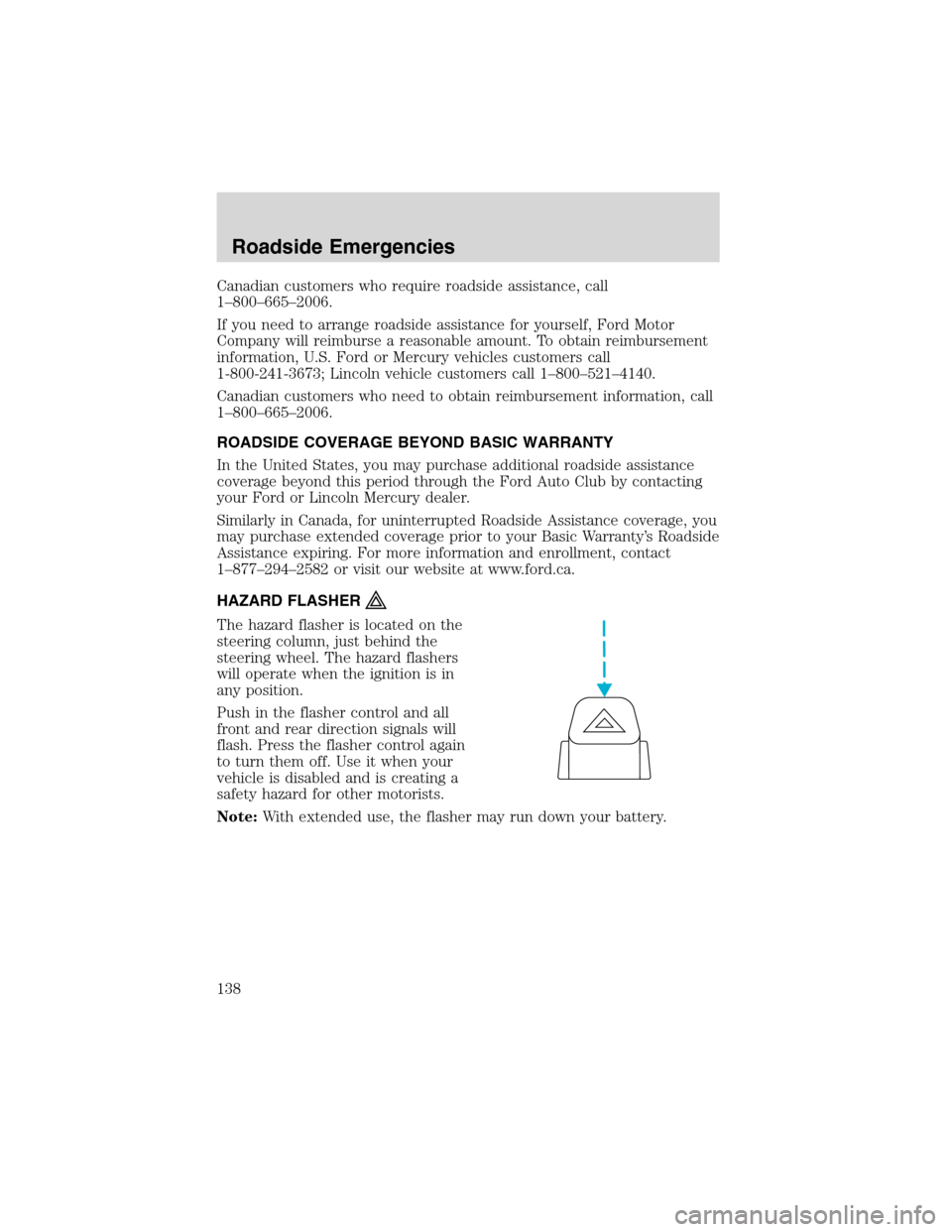
The hazard flasher is located on the
steering column, just behind the
steering wheel. The hazard flashers
will operate when the ignition is in
any position.
Push in the flasher control and all
front and rear direction signals will
flash. Press the flasher control again
to turn them off. Use it when your
vehicle is disabled and is creating a
safety hazard for other motorists.
Note:With extended use, the flasher may run down your battery.
Roadside Emergencies
138