ignition FORD E SERIES 2003 4.G Owner's Guide
[x] Cancel search | Manufacturer: FORD, Model Year: 2003, Model line: E SERIES, Model: FORD E SERIES 2003 4.GPages: 232, PDF Size: 3.4 MB
Page 201 of 232
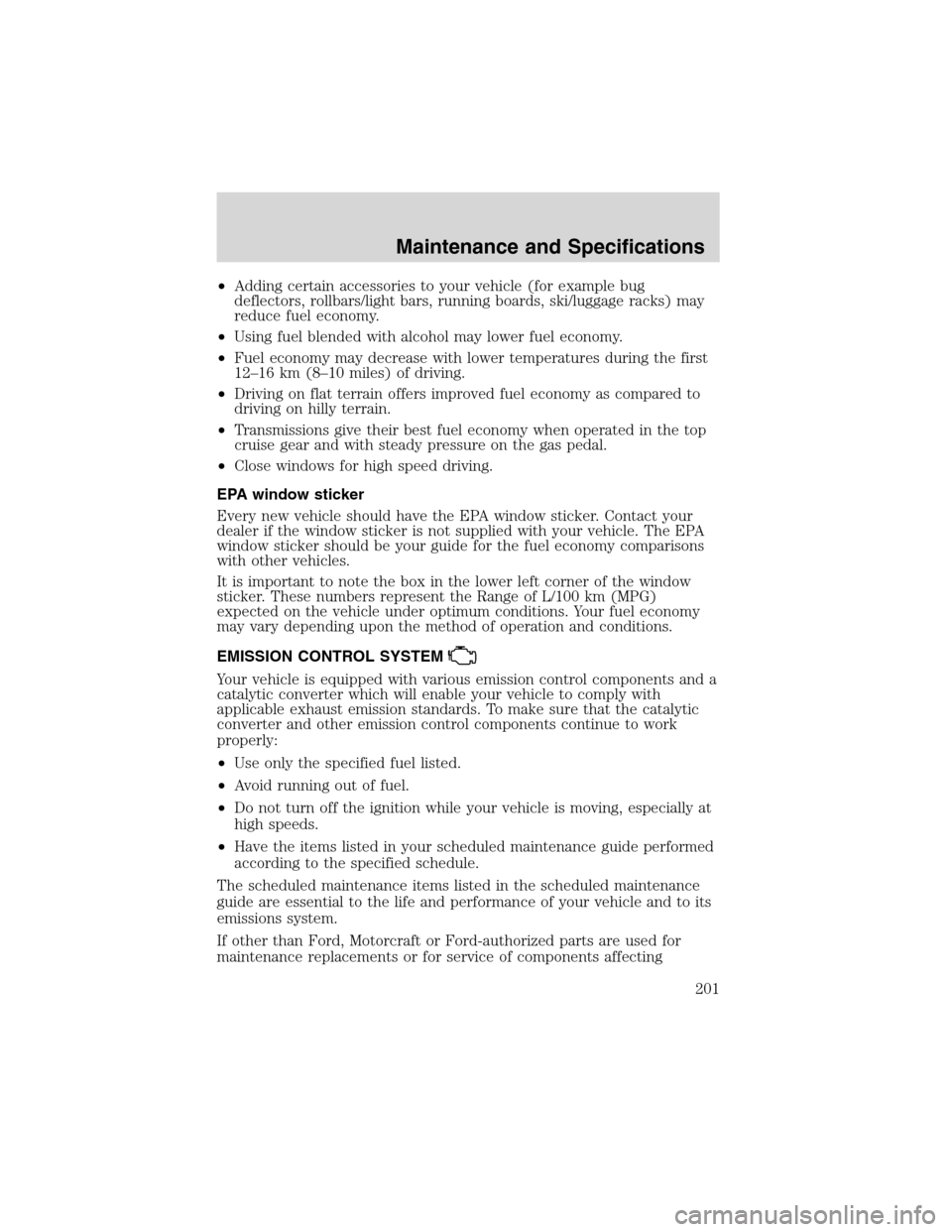
•Adding certain accessories to your vehicle (for example bug
deflectors, rollbars/light bars, running boards, ski/luggage racks) may
reduce fuel economy.
•Using fuel blended with alcohol may lower fuel economy.
•Fuel economy may decrease with lower temperatures during the first
12–16 km (8–10 miles) of driving.
•Driving on flat terrain offers improved fuel economy as compared to
driving on hilly terrain.
•Transmissions give their best fuel economy when operated in the top
cruise gear and with steady pressure on the gas pedal.
•Close windows for high speed driving.
EPA window sticker
Every new vehicle should have the EPA window sticker. Contact your
dealer if the window sticker is not supplied with your vehicle. The EPA
window sticker should be your guide for the fuel economy comparisons
with other vehicles.
It is important to note the box in the lower left corner of the window
sticker. These numbers represent the Range of L/100 km (MPG)
expected on the vehicle under optimum conditions. Your fuel economy
may vary depending upon the method of operation and conditions.
EMISSION CONTROL SYSTEM
Your vehicle is equipped with various emission control components and a
catalytic converter which will enable your vehicle to comply with
applicable exhaust emission standards. To make sure that the catalytic
converter and other emission control components continue to work
properly:
•Use only the specified fuel listed.
•Avoid running out of fuel.
•Do not turn off the ignition while your vehicle is moving, especially at
high speeds.
•Have the items listed in your scheduled maintenance guide performed
according to the specified schedule.
The scheduled maintenance items listed in the scheduled maintenance
guide are essential to the life and performance of your vehicle and to its
emissions system.
If other than Ford, Motorcraft or Ford-authorized parts are used for
maintenance replacements or for service of components affecting
Maintenance and Specifications
201
Page 220 of 232
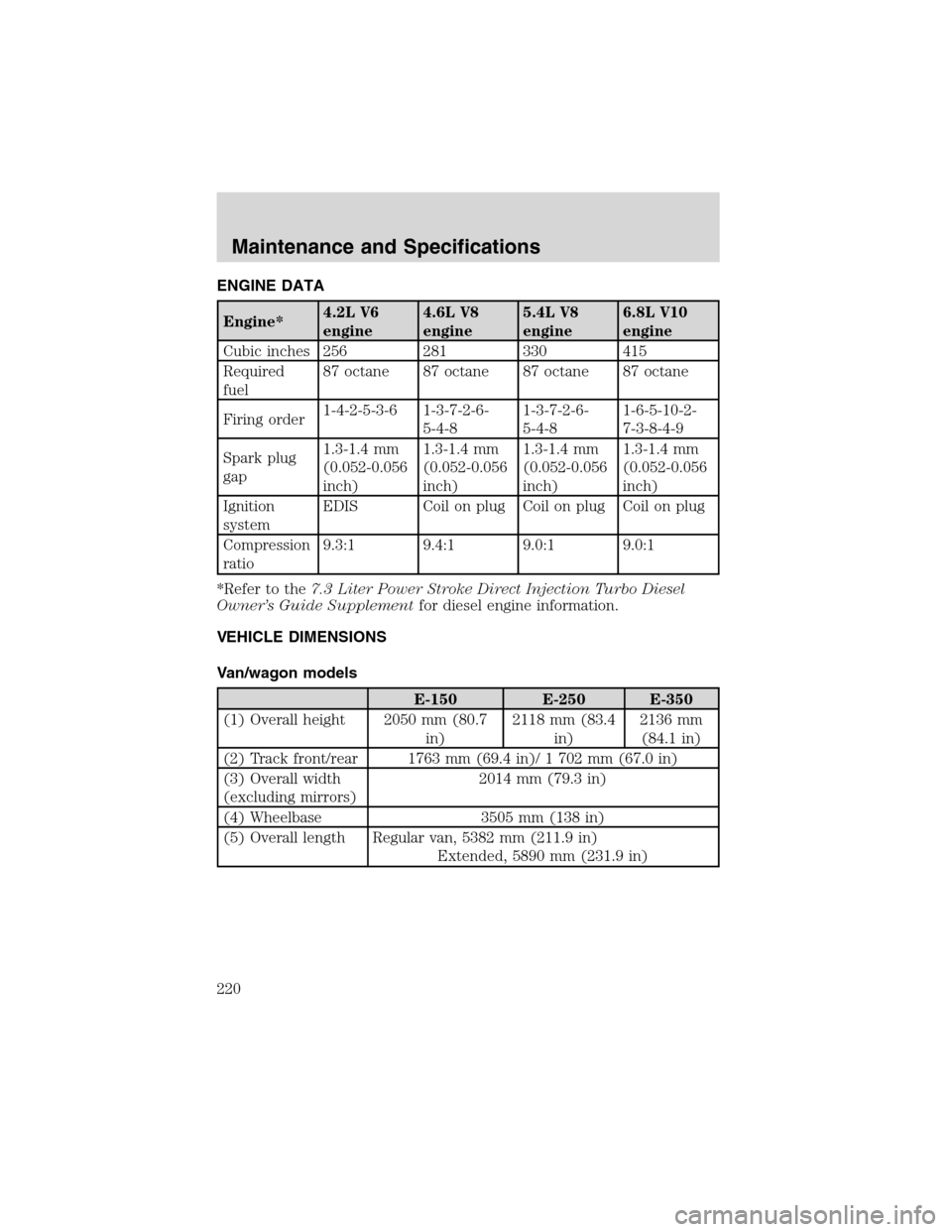
ENGINE DATA
Engine*4.2L V6
engine4.6L V8
engine5.4L V8
engine6.8L V10
engine
Cubic inches 256 281 330 415
Required
fuel87 octane 87 octane 87 octane 87 octane
Firing order1-4-2-5-3-6 1-3-7-2-6-
5-4-81-3-7-2-6-
5-4-81-6-5-10-2-
7-3-8-4-9
Spark plug
gap1.3-1.4 mm
(0.052-0.056
inch)1.3-1.4 mm
(0.052-0.056
inch)1.3-1.4 mm
(0.052-0.056
inch)1.3-1.4 mm
(0.052-0.056
inch)
Ignition
systemEDIS Coil on plug Coil on plug Coil on plug
Compression
ratio9.3:1 9.4:1 9.0:1 9.0:1
*Refer to the7.3 Liter Power Stroke Direct Injection Turbo Diesel
Owner’s Guide Supplementfor diesel engine information.
VEHICLE DIMENSIONS
Van/wagon models
E-150 E-250 E-350
(1) Overall height 2050 mm (80.7
in)2118 mm (83.4
in)2136 mm
(84.1 in)
(2) Track front/rear 1763 mm (69.4 in)/ 1 702 mm (67.0 in)
(3) Overall width
(excluding mirrors)2014 mm (79.3 in)
(4) Wheelbase 3505 mm (138 in)
(5) Overall length Regular van, 5382 mm (211.9 in)
Extended, 5890 mm (231.9 in)
Maintenance and Specifications
220
Page 229 of 232
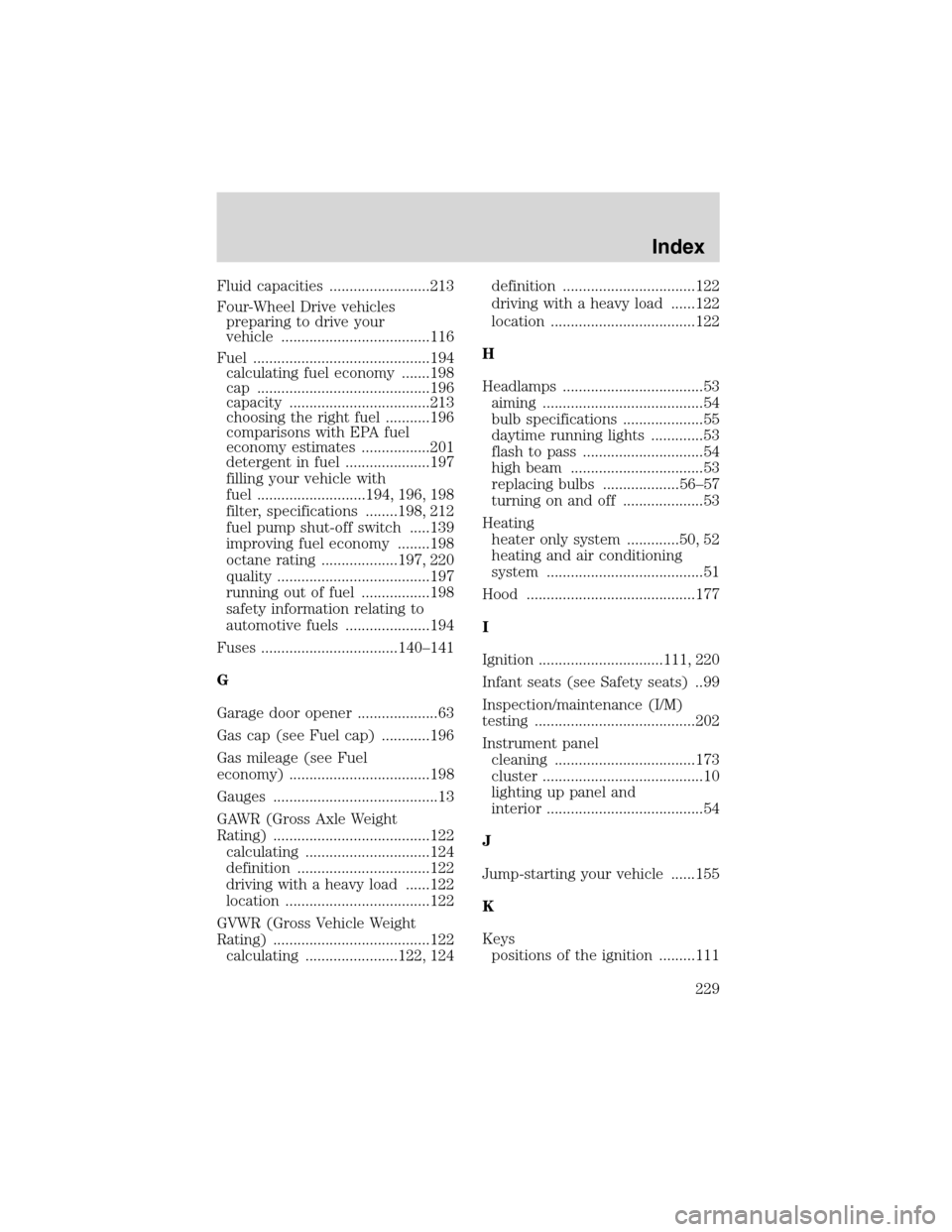
Fluid capacities .........................213
Four-Wheel Drive vehicles
preparing to drive your
vehicle .....................................116
Fuel ............................................194
calculating fuel economy .......198
cap ...........................................196
capacity ...................................213
choosing the right fuel ...........196
comparisons with EPA fuel
economy estimates .................201
detergent in fuel .....................197
filling your vehicle with
fuel ...........................194, 196, 198
filter, specifications ........198, 212
fuel pump shut-off switch .....139
improving fuel economy ........198
octane rating ...................197, 220
quality ......................................197
running out of fuel .................198
safety information relating to
automotive fuels .....................194
Fuses ..................................140–141
G
Garage door opener ....................63
Gas cap (see Fuel cap) ............196
Gas mileage (see Fuel
economy) ...................................198
Gauges .........................................13
GAWR (Gross Axle Weight
Rating) .......................................122
calculating ...............................124
definition .................................122
driving with a heavy load ......122
location ....................................122
GVWR (Gross Vehicle Weight
Rating) .......................................122
calculating .......................122, 124definition .................................122
driving with a heavy load ......122
location ....................................122
H
Headlamps ...................................53
aiming ........................................54
bulb specifications ....................55
daytime running lights .............53
flash to pass ..............................54
high beam .................................53
replacing bulbs ...................56–57
turning on and off ....................53
Heating
heater only system .............50, 52
heating and air conditioning
system .......................................51
Hood ..........................................177
I
Ignition ...............................111, 220
Infant seats (see Safety seats) ..99
Inspection/maintenance (I/M)
testing ........................................202
Instrument panel
cleaning ...................................173
cluster ........................................10
lighting up panel and
interior .......................................54
J
Jump-starting your vehicle ......155
K
Keys
positions of the ignition .........111
Index
229