lights FORD E SERIES 2004 4.G User Guide
[x] Cancel search | Manufacturer: FORD, Model Year: 2004, Model line: E SERIES, Model: FORD E SERIES 2004 4.GPages: 240, PDF Size: 3.62 MB
Page 56 of 240
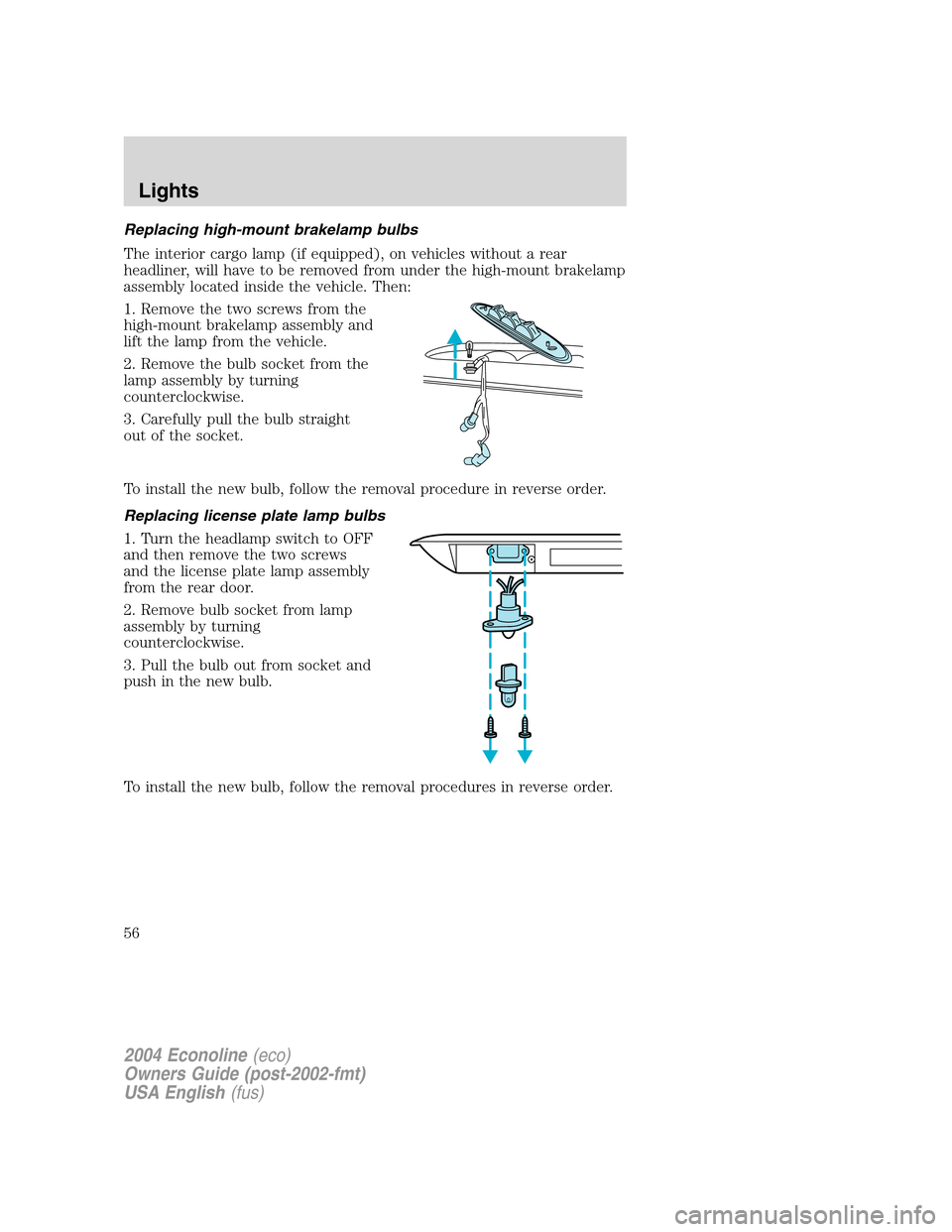
Replacing high-mount brakelamp bulbs
The interior cargo lamp (if equipped), on vehicles without a rear
headliner, will have to be removed from under the high-mount brakelamp
assembly located inside the vehicle. Then:
1. Remove the two screws from the
high-mount brakelamp assembly and
lift the lamp from the vehicle.
2. Remove the bulb socket from the
lamp assembly by turning
counterclockwise.
3. Carefully pull the bulb straight
out of the socket.
To install the new bulb, follow the removal procedure in reverse order.
Replacing license plate lamp bulbs
1. Turn the headlamp switch to OFF
and then remove the two screws
and the license plate lamp assembly
from the rear door.
2. Remove bulb socket from lamp
assembly by turning
counterclockwise.
3. Pull the bulb out from socket and
push in the new bulb.
To install the new bulb, follow the removal procedures in reverse order.
2004 Econoline(eco)
Owners Guide (post-2002-fmt)
USA English(fus)
Lights
56
Page 57 of 240
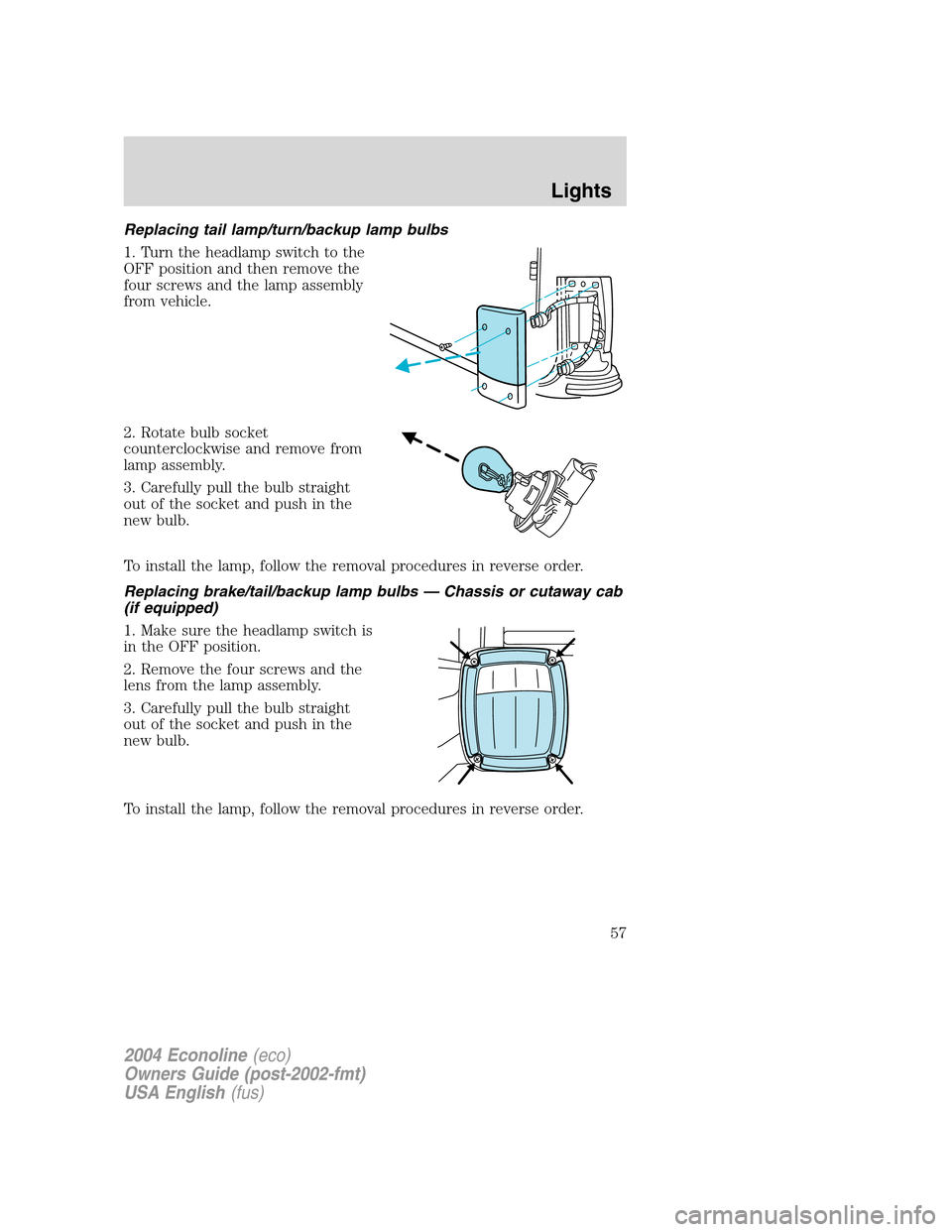
Replacing tail lamp/turn/backup lamp bulbs
1. Turn the headlamp switch to the
OFF position and then remove the
four screws and the lamp assembly
from vehicle.
2. Rotate bulb socket
counterclockwise and remove from
lamp assembly.
3. Carefully pull the bulb straight
out of the socket and push in the
new bulb.
To install the lamp, follow the removal procedures in reverse order.
Replacing brake/tail/backup lamp bulbs — Chassis or cutaway cab
(if equipped)
1. Make sure the headlamp switch is
in the OFF position.
2. Remove the four screws and the
lens from the lamp assembly.
3. Carefully pull the bulb straight
out of the socket and push in the
new bulb.
To install the lamp, follow the removal procedures in reverse order.
2004 Econoline(eco)
Owners Guide (post-2002-fmt)
USA English(fus)
Lights
57
Page 72 of 240
3. The doors will lock, then unlock, to confirm that the programming
mode has been activated.
4. Within 20 seconds press any button on the remote entry transmitter.
Note:If more than 20 seconds have passed you will need to start the
procedure over again.
5. The doors will lock, then unlock, to confirm that this remote entry
transmitter has been programmed.
6. Repeat Steps 4 and 5 to program each additional remote entry
transmitter (up to four transmitters).
7. Turn the ignition to the (3) OFF position after you have finished
programming all of the remote entry transmitters.
8. The doors will lock, then unlock, to confirm that the programming
mode has been exited.
Illuminated entry
The interior lamps illuminate when the remote entry system is used to
unlock the door(s) or sound the personal alarm.
The illuminated entry system will turn off the interior lights if:
•the ignition switch is turned to the ON or ACC position, or
•the remote transmitter lock control is pressed, or
•after 25 seconds of illumination.
The dome lamp control (if equipped) mustnotbe set to the OFF
position for the illuminated entry system to operate.
The inside lights will not turn off if:
•they have been turned on with the dimmer control, or
•any door is open.
2004 Econoline(eco)
Owners Guide (post-2002-fmt)
USA English(fus)
Locks and Security
72
Page 108 of 240
STARTING
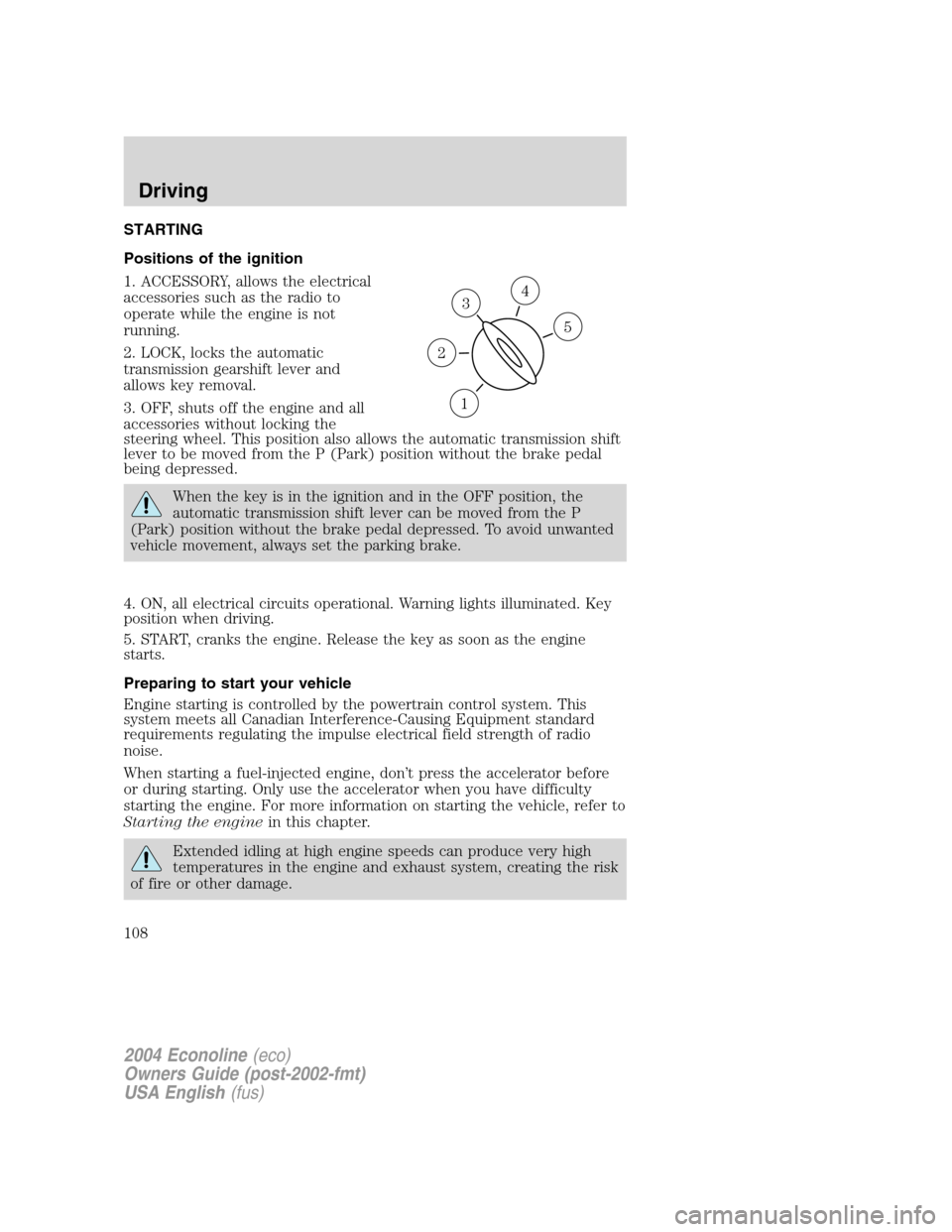
Positions of the ignition
1. ACCESSORY, allows the electrical
accessories such as the radio to
operate while the engine is not
running.
2. LOCK, locks the automatic
transmission gearshift lever and
allows key removal.
3. OFF, shuts off the engine and all
accessories without locking the
steering wheel. This position also allows the automatic transmission shift
lever to be moved from the P (Park) position without the brake pedal
being depressed.
When the key is in the ignition and in the OFF position, the
automatic transmission shift lever can be moved from the P
(Park) position without the brake pedal depressed. To avoid unwanted
vehicle movement, always set the parking brake.
4. ON, all electrical circuits operational. Warning lights illuminated. Key
position when driving.
5. START, cranks the engine. Release the key as soon as the engine
starts.
Preparing to start your vehicle
Engine starting is controlled by the powertrain control system. This
system meets all Canadian Interference-Causing Equipment standard
requirements regulating the impulse electrical field strength of radio
noise.
When starting a fuel-injected engine, don’t press the accelerator before
or during starting. Only use the accelerator when you have difficulty
starting the engine. For more information on starting the vehicle, refer to
Starting the enginein this chapter.
Extended idling at high engine speeds can produce very high
temperatures in the engine and exhaust system, creating the risk
of fire or other damage.
3
1
2
5
4
2004 Econoline(eco)
Owners Guide (post-2002-fmt)
USA English(fus)
Driving
108
Page 110 of 240
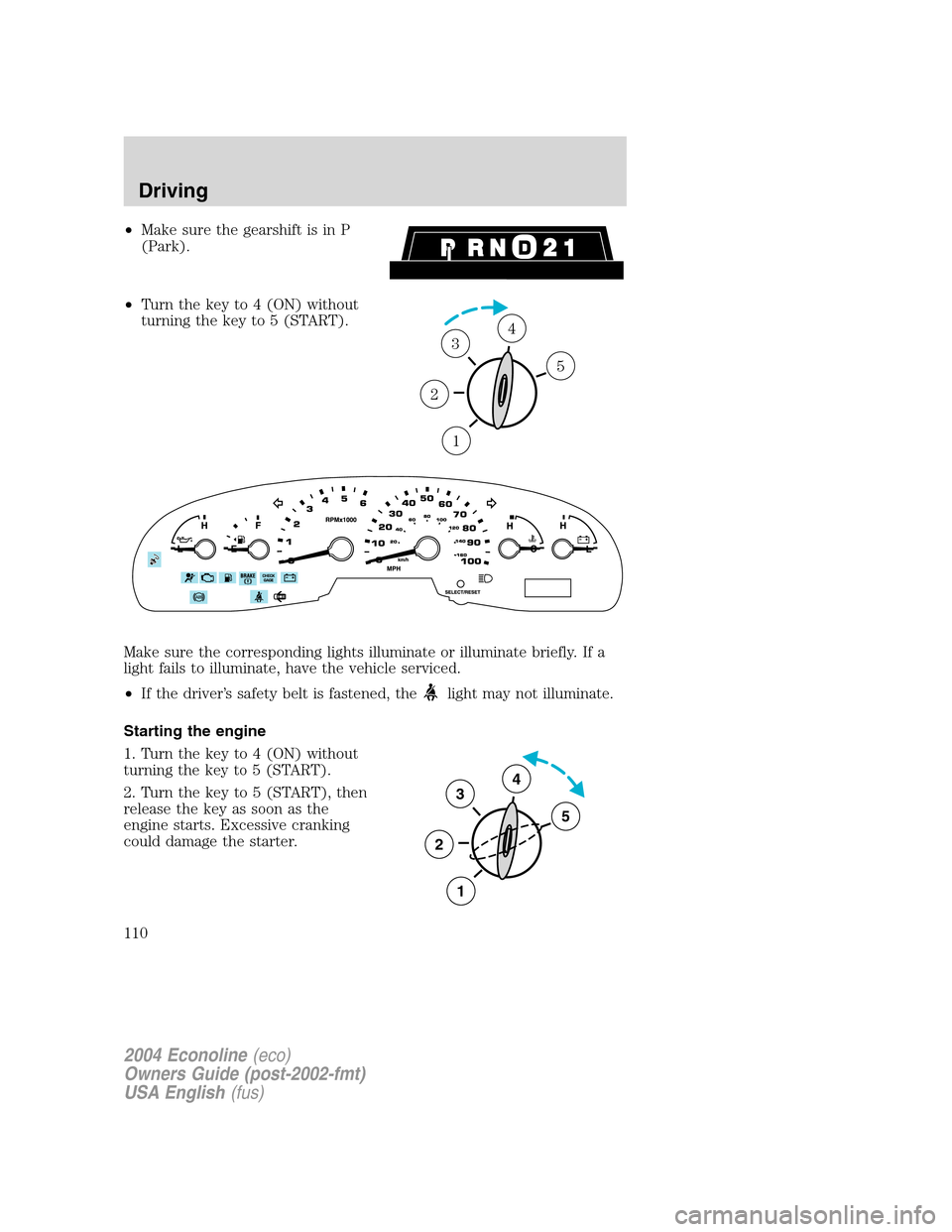
•Make sure the gearshift is in P
(Park).
•Turn the key to 4 (ON) without
turning the key to 5 (START).
Make sure the corresponding lights illuminate or illuminate briefly. If a
light fails to illuminate, have the vehicle serviced.
•If the driver’s safety belt is fastened, the
light may not illuminate.
Starting the engine
1. Turn the key to 4 (ON) without
turning the key to 5 (START).
2. Turn the key to 5 (START), then
release the key as soon as the
engine starts. Excessive cranking
could damage the starter.
1
2
34
5
3
2
1
5
4
2004 Econoline(eco)
Owners Guide (post-2002-fmt)
USA English(fus)
Driving
110
Page 129 of 240
Safety chains
Always connect the trailer’s safety chains to the frame or hook retainers
of the vehicle hitch. To connect the trailer’s safety chains, cross the
chains under the trailer tongue and allow slack for turning corners.
If you use a rental trailer, follow the instructions that the rental agency
gives to you.
Do not attach safety chains to the bumper.
Trailer brakes
Electric brakes and manual, automatic or surge-type trailer brakes are
safe if installed properly and adjusted to the manufacturer’s
specifications. The trailer brakes must meet local and Federal
regulations.
Do not connect a trailer’s hydraulic brake system directly to your
vehicle’s brake system. Your vehicle may not have enough
braking power and your chances of having a collision greatly increase.
The braking system of the tow vehicle is rated for operation at the
GVWR not GCWR.
Trailer lamps
Trailer lamps are required on most towed vehicles. Make sure all running
lights, brake lights, turn signals and hazard lights are working. See your
dealer or trailer rental agency for proper instructions and equipment for
hooking up trailer lamps.
Using a step bumper (if equipped)
The rear bumper is equipped with an integral hitch and only requires a
ball with a 25.4 mm (one inch) shank diameter. The bumper has a 2,270
kg (5,000 lb.) trailer weight and 227 kg (500 lb.) tongue weight capacity.
If it is necessary to relocate the trailer hitch ball position, a
frame-mounted trailer hitch must be installed.
Driving while you tow
When towing a trailer:
•Turn off the speed control. The speed control may shut off
automatically when you are towing on long, steep grades.
•Consult your local motor vehicle speed regulations for towing a trailer.
2004 Econoline(eco)
Owners Guide (post-2002-fmt)
USA English(fus)
Driving
129
Page 198 of 240
Do not make any unauthorized changes to your vehicle or engine. By
law, vehicle owners and anyone who manufactures, repairs, services,
sells, leases, trades vehicles, or supervises a fleet of vehicles are not
permitted to intentionally remove an emission control device or prevent
it from working. Information about your vehicle’s emission system is on
the Vehicle Emission Control Information Decal located on or near the
engine. This decal identifies engine displacement and gives some tune up
specifications.
Please consult yourWarranty Guidefor complete emission warranty
information.
On board diagnostics (OBD-II)
Your vehicle is equipped with a computer that monitors the engine’s
emission control system. This system is commonly known as the On
Board Diagnostics System (OBD-II). This OBD-II system protects the
environment by ensuring that your vehicle continues to meet
government emission standards. The OBD-II system also assists the
service technician in properly servicing your vehicle. When theCheck
Engine/Service Engine Soonlight illuminates, the OBD-II system has
detected a malfunction. Temporary malfunctions may cause yourCheck
Engine/Service Engine Soonlight to illuminate. Examples are:
1. The vehicle has run out of fuel. (The engine may misfire or run
poorly.)
2. Poor fuel quality or water in the fuel.
3. The fuel cap may not have been securely tightened.
These temporary malfunctions can be corrected by filling the fuel tank
with good quality fuel and/or properly tightening the fuel cap. After three
driving cycles without these or any other temporary malfunctions
present, theCheck Engine/Service Engine Soonlight should turn off.
(A driving cycle consists of a cold engine startup followed by mixed
city/highway driving.) No additional vehicle service is required.
If theCheck Engine/Service Engine Soonlight remains on, have your
vehicle serviced at the first available opportunity.
Readiness for Inspection/Maintenance (I/M) testing
In some localities, it may be a legal requirement to pass an I/M test of
the on-board diagnostics system. If your“Check Engine/Service Engine
Soon”light is on, refer to the description in theWarning lights and
chimessection of theInstrument clusterchapter. Your vehicle may not
pass the I/M test with the“Check Engine/Service Engine Soon”light on.
2004 Econoline(eco)
Owners Guide (post-2002-fmt)
USA English(fus)
Maintenance and Specifications
198
Page 231 of 240
FORD ACCESSORIES FOR YOUR VEHICLE
A wide selection of genuine Ford accessories are available for your
vehicle through your local authorized Ford or Ford of Canada dealer.
These quality accessories have been specifically engineered to fulfill your
automotive needs; they are custom designed to complement the style
and aerodynamic appearance of your vehicle. In addition, each accessory
is made from high quality materials and meets or exceeds Ford’s rigorous
engineering and safety specifications. Ford Motor Company will repair or
replace any properly dealer-installed Ford accessory found to be
defective in factory-supplied materials or workmanship during the
warranty period, as well as any component damaged by the defective
accessory. The accessory will be warranted for whichever provides you
the greatest benefit:
•12 months or 20,000 km (12,000 miles) (whichever occurs first), or
•the remainder of your new vehicle limited warranty.
This means that genuine Ford accessories purchased along with your
new vehicle and installed by the dealer are covered for the full length of
your New Vehicle’s Limited Warranty—3 years or 60,000 km (36,000
miles) (whichever occurs first). Contact your dealer for details and a
copy of the warranty.
Not all accessories are available for all models.
The following is a list of several Ford Genuine Accessory products for
your vehicle. Not all accessories are available for all models. For a
complete listing of the accessories that are available for your vehicle,
please contact your dealer or visit our online store at:
www.fordaccessoriesstore.com.
Exterior style
Bug shields
Deflectors
Exterior trim
Fender flares
Front end covers
Grille inserts
Headlamps, taillamps, fog lights and Daytime Running Lamps (DRLS)
Running boards
Sliding rear windows - manual and power
2004 Econoline(eco)
Owners Guide (post-2002-fmt)
USA English(fus)
Accessories
231
Page 236 of 240
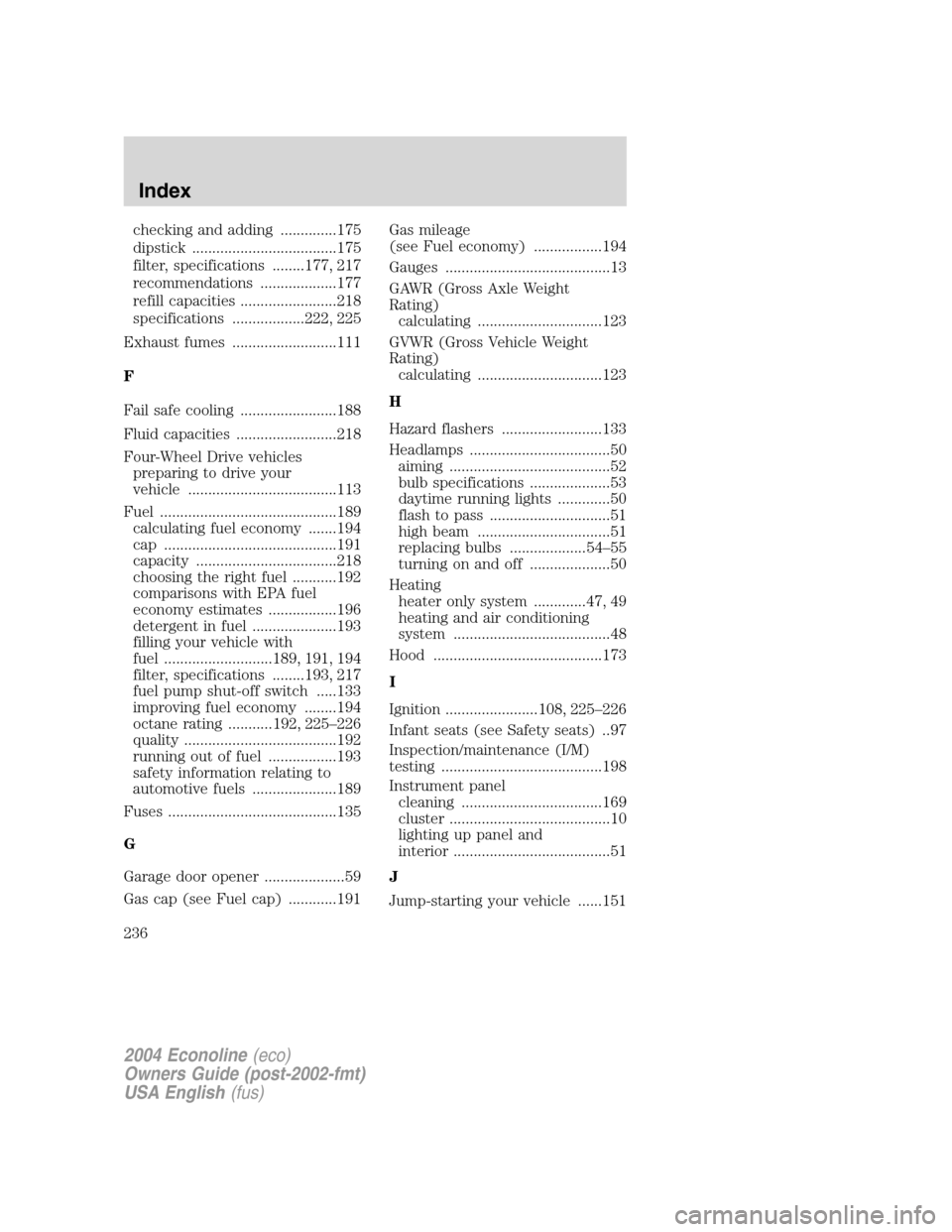
checking and adding ..............175
dipstick ....................................175
filter, specifications ........177, 217
recommendations ...................177
refill capacities ........................218
specifications ..................222, 225
Exhaust fumes ..........................111
F
Fail safe cooling ........................188
Fluid capacities .........................218
Four-Wheel Drive vehicles
preparing to drive your
vehicle .....................................113
Fuel ............................................189
calculating fuel economy .......194
cap ...........................................191
capacity ...................................218
choosing the right fuel ...........192
comparisons with EPA fuel
economy estimates .................196
detergent in fuel .....................193
filling your vehicle with
fuel ...........................189, 191, 194
filter, specifications ........193, 217
fuel pump shut-off switch .....133
improving fuel economy ........194
octane rating ...........192, 225–226
quality ......................................192
running out of fuel .................193
safety information relating to
automotive fuels .....................189
Fuses ..........................................135
G
Garage door opener ....................59
Gas cap (see Fuel cap) ............191Gas mileage
(see Fuel economy) .................194
Gauges .........................................13
GAWR (Gross Axle Weight
Rating)
calculating ...............................123
GVWR (Gross Vehicle Weight
Rating)
calculating ...............................123
H
Hazard flashers .........................133
Headlamps ...................................50
aiming ........................................52
bulb specifications ....................53
daytime running lights .............50
flash to pass ..............................51
high beam .................................51
replacing bulbs ...................54–55
turning on and off ....................50
Heating
heater only system .............47, 49
heating and air conditioning
system .......................................48
Hood ..........................................173
I
Ignition .......................108, 225–226
Infant seats (see Safety seats) ..97
Inspection/maintenance (I/M)
testing ........................................198
Instrument panel
cleaning ...................................169
cluster ........................................10
lighting up panel and
interior .......................................51
J
Jump-starting your vehicle ......151
2004 Econoline(eco)
Owners Guide (post-2002-fmt)
USA English(fus)
Index
236
Page 237 of 240
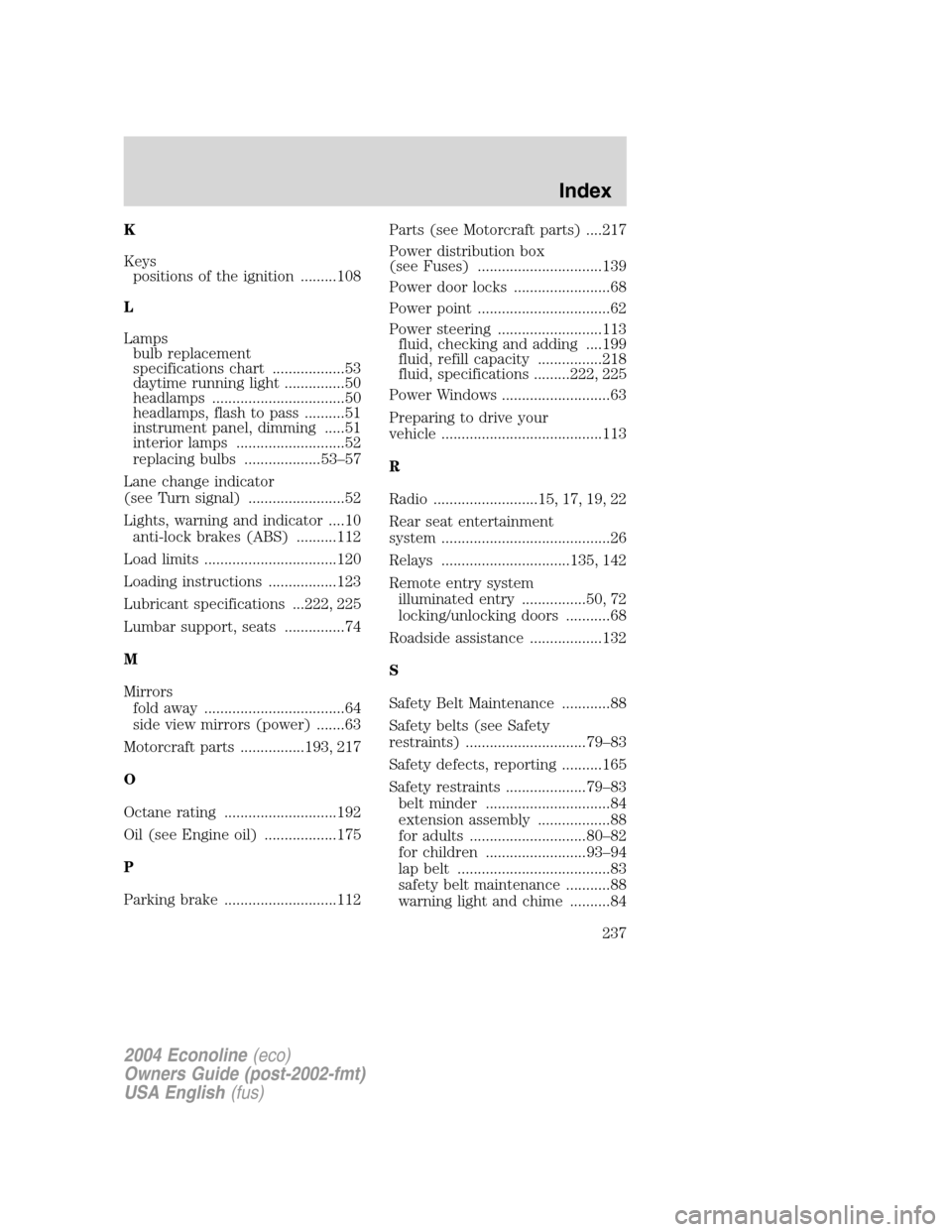
K
Keys
positions of the ignition .........108
L
Lamps
bulb replacement
specifications chart ..................53
daytime running light ...............50
headlamps .................................50
headlamps, flash to pass ..........51
instrument panel, dimming .....51
interior lamps ...........................52
replacing bulbs ...................53–57
Lane change indicator
(see Turn signal) ........................52
Lights, warning and indicator ....10
anti-lock brakes (ABS) ..........112
Load limits .................................120
Loading instructions .................123
Lubricant specifications ...222, 225
Lumbar support, seats ...............74
M
Mirrors
fold away ...................................64
side view mirrors (power) .......63
Motorcraft parts ................193, 217
O
Octane rating ............................192
Oil (see Engine oil) ..................175
P
Parking brake ............................112Parts (see Motorcraft parts) ....217
Power distribution box
(see Fuses) ...............................139
Power door locks ........................68
Power point .................................62
Power steering ..........................113
fluid, checking and adding ....199
fluid, refill capacity ................218
fluid, specifications .........222, 225
Power Windows ...........................63
Preparing to drive your
vehicle ........................................113
R
Radio ..........................15, 17, 19, 22
Rear seat entertainment
system ..........................................26
Relays ................................135, 142
Remote entry system
illuminated entry ................50, 72
locking/unlocking doors ...........68
Roadside assistance ..................132
S
Safety Belt Maintenance ............88
Safety belts (see Safety
restraints) ..............................79–83
Safety defects, reporting ..........165
Safety restraints ....................79–83
belt minder ...............................84
extension assembly ..................88
for adults .............................80–82
for children .........................93–94
lap belt ......................................83
safety belt maintenance ...........88
warning light and chime ..........84
2004 Econoline(eco)
Owners Guide (post-2002-fmt)
USA English(fus)
Index
237