weight FORD E SERIES 2006 4.G User Guide
[x] Cancel search | Manufacturer: FORD, Model Year: 2006, Model line: E SERIES, Model: FORD E SERIES 2006 4.GPages: 248, PDF Size: 2.54 MB
Page 122 of 248
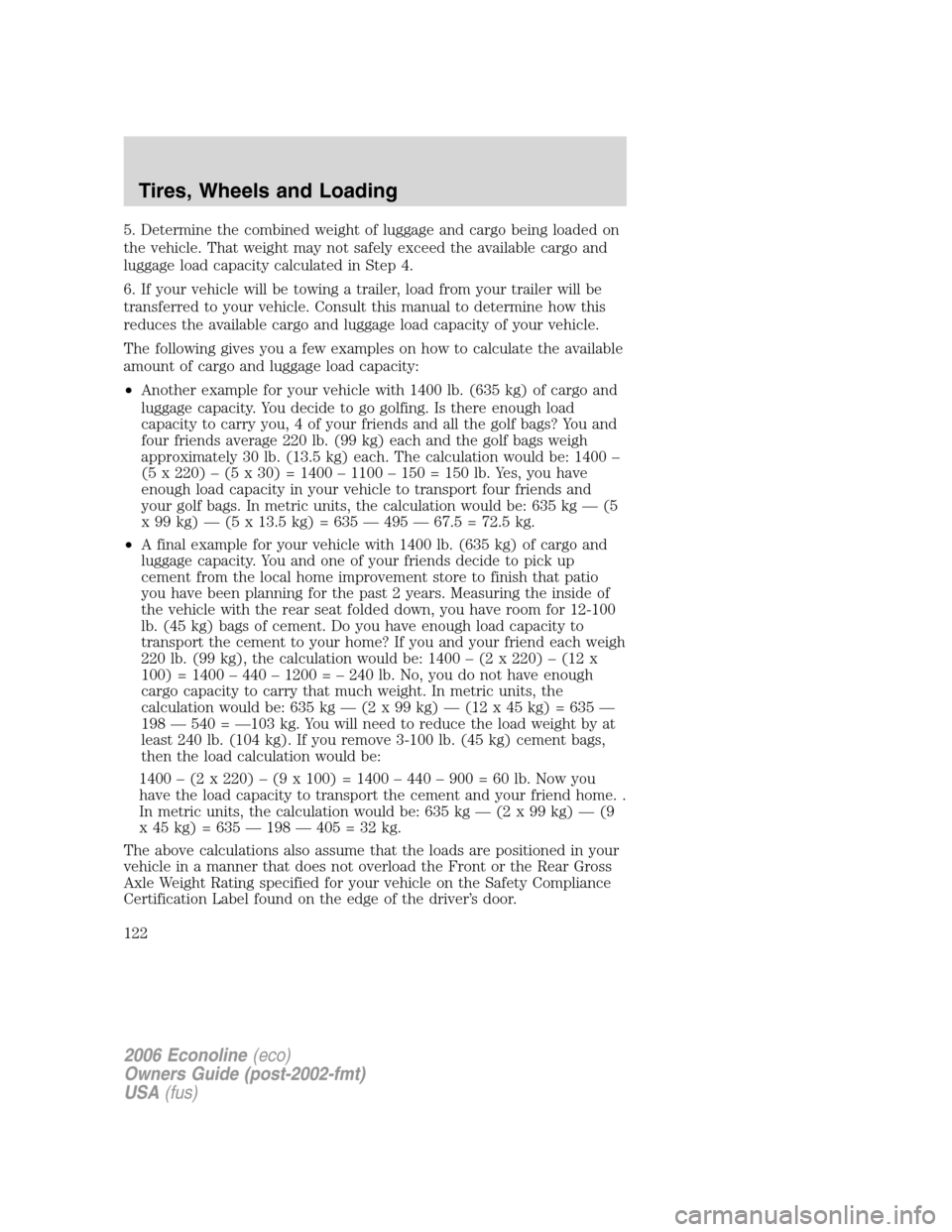
5. Determine the combined weight of luggage and cargo being loaded on
the vehicle. That weight may not safely exceed the available cargo and
luggage load capacity calculated in Step 4.
6. If your vehicle will be towing a trailer, load from your trailer will be
transferred to your vehicle. Consult this manual to determine how this
reduces the available cargo and luggage load capacity of your vehicle.
The following gives you a few examples on how to calculate the available
amount of cargo and luggage load capacity:
•Another example for your vehicle with 1400 lb. (635 kg) of cargo and
luggage capacity. You decide to go golfing. Is there enough load
capacity to carry you, 4 of your friends and all the golf bags? You and
four friends average 220 lb. (99 kg) each and the golf bags weigh
approximately 30 lb. (13.5 kg) each. The calculation would be: 1400 –
(5 x 220) – (5 x 30) = 1400 – 1100 – 150 = 150 lb. Yes, you have
enough load capacity in your vehicle to transport four friends and
your golf bags. In metric units, the calculation would be: 635 kg — (5
x 99 kg) — (5 x 13.5 kg) = 635 — 495 — 67.5 = 72.5 kg.
•A final example for your vehicle with 1400 lb. (635 kg) of cargo and
luggage capacity. You and one of your friends decide to pick up
cement from the local home improvement store to finish that patio
you have been planning for the past 2 years. Measuring the inside of
the vehicle with the rear seat folded down, you have room for 12-100
lb. (45 kg) bags of cement. Do you have enough load capacity to
transport the cement to your home? If you and your friend each weigh
220 lb. (99 kg), the calculation would be: 1400 – (2 x 220) – (12 x
100) = 1400 – 440 – 1200 = – 240 lb. No, you do not have enough
cargo capacity to carry that much weight. In metric units, the
calculation would be: 635 kg — (2 x 99 kg) — (12 x 45 kg) = 635 —
198 — 540 = —103 kg. You will need to reduce the load weight by at
least 240 lb. (104 kg). If you remove 3-100 lb. (45 kg) cement bags,
then the load calculation would be:
1400 – (2 x 220) – (9 x 100) = 1400 – 440 – 900 = 60 lb. Now you
have the load capacity to transport the cement and your friend home. .
In metric units, the calculation would be: 635 kg — (2 x 99 kg) — (9
x 45 kg) = 635 — 198 — 405 = 32 kg.
The above calculations also assume that the loads are positioned in your
vehicle in a manner that does not overload the Front or the Rear Gross
Axle Weight Rating specified for your vehicle on the Safety Compliance
Certification Label found on the edge of the driver’s door.
2006 Econoline(eco)
Owners Guide (post-2002-fmt)
USA(fus)
Tires, Wheels and Loading
122
Page 123 of 248
Special loading instructions for owners of pickup trucks and
utility-type vehicles
For important information regarding safe operation of this type
of vehicle, see thePreparing to drive your vehiclesection in
theDrivingchapter of thisOwner’s Guide.
Loaded vehicles may handle differently than unloaded vehicles.
Extra precautions, such as slower speeds and increased stopping
distance, should be taken when driving a heavily loaded vehicle.
Your vehicle can haul more cargo and people than most passenger cars.
Depending upon the type and placement of the load, hauling cargo and
people may raise the center of gravity of the vehicle.
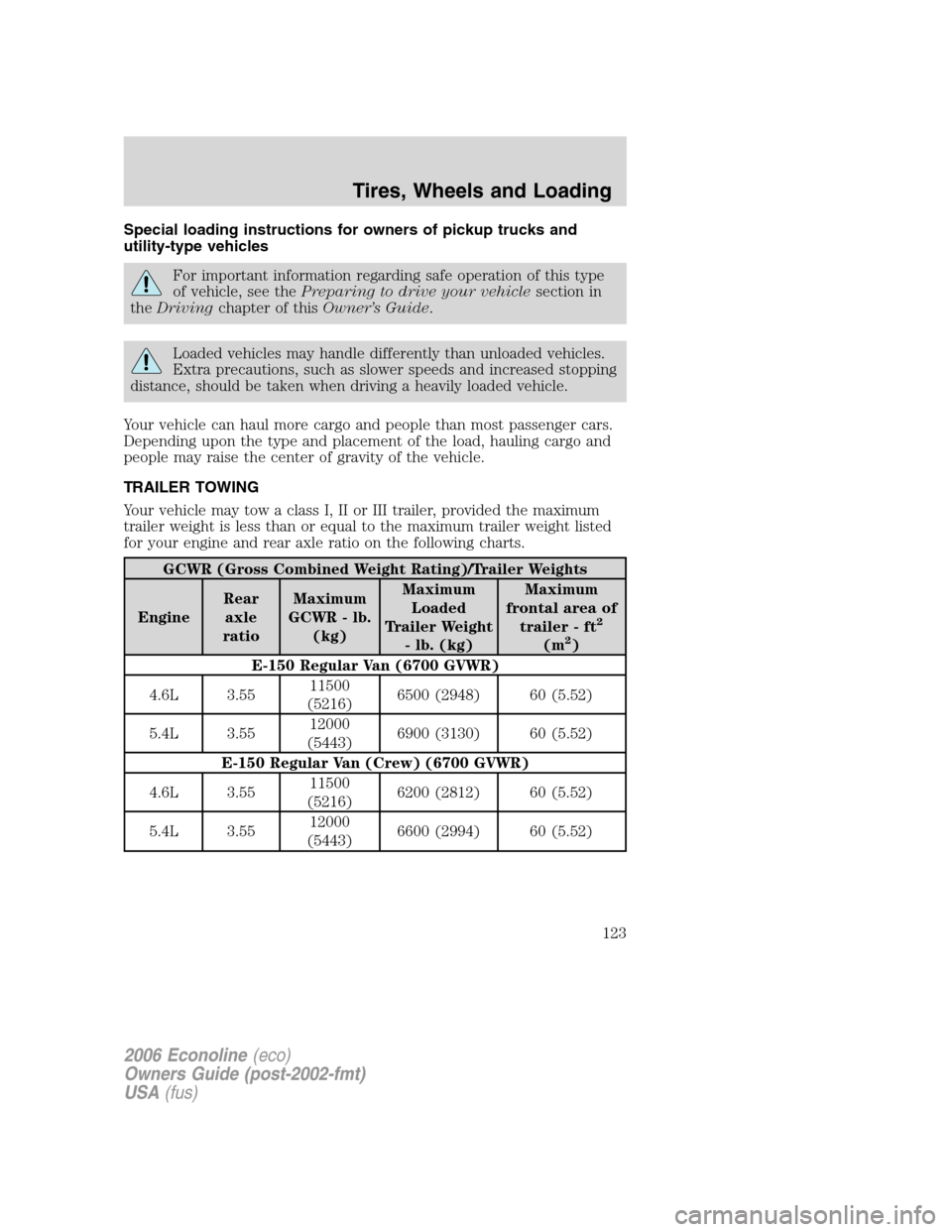
TRAILER TOWING
Your vehicle may tow a class I, II or III trailer, provided the maximum
trailer weight is less than or equal to the maximum trailer weight listed
for your engine and rear axle ratio on the following charts.
GCWR (Gross Combined Weight Rating)/Trailer Weights
EngineRear
axle
ratioMaximum
GCWR - lb.
(kg)Maximum
Loaded
Trailer Weight
- lb. (kg)Maximum
frontal area of
trailer - ft
2
(m2)
E-150 Regular Van (6700 GVWR)
4.6L 3.5511500
(5216)6500 (2948) 60 (5.52)
5.4L 3.5512000
(5443)6900 (3130) 60 (5.52)
E-150 Regular Van (Crew) (6700 GVWR)
4.6L 3.5511500
(5216)6200 (2812) 60 (5.52)
5.4L 3.5512000
(5443)6600 (2994) 60 (5.52)
2006 Econoline(eco)
Owners Guide (post-2002-fmt)
USA(fus)
Tires, Wheels and Loading
123
Page 124 of 248
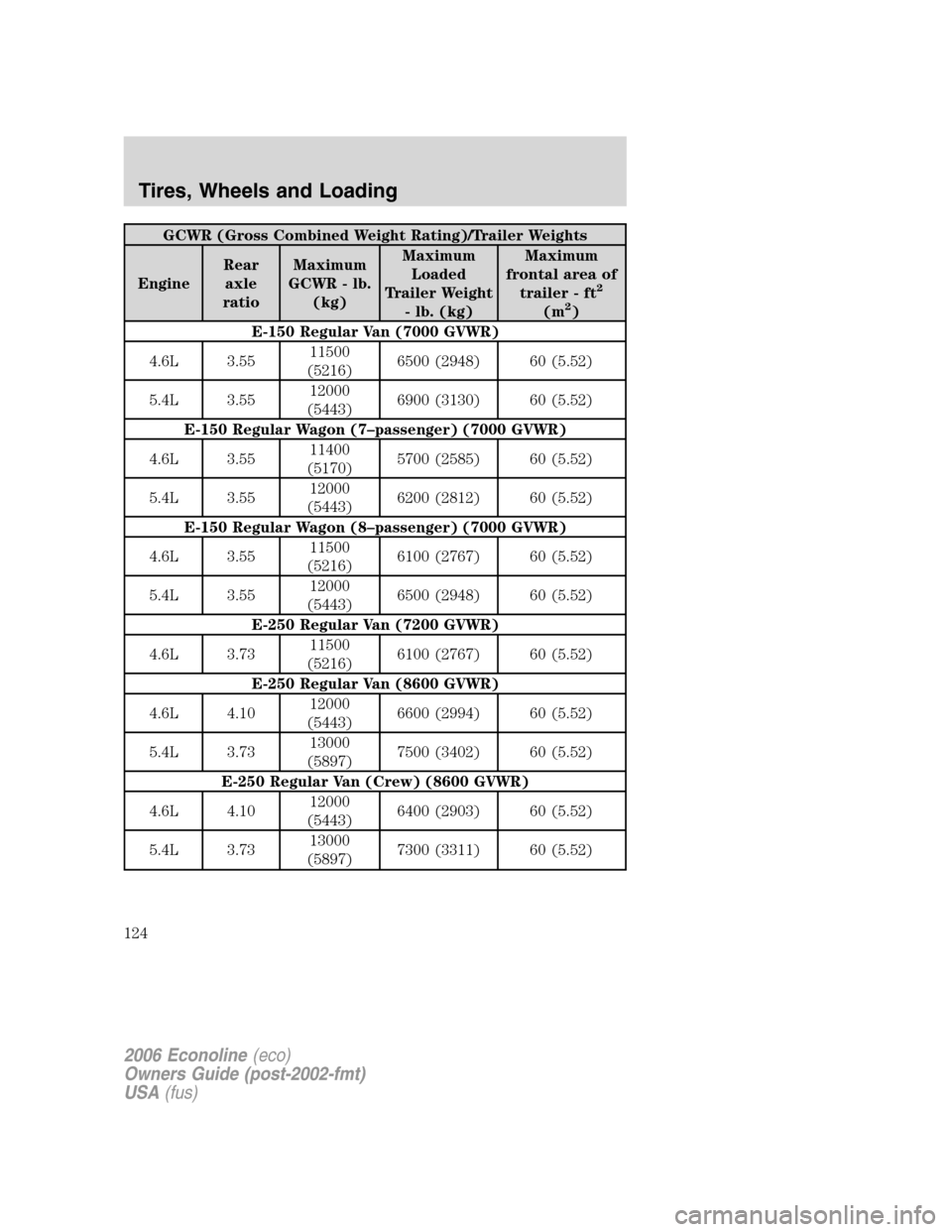
GCWR (Gross Combined Weight Rating)/Trailer Weights
EngineRear
axle
ratioMaximum
GCWR - lb.
(kg)Maximum
Loaded
Trailer Weight
- lb. (kg)Maximum
frontal area of
trailer - ft
2
(m2)
E-150 Regular Van (7000 GVWR)
4.6L 3.5511500
(5216)6500 (2948) 60 (5.52)
5.4L 3.5512000
(5443)6900 (3130) 60 (5.52)
E-150 Regular Wagon (7–passenger) (7000 GVWR)
4.6L 3.5511400
(5170)5700 (2585) 60 (5.52)
5.4L 3.5512000
(5443)6200 (2812) 60 (5.52)
E-150 Regular Wagon (8–passenger) (7000 GVWR)
4.6L 3.5511500
(5216)6100 (2767) 60 (5.52)
5.4L 3.5512000
(5443)6500 (2948) 60 (5.52)
E-250 Regular Van (7200 GVWR)
4.6L 3.7311500
(5216)6100 (2767) 60 (5.52)
E-250 Regular Van (8600 GVWR)
4.6L 4.1012000
(5443)6600 (2994) 60 (5.52)
5.4L 3.7313000
(5897)7500 (3402) 60 (5.52)
E-250 Regular Van (Crew) (8600 GVWR)
4.6L 4.1012000
(5443)6400 (2903) 60 (5.52)
5.4L 3.7313000
(5897)7300 (3311) 60 (5.52)
2006 Econoline(eco)
Owners Guide (post-2002-fmt)
USA(fus)
Tires, Wheels and Loading
124
Page 125 of 248
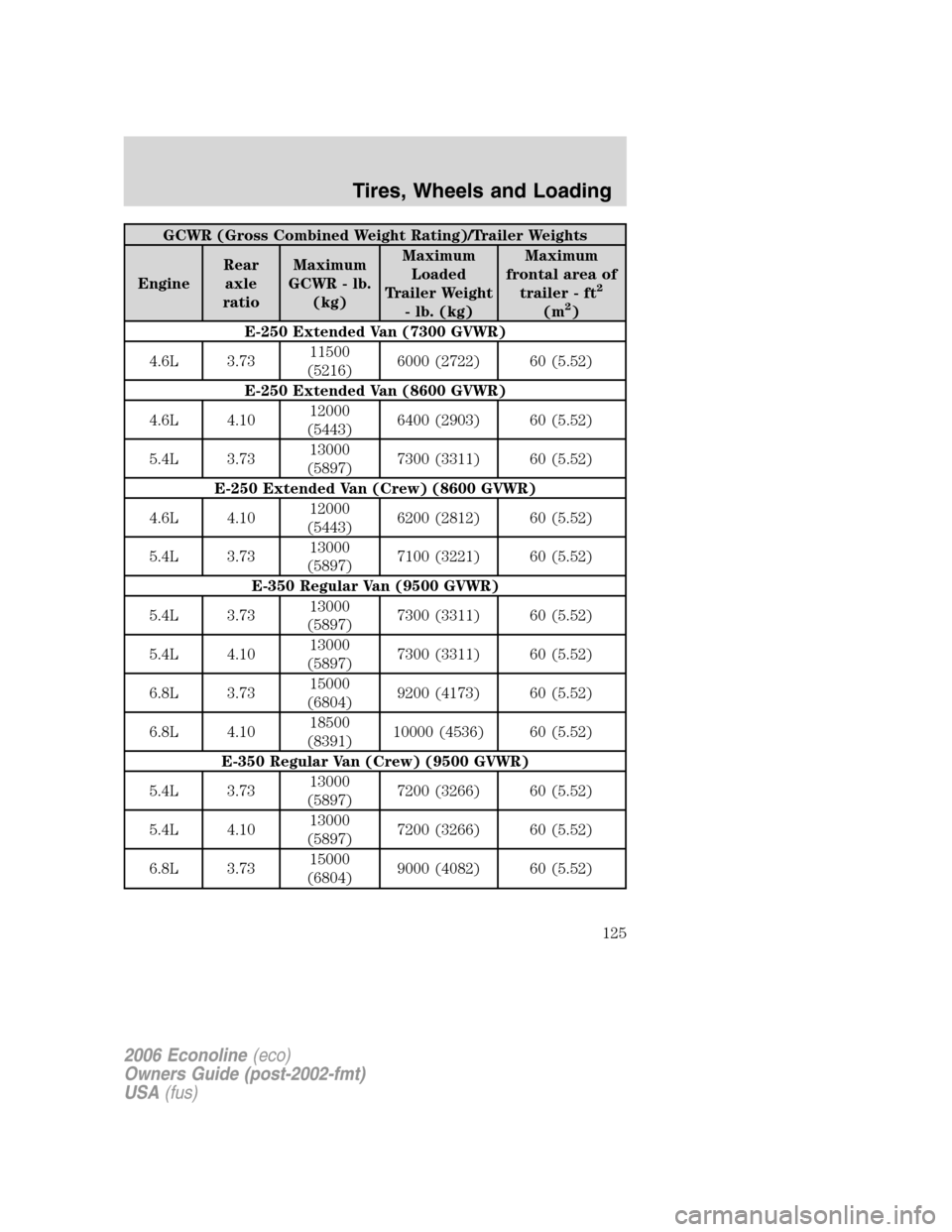
GCWR (Gross Combined Weight Rating)/Trailer Weights
EngineRear
axle
ratioMaximum
GCWR - lb.
(kg)Maximum
Loaded
Trailer Weight
- lb. (kg)Maximum
frontal area of
trailer - ft
2
(m2)
E-250 Extended Van (7300 GVWR)
4.6L 3.7311500
(5216)6000 (2722) 60 (5.52)
E-250 Extended Van (8600 GVWR)
4.6L 4.1012000
(5443)6400 (2903) 60 (5.52)
5.4L 3.7313000
(5897)7300 (3311) 60 (5.52)
E-250 Extended Van (Crew) (8600 GVWR)
4.6L 4.1012000
(5443)6200 (2812) 60 (5.52)
5.4L 3.7313000
(5897)7100 (3221) 60 (5.52)
E-350 Regular Van (9500 GVWR)
5.4L 3.7313000
(5897)7300 (3311) 60 (5.52)
5.4L 4.1013000
(5897)7300 (3311) 60 (5.52)
6.8L 3.7315000
(6804)9200 (4173) 60 (5.52)
6.8L 4.1018500
(8391)10000 (4536) 60 (5.52)
E-350 Regular Van (Crew) (9500 GVWR)
5.4L 3.7313000
(5897)7200 (3266) 60 (5.52)
5.4L 4.1013000
(5897)7200 (3266) 60 (5.52)
6.8L 3.7315000
(6804)9000 (4082) 60 (5.52)
2006 Econoline(eco)
Owners Guide (post-2002-fmt)
USA(fus)
Tires, Wheels and Loading
125
Page 126 of 248
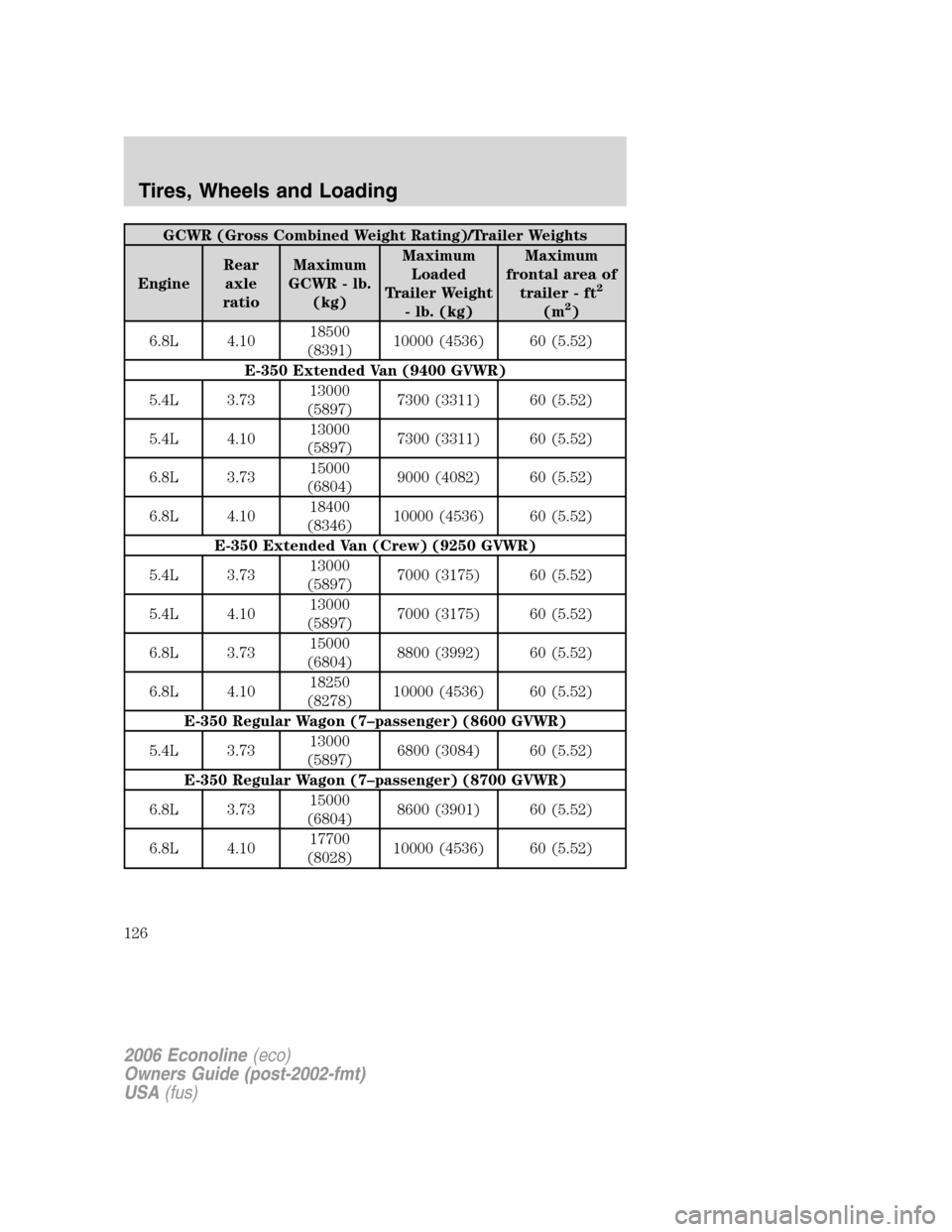
GCWR (Gross Combined Weight Rating)/Trailer Weights
EngineRear
axle
ratioMaximum
GCWR - lb.
(kg)Maximum
Loaded
Trailer Weight
- lb. (kg)Maximum
frontal area of
trailer - ft
2
(m2)
6.8L 4.1018500
(8391)10000 (4536) 60 (5.52)
E-350 Extended Van (9400 GVWR)
5.4L 3.7313000
(5897)7300 (3311) 60 (5.52)
5.4L 4.1013000
(5897)7300 (3311) 60 (5.52)
6.8L 3.7315000
(6804)9000 (4082) 60 (5.52)
6.8L 4.1018400
(8346)10000 (4536) 60 (5.52)
E-350 Extended Van (Crew) (9250 GVWR)
5.4L 3.7313000
(5897)7000 (3175) 60 (5.52)
5.4L 4.1013000
(5897)7000 (3175) 60 (5.52)
6.8L 3.7315000
(6804)8800 (3992) 60 (5.52)
6.8L 4.1018250
(8278)10000 (4536) 60 (5.52)
E-350 Regular Wagon (7–passenger) (8600 GVWR)
5.4L 3.7313000
(5897)6800 (3084) 60 (5.52)
E-350 Regular Wagon (7–passenger) (8700 GVWR)
6.8L 3.7315000
(6804)8600 (3901) 60 (5.52)
6.8L 4.1017700
(8028)10000 (4536) 60 (5.52)
2006 Econoline(eco)
Owners Guide (post-2002-fmt)
USA(fus)
Tires, Wheels and Loading
126
Page 127 of 248
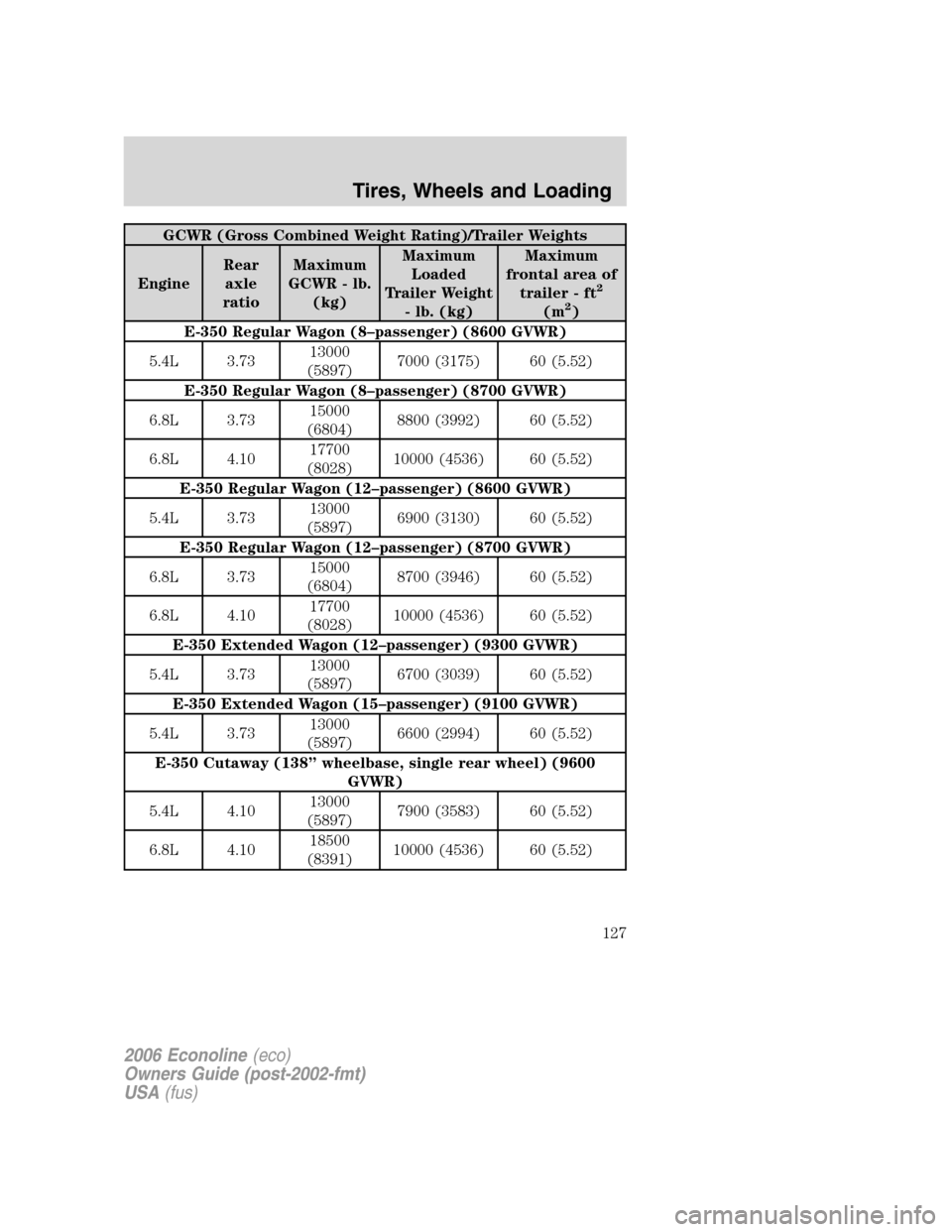
GCWR (Gross Combined Weight Rating)/Trailer Weights
EngineRear
axle
ratioMaximum
GCWR - lb.
(kg)Maximum
Loaded
Trailer Weight
- lb. (kg)Maximum
frontal area of
trailer - ft
2
(m2)
E-350 Regular Wagon (8–passenger) (8600 GVWR)
5.4L 3.7313000
(5897)7000 (3175) 60 (5.52)
E-350 Regular Wagon (8–passenger) (8700 GVWR)
6.8L 3.7315000
(6804)8800 (3992) 60 (5.52)
6.8L 4.1017700
(8028)10000 (4536) 60 (5.52)
E-350 Regular Wagon (12–passenger) (8600 GVWR)
5.4L 3.7313000
(5897)6900 (3130) 60 (5.52)
E-350 Regular Wagon (12–passenger) (8700 GVWR)
6.8L 3.7315000
(6804)8700 (3946) 60 (5.52)
6.8L 4.1017700
(8028)10000 (4536) 60 (5.52)
E-350 Extended Wagon (12–passenger) (9300 GVWR)
5.4L 3.7313000
(5897)6700 (3039) 60 (5.52)
E-350 Extended Wagon (15–passenger) (9100 GVWR)
5.4L 3.7313000
(5897)6600 (2994) 60 (5.52)
E-350 Cutaway (138” wheelbase, single rear wheel) (9600
GVWR)
5.4L 4.1013000
(5897)7900 (3583) 60 (5.52)
6.8L 4.1018500
(8391)10000 (4536) 60 (5.52)
2006 Econoline(eco)
Owners Guide (post-2002-fmt)
USA(fus)
Tires, Wheels and Loading
127
Page 128 of 248
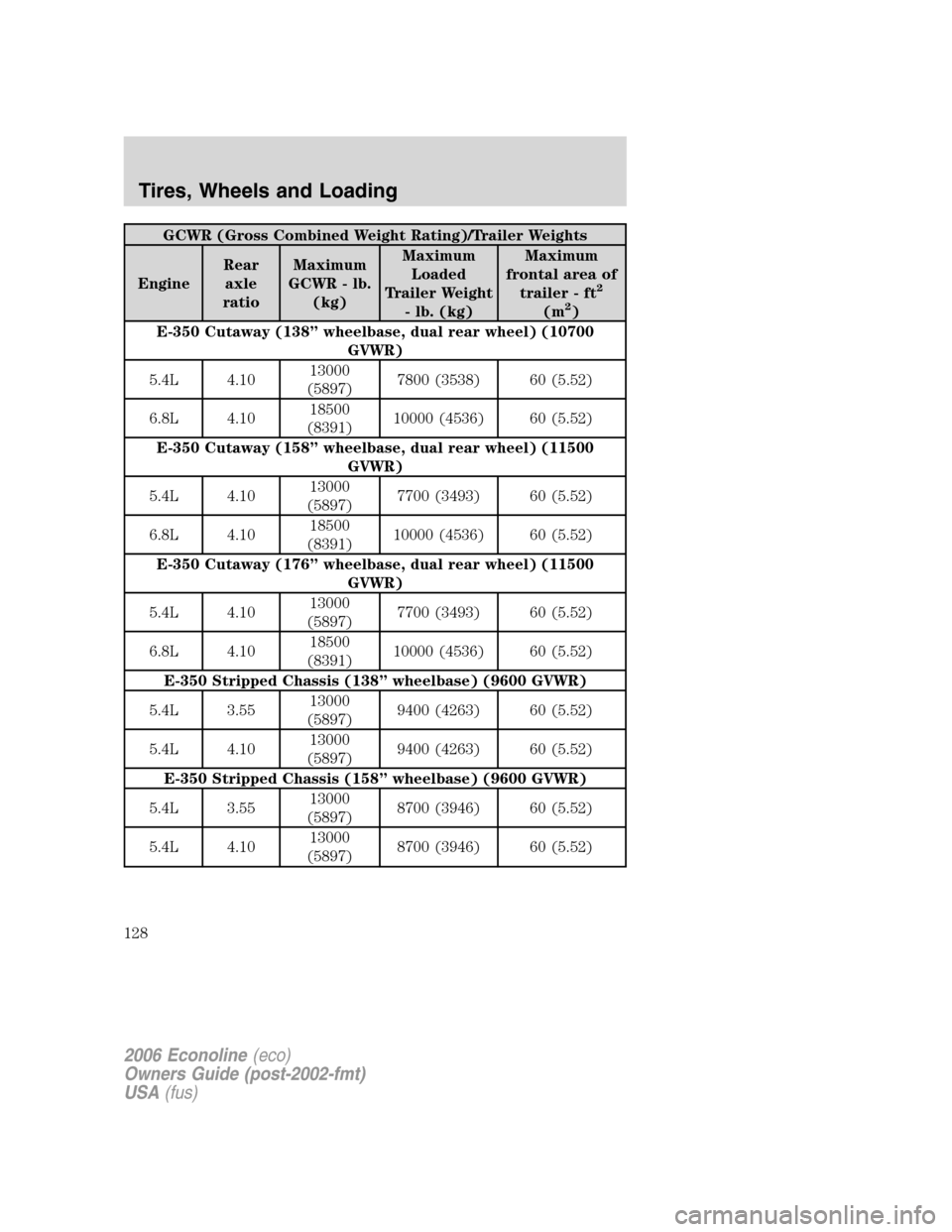
GCWR (Gross Combined Weight Rating)/Trailer Weights
EngineRear
axle
ratioMaximum
GCWR - lb.
(kg)Maximum
Loaded
Trailer Weight
- lb. (kg)Maximum
frontal area of
trailer - ft
2
(m2)
E-350 Cutaway (138” wheelbase, dual rear wheel) (10700
GVWR)
5.4L 4.1013000
(5897)7800 (3538) 60 (5.52)
6.8L 4.1018500
(8391)10000 (4536) 60 (5.52)
E-350 Cutaway (158” wheelbase, dual rear wheel) (11500
GVWR)
5.4L 4.1013000
(5897)7700 (3493) 60 (5.52)
6.8L 4.1018500
(8391)10000 (4536) 60 (5.52)
E-350 Cutaway (176” wheelbase, dual rear wheel) (11500
GVWR)
5.4L 4.1013000
(5897)7700 (3493) 60 (5.52)
6.8L 4.1018500
(8391)10000 (4536) 60 (5.52)
E-350 Stripped Chassis (138” wheelbase) (9600 GVWR)
5.4L 3.5513000
(5897)9400 (4263) 60 (5.52)
5.4L 4.1013000
(5897)9400 (4263) 60 (5.52)
E-350 Stripped Chassis (158” wheelbase) (9600 GVWR)
5.4L 3.5513000
(5897)8700 (3946) 60 (5.52)
5.4L 4.1013000
(5897)8700 (3946) 60 (5.52)
2006 Econoline(eco)
Owners Guide (post-2002-fmt)
USA(fus)
Tires, Wheels and Loading
128
Page 129 of 248
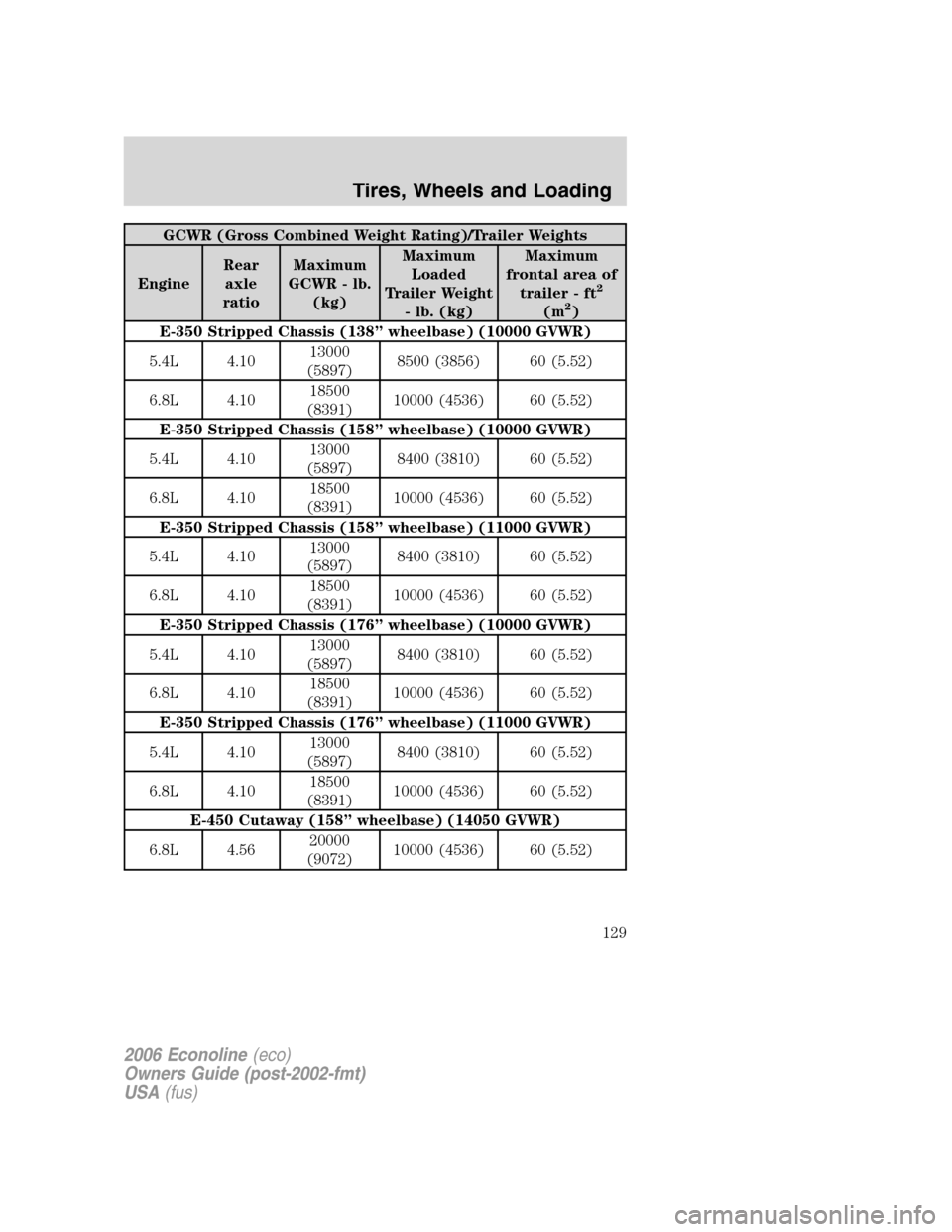
GCWR (Gross Combined Weight Rating)/Trailer Weights
EngineRear
axle
ratioMaximum
GCWR - lb.
(kg)Maximum
Loaded
Trailer Weight
- lb. (kg)Maximum
frontal area of
trailer - ft
2
(m2)
E-350 Stripped Chassis (138” wheelbase) (10000 GVWR)
5.4L 4.1013000
(5897)8500 (3856) 60 (5.52)
6.8L 4.1018500
(8391)10000 (4536) 60 (5.52)
E-350 Stripped Chassis (158” wheelbase) (10000 GVWR)
5.4L 4.1013000
(5897)8400 (3810) 60 (5.52)
6.8L 4.1018500
(8391)10000 (4536) 60 (5.52)
E-350 Stripped Chassis (158” wheelbase) (11000 GVWR)
5.4L 4.1013000
(5897)8400 (3810) 60 (5.52)
6.8L 4.1018500
(8391)10000 (4536) 60 (5.52)
E-350 Stripped Chassis (176” wheelbase) (10000 GVWR)
5.4L 4.1013000
(5897)8400 (3810) 60 (5.52)
6.8L 4.1018500
(8391)10000 (4536) 60 (5.52)
E-350 Stripped Chassis (176” wheelbase) (11000 GVWR)
5.4L 4.1013000
(5897)8400 (3810) 60 (5.52)
6.8L 4.1018500
(8391)10000 (4536) 60 (5.52)
E-450 Cutaway (158” wheelbase) (14050 GVWR)
6.8L 4.5620000
(9072)10000 (4536) 60 (5.52)
2006 Econoline(eco)
Owners Guide (post-2002-fmt)
USA(fus)
Tires, Wheels and Loading
129
Page 130 of 248
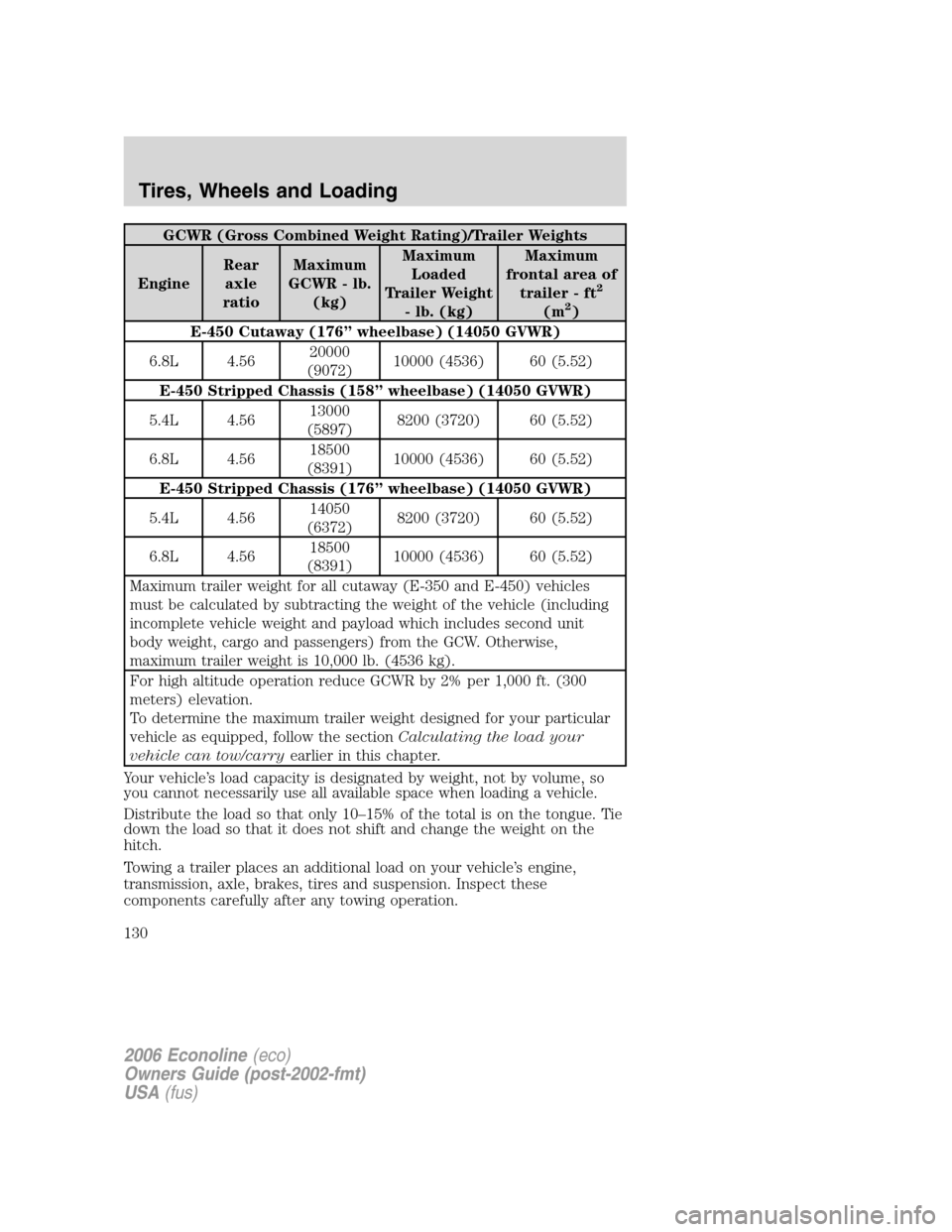
GCWR (Gross Combined Weight Rating)/Trailer Weights
EngineRear
axle
ratioMaximum
GCWR - lb.
(kg)Maximum
Loaded
Trailer Weight
- lb. (kg)Maximum
frontal area of
trailer - ft
2
(m2)
E-450 Cutaway (176” wheelbase) (14050 GVWR)
6.8L 4.5620000
(9072)10000 (4536) 60 (5.52)
E-450 Stripped Chassis (158” wheelbase) (14050 GVWR)
5.4L 4.5613000
(5897)8200 (3720) 60 (5.52)
6.8L 4.5618500
(8391)10000 (4536) 60 (5.52)
E-450 Stripped Chassis (176” wheelbase) (14050 GVWR)
5.4L 4.5614050
(6372)8200 (3720) 60 (5.52)
6.8L 4.5618500
(8391)10000 (4536) 60 (5.52)
Maximum trailer weight for all cutaway (E-350 and E-450) vehicles
must be calculated by subtracting the weight of the vehicle (including
incomplete vehicle weight and payload which includes second unit
body weight, cargo and passengers) from the GCW. Otherwise,
maximum trailer weight is 10,000 lb. (4536 kg).
For high altitude operation reduce GCWR by 2% per 1,000 ft. (300
meters) elevation.
To determine the maximum trailer weight designed for your particular
vehicle as equipped, follow the sectionCalculating the load your
vehicle can tow/carryearlier in this chapter.
Your vehicle’s load capacity is designated by weight, not by volume, so
you cannot necessarily use all available space when loading a vehicle.
Distribute the load so that only 10–15% of the total is on the tongue. Tie
down the load so that it does not shift and change the weight on the
hitch.
Towing a trailer places an additional load on your vehicle’s engine,
transmission, axle, brakes, tires and suspension. Inspect these
components carefully after any towing operation.
2006 Econoline(eco)
Owners Guide (post-2002-fmt)
USA(fus)
Tires, Wheels and Loading
130
Page 131 of 248
Note:Do not exceed the GVWR or the GAWR specified on the
certification label.
Towing trailers beyond the maximum recommended gross trailer
weight exceeds the limit of the vehicle and could result in
engine damage, transmission damage, structural damage, loss of vehicle
control, vehicle rollover and personal injury.
Preparing to tow
Use the proper equipment for towing a trailer and make sure it is
properly attached to your vehicle. See your dealer or a reliable trailer
dealer if you require assistance.
Hitches
Do not use or install hitches that clamp onto the bumper or to the axle.
Underbody hitches are acceptable if installed properly.
Safety chains
Always connect the trailer’s safety chains to the frame or hook retainers
of the vehicle hitch. To connect the trailer’s safety chains, cross the
chains under the trailer tongue and allow slack for turning corners.
If you use a rental trailer, follow the instructions that the rental agency
gives to you.
Do not attach safety chains to the bumper.
Trailer brakes
Electric brakes and manual, automatic or surge-type trailer brakes are
safe if installed properly and adjusted to the manufacturer’s
specifications. The trailer brakes must meet local and Federal
regulations.
Do not connect a trailer’s hydraulic brake system directly to your
vehicle’s brake system. Your vehicle may not have enough
braking power and your chances of having a collision greatly increase.
The braking system of the tow vehicle is rated for operation at the
GVWR not GCWR.
Trailer lamps
Trailer lamps are required on most towed vehicles. Make sure all running
lights, brake lights, turn signals and hazard lights are working. See your
dealer or trailer rental agency for proper instructions and equipment for
hooking up trailer lamps.
2006 Econoline(eco)
Owners Guide (post-2002-fmt)
USA(fus)
Tires, Wheels and Loading
131