AUX FORD E SERIES 2009 4.G User Guide
[x] Cancel search | Manufacturer: FORD, Model Year: 2009, Model line: E SERIES, Model: FORD E SERIES 2009 4.GPages: 321, PDF Size: 2.31 MB
Page 219 of 321
Night time and dark area use
At night time or in dark areas, the reverse camera system relies on the
reverse lamp lighting to produce an image. Therefore it is necessary that
both reverse lamps are operating in order to get a clear image in the
dark. If either of the lamps are not operating, stop using the reverse
camera system, at least in the dark, until the lamp(s) are replaced and
functioning.
Servicing
•If the image comes on while the vehicle is not in R (Reverse), have
the system inspected by your authorized dealer.
•If the image is not clear, then check if there is anything covering the
lens such as dirt, mud, ice, snow, etc. If the image is still not clear
after cleaning, have your system inspected by your authorized dealer.
VEHICLE USED AS A STATIONARY POWER SOURCE
Auxiliary equipment called power take-off or PTO, is often added to the
engine or transmission to operate utility equipment. Examples include a
wheel-lift for tow trucks, cranes, tools for construction or tire service and
pumping fluids. PTO applications draw auxiliary horsepower from the
powertrain, often while the vehicle is stationary. In this condition, there
is limited cooling air flow through the radiator and around the vehicle
that normally occurs when a vehicle is moving. The aftermarket PTO
system installer, having the most knowledge of the final application, is
responsible for determining whether additional chassis heat protection or
powertrain cooling is required, and alerting the user to the safe and
proper operation.
Your vehicle is qualified for use as a stationary power source, within
limits detailed in theFord Truck Body Builders Layout Book,found at
www.fleet.ford.com/truckbbas, and through the Ford Truck Body Builders
Advisory Service.
Gas engine vehicles are qualified for up to 10 minutes of continuous
operation as a stationary power source, due to the potential for the
normal venting of fuel vapors. For stationary PTO operation of extended
duration (beyond 10 minutes), diesel engine is recommended. Further
consult your aftermarket PTO installer, since the duration of operation
limit for the aftermarket PTO may be less than the vehicle is capable of.
2009 Econoline(eco)
Owners Guide, 1st Printing
USA(fus)
Driving
219
Page 226 of 321
WARNING:Always disconnect the battery before servicing high
current fuses.
If your vehicle is equipped with an auxiliary battery,
disconnecting the primary under-hood battery DOES NOT remove
power from all circuits.
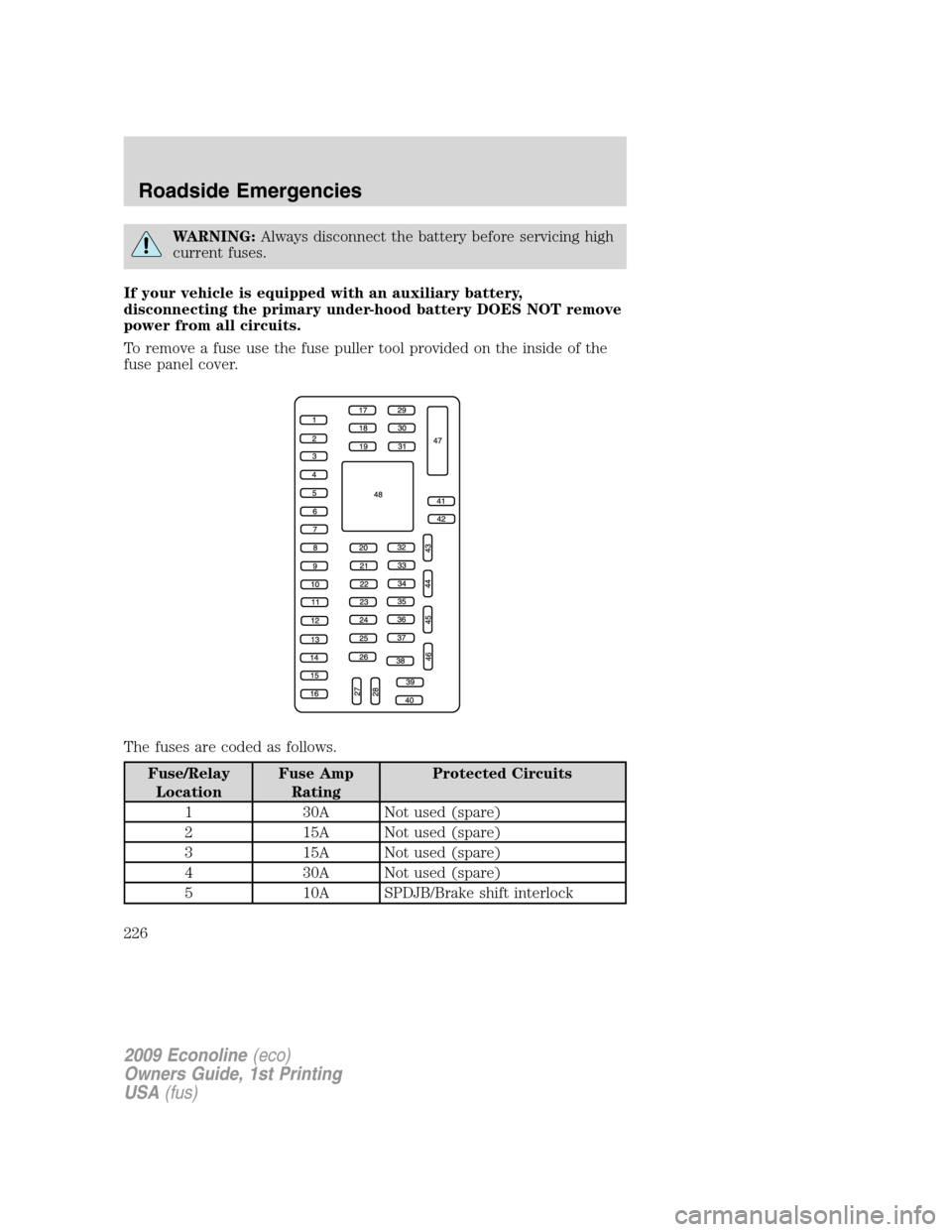
To remove a fuse use the fuse puller tool provided on the inside of the
fuse panel cover.
The fuses are coded as follows.
Fuse/Relay
LocationFuse Amp
RatingProtected Circuits
1 30A Not used (spare)
2 15A Not used (spare)
3 15A Not used (spare)
4 30A Not used (spare)
5 10A SPDJB/Brake shift interlock
2009 Econoline(eco)
Owners Guide, 1st Printing
USA(fus)
Roadside Emergencies
226
Page 228 of 321
Fuse/Relay
LocationFuse Amp
RatingProtected Circuits
36 5A PATS RF module
37 10A Climate control, Stripped chassis
IP #1 run/start
38 20A Not used (spare)
39 20A Radio, Navigation
40 20A Amplifier
41 15A Radio, Switch illumination,
Reverse camera mirror
42 10A Upfitter switch
43 10A Overhead console, Stripped
chassis IP1
44 10A Auxiliary Battery Relay
45 5A Wipers, Stripped chassis Engine
connector 3
46 7.5A PADI
47 30A circuit
breakerWindows accessory delay
48 Relay Delayed accessory
Power distribution box
The power distribution box is located in the engine compartment. The
power distribution box contains high-current fuses that protect your
vehicle’s main electrical systems from overloads.
WARNING:Always disconnect the battery before servicing high
current fuses.
WARNING:To reduce risk of electrical shock, always replace
the cover to the Power Distribution Box before reconnecting the
battery or refilling fluid reservoirs.
If your vehicle is equipped with an auxiliary battery,
disconnecting the primary under-hood battery DOES NOT remove
power from all circuits.
If the battery has been disconnected and reconnected, refer to the
Batterysection of theMaintenance and Specificationschapter.
2009 Econoline(eco)
Owners Guide, 1st Printing
USA(fus)
Roadside Emergencies
228
Page 229 of 321
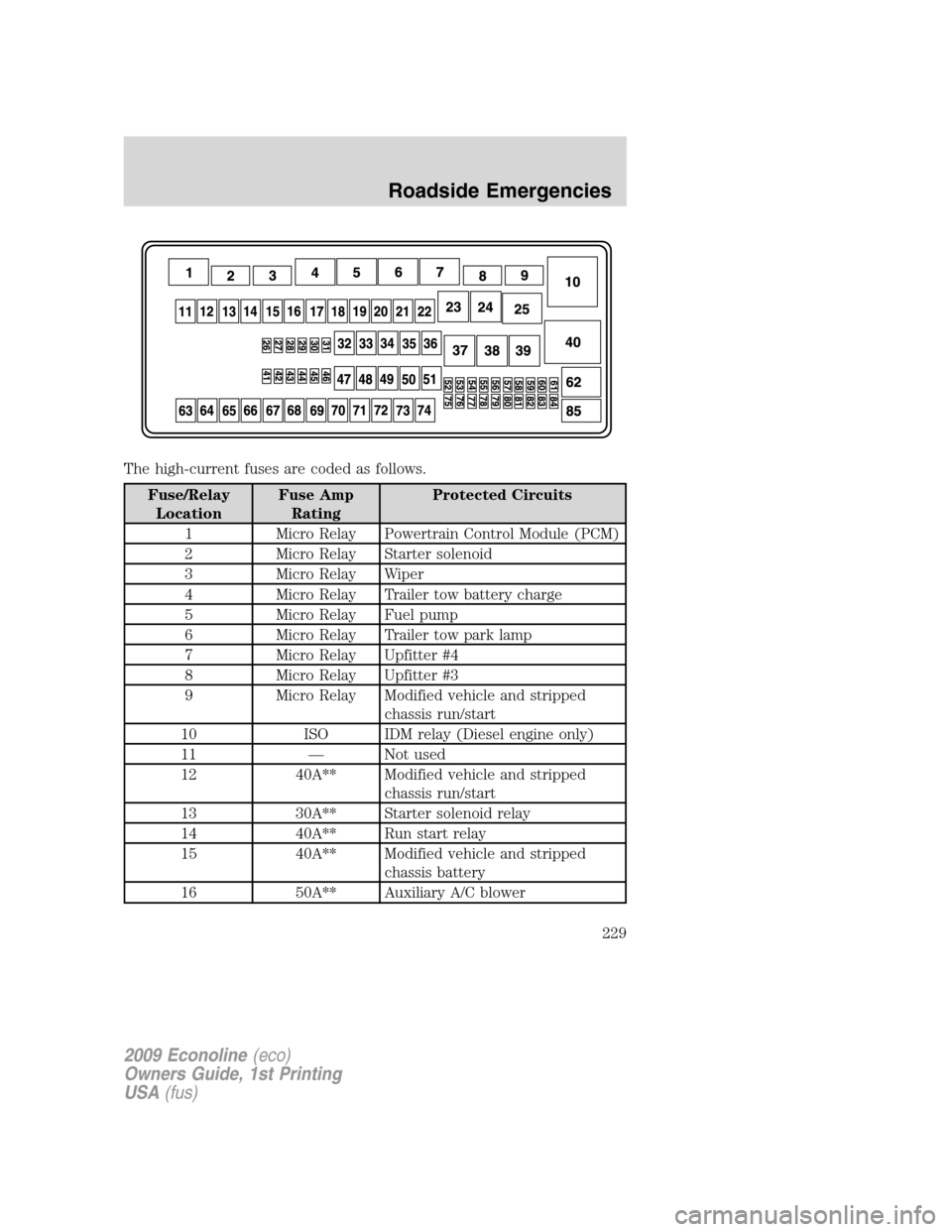
The high-current fuses are coded as follows.
Fuse/Relay
LocationFuse Amp
RatingProtected Circuits
1 Micro Relay Powertrain Control Module (PCM)
2 Micro Relay Starter solenoid
3 Micro Relay Wiper
4 Micro Relay Trailer tow battery charge
5 Micro Relay Fuel pump
6 Micro Relay Trailer tow park lamp
7 Micro Relay Upfitter #4
8 Micro Relay Upfitter #3
9 Micro Relay Modified vehicle and stripped
chassis run/start
10 ISO IDM relay (Diesel engine only)
11 — Not used
12 40A** Modified vehicle and stripped
chassis run/start
13 30A** Starter solenoid relay
14 40A** Run start relay
15 40A** Modified vehicle and stripped
chassis battery
16 50A** Auxiliary A/C blower
2009 Econoline(eco)
Owners Guide, 1st Printing
USA(fus)
Roadside Emergencies
229
Page 230 of 321
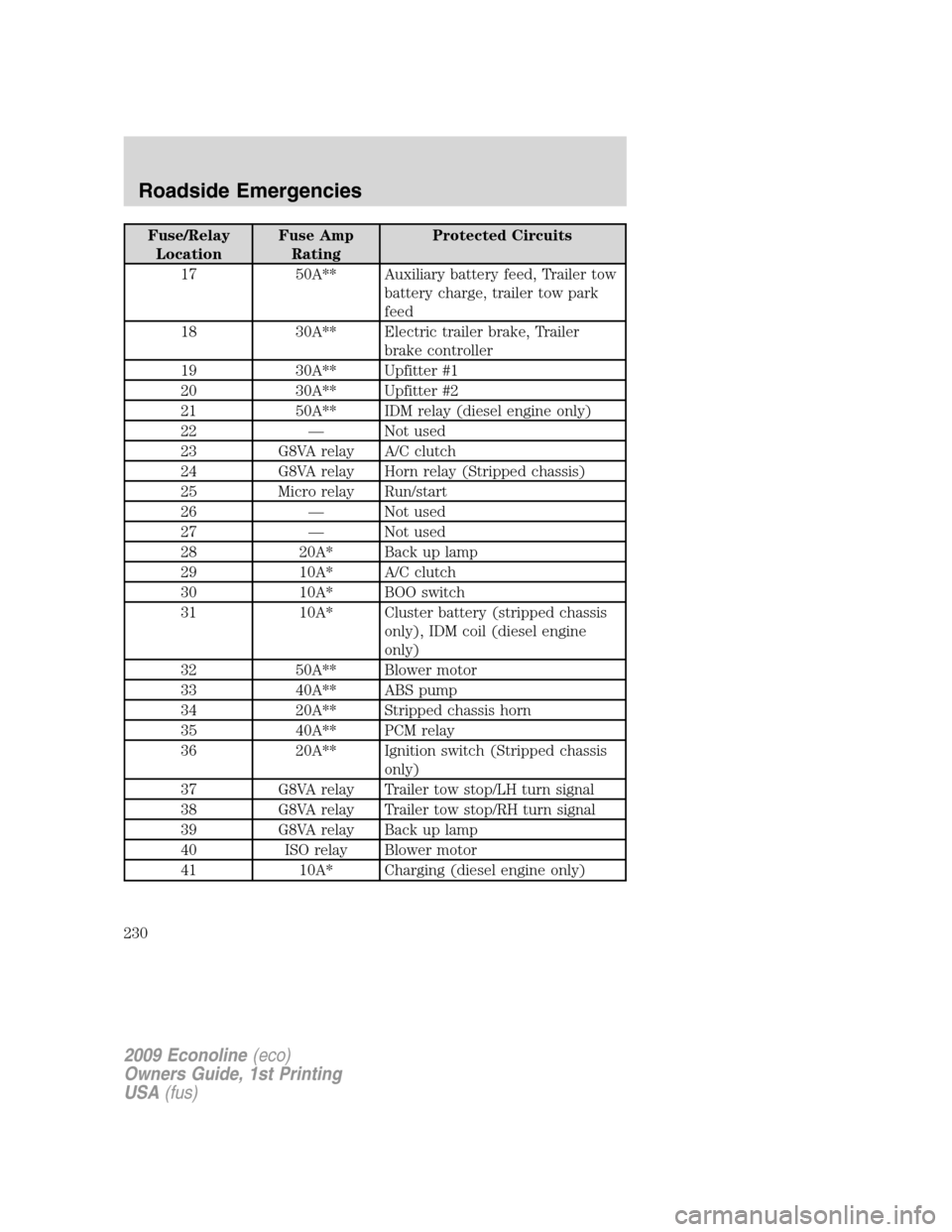
Fuse/Relay
LocationFuse Amp
RatingProtected Circuits
17 50A** Auxiliary battery feed, Trailer tow
battery charge, trailer tow park
feed
18 30A** Electric trailer brake, Trailer
brake controller
19 30A** Upfitter #1
20 30A** Upfitter #2
21 50A** IDM relay (diesel engine only)
22 — Not used
23 G8VA relay A/C clutch
24 G8VA relay Horn relay (Stripped chassis)
25 Micro relay Run/start
26 — Not used
27 — Not used
28 20A* Back up lamp
29 10A* A/C clutch
30 10A* BOO switch
31 10A* Cluster battery (stripped chassis
only), IDM coil (diesel engine
only)
32 50A** Blower motor
33 40A** ABS pump
34 20A** Stripped chassis horn
35 40A** PCM relay
36 20A** Ignition switch (Stripped chassis
only)
37 G8VA relay Trailer tow stop/LH turn signal
38 G8VA relay Trailer tow stop/RH turn signal
39 G8VA relay Back up lamp
40 ISO relay Blower motor
41 10A* Charging (diesel engine only)
2009 Econoline(eco)
Owners Guide, 1st Printing
USA(fus)
Roadside Emergencies
230
Page 231 of 321
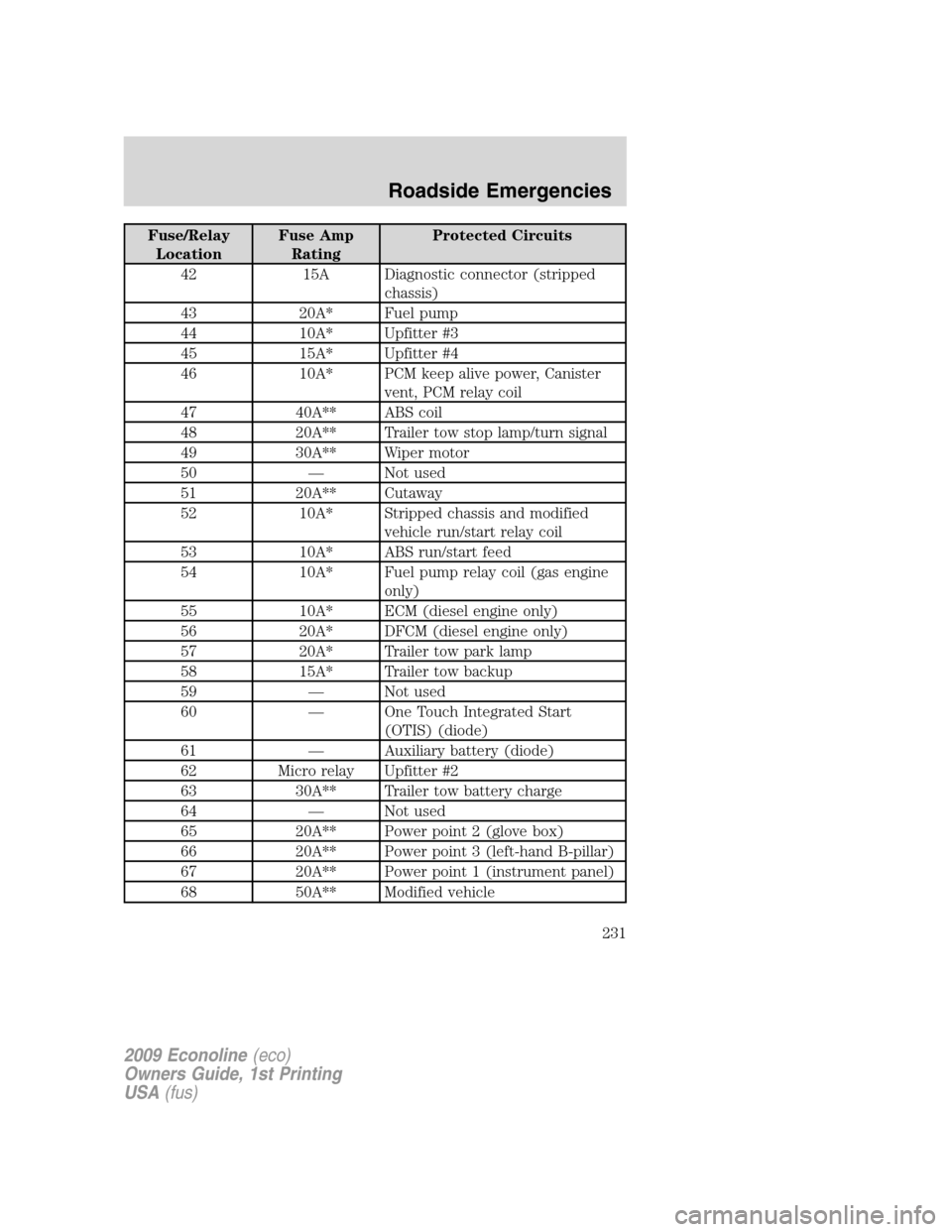
Fuse/Relay
LocationFuse Amp
RatingProtected Circuits
42 15A Diagnostic connector (stripped
chassis)
43 20A* Fuel pump
44 10A* Upfitter #3
45 15A* Upfitter #4
46 10A* PCM keep alive power, Canister
vent, PCM relay coil
47 40A** ABS coil
48 20A** Trailer tow stop lamp/turn signal
49 30A** Wiper motor
50 — Not used
51 20A** Cutaway
52 10A* Stripped chassis and modified
vehicle run/start relay coil
53 10A* ABS run/start feed
54 10A* Fuel pump relay coil (gas engine
only)
55 10A* ECM (diesel engine only)
56 20A* DFCM (diesel engine only)
57 20A* Trailer tow park lamp
58 15A* Trailer tow backup
59 — Not used
60 — One Touch Integrated Start
(OTIS) (diode)
61 — Auxiliary battery (diode)
62 Micro relay Upfitter #2
63 30A** Trailer tow battery charge
64 — Not used
65 20A** Power point 2 (glove box)
66 20A** Power point 3 (left-hand B-pillar)
67 20A** Power point 1 (instrument panel)
68 50A** Modified vehicle
2009 Econoline(eco)
Owners Guide, 1st Printing
USA(fus)
Roadside Emergencies
231
Page 266 of 321
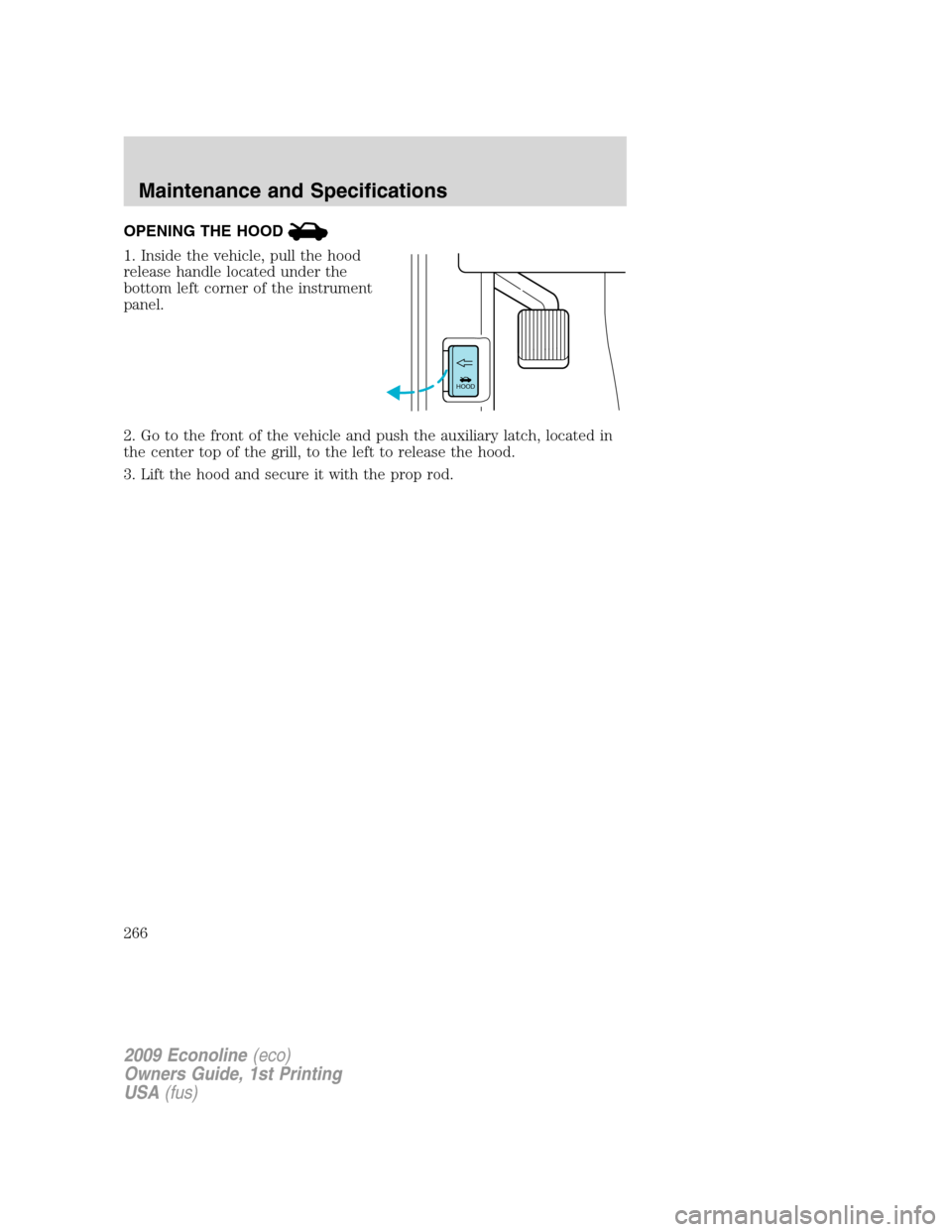
OPENING THE HOOD
1. Inside the vehicle, pull the hood
release handle located under the
bottom left corner of the instrument
panel.
2. Go to the front of the vehicle and push the auxiliary latch, located in
the center top of the grill, to the left to release the hood.
3. Lift the hood and secure it with the prop rod.
HOOD
2009 Econoline(eco)
Owners Guide, 1st Printing
USA(fus)
Maintenance and Specifications
266
Page 273 of 321
It is recommended that the negative battery cable terminal be
disconnected from the battery if you plan to store your vehicle for an
extended period of time. This will minimize the discharge of your battery
during storage.
WARNING:Batteries normally produce explosive gases which
can cause personal injury. Therefore, do not allow flames, sparks
or lighted substances to come near the battery. When working near the
battery, always shield your face and protect your eyes. Always provide
proper ventilation.
WARNING:When lifting a plastic-cased battery, excessive
pressure on the end walls could cause acid to flow through the
vent caps, resulting in personal injury and/or damage to the vehicle or
battery. Lift the battery with a battery carrier or with your hands on
opposite corners.
WARNING:Keep batteries out of reach of children. Batteries
contain sulfuric acid. Avoid contact with skin, eyes or clothing.
Shield your eyes when working near the battery to protect against
possible splashing of acid solution. In case of acid contact with skin or
eyes, flush immediately with water for a minimum of 15 minutes and
get prompt medical attention. If acid is swallowed, call a physician
immediately.
WARNING:Battery posts, terminals and related accessories
contain lead and lead compounds.Wash hands after handling.
For information on transmission operation after the battery has been
disconnected, refer toAutomatic transmission operationin the
Drivingchapter.
Auxiliary battery (if equipped)
Your vehicle may be equipped with a frame-mounted auxiliary battery
located on the passenger side frame rail, behind the front passenger
door. This auxiliary battery is connected to the auxiliary battery relay, so
it is not used to start the vehicle.
2009 Econoline(eco)
Owners Guide, 1st Printing
USA(fus)
Maintenance and Specifications
273
Page 302 of 321
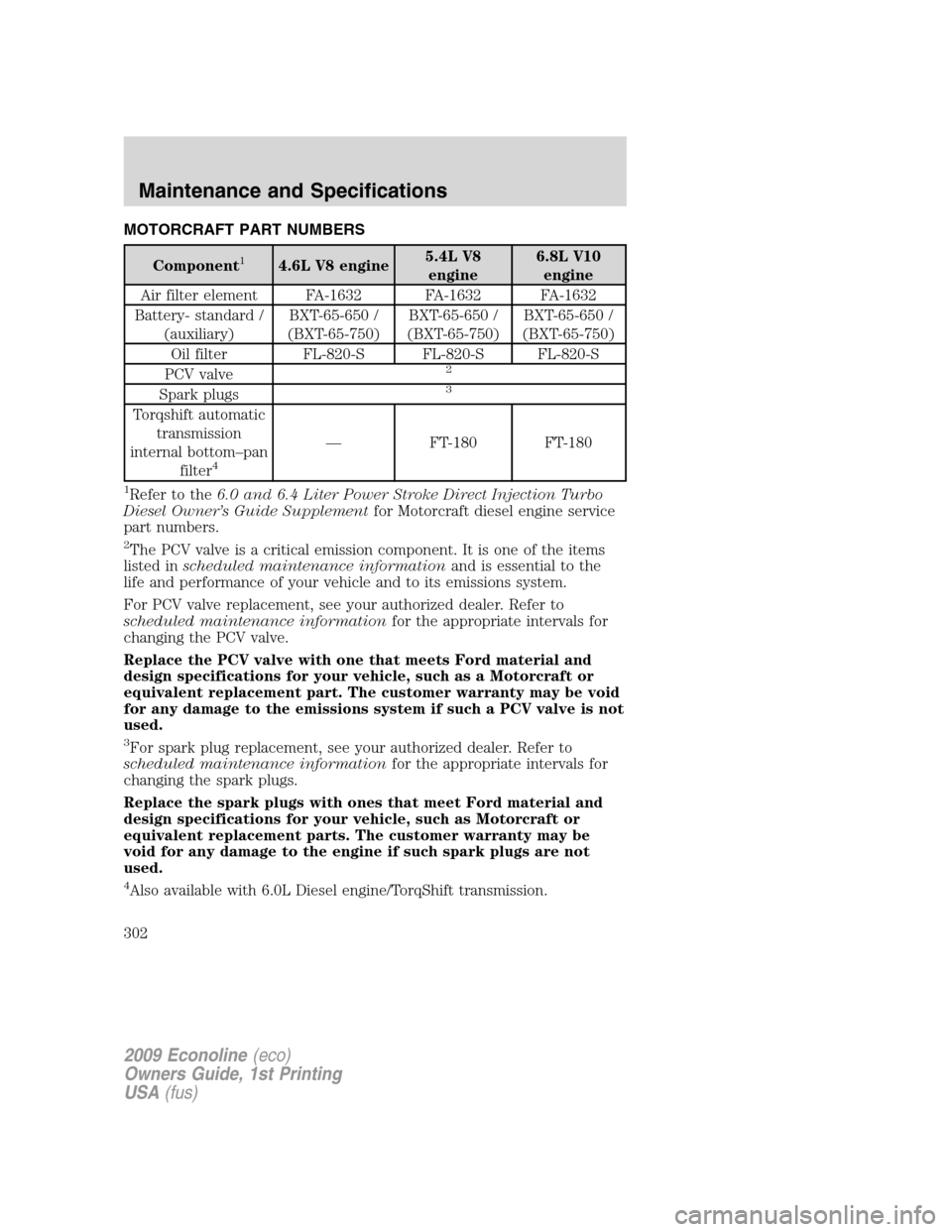
MOTORCRAFT PART NUMBERS
Component14.6L V8 engine5.4L V8
engine6.8L V10
engine
Air filter element FA-1632 FA-1632 FA-1632
Battery- standard /
(auxiliary)BXT-65-650 /
(BXT-65-750)BXT-65-650 /
(BXT-65-750)BXT-65-650 /
(BXT-65-750)
Oil filter FL-820-S FL-820-S FL-820-S
PCV valve
2
Spark plugs3
Torqshift automatic
transmission
internal bottom–pan
filter
4
— FT-180 FT-180
1Refer to the6.0 and 6.4 Liter Power Stroke Direct Injection Turbo
Diesel Owner’s Guide Supplementfor Motorcraft diesel engine service
part numbers.
2The PCV valve is a critical emission component. It is one of the items
listed inscheduled maintenance informationand is essential to the
life and performance of your vehicle and to its emissions system.
For PCV valve replacement, see your authorized dealer. Refer to
scheduled maintenance informationfor the appropriate intervals for
changing the PCV valve.
Replace the PCV valve with one that meets Ford material and
design specifications for your vehicle, such as a Motorcraft or
equivalent replacement part. The customer warranty may be void
for any damage to the emissions system if such a PCV valve is not
used.
3For spark plug replacement, see your authorized dealer. Refer to
scheduled maintenance informationfor the appropriate intervals for
changing the spark plugs.
Replace the spark plugs with ones that meet Ford material and
design specifications for your vehicle, such as Motorcraft or
equivalent replacement parts. The customer warranty may be
void for any damage to the engine if such spark plugs are not
used.
4Also available with 6.0L Diesel engine/TorqShift transmission.
2009 Econoline(eco)
Owners Guide, 1st Printing
USA(fus)
Maintenance and Specifications
302
Page 304 of 321
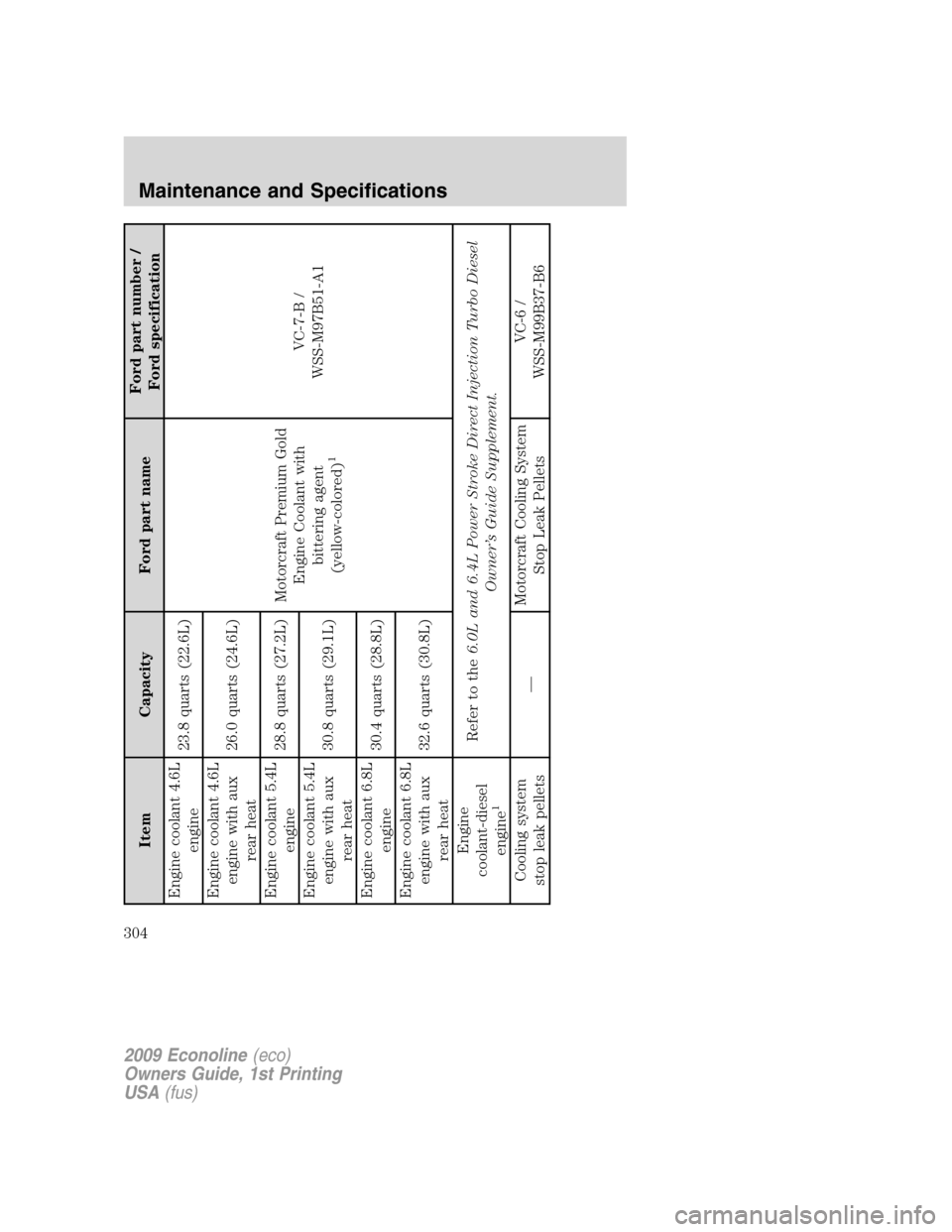
Item Capacity Ford part nameFord part number /
Ford specification
Engine coolant 4.6L
engine23.8 quarts (22.6L)
Motorcraft Premium Gold
Engine Coolant with
bittering agent
(yellow-colored)
1
VC-7-B /
WSS-M97B51-A1 Engine coolant 4.6L
engine with aux
rear heat26.0 quarts (24.6L)
Engine coolant 5.4L
engine28.8 quarts (27.2L)
Engine coolant 5.4L
engine with aux
rear heat30.8 quarts (29.1L)
Engine coolant 6.8L
engine30.4 quarts (28.8L)
Engine coolant 6.8L
engine with aux
rear heat32.6 quarts (30.8L)
Engine
coolant-diesel
engine
1
Refer to the6.0L and 6.4L Power Stroke Direct Injection Turbo Diesel
Owner’s Guide Supplement.
Cooling system
stop leak pellets—Motorcraft Cooling System
Stop Leak PelletsVC-6 /
WSS-M99B37-B6
2009 Econoline(eco)
Owners Guide, 1st Printing
USA(fus)
Maintenance and Specifications
304