weight FORD E SERIES 2011 4.G Owner's Manual
[x] Cancel search | Manufacturer: FORD, Model Year: 2011, Model line: E SERIES, Model: FORD E SERIES 2011 4.GPages: 337, PDF Size: 3.26 MB
Page 172 of 337
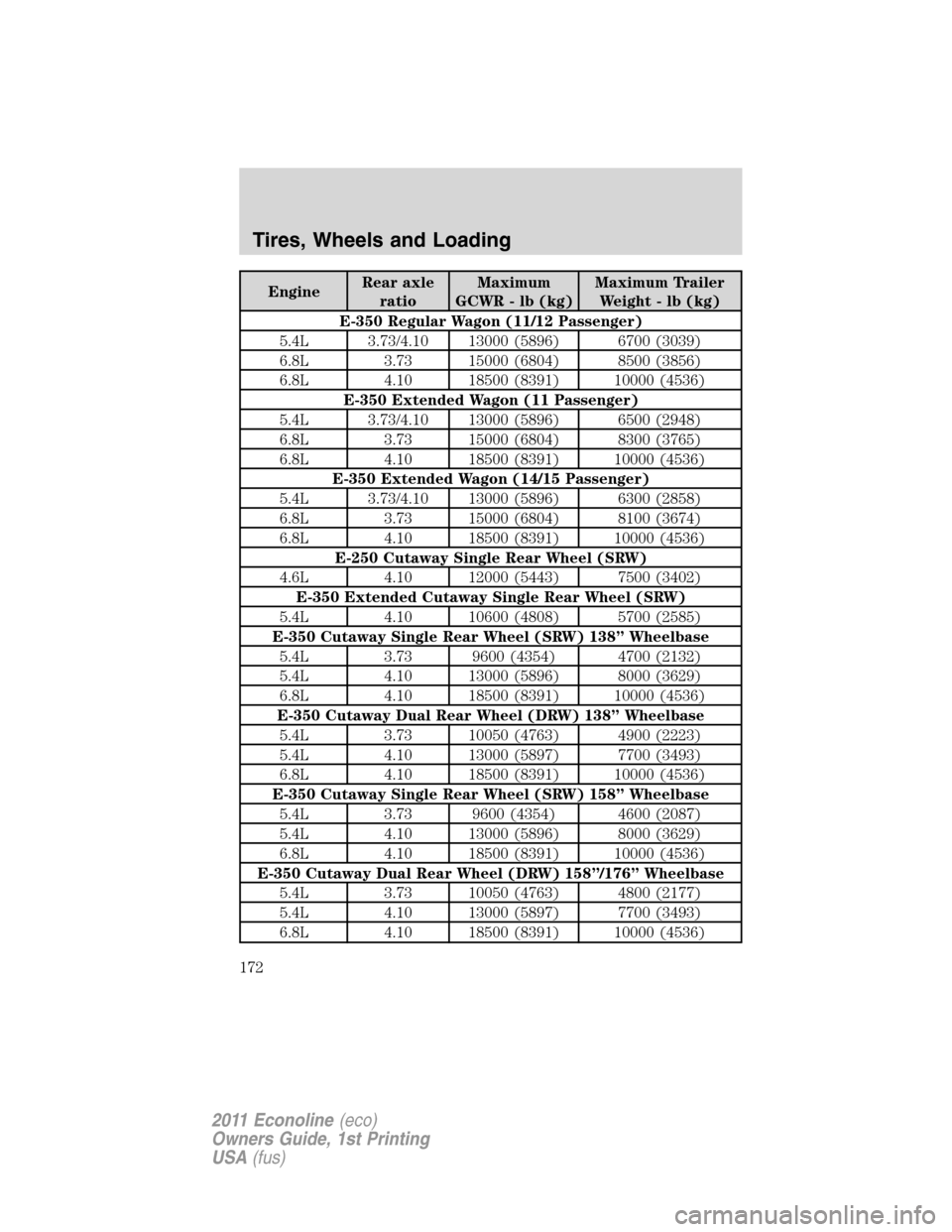
EngineRear axle
ratioMaximum
GCWR - lb (kg)Maximum Trailer
Weight - lb (kg)
E-350 Regular Wagon (11/12 Passenger)
5.4L 3.73/4.10 13000 (5896) 6700 (3039)
6.8L 3.73 15000 (6804) 8500 (3856)
6.8L 4.10 18500 (8391) 10000 (4536)
E-350 Extended Wagon (11 Passenger)
5.4L 3.73/4.10 13000 (5896) 6500 (2948)
6.8L 3.73 15000 (6804) 8300 (3765)
6.8L 4.10 18500 (8391) 10000 (4536)
E-350 Extended Wagon (14/15 Passenger)
5.4L 3.73/4.10 13000 (5896) 6300 (2858)
6.8L 3.73 15000 (6804) 8100 (3674)
6.8L 4.10 18500 (8391) 10000 (4536)
E-250 Cutaway Single Rear Wheel (SRW)
4.6L 4.10 12000 (5443) 7500 (3402)
E-350 Extended Cutaway Single Rear Wheel (SRW)
5.4L 4.10 10600 (4808) 5700 (2585)
E-350 Cutaway Single Rear Wheel (SRW) 138” Wheelbase
5.4L 3.73 9600 (4354) 4700 (2132)
5.4L 4.10 13000 (5896) 8000 (3629)
6.8L 4.10 18500 (8391) 10000 (4536)
E-350 Cutaway Dual Rear Wheel (DRW) 138” Wheelbase
5.4L 3.73 10050 (4763) 4900 (2223)
5.4L 4.10 13000 (5897) 7700 (3493)
6.8L 4.10 18500 (8391) 10000 (4536)
E-350 Cutaway Single Rear Wheel (SRW) 158” Wheelbase
5.4L 3.73 9600 (4354) 4600 (2087)
5.4L 4.10 13000 (5896) 8000 (3629)
6.8L 4.10 18500 (8391) 10000 (4536)
E-350 Cutaway Dual Rear Wheel (DRW) 158”/176” Wheelbase
5.4L 3.73 10050 (4763) 4800 (2177)
5.4L 4.10 13000 (5897) 7700 (3493)
6.8L 4.10 18500 (8391) 10000 (4536)
Tires, Wheels and Loading
172
2011 Econoline(eco)
Owners Guide, 1st Printing
USA(fus)
Page 173 of 337
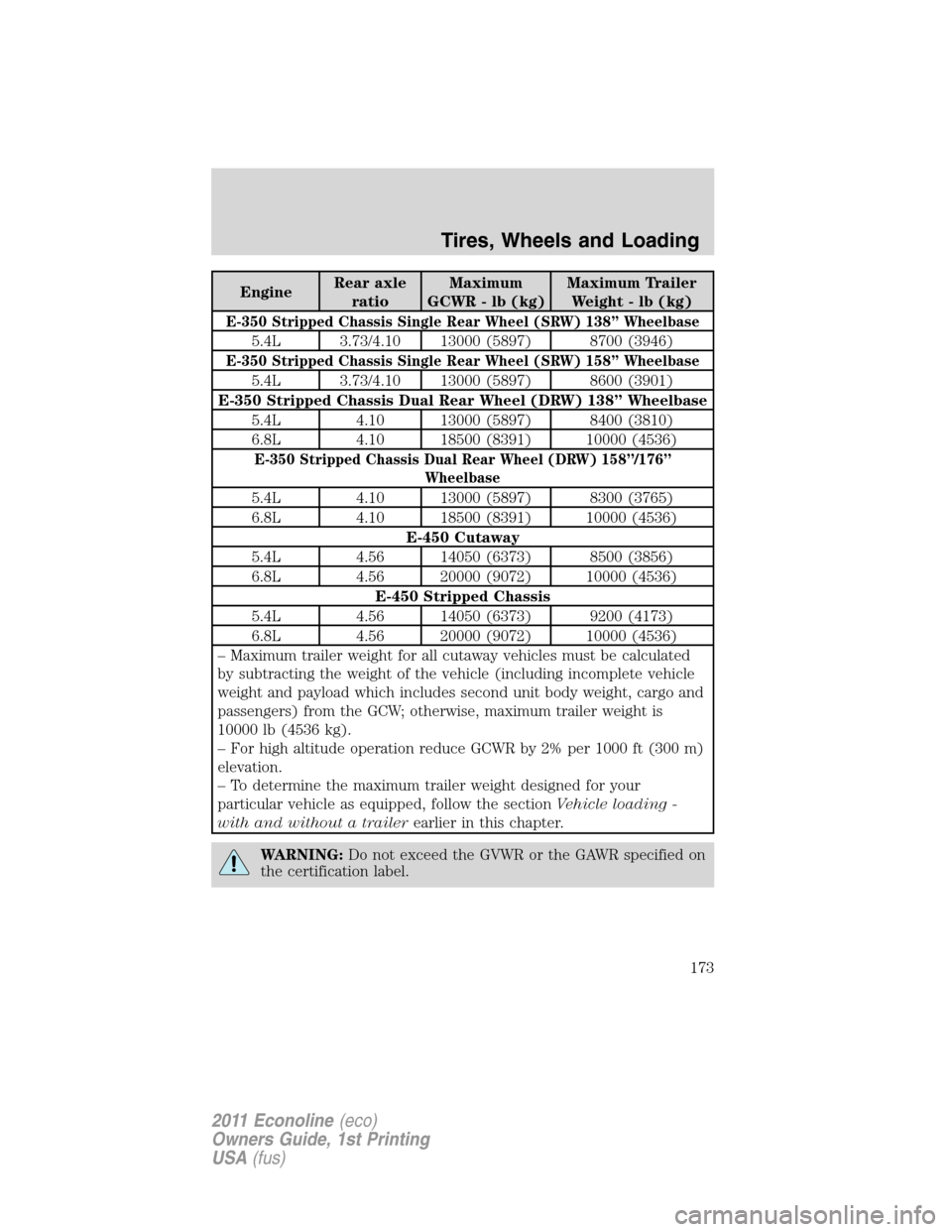
EngineRear axle
ratioMaximum
GCWR - lb (kg)Maximum Trailer
Weight - lb (kg)
E-350 Stripped Chassis Single Rear Wheel (SRW) 138” Wheelbase
5.4L 3.73/4.10 13000 (5897) 8700 (3946)
E-350 Stripped Chassis Single Rear Wheel (SRW) 158” Wheelbase
5.4L 3.73/4.10 13000 (5897) 8600 (3901)
E-350 Stripped Chassis Dual Rear Wheel (DRW) 138” Wheelbase
5.4L 4.10 13000 (5897) 8400 (3810)
6.8L 4.10 18500 (8391) 10000 (4536)
E-350 Stripped Chassis Dual Rear Wheel (DRW) 158”/176”
Wheelbase
5.4L 4.10 13000 (5897) 8300 (3765)
6.8L 4.10 18500 (8391) 10000 (4536)
E-450 Cutaway
5.4L 4.56 14050 (6373) 8500 (3856)
6.8L 4.56 20000 (9072) 10000 (4536)
E-450 Stripped Chassis
5.4L 4.56 14050 (6373) 9200 (4173)
6.8L 4.56 20000 (9072) 10000 (4536)
– Maximum trailer weight for all cutaway vehicles must be calculated
by subtracting the weight of the vehicle (including incomplete vehicle
weight and payload which includes second unit body weight, cargo and
passengers) from the GCW; otherwise, maximum trailer weight is
10000 lb (4536 kg).
– For high altitude operation reduce GCWR by 2% per 1000 ft (300 m)
elevation.
– To determine the maximum trailer weight designed for your
particular vehicle as equipped, follow the sectionVehicle loading -
with and without a trailerearlier in this chapter.
WARNING:Do not exceed the GVWR or the GAWR specified on
the certification label.
Tires, Wheels and Loading
173
2011 Econoline(eco)
Owners Guide, 1st Printing
USA(fus)
Page 174 of 337
WARNING:Towing trailers beyond the maximum recommended
gross trailer weight exceeds the limit of the vehicle and could
result in engine damage, transmission damage, structural damage, loss
of vehicle control, vehicle rollover and personal injury.
Preparing to tow
Use the proper equipment for towing a trailer and make sure it is
properly attached to your vehicle. Contact your authorized dealer or a
reliable trailer dealer as soon as possible if you require assistance.
Hitches
Do not use or install hitches that clamp onto the bumper or to the axle.
Underbody hitches are acceptable if installed properly.
Using a step bumper (if equipped)
The rear bumper is equipped with an integral hitch and only requires a
ball with a one inch (25.4 mm) shank diameter. The bumper has a
5,000 lb (2,270 kg) trailer weight and 500 lb (227 kg) tongue weight
capacity.
If it is necessary to relocate the trailer hitch ball position, a
frame-mounted trailer hitch must be installed.
Safety chains
Always connect the trailer’s safety chains to the frame or hook retainers
of the vehicle hitch. To connect the trailer’s safety chains, cross the
chains under the trailer tongue and allow slack for turning corners.
If you use a rental trailer, follow the instructions that the rental agency
gives to you.
Do not attach safety chains to the bumper.
Trailer brakes
Electric brakes and manual, automatic or surge-type trailer brakes are
safe if installed properly and adjusted to the manufacturer’s
specifications. The trailer brakes must meet local and Federal
regulations.
WARNING:Do not connect a trailer’s hydraulic brake system
directly to your vehicle’s brake system. Your vehicle may not
have enough braking power and your chances of having a collision
greatly increase.
Tires, Wheels and Loading
174
2011 Econoline(eco)
Owners Guide, 1st Printing
USA(fus)
Page 195 of 337
WARNING:Vehicles with a higher center of gravity such as
utility vehicles and trucks handle differently than vehicles with a
lower center of gravity. Utility vehicles and trucks arenotdesigned for
cornering at speeds as high as passenger cars any more than low-slung
sports cars are designed to perform satisfactorily under off-road
conditions. Avoid sharp turns, excessive speed or abrupt maneuvers in
these vehicles. Failure to drive cautiously could result in an increased
risk of loss of vehicle control, vehicle rollover, personal injury and
death.
WARNING:Loaded vehicles, with a higher center of gravity,
may handle differently than unloaded vehicles. Do not overload
your vehicle and use extra precautions, such as driving at slower
speeds, avoiding abrupt steering changes and allowing for increased
stopping distance, when driving a heavily loaded vehicle. Over-loading
or loading the vehicle improperly can deteriorate handling capability
and contribute to loss of vehicle control and vehicle rollover.
Vehicle stability and handling
The risk of a rollover crash increases as the number of people and load
in the vehicle increase. This increased risk occurs because the passenger
weight and load raises the vehicle’s center of gravity and causes it to
shift rearward. As a result, the van has less resistance to rollover and
handles differently from other commonly driven passenger vehicles,
making it more difficult to control in an emergency situation. Placing any
load on the roof also raises the center of gravity and increases the
potential for rollover.
The van should be operated by an experienced driver. An organization
that owns a 15–passenger van should select one or two experienced
drivers to drive the van on a regular basis. These drivers will gain
valuable experience handling the van. This experience will help make
each trip safer.
The van should be operated at a safe speed which, in some conditions,
may be less than the posted speed limit.
Further, all occupants should be properly restrained. Most people killed
in rollover crashes were unbelted. Occupants can dramatically reduce
their risk of being killed or seriously injured in a rollover crash by simply
using their seat belts. Organizations that own 15–passenger vans should
have a written seat belt use policy. Drivers should be responsible for
enforcing the policy.
Driving
195
2011 Econoline(eco)
Owners Guide, 1st Printing
USA(fus)
Page 278 of 337
•Anticipate stopping; slowing down may eliminate the need to stop.
•Sudden or hard accelerations may reduce fuel economy.
•Slow down gradually.
•Driving at reasonable speeds (traveling at 55 mph [88 km/h] uses 15%
less fuel than traveling at 65 mph [105 km/h]).
•Revving the engine before turning it off may reduce fuel economy.
•Using the air conditioner or defroster may reduce fuel economy.
•You may want to turn off the speed control in hilly terrain if
unnecessary shifting between the top gears occurs. Unnecessary
shifting of this type could result in reduced fuel economy.
•Warming up a vehicle on cold mornings is not required and may
reduce fuel economy.
•Resting your foot on the brake pedal while driving may reduce fuel
economy.
•Combine errands and minimize stop-and-go driving.
Maintenance
•Keep tires properly inflated and use only recommended size.
•Operating a vehicle with the wheels out of alignment will reduce fuel
economy.
•Use recommended engine oil. Refer toMaintenance product
specifications and capacitiesin this chapter.
•Perform all regularly scheduled maintenance items. Follow the
recommended maintenance schedule and owner maintenance checks
found inscheduled maintenance information.
Conditions
•Heavily loading a vehicle or towing a trailer may reduce fuel economy
at any speed.
•Carrying unnecessary weight may reduce fuel economy (approximately
1 mpg [0.4 km/L] is lost for every 400 lb [180 kg] of weight carried).
•Adding certain accessories to your vehicle (for example bug
deflectors, rollbars/light bars, running boards, ski racks) may reduce
fuel economy.
•Using fuel blended with alcohol may lower fuel economy.
•Fuel economy may decrease with lower temperatures during the first
8–10 miles (12–16 km) of driving.
Maintenance and Specifications
278
2011 Econoline(eco)
Owners Guide, 1st Printing
USA(fus)
Page 303 of 337
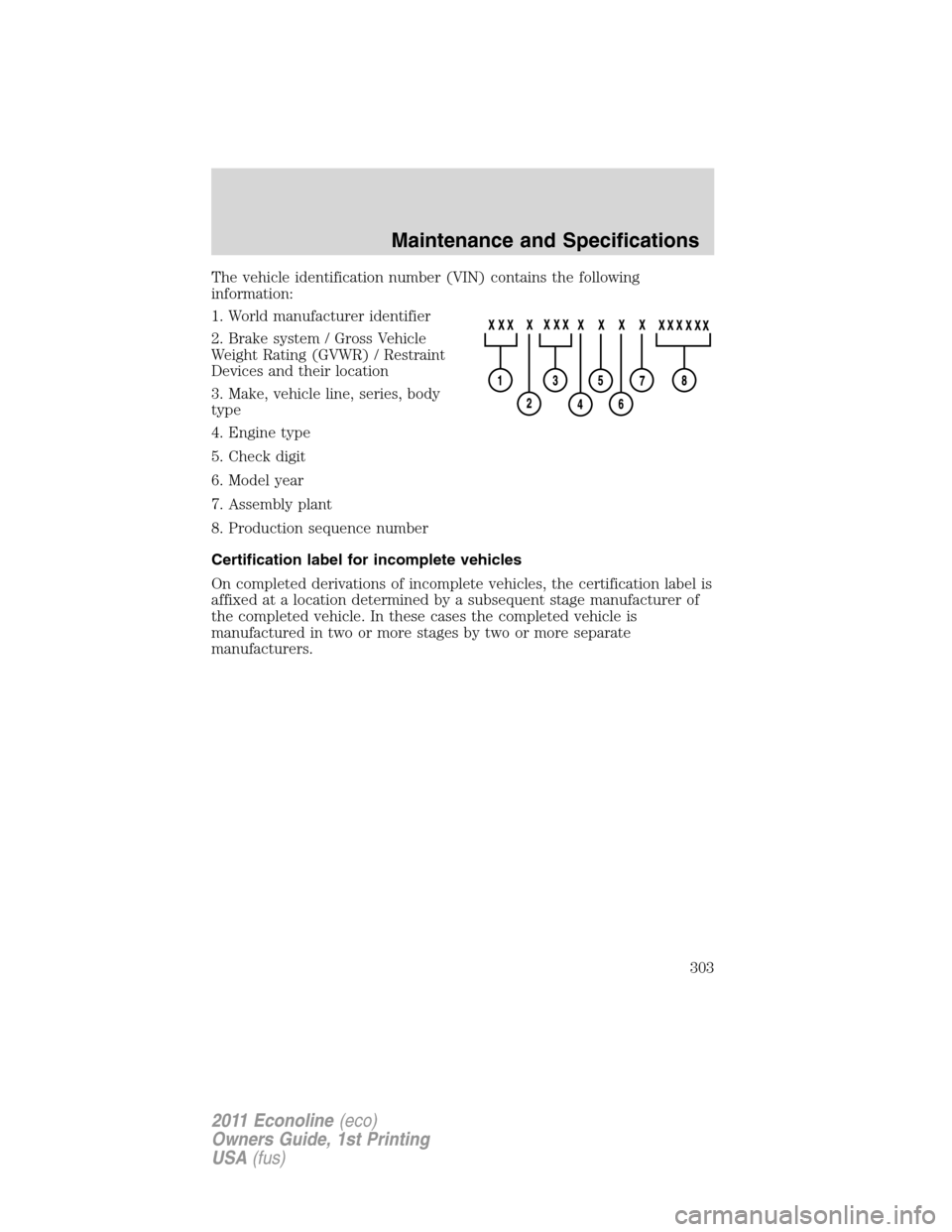
The vehicle identification number (VIN) contains the following
information:
1. World manufacturer identifier
2. Brake system / Gross Vehicle
Weight Rating (GVWR) / Restraint
Devices and their location
3. Make, vehicle line, series, body
type
4. Engine type
5. Check digit
6. Model year
7. Assembly plant
8. Production sequence number
Certification label for incomplete vehicles
On completed derivations of incomplete vehicles, the certification label is
affixed at a location determined by a subsequent stage manufacturer of
the completed vehicle. In these cases the completed vehicle is
manufactured in two or more stages by two or more separate
manufacturers.
Maintenance and Specifications
303
2011 Econoline(eco)
Owners Guide, 1st Printing
USA(fus)
Page 306 of 337
•Vehicle tracking and recovery*•Hitch mounted parking sensor*
•Bumper mounted parking sensors*
*Ford Licensed Accessories (FLA) are warranted by the accessory
manufacturer’s warranty. Ford Licensed Accessories are fully designed
and developed by the accessory manufacturer and have not been
designed or tested to Ford Motor Company engineering requirements.
Contact your Ford dealer for details regarding the manufacturer’s limited
warranty and/or a copy of the FLA product limited warranty offered by
the accessory manufacturer.
For maximum vehicle performance, keep the following information in
mind when adding accessories or equipment to your vehicle:
•When adding accessories, equipment, passengers and luggage to your
vehicle, do not exceed the total weight capacity of the vehicle or of
the front or rear axle (GVWR or GAWR as indicated on the Safety
Compliance Certification label). Consult your authorized dealer for
specific weight information.
•The Federal Communications Commission (FCC) and Canadian Radio
Telecommunications Commission (CRTC) regulate the use of mobile
communications systems — such as two-way radios, telephones and
theft alarms - that are equipped with radio transmitters. Any such
equipment installed in your vehicle should comply with FCC or CRTC
regulations and should be installed only by a qualified service
technician.
•Mobile communications systems may harm the operation of your
vehicle, particularly if they are not properly designed for automotive
use.
•To avoid interference with other vehicle functions, such as anti-lock
braking systems, amateur radio users who install radios and antennas
onto their vehicle should not locate the Amateur Radio Antennas in
the area of the driver’s side hood.
•Electrical or electronic accessories or components that are added to
the vehicle by the authorized dealer or the owner may adversely affect
battery performance and durability.
Accessories
306
2011 Econoline(eco)
Owners Guide, 1st Printing
USA(fus)
Page 329 of 337
EXCEPTIONS
In addition, there are several exceptions to the Normal Schedule. They
are listed below:
Normal vehicle axle maintenance
❑Rear axles and power take-off (PTO) units containing synthetic lubricant and light duty trucks equipped with Ford-design
axles are lubricated for life. These lubricants are not to be checked or changed unless a leak is suspected, service is re-
quired or the axle assembly has been submerged in water. The axle and PTO lubricant should be changed anytime the axle
and PTO have been submerged in water. During extended trailer tow operation above 70°F (21°C) ambient and wide open
throttle for extended periods above 45 mph (72 km/h), non-synthetic rear axle lubricants should be replaced every
3,000 miles (4,800 km) or 3 months, whichever occurs first. The 3,000 mile (4,800 km) lubricant change interval may
be waived if the axle was filled with 75W140 synthetic gear lubricant meeting Ford specification WSL-M2C192-A, part
number F1TZ-19580-B or equivalent. Add friction modifier XL-3 (EST-M2C118-A) or equivalent for complete refill of Traction-
Lok rear axles (refer to
Maintenance product and specificationsin theMaintenance and Specificationschapter for details).
The axle lubricant should be changed anytime an axle has been submerged in water.
Police/Taxi/Livery vehicle axle maintenance
❑Replace rear axle lubricant every 100,000 miles (160,000 km). Rear axle lubricant change may be waived if the axle
was filled with 75W140 synthetic gear lubricant meeting Ford specification WSL-M2C192-A, part number FITZ-19580-B or
equivalent. Add four ounces (118 mL) of additive friction modifier XL-3 (EST-M2C118-A) or equivalent for complete refill of
Traction-Lok rear axles. The axle lubricant should be changed anytime the axle has been submerged in water.
E–450 and F–450/550 axle maintenance
❑Replace rear axle lubricant every 100,000 miles (160,000 km) under normal driving conditions on all E–450 and
F–450/550 applications. For E–450 and F–450/550 vehicles operated at or near maximum Gross Vehicle Weights, the
rear axle lubricant should be replaced every 50,000 miles (80,000 km). In addition, this 50,000 mile (80,000 km)
schedule should be observed when the vehicles are operated under the Special Operating Conditions.
California fuel filter replacement
❑If vehicle is registered in California, the California Air Resources Board has determined that the failure to perform this main-
tenance item will not nullify the emission warranty or limit recall liability prior to the completion of the vehicle’s useful life.
Ford Motor Company, however, urges you to have all recommended maintenance services performed at the specified inter-
vals and to record all vehicle service.
Class A Motorhome
❑Every two years - Change brake fluid
Scheduled Maintenance Guide
329
2011 Econoline(eco)
Owners Guide, 1st Printing
USA(fus)