remove seats FORD E SERIES 2011 4.G Owners Manual
[x] Cancel search | Manufacturer: FORD, Model Year: 2011, Model line: E SERIES, Model: FORD E SERIES 2011 4.GPages: 337, PDF Size: 3.26 MB
Page 47 of 337
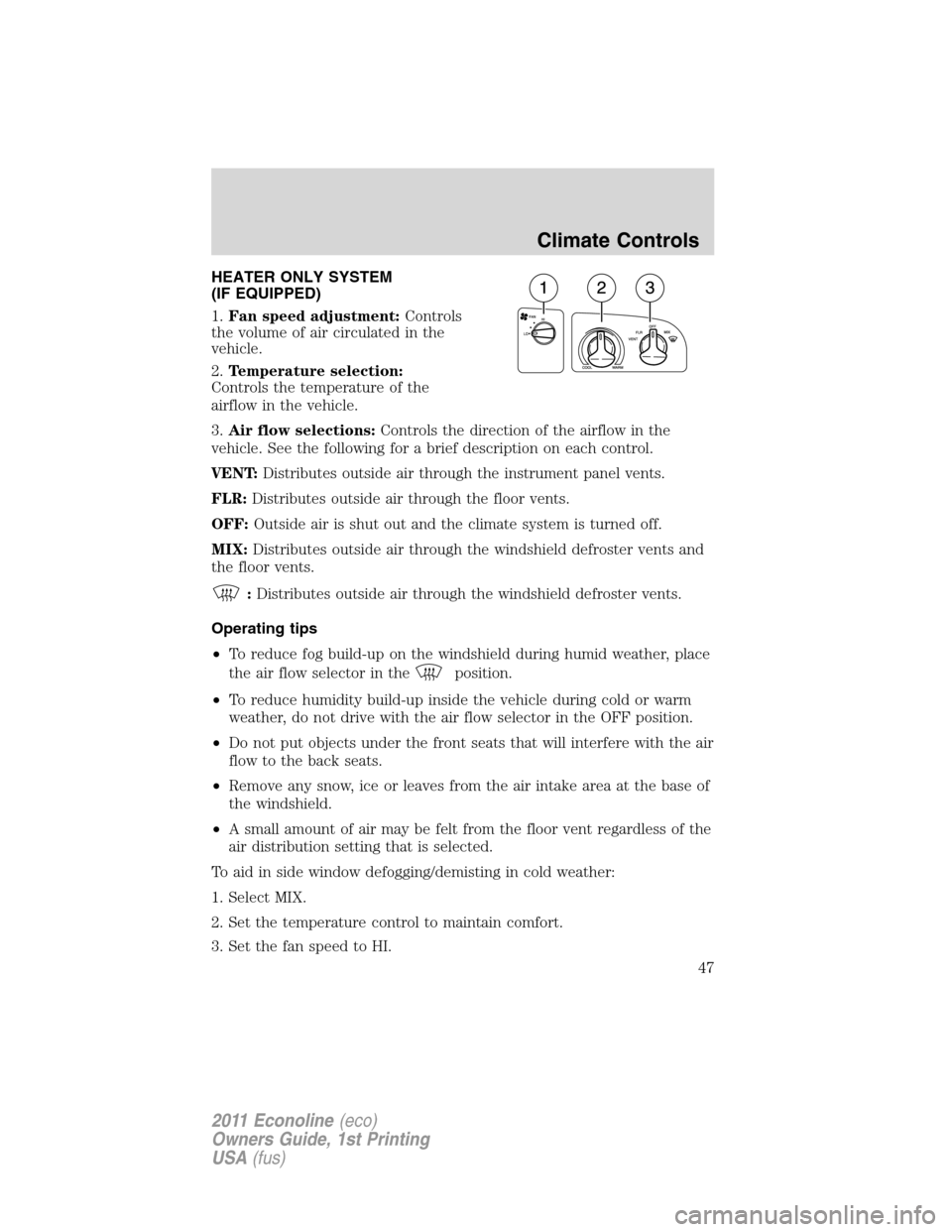
HEATER ONLY SYSTEM
(IF EQUIPPED)
1.Fan speed adjustment:Controls
the volume of air circulated in the
vehicle.
2.Temperature selection:
Controls the temperature of the
airflow in the vehicle.
3.Air flow selections:Controls the direction of the airflow in the
vehicle. See the following for a brief description on each control.
VENT:Distributes outside air through the instrument panel vents.
FLR:Distributes outside air through the floor vents.
OFF:Outside air is shut out and the climate system is turned off.
MIX:Distributes outside air through the windshield defroster vents and
the floor vents.
:Distributes outside air through the windshield defroster vents.
Operating tips
•To reduce fog build-up on the windshield during humid weather, place
the air flow selector in the
position.
•To reduce humidity build-up inside the vehicle during cold or warm
weather, do not drive with the air flow selector in the OFF position.
•Do not put objects under the front seats that will interfere with the air
flow to the back seats.
•Remove any snow, ice or leaves from the air intake area at the base of
the windshield.
•A small amount of air may be felt from the floor vent regardless of the
air distribution setting that is selected.
To aid in side window defogging/demisting in cold weather:
1. Select MIX.
2. Set the temperature control to maintain comfort.
3. Set the fan speed to HI.
Climate Controls
47
2011 Econoline(eco)
Owners Guide, 1st Printing
USA(fus)
Page 48 of 337
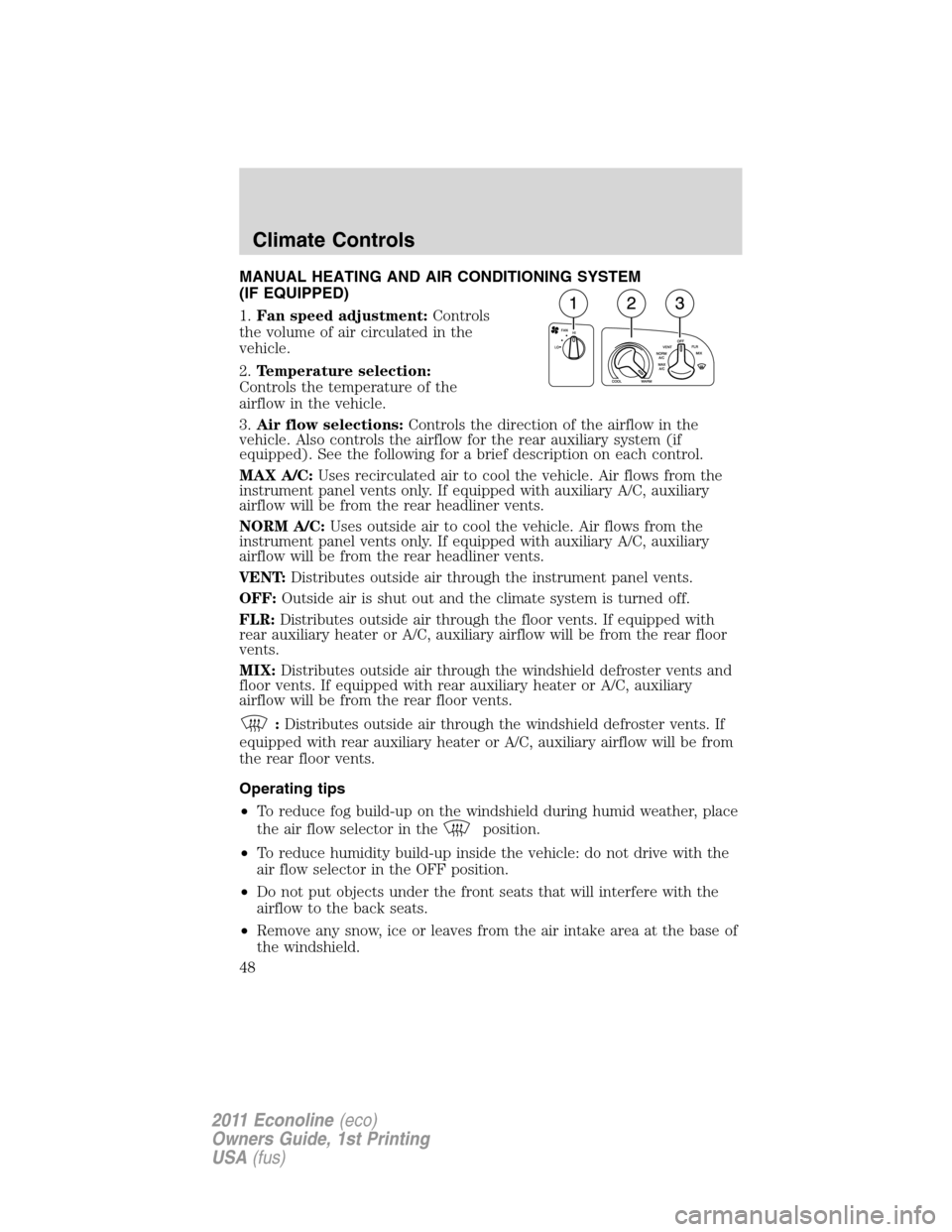
MANUAL HEATING AND AIR CONDITIONING SYSTEM
(IF EQUIPPED)
1.Fan speed adjustment:Controls
the volume of air circulated in the
vehicle.
2.Temperature selection:
Controls the temperature of the
airflow in the vehicle.
3.Air flow selections:Controls the direction of the airflow in the
vehicle. Also controls the airflow for the rear auxiliary system (if
equipped). See the following for a brief description on each control.
MAX A/C:Uses recirculated air to cool the vehicle. Air flows from the
instrument panel vents only. If equipped with auxiliary A/C, auxiliary
airflow will be from the rear headliner vents.
NORM A/C:Uses outside air to cool the vehicle. Air flows from the
instrument panel vents only. If equipped with auxiliary A/C, auxiliary
airflow will be from the rear headliner vents.
VENT:Distributes outside air through the instrument panel vents.
OFF:Outside air is shut out and the climate system is turned off.
FLR:Distributes outside air through the floor vents. If equipped with
rear auxiliary heater or A/C, auxiliary airflow will be from the rear floor
vents.
MIX:Distributes outside air through the windshield defroster vents and
floor vents. If equipped with rear auxiliary heater or A/C, auxiliary
airflow will be from the rear floor vents.
:Distributes outside air through the windshield defroster vents. If
equipped with rear auxiliary heater or A/C, auxiliary airflow will be from
the rear floor vents.
Operating tips
•To reduce fog build-up on the windshield during humid weather, place
the air flow selector in the
position.
•To reduce humidity build-up inside the vehicle: do not drive with the
air flow selector in the OFF position.
•Do not put objects under the front seats that will interfere with the
airflow to the back seats.
•Remove any snow, ice or leaves from the air intake area at the base of
the windshield.
Climate Controls
48
2011 Econoline(eco)
Owners Guide, 1st Printing
USA(fus)
Page 90 of 337
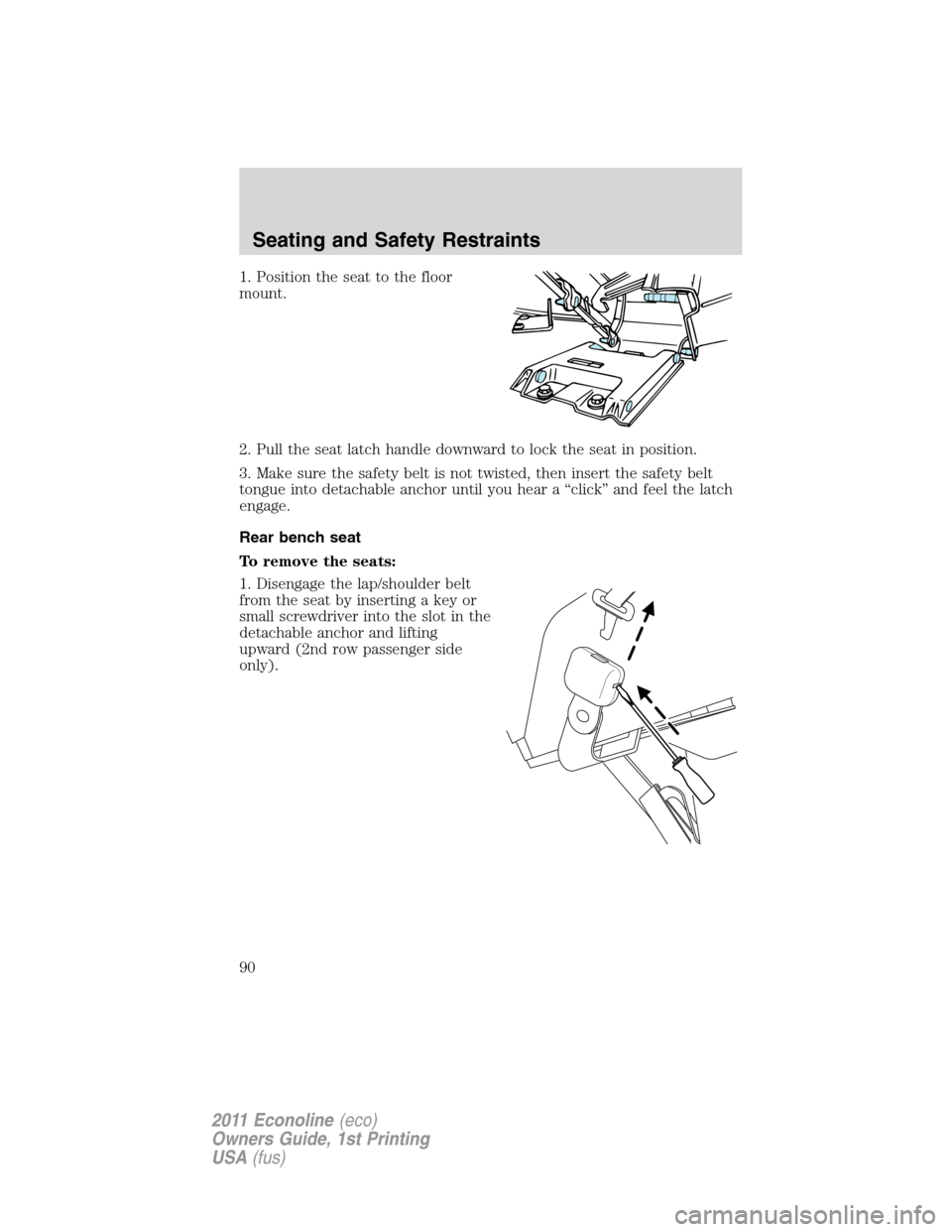
1. Position the seat to the floor
mount.
2. Pull the seat latch handle downward to lock the seat in position.
3. Make sure the safety belt is not twisted, then insert the safety belt
tongue into detachable anchor until you hear a “click” and feel the latch
engage.
Rear bench seat
To remove the seats:
1. Disengage the lap/shoulder belt
from the seat by inserting a key or
small screwdriver into the slot in the
detachable anchor and lifting
upward (2nd row passenger side
only).
Seating and Safety Restraints
90
2011 Econoline(eco)
Owners Guide, 1st Printing
USA(fus)
Page 92 of 337
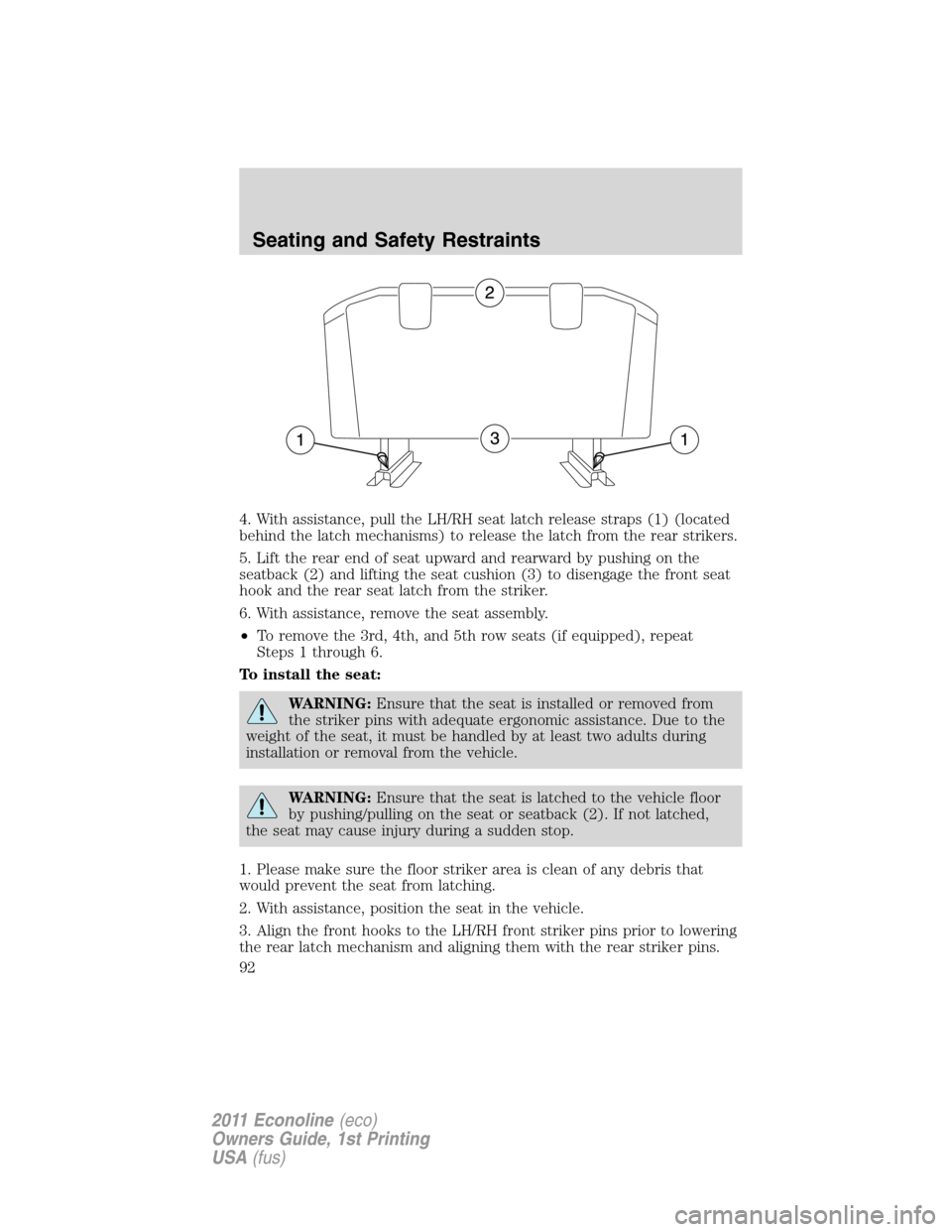
4. With assistance, pull the LH/RH seat latch release straps (1) (located
behind the latch mechanisms) to release the latch from the rear strikers.
5. Lift the rear end of seat upward and rearward by pushing on the
seatback (2) and lifting the seat cushion (3) to disengage the front seat
hook and the rear seat latch from the striker.
6. With assistance, remove the seat assembly.
•To remove the 3rd, 4th, and 5th row seats (if equipped), repeat
Steps 1 through 6.
To install the seat:
WARNING:Ensure that the seat is installed or removed from
the striker pins with adequate ergonomic assistance. Due to the
weight of the seat, it must be handled by at least two adults during
installation or removal from the vehicle.
WARNING:Ensure that the seat is latched to the vehicle floor
by pushing/pulling on the seat or seatback (2). If not latched,
the seat may cause injury during a sudden stop.
1. Please make sure the floor striker area is clean of any debris that
would prevent the seat from latching.
2. With assistance, position the seat in the vehicle.
3. Align the front hooks to the LH/RH front striker pins prior to lowering
the rear latch mechanism and aligning them with the rear striker pins.
Seating and Safety Restraints
92
2011 Econoline(eco)
Owners Guide, 1st Printing
USA(fus)
Page 93 of 337
4. Engage the front LH/RH hooks to the LH/RH front striker pins.
5. After the front LH/RH hooks are engaged to the LH/RH front striker
pins, pull LH/RH seat latch release straps to allow engagement of the
latch to the striker pins. Refer to the illustration inTo remove the rear
seatsabove.
6. Pull/push seat back forward/backward to check for proper seat
installation.
WARNING:Always latch the vehicle seat to the floor, whether
the seat is occupied or empty. If not latched, the seat may cause
injury during a sudden stop.
WARNING:Do not hang or attach any cargo to the release
straps of the rear bench seats. Doing so could cause the release
straps to inadvertently unlatch the rear bench seat. If not latched, the
seat may cause serious injury during a sudden stop.
SAFETY RESTRAINTS
Safety restraints precautions
WARNING:Always drive and ride with your seatback upright
and the lap belt snug and low across the hips.
WARNING:To reduce the risk of injury, make sure children sit
in a rear seating position where they can be properly restrained.
WARNING:Never let a passenger hold a child on his or her lap
while the vehicle is moving. The passenger cannot protect the
child from injury in a collision.
WARNING:All occupants of the vehicle, including the driver,
should always properly wear their safety belts, even when an
airbag supplemental restraint system (SRS) is provided.
Seating and Safety Restraints
93
2011 Econoline(eco)
Owners Guide, 1st Printing
USA(fus)
Page 95 of 337
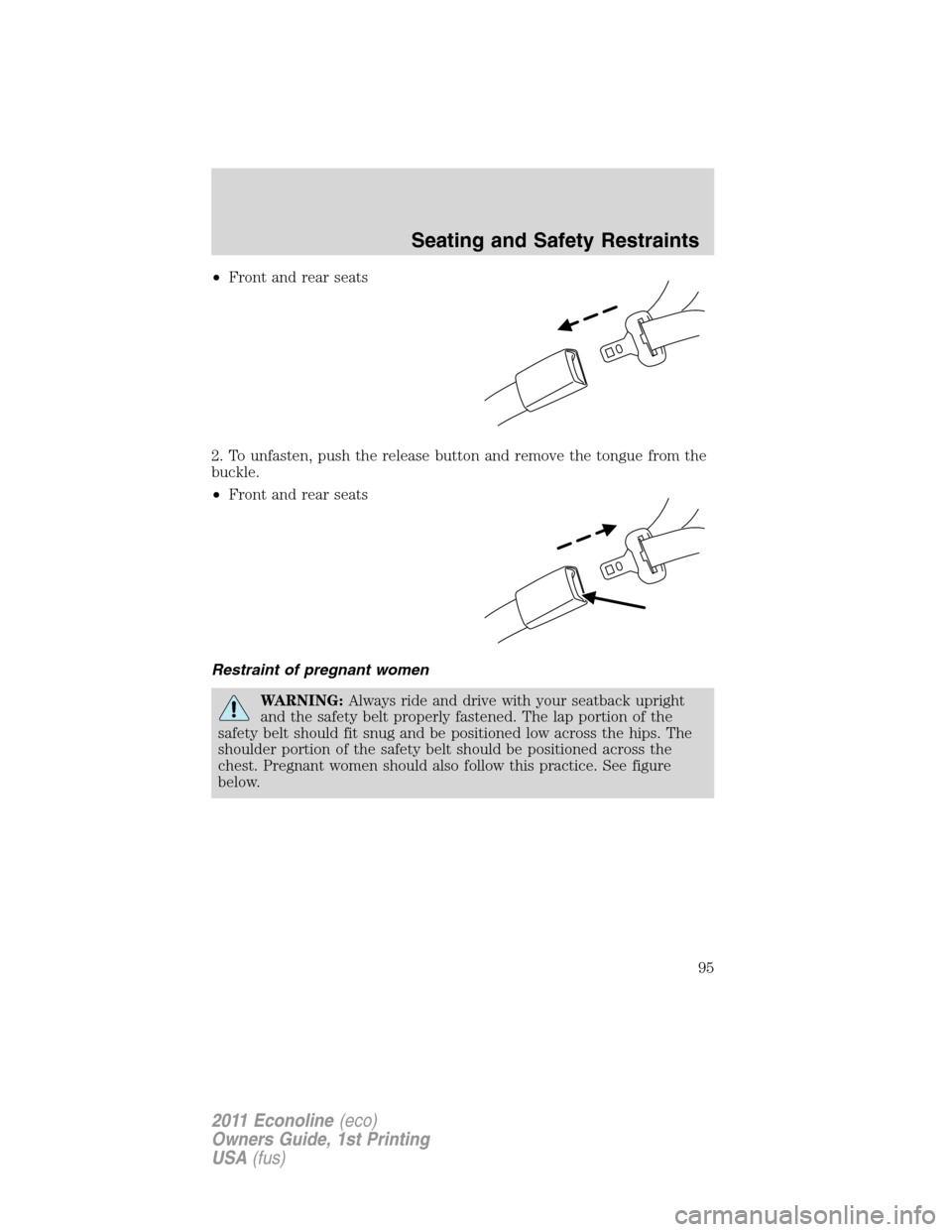
•Front and rear seats
2. To unfasten, push the release button and remove the tongue from the
buckle.
•Front and rear seats
Restraint of pregnant women
WARNING:Always ride and drive with your seatback upright
and the safety belt properly fastened. The lap portion of the
safety belt should fit snug and be positioned low across the hips. The
shoulder portion of the safety belt should be positioned across the
chest. Pregnant women should also follow this practice. See figure
below.
Seating and Safety Restraints
95
2011 Econoline(eco)
Owners Guide, 1st Printing
USA(fus)
Page 96 of 337
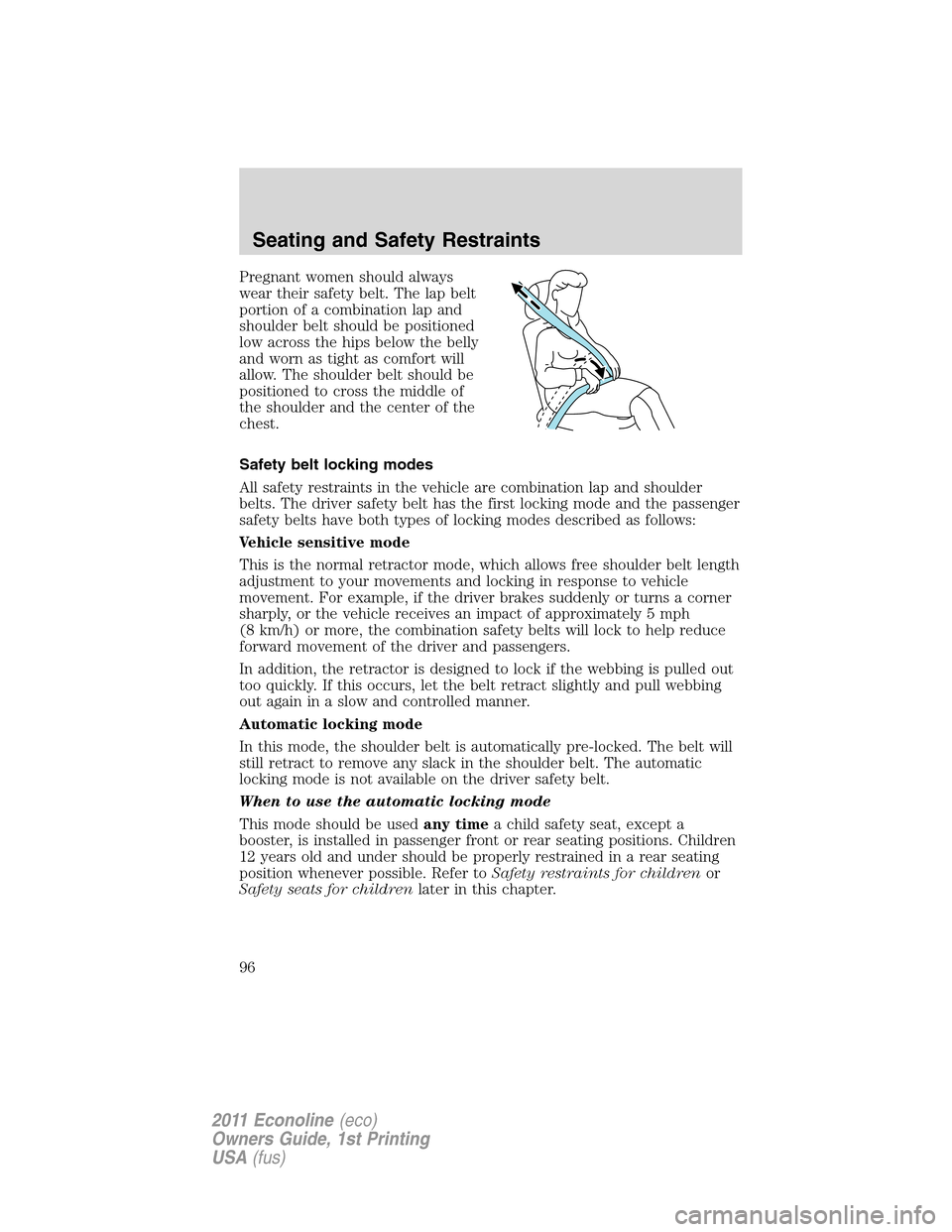
Pregnant women should always
wear their safety belt. The lap belt
portion of a combination lap and
shoulder belt should be positioned
low across the hips below the belly
and worn as tight as comfort will
allow. The shoulder belt should be
positioned to cross the middle of
the shoulder and the center of the
chest.
Safety belt locking modes
All safety restraints in the vehicle are combination lap and shoulder
belts. The driver safety belt has the first locking mode and the passenger
safety belts have both types of locking modes described as follows:
Vehicle sensitive mode
This is the normal retractor mode, which allows free shoulder belt length
adjustment to your movements and locking in response to vehicle
movement. For example, if the driver brakes suddenly or turns a corner
sharply, or the vehicle receives an impact of approximately 5 mph
(8 km/h) or more, the combination safety belts will lock to help reduce
forward movement of the driver and passengers.
In addition, the retractor is designed to lock if the webbing is pulled out
too quickly. If this occurs, let the belt retract slightly and pull webbing
out again in a slow and controlled manner.
Automatic locking mode
In this mode, the shoulder belt is automatically pre-locked. The belt will
still retract to remove any slack in the shoulder belt. The automatic
locking mode is not available on the driver safety belt.
When to use the automatic locking mode
This mode should be usedany timea child safety seat, except a
booster, is installed in passenger front or rear seating positions. Children
12 years old and under should be properly restrained in a rear seating
position whenever possible. Refer toSafety restraints for childrenor
Safety seats for childrenlater in this chapter.
Seating and Safety Restraints
96
2011 Econoline(eco)
Owners Guide, 1st Printing
USA(fus)
Page 109 of 337
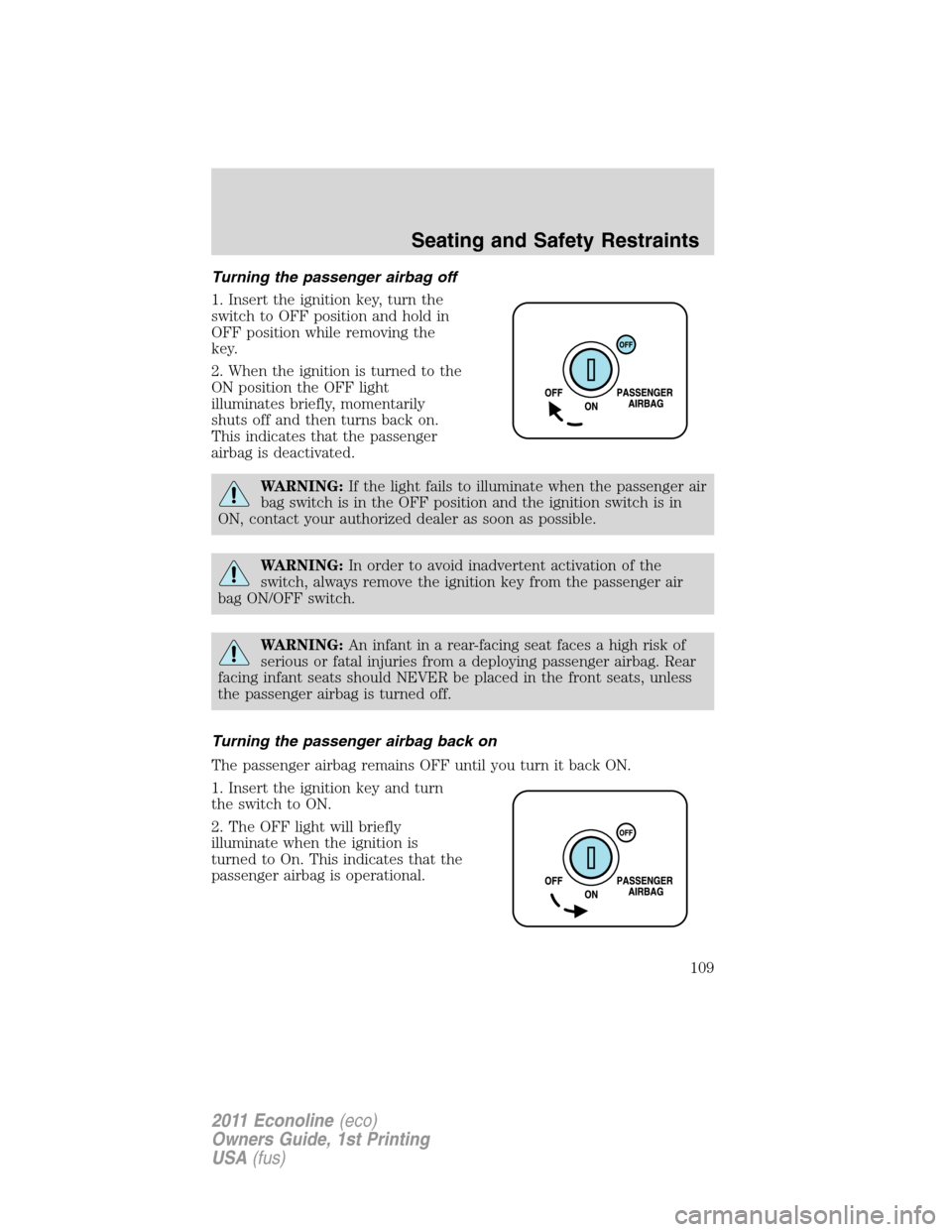
Turning the passenger airbag off
1. Insert the ignition key, turn the
switch to OFF position and hold in
OFF position while removing the
key.
2. When the ignition is turned to the
ON position the OFF light
illuminates briefly, momentarily
shuts off and then turns back on.
This indicates that the passenger
airbag is deactivated.
WARNING:If the light fails to illuminate when the passenger air
bag switch is in the OFF position and the ignition switch is in
ON, contact your authorized dealer as soon as possible.
WARNING:In order to avoid inadvertent activation of the
switch, always remove the ignition key from the passenger air
bag ON/OFF switch.
WARNING:An infant in a rear-facing seat faces a high risk of
serious or fatal injuries from a deploying passenger airbag. Rear
facing infant seats should NEVER be placed in the front seats, unless
the passenger airbag is turned off.
Turning the passenger airbag back on
The passenger airbag remains OFF until you turn it back ON.
1. Insert the ignition key and turn
the switch to ON.
2. The OFF light will briefly
illuminate when the ignition is
turned to On. This indicates that the
passenger airbag is operational.
Seating and Safety Restraints
109
2011 Econoline(eco)
Owners Guide, 1st Printing
USA(fus)
Page 121 of 337
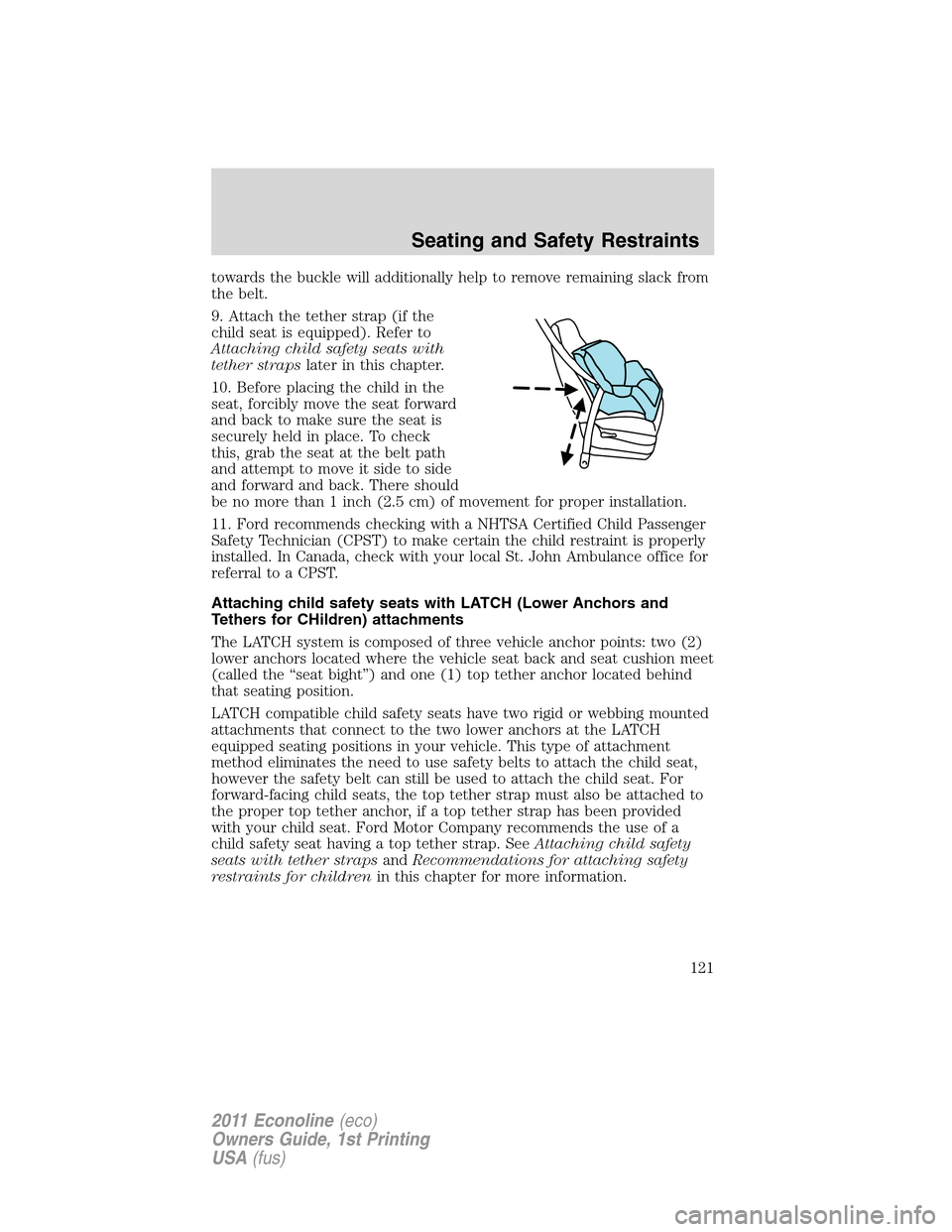
towards the buckle will additionally help to remove remaining slack from
the belt.
9. Attach the tether strap (if the
child seat is equipped). Refer to
Attaching child safety seats with
tether strapslater in this chapter.
10. Before placing the child in the
seat, forcibly move the seat forward
and back to make sure the seat is
securely held in place. To check
this, grab the seat at the belt path
and attempt to move it side to side
and forward and back. There should
be no more than 1 inch (2.5 cm) of movement for proper installation.
11. Ford recommends checking with a NHTSA Certified Child Passenger
Safety Technician (CPST) to make certain the child restraint is properly
installed. In Canada, check with your local St. John Ambulance office for
referral to a CPST.
Attaching child safety seats with LATCH (Lower Anchors and
Tethers for CHildren) attachments
The LATCH system is composed of three vehicle anchor points: two (2)
lower anchors located where the vehicle seat back and seat cushion meet
(called the “seat bight”) and one (1) top tether anchor located behind
that seating position.
LATCH compatible child safety seats have two rigid or webbing mounted
attachments that connect to the two lower anchors at the LATCH
equipped seating positions in your vehicle. This type of attachment
method eliminates the need to use safety belts to attach the child seat,
however the safety belt can still be used to attach the child seat. For
forward-facing child seats, the top tether strap must also be attached to
the proper top tether anchor, if a top tether strap has been provided
with your child seat. Ford Motor Company recommends the use of a
child safety seat having a top tether strap. SeeAttaching child safety
seats with tether strapsandRecommendations for attaching safety
restraints for childrenin this chapter for more information.
Seating and Safety Restraints
121
2011 Econoline(eco)
Owners Guide, 1st Printing
USA(fus)
Page 132 of 337
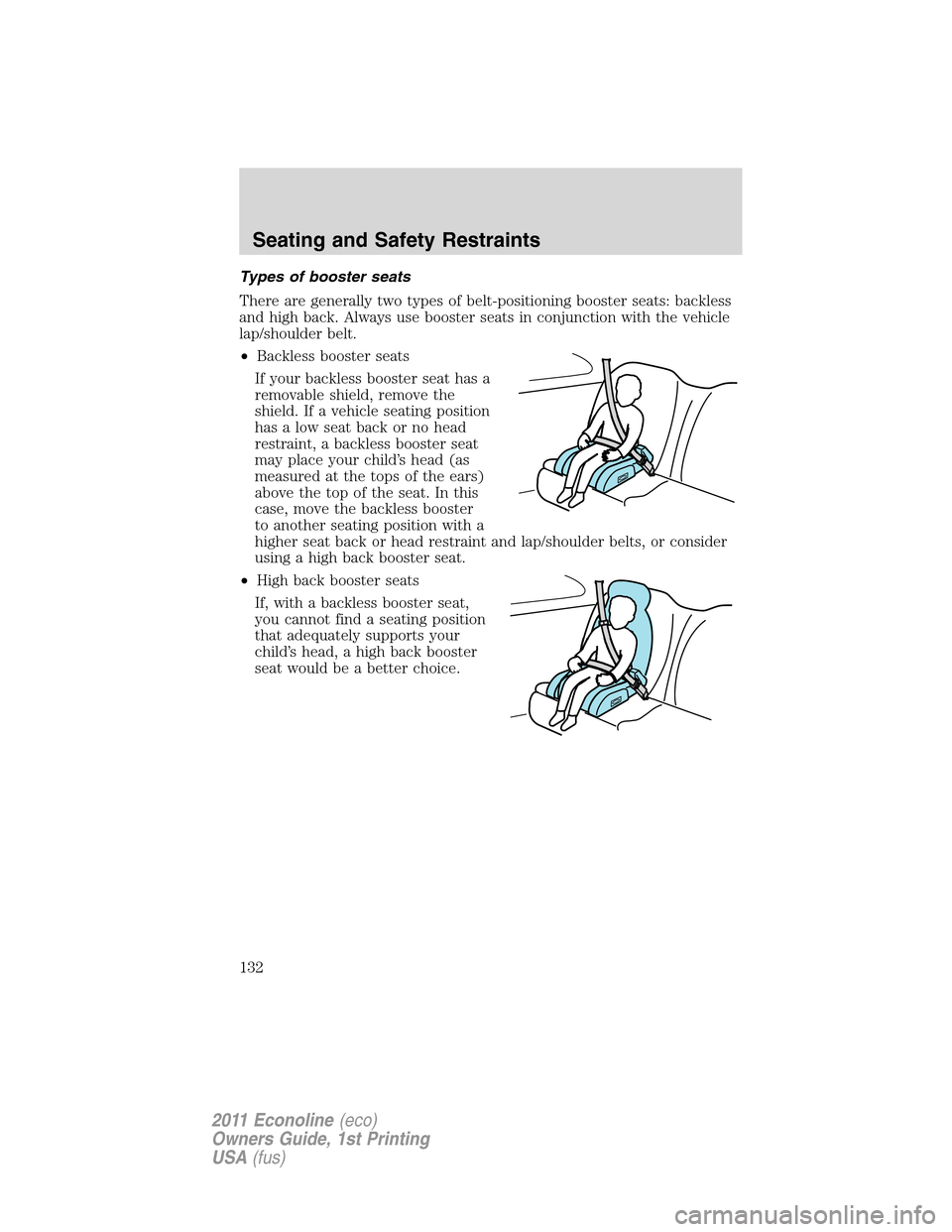
Types of booster seats
There are generally two types of belt-positioning booster seats: backless
and high back. Always use booster seats in conjunction with the vehicle
lap/shoulder belt.
•Backless booster seats
If your backless booster seat has a
removable shield, remove the
shield. If a vehicle seating position
has a low seat back or no head
restraint, a backless booster seat
may place your child’s head (as
measured at the tops of the ears)
above the top of the seat. In this
case, move the backless booster
to another seating position with a
higher seat back or head restraint and lap/shoulder belts, or consider
using a high back booster seat.
•High back booster seats
If, with a backless booster seat,
you cannot find a seating position
that adequately supports your
child’s head, a high back booster
seat would be a better choice.
Seating and Safety Restraints
132
2011 Econoline(eco)
Owners Guide, 1st Printing
USA(fus)