spare tire FORD E SERIES 2013 4.G User Guide
[x] Cancel search | Manufacturer: FORD, Model Year: 2013, Model line: E SERIES, Model: FORD E SERIES 2013 4.GPages: 416, PDF Size: 4.29 MB
Page 262 of 416
Follow these guidelines when using snow tires and chains:
•If possible, avoid fully loading your vehicle.
•Use only SAE Class S chains.
•Install chains securely, verifying that the chains do not touch any
wiring, brake lines or fuel lines.
•Drive cautiously. If you hear the chains rub or bang against your
vehicle, stop and retighten the chains. If this does not work, remove
the chains to prevent damage to your vehicle.
•Remove the tire chains when they are no longer needed. Do not use
tire chains on dry roads.
TIRE PRESSURE MONITORING SYSTEM
WARNING:The tire pressure monitoring system is NOT a
substitute for manually checking tire pressure. The tire pressure
should be checked periodically (at least monthly) using a tire gauge.
SeeInflating Your Tiresin this chapter. Failure to properly maintain
your tire pressure could increase the risk of tire failure, loss of control,
vehicle rollover and personal injury.
Each tire, including the spare (if provided), should be checked
monthly when cold and inflated to the inflation pressure
recommended by the vehicle manufacturer on the vehicle
placard or tire inflation pressure label. (If your vehicle has tires of a
different size than the size indicated on the vehicle placard or tire
inflation pressure label, you should determine the proper tire inflation
pressure for those tires.)
As an added safety feature, your vehicle has been equipped with a tire
pressure monitoring system (TPMS) that illuminates a low tire pressure
telltale when one or more of your tires is significantly under-inflated.
Accordingly, when the low tire pressure telltale illuminates, you should
stop and check your tires as soon as possible, and inflate them to the
proper pressure. Driving on a significantly under-inflated tire causes the
tire to overheat and can lead to tire failure. Under-inflation also reduces
fuel efficiency and tire tread life, and may affect the vehicle’s handling
and stopping ability.
The TPMS is not a substitute for proper tire maintenance, and it is the
driver’s responsibility to maintain correct tire pressure, even if
under-inflation has not reached the level to trigger illumination of the
TPMS low tire pressure telltale.
262Wheels and Tires
2013 Econoline(eco)
Owners Guide gf, 1st Printing
USA(fus)
Page 264 of 416
Understanding your tire pressure monitoring system
The tire pressure monitoring system measures pressure in your four road
tires and sends the tire pressure readings to your vehicle. The low tire
pressure warning light will turn on if the tire pressure is significantly low.
Once the light is illuminated, your tires are under-inflated and need to be
inflated to the manufacturer’s recommended tire pressure. Even if the
light turns on and a short time later turns off, your tire pressure still
needs to be checked.
When your temporary spare tire is installed
When one of your road tires needs to be replaced with the temporary
spare, the TPMS will continue to identify an issue to remind you that the
damaged road wheel/tire needs to be repaired and put back on your
vehicle.
To restore the full functionality of the tire pressure monitoring system,
have the damaged road wheel/tire repaired and remounted on your
vehicle. For additional information, refer toChanging tires with a
TPMSin this section.
264Wheels and Tires
2013 Econoline(eco)
Owners Guide gf, 1st Printing
USA(fus)
Page 265 of 416
When you believe your system is not operating properly
The main function of the tire pressure monitoring system is to warn you
when your tires need air. It can also warn you in the event the system is no
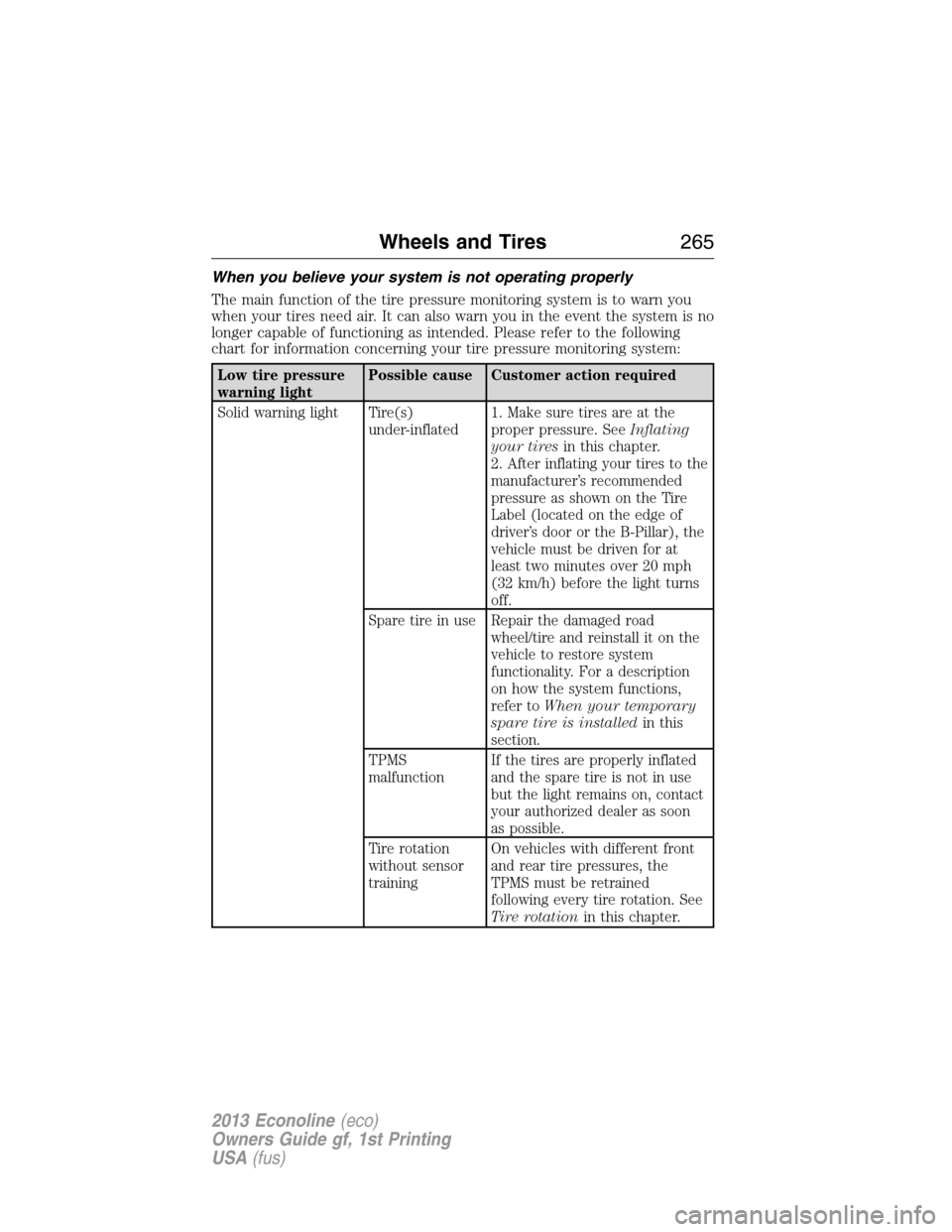
longer capable of functioning as intended. Please refer to the following
chart for information concerning your tire pressure monitoring system:
Low tire pressure
warning lightPossible cause Customer action required
Solid warning light Tire(s)
under-inflated1. Make sure tires are at the
proper pressure. SeeInflating
your tiresin this chapter.
2. After inflating your tires to the
manufacturer’s recommended
pressure as shown on the Tire
Label (located on the edge of
driver’s door or the B-Pillar), the
vehicle must be driven for at
least two minutes over 20 mph
(32 km/h) before the light turns
off.
Spare tire in use Repair the damaged road
wheel/tire and reinstall it on the
vehicle to restore system
functionality. For a description
on how the system functions,
refer toWhen your temporary
spare tire is installedin this
section.
TPMS
malfunctionIf the tires are properly inflated
and the spare tire is not in use
but the light remains on, contact
your authorized dealer as soon
as possible.
Tire rotation
without sensor
trainingOn vehicles with different front
and rear tire pressures, the
TPMS must be retrained
following every tire rotation. See
Tire rotationin this chapter.
Wheels and Tires265
2013 Econoline(eco)
Owners Guide gf, 1st Printing
USA(fus)
Page 266 of 416
Low tire pressure
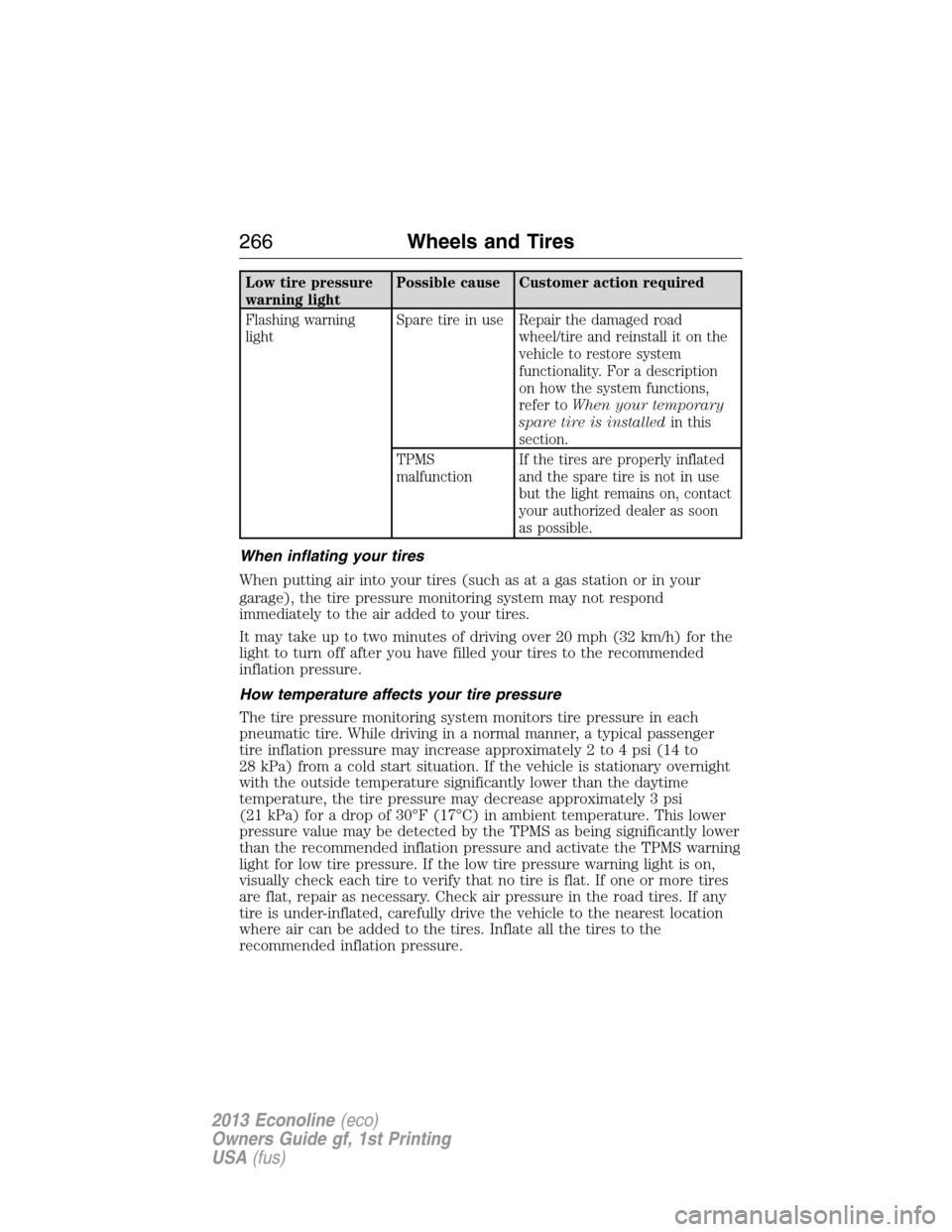
warning lightPossible cause Customer action required
Flashing warning
lightSpare tire in use Repair the damaged road
wheel/tire and reinstall it on the
vehicle to restore system
functionality. For a description
on how the system functions,
refer toWhen your temporary
spare tire is installedin this
section.
TPMS
malfunctionIf the tires are properly inflated
and the spare tire is not in use
but the light remains on, contact
your authorized dealer as soon
as possible.
When inflating your tires
When putting air into your tires (such as at a gas station or in your
garage), the tire pressure monitoring system may not respond
immediately to the air added to your tires.
It may take up to two minutes of driving over 20 mph (32 km/h) for the
light to turn off after you have filled your tires to the recommended
inflation pressure.
How temperature affects your tire pressure
The tire pressure monitoring system monitors tire pressure in each
pneumatic tire. While driving in a normal manner, a typical passenger
tire inflation pressure may increase approximately 2 to 4 psi (14 to
28 kPa) from a cold start situation. If the vehicle is stationary overnight
with the outside temperature significantly lower than the daytime
temperature, the tire pressure may decrease approximately 3 psi
(21 kPa) for a drop of 30°F (17°C) in ambient temperature. This lower
pressure value may be detected by the TPMS as being significantly lower
than the recommended inflation pressure and activate the TPMS warning
light for low tire pressure. If the low tire pressure warning light is on,
visually check each tire to verify that no tire is flat. If one or more tires
are flat, repair as necessary. Check air pressure in the road tires. If any
tire is under-inflated, carefully drive the vehicle to the nearest location
where air can be added to the tires. Inflate all the tires to the
recommended inflation pressure.
266Wheels and Tires
2013 Econoline(eco)
Owners Guide gf, 1st Printing
USA(fus)
Page 269 of 416
Full-size matching spare tire/wheel information
This spare tire/wheel will match the road tire/wheel. When driving with
the full size matching spare tire/wheel, do not exceed 70 mph
(113 km/h). It is intended for temporary use only. This means if you
need to use it, you should replace it as soon as possible.
CHANGING A ROAD WHEEL
WARNING:The use of tire sealants may damage your tire
pressure monitoring system (TPMS) and should not be used.
However, if you must use a sealant, the TPMS sensor and valve stem on
the wheel must be replaced by an authorized Ford dealer.
WARNING:SeeTire Pressure Monitoring Systemin this
chapter for important information. If the tire pressure monitor
sensor becomes damaged, it will no longer function.
Note:The tire pressure monitoring system indicator light will illuminate
when the spare tire is in use. To restore the full functionality of the
monitoring system, all road wheels equipped with tire pressure
monitoring sensors must be mounted on the vehicle.
If you get a flat tire while driving, do not apply the brake heavily.
Instead, gradually decrease your speed. Hold the steering wheel firmly
and slowly move to a safe place on the side of the road.
Have a flat serviced by an authorized dealer in order to prevent damage
to the TPMS sensors. SeeTire Pressure Monitoring Systemearlier in
the chapter. Replace the spare tire with a road tire as soon as possible.
During repairing or replacing of the flat tire, have the authorized dealer
inspect the TPMS sensor for damage.
Dissimilar Spare Tire and Wheel Assembly Information
WARNING:Failure to follow these guidelines could result in an
increased risk of loss of vehicle control, injury or death.
If you have a dissimilar spare tire and wheel assembly, then it is intended
for temporary use only. This means that if you need to use it, you should
replace it as soon as possible with a road tire and wheel assembly that is
the same size and type as the road tires and wheels that were originally
provided by Ford. If the dissimilar spare tire or wheel is damaged, it
should be replaced rather than repaired.
Wheels and Tires269
2013 Econoline(eco)
Owners Guide gf, 1st Printing
USA(fus)
Page 270 of 416
A dissimilar spare tire and wheel assembly is defined as a spare tire or
wheel that is different in brand, size or appearance from the road tires
and wheels and can be one of three types:
1.T-type mini-spare:This spare tire begins with the letter T for tire
size and may have Temporary Use Only molded in the sidewall.
2.Full-size dissimilar spare with label on wheel:This spare tire has
a label on the wheel that states: THIS TIRE AND WHEEL FOR
TEMPORARY USE ONLY
When driving with one of the dissimilar spare tires listed above, do not:
•exceed 50 mph (80 km/h).
•load the vehicle beyond maximum vehicle load rating listed on the
Safety Compliance Label.
•tow a trailer.
•use snow chains on the end of the vehicle with the dissimilar spare
tire.
•use more than one dissimilar spare tire at a time.
•use commercial car washing equipment.
•try to repair the dissimilar spare tire.
Use of one of the dissimilar spare tires listed above at any one wheel
location can lead to impairment of the following:
•Handling, stability and braking performance
•Comfort and noise
•Ground clearance and parking at curbs
•Winter weather driving capability
•Wet weather driving capability
•All-wheel driving capability (if applicable)
3.Full-size dissimilar spare without label on wheel
When driving with the full-size dissimilar spare tire and wheel assembly,
do not:
•exceed 70 mph (113 km/h).
•use more than one dissimilar spare tire and wheel at a time.
•use commercial car washing equipment.
•use snow chains on the end of the vehicle with the dissimilar spare
tire and wheel.
270Wheels and Tires
2013 Econoline(eco)
Owners Guide gf, 1st Printing
USA(fus)
Page 271 of 416
The usage of a full-size dissimilar spare tire and wheel assembly can lead
to impairment of the following:
•Handling, stability and braking performance
•Comfort and noise
•Ground clearance and parking at curbs
•Winter weather driving capability
•Wet weather driving capability
•All-wheel driving capability (if applicable)
•Load leveling adjustment (if applicable)
When driving with the full-size dissimilar spare tire and wheel assembly,
additional caution should be given to:
•towing a trailer.
•driving vehicles equipped with a camper body.
•driving vehicles with a load on the cargo rack.
Drive cautiously when using a full-size dissimilar spare tire and wheel,
and seek service as soon as possible.
Tire Change Procedure
WARNING:When one of the front wheels is off the ground, the
transmission alone will not prevent the vehicle from moving or
slipping off the jack, even if the transmission selector lever is in
positionP.
WARNING:To help prevent the vehicle from moving when you
change a tire, be sure to place the transmission selector lever in
positionP, set the parking brake and block (in both directions) the
wheel that is diagonally opposite (other side and end of the vehicle) to
the tire being changed.
WARNING:Never get underneath a vehicle that is supported
only by a jack. If the vehicle slips off the jack, you or someone
else could be seriously injured.
Wheels and Tires271
2013 Econoline(eco)
Owners Guide gf, 1st Printing
USA(fus)
Page 272 of 416
WARNING:Do not attempt to change a tire on the side of the
vehicle close to moving traffic. Pull far enough off the road to
avoid the danger of being hit when operating the jack or changing the
wheel.
WARNING:Always use the jack provided as original equipment
with your vehicle. If using a jack other than the one provided as
original equipment with your vehicle, make sure the jack capacity is
adequate for the vehicle weight, including any vehicle cargo or
modifications.
WARNING:Never use wheels or lug nuts different than the
original equipment as this could damage the wheel or mounting
system. This damage could allow the wheels to come off while the
vehicle is being driven.
Note:Passengers should not remain in the vehicle when the vehicle is
being jacked.
Spare tire information
The spare tire for your vehicle is stowed under the rear of your vehicle
(except cutaway and stripped chassis models).
Park on a level surface, activate the warning flashers, and place the
transmission selector lever in positionP. Then, apply the parking brake
and turn the engine off.
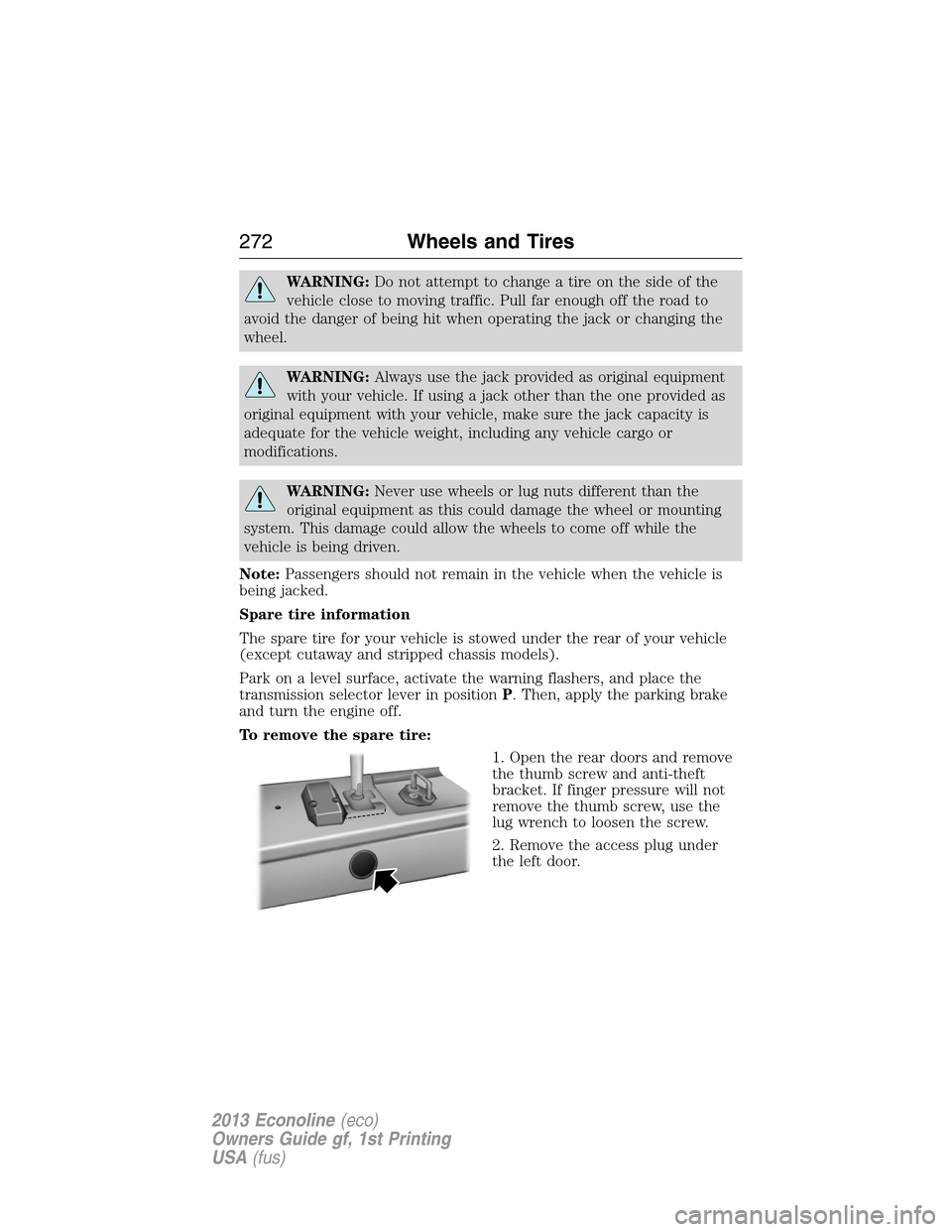
To remove the spare tire:
1. Open the rear doors and remove
the thumb screw and anti-theft
bracket. If finger pressure will not
remove the thumb screw, use the
lug wrench to loosen the screw.
2. Remove the access plug under
the left door.
272Wheels and Tires
2013 Econoline(eco)
Owners Guide gf, 1st Printing
USA(fus)
Page 273 of 416
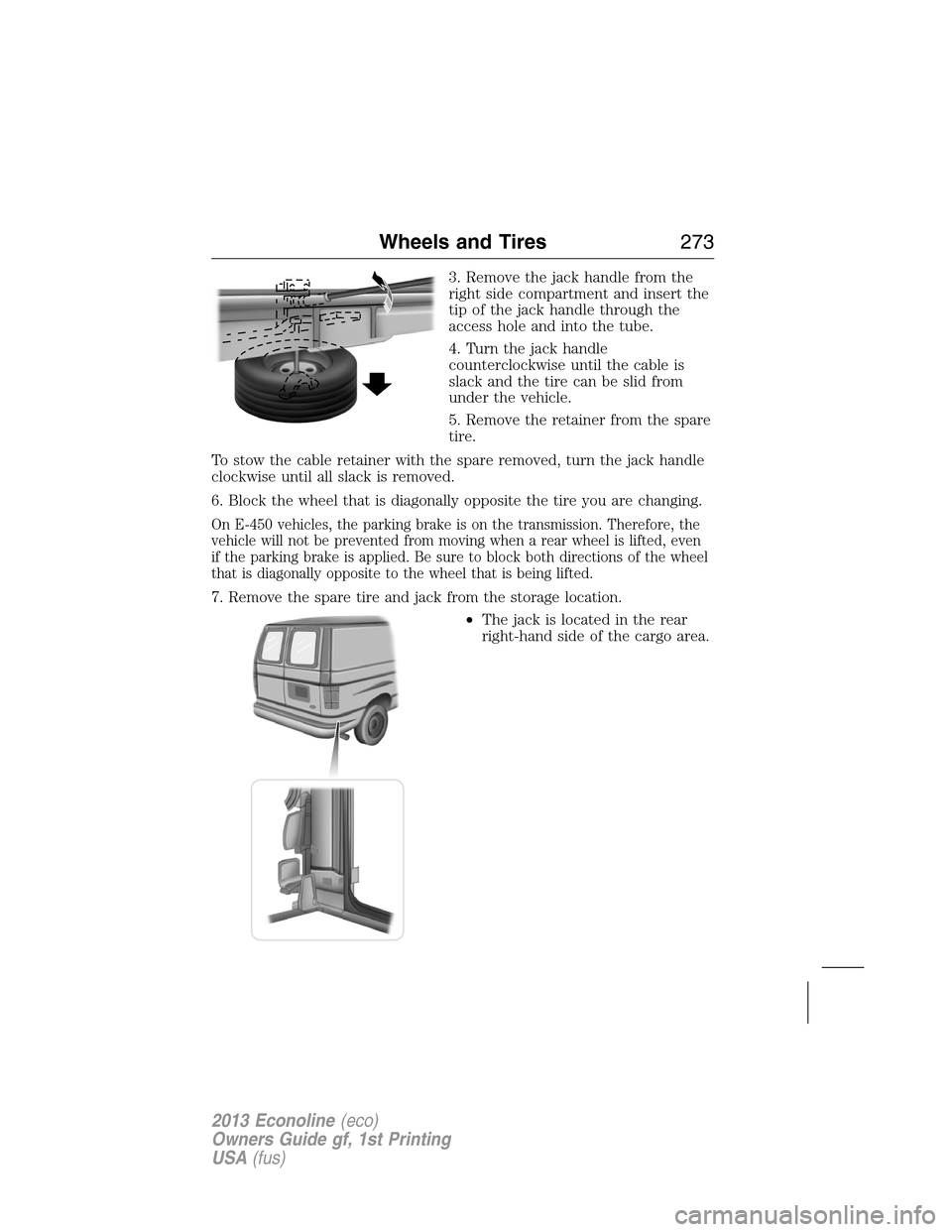
3. Remove the jack handle from the
right side compartment and insert the
tip of the jack handle through the
access hole and into the tube.
4. Turn the jack handle
counterclockwise until the cable is
slack and the tire can be slid from
under the vehicle.
5. Remove the retainer from the spare
tire.
To stow the cable retainer with the spare removed, turn the jack handle
clockwise until all slack is removed.
6. Block the wheel that is diagonally opposite the tire you are changing.
On E-450 vehicles, the parking brake is on the transmission. Therefore, the
vehicle will not be prevented from moving when a rear wheel is lifted, even
if the parking brake is applied. Be sure to block both directions of the wheel
that is diagonally opposite to the wheel that is being lifted.
7. Remove the spare tire and jack from the storage location.
•The jack is located in the rear
right-hand side of the cargo area.
Wheels and Tires273
2013 Econoline(eco)
Owners Guide gf, 1st Printing
USA(fus)
Page 275 of 416
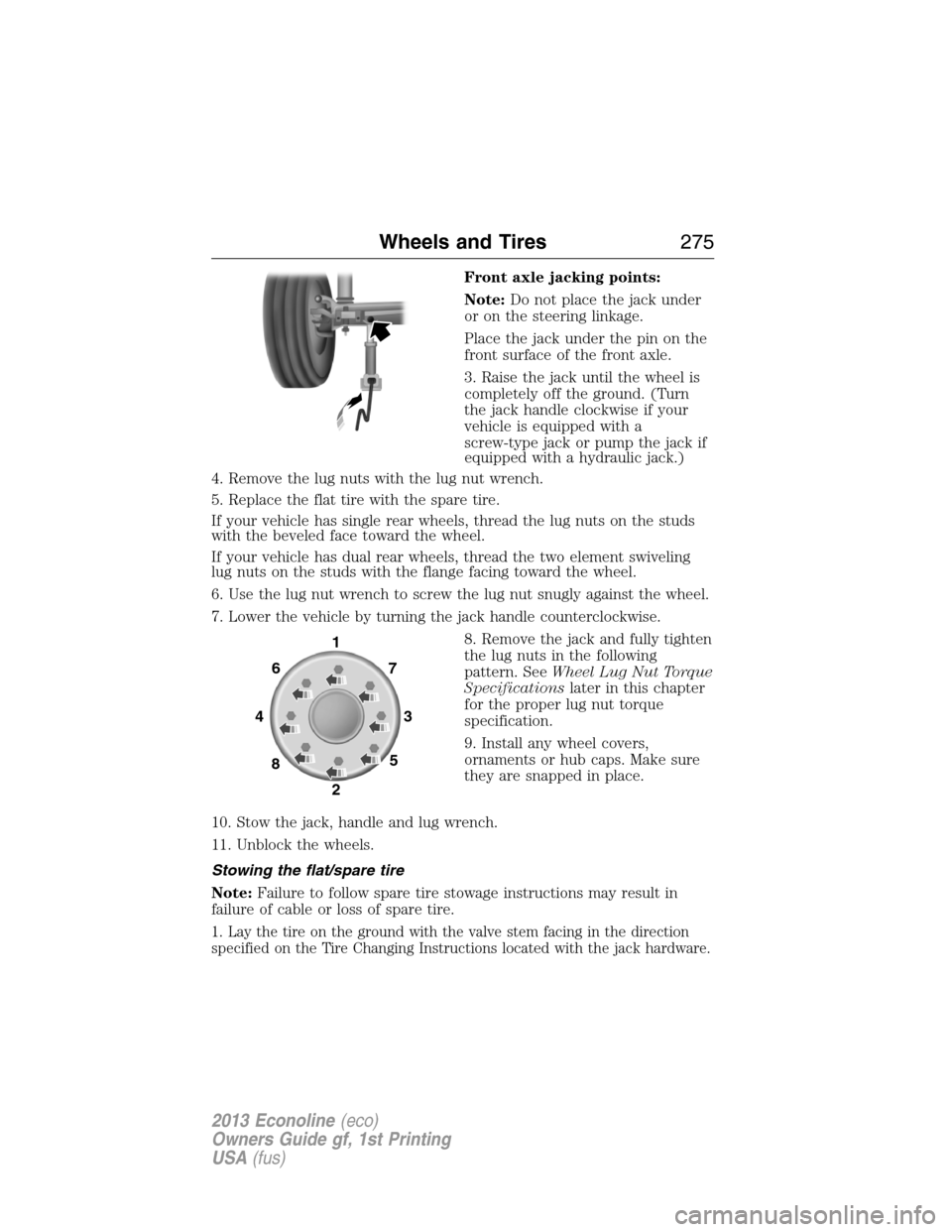
Front axle jacking points:
Note:Do not place the jack under
or on the steering linkage.
Place the jack under the pin on the
front surface of the front axle.
3. Raise the jack until the wheel is
completely off the ground. (Turn
the jack handle clockwise if your
vehicle is equipped with a
screw-type jack or pump the jack if
equipped with a hydraulic jack.)
4. Remove the lug nuts with the lug nut wrench.
5. Replace the flat tire with the spare tire.
If your vehicle has single rear wheels, thread the lug nuts on the studs
with the beveled face toward the wheel.
If your vehicle has dual rear wheels, thread the two element swiveling
lug nuts on the studs with the flange facing toward the wheel.
6. Use the lug nut wrench to screw the lug nut snugly against the wheel.
7. Lower the vehicle by turning the jack handle counterclockwise.
8. Remove the jack and fully tighten
the lug nuts in the following
pattern. SeeWheel Lug Nut Torque
Specificationslater in this chapter
for the proper lug nut torque
specification.
9. Install any wheel covers,
ornaments or hub caps. Make sure
they are snapped in place.
10. Stow the jack, handle and lug wrench.
11. Unblock the wheels.
Stowing the flat/spare tire
Note:Failure to follow spare tire stowage instructions may result in
failure of cable or loss of spare tire.
1. Lay the tire on the ground with the valve stem facing in the direction
specified on the Tire Changing Instructions located with the jack hardware.
1
7
3
5 6
4
8
2
Wheels and Tires275
2013 Econoline(eco)
Owners Guide gf, 1st Printing
USA(fus)