belt FORD E SERIES 2013 4.G Owner's Guide
[x] Cancel search | Manufacturer: FORD, Model Year: 2013, Model line: E SERIES, Model: FORD E SERIES 2013 4.GPages: 416, PDF Size: 4.29 MB
Page 52 of 416
3.Medical condition.A passenger has a medical condition which,
according to his or her physician:
•causes the passenger airbag to pose a special risk for the passenger;
and
•makes the potential harm from the passenger airbag in a crash greater
than the potential harm from turning OFF the airbag and allowing the
passenger, even if belted, to hit the dashboard or windshield in a
crash.
Transport Canada Deactivation Criteria (Canada Only)
WARNING:This vehicle has special energy management safety
belts for the driver and right front passenger. These particular
belts are specifically designed to work with airbags to help reduce the
risk of injury in a collision. The energy management safety belt is
designed to give or release additional belt webbing in some accidents to
reduce concentration of force on an occupant’s chest and reduce the
risk of certain bone fractures and injuries to underlying organs. In a
crash, if the airbag is turned OFF, this energy management safety belt
might permit the person wearing the belt to move forward enough to
incur a serious or fatal injury. The more severe the crash, and the
heavier the occupant, the greater the risk is. Be sure the airbag is
turned ON for any person who does not qualify under the NHTSA
deactivation criteria.
1.Infant:An infant (less than 1 year old) must ride in the front seat
because:
•my vehicle has no rear seat;
•the rear seat in my vehicle cannot accommodate a rear-facing infant
seat; or
•the infant has a medical condition which, according to the infant’s
physician, makes it necessary for the infant to ride in the front seat so
that the driver can monitor the infant’s condition.
52Supplementary Restraints System
2013 Econoline(eco)
Owners Guide gf, 1st Printing
USA(fus)
Page 53 of 416
2.Child age 12 or under:A child age 12 or under must ride in the
front seat because:
•my vehicle has no rear seat;
•although children age 12 and under ride in the rear seat whenever
possible, children age 12 and under have no option but to sometimes
ride in the front seat because rear seat space is insufficient; or
•the child has a medical condition that, according to the child’s
physician, makes it necessary for the child to ride in the front seat so
that the driver can monitor the child’s condition.
3.Medical condition:A passenger has a medical condition that,
according to his or her physician:
•poses a special risk for the passenger if the airbag deploys; and
•makes the potential harm from the passenger airbag deployment
greater than the potential harm from turning OFF the airbag and
experiencing a crash without the protection offered by the airbag
CRASH SENSORS AND AIRBAG INDICATOR
WARNING:Modifying or adding equipment to the front end of
your vehicle (including frame, bumper, front end body structure
and tow hooks) may affect the performance of the airbag system,
increasing the risk of injury. Do not modify the front end of your
vehicle.
Your vehicle has a collection of crash and occupant sensors which
provide information to the Restraints Control Module (RCM) which
deploys (activates) the front safety belt pretensioners, driver airbag and
passenger airbag. Based on the type of accident, the restraints control
module will deploy the appropriate safety devices.
The restraints control module also monitors the readiness of the above
safety devices plus the crash and occupant sensors. The readiness of the
safety system is indicated by a warning indicator light in the instrument
cluster or by a backup tone if the warning light is not working. See
Warning lamps and indicatorsin theInstrument Clusterchapter.
Routine maintenance of the airbag is not required.
Supplementary Restraints System53
2013 Econoline(eco)
Owners Guide gf, 1st Printing
USA(fus)
Page 54 of 416
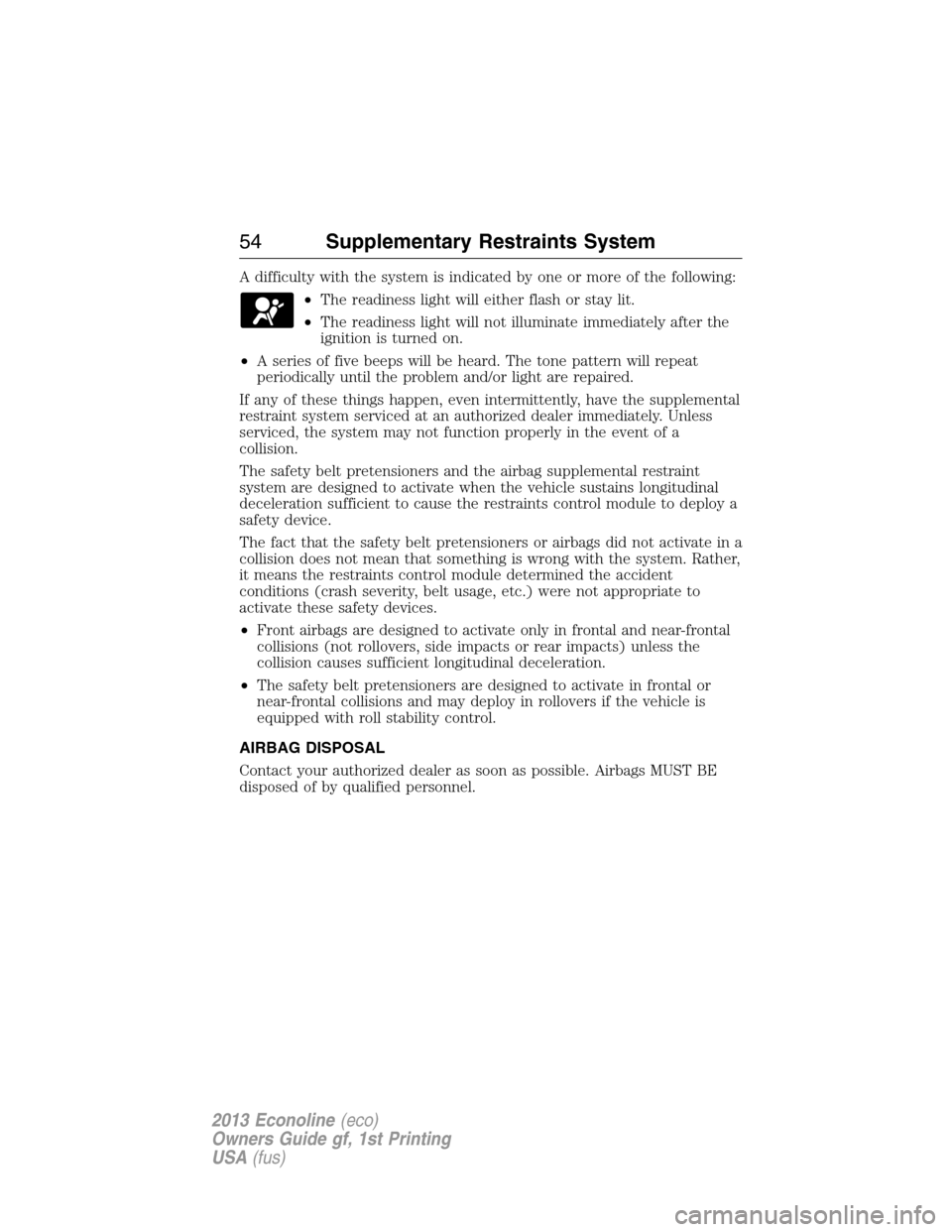
A difficulty with the system is indicated by one or more of the following:
•The readiness light will either flash or stay lit.
•The readiness light will not illuminate immediately after the
ignition is turned on.
•A series of five beeps will be heard. The tone pattern will repeat
periodically until the problem and/or light are repaired.
If any of these things happen, even intermittently, have the supplemental
restraint system serviced at an authorized dealer immediately. Unless
serviced, the system may not function properly in the event of a
collision.
The safety belt pretensioners and the airbag supplemental restraint
system are designed to activate when the vehicle sustains longitudinal
deceleration sufficient to cause the restraints control module to deploy a
safety device.
The fact that the safety belt pretensioners or airbags did not activate in a
collision does not mean that something is wrong with the system. Rather,
it means the restraints control module determined the accident
conditions (crash severity, belt usage, etc.) were not appropriate to
activate these safety devices.
•Front airbags are designed to activate only in frontal and near-frontal
collisions (not rollovers, side impacts or rear impacts) unless the
collision causes sufficient longitudinal deceleration.
•The safety belt pretensioners are designed to activate in frontal or
near-frontal collisions and may deploy in rollovers if the vehicle is
equipped with roll stability control.
AIRBAG DISPOSAL
Contact your authorized dealer as soon as possible. Airbags MUST BE
disposed of by qualified personnel.
54Supplementary Restraints System
2013 Econoline(eco)
Owners Guide gf, 1st Printing
USA(fus)
Page 79 of 416
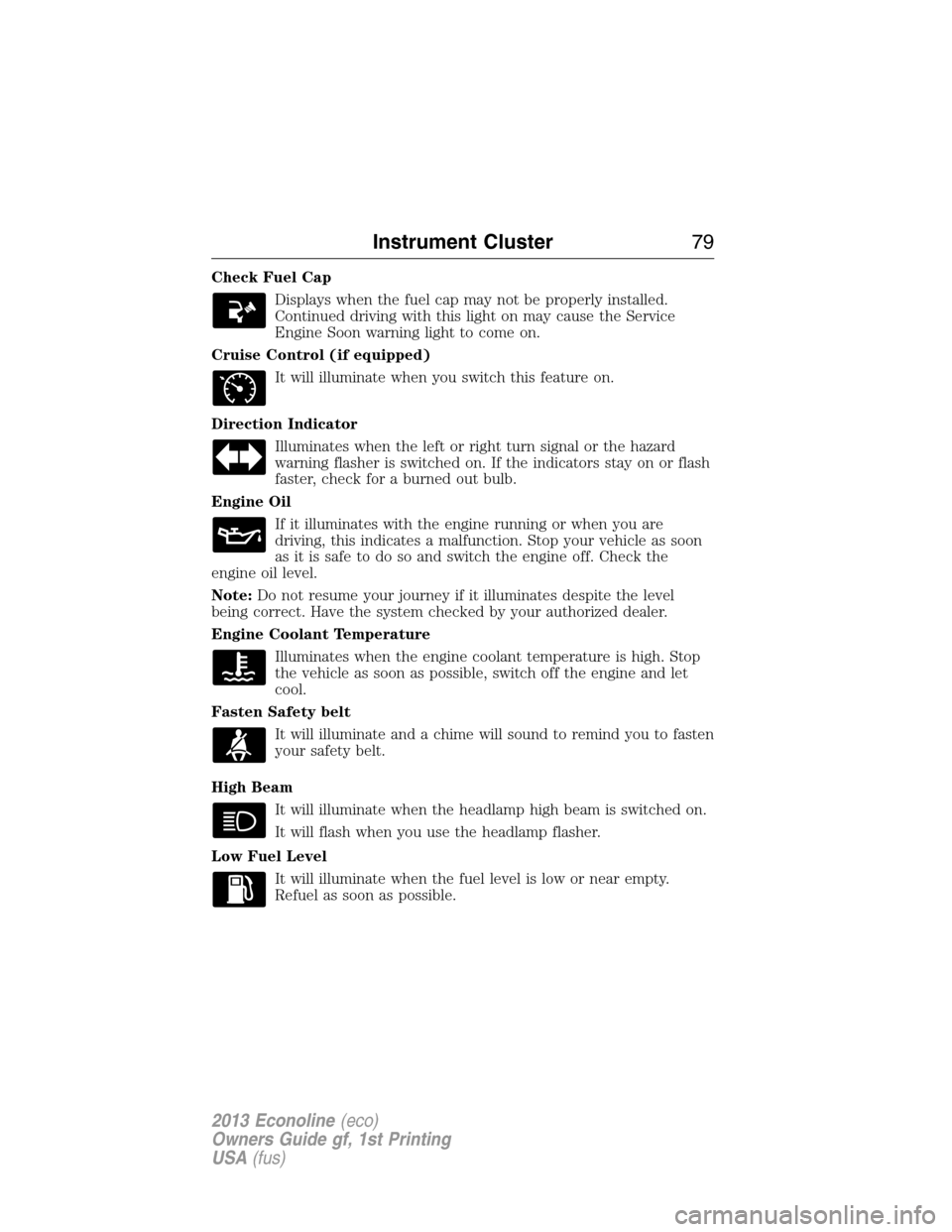
Check Fuel Cap
Displays when the fuel cap may not be properly installed.
Continued driving with this light on may cause the Service
Engine Soon warning light to come on.
Cruise Control (if equipped)
It will illuminate when you switch this feature on.
Direction Indicator
Illuminates when the left or right turn signal or the hazard
warning flasher is switched on. If the indicators stay on or flash
faster, check for a burned out bulb.
Engine Oil
If it illuminates with the engine running or when you are
driving, this indicates a malfunction. Stop your vehicle as soon
as it is safe to do so and switch the engine off. Check the
engine oil level.
Note:Do not resume your journey if it illuminates despite the level
being correct. Have the system checked by your authorized dealer.
Engine Coolant Temperature
Illuminates when the engine coolant temperature is high. Stop
the vehicle as soon as possible, switch off the engine and let
cool.
Fasten Safety belt
It will illuminate and a chime will sound to remind you to fasten
your safety belt.
High Beam
It will illuminate when the headlamp high beam is switched on.
It will flash when you use the headlamp flasher.
Low Fuel Level
It will illuminate when the fuel level is low or near empty.
Refuel as soon as possible.
Instrument Cluster79
2013 Econoline(eco)
Owners Guide gf, 1st Printing
USA(fus)
Page 103 of 416
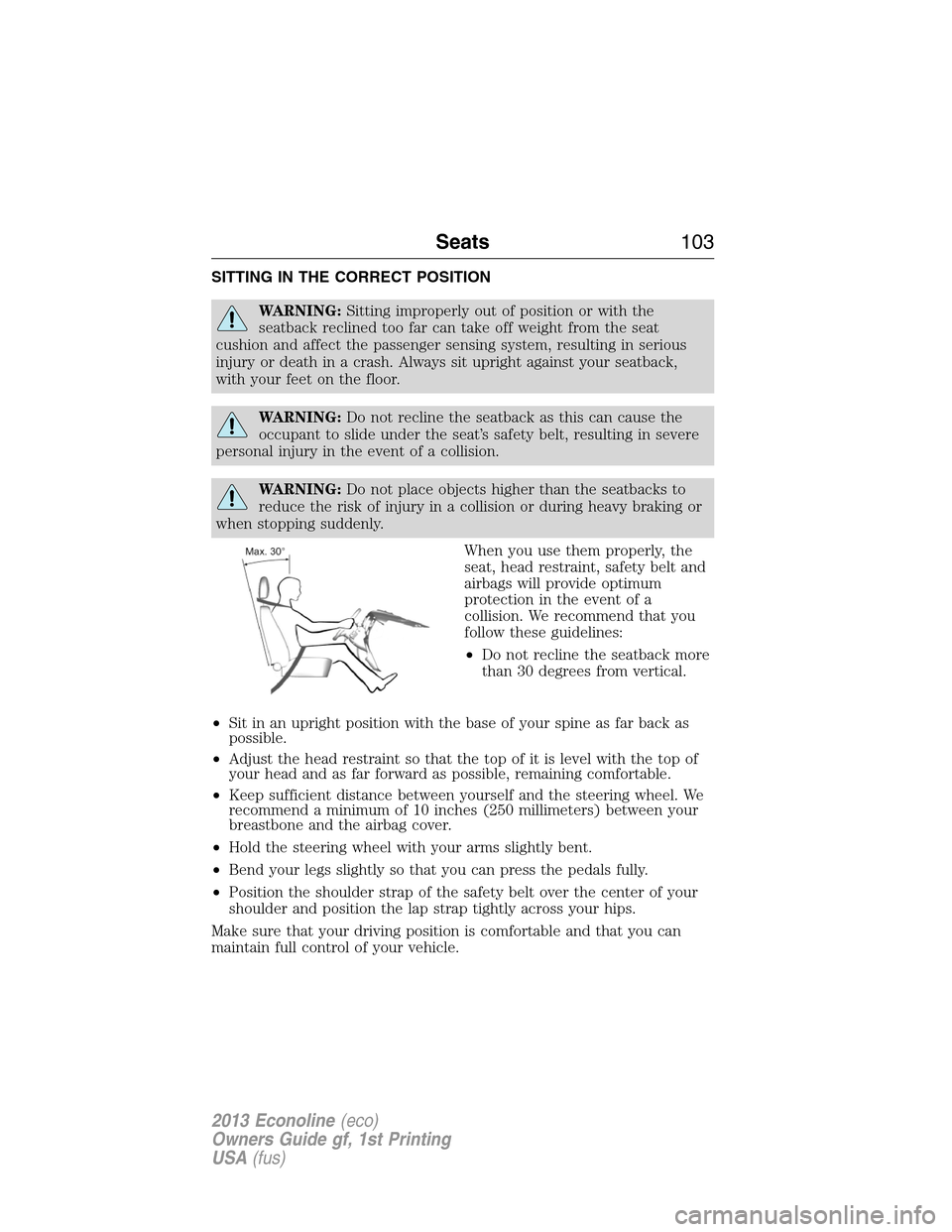
SITTING IN THE CORRECT POSITION
WARNING:Sitting improperly out of position or with the
seatback reclined too far can take off weight from the seat
cushion and affect the passenger sensing system, resulting in serious
injury or death in a crash. Always sit upright against your seatback,
with your feet on the floor.
WARNING:Do not recline the seatback as this can cause the
occupant to slide under the seat’s safety belt, resulting in severe
personal injury in the event of a collision.
WARNING:Do not place objects higher than the seatbacks to
reduce the risk of injury in a collision or during heavy braking or
when stopping suddenly.
When you use them properly, the
seat, head restraint, safety belt and
airbags will provide optimum
protection in the event of a
collision. We recommend that you
follow these guidelines:
•Do not recline the seatback more
than 30 degrees from vertical.
•Sit in an upright position with the base of your spine as far back as
possible.
•Adjust the head restraint so that the top of it is level with the top of
your head and as far forward as possible, remaining comfortable.
•Keep sufficient distance between yourself and the steering wheel. We
recommend a minimum of 10 inches (250 millimeters) between your
breastbone and the airbag cover.
•Hold the steering wheel with your arms slightly bent.
•Bend your legs slightly so that you can press the pedals fully.
•Position the shoulder strap of the safety belt over the center of your
shoulder and position the lap strap tightly across your hips.
Make sure that your driving position is comfortable and that you can
maintain full control of your vehicle.
Seats103
2013 Econoline(eco)
Owners Guide gf, 1st Printing
USA(fus)
Page 107 of 416
Quick-Release Captains Chair (7 Passenger Configuration- Second
Row Only)
WARNING:Check to see that the seat and seatback is latched
securely in position. Keep floor area free of objects that would
prevent proper seat engagement. Never attempt to adjust the seat while
the vehicle is in motion.
WARNING:Make sure that the seat is latched to the vehicle
floor by pushing and pulling on the seat. If not latched, the seat
may cause injury during a sudden stop.
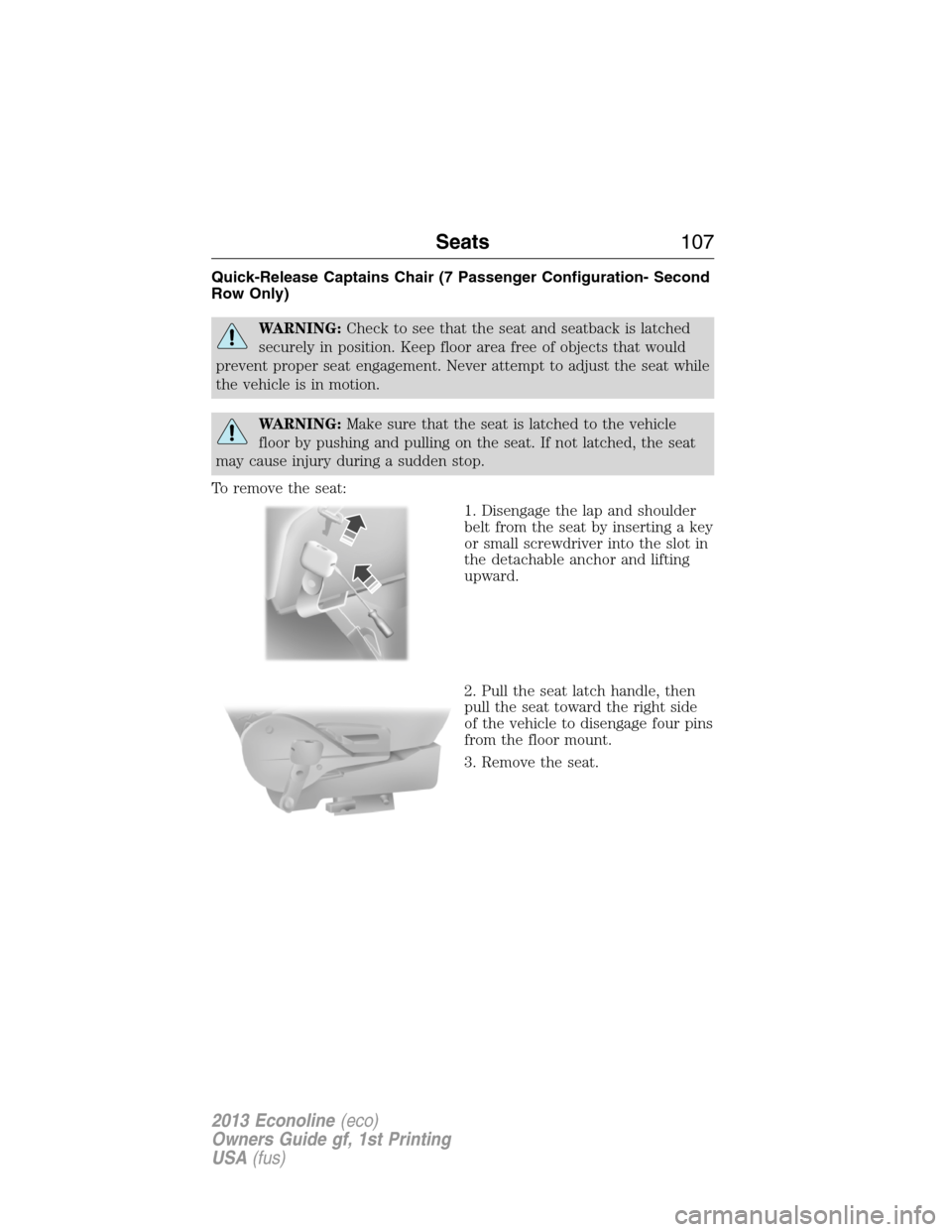
To remove the seat:
1. Disengage the lap and shoulder
belt from the seat by inserting a key
or small screwdriver into the slot in
the detachable anchor and lifting
upward.
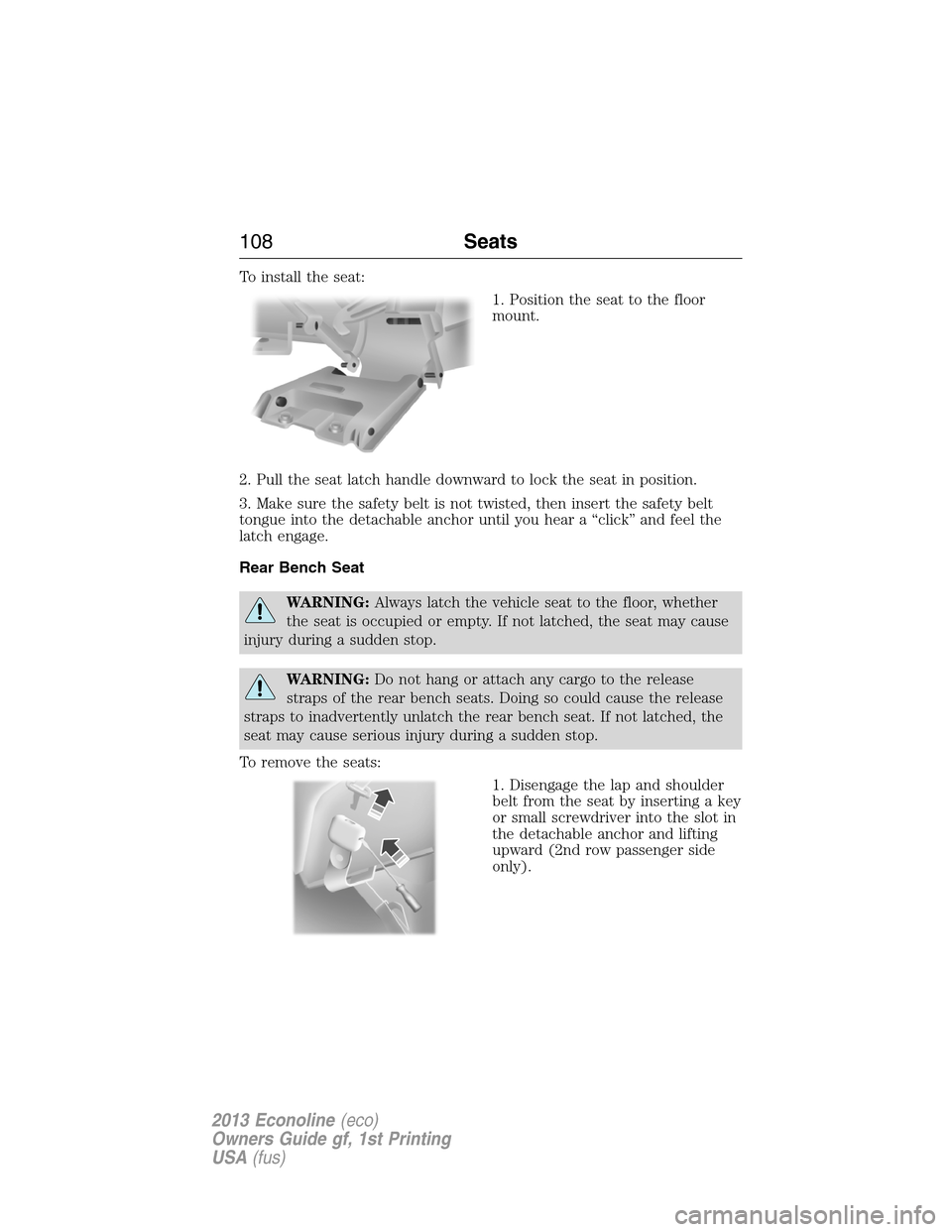
2. Pull the seat latch handle, then
pull the seat toward the right side
of the vehicle to disengage four pins
from the floor mount.
3. Remove the seat.
Seats107
2013 Econoline(eco)
Owners Guide gf, 1st Printing
USA(fus)
Page 108 of 416
To install the seat:
1. Position the seat to the floor
mount.
2. Pull the seat latch handle downward to lock the seat in position.
3. Make sure the safety belt is not twisted, then insert the safety belt
tongue into the detachable anchor until you hear a “click” and feel the
latch engage.
Rear Bench Seat
WARNING:Always latch the vehicle seat to the floor, whether
the seat is occupied or empty. If not latched, the seat may cause
injury during a sudden stop.
WARNING:Do not hang or attach any cargo to the release
straps of the rear bench seats. Doing so could cause the release
straps to inadvertently unlatch the rear bench seat. If not latched, the
seat may cause serious injury during a sudden stop.
To remove the seats:
1. Disengage the lap and shoulder
belt from the seat by inserting a key
or small screwdriver into the slot in
the detachable anchor and lifting
upward (2nd row passenger side
only).
108Seats
2013 Econoline(eco)
Owners Guide gf, 1st Printing
USA(fus)
Page 109 of 416
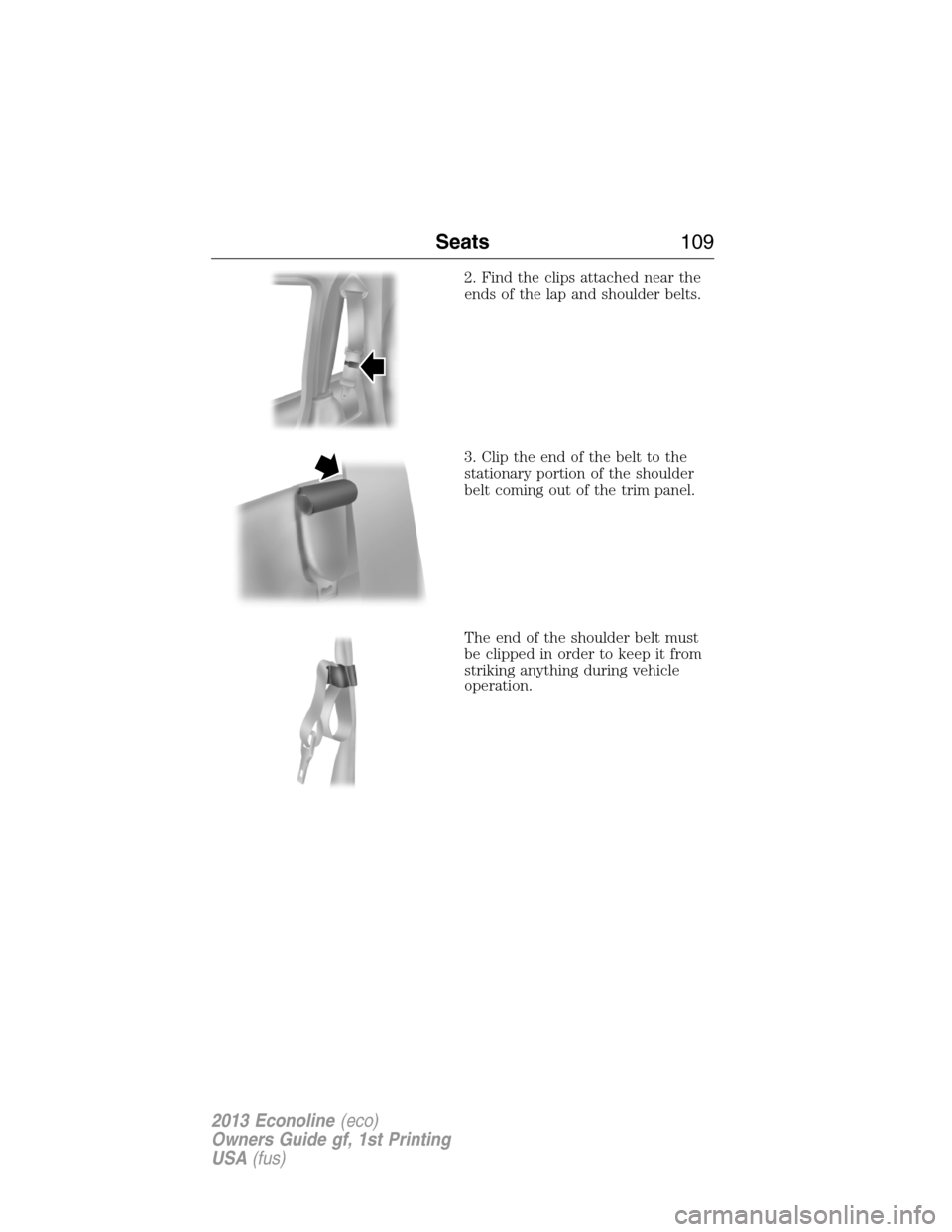
2. Find the clips attached near the
ends of the lap and shoulder belts.
3. Clip the end of the belt to the
stationary portion of the shoulder
belt coming out of the trim panel.
The end of the shoulder belt must
be clipped in order to keep it from
striking anything during vehicle
operation.
Seats109
2013 Econoline(eco)
Owners Guide gf, 1st Printing
USA(fus)
Page 115 of 416
IGNITION SWITCH
Note:To switch the engine off when your vehicle is moving, move the
transmission selector lever to positionN.Use the brakes to bring your
vehicle to a safe stop. After your vehicle has stopped, switch the engine
off and move the transmission selector lever to positionP.Turn the key
to the accessory or off position.
Note:Do not store the key in the ignition after the vehicle is turned off
and you have left the vehicle. This could cause a drain on the battery.
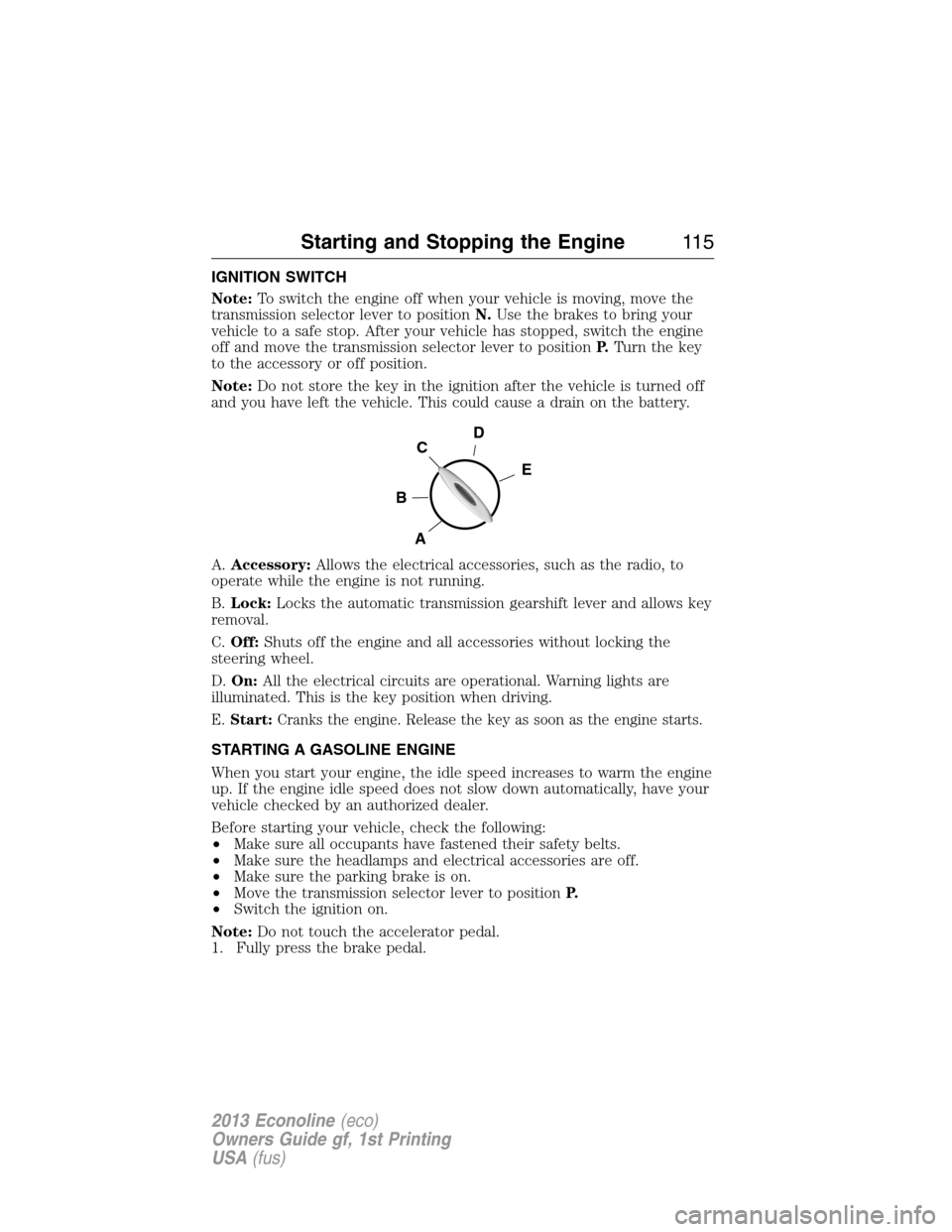
A.Accessory:Allows the electrical accessories, such as the radio, to
operate while the engine is not running.
B.Lock:Locks the automatic transmission gearshift lever and allows key
removal.
C.Off:Shuts off the engine and all accessories without locking the
steering wheel.
D.On:All the electrical circuits are operational. Warning lights are
illuminated. This is the key position when driving.
E.Start:Cranks the engine. Release the key as soon as the engine starts.
STARTING A GASOLINE ENGINE
When you start your engine, the idle speed increases to warm the engine
up. If the engine idle speed does not slow down automatically, have your
vehicle checked by an authorized dealer.
Before starting your vehicle, check the following:
•Make sure all occupants have fastened their safety belts.
•Make sure the headlamps and electrical accessories are off.
•Make sure the parking brake is on.
•Move the transmission selector lever to positionP.
•Switch the ignition on.
Note:Do not touch the accelerator pedal.
1. Fully press the brake pedal.
D
E
C
B
A
Starting and Stopping the Engine11 5
2013 Econoline(eco)
Owners Guide gf, 1st Printing
USA(fus)
Page 170 of 416
Exceeding these limits may allow water to enter vehicle components:
•Causing internal damage to the components.
•Affecting driveability, emissions, and reliability.
Replace the rear axle lubricant anytime the rear axle has been
submerged in water. Water may have contaminated the rear axle
lubricant, which is not normally checked or changed unless a leak is
suspected or other axle repair is required.
WRECKER TOWING
If you need to have your vehicle towed, contact a professional towing
service or, if you are a member of a roadside assistance program, your
roadside assistance service provider.
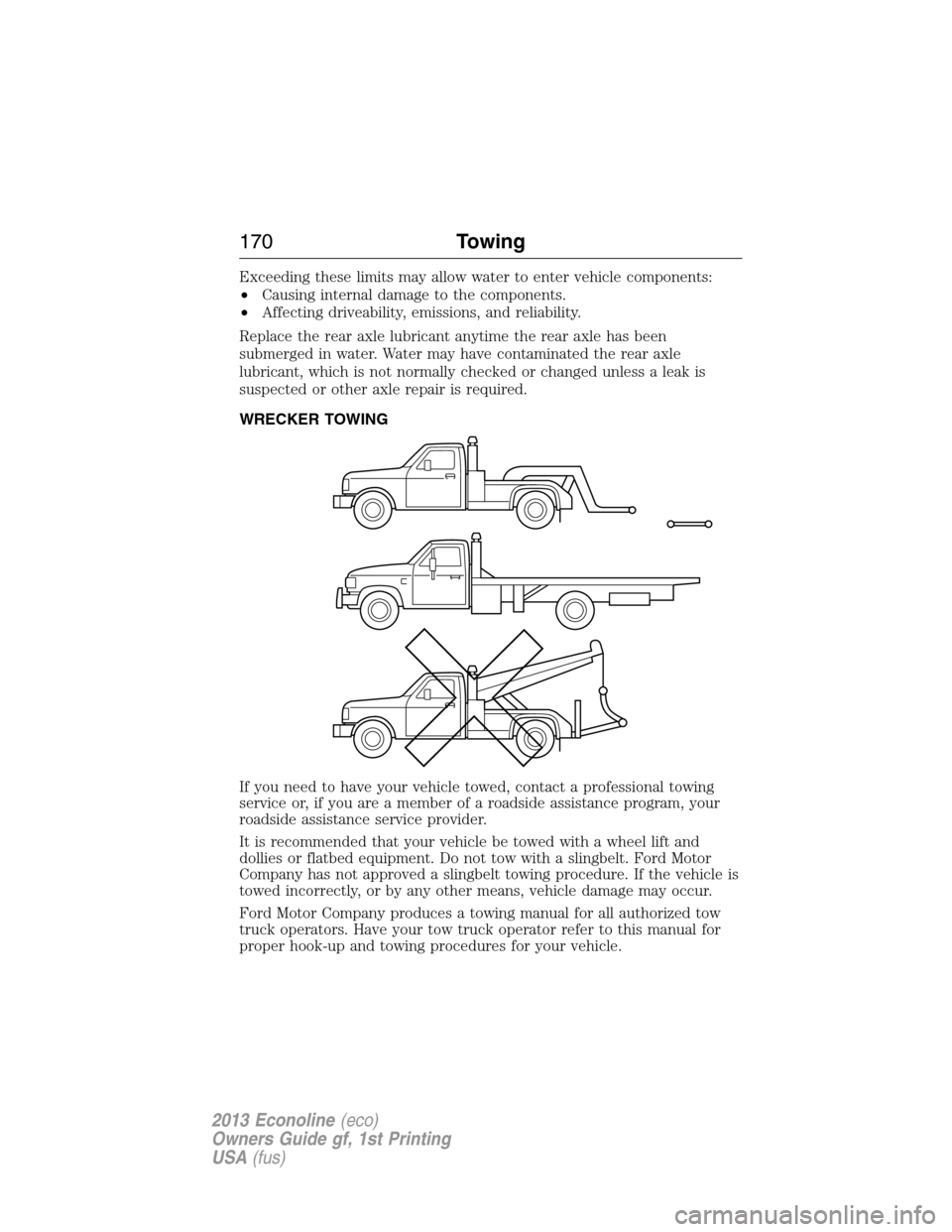
It is recommended that your vehicle be towed with a wheel lift and
dollies or flatbed equipment. Do not tow with a slingbelt. Ford Motor
Company has not approved a slingbelt towing procedure. If the vehicle is
towed incorrectly, or by any other means, vehicle damage may occur.
Ford Motor Company produces a towing manual for all authorized tow
truck operators. Have your tow truck operator refer to this manual for
proper hook-up and towing procedures for your vehicle.
170Towing
2013 Econoline(eco)
Owners Guide gf, 1st Printing
USA(fus)