engine coolant FORD E SERIES 2014 4.G User Guide
[x] Cancel search | Manufacturer: FORD, Model Year: 2014, Model line: E SERIES, Model: FORD E SERIES 2014 4.GPages: 438, PDF Size: 5.12 MB
Page 201 of 438
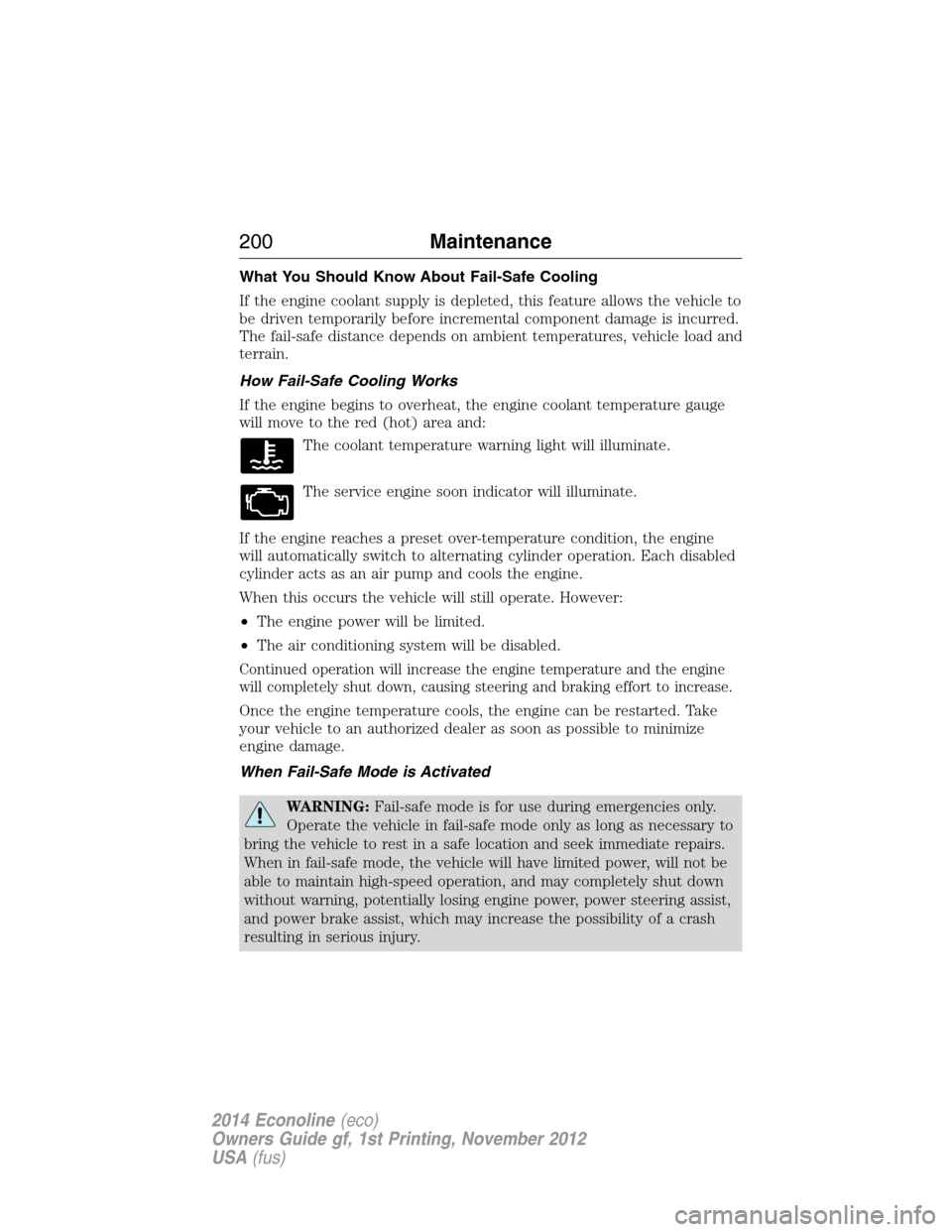
What You Should Know About Fail-Safe Cooling
If the engine coolant supply is depleted, this feature allows the vehicle to
be driven temporarily before incremental component damage is incurred.
The fail-safe distance depends on ambient temperatures, vehicle load and
terrain.
How Fail-Safe Cooling Works
If the engine begins to overheat, the engine coolant temperature gauge
will move to the red (hot) area and:
The coolant temperature warning light will illuminate.
The service engine soon indicator will illuminate.
If the engine reaches a preset over-temperature condition, the engine
will automatically switch to alternating cylinder operation. Each disabled
cylinder acts as an air pump and cools the engine.
When this occurs the vehicle will still operate. However:
•The engine power will be limited.
•The air conditioning system will be disabled.
Continued operation will increase the engine temperature and the engine
will completely shut down, causing steering and braking effort to increase.
Once the engine temperature cools, the engine can be restarted. Take
your vehicle to an authorized dealer as soon as possible to minimize
engine damage.
When Fail-Safe Mode is Activated
WARNING:Fail-safe mode is for use during emergencies only.
Operate the vehicle in fail-safe mode only as long as necessary to
bring the vehicle to rest in a safe location and seek immediate repairs.
When in fail-safe mode, the vehicle will have limited power, will not be
able to maintain high-speed operation, and may completely shut down
without warning, potentially losing engine power, power steering assist,
and power brake assist, which may increase the possibility of a crash
resulting in serious injury.
200Maintenance
2014 Econoline(eco)
Owners Guide gf, 1st Printing, November 2012
USA(fus)
Page 202 of 438
WARNING:Never remove the coolant reservoir cap while the
engine is running or hot.
You have limited engine power when in the fail-safe mode, so drive the
vehicle with caution. The vehicle will not be able to maintain high-speed
operation and the engine will run rough. Remember that the engine is
capable of completely shutting down automatically to prevent engine
damage, therefore:
1. Pull off the road as soon as safely possible and turn off the engine.
2. Arrange for the vehicle to be taken to an authorized dealer.
3. If this is not possible, wait a short period for the engine to cool.
4. Check the coolant level and replenish if low.
5. Restart the engine and take your vehicle to an authorized dealer.
Note:Driving the vehicle without repairing the engine problem increases
the chance of engine damage. Take your vehicle to an authorized dealer
as soon as possible.
TRANSMISSION FLUID CHECK
Checking Automatic Transmission Fluid (If Equipped)
Refer to yourscheduled maintenance informationfor scheduled
intervals for fluid checks and changes. Your transmission does not
consume fluid. However, the fluid level should be checked if the
transmission is not working properly, i.e., if the transmission slips or
shifts slowly or if you notice some sign of fluid leakage.
Automatic transmission fluid expands when warmed. To obtain an
accurate fluid check, drive the vehicle until it is at normal operating
temperature (approximately 20 miles [30 kilometers]). If your vehicle has
been operated for an extended period at high speeds, in city traffic
during hot weather or pulling a trailer, the vehicle should be turned off
for about 30 minutes to allow fluid to cool before checking.
1. Drive the vehicle 20 miles (30 kilometers) or until it reaches normal
operating temperature.
2. Park the vehicle on a level surface and engage the parking brake.
3. With the engine running, parking brake engaged and your foot on the
brake pedal, move the gearshift lever through all of the gear ranges.
Allow sufficient time for each gear to engage.
4. Latch the gearshift lever in P (Park) and leave the engine running.
Maintenance201
2014 Econoline(eco)
Owners Guide gf, 1st Printing, November 2012
USA(fus)
Page 232 of 438
Body
•Wash vehicle thoroughly to remove dirt, grease, oil, tar or mud from
exterior surfaces, rear-wheel housing and underside of front fenders.
•Periodically wash vehicles stored in exposed locations.
•Touch up raw or primed metal to prevent rust.
•Cover chrome and stainless steel parts with a thick coat of auto wax
to prevent discoloration. Re-wax as necessary when the vehicle is
washed.
•Lubricate hood latch, all door latches and trunk lid hinges with a light
grade oil.
•Cover interior trim to prevent fading.
•Keep all rubber parts free from oil and solvents.
Engine
•The engine oil and filter should be changed prior to storage, as used
engine oil contains contaminates that may cause engine damage.
•Start the engine every 15 days. Run at fast idle until it reaches normal
operating temperature.
•With your foot on the brake, shift through all the gears while the
engine is running.
Fuel system
•Fill the fuel tank with high-quality fuel until the first automatic shutoff
of the fuel pump nozzle.
Cooling system
•Protect against freezing temperatures.
•When removing vehicle from storage, check coolant fluid level.
Confirm there are no cooling system leaks, and fluid is at the
recommended level.
Battery
•Check and recharge as necessary. Keep connections clean.
•If storing your vehicle for more than 30 days without recharging the
battery, it may be advisable to disconnect the battery cables to ensure
battery charge is maintained for quick starting.
Note:If battery cables are disconnected, it will be necessary to reset
memory features.
Vehicle Care231
2014 Econoline(eco)
Owners Guide gf, 1st Printing, November 2012
USA(fus)
Page 273 of 438
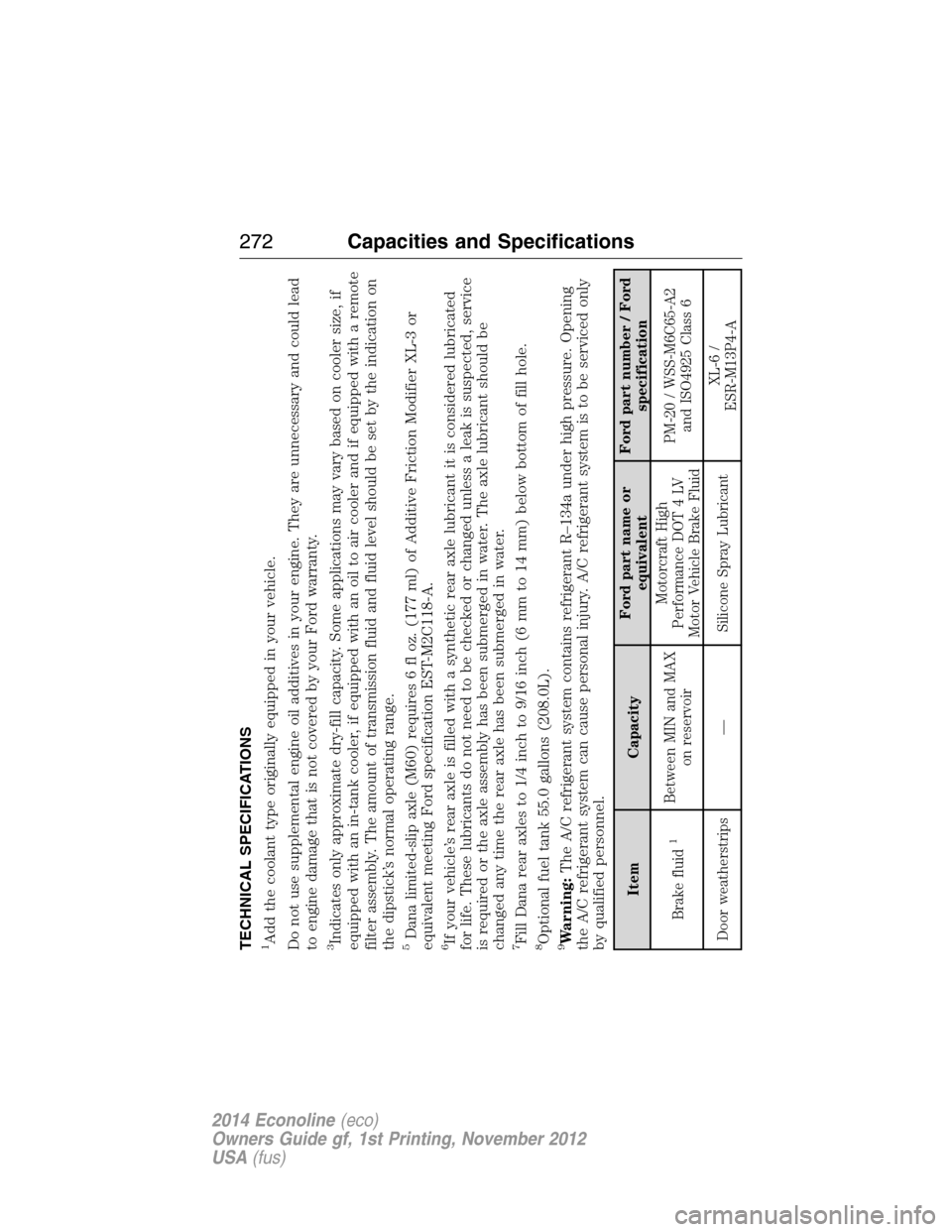
TECHNICAL SPECIFICATIONS1Add the coolant type originally equipped in your vehicle.
Do not use supplemental engine oil additives in your engine. They are unnecessary and could lead
to engine damage that is not covered by your Ford warranty.3Indicates only approximate dry-fill capacity. Some applications may vary based on cooler size, if
equipped with an in-tank cooler, if equipped with an oil to air cooler and if equipped with a remote
filter assembly. The amount of transmission fluid and fluid level should be set by the indication on
the dipstick’s normal operating range.5Dana limited-slip axle (M60) requires 6 fl oz. (177 ml) of Additive Friction Modifier XL-3 or
equivalent meeting Ford specification EST-M2C118-A.6If your vehicle’s rear axle is filled with a synthetic rear axle lubricant it is considered lubricated
for life. These lubricants do not need to be checked or changed unless a leak is suspected, service
is required or the axle assembly has been submerged in water. The axle lubricant should be
changed any time the rear axle has been submerged in water.7Fill Dana rear axles to 1/4 inch to 9/16 inch (6 mm to 14 mm) below bottom of fill hole.8Optional fuel tank 55.0 gallons (208.0L).9Warning:The A/C refrigerant system contains refrigerant R–134a under high pressure. Opening
the A/C refrigerant system can cause personal injury. A/C refrigerant system is to be serviced only
by qualified personnel.
Item CapacityFord part name or
equivalentFord part number / Ford
specification
Brake fluid
1
Between MIN and MAX
on reservoirMotorcraft High
Performance DOT 4 LV
Motor Vehicle Brake FluidPM-20 / WSS-M6C65-A2
and ISO4925 Class 6
Door weatherstrips — Silicone Spray LubricantXL-6 /
ESR-M13P4-A
272Capacities and Specifications
2014 Econoline(eco)
Owners Guide gf, 1st Printing, November 2012
USA(fus)
Page 274 of 438
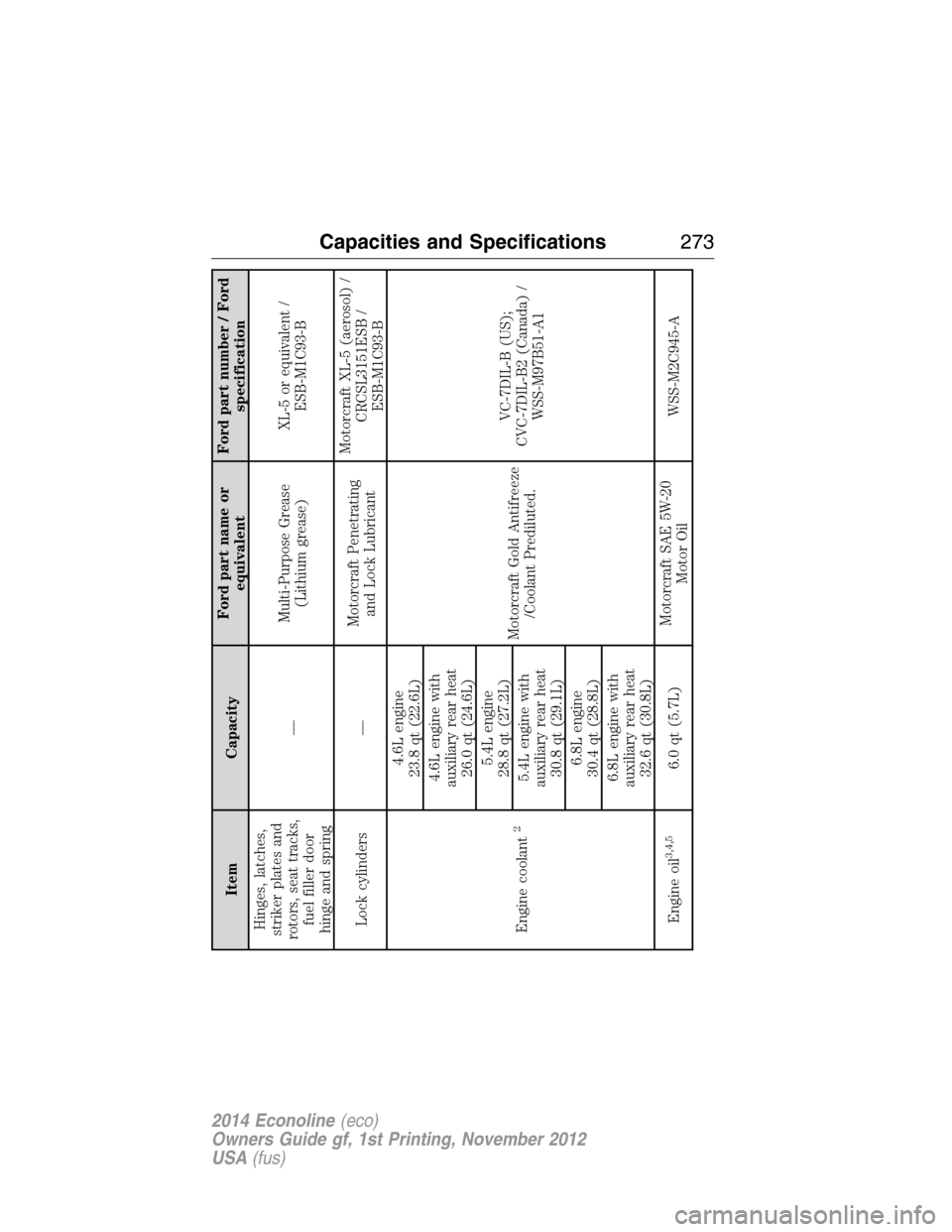
Item CapacityFord part name or
equivalentFord part number / Ford
specification
Hinges, latches,
striker plates and
rotors, seat tracks,
fuel filler door
hinge and spring—Multi-Purpose Grease
(Lithium grease)XL-5 or equivalent /
ESB-M1C93-B
Lock cylinders —Motorcraft Penetrating
and Lock LubricantMotorcraft XL-5 (aerosol) /
CRCSL3151ESB /
ESB-M1C93-B
Engine coolant
2
4.6L engine
23.8 qt (22.6L)
Motorcraft Gold Antifreeze
/Coolant Prediluted.VC-7DIL-B (US);
CVC-7DIL-B2 (Canada) /
WSS-M97B51-A1 4.6L engine with
auxiliary rear heat
26.0 qt (24.6L)
5.4L engine
28.8 qt (27.2L)
5.4L engine with
auxiliary rear heat
30.8 qt (29.1L)
6.8L engine
30.4 qt (28.8L)
6.8L engine with
auxiliary rear heat
32.6 qt (30.8L)
Engine oil
3,4,5
6.0 qt (5.7L)Motorcraft SAE 5W-20
Motor OilWSS-M2C945-A
Capacities and Specifications273
2014 Econoline(eco)
Owners Guide gf, 1st Printing, November 2012
USA(fus)
Page 278 of 438
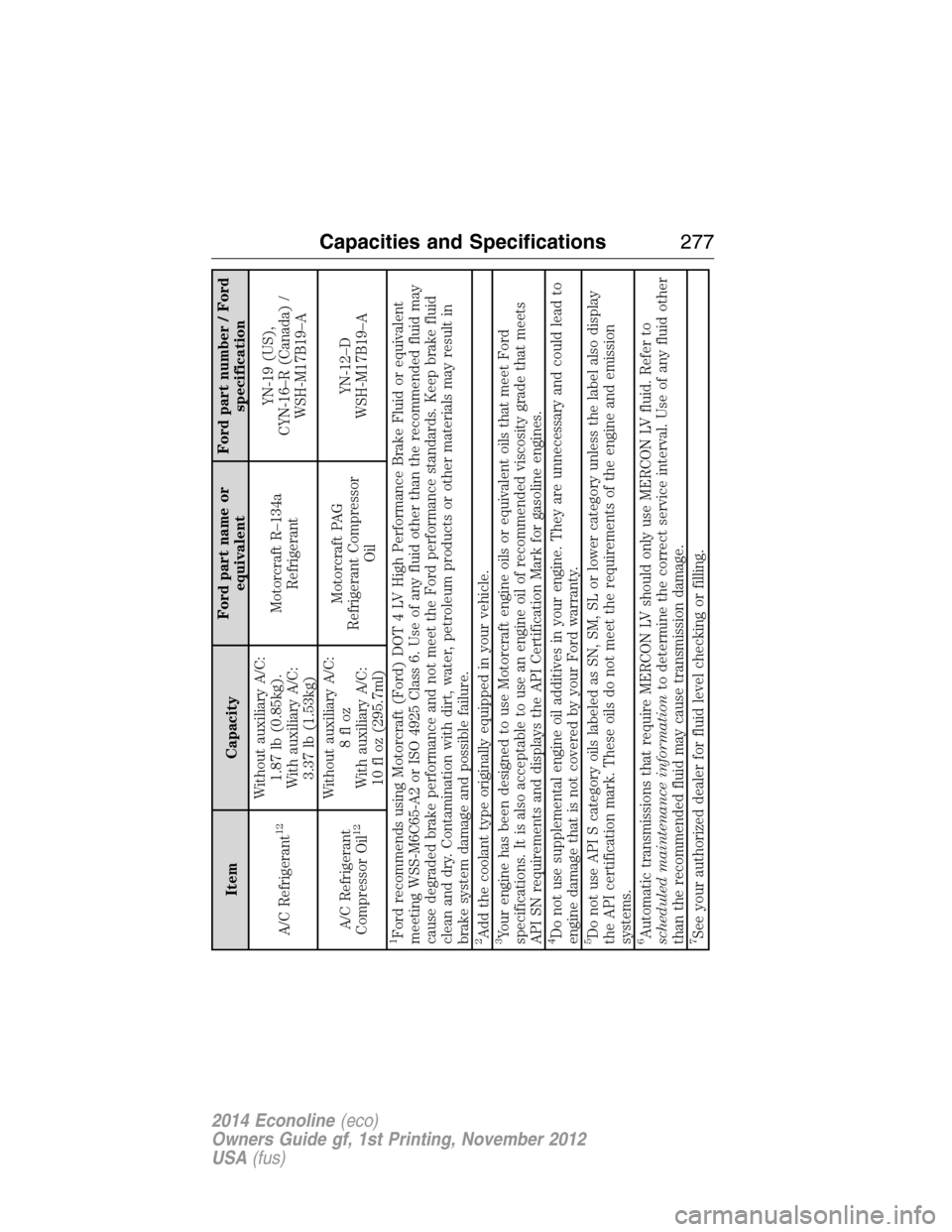
Item CapacityFord part name or
equivalentFord part number / Ford
specification
A/C Refrigerant
12
Without auxiliary A/C:
1.87 lb (0.85kg).
With auxiliary A/C:
3.37 lb (1.53kg)Motorcraft R–134a
RefrigerantYN-19 (US),
CYN-16–R (Canada) /
WSH-M17B19–A
A/C Refrigerant
Compressor Oil
12
Without auxiliary A/C:
8floz
With auxiliary A/C:
10 fl oz (295.7ml)Motorcraft PAG
Refrigerant Compressor
OilYN-12–D
WSH-M17B19–A
1Ford recommends using Motorcraft (Ford) DOT 4 LV High Performance Brake Fluid or equivalent
meeting WSS-M6C65-A2 or ISO 4925 Class 6. Use of any fluid other than the recommended fluid may
cause degraded brake performance and not meet the Ford performance standards. Keep brake fluid
clean and dry. Contamination with dirt, water, petroleum products or other materials may result in
brake system damage and possible failure.2Add the coolant type originally equipped in your vehicle.3Your engine has been designed to use Motorcraft engine oils or equivalent oils that meet Ford
specifications. It is also acceptable to use an engine oil of recommended viscosity grade that meets
API SN requirements and displays the API Certification Mark for gasoline engines.4Do not use supplemental engine oil additives in your engine. They are unnecessary and could lead to
engine damage that is not covered by your Ford warranty.5Do not use API S category oils labeled as SN, SM, SL or lower category unless the label also display
the API certification mark. These oils do not meet the requirements of the engine and emission
systems.6Automatic transmissions that require MERCON LV should only use MERCON LV fluid. Refer to
scheduled maintenance informationto determine the correct service interval. Use of any fluid other
than the recommended fluid may cause transmission damage.7See your authorized dealer for fluid level checking or filling.
Capacities and Specifications277
2014 Econoline(eco)
Owners Guide gf, 1st Printing, November 2012
USA(fus)
Page 417 of 438
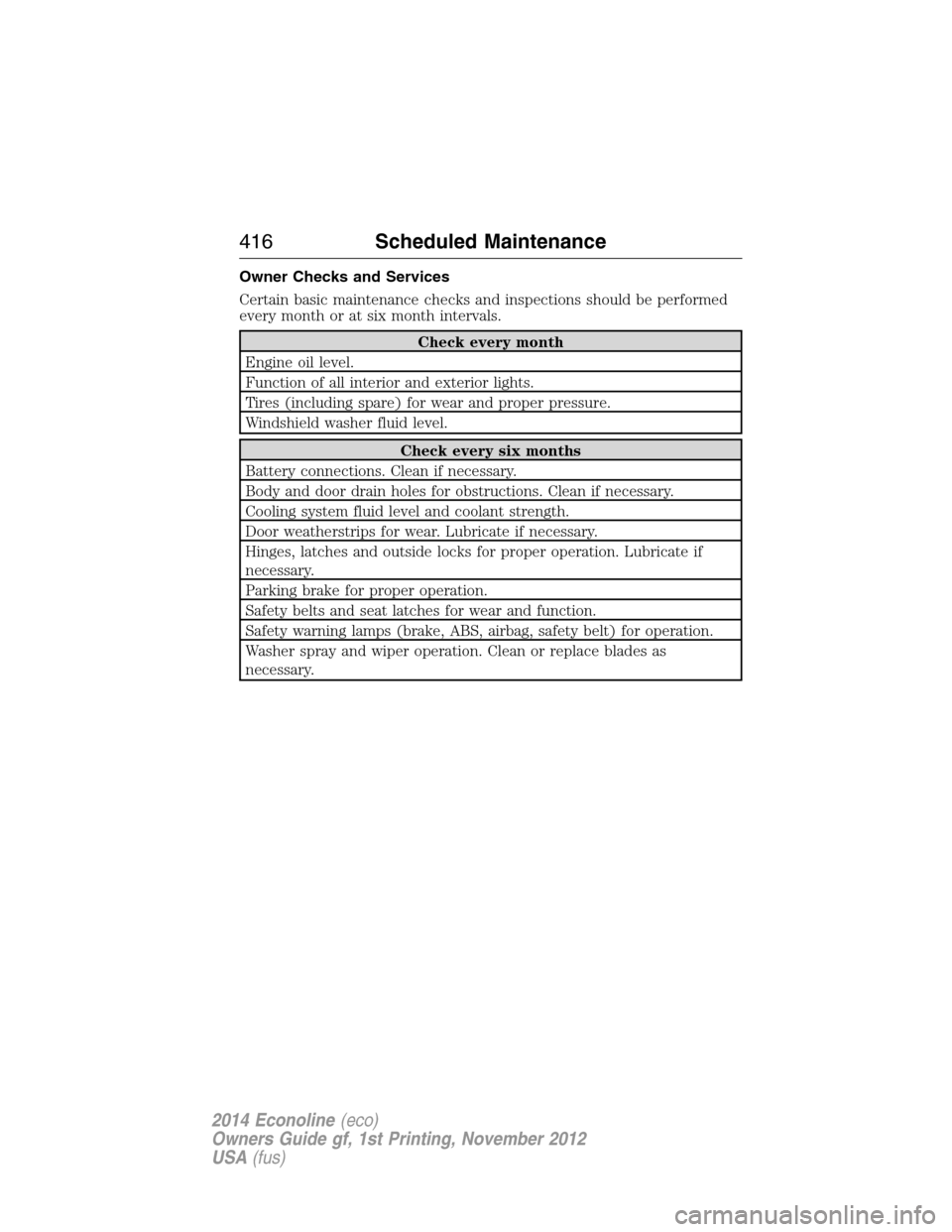
Owner Checks and Services
Certain basic maintenance checks and inspections should be performed
every month or at six month intervals.
Check every month
Engine oil level.
Function of all interior and exterior lights.
Tires (including spare) for wear and proper pressure.
Windshield washer fluid level.
Check every six months
Battery connections. Clean if necessary.
Body and door drain holes for obstructions. Clean if necessary.
Cooling system fluid level and coolant strength.
Door weatherstrips for wear. Lubricate if necessary.
Hinges, latches and outside locks for proper operation. Lubricate if
necessary.
Parking brake for proper operation.
Safety belts and seat latches for wear and function.
Safety warning lamps (brake, ABS, airbag, safety belt) for operation.
Washer spray and wiper operation. Clean or replace blades as
necessary.
416Scheduled Maintenance
2014 Econoline(eco)
Owners Guide gf, 1st Printing, November 2012
USA(fus)
Page 418 of 438
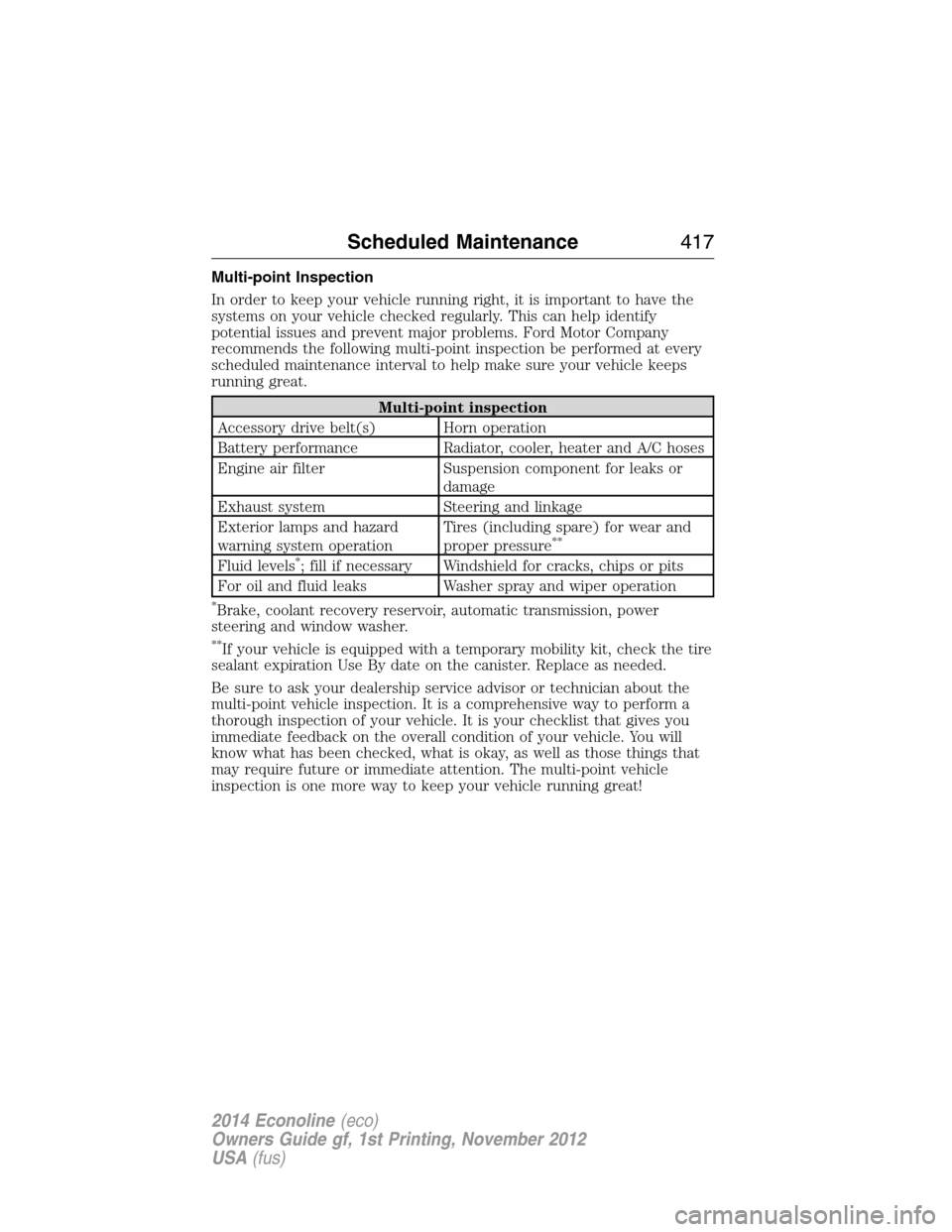
Multi-point Inspection
In order to keep your vehicle running right, it is important to have the
systems on your vehicle checked regularly. This can help identify
potential issues and prevent major problems. Ford Motor Company
recommends the following multi-point inspection be performed at every
scheduled maintenance interval to help make sure your vehicle keeps
running great.
Multi-point inspection
Accessory drive belt(s) Horn operation
Battery performance Radiator, cooler, heater and A/C hoses
Engine air filter Suspension component for leaks or
damage
Exhaust system Steering and linkage
Exterior lamps and hazard
warning system operationTires (including spare) for wear and
proper pressure
**
Fluid levels*; fill if necessary Windshield for cracks, chips or pits
For oil and fluid leaks Washer spray and wiper operation
*Brake, coolant recovery reservoir, automatic transmission, power
steering and window washer.
**If your vehicle is equipped with a temporary mobility kit, check the tire
sealant expiration Use By date on the canister. Replace as needed.
Be sure to ask your dealership service advisor or technician about the
multi-point vehicle inspection. It is a comprehensive way to perform a
thorough inspection of your vehicle. It is your checklist that gives you
immediate feedback on the overall condition of your vehicle. You will
know what has been checked, what is okay, as well as those things that
may require future or immediate attention. The multi-point vehicle
inspection is one more way to keep your vehicle running great!
Scheduled Maintenance417
2014 Econoline(eco)
Owners Guide gf, 1st Printing, November 2012
USA(fus)
Page 421 of 438
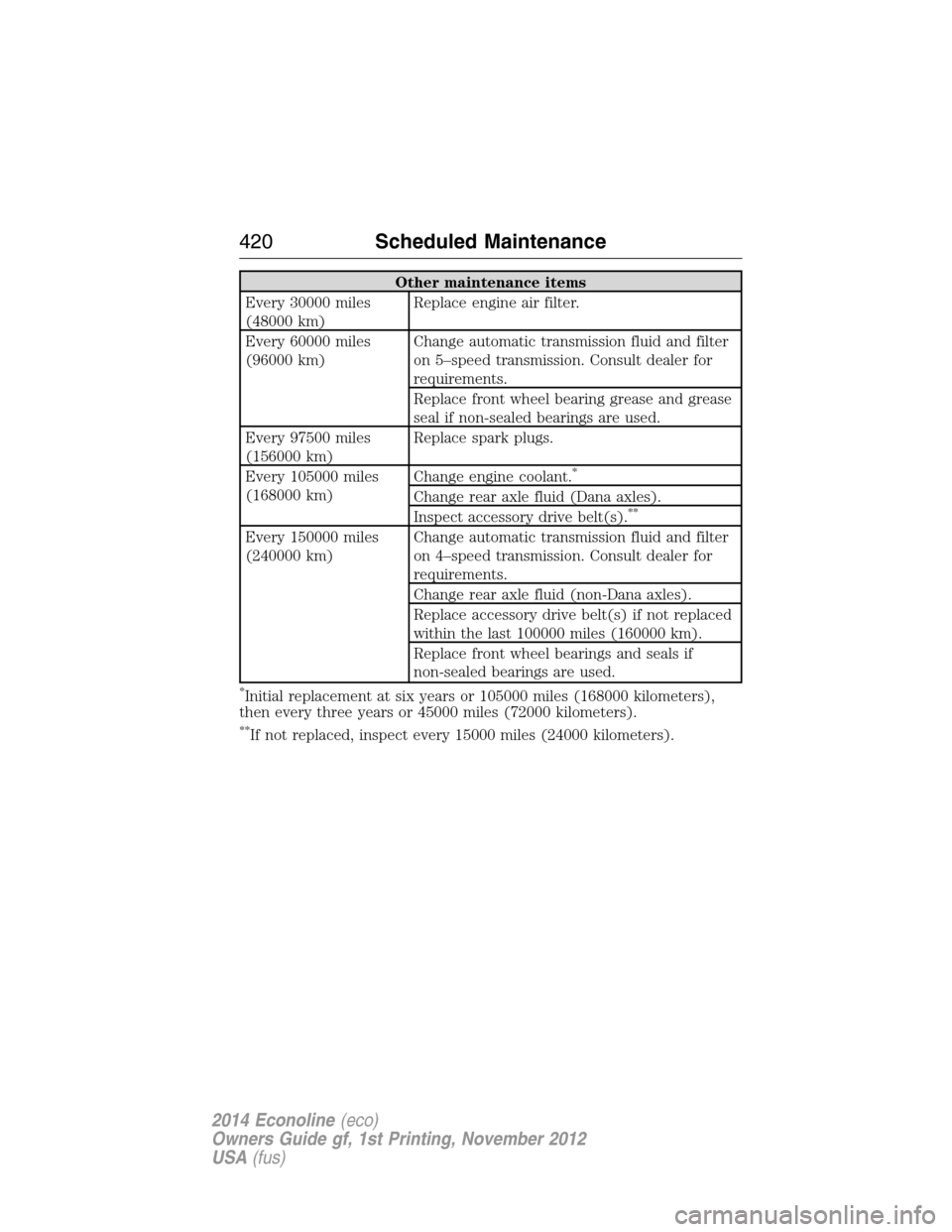
Other maintenance items
Every 30000 miles
(48000 km)Replace engine air filter.
Every 60000 miles
(96000 km)Change automatic transmission fluid and filter
on 5–speed transmission. Consult dealer for
requirements.
Replace front wheel bearing grease and grease
seal if non-sealed bearings are used.
Every 97500 miles
(156000 km)Replace spark plugs.
Every 105000 miles
(168000 km)Change engine coolant.
*
Change rear axle fluid (Dana axles).
Inspect accessory drive belt(s).**
Every 150000 miles
(240000 km)Change automatic transmission fluid and filter
on 4–speed transmission. Consult dealer for
requirements.
Change rear axle fluid (non-Dana axles).
Replace accessory drive belt(s) if not replaced
within the last 100000 miles (160000 km).
Replace front wheel bearings and seals if
non-sealed bearings are used.
*Initial replacement at six years or 105000 miles (168000 kilometers),
then every three years or 45000 miles (72000 kilometers).
**If not replaced, inspect every 15000 miles (24000 kilometers).
420Scheduled Maintenance
2014 Econoline(eco)
Owners Guide gf, 1st Printing, November 2012
USA(fus)
Page 431 of 438
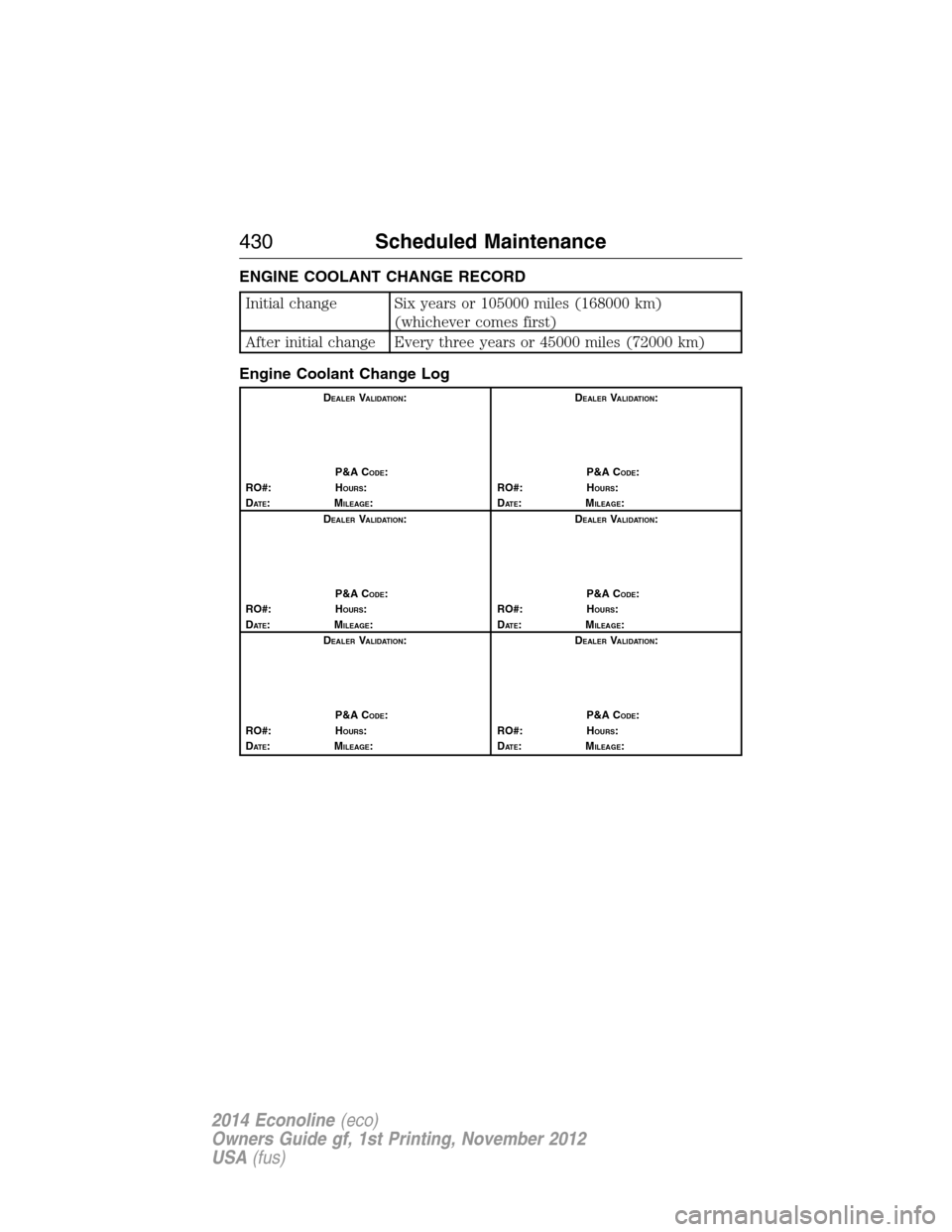
ENGINE COOLANT CHANGE RECORD
Initial change Six years or 105000 miles (168000 km)
(whichever comes first)
After initial change Every three years or 45000 miles (72000 km)
Engine Coolant Change Log
DEALERVALIDATION:
P&A C
ODE:
RO#: HOURS:
DAT E:MILEAGE:D
EALERVALIDATION:
P&A C
ODE:
RO#: HOURS:
DAT E:MILEAGE:
D
EALERVALIDATION:
P&A C
ODE:
RO#: HOURS:
DAT E:MILEAGE:D
EALERVALIDATION:
P&A C
ODE:
RO#: HOURS:
DAT E:MILEAGE:
D
EALERVALIDATION:
P&A C
ODE:
RO#: HOURS:
DAT E:MILEAGE:D
EALERVALIDATION:
P&A C
ODE:
RO#: HOURS:
DAT E:MILEAGE:
430Scheduled Maintenance
2014 Econoline(eco)
Owners Guide gf, 1st Printing, November 2012
USA(fus)