transmission fluid FORD E SERIES 2014 4.G Owners Manual
[x] Cancel search | Manufacturer: FORD, Model Year: 2014, Model line: E SERIES, Model: FORD E SERIES 2014 4.GPages: 438, PDF Size: 5.12 MB
Page 6 of 438
Maintenance 193
General information...................................193
Opening and closing the hood............................194
Under hood overview..................................195
Engine oil dipstick....................................196
Engine oil check......................................196
Engine coolant check..................................197
Automatic transmission fluid check........................201
Brake fluid check.....................................208
Power steering fluid check..............................208
Fuel filter...........................................208
Washer fluid check....................................209
Changing the vehicle battery.............................209
Checking the wiper blades..............................212
Changing the wiper blades..............................212
Air filter(s).........................................213
Adjusting the headlamps................................214
Changing a bulb......................................217
Removing a headlamp..................................217
Vehicle Care 224
Cleaning products.....................................224
Cleaning the exterior..................................224
Waxing.............................................226
Repairing minor paint damage............................226
Cleaning the engine...................................226
Cleaning the windows and wiper blades.....................227
Cleaning the interior...................................228
Cleaning the instrument panel and instrument cluster lens.......228
Cleaning leather seats..................................229
Cleaning the alloy wheels...............................230
Vehiclestorage.......................................230
Table of Contents5
2014 Econoline(eco)
Owners Guide gf, 1st Printing, November 2012
USA(fus)
Page 169 of 438
•Keep the tires properly inflated and use only the recommended size.
•Use the recommended engine oil.
•Perform all regularly scheduled maintenance.
There are also some things you may not want to do because they may
reduce your fuel economy:
•Sudden or hard accelerations.
•Rev the engine before turning it off.
•Idle for periods longer than one minute.
•Warm up your vehicle on cold mornings.
•Use the air conditioner or front defroster.
•Use the speed control in hilly terrain.
•Rest your foot on the brake pedal while driving.
•Drive a heavily loaded vehicle or tow a trailer.
•Carry unnecessary weight (approximately 1 mpg [0.4 km/L] is lost for
every 400 pounds [180 kilograms] of weight carried).
•Add particular accessories to your vehicle (e.g.; bug deflectors,
rollbars or light bars, running boards, ski racks).
•Drive with the wheels out of alignment.
DRIVING THROUGH WATER
Note:Driving through deep water may allow water into the transmission
and engine causing internal damage. If you drove through deep water,
check the transmission and engine fluid. If water is found, see your
authorized dealer immediately for fluid replacement.
Do not drive quickly through standing water, especially if the depth is
unknown. Traction or brake capability may be limited and if the ignition
system gets wet, your engine may stall. Water may also enter your
engine’s air intake and severely damage your engine.
168Driving Hints
2014 Econoline(eco)
Owners Guide gf, 1st Printing, November 2012
USA(fus)
Page 196 of 438
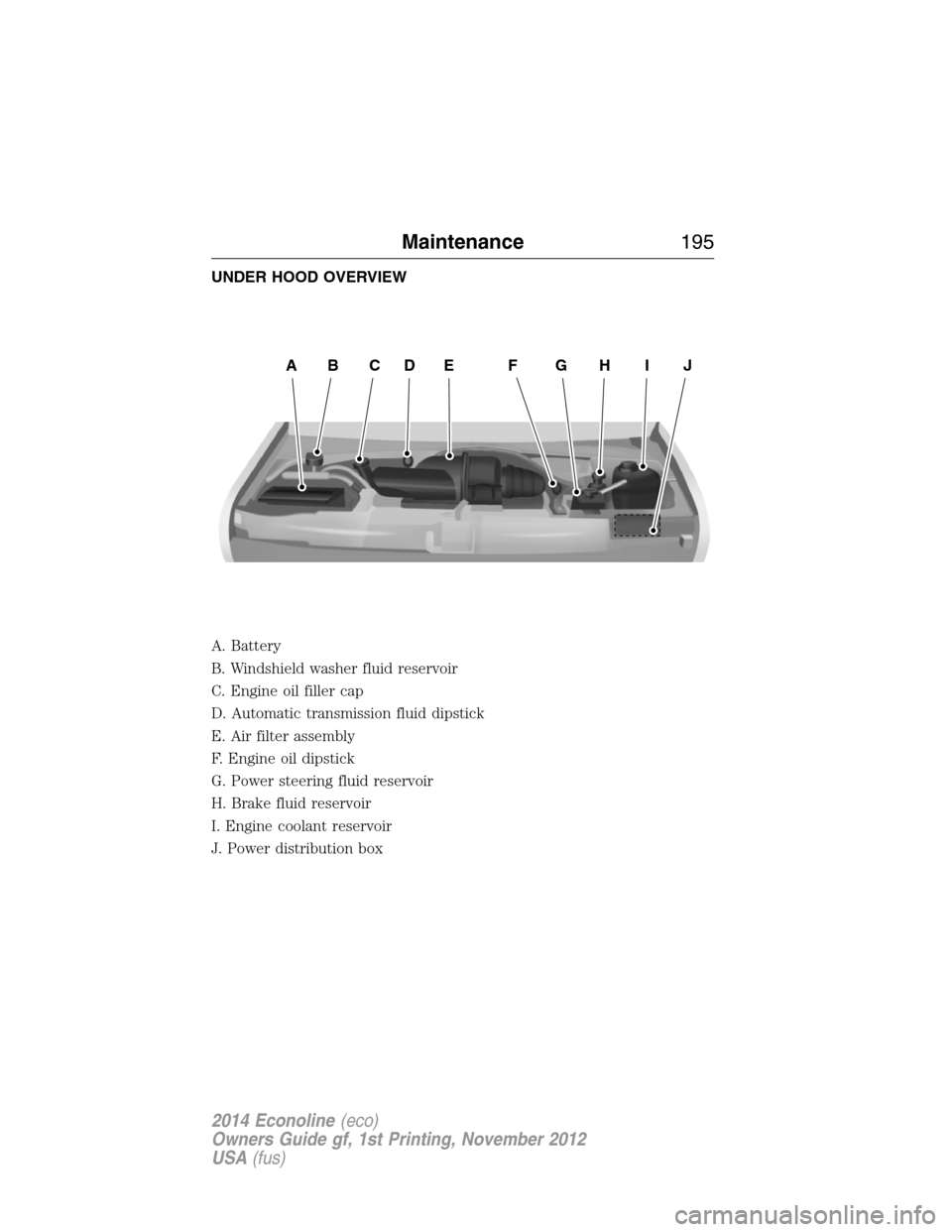
UNDER HOOD OVERVIEW
A. Battery
B. Windshield washer fluid reservoir
C. Engine oil filler cap
D. Automatic transmission fluid dipstick
E. Air filter assembly
F. Engine oil dipstick
G. Power steering fluid reservoir
H. Brake fluid reservoir
I. Engine coolant reservoir
J. Power distribution box
ABCDEFGHIJ
Maintenance195
2014 Econoline(eco)
Owners Guide gf, 1st Printing, November 2012
USA(fus)
Page 202 of 438
WARNING:Never remove the coolant reservoir cap while the
engine is running or hot.
You have limited engine power when in the fail-safe mode, so drive the
vehicle with caution. The vehicle will not be able to maintain high-speed
operation and the engine will run rough. Remember that the engine is
capable of completely shutting down automatically to prevent engine
damage, therefore:
1. Pull off the road as soon as safely possible and turn off the engine.
2. Arrange for the vehicle to be taken to an authorized dealer.
3. If this is not possible, wait a short period for the engine to cool.
4. Check the coolant level and replenish if low.
5. Restart the engine and take your vehicle to an authorized dealer.
Note:Driving the vehicle without repairing the engine problem increases
the chance of engine damage. Take your vehicle to an authorized dealer
as soon as possible.
TRANSMISSION FLUID CHECK
Checking Automatic Transmission Fluid (If Equipped)
Refer to yourscheduled maintenance informationfor scheduled
intervals for fluid checks and changes. Your transmission does not
consume fluid. However, the fluid level should be checked if the
transmission is not working properly, i.e., if the transmission slips or
shifts slowly or if you notice some sign of fluid leakage.
Automatic transmission fluid expands when warmed. To obtain an
accurate fluid check, drive the vehicle until it is at normal operating
temperature (approximately 20 miles [30 kilometers]). If your vehicle has
been operated for an extended period at high speeds, in city traffic
during hot weather or pulling a trailer, the vehicle should be turned off
for about 30 minutes to allow fluid to cool before checking.
1. Drive the vehicle 20 miles (30 kilometers) or until it reaches normal
operating temperature.
2. Park the vehicle on a level surface and engage the parking brake.
3. With the engine running, parking brake engaged and your foot on the
brake pedal, move the gearshift lever through all of the gear ranges.
Allow sufficient time for each gear to engage.
4. Latch the gearshift lever in P (Park) and leave the engine running.
Maintenance201
2014 Econoline(eco)
Owners Guide gf, 1st Printing, November 2012
USA(fus)
Page 204 of 438
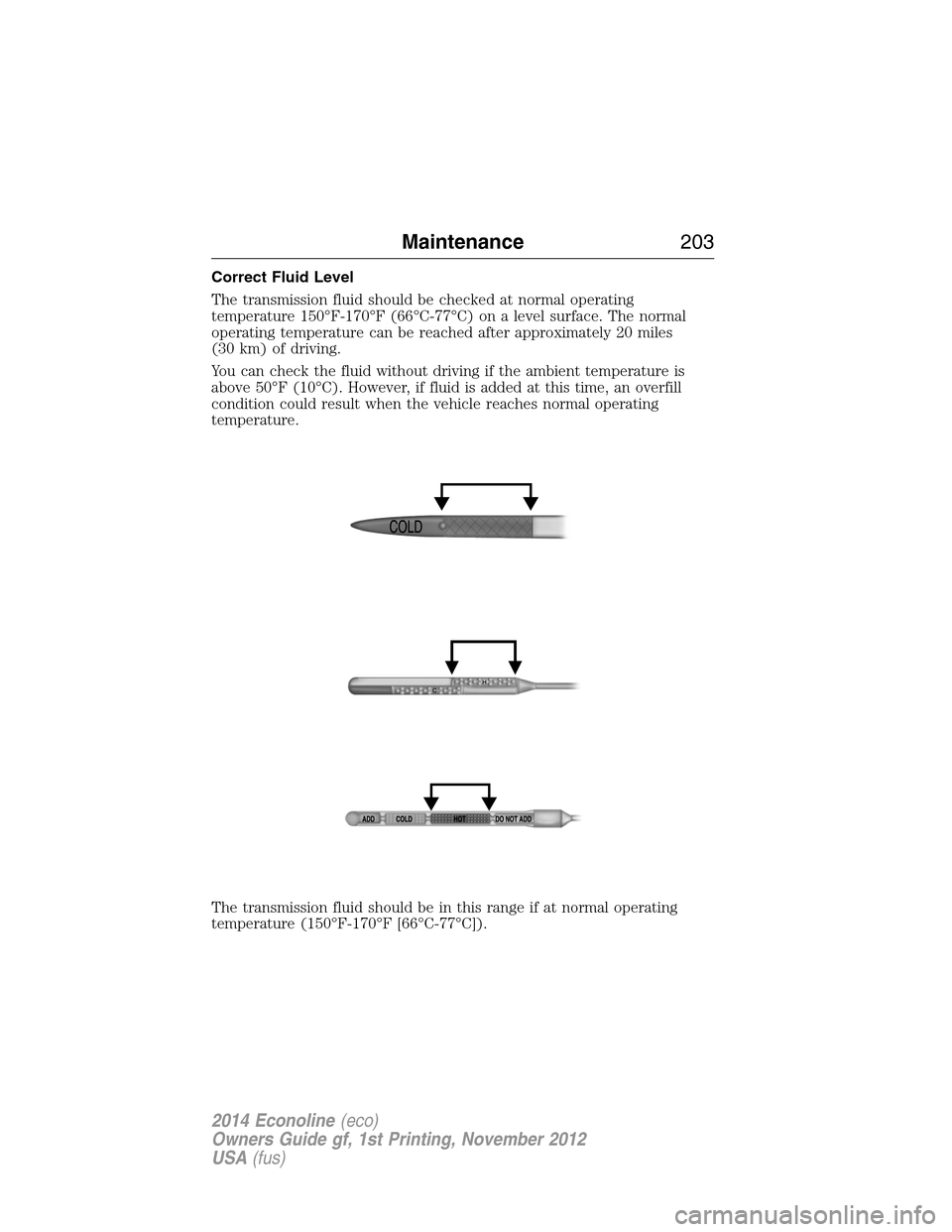
Correct Fluid Level
The transmission fluid should be checked at normal operating
temperature 150°F-170°F (66°C-77°C) on a level surface. The normal
operating temperature can be reached after approximately 20 miles
(30 km) of driving.
You can check the fluid without driving if the ambient temperature is
above 50°F (10°C). However, if fluid is added at this time, an overfill
condition could result when the vehicle reaches normal operating
temperature.
The transmission fluid should be in this range if at normal operating
temperature (150°F-170°F [66°C-77°C]).
Maintenance203
2014 Econoline(eco)
Owners Guide gf, 1st Printing, November 2012
USA(fus)
Page 205 of 438
![FORD E SERIES 2014 4.G Owners Manual The transmission fluid should be in this range if at ambient temperature
(50°F-95°F [10°C-35°C]).
204Maintenance
2014 Econoline(eco)
Owners Guide gf, 1st Printing, November 2012
USA(fus)](/img/11/4823/w960_4823-204.png "FORD E SERIES 2014 4.G Owners Manual The transmission fluid should be in this range if at ambient temperature
(50°F-95°F [10°C-35°C]).
204Maintenance
2014 Econoline(eco)
Owners Guide gf, 1st Printing, November 2012
USA(fus)")
The transmission fluid should be in this range if at ambient temperature
(50°F-95°F [10°C-35°C]).
204Maintenance
2014 Econoline(eco)
Owners Guide gf, 1st Printing, November 2012
USA(fus)
Page 206 of 438
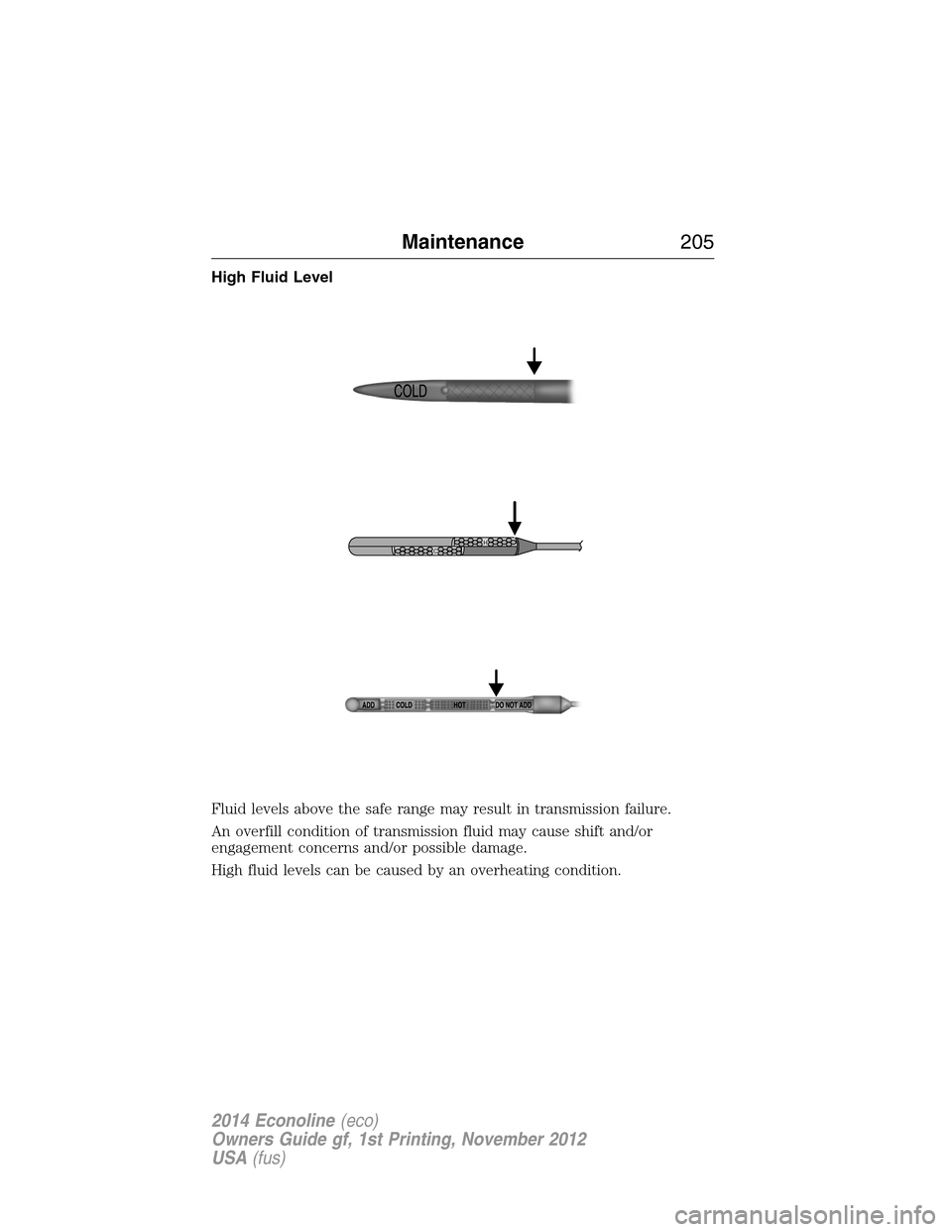
High Fluid Level
Fluid levels above the safe range may result in transmission failure.
An overfill condition of transmission fluid may cause shift and/or
engagement concerns and/or possible damage.
High fluid levels can be caused by an overheating condition.
H
C
Maintenance205
2014 Econoline(eco)
Owners Guide gf, 1st Printing, November 2012
USA(fus)
Page 207 of 438
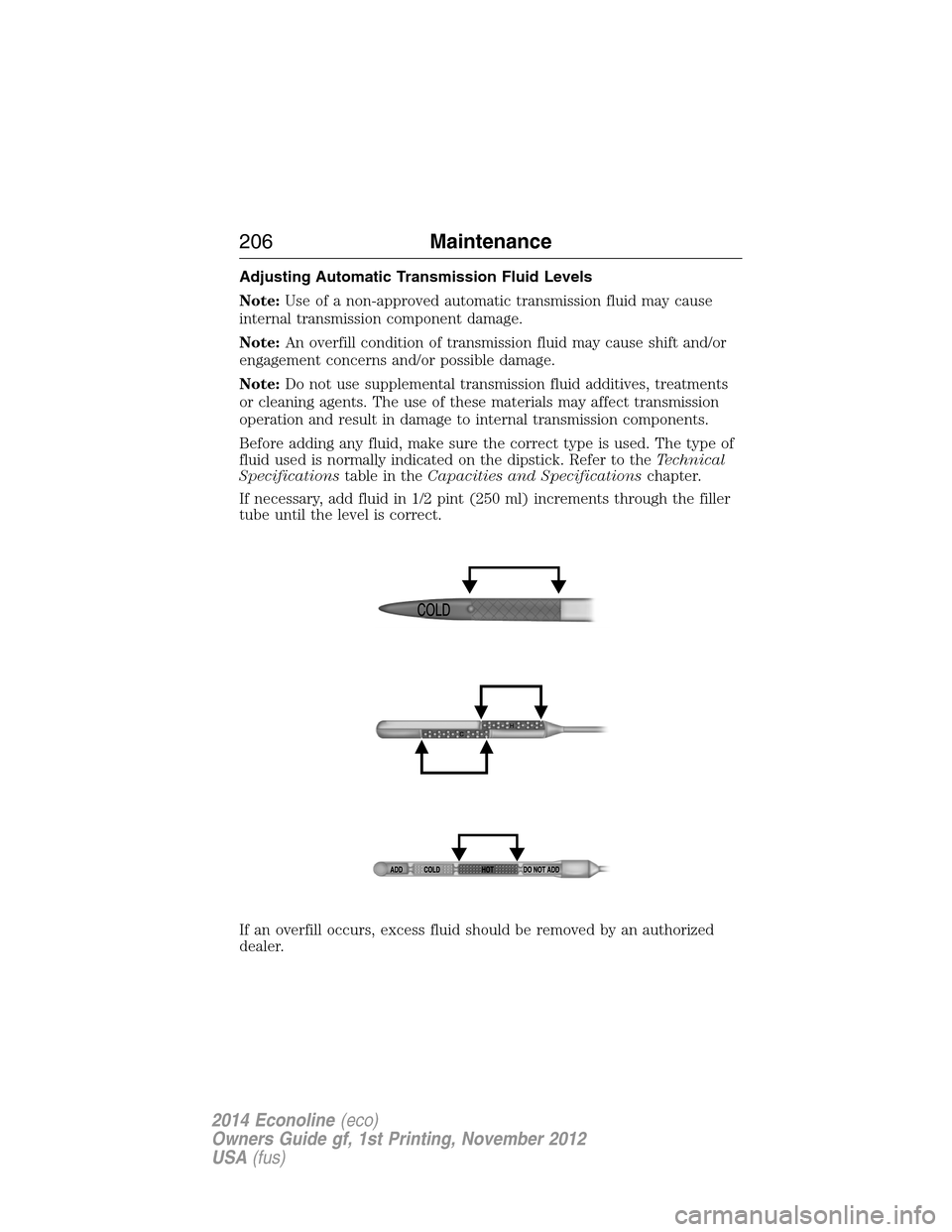
Adjusting Automatic Transmission Fluid Levels
Note:Use of a non-approved automatic transmission fluid may cause
internal transmission component damage.
Note:An overfill condition of transmission fluid may cause shift and/or
engagement concerns and/or possible damage.
Note:Do not use supplemental transmission fluid additives, treatments
or cleaning agents. The use of these materials may affect transmission
operation and result in damage to internal transmission components.
Before adding any fluid, make sure the correct type is used. The type of
fluid used is normally indicated on the dipstick. Refer to theTechnical
Specificationstable in theCapacities and Specificationschapter.
If necessary, add fluid in 1/2 pint (250 ml) increments through the filler
tube until the level is correct.
If an overfill occurs, excess fluid should be removed by an authorized
dealer.
206Maintenance
2014 Econoline(eco)
Owners Guide gf, 1st Printing, November 2012
USA(fus)
Page 208 of 438
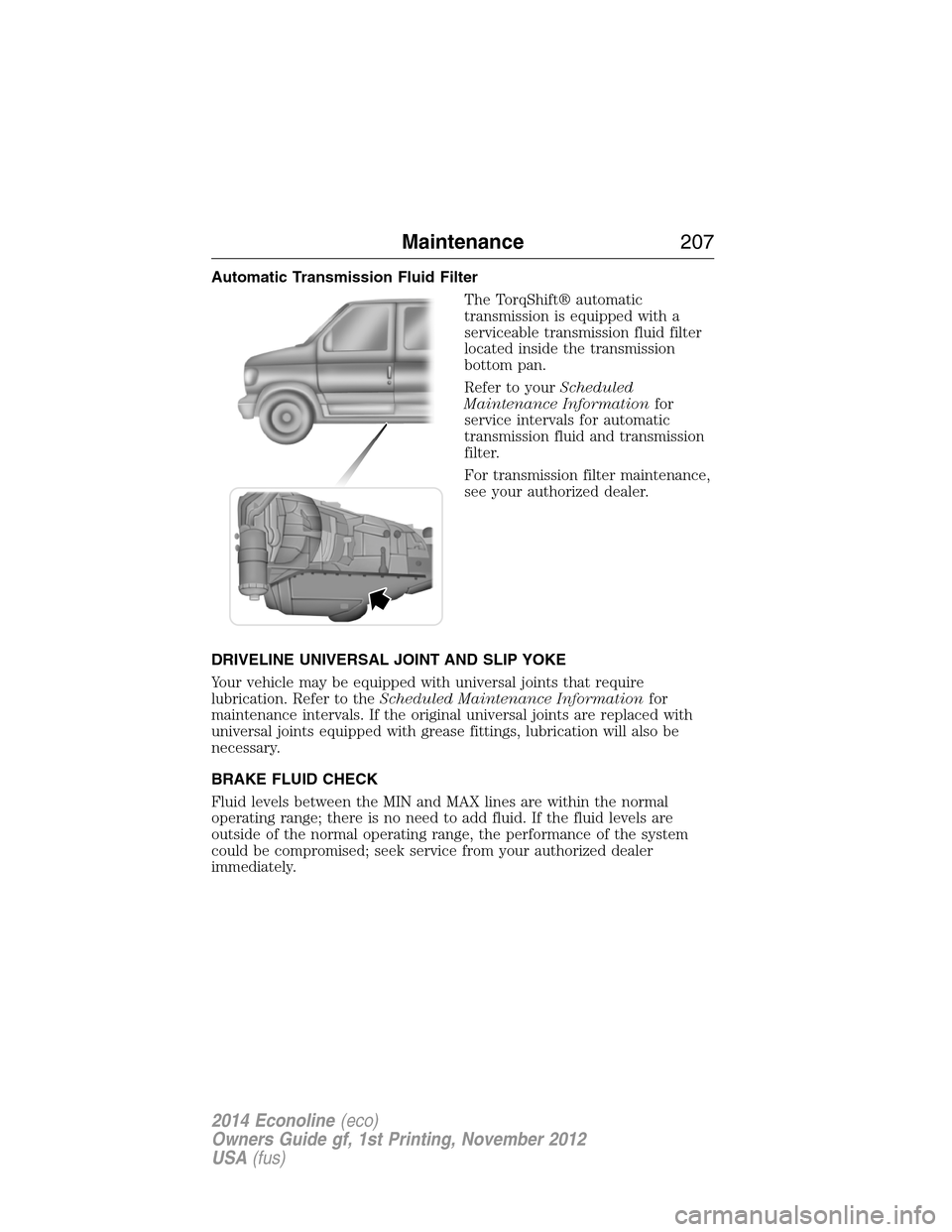
Automatic Transmission Fluid Filter
The TorqShift® automatic
transmission is equipped with a
serviceable transmission fluid filter
located inside the transmission
bottom pan.
Refer to yourScheduled
Maintenance Informationfor
service intervals for automatic
transmission fluid and transmission
filter.
For transmission filter maintenance,
see your authorized dealer.
DRIVELINE UNIVERSAL JOINT AND SLIP YOKE
Your vehicle may be equipped with universal joints that require
lubrication. Refer to theScheduled Maintenance Informationfor
maintenance intervals. If the original universal joints are replaced with
universal joints equipped with grease fittings, lubrication will also be
necessary.
BRAKE FLUID CHECK
Fluid levels between the MIN and MAX lines are within the normal
operating range; there is no need to add fluid. If the fluid levels are
outside of the normal operating range, the performance of the system
could be compromised; seek service from your authorized dealer
immediately.
Maintenance207
2014 Econoline(eco)
Owners Guide gf, 1st Printing, November 2012
USA(fus)
Page 273 of 438
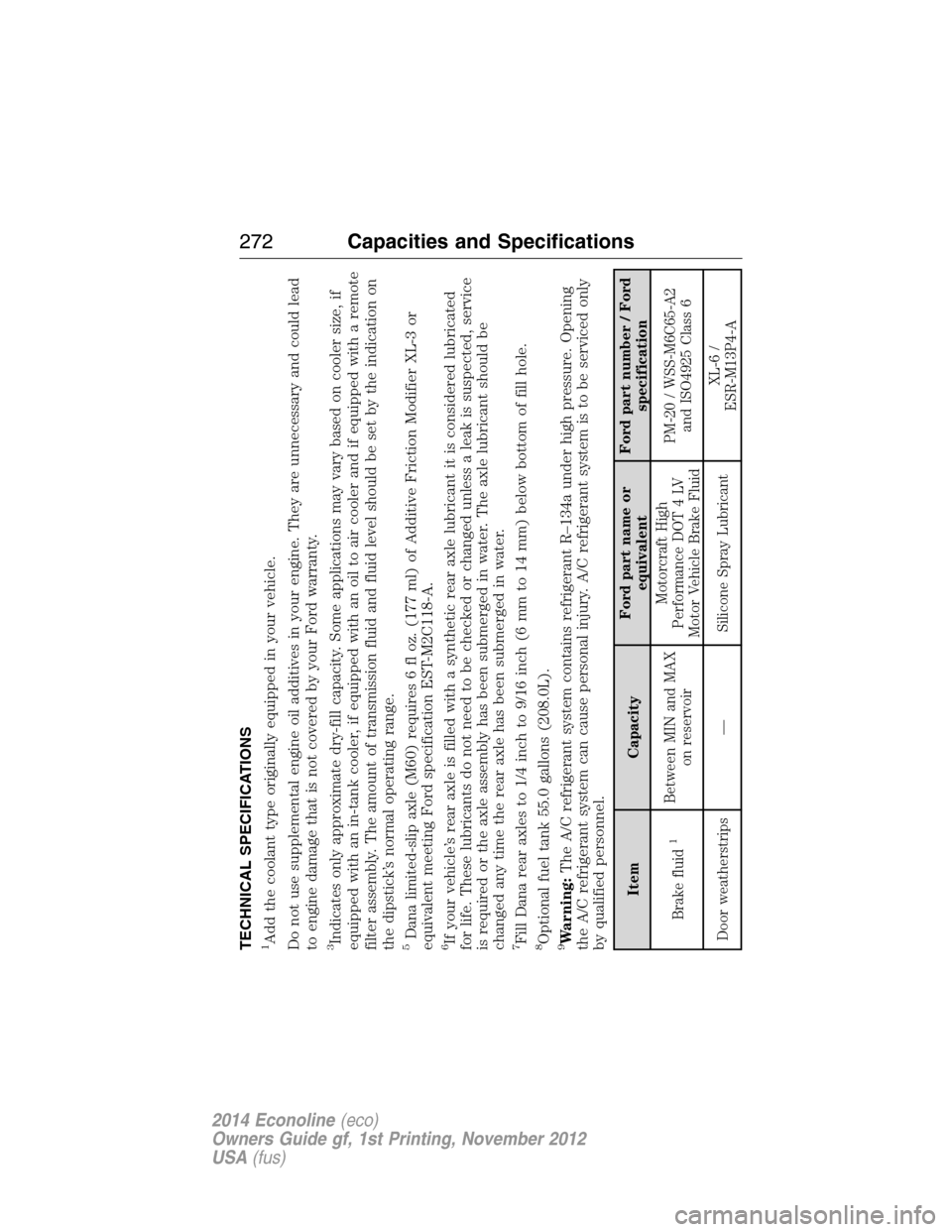
TECHNICAL SPECIFICATIONS1Add the coolant type originally equipped in your vehicle.
Do not use supplemental engine oil additives in your engine. They are unnecessary and could lead
to engine damage that is not covered by your Ford warranty.3Indicates only approximate dry-fill capacity. Some applications may vary based on cooler size, if
equipped with an in-tank cooler, if equipped with an oil to air cooler and if equipped with a remote
filter assembly. The amount of transmission fluid and fluid level should be set by the indication on
the dipstick’s normal operating range.5Dana limited-slip axle (M60) requires 6 fl oz. (177 ml) of Additive Friction Modifier XL-3 or
equivalent meeting Ford specification EST-M2C118-A.6If your vehicle’s rear axle is filled with a synthetic rear axle lubricant it is considered lubricated
for life. These lubricants do not need to be checked or changed unless a leak is suspected, service
is required or the axle assembly has been submerged in water. The axle lubricant should be
changed any time the rear axle has been submerged in water.7Fill Dana rear axles to 1/4 inch to 9/16 inch (6 mm to 14 mm) below bottom of fill hole.8Optional fuel tank 55.0 gallons (208.0L).9Warning:The A/C refrigerant system contains refrigerant R–134a under high pressure. Opening
the A/C refrigerant system can cause personal injury. A/C refrigerant system is to be serviced only
by qualified personnel.
Item CapacityFord part name or
equivalentFord part number / Ford
specification
Brake fluid
1
Between MIN and MAX
on reservoirMotorcraft High
Performance DOT 4 LV
Motor Vehicle Brake FluidPM-20 / WSS-M6C65-A2
and ISO4925 Class 6
Door weatherstrips — Silicone Spray LubricantXL-6 /
ESR-M13P4-A
272Capacities and Specifications
2014 Econoline(eco)
Owners Guide gf, 1st Printing, November 2012
USA(fus)