brake fluid FORD E SERIES 2018 User Guide
[x] Cancel search | Manufacturer: FORD, Model Year: 2018, Model line: E SERIES, Model: FORD E SERIES 2018Pages: 323, PDF Size: 7.09 MB
Page 152 of 323
•the dipstick handle.
•See Capacities and Specifications(page 194).
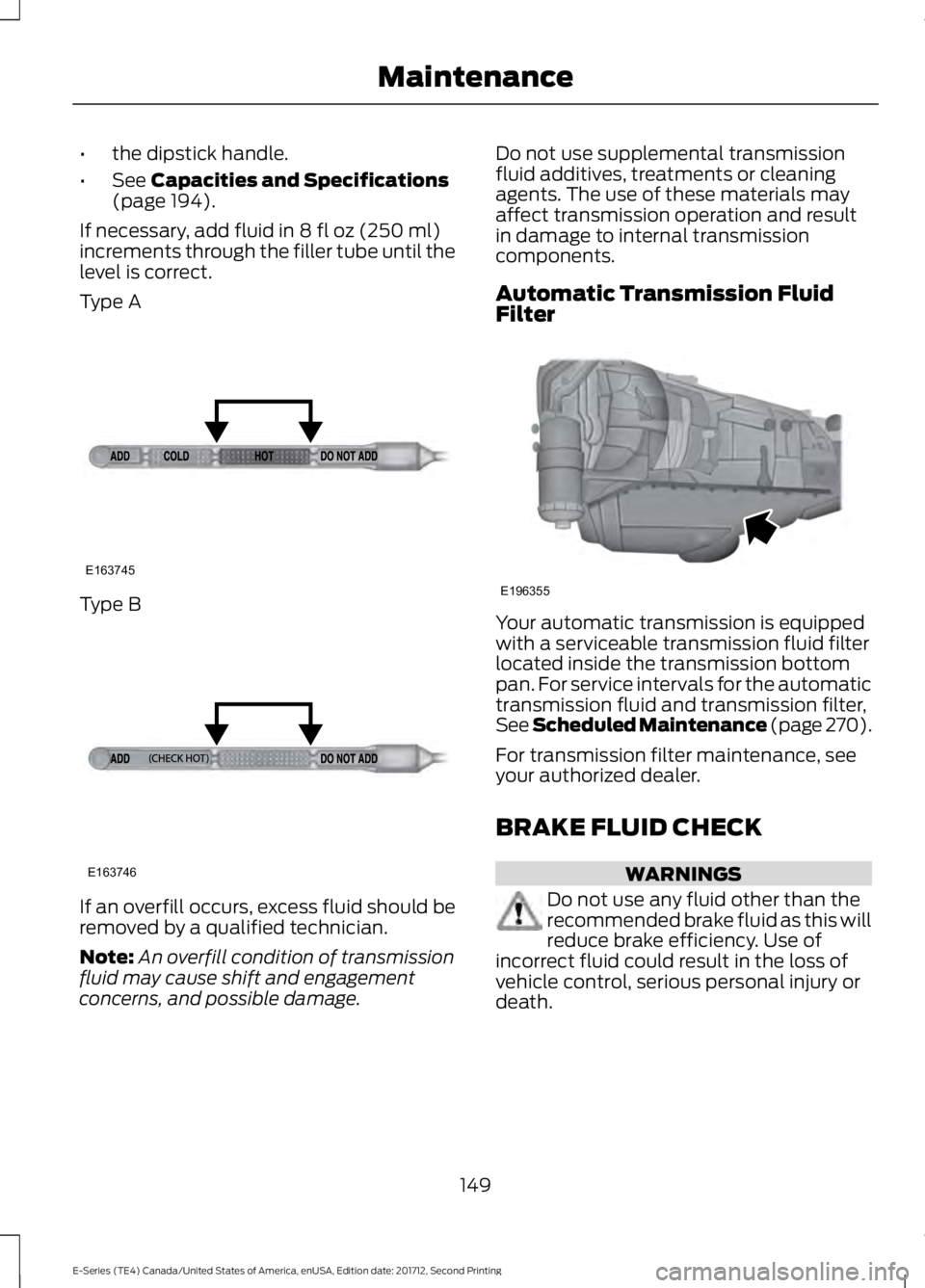
If necessary, add fluid in 8 fl oz (250 ml)increments through the filler tube until thelevel is correct.
Type A
Type B
If an overfill occurs, excess fluid should beremoved by a qualified technician.
Note:An overfill condition of transmissionfluid may cause shift and engagementconcerns, and possible damage.
Do not use supplemental transmissionfluid additives, treatments or cleaningagents. The use of these materials mayaffect transmission operation and resultin damage to internal transmissioncomponents.
Automatic Transmission FluidFilter
Your automatic transmission is equippedwith a serviceable transmission fluid filterlocated inside the transmission bottompan. For service intervals for the automatictransmission fluid and transmission filter,See Scheduled Maintenance (page 270).
For transmission filter maintenance, seeyour authorized dealer.
BRAKE FLUID CHECK
WARNINGS
Do not use any fluid other than therecommended brake fluid as this willreduce brake efficiency. Use ofincorrect fluid could result in the loss ofvehicle control, serious personal injury ordeath.
149
E-Series (TE4) Canada/United States of America, enUSA, Edition date: 201712, Second Printing
MaintenanceE163745 E163746 E196355
Page 153 of 323
WARNINGS
Only use brake fluid from a sealedcontainer. Contamination with dirt,water, petroleum products or othermaterials may result in brake systemdamage or failure. Failure to adhere to thiswarning could result in the loss of vehiclecontrol, serious personal injury or death.
Do not allow the fluid to touch yourskin or eyes. If this happens, rinse theaffected areas immediately withplenty of water and contact your physician.
A fluid level between the MAX andMIN lines is within the normaloperating range and there is no needto add fluid. A fluid level not in the normaloperating range could compromise theperformance of the system. Have yourvehicle checked immediately.
To avoid fluid contamination, the reservoircap must remain in place and fully tight,unless you are adding fluid.
Only use fluid that meets Fordspecifications. See Capacities andSpecifications (page 194).
POWER STEERING FLUID
CHECK
WARNINGS
A fluid level between the MAX andMIN lines is within the normaloperating range and there is no needto add fluid. A fluid level not in the normaloperating range could compromise theperformance of the system.
For E-350 and E-450 vehicles withthe Hydro-Boost Brake System, donot press the brake pedal after theengine has been turned off. Pressing thebrake pedal after the engine has beenturned off will give a false power steeringfluid level reading.
Only use fluid that meets Fordspecifications. See Capacities andSpecifications (page 199).
To top up the power steering fluid level dothe following.
1. Start the engine and let it run until itreaches normal operating temperature.
2. Make sure the fluid is within the MINand MAX range.
3. If the fluid level is low, add fluid to bewithin the MIN and MAX range. Do notoverfill.
4.While the engine idles, turn the steeringwheel left and right several times.
5. Recheck the fluid level in the reservoir.
Note:Do not operate the vehicle with a lowpower steering pump fluid level.
WASHER FLUID CHECK
WARNING
If you operate your vehicle intemperatures below 40°F (5°C), usewasher fluid with antifreezeprotection. Failure to use washer fluid withantifreeze protection in cold weather couldresult in impaired windshield vision andincrease the risk of injury or accident.
Add fluid to fill the reservoir if the level islow. Only use a washer fluid that meetsFord specifications. See Capacities andSpecifications (page 194).
State or local regulations on volatileorganic compounds may restrict the useof methanol, a common windshield washerantifreeze additive. Washer fluidscontaining non-methanol antifreezeagents should be used only if they providecold weather protection without damagingthe vehicle’s paint finish, wiper blades orwasher system.
150
E-Series (TE4) Canada/United States of America, enUSA, Edition date: 201712, Second Printing
Maintenance
Page 155 of 323
4. Turn the A/C on and allow the engineto idle for at least one minute.
5. Fully press the foot brake. Release theparking brake. Shift the gearshift leverto Drive (D) and allow the engine toidle for at least one minute.
6. Drive the vehicle for approximately10 mi (16 km) to complete therelearning process.
Note:If you do not carry out the aboveprocess, the idle quality of your vehicle maybe adversely affected until the idle trim iseventually relearned.
Flexible fuel vehicles operating on E85 mayexperience poor starts and driveabilityproblems until the fuel trim and ethanolcontent have been relearned.
When the battery is disconnected or a newbattery installed, the transmission mustlearn its adaptive strategy. As a result ofthis, the transmission may shift firmly. Thisoperation is considered normal and fullyupdates transmission operation to itsoptimum shift feel. We recommend thatthe negative battery cable terminal bedisconnected from the battery if you planto store your vehicle for an extended periodof time. This minimizes the discharge ofyour battery during storage.
Dual Batteries (If Equipped)
Your vehicle may be fitted with aframe-mounted battery located on thepassenger side frame rail, behind the frontpassenger door. This battery is connectedin parallel with the battery in the enginecompartment. Both batteries are used tostart the vehicle.
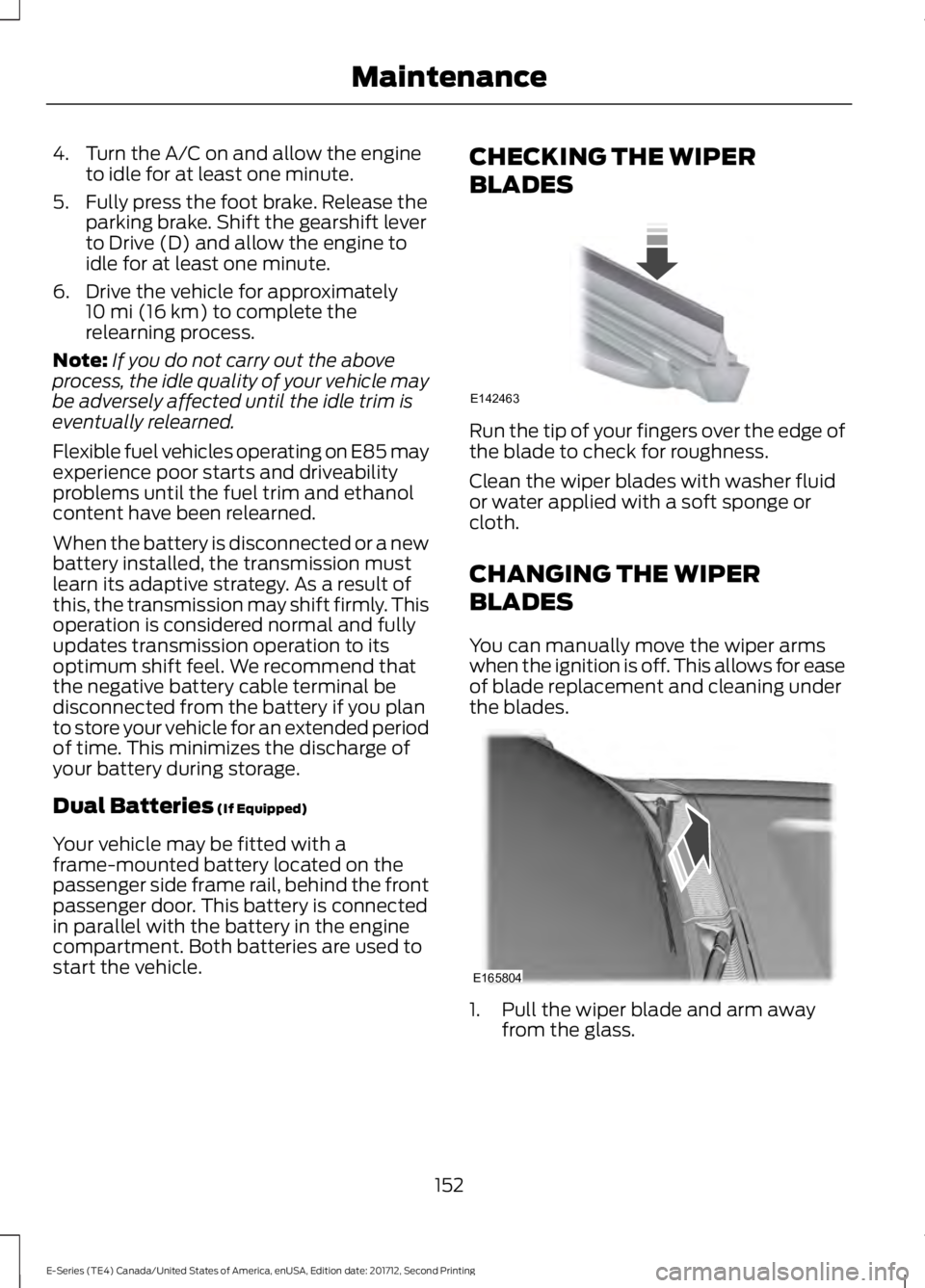
CHECKING THE WIPER
BLADES
Run the tip of your fingers over the edge ofthe blade to check for roughness.
Clean the wiper blades with washer fluidor water applied with a soft sponge orcloth.
CHANGING THE WIPER
BLADES
You can manually move the wiper armswhen the ignition is off. This allows for easeof blade replacement and cleaning underthe blades.
1. Pull the wiper blade and arm awayfrom the glass.
152
E-Series (TE4) Canada/United States of America, enUSA, Edition date: 201712, Second Printing
MaintenanceE142463 E165804
Page 167 of 323
Note: Using non-recommended cleaners,harsh cleaning products, chrome wheelcleaners or abrasive materials coulddamage wheel rims and covers.
VEHICLE STORAGE
If you plan on storing your vehicle for 30days or more, read the followingmaintenance recommendations to makesure your vehicle stays in good operatingcondition.
We engineer and test all motor vehiclesand their components for reliable, regulardriving. Under various conditions,long-term storage may lead to degradedengine performance or failure unless youuse specific precautions to preserve enginecomponents.
General
•Store all vehicles in a dry, ventilatedplace.
•Protect from sunlight, if possible.
•If vehicles are stored outside, theyrequire regular maintenance to protectagainst rust and damage.
Body
•Wash your vehicle thoroughly toremove dirt, grease, oil, tar or mud fromexterior surfaces, rear-wheel housingand the underside of front fenders.
•Periodically wash your vehicle if it isstored in exposed locations.
•Touch-up exposed or primed metal toprevent rust.
•Cover chrome and stainless steel partswith a thick coat of auto wax to preventdiscoloration. Re-wax as necessarywhen you wash your vehicle.
•Lubricate all hood, door and luggagecompartment hinges and latches witha light grade oil.
•Cover interior trim to prevent fading.
•Keep all rubber parts free from oil andsolvents.
Engine
•Change the engine oil and filter prior tostorage because used engine oilcontains contaminates which maycause engine damage.
•Start the engine every 15 days for aminimum of 15 minutes. Run at fast idlewith the climate controls set to defrostuntil the engine reaches normaloperating temperature.
•With your foot on the brake, shiftthrough all the gears while the engineis running.
•We recommend that you change theengine oil before you use your vehicleagain.
Fuel system
•Fill the fuel tank with high-quality fueluntil the first automatic shutoff of thefuel pump nozzle.
Cooling system
•Protect against freezing temperatures.
•When removing your vehicle fromstorage, check coolant fluid level.Confirm that there are no coolingsystem leaks and that fluid is at therecommended level.
Battery
•Check and recharge as necessary. Keepconnections clean.
•If storing your vehicle for more than 30days without recharging the battery,we recommend that you disconnectthe battery cables to maintain batterycharge for quick starting.
164
E-Series (TE4) Canada/United States of America, enUSA, Edition date: 201712, Second Printing
Vehicle Care
Page 168 of 323
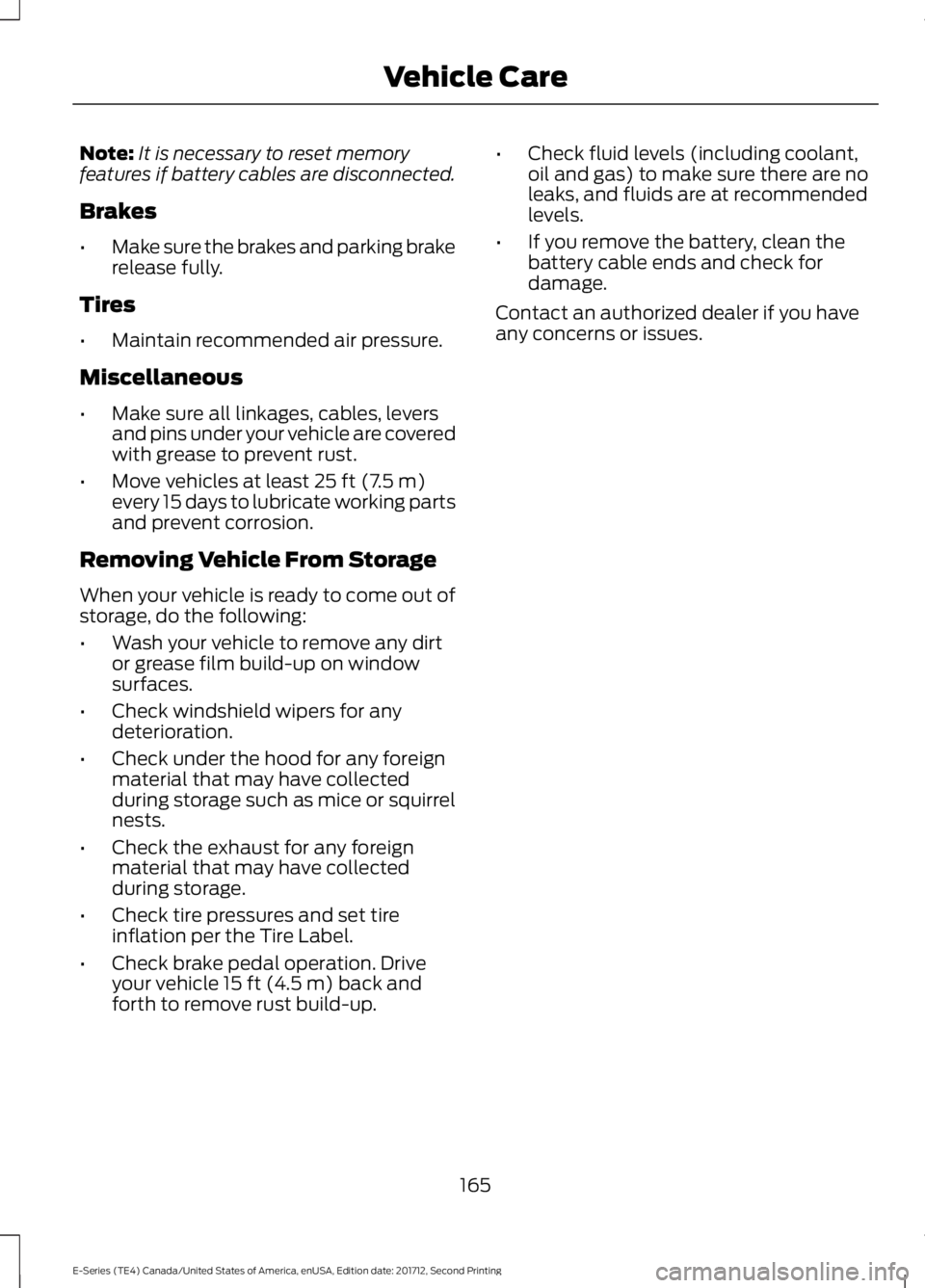
Note:It is necessary to reset memoryfeatures if battery cables are disconnected.
Brakes
•Make sure the brakes and parking brakerelease fully.
Tires
•Maintain recommended air pressure.
Miscellaneous
•Make sure all linkages, cables, leversand pins under your vehicle are coveredwith grease to prevent rust.
•Move vehicles at least 25 ft (7.5 m)every 15 days to lubricate working partsand prevent corrosion.
Removing Vehicle From Storage
When your vehicle is ready to come out ofstorage, do the following:
•Wash your vehicle to remove any dirtor grease film build-up on windowsurfaces.
•Check windshield wipers for anydeterioration.
•Check under the hood for any foreignmaterial that may have collectedduring storage such as mice or squirrelnests.
•Check the exhaust for any foreignmaterial that may have collectedduring storage.
•Check tire pressures and set tireinflation per the Tire Label.
•Check brake pedal operation. Driveyour vehicle 15 ft (4.5 m) back andforth to remove rust build-up.
•Check fluid levels (including coolant,oil and gas) to make sure there are noleaks, and fluids are at recommendedlevels.
•If you remove the battery, clean thebattery cable ends and check fordamage.
Contact an authorized dealer if you haveany concerns or issues.
165
E-Series (TE4) Canada/United States of America, enUSA, Edition date: 201712, Second Printing
Vehicle Care
Page 202 of 323
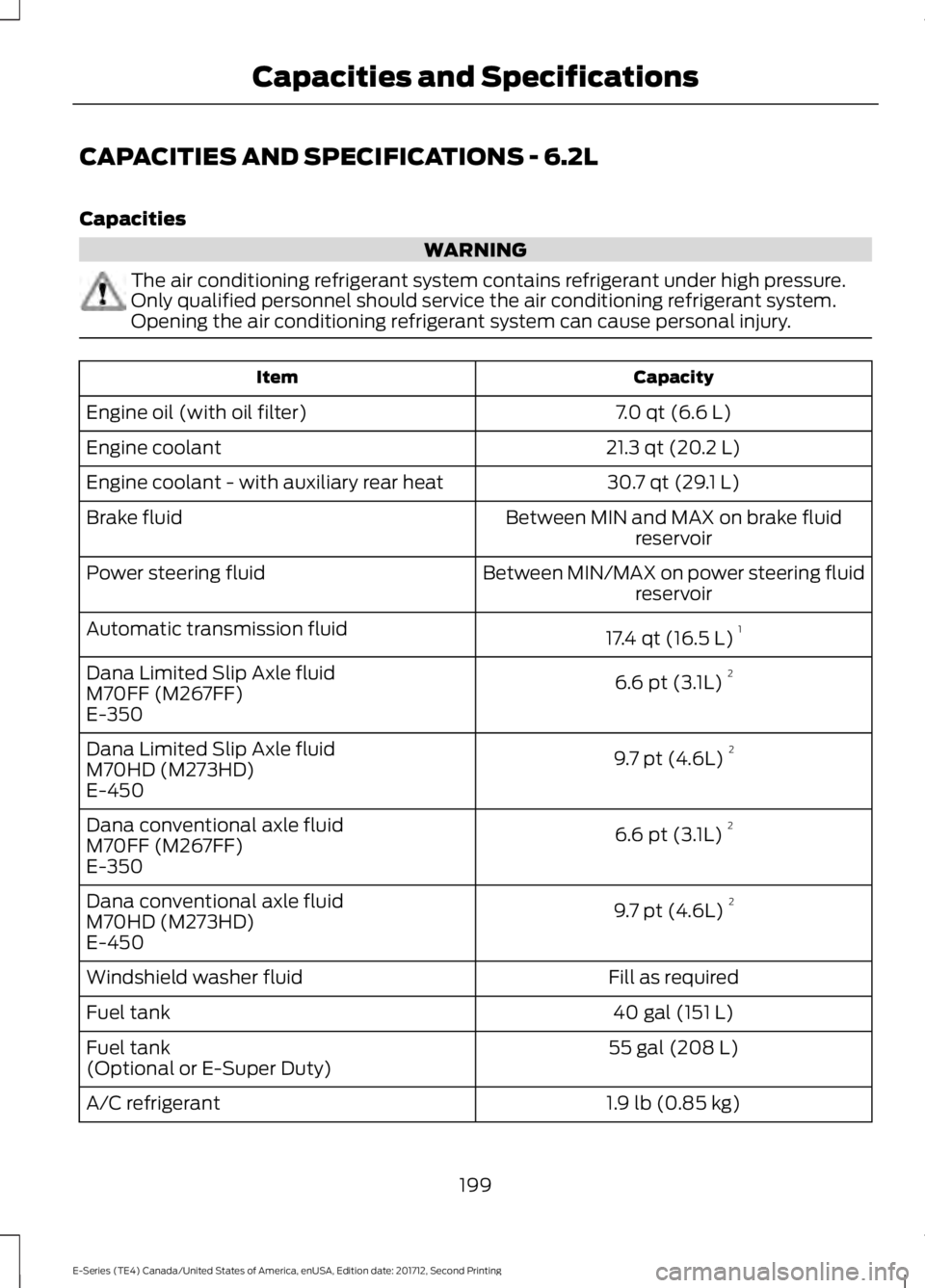
CAPACITIES AND SPECIFICATIONS - 6.2L
Capacities
WARNING
The air conditioning refrigerant system contains refrigerant under high pressure.Only qualified personnel should service the air conditioning refrigerant system.Opening the air conditioning refrigerant system can cause personal injury.
CapacityItem
7.0 qt (6.6 L)Engine oil (with oil filter)
21.3 qt (20.2 L)Engine coolant
30.7 qt (29.1 L)Engine coolant - with auxiliary rear heat
Between MIN and MAX on brake fluidreservoirBrake fluid
Between MIN/MAX on power steering fluidreservoirPower steering fluid
17.4 qt (16.5 L)1Automatic transmission fluid
6.6 pt (3.1L) 2Dana Limited Slip Axle fluidM70FF (M267FF)E-350
9.7 pt (4.6L) 2Dana Limited Slip Axle fluidM70HD (M273HD)E-450
6.6 pt (3.1L) 2Dana conventional axle fluidM70FF (M267FF)E-350
9.7 pt (4.6L) 2Dana conventional axle fluidM70HD (M273HD)E-450
Fill as requiredWindshield washer fluid
40 gal (151 L)Fuel tank
55 gal (208 L)Fuel tank(Optional or E-Super Duty)
1.9 lb (0.85 kg)A/C refrigerant
199
E-Series (TE4) Canada/United States of America, enUSA, Edition date: 201712, Second Printing
Capacities and Specifications
Page 203 of 323
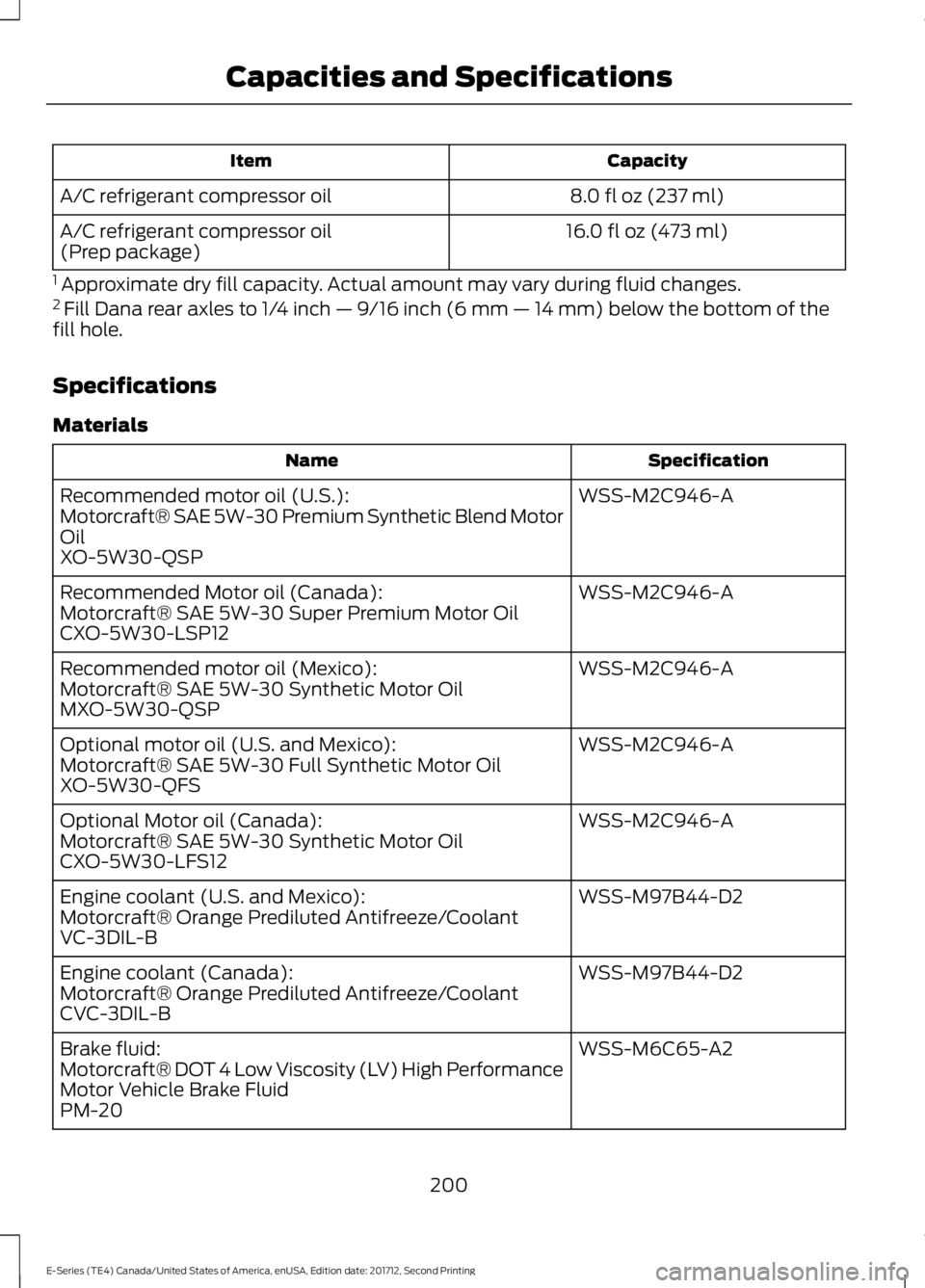
CapacityItem
8.0 fl oz (237 ml)A/C refrigerant compressor oil
16.0 fl oz (473 ml)A/C refrigerant compressor oil(Prep package)
1 Approximate dry fill capacity. Actual amount may vary during fluid changes.2 Fill Dana rear axles to 1/4 inch — 9/16 inch (6 mm — 14 mm) below the bottom of thefill hole.
Specifications
Materials
SpecificationName
WSS-M2C946-ARecommended motor oil (U.S.):Motorcraft® SAE 5W-30 Premium Synthetic Blend MotorOilXO-5W30-QSP
WSS-M2C946-ARecommended Motor oil (Canada):Motorcraft® SAE 5W-30 Super Premium Motor OilCXO-5W30-LSP12
WSS-M2C946-ARecommended motor oil (Mexico):Motorcraft® SAE 5W-30 Synthetic Motor OilMXO-5W30-QSP
WSS-M2C946-AOptional motor oil (U.S. and Mexico):Motorcraft® SAE 5W-30 Full Synthetic Motor OilXO-5W30-QFS
WSS-M2C946-AOptional Motor oil (Canada):Motorcraft® SAE 5W-30 Synthetic Motor OilCXO-5W30-LFS12
WSS-M97B44-D2Engine coolant (U.S. and Mexico):Motorcraft® Orange Prediluted Antifreeze/CoolantVC-3DIL-B
WSS-M97B44-D2Engine coolant (Canada):Motorcraft® Orange Prediluted Antifreeze/CoolantCVC-3DIL-B
WSS-M6C65-A2Brake fluid:Motorcraft® DOT 4 Low Viscosity (LV) High PerformanceMotor Vehicle Brake FluidPM-20
200
E-Series (TE4) Canada/United States of America, enUSA, Edition date: 201712, Second Printing
Capacities and Specifications
Page 205 of 323
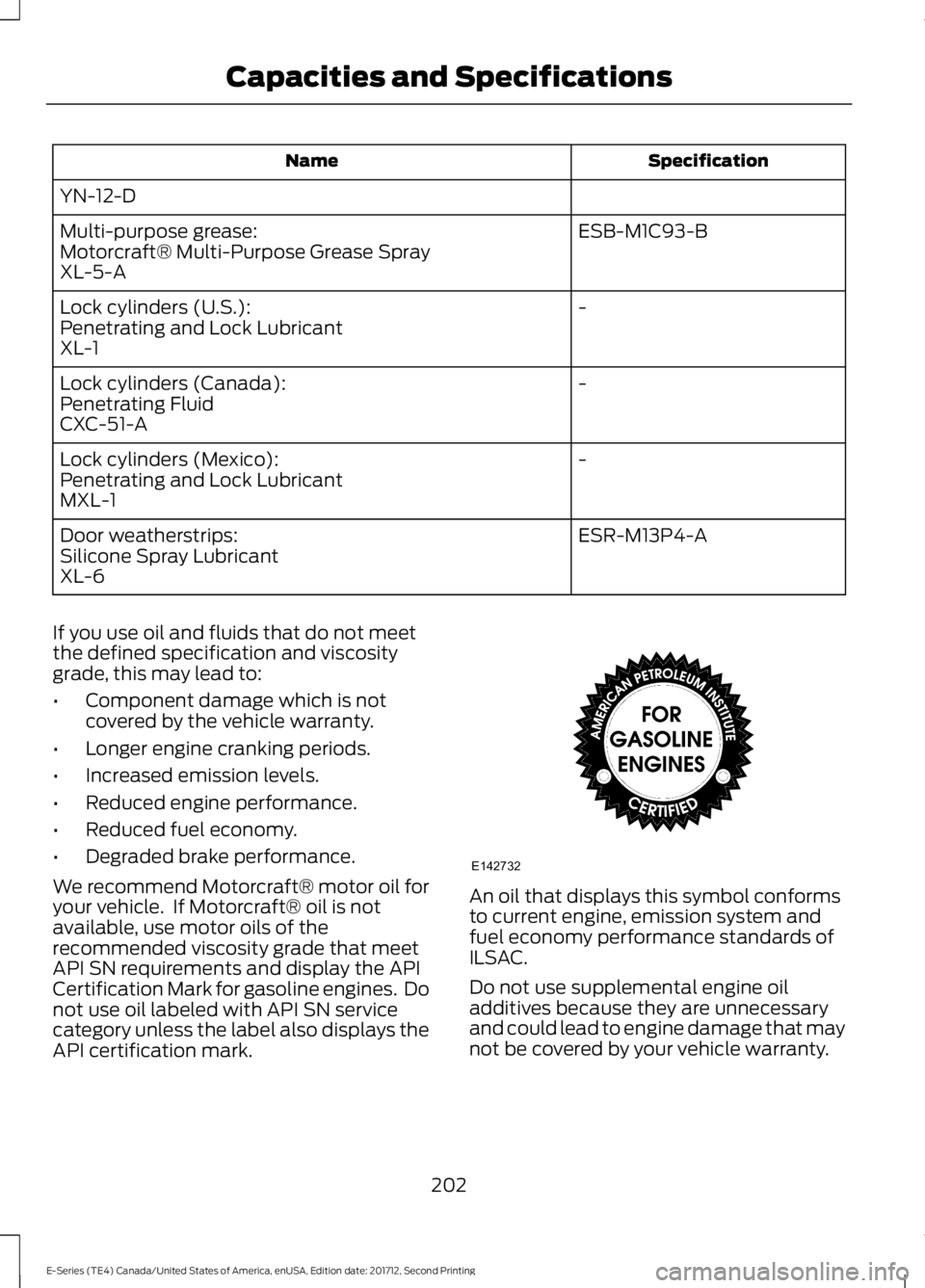
SpecificationName
YN-12-D
ESB-M1C93-BMulti-purpose grease:Motorcraft® Multi-Purpose Grease SprayXL-5-A
-Lock cylinders (U.S.):Penetrating and Lock LubricantXL-1
-Lock cylinders (Canada):Penetrating FluidCXC-51-A
-Lock cylinders (Mexico):Penetrating and Lock LubricantMXL-1
ESR-M13P4-ADoor weatherstrips:Silicone Spray LubricantXL-6
If you use oil and fluids that do not meetthe defined specification and viscositygrade, this may lead to:
•Component damage which is notcovered by the vehicle warranty.
•Longer engine cranking periods.
•Increased emission levels.
•Reduced engine performance.
•Reduced fuel economy.
•Degraded brake performance.
We recommend Motorcraft® motor oil foryour vehicle. If Motorcraft® oil is notavailable, use motor oils of therecommended viscosity grade that meetAPI SN requirements and display the APICertification Mark for gasoline engines. Donot use oil labeled with API SN servicecategory unless the label also displays theAPI certification mark.
An oil that displays this symbol conformsto current engine, emission system andfuel economy performance standards ofILSAC.
Do not use supplemental engine oiladditives because they are unnecessaryand could lead to engine damage that maynot be covered by your vehicle warranty.
202
E-Series (TE4) Canada/United States of America, enUSA, Edition date: 201712, Second Printing
Capacities and SpecificationsE142732
Page 206 of 323
Note:Ford recommends using DOT 4 LowViscosity (LV) High Performance Brake Fluidor equivalent meeting WSS-M6C65-A2. Useof any fluid other than the recommendedfluid may cause degraded brakeperformance and not meet the Fordperformance standards. Keep brake fluidclean and dry. Contamination with dirt,water, petroleum products or othermaterials may result in brake systemdamage and possible failure.
Note: Automatic transmissions that requireMERCON® LV transmission fluid shouldonly use MERCON® LV transmission fluid.The use of any other fluid may causetransmission damage.
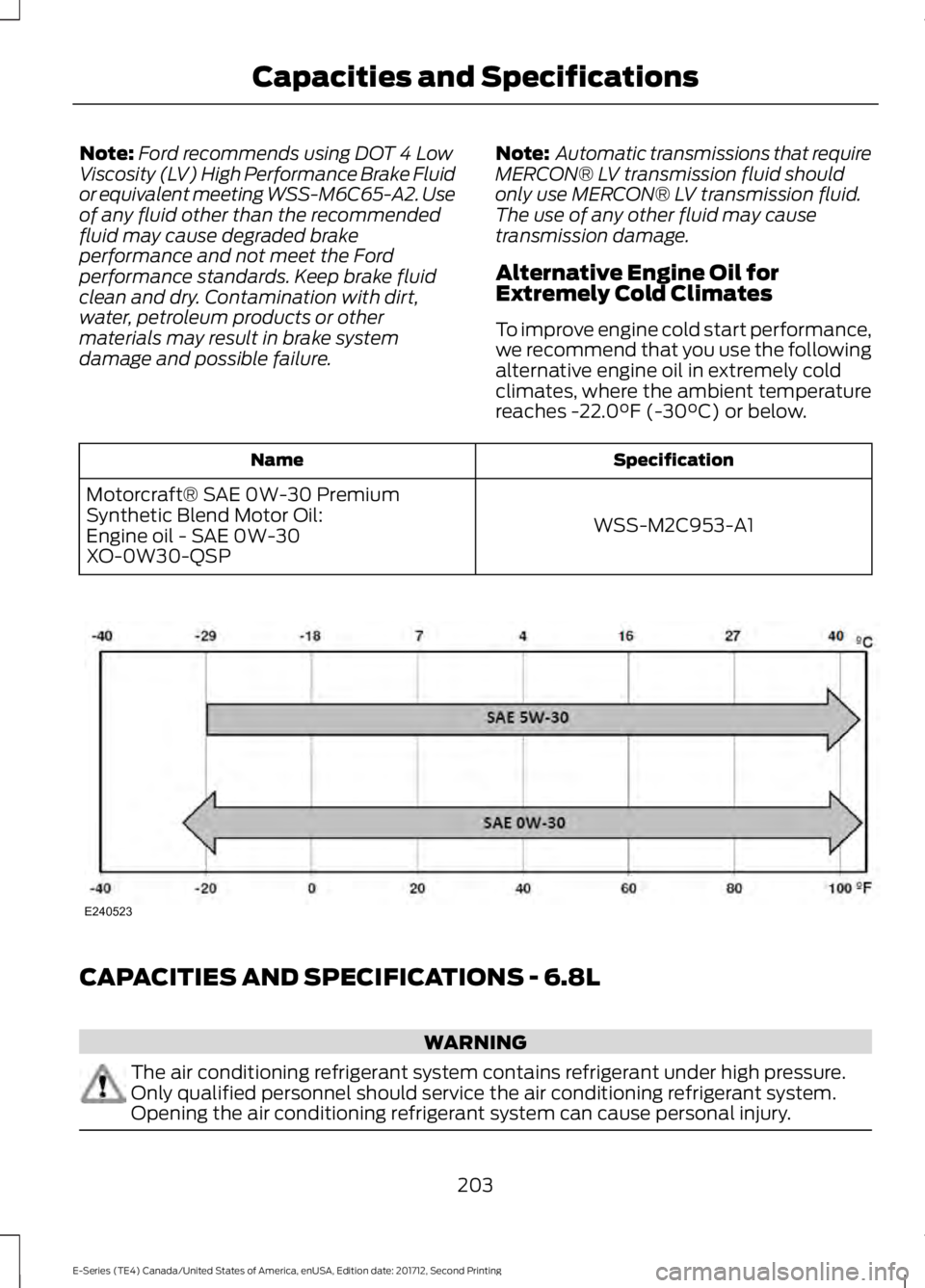
Alternative Engine Oil forExtremely Cold Climates
To improve engine cold start performance,we recommend that you use the followingalternative engine oil in extremely coldclimates, where the ambient temperaturereaches -22.0°F (-30°C) or below.
SpecificationName
WSS-M2C953-A1
Motorcraft® SAE 0W-30 PremiumSynthetic Blend Motor Oil:Engine oil - SAE 0W-30XO-0W30-QSP
CAPACITIES AND SPECIFICATIONS - 6.8L
WARNING
The air conditioning refrigerant system contains refrigerant under high pressure.Only qualified personnel should service the air conditioning refrigerant system.Opening the air conditioning refrigerant system can cause personal injury.
203
E-Series (TE4) Canada/United States of America, enUSA, Edition date: 201712, Second Printing
Capacities and SpecificationsE240523
Page 207 of 323
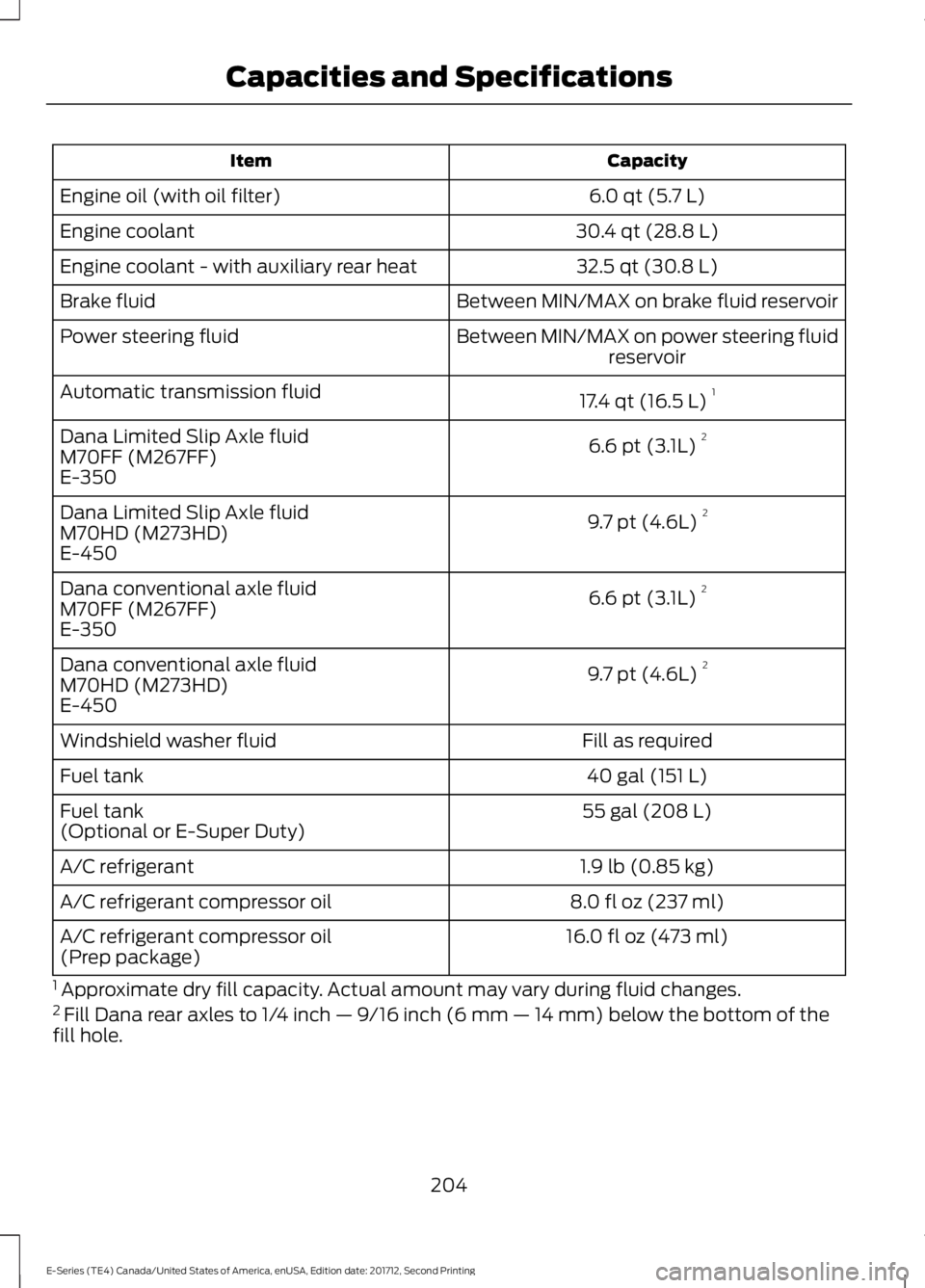
CapacityItem
6.0 qt (5.7 L)Engine oil (with oil filter)
30.4 qt (28.8 L)Engine coolant
32.5 qt (30.8 L)Engine coolant - with auxiliary rear heat
Between MIN/MAX on brake fluid reservoirBrake fluid
Between MIN/MAX on power steering fluidreservoirPower steering fluid
17.4 qt (16.5 L)1Automatic transmission fluid
6.6 pt (3.1L) 2Dana Limited Slip Axle fluidM70FF (M267FF)E-350
9.7 pt (4.6L) 2Dana Limited Slip Axle fluidM70HD (M273HD)E-450
6.6 pt (3.1L) 2Dana conventional axle fluidM70FF (M267FF)E-350
9.7 pt (4.6L) 2Dana conventional axle fluidM70HD (M273HD)E-450
Fill as requiredWindshield washer fluid
40 gal (151 L)Fuel tank
55 gal (208 L)Fuel tank(Optional or E-Super Duty)
1.9 lb (0.85 kg)A/C refrigerant
8.0 fl oz (237 ml)A/C refrigerant compressor oil
16.0 fl oz (473 ml)A/C refrigerant compressor oil(Prep package)
1 Approximate dry fill capacity. Actual amount may vary during fluid changes.2 Fill Dana rear axles to 1/4 inch — 9/16 inch (6 mm — 14 mm) below the bottom of thefill hole.
204
E-Series (TE4) Canada/United States of America, enUSA, Edition date: 201712, Second Printing
Capacities and Specifications