belt FORD E150 1999 Owner's Manual
[x] Cancel search | Manufacturer: FORD, Model Year: 1999, Model line: E150, Model: FORD E150 1999Pages: 208, PDF Size: 1.93 MB
Page 92 of 208
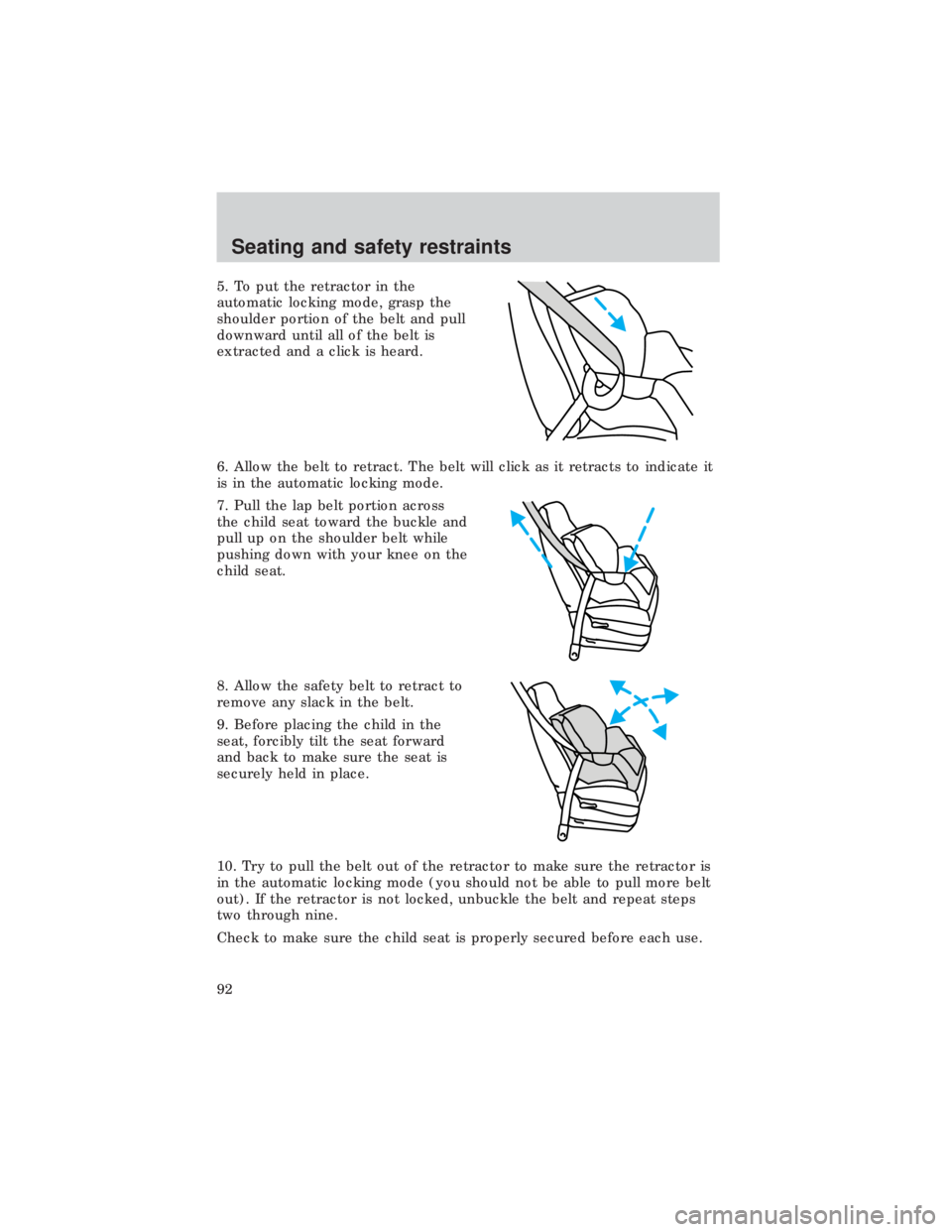
5. To put the retractor in the
automatic locking mode, grasp the
shoulder portion of the belt and pull
downward until all of the belt is
extracted and a click is heard.
6. Allow the belt to retract. The belt will click as it retracts to indicate it
is in the automatic locking mode.
7. Pull the lap belt portion across
the child seat toward the buckle and
pull up on the shoulder belt while
pushing down with your knee on the
child seat.
8. Allow the safety belt to retract to
remove any slack in the belt.
9. Before placing the child in the
seat, forcibly tilt the seat forward
and back to make sure the seat is
securely held in place.
10. Try to pull the belt out of the retractor to make sure the retractor is
in the automatic locking mode (you should not be able to pull more belt
out). If the retractor is not locked, unbuckle the belt and repeat steps
two through nine.
Check to make sure the child seat is properly secured before each use.
Seating and safety restraints
92
Page 96 of 208
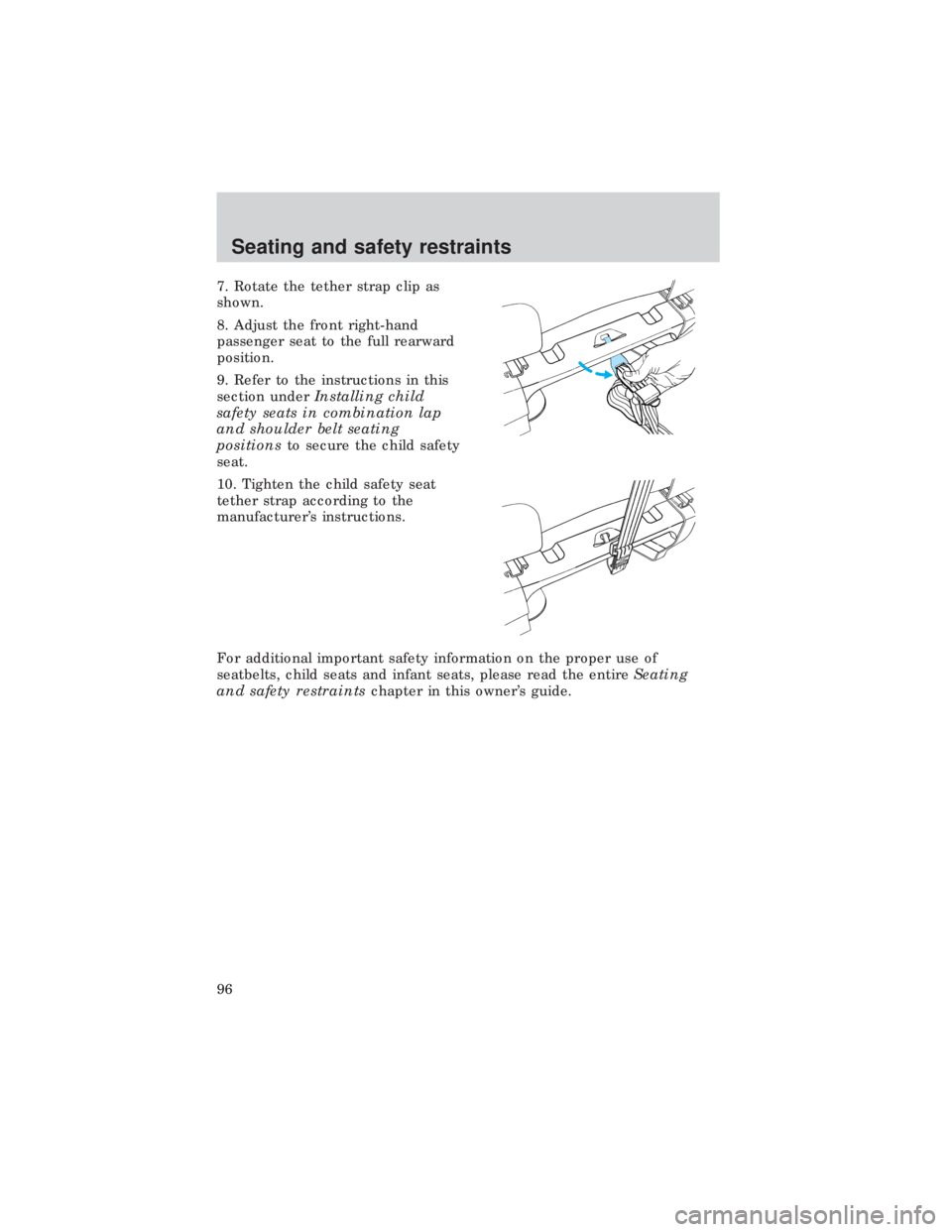
7. Rotate the tether strap clip as
shown.
8. Adjust the front right-hand
passenger seat to the full rearward
position.
9. Refer to the instructions in this
section underInstalling child
safety seats in combination lap
and shoulder belt seating
positionsto secure the child safety
seat.
10. Tighten the child safety seat
tether strap according to the
manufacturer's instructions.
For additional important safety information on the proper use of
seatbelts, child seats and infant seats, please read the entireSeating
and safety restraintschapter in this owner's guide.
Seating and safety restraints
96
Page 98 of 208
PREPARING TO START YOUR VEHICLE
Engine starting is controlled by the ignition system. This system meets
all Canadian Interference-Causing Equipment standard requirements
regulating the impulse electrical field strength of radio noise.
When starting a fuel-injected engine, avoid pressing the accelerator
before or during starting. Only use the accelerator when you have
difficulty starting the engine. For more information on starting the
vehicle, refer toStarting the enginein this chapter.
Extended idling at high engine speeds can produce very high
temperatures in the engine and exhaust system, creating the risk
of fire or other damage.
Do not park, idle, or drive your vehicle in dry grass or other dry
ground cover. The emission system heats up the engine
compartment and exhaust system, which can start a fire.
Do not start your vehicle in a closed garage or in other enclosed
areas. Exhaust fumes can be toxic. Always open the garage door
before you start the engine. SeeGuarding against exhaust fumesin
this chapter for more instructions.
If you smell exhaust fumes inside your vehicle, have your dealer
inspect your vehicle immediately. Do not drive if you smell
exhaust fumes.
Important safety precautions
A computer system controls the engine's idle revolutions per minute
(RPM). When the engine starts, the idle RPM runs faster to warm the
engine. If the engine idle speed does not slow down automatically, have
the vehicle checked. Do not allow the vehicle to idle for more than ten
minutes at the higher engine RPM.
Before starting the vehicle:
1. Make sure all vehicle occupants have buckled their safety belts. For
more information on safety belts and their proper usage, refer to the
Seating and safety restraintschapter.
Starting
98
Page 100 of 208
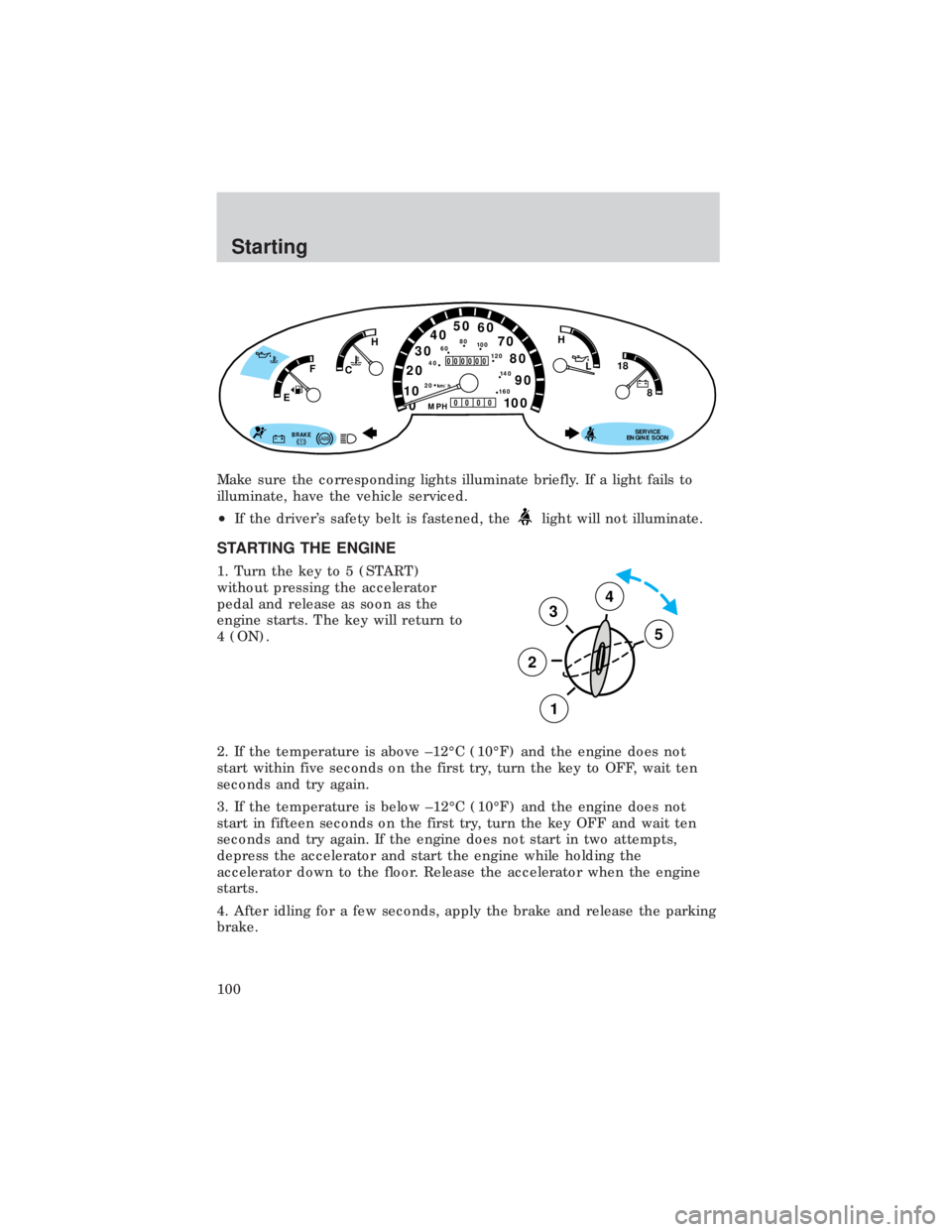
Make sure the corresponding lights illuminate briefly. If a light fails to
illuminate, have the vehicle serviced.
²If the driver's safety belt is fastened, the
light will not illuminate.
STARTING THE ENGINE
1. Turn the key to 5 (START)
without pressing the accelerator
pedal and release as soon as the
engine starts. The key will return to
4 (ON).
2. If the temperature is above ±12ÉC (10ÉF) and the engine does not
start within five seconds on the first try, turn the key to OFF, wait ten
seconds and try again.
3. If the temperature is below ±12ÉC (10ÉF) and the engine does not
start in fifteen seconds on the first try, turn the key OFF and wait ten
seconds and try again. If the engine does not start in two attempts,
depress the accelerator and start the engine while holding the
accelerator down to the floor. Release the accelerator when the engine
starts.
4. After idling for a few seconds, apply the brake and release the parking
brake.
0 1020304050
60
70
80
90
10 0
20 km/h
406080
10 0
12 0
14 0
H
L
16 0
MPH
000000
0000
BRAKE
18
8
SERVICE
ENGINE SOON
FH
C
E
3
2
1
5
4
Starting
100
Page 141 of 208
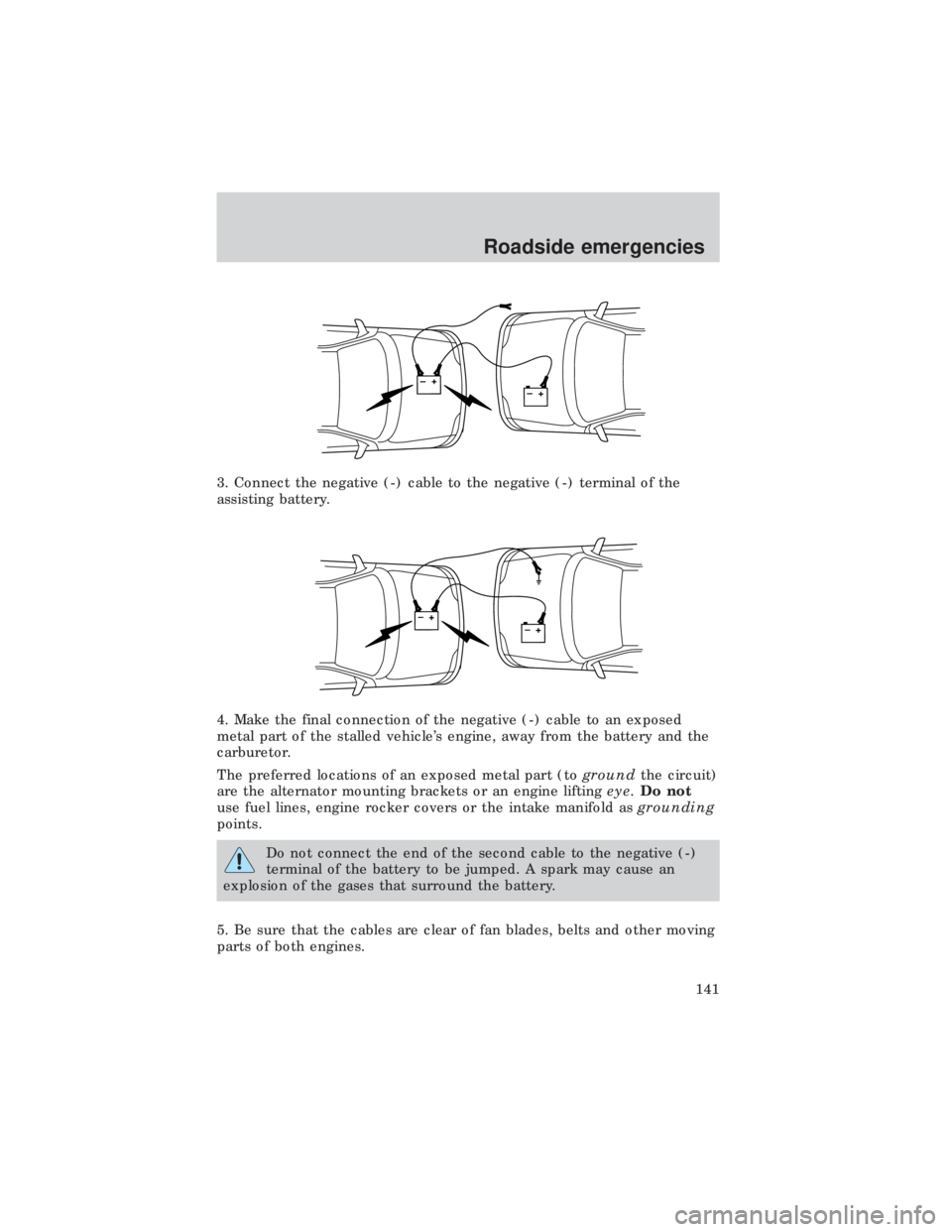
3. Connect the negative (-) cable to the negative (-) terminal of the
assisting battery.
4. Make the final connection of the negative (-) cable to an exposed
metal part of the stalled vehicle's engine, away from the battery and the
carburetor.
The preferred locations of an exposed metal part (togroundthe circuit)
are the alternator mounting brackets or an engine liftingeye.Do not
use fuel lines, engine rocker covers or the intake manifold asgrounding
points.
Do not connect the end of the second cable to the negative (-)
terminal of the battery to be jumped. A spark may cause an
explosion of the gases that surround the battery.
5. Be sure that the cables are clear of fan blades, belts and other moving
parts of both engines.
+–+–
+–+–
Roadside emergencies
141
Page 187 of 208
Cleaning and maintaining the safety belts
Clean the safety belts with a mild soap solution recommended for
cleaning upholstery or carpets. Do not bleach or dye the belts, because
these actions may weaken the belt webbing.
Check the safety belt system periodically to make sure there are no
nicks, wear or cuts. If your vehicle has been involved in an accident,
refer to theSafety belt maintenancesection in theSeating and safety
restraintschapter.
Underbody
Flush the complete underside of vehicle frequently. Keep body drain
holes unplugged. Inspect for road damage.
Inside windows
Use glass cleaner for the inside windows if they become fogged.
Maintenance and care
187
Page 201 of 208
bulb specifications ..................183
high beam ............................11,15
warning chime ..........................11
Heating ........................................16
auxiliary heater and air
conditioner ...........................21,22
heater only system .........16,17,18
heating and air conditioning
system .............................18,19,20
Hood ..........................................146
Ignition .......................................195
Inspection/maintenance
(I/M) testing ..............................179
Instrument panel
cleaning ...................................186
Keys
key in ignition chime ...............11
positions of the ignition ...........56
Lamps
daytime running light ...............15
headlamps .................................15
headlamps, flash to pass ..........16
instrument panel, dimming .....16
interior lamps ...........................63
replacing bulbs ..179,180,181,182
Lane change indicator
(see Turn signal) ........................57
Lights, warning and indicator
air bag ........................................10
anti-lock brakes (ABS) ..............8
brake ............................................8
charging system ........................10
engine oil pressure ...................11
safety belt .................................10
service engine soon .................8,9
turn signal indicator .................10
Lumbar support,
seats ..............................73,74,75,76
Mirrors
side view mirrors (power) .......65
Motorcraft parts ........................174
Octane rating ............................172Odometer .....................................14
Overdrive .....................................62
Panic alarm feature, remote
entry system ................................67
Parking brake ............................105
Power distribution box
(see Fuses) ...............................129
Power door locks ........................64
Power steering ..........................107
fluid, checking and adding ....156
Radio ...................23,24,25,26,27,28
29,30,31,32,33,34,35,36,37
Relays .................................125,131
Remote entry system .................65
illuminated entry ......................70
locking/unlocking doors ......65,66
replacement/additional
transmitters ...............................69
replacing the batteries .............67
Safety belts (see Safety
restraints) ....................................11
Safety restraints
cleaning the safety belts ...82,187
extension assembly ..................81
for children ..........................87,88
lap belt ......................................80
warning light and chime .....11,82
Seat belts (see Safety
restraints) ................76,77,78,79,80
Seats ............................................71
child safety seats ......................89
Servicing your vehicle ..............145
Spark plugs, specifications .......188
Special notice ................................3
ambulance conversions ..............3
diesel-powered vehicles .............4
Specification chart, lubricants .193
Speed control ..............................57
Speedometer ...............................12
Starting your vehicle ...........98,100
jump starting ............139,140,142
Index
201